



…New research suggests millions of UK investors may be leaving digital assets inaccessible to heirs
Digital investing has transformed how people manage money. From trading apps and crypto exchanges to online ISA platforms and app-based savings accounts, an increasing share of household wealth now lives behind usernames, passwords and authentication apps.
But while investing has become digital, estate planning has not kept pace.
The Research
New research by The Investors Centre, based on a nationally representative survey of 2,000 UK adults, suggests that millions of investors could be leaving digital wealth difficult for families to access. The study identified £67.6 million in digital financial assets within the survey sample alone, highlighting how significant sums may now sit behind digital credentials and authentication systems.
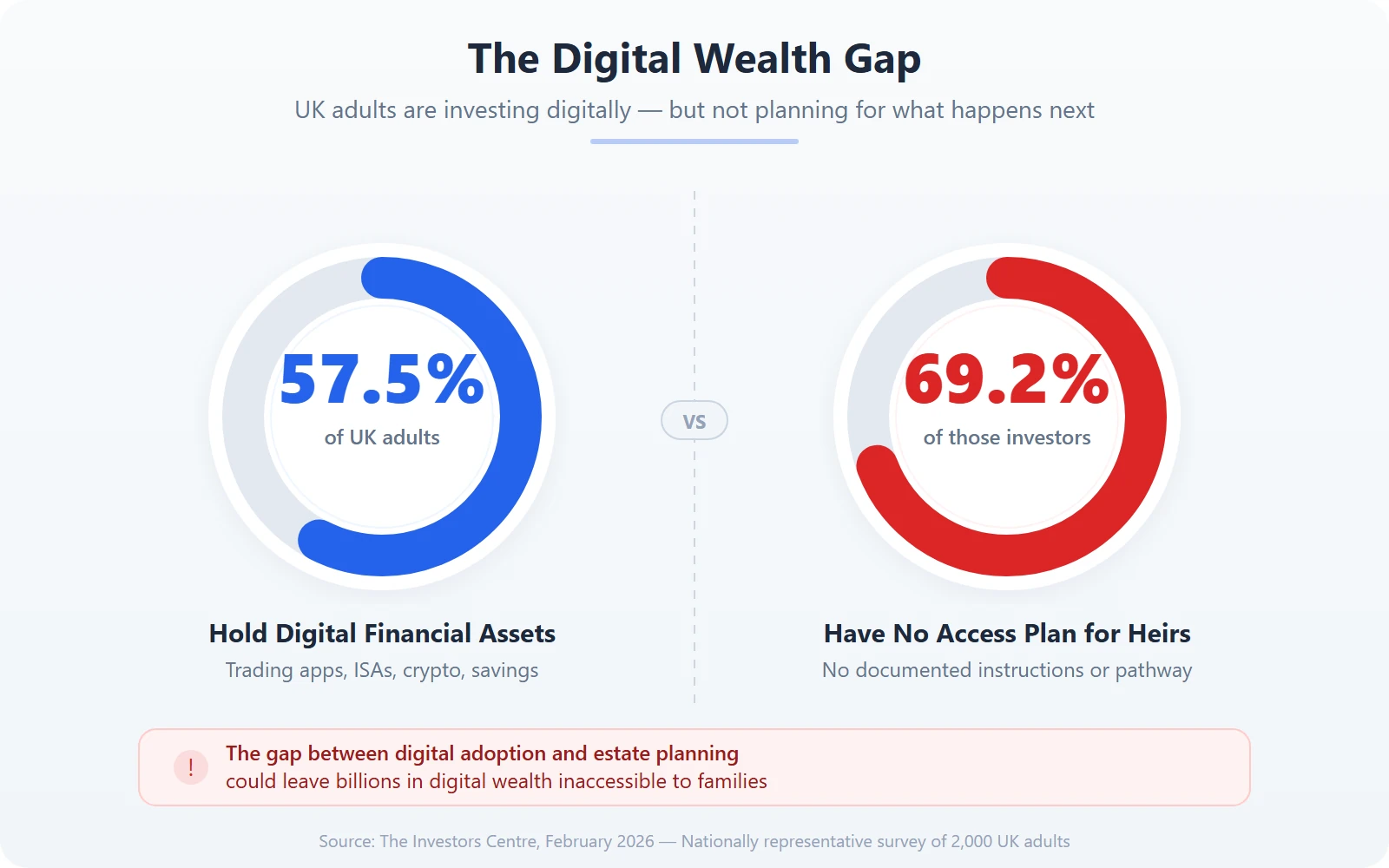
This risk comes at a critical moment. The UK is entering what economists call the “Great Wealth Transfer,” with an estimated £5.5–£7 trillion expected to pass between generations over the next three decades, while inheritance flows already exceed £100 billion annually.
As a growing share of household wealth moves into digital investment platforms, the ability for families to locate and retrieve accounts may become an increasingly important financial issue.
Key findings
| Share of UK adults holding digital financial assets | 57.5% |
| Digital investors with no access plan for heirs | 69.2% |
| Digital wealth identified in survey sample | £67.6m |
| Estimated wealth exposed to access risk | £46–£47m |
| Investors holding £20,000+ on digital platforms | 46.4% |
Digital investing is now mainstream
The study found that digital financial assets are now widely held across the UK population.
More than half of UK adults report holding investments through digital platforms.
These digital assets include:
- trading apps
- online brokerage accounts
- ISA investment platforms
- crypto exchanges
- app-based savings services
For many investors, these accounts now represent core investment portfolios rather than small trading balances.
Nearly 70% of digital investors face access risk
Among those who hold digital financial assets, 69.2% meet the study’s strict definition of “access risk.”
Investors were classified as access-risk if they:
- had no documented instructions explaining how accounts could be accessed
- relied on passwords stored only in memory or informal locations
- depended on device-based authentication systems
- had not provided a confirmed pathway for executors or family members
This means around seven in ten digital investors may be leaving accounts without clear access arrangements for heirs.
In practical terms, that could leave families struggling to identify and retrieve accounts during estate administration.
How much wealth is involved?
Within the survey sample, respondents reported £67.6 million in digital financial assets across various platforms.
Using standard midpoint modelling for value ranges — the approach commonly used in household wealth analysis — the data suggests that significant sums are now held digitally.
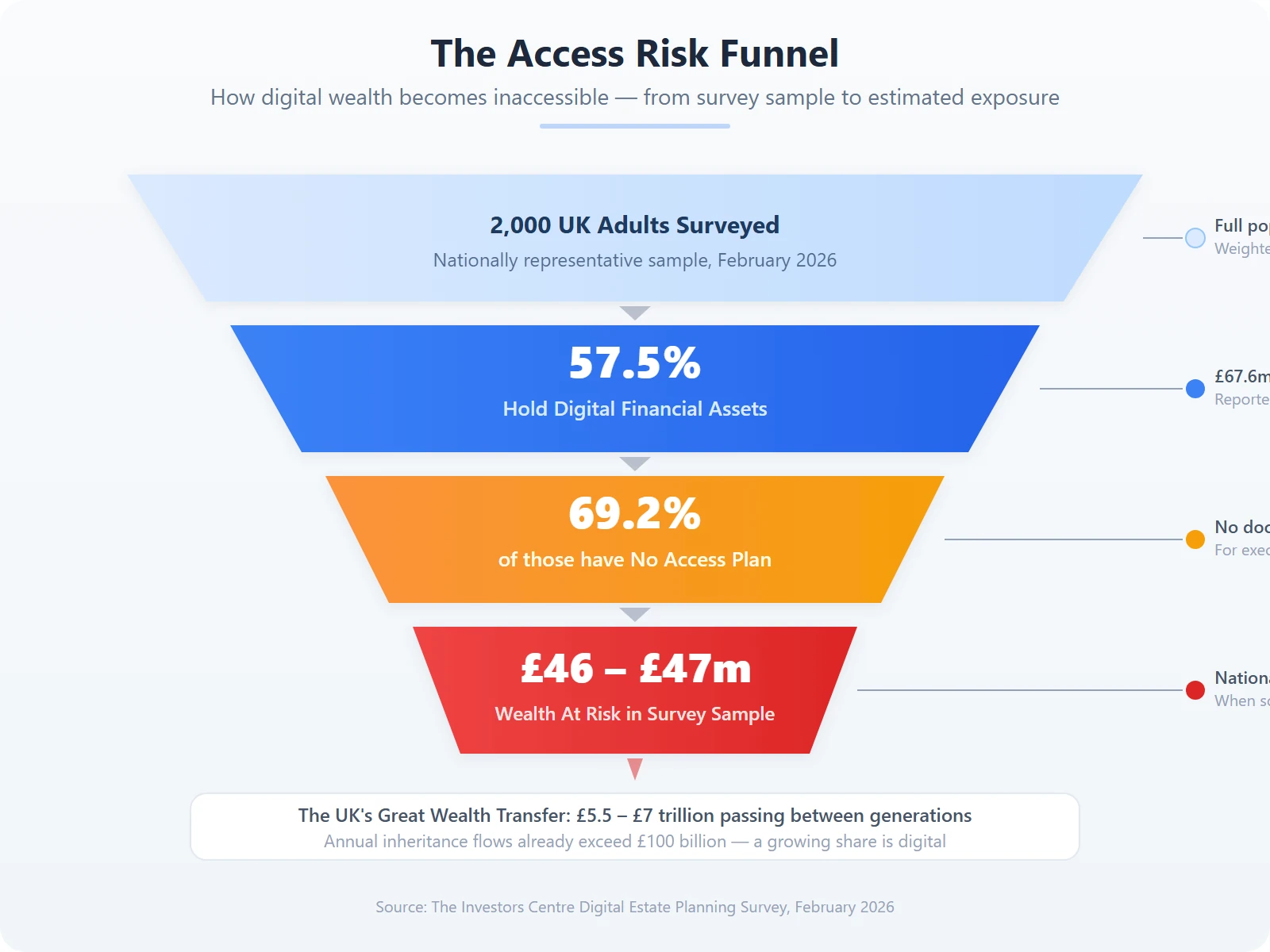
A conservative lower-bound estimate indicates that even the minimum values reported still amount to £42.4 million in digital financial assets within the survey sample.
If the 69.2% access-risk share were applied proportionally across the reported asset ranges:
- £46–£47 million of the £67.6 million sample total could theoretically fall into the access-risk category.
When considered against the millions of digitally engaged investors across the UK, this sample-level finding suggests the national value of digital assets potentially exposed to access challenges could amount to many billions of pounds.
Many investors hold significant portfolios digitally
The survey also examined how much wealth investors hold on digital platforms.
| Range of Digital Wealth Distribution | Share of Investors |
|---|---|
| Less than £1,000 | 11.2% |
| £1,000 – £4,999 | 20.5% |
| £5,000 – £19,999 | 21.9% |
| £20,000 – £49,999 | 19.4% |
| £50,000 – £99,999 | 10.0% |
| £100,000 – £249,999 | 10.5% |
| £250,000+ | 6.5% |
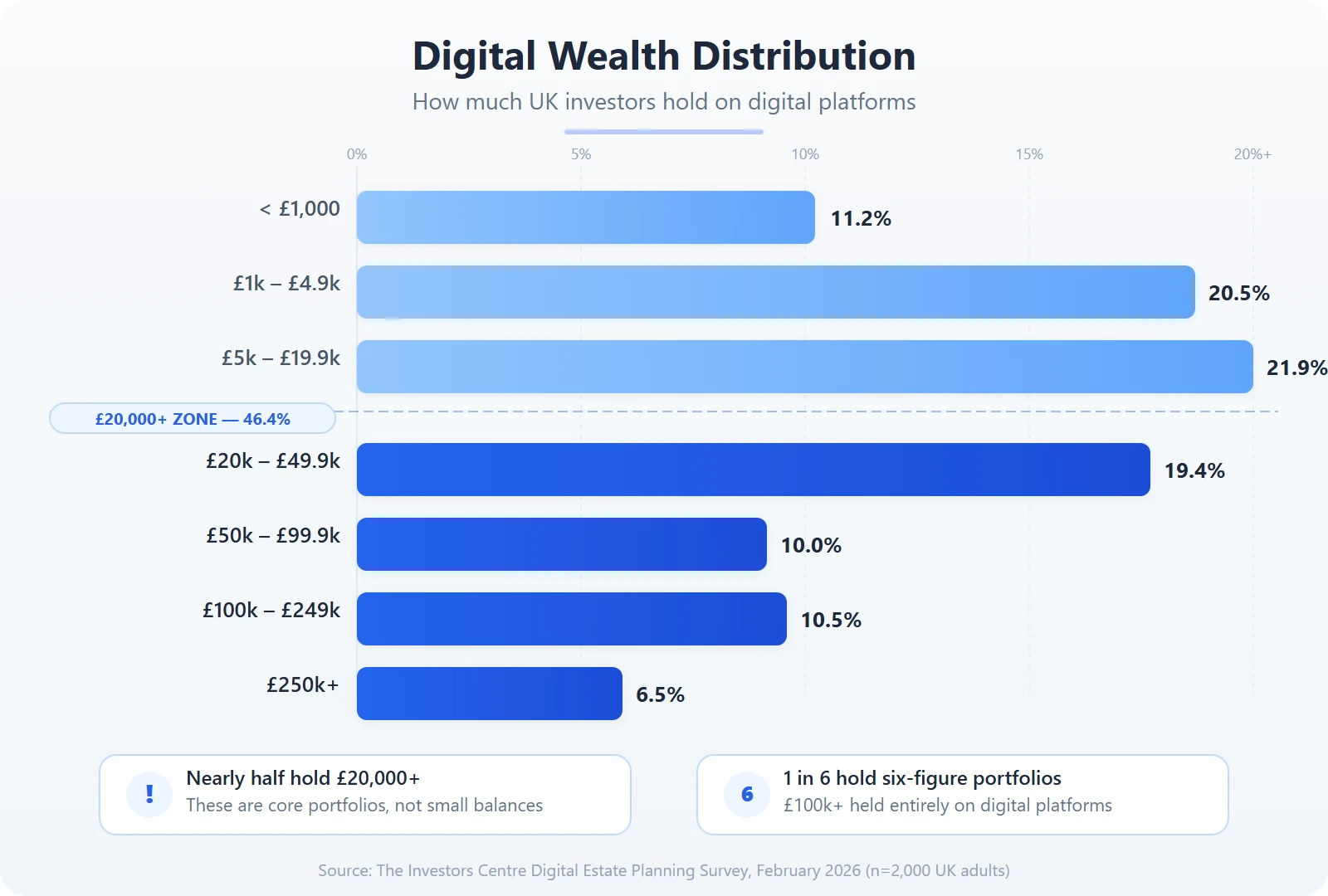
Nearly half of digital investors report holding at least £20,000 in digital accounts, while almost one in five report six-figure portfolios.
This suggests that digital platforms are increasingly used to hold substantial long-term investments, not just small speculative trades.
Where digital access problems begin
The research also explored how investors manage the credentials required to access their accounts.
The findings show that nearly half of investors rely on memory or informal systems for managing passwords.
While convenient for everyday use, these methods can make accounts difficult to access if credentials are lost.
The authentication bottleneck
Security systems used by digital platforms are also becoming increasingly complex.
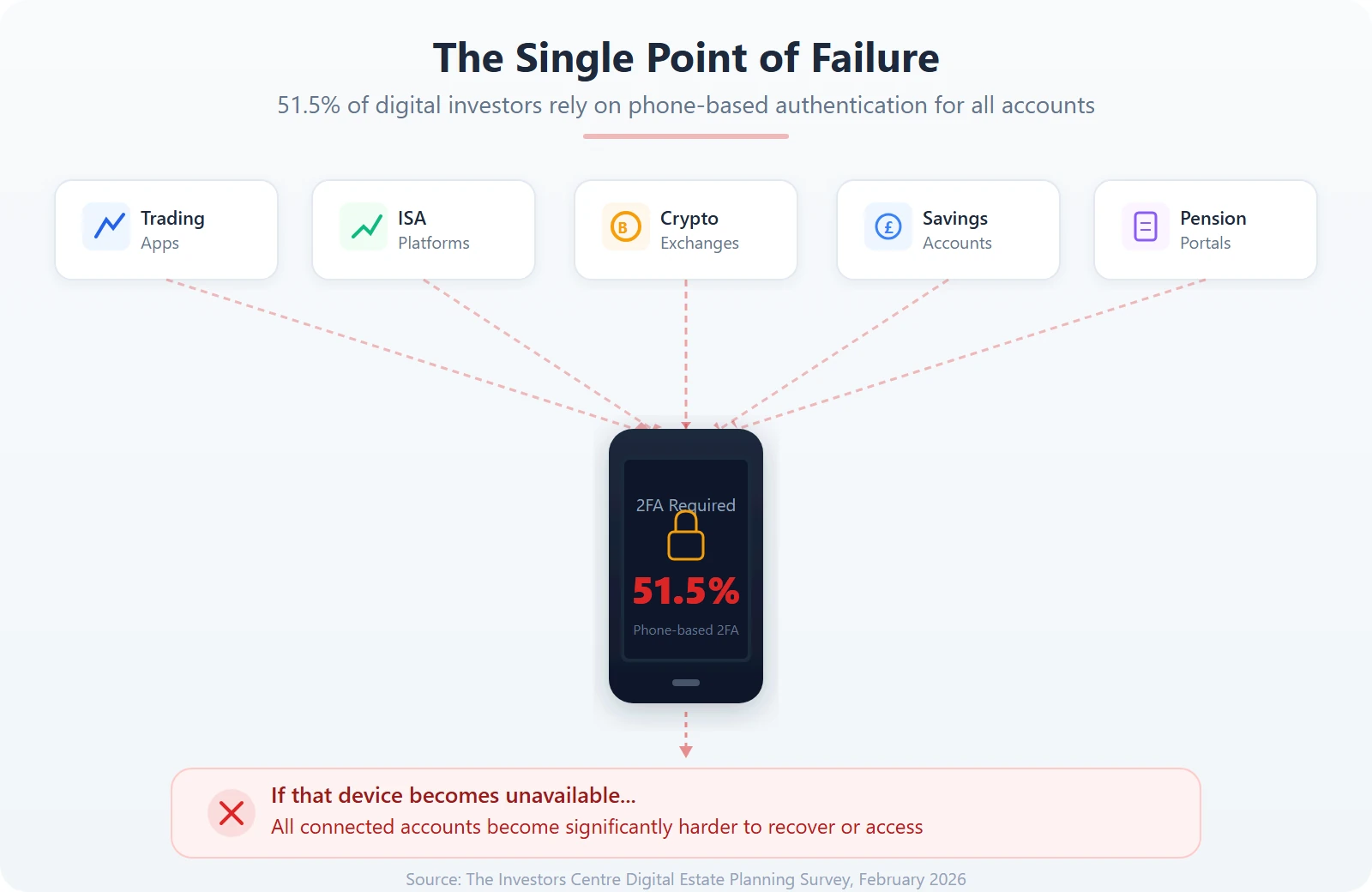
The survey found that 51.5% of investors rely on phone-based two-factor authentication (2FA).
| Authentication Method | Share of Investors |
|---|---|
| Phone-based authentication | 51.5% |
| Other authentication methods | 48.5% |
This means that access to many accounts depends on a single device — typically a smartphone containing authentication apps or SMS verification codes.
If that device becomes unavailable, recovering access to accounts can be significantly more difficult.
Estate planning has not kept pace with digital investing
Despite the growth of digital wealth, estate planning practices appear to lag behind.
In other words, the vast majority of UK adults have not documented how their digital accounts could be accessed after death.
This can leave executors searching for accounts that may not be immediately visible.
Why this matters during the wealth transfer era
The scale of the issue becomes clearer when viewed against broader economic trends.
The UK is entering the largest intergenerational wealth transfer in modern history.
Over the next 30 years:
- £5.5–£7 trillion is expected to pass between generations
- annual inheritance flows already exceed £100 billion
- a growing share of these assets are held digitally
If digital estate planning does not evolve alongside investing habits, a portion of this wealth could become difficult to locate or retrieve.
Expert perspective
“Digital investing has made financial markets more accessible than ever before,” said Thomas Drury, Co-Founder and Senior Trading Analyst at The Investors Centre.
“But as investing moves onto apps and platforms, access to wealth increasingly depends on passwords and personal devices. As the UK enters the largest intergenerational wealth transfer in modern history, ensuring families can locate and access digital accounts will become increasingly important.”
How investors can reduce digital access risk
The risks highlighted by the research are largely preventable with simple planning.
Below are practical steps investors can take to ensure digital assets remain accessible to family members and executors.
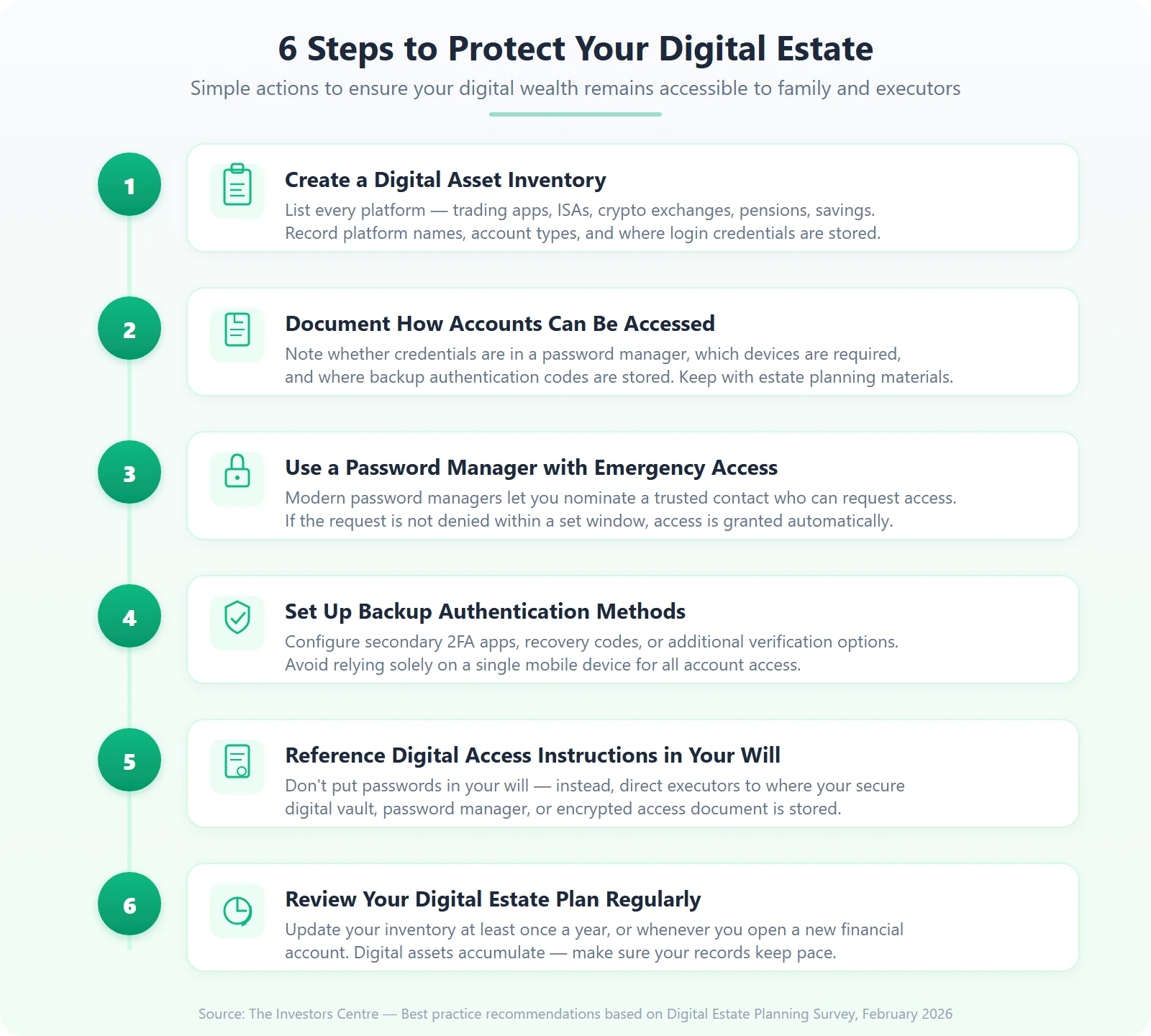
Create a digital asset inventory
Investors should begin by compiling a clear inventory of all digital financial accounts they hold. This should include trading platforms, online ISA or pension portals, crypto exchanges, app-based savings accounts and any other financial services accessed through digital logins. The list should record the platform name, account type and where login credentials are stored, but should avoid including full passwords for security reasons. A simple document that identifies where assets are held can significantly reduce the time executors spend locating accounts during estate administration.
Document how accounts can be accessed
Beyond identifying accounts, investors should provide basic instructions explaining how those accounts can be accessed. This may include noting whether credentials are stored in a password manager, whether access requires a specific device, or where backup authentication codes are stored. Such guidance can be kept in a secure document alongside estate planning materials, ensuring executors understand the process required to retrieve digital assets without compromising account security.
Use a password manager with emergency access
Password managers can provide a secure way to store login credentials while still allowing controlled access for trusted individuals. Many modern password management services offer emergency access features, which allow a nominated contact — such as a spouse or executor — to request access to stored credentials. If the request is not denied within a specified time window, access can be granted automatically, ensuring accounts can be recovered while maintaining strong security protections.
Set up backup authentication methods
Two-factor authentication has become a standard security feature for financial platforms, but relying solely on a single mobile device can create complications if that device becomes inaccessible. Investors should ensure that backup authentication methods are configured, such as secondary authentication apps, recovery codes or additional verification options. These safeguards allow accounts to be recovered if the primary device is lost, locked or unavailable.
Reference digital access instructions in your will
While passwords themselves should generally not be written directly into a will, estate planning documents should clearly indicate where digital access instructions are stored. This may include referencing a secure digital vault, password manager or encrypted document containing account guidance. By directing executors to the location of this information, investors can ensure that digital assets are identified and accessed efficiently during estate administration.
Review your digital estate plan regularly
Digital financial accounts often accumulate over time as investors open new brokerage platforms, savings apps or crypto services. As a result, digital estate planning should be treated as an ongoing process rather than a one-off exercise. Experts recommend reviewing digital asset inventories and access arrangements at least once a year, or whenever a new financial account is opened, to ensure records remain accurate and executors are not left searching for unknown accounts.
Methodology
The statistics are based on a February 2026 nationally representative survey of 2,000 UK adults aged 18 and over conducted by The Investors Centre.
Responses were weighted by age, gender and region to reflect the UK population profile.
Participants reported whether they held digital financial assets and selected value ranges representing the amount held across digital accounts. Midpoint conversion — the standard approach used in household wealth analysis — was used to estimate the value represented within the sample, producing £67.6 million in digital assets.
A lower-bound estimate assigning the minimum value within each band indicates the sample contains at least £42.4 million.
Respondents were classified as “access risk” if they held digital assets but lacked a confirmed access pathway for a trusted individual and relied on device-based authentication or undocumented credentials.
All figures represent potential access exposure based on self-reported financial ranges rather than verified balances or confirmed financial losses.
References
- The Investors Centre. "Digital Estate Planning and Wealth Transfer Survey." Conducted February 2026.
- Office for National Statistics (ONS). Household Wealth Analysis and Midpoint Modeling Guidelines.