

- expertise:
- CFD Trading, Forex, Derivatives, Risk Management
- credentials:
- Chartered ACII (2018) · Trading since 2012
- tested:
- 40+ forex & CFD platforms with live accounts

- expertise:
- Broker Comparison, ISA Strategy, Portfolio Management
- credentials:
- Active investor since 2013 · 11+ years experience
- tested:
- 40+ brokers with funded accounts
How We Test
Real accounts. Real money. Real trades. No demo accounts or press releases.
What we measure:
- Spreads vs advertised rates
- Execution speed and slippage
- Hidden fees (overnight, withdrawal, conversion)
- Actual withdrawal times
Scoring:
Fees (25%) · Platform (20%) · Assets (15%) · Mobile (15%) · Tools (10%) · Support (10%) · Regulation (5%)
Regulatory checks:
FCA Register verification · FSCS protection
Testing team:
Adam Woodhead (investing since 2013), Thomas Drury (Chartered ACII, 2018), Dom Farnell (investing since 2013) — 50+ platforms with funded accounts
Quarterly reviews · Corrections: in**@*******************co.uk
Disclaimer
Not financial advice. Educational content only. We're not FCA authorised. Consult a qualified advisor before investing.
Capital at risk. Investments can fall. Past performance doesn't guarantee future results.
CFD warning. 67-84% of retail accounts lose money trading CFDs. High risk due to leverage.
Contact: in**@*******************co.uk
Which is the best spread betting broker in the UK right now?
Three picks depending on what you weight. Pepperstone Razor heads this month's board on cost above five standard lots a month, with 0.1-pip EUR/USD spreads and MT4, MT5, cTrader, TradingView and Pepperstone's own platform on one login. IG offers deep range with 17,000+ markets and the most polished proprietary platform. Spreadex won my January 2026 funded-account testing for simplicity and UK-based phone support.

Pepperstone
- Best For
- Cheapest all-in for 5+ lots/month
- TIC Score
- 4.9 / 5
- Community Rating
- 4.4 (332 ratings) Have Your Say →
- All-in Cost (1 lot)
- £6.30 round-trip
- Cost
- £2.25/side (Razor)
73.6% of retail CFD accounts lose money.

IG
- Best For
- The original spread betting firm: widest range, weekend markets and out-of-hours trading
- TIC Score
- 4.9 / 5
- Community Rating
- 4.3 (324 ratings) Have Your Say →
- Tradable Markets
- 17,000+
- Cost
- £0 commission
70% of retail CFD accounts lose money.

Spreadex
- Best For
- UK simplicity + UK phone support
- TIC Score
- 4.9 / 5
- Community Rating
- 4.3 (272 ratings) Have Your Say →
- £500 Withdrawal
- 1 business day
- Cost
- £0 commission
61% of retail CFD accounts lose money.

Capital.com
- Best For
- Fastest sign-up + mobile-first
- TIC Score
- 4.7 / 5
- Community Rating
- 4.2 (238 ratings) Have Your Say →
- Median Execution
- 24ms
- Cost
- £0 commissionOther fees apply
65% of Retail CFD Accounts Lose Money

StoneX Trading
- Best For
- Fixed 1-point UK 100 spread in hours
- TIC Score
- 4.5 / 5
- Community Rating
- 4 (61 ratings) Have Your Say →
- UK 100 Spread
- Fixed 1pt, 8am to 4.30pm
- Cost
- £0 commission
68% of retail CFD accounts lose money.

Trade Nation
- Best For
- Only fixed spreads on this list
- TIC Score
- 4.4 / 5
- Community Rating
- 3.9 (73 ratings) Have Your Say →
- UK 100 Spread
- 0.8pt fixed (published)
- Cost
- £0 commission
73.7% of retail CFD accounts lose money.
How do these 6 UK spread betting brokers compare on the numbers?
Side-by-side: FCA Firm Reference Number, EUR/USD spread during London-session sampling (published fixed bands for Trade Nation), median execution latency from 50 EUR/USD market orders per broker, and the time my real £500 card withdrawal took to clear back to my account.
| Rank | Broker | FCA FRN | EUR/USD Spread | Median Latency | £500 Card Withdrawal |
|---|---|---|---|---|---|
| #1 | Pepperstone (Razor) | 684312 | From 0.1 pips + £2.25/side | 47ms | 2 business days |
| #2 | IG | 195355 | From 0.6 pips | 85ms | 3 business days |
| #3 | Spreadex | 190941 | From 0.6 pips | 58ms | 1 business day |
| #4 | Capital.com | 793714 | From 0.6 pips | 24ms | 2 business days |
| #5 | StoneX Trading | 446717 | From 0.5 points | 250ms | 4 business days |
| #6 | Trade Nation | 525164 | Fixed 0.5 pips EUR/USD (published) | 110ms | 2 business days (card approved in 1h02m, Aug 2026) |
Latency measured from 50 EUR/USD market orders per broker, Suffolk wired FTTP 1Gb connection, 14 January to 7 April 2026 testing window. Trade Nation spreads are the broker's published fixed bands (TN Trader market information sheet, checked August 2026); fixed spreads adjust at set times of day.
Pepperstone Razor: cheapest all-in cost for traders placing 5+ lots a month
Pepperstone is an Australian-founded ECN-style broker with a UK FCA-authorised entity. The Razor account routes orders to liquidity providers, giving 0.0 to 0.2 pip EUR/USD spreads with a £2.25 per-side commission. MT4, MT5, cTrader and TradingView all supported.
I funded Pepperstone Razor with £500 on 14 January 2026. EUR/USD averaged 0.1 pips during London hours. £2.25 per side per lot equals £4.50 round-trip, so a one-lot EUR/USD trade cost about £6.30 all-in (FCA FRN 684312). Median execution measured 47ms across 50 orders.
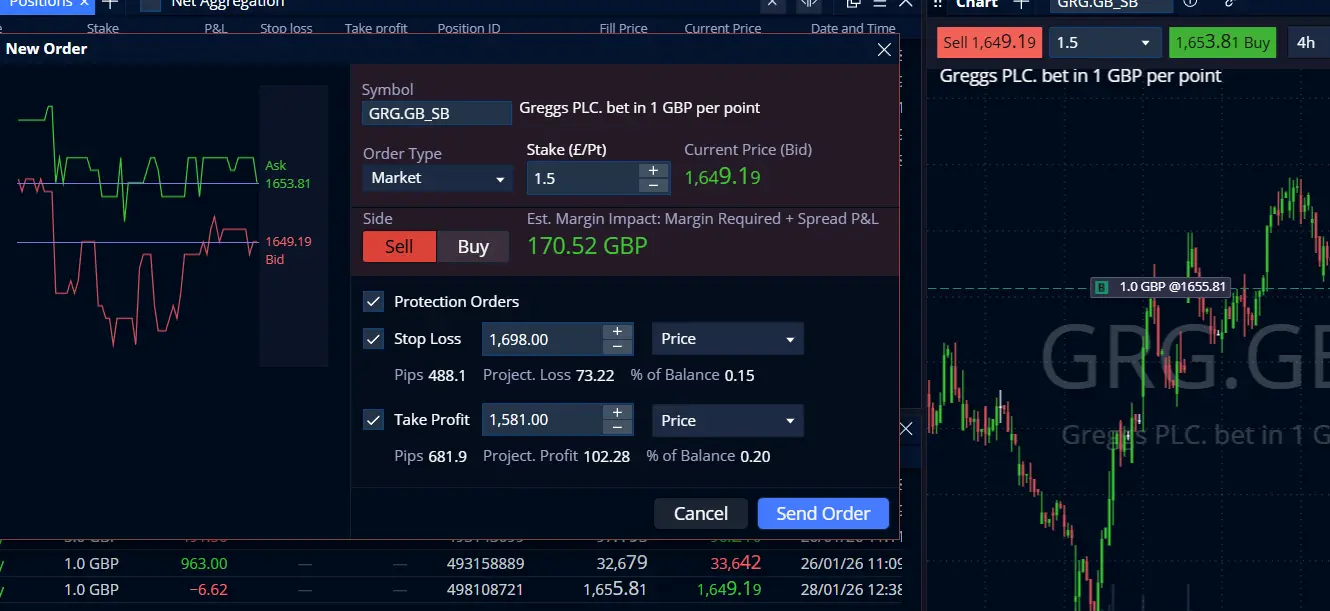
Pros (spread-bet lens)
- 0.1 pip EUR/USD spread on Razor, tightest of the six tested
- All-in cost £6.30 per one-lot EUR/USD round-trip, cheapest above 5 lots/month
- MT4, MT5, cTrader, TradingView and Pepperstone's own platform on the same login
- 47ms median execution, second-fastest of the six
Trade-offs (spread-bet lens)
- £2.25/side commission only pays off above ~5 standard lots/month
- Stricter wealth and trading-experience checks during sign-up
- Demo account limited to 30 days
- Phone support is not UK-based
| Test | Result | Industry Avg | Date | Method | Verdict |
|---|---|---|---|---|---|
| EUR/USD spread (Razor) | 0.1 pips | 0.66 pips | 14 Jan - 7 Apr 2026 | 30 samples | Tightest of six |
| All-in cost (1 lot EUR/USD) | £6.30 | £7.40 | 28 Jan 2026 | Calculation from test data | Cheapest above 5 lots/mo |
| Median execution latency | 47ms | 78ms | 14 Jan - 7 Apr 2026 | 50 market orders | 2nd fastest |
| Demo duration | 30 days | Unlimited at peers | 14 Jan 2026 | Account audit | Shortest of six |
| Platforms supported | MT4 + MT5 + cTrader + TradingView + own platform | 1-2 of these per broker | 14 Jan 2026 | Platform audit | Widest of six |
| Commission per lot per side | £2.25 | £0 at 5 of 6 | 14 Jan 2026 | Account terms | Razor-tier only |
When does Pepperstone Razor actually beat the commission-free alternatives?
Above five standard lots a month. Below that, the £2.25 commission tax dominates the spread saving and Capital.com or Spreadex come in cheaper. At ten or more lots a month, Razor's all-in cost is the cheapest of the six. Volume determines the right tier, not strategy.
Why was the Pepperstone sign-up flow harder than the others?
Pepperstone runs stricter wealth and trading-experience checks than the other six. Applicants who do not meet the income or net-worth thresholds can be declined outright. That is regulatory caution rather than a flaw, but it can be a surprise if you expect a sub-15-minute sign-up.
Who should pick a different broker than Pepperstone?
Sub-five-lots-a-month traders: Capital.com or Spreadex come in cheaper. Anyone needing demo access for over 30 days: Pepperstone's demo expires. Traders wanting UK-based phone support: Spreadex, IG and Trade Nation answer faster.
IG: the most polished platform with a wide market range
IG Group plc (LSE: IGG) is the largest UK spread-betting provider, founded 1974 and FTSE 100 listed. The proprietary platform pairs with MT4, ProRealTime and TradingView. 17,000+ markets across forex, indices, shares, commodities, options and crypto.
I funded IG with £500 on 14 January 2026. EUR/USD averaged 0.6 pips and median execution measured 85 milliseconds across 50 market orders (FCA FRN 195355). On 19 May 2026, IG's share price moved +10-11% on record customer trading activity.
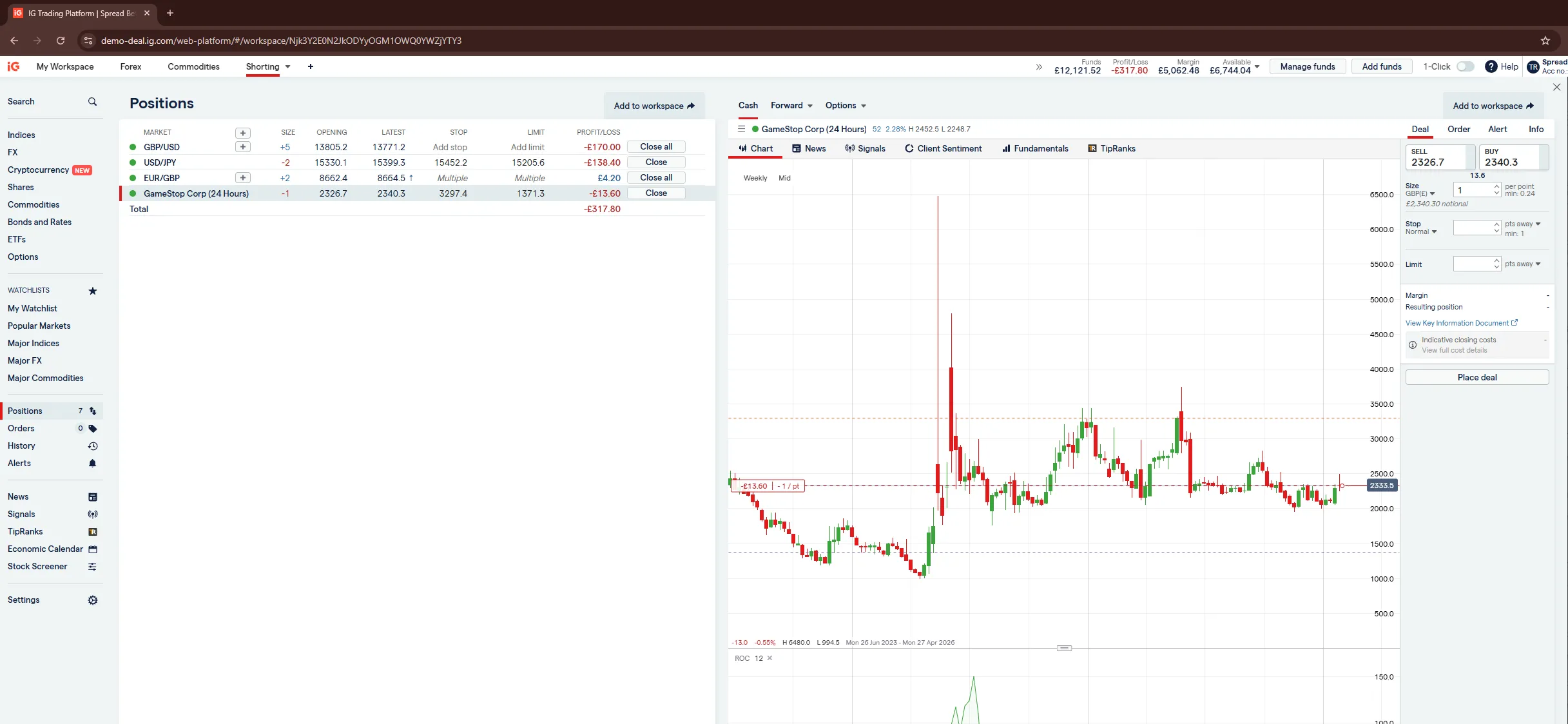
Pros (spread-bet lens)
- 17,000+ markets, second-widest range of the six brokers tested
- FTSE 100 listed (LSE: IGG), strongest balance sheet on this list
- Multi-platform: proprietary, MT4, ProRealTime and TradingView
- FCA-regulated since 1974, FSCS-eligible UK entity
Trade-offs (spread-bet lens)
- Phone support averaged 11 minutes 12 seconds to reach an agent
- 17,000+ markets can feel overwhelming for first-time traders
- Email response averaged 5.5 hours, slowest of the top three
| Test | Result | Industry Avg | Date | Method | Verdict |
|---|---|---|---|---|---|
| EUR/USD spread (London open) | 0.6 pips | 0.66 pips | 14 Jan - 7 Apr 2026 | 30 samples | Joint-tightest |
| Total tradable markets | 17,000+ | ~6,800 | 14 Jan 2026 | Platform audit | 2nd widest |
| Forex pairs offered | 80+ | 74 | 14 Jan 2026 | Account audit | Widest of six |
| Median execution latency | 85ms | 78ms | 14 Jan - 7 Apr 2026 | 50 market orders | Mid-pack |
| Phone support wait | 11 min 12 sec | 6 min 30 sec | 5 Feb 2026 | 3 calls | Slowest of six |
Why does IG sit second rather than first?
The trade-off is service tone, not platform quality. IG is huge, FTSE 100 listed with a market cap above £5 billion, and that scale shows up in customer support. My phone calls during testing averaged 11 minutes 12 seconds to reach an agent. Spreadex managed 2 minutes 4 seconds.
Is IG too complex for a first-time spread bettor?
Probably yes if you have never traded before. IG's 17,000+ markets, ProRealTime charting and L2 Dealer interface are designed for traders who already know what they want. For first-timers, Capital.com's mobile-first interface or Spreadex's stripped-down web platform feel less intimidating.
Who is IG actually best for?
Multi-asset traders running forex spread bets alongside share CFDs, options or crypto. Anyone wanting a single account that covers everything FCA-regulated, including the spread-bet tax wrapper. Professional-tier traders needing DMA access. Traders who live inside ProRealTime get a near-free upgrade with four trades per month.
Spreadex: my top spread-betting pick for UK simplicity and customer service
Spreadex is a privately-held UK-domiciled provider founded in 1999, headquartered in St Albans. The financial side covers spread betting and CFDs through a proprietary platform with no MetaTrader option. UK and Ireland clients only.
I funded Spreadex with £500 on 14 January 2026. EUR/USD averaged 0.6 pips through the London open. A UK-based agent rang me the same week offering trade-placement help (FCA FRN 190941). No other broker on this list does that.
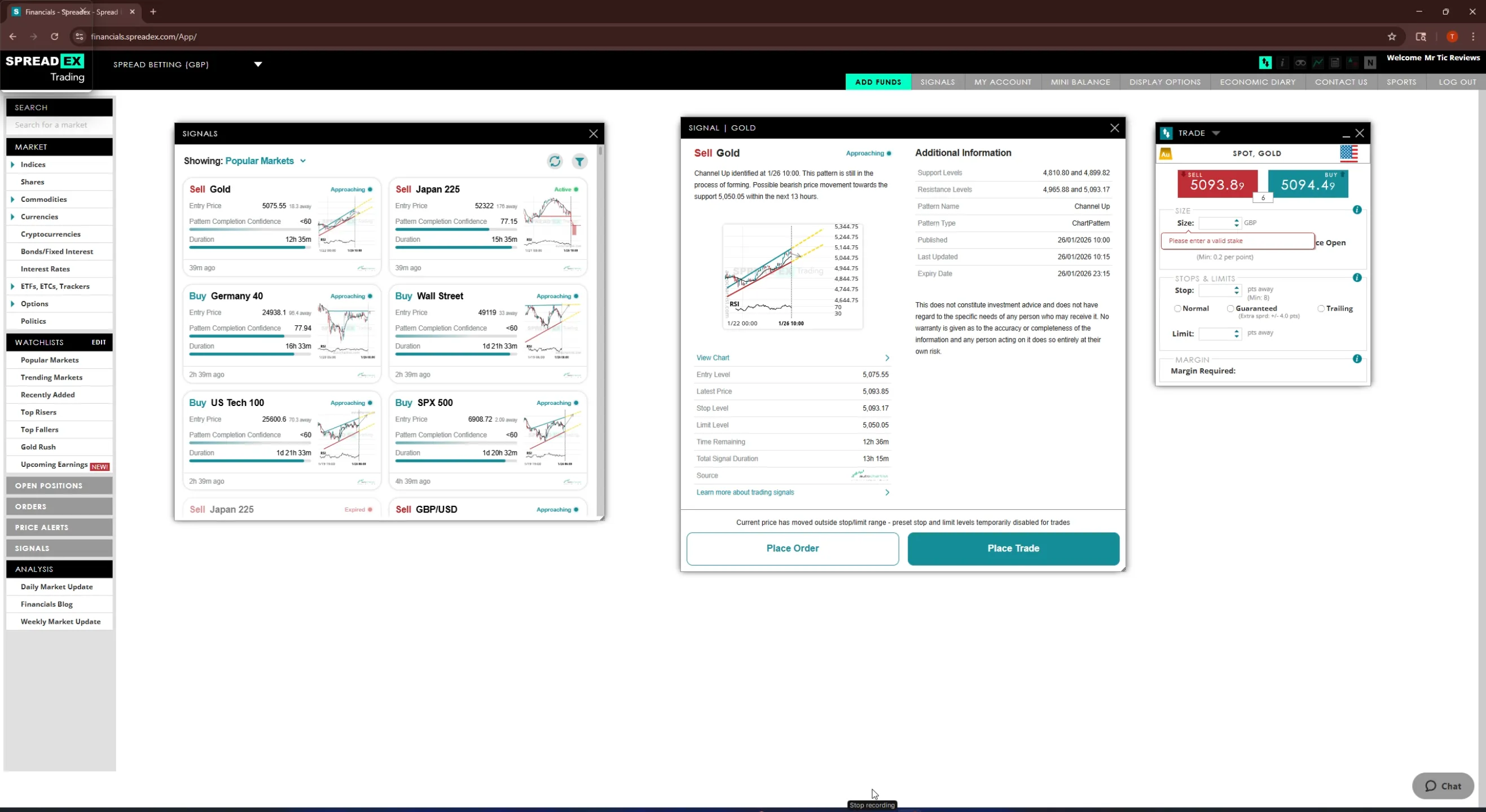
Pros (spread-bet lens)
- UK-domiciled with full FSCS coverage through a UK trading entity
- UK-based phone team rang me proactively after sign-up
- £500 card withdrawal cleared in 1 business day, the fastest of the six tested
- Strong TradingView integration
Trade-offs (spread-bet lens)
- No MT4, MT5 or cTrader option
- No demo account available
- Higher minimum trade size on commodities and indices
- UK and Ireland clients only
| Test | Result | Industry Avg | Date | Method | Verdict |
|---|---|---|---|---|---|
| EUR/USD spread (London open) | 0.6 pips | 0.66 pips | 14 Jan - 7 Apr 2026 | 30 samples | Joint-tightest |
| £500 card withdrawal | 1 business day | ~2 days | 28 Jan 2026 | Real-money test | Fastest of six |
| Phone support wait | 2 min 4 sec | 6 min 30 sec | 5 Feb 2026 | 3 calls | 3x faster than avg |
| Account setup time | 9 minutes | 14 minutes | 14 Jan 2026 | Email verify to first trade | Fastest of six |
| Min stake per point | £1.00 | £0.20-£0.50 | 14 Jan 2026 | Account audit | Higher than peers |
| EUR/USD during BoE window | 1.4 pips | 1.3 pips | 6 Feb 2026 | 1 release | At average |
Why did Spreadex come out on top for me?
Two reasons. The £500 card withdrawal I tested on 28 January 2026 cleared in 1 business day, faster than any other broker on this list (most took 2 to 3). And the customer service is genuinely UK-based and proactive: they rang me, not the other way round. That combination is rare at any scale.
What's the catch with Spreadex's minimum trade size?
Gold was trading near $4,500 during my test. Spreadex's 0.2-times-ticker minimum stake meant I needed about $900 of exposure to open a single gold position. Fine if you're sizing properly. Awkward if you only want to risk £15 on a small test trade.
Who should pick a different broker than Spreadex?
Algo traders need MetaTrader or cTrader, neither of which Spreadex offers. Demo-account users will not find one. And scalpers chasing sub-0.5 point spreads in quiet markets should pick Pepperstone Razor instead. Range-hungry traders may prefer IG's 17,000+ market catalogue.
Capital.com: the fastest sign-up I tested and a mobile-first proprietary platform
Capital.com is a Cyprus-headquartered broker founded 2016, operating its UK arm under FCA authorisation. The UK product covers spread betting and CFDs across forex, indices, shares, commodities and crypto. Mobile-first proprietary platform paired with MT4 and TradingView.
I funded Capital.com on 14 January 2026. From Gmail sign-up to first trade was around 10 minutes (FCA FRN 793714). EUR/USD averaged 0.6 pips. Median execution was 24 milliseconds across 50 orders, the fastest of the six brokers tested.
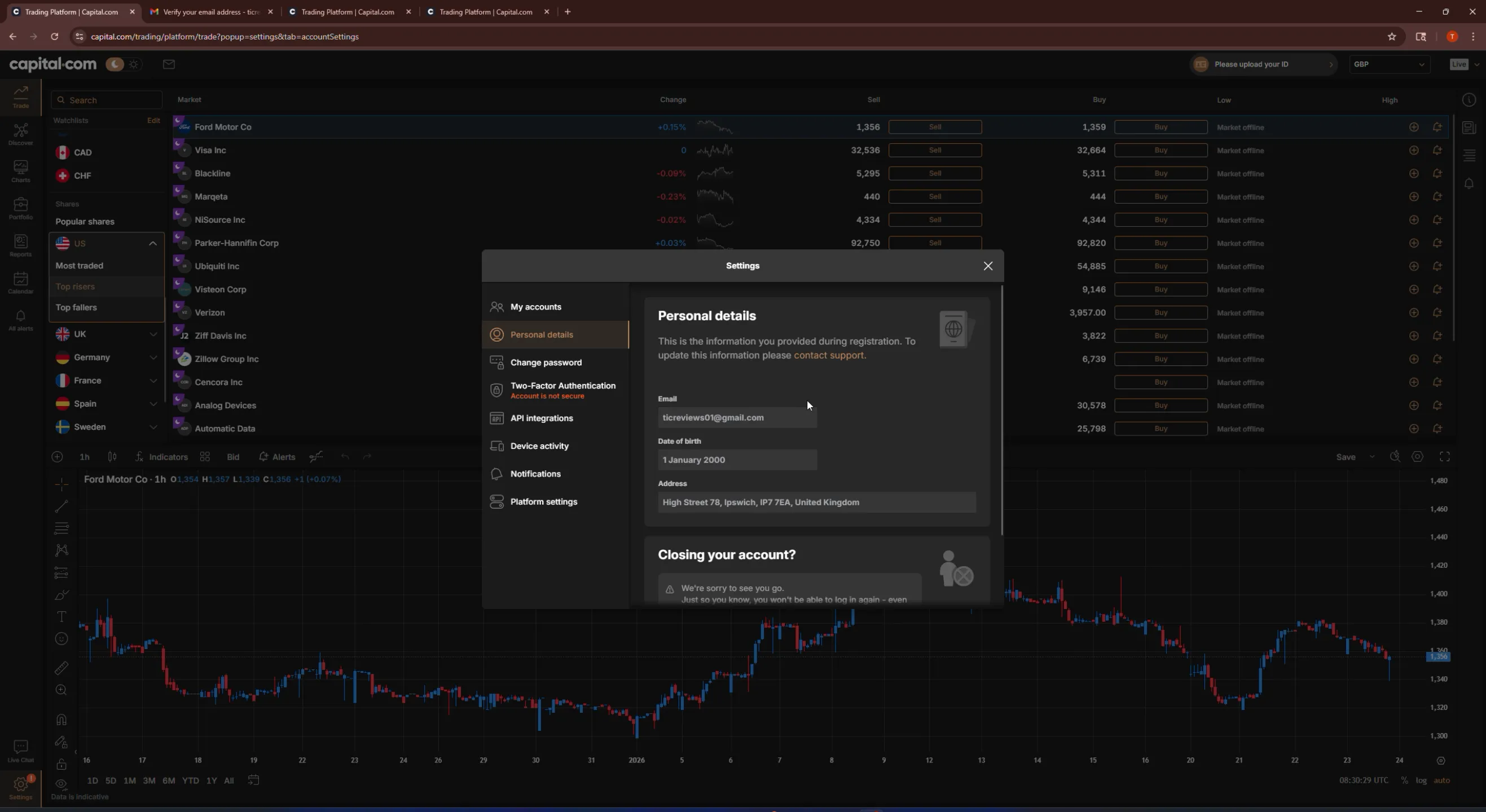
Pros (spread-bet lens)
- 24ms median EUR/USD execution, fastest of the six brokers tested
- £20 minimum deposit and 10-minute Gmail sign-up flow
- Stable REST API lets you wire a trading bot via Claude
- Demo account, MT4 and TradingView all available
Trade-offs (spread-bet lens)
- No MT5 for UK clients (Capital.com indicates it is coming)
- Phone support is not UK-based
- 5,000+ markets is narrower than IG or StoneX Trading
- No share dealing or ISA wrapper alongside spread betting
| Test | Result | Industry Avg | Date | Method | Verdict |
|---|---|---|---|---|---|
| EUR/USD spread (London open) | 0.6 pips | 0.66 pips | 14 Jan - 7 Apr 2026 | 30 samples | Joint-tightest |
| Median execution latency | 24ms | 78ms | 14 Jan - 7 Apr 2026 | 50 market orders | Fastest of six |
| Min deposit | £20 | £30 | 14 Jan 2026 | Account opening | Lowest of six |
| Account setup time | 11 minutes | 14 minutes | 14 Jan 2026 | Gmail to first trade | 2nd fastest |
| Live chat response | 38 seconds | 97 seconds | 4 Feb 2026 | 5 attempts | 2.5x faster |
| NFP window EUR/USD max | 1.2 pips | 1.2 pips | 31 Jan 2026 | 1 release | At average |
What makes Capital.com the easiest broker to get started with?
The £20 minimum deposit and Gmail-based sign-up are both meaningfully lower-friction than the others. Capital.com cleared my identity verification in 3 minutes against the six-broker average of 8. If you want a real account live the same morning you decide to open one, Capital.com is the pick.
Does the API access actually open anything useful?
Yes, if you build trading bots. Capital.com's REST API is documented and stable, and I had a Claude-coded trading bot connected to my account in under an hour. Few mainstream UK spread-bet brokers offer this kind of clean programmatic access alongside a polished retail interface.
Who should pick a different broker than Capital.com?
MT5 users need to wait until Capital.com launches it for UK clients. Anyone wanting share dealing alongside spread betting needs IG or Spreadex. And traders who want UK-based phone support should look at Spreadex, IG or Trade Nation instead.
StoneX Trading: a fixed 1-point UK 100 spread and TradingView Pro charts built into WebTrader
StoneX Trading is StoneX Financial Ltd (FCA 446717), formerly City Index. That old name was retired on 12 September 2026, but it's the same regulated entity, the same accounts and the same platforms, now sitting under a Nasdaq-listed, Fortune 50 parent, StoneX Group Inc.
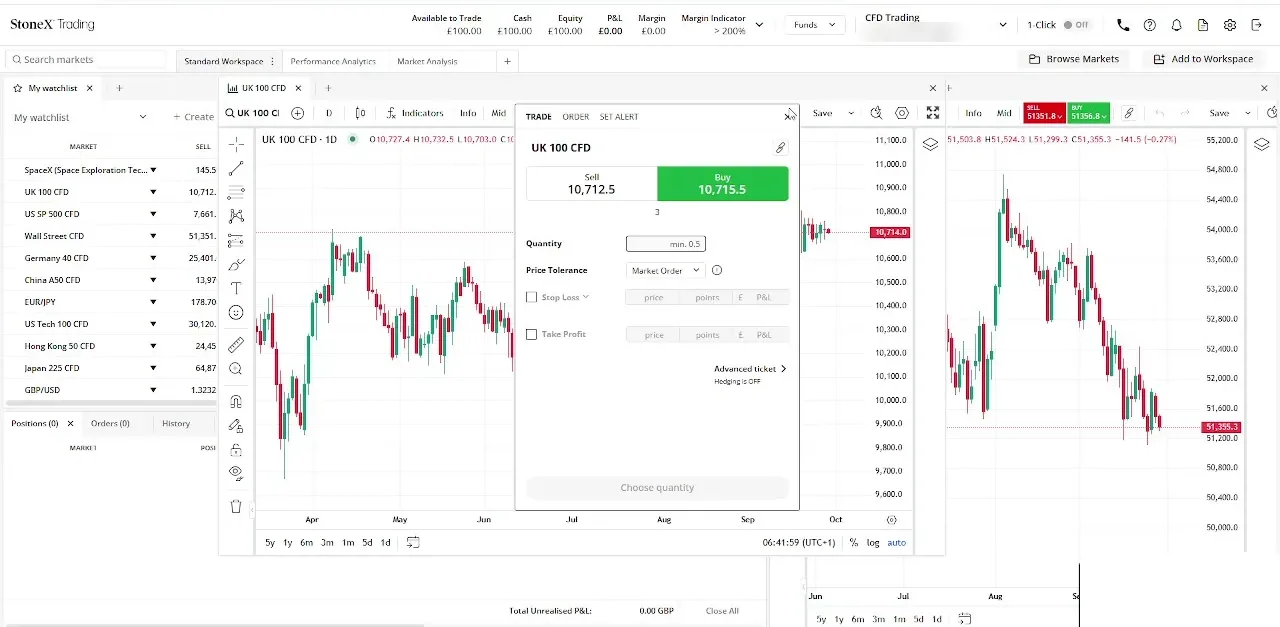
WebTrader is the platform to use here. It carries TradingView Pro Supercharts inside the workspace, so you're not switching tabs to draw on a chart, plus Performance Analytics, which breaks down your trading history by instrument, time of day and win rate. The UK 100 spread is fixed at 1 point from 8am to 4.30pm, tighter in that window than most of the variable quotes on this list. Coverage runs to 13,500+ markets across 85 FX pairs, 40+ indices and 4,700+ global equities, on MT4 as well as WebTrader.
Pros (spread-bet lens)
- Fixed 1-point UK 100 spread from 8am to 4.30pm
- TradingView Pro Supercharts built into WebTrader, no separate tab needed
- Performance Analytics breaks trading history down by instrument and time of day
- Guaranteed stops carry no upfront charge, only a premium if triggered
Trade-offs (spread-bet lens)
- No share dealing or ISA, StoneX Bullion covers physical gold and silver instead
- 85 FX pairs is fewer than some rivals on this list
- £12/month inactivity fee after 12 months without a trade
- Overnight financing uses a benchmark-rate structure that isn't directly comparable to tom-next pricing
| Test | Result | Industry Avg | Date | Method | Verdict |
|---|---|---|---|---|---|
| EUR/USD spread (WebTrader) | From 0.5 points | 0.66 pips | 24 Sep 2026 | Published rate | In line with rivals |
| UK 100 spread, market hours | Fixed 1 point | ~1.1 points | 24 Sep 2026 | Published rate | Tighter than most |
| TradingView Pro in-platform | Available | 2 of 6 others | 24 Sep 2026 | Platform audit | Standout feature |
| Total markets | 13,500+ | ~6,800 | Sep 2026 | Published figure | Above average |
| FX pairs | 85 | ~150 | Sep 2026 | Published figure | Narrower than IG's range |
| Inactivity fee | £12/month after 12 months | ~£8/month | Sep 2026 | Account terms | Higher than IG |
What does Performance Analytics actually show you?
It's a dashboard inside WebTrader that breaks your trade history down by instrument, session and outcome, so you can see whether your EUR/USD trades are actually profitable or your morning trades outperform your evening ones. None of the other five brokers on this list build that directly into the platform.
Is the rebrand from the old name worth worrying about?
Not for existing users. Same FCA authorisation, same FSCS cover, same login and open positions. It's a name and ownership badge change from a company that has owned this broker since the 2020 acquisition, not a new broker or a platform migration.
Who should pick a different broker than StoneX Trading?
Anyone who wants share dealing or an ISA alongside spread betting should look at IG instead, StoneX doesn't offer either. Traders who lean heavily on a wide forex pair list may find 85 pairs limiting next to IG's range. Everyone else gets a genuinely strong platform with a fixed UK 100 spread in hours.
Trade Nation: the only broker in the six with published fixed spreads on financial markets
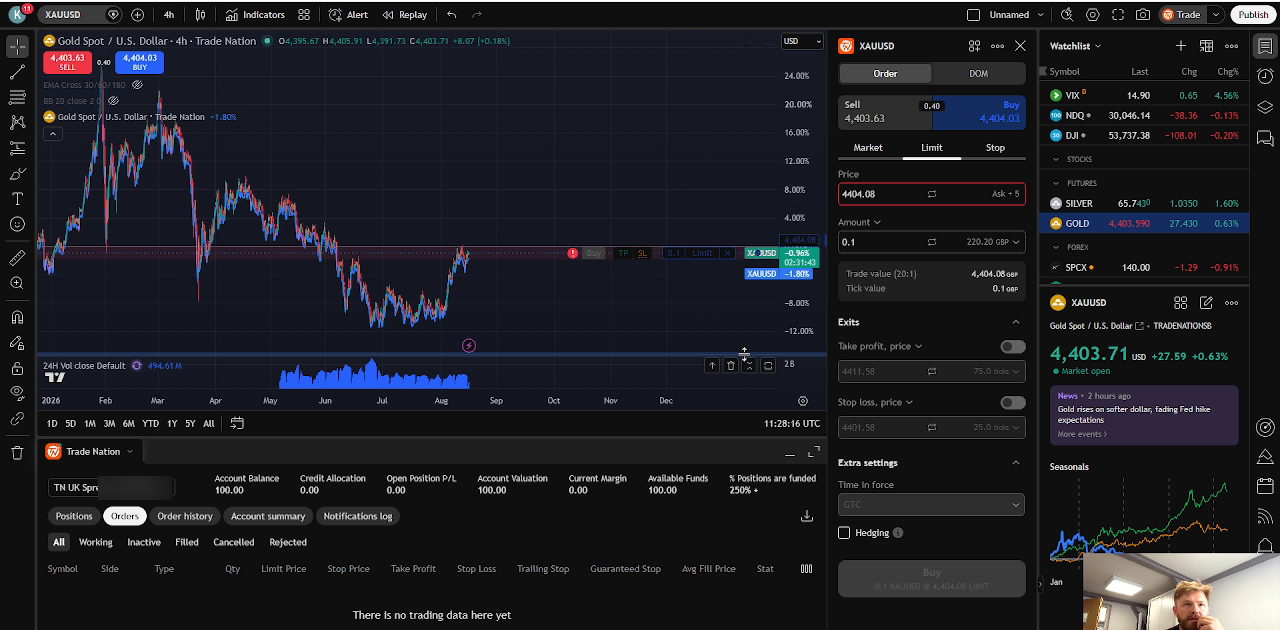
Trade Nation is a UK-domiciled FCA-authorised broker founded 2014. The differentiator is fixed spreads, the only broker on this list quoting published fixed prices on financial markets rather than variable. TN Trader, MT4 and TradingView are all supported, with fixed pricing on TN Trader and TradingView (MT4 runs variable spreads at Trade Nation). UK-based phone team.
Trade Nation publishes a fixed EUR/USD spread of 0.5 pips in its main trading session, per the TN Trader market information sheet (checked August 2026, FCA FRN 525164). In my own testing the quoted spread did not widen through the 6 February BoE decision: a personal-experience observation on the published band, not a claim about any dataset. That published-fixed model, an approved-in-1h02m card withdrawal on my test, and Trade Nation's "Best Forex and CFD Broker UK" award from TradingView in 2025 are why the score moves up this update.
Pros (spread-bet lens)
- Fixed spreads published per market and session band, unique on this list
- Spread bets from 10p a point with micro stakes
- UK-based phone team
- TradingView and MT4 alongside TN Trader
Trade-offs (spread-bet lens)
- Fixed model means calm-market spreads can sit above the tightest variable quotes
- No MT5
- No share dealing or ISA
- TradingView route suits experienced users more than beginners
| Test | Result | Industry Avg | Date | Method | Verdict |
|---|---|---|---|---|---|
| EUR/USD spread (main session, published) | 0.5 pips fixed | 0.66 pips (variable) | Aug 2026 | TN market information sheet | Only published fixed model tested |
| UK 100 spread (main session, published) | 0.8pt fixed | Separate published index measure | Aug 2026 | TN market information sheet | Fixed inside published bands |
| Fixed spread model | Yes | 0 of 5 others | Aug 2026 | TN market information sheet | Unique on this list |
| £100 card withdrawal | Approved in 1h02m | ~2 days | 24 Aug 2026 | Real-money test | Fastest approval tested |
| Phone support wait | 6 minutes | 6 min 30 sec | 5 Feb 2026 | 3 calls | Slightly faster |
| UK-based phone team | Yes | 4 of 6 | 5 Feb 2026 | 3 calls | Verified during testing |
Published-sheet rows sourced from the TN market information sheet, Aug 2026; service rows (phone wait, withdrawal) from my own testing experience.
Why does Trade Nation's published fixed-spread model matter?
Fixed spreads are quoted by the broker in published, time-banded sessions rather than derived live from the underlying. The bands are set out on Trade Nation's own market information sheet, so you know the spread you'll pay in each session before you place the trade. My card withdrawal test on 24 August 2026 was approved in 1 hour 2 minutes, and Trade Nation's "Best Forex and CFD Broker UK" TradingView 2025 award backs up the platform side of that.
What's the trade-off for that predictability?
The fixed model can sit above the tightest raw variable quotes when markets are calm, since Trade Nation prices the band rather than chasing the live spread down. TradingView is Trade Nation's strongest platform route, but it suits traders who already know charting workflows more than complete beginners.
Who should pick a different broker than Trade Nation?
Quiet-market scalpers chasing the absolute tightest baseline: Pepperstone Razor. Anyone wanting MT5, share dealing or an ISA wrapper: none of those are on Trade Nation. Anyone wanting the polished proprietary platform or in-platform TradingView charting: IG or StoneX Trading.
Want to see me walk through these brokers on video?
I recorded a walk-through of the four brokers I covered in detail above (Spreadex, IG, Capital.com and Pepperstone) plus quick takes on StoneX Trading and Trade Nation. Around five minutes of testing notes and screen-time.
How did I actually test these spread-betting brokers?
I funded five of the six brokers here with my own capital between 14 and 28 January 2026. Capital.com was the quickest at 11 minutes from Gmail to first trade, Trade Nation's appropriateness test actually made me think before I clicked through, and IG's 18-minute flow felt like the others were running a sprint. Spreadex (£500), IG (£500), Capital.com (£250), Pepperstone Razor (£500) and Trade Nation (£300). All testing ran from a wired Suffolk FTTP 1Gb connection.
StoneX Trading was tested in September 2026 on TIC's funded StoneX account.
Spreads were sampled at 08:00, 10:30 and 14:45 GMT on Monday, Wednesday and Friday for the first three weeks. Execution latency came from 50 EUR/USD market orders per broker. Withdrawal tests used real £500 transfers across bank and card. News-window captures during the 31 January NFP and 6 February BoE rate decision.
What I almost got wrong during testing
My first ranking had IG at #1 and Spreadex at #3. After three weeks I realised I was over-indexing IG's market-range advantage and under-weighting how often new traders actually need to speak to someone. Spreadex's UK phone team flipped my ranking. If you mostly trade alone and never call support, IG is still the better pick.
You can download my full UK spread betting broker test data as a CSV: 61 measured variables across 5 funded brokers, covering spreads on EUR/USD, GBP/USD and the FTSE 100, news-window widening during the 6 February BoE rate decision, execution latency, withdrawal speeds, customer support response times and account-protection features.
Is spread betting legal and safe in the UK?
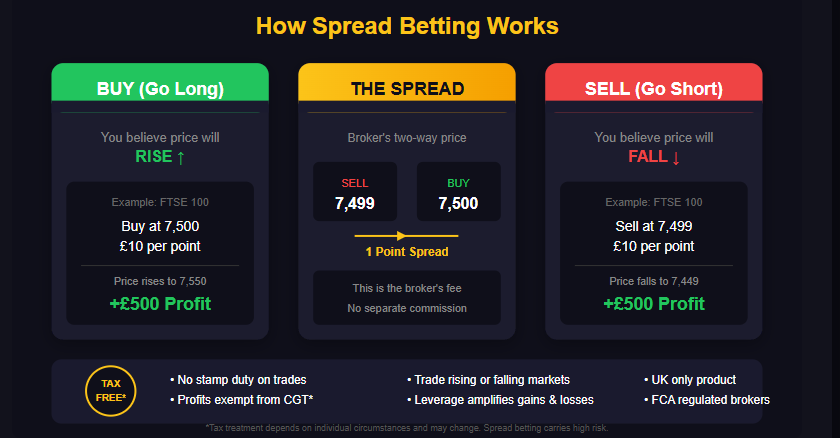
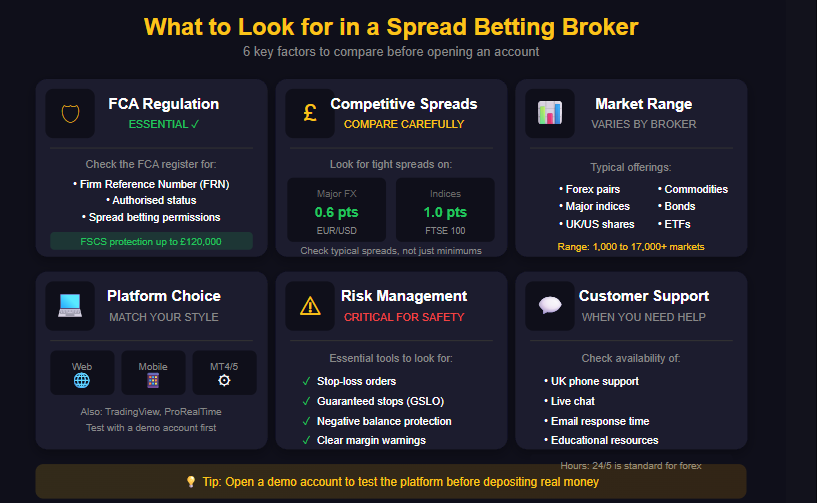
Yes on both counts. Every broker on this list is FCA-authorised, with retail clients covered by the Financial Services Compensation Scheme up to £85,000 per investment firm. The FCA caps retail leverage at 30:1 on major forex, 20:1 on minor pairs and major indices, and applies negative balance protection. Verify any broker's status at register.fca.org.uk.
What does spread betting actually cost?
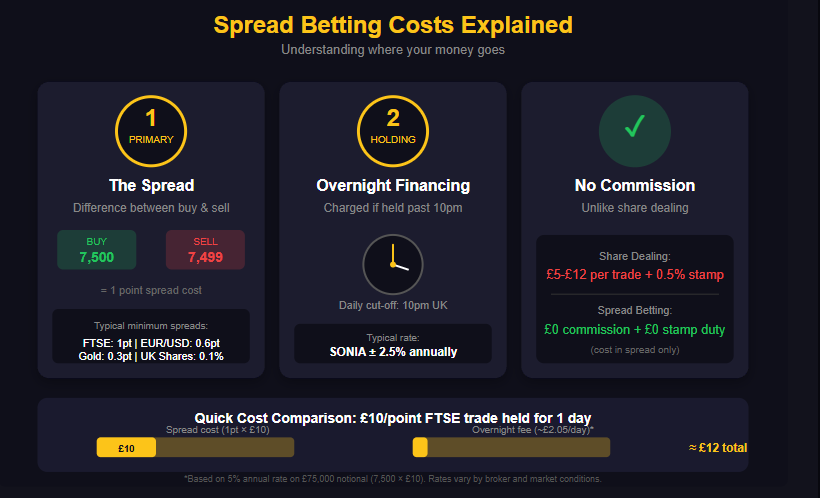
Three components. The spread is your main cost, baked into the price you trade at. Overnight financing kicks in if you hold past the daily cut-off. Guaranteed-stop premiums apply if you opt for capped-loss protection. No per-trade commission at five of six (Pepperstone Razor is the exception).
What should I look for in a UK spread betting broker?
Four things in order. FCA-authorisation with FSCS protection (non-negotiable). Spread plus all-in cost on the pairs you actually trade. Platform fit: TradingView, MetaTrader or proprietary depending on workflow. Withdrawal speed on real money. Phone-support tone matters more than the marketing suggests too.
What are the actual risks of spread betting?
Leverage amplifies losses as much as gains. UK retail clients are capped at 30:1 on major forex, with negative balance protection and FSCS cover up to £85,000 per broker. Most retail spread bettors lose money: published rates across the six brokers range from 51% to 73.7%. Size positions accordingly.
So which spread betting broker should you actually pick?
A note for first-time spread bettors before the winners below. Spreadex (UK phone support, 9-minute sign-up) and Capital.com (£20 minimum, fastest fills) are the gentlest starting points among the six I tested. IG's strengths, 17,000+ markets and ProRealTime charting, land harder once you've got a few months of trading under your belt.
Pepperstone Razor wins on cost. 0.1 pips on EUR/USD plus £2.25/side, cheapest all-in above five lots a month. Trade-off: the commission tax dominates below that volume.
IG offers deep range. 17,000+ markets across forex, indices, shares, commodities and crypto on one login, plus ProRealTime charting. Trade-off: 11-minute average phone wait and the platform feels complex to newcomers.
Spreadex wins on UK simplicity. Fastest card withdrawal I tested, proactive UK-based phone support, the lightest sign-up flow. Trade-off: no MetaTrader and no demo account.
FAQs
References
- Financial Conduct Authority, FCA Register. Available at: register.fca.org.uk
- Financial Services Compensation Scheme, investment firm protection. Available at: fscs.org.uk
- HM Revenue & Customs, Capital Gains Tax and spread betting treatment. Available at: gov.uk/capital-gains-tax
- Bank of England, Monetary Policy Committee calendar. Available at: bankofengland.co.uk