



Something unprecedented is happening at one of the world's most strategically critical waterways — and most investors haven't fully registered what it means yet.
Iran is demanding Bitcoin to let oil tankers through the Strait of Hormuz. Not dollars. Not bank transfers. Bitcoin. And stablecoins. Paid within seconds, directly to a military organisation that controls access to 20% of the world's daily oil supply.
This isn't a rumour. Bloomberg confirmed it on April 1st. The Financial Times confirmed Bitcoin specifically on April 8th. Iran's parliament codified it into law on March 31st. Here's what's actually happening — and what it means for every major asset class right now.
What is the Strait of Hormuz?
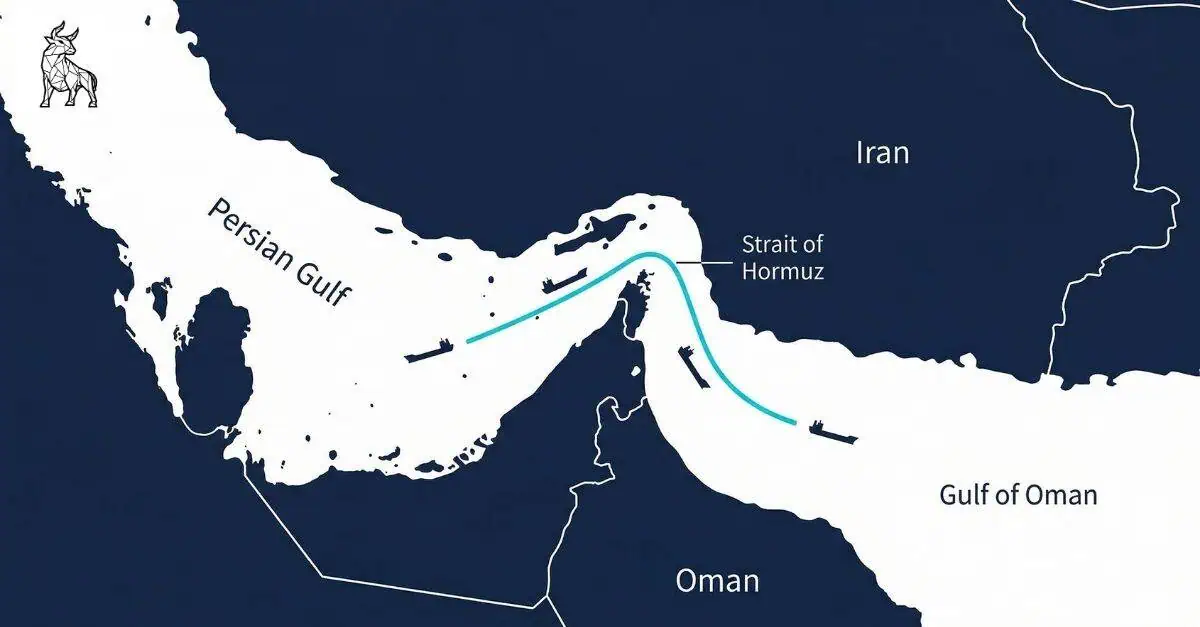
The Strait of Hormuz is a narrow waterway — just 21 miles wide at its narrowest point — sitting between Iran to the north and Oman to the south. It connects the Persian Gulf to the rest of the world's oceans.
Through it flows roughly 20% of the world's daily oil supply and 20% of global liquefied natural gas. For Gulf producers like Saudi Arabia, the UAE, Qatar and Kuwait, it is the only exit route for their energy exports. There is no viable alternative.
On 28 February 2026, US and Israeli strikes on Iran triggered retaliatory action that effectively closed the strait to commercial shipping. The IEA called it the largest supply disruption in the history of global oil markets. Goldman Sachs agreed. And the ripple effects are still moving through every major asset class as you read this.
So why is Iran demanding crypto — not dollars?
The answer is simpler than it sounds: Iran cannot receive dollars.
Since 1979, Iran has been progressively cut off from the global dollar clearing system. It has no meaningful SWIFT access. Western banks won't touch Iranian transactions. Traditional payment rails are effectively closed to Tehran.
Bitcoin and stablecoins solve that problem. They require no bank account, no correspondent banking relationship, no SWIFT code. Dollar-equivalent value moves across a blockchain in seconds — completely outside the infrastructure that Western sanctions rely on.
This is not improvised. Iran legalised Bitcoin mining in 2019, at its peak accounting for 4–5% of global Bitcoin hash rate. By 2025, Iranian crypto activity reached $7.8 billion on-chain, with around half flowing through addresses linked to the IRGC. The Central Bank of Iran has reportedly accumulated over $500 million in stablecoins. In January 2026, Iran began accepting crypto for arms export payments.
The Hormuz toll is the logical next step in a long-running strategy.
How does the Bitcoin toll system actually work?
The process is more structured than most people realise. This is not ships being stopped at gunpoint and asked to hand over crypto. It is a formalised, legislated system.
| Step | What happens |
|---|---|
| 1. Submit | Ship operator emails full cargo details to an IRGC-linked intermediary — vessel ownership, flag registration, cargo manifest, crew list, destination port, AIS tracking data |
| 2. Vet | The IRGC's Hormozgan Provincial Command screens the vessel for ties to the US, Israel or other designated adversaries |
| 3. Rank | Each nation is scored on a one-to-five friendliness scale — friendly nations get better terms or free passage, US and Israeli-linked vessels are denied entirely |
| 4. Quote | If approved, a fee is quoted at approximately $1 per barrel of oil cargo — a fully loaded supertanker carrying 2 million barrels faces up to $2 million per crossing |
| 5. Pay | The operator has seconds to pay in Bitcoin, USDT or USDC |
| 6. Passcode | On payment, a single-use code is broadcast over VHF radio |
| 7. Escort | An Iranian naval escort guides the vessel through the strait to the Gulf of Oman |
Iran's parliament formally approved the Strait of Hormuz Management Plan on March 31st, giving the entire system legislative backing. At current estimates, the toll system could generate up to $20 million per day from oil tankers alone — potentially $600–800 million per month if LNG vessels are included.
Bitcoin, stablecoins or both — which cryptos are actually being used?
There are three crypto instruments in play, each serving a slightly different operational purpose.
USDT (Tether) — the primary choice
The dominant payment method when the system launched. Running on the Tron blockchain — which settles in seconds for fractions of a cent — it gives Iran dollar-equivalent value with no price volatility between invoice and payment. Iran's Central Bank has accumulated over $500 million in USDT. The downside for Iran: Tether has previously frozen wallets and cooperated with OFAC enforcement, freezing around $3.3 billion in USDT across 7,000+ wallets to date.
USDC (Circle) — also accepted
Also accepted but carries even more regulatory risk for Iran. Circle has closer ties to US regulators and a stronger track record of cooperating with sanctions enforcement. Both USDT and USDC run on Ethereum as well as their respective preferred networks.
Bitcoin — specifically demanded during the ceasefire
The Financial Times reported on April 8th that Bitcoin is now being demanded specifically during the ceasefire period. Unlike stablecoins, Bitcoin has no central issuer who can freeze a wallet. Vessels are given seconds to pay — deliberately fast, to prevent funds being traced and frozen before the transaction completes.
The compliance exposure for shipping companies
For shipping companies, the legal risk is severe regardless of which crypto they use. The IRGC carries terrorism designations in the US, EU and UK — meaning any transaction that benefits it risks OFAC civil penalties of up to twice the transaction value per crossing. For a $2 million toll, that is $4 million in civil exposure per transit, before any criminal charges. Most Western-linked carriers are choosing stranded vessels over that risk.
How have markets reacted?
Three assets. Three completely different stories. Understanding why each behaved differently is arguably more useful for investors than the price moves themselves.
Bitcoin and crypto
Bitcoin's behaviour during this crisis has been genuinely fascinating — and not what most people expected.
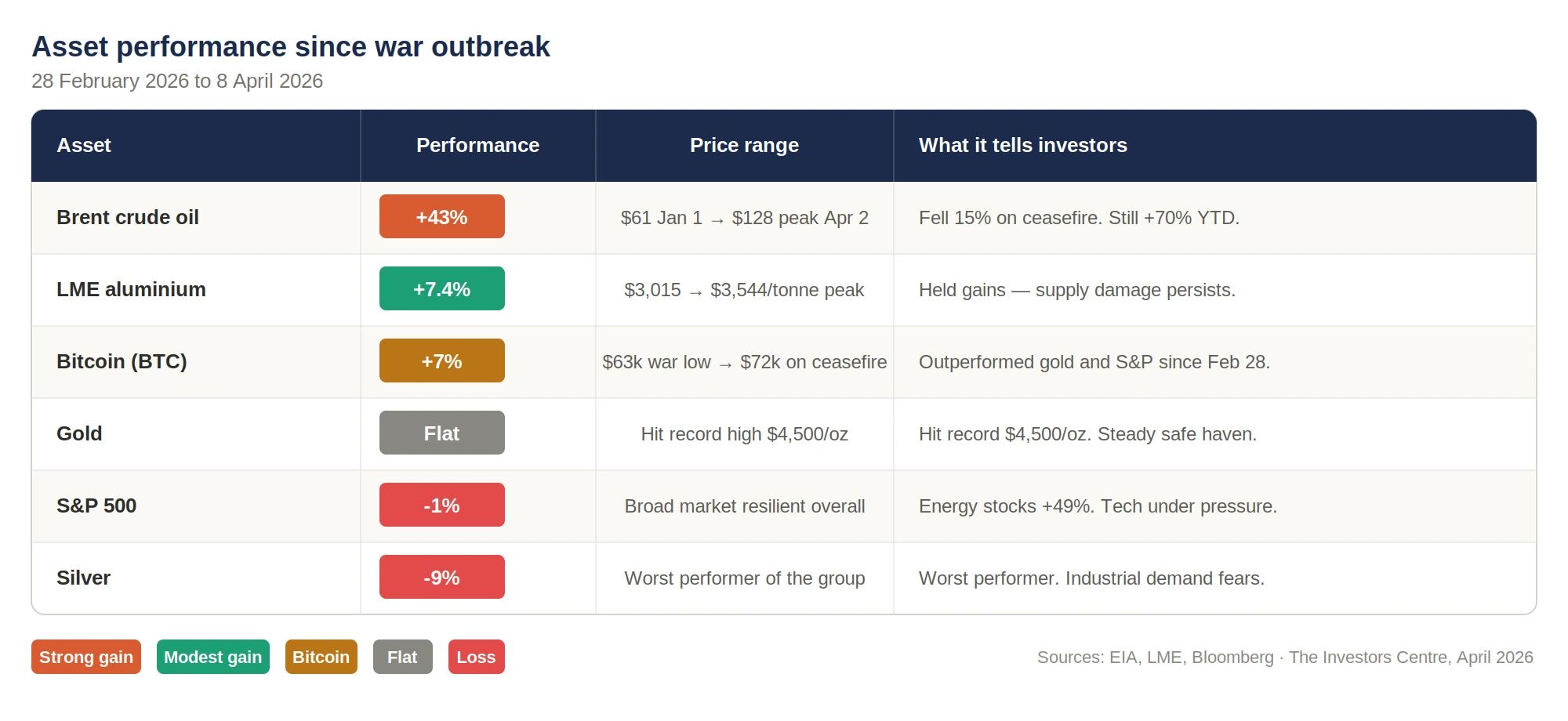
When US and Israeli strikes hit Iran on the night of Saturday 28 February, Bitcoin was the only major liquid market open. It dropped 8.5% immediately, falling from around $70,000 to $63,000. But then something interesting happened. Every subsequent escalation found buyers at a higher level than the last. The selloff floors rose steadily: $64k, $66k, $68k, $69.4k. Higher lows, week after week.
The result: since February 28th, Bitcoin has actually outperformed the S&P 500 (-1%), gold (flat) and silver (-9%). It held a $65k–$73k range for over 50 days through the worst geopolitical crisis in a generation.
Then came April 8th. The FT reported Iran was demanding Bitcoin specifically for Hormuz transits. Bitcoin jumped from around $68,000 to above $72,000 within hours of the story breaking. Solana surged 7%. Ethereum 8%. The ceasefire announced the same day sent Bitcoin briefly to $73,000. Bitcoin ETF inflows hit $471 million on ceasefire day — the highest since February.
Brent crude oil
Oil told the most dramatic story of all. Brent started 2026 at $61 per barrel. By the time war broke out on February 28th it was already at $72 — up 18% on rising geopolitical tension alone. Then the strait effectively closed and prices went vertical. The March average hit $103 per barrel. On April 2nd, Brent touched $128 — the Q1 increase was the largest on an inflation-adjusted basis since records began in 1988.
The ceasefire on April 8th triggered an immediate, violent reversal. WTI fell 15% in a single session. Brent dropped 5%. The war risk premium compressed from around $14 per barrel to $4–6 overnight. Oil is currently around $103 per barrel — still up roughly 70% year to date.
Aluminium
Aluminium's price story is subtler than oil's — and in some ways more important for investors to understand, because it tells a different kind of story.
LME aluminium started 2026 at around $3,015 per tonne. It gained 4.9% in the first week of war alone. It peaked at $3,544 per tonne — the highest level since March 2022 — and here's the key thing: it barely moved on the ceasefire news.
While oil fell 15% on April 8th, aluminium held almost all its gains. Why? Because aluminium isn't pricing a fear premium that disappears when a ceasefire is announced. It's pricing real, physical damage to supply chains that a two-week truce does nothing to fix. Bahrain's Alba declared force majeure on deliveries. Qatar's Qatalum shut down production entirely due to gas shortages. Emirates Global Aluminium's Al Taweelah facility was struck by missiles on March 28th.
There's also a compounding upstream problem. Guinea — which supplies over 70% of the world's seaborne bauxite — is simultaneously enforcing export curbs after prices collapsed 50% since early 2025. So aluminium is dealing with a chaotic upstream and a blocked downstream at the same time. ING Group forecasts prices above $4,000 per tonne if disruption continues. Wood Mackenzie estimates 3–3.5 million tonnes of 2026 output is at risk.
Gold
Gold did exactly what gold is supposed to do. It rose steadily as tensions escalated, hit record highs above $4,500 per ounce during peak conflict, and held its gains more steadily than oil when the ceasefire was announced. Classic safe haven behaviour — no dramatic reversal, no 15% single-session drop.
The Bitcoin versus gold comparison during this crisis is instructive. Bitcoin actually outperformed gold over the six weeks since war broke out — up around 7% versus gold's flat performance. But gold showed the steadier hand. It didn't drop 8.5% on day one. It didn't spike 4.5% on ceasefire news. It just quietly went up and held.
Energy stocks and broader equities
The S&P 500 is down around 1% since the war broke out — a remarkably resilient performance given the scale of the disruption. But inside that headline number, the rotation has been dramatic. Energy stocks are the standout performers. Occidental Petroleum was up close to 50% year to date at its peak. US domestic producers have been explicitly characterised as "Hormuz hedges" by analysts — companies whose output is entirely insulated from Gulf supply disruption.
Tech and growth stocks have faced the opposite pressure. High oil prices are inflationary, which delays Fed rate cuts, which hurts high-multiple growth companies. Markets were pricing a 52% probability of a Fed rate hike at the April FOMC meeting before the ceasefire changed sentiment.
Is Bitcoin actually a war hedge? The data has a clear answer
This is the question the crypto industry has debated for years. The Hormuz crisis has given us the most comprehensive real-world test yet — and the answer is more nuanced than either side wants to admit.
Bitcoin is not a traditional safe haven. It sold off first and hardest when the war broke out — dropping 8.5% on day one while gold barely moved. Every major escalation event produced immediate Bitcoin selling, not buying.
But it is not purely a risk asset either. It recovered faster than equities after each selloff, held higher floors with each passing week, and outperformed both stocks and gold over the full six-week period. Its 24/7 trading structure means it absorbs geopolitical shocks faster than anything else — because it's the only thing trading when the shocks arrive.
And then came April 8th, which added a genuinely new dimension. For the first time in history, a nation-state generated real economic demand for Bitcoin at a strategic geopolitical chokepoint. Ships needed Bitcoin to pass through Hormuz. That is inelastic, real-economy demand — entirely independent of investor sentiment.
Our read: Bitcoin is a 24/7 geopolitical sentiment barometer that has just acquired a novel real-economy demand driver. That combination doesn't fit neatly into any existing asset category — which is precisely what makes it interesting right now.
What does this mean for UK investors?
| Short-term risks | Long-term opportunity |
|---|---|
| Regulatory crackdown on stablecoin issuers could impair crypto liquidity | Crypto proven at sovereign geopolitical level for the first time |
| Bitcoin highly sensitive to ceasefire fragility — any breakdown sends price toward $65k | Aluminium supply repricing is structural, not temporary |
| Aluminium supply chain damage persists beyond any two-week truce | Gulf-insulated producers (Alcoa, Rio Tinto) attracting capital |
There are two competing signals coming out of this story, and being clear-eyed about both is important.
The short-term risks are real. Regulatory pressure on Tether and Circle will intensify — OFAC cannot indefinitely ignore $2 million Bitcoin transactions flowing to a terrorism-designated organisation. If stablecoin issuers are forced to act, that could create liquidity disruption across the broader crypto market. Bitcoin's price remains highly sensitive to ceasefire developments — any breakdown sends it back toward $65k quickly.
The long-term case has arguably strengthened. Crypto has just demonstrated genuine real-world utility at a sovereign level that didn't exist six weeks ago. The Hormuz toll system is the first time a nation-state has used blockchain infrastructure as a primary revenue mechanism at a strategic global asset. That matters for the long-term investment thesis around digital assets.
For commodity-linked portfolios, aluminium exposure specifically looks sticky and structural — the supply chain damage outlasts any ceasefire. Producers with assets outside the Gulf corridor are where capital has been moving: Alcoa and Rio Tinto specifically, given their Australian and Brazilian operations sit entirely outside the Hormuz risk zone. Secondary aluminium and recycling plays are also attracting attention — scrap-based production is completely insulated from Gulf supply disruption.
If you're new to crypto investing, our guide to the best crypto platforms in the UK covers everything you need to know about getting started. And if you're specifically considering Bitcoin, our in-depth guide to investing in Bitcoin in the UK walks through the full process.
The bigger picture — a turning point for crypto?
This is the first time in history that a nation-state has used crypto as a sovereign revenue mechanism at a major global chokepoint. That is a different conversation to the one we were having six weeks ago.
The Hormuz parallel is worth noting. This waterway is where the petrodollar system was effectively born in 1974, when US Secretary of State Henry Kissinger brokered an arrangement with Saudi Arabia that recycled oil export revenue into dollars and back into US Treasuries. That deal made the Strait of Hormuz the physical anchor of dollar dominance for half a century.
Now, Iran — while at war with the US — is collecting tolls in digital dollars at the very same chokepoint. Not through banks, but over a blockchain. The dollar is not dying. But the way it moves is changing. And the Strait of Hormuz, it turns out, is where that change is playing out in real time.
Our view
Here's the honest take from where we sit, watching retail and private investor behaviour day to day.
All signs are pointing to more volatility ahead. The ceasefire is two weeks long, Iran has already said it does not mean the end of the war, and the structural damage to Gulf supply chains — in energy, in aluminium, in fertiliser, in helium — does not reverse with a temporary truce.
Any asset connected to commodities moving through these waterways — which is most of them — is in for a rough ride until genuine, long-term peace is secured in the region. That is not a prediction about timing. It is an observation about the nature of the disruption.
What has changed permanently, in our view, is crypto's role in all of this. Whether you are bullish or bearish on Bitcoin, you cannot ignore what just happened: digital assets just became part of how sovereign states manage access to the world's most critical physical infrastructure. That is a different conversation to the one we were having six weeks ago.
We will be updating this article as events develop.
References
- Bloomberg. "Strait of Hormuz: Ships Paying Iran Yuan and Crypto Tolls for Safe Passage." April 1, 2026.
- Financial Times. "Iran eyes crypto toll for oil tanker transits through Strait of Hormuz." April 8, 2026.
- US Energy Information Administration (EIA). Short-Term Energy Outlook, April 2026.
- International Energy Agency (IEA). Oil Market Report, March 2026.
- TRM Labs. "Iranian Crypto Tolls in Strait of Hormuz." April 2026.
- Chainalysis. "Inside Iran's Growing $7.8 Billion Crypto Ecosystem." January 2026.
- Wood Mackenzie. "Middle East Impact on Aluminium Market." April 2026.
- World Economic Forum. "Beyond Oil: 9 Commodities Impacted by the Strait of Hormuz Crisis." April 2026.