


A Lot Size in Forex is...
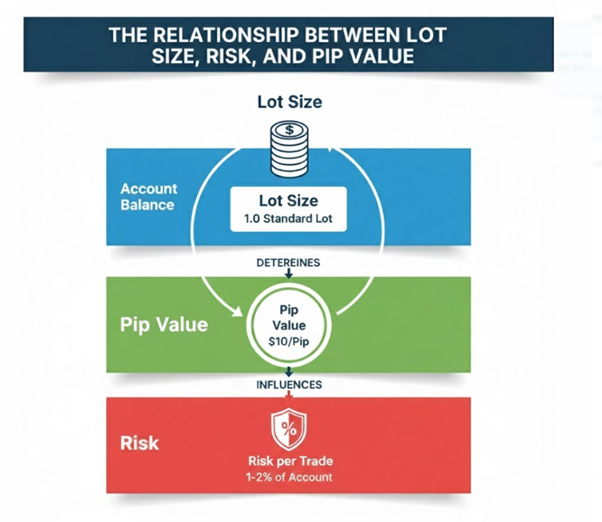
A lot size in forex refers to the number of currency units you buy or sell in a single trade. In simple terms, it defines how big or small your position is, and how much each pip movement is worth in pounds and pence.
It’s one of those terms new traders hear all the time but rarely grasp until they see it reflected in their balance. Lot size isn’t just a technical measure; it’s the foundation of your risk. Change the size, and you change your exposure, often more dramatically than you might expect.
But understanding how lot size connects to your account balance, leverage, and pip value isn’t difficult once you see the relationships laid out clearly. Many traders find that once they get to grips with this, their entire approach to position sizing and capital management becomes far more deliberate.
What Does “Lot Size” Really Mean in Forex Trading?
A lot is simply a standardised unit of measurement, the amount of currency you buy or sell in a single forex trade. It’s the trading world’s version of a contract, a fixed block that keeps transactions consistent across brokers and platforms. Without it, markets would be chaotic, with every trader dealing in arbitrary quantities.
Think of it a bit like buying fruit wholesale. You don’t purchase individual apples; you buy crates. Each crate holds a predictable amount, whether you’re a greengrocer in Manchester or Madrid. The same logic applies to forex: a “lot” bundles up a fixed number of currency units so that traders, brokers, and systems all speak the same numerical language.
While most forex traders focus on CFDs, spread betting offers a similar way to speculate on currency movements, but with key tax advantages for UK residents. You can read our guide to spread betting in forex to see how it compares.
Why Lot Size Matters to Every Trader
But while the concept is simple, its implications are powerful. Your lot size determines how sensitive your trade is to price changes, and by extension, how quickly profits or losses can accumulate.
In practice, if you buy one standard lot of GBP/USD, you’re effectively trading £100,000 of the base currency, even if your real deposit is a fraction of that amount thanks to leverage. It’s a striking reminder that in forex, scale matters, and understanding it is what separates controlled risk-taking from reckless exposure.
The Four Main Forex Lot Sizes Explained
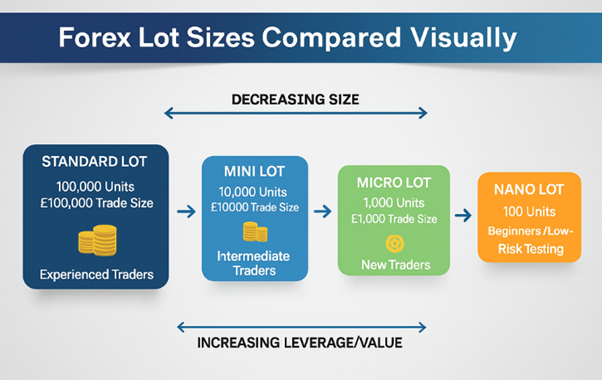
Lot sizes come in several standard formats, allowing traders to scale their exposure according to experience, strategy, and risk tolerance.
What Is a Standard Lot in Forex?
A standard lot represents 100,000 units of the base currency. It’s the benchmark for professional and institutional traders, offering greater profit potential but also significantly higher risk. Each pip movement in a standard lot typically equals around $10 (or roughly £8), meaning even small market shifts can have a big financial impact. That’s why experienced traders pair larger positions with strict risk management.
What Is a Mini Lot in Forex?
A mini lot equals 10,000 units, one-tenth of a standard lot. Many intermediate traders favour this size because it allows meaningful returns without exposing their accounts to excessive volatility. In practice, each pip movement is worth about $1, offering a balanced middle ground between flexibility and risk.
What Is a Micro Lot in Forex?
A micro lot, at 1,000 units, is often the starting point for new traders or those fine-tuning a strategy. The smaller scale means each pip is worth around $0.10, allowing beginners to experience live market conditions without large losses. It’s fair to say most successful traders have spent plenty of time here before moving up.
Not every broker supports them, so check before you plan a strategy around one. XTB quotes from 0.01 lots, which on EUR/USD at a published spread of 0.8 pips puts the cost of a round trip at roughly 7p. At that size you can run a setup for a month, take fifty trades, and learn what your strategy actually does for less than the price of lunch.
What Is a Nano Lot in Forex?
The nano lot, worth just 100 units, is the smallest available size. It’s ideal for testing strategies or building confidence with real-money trades that carry minimal financial risk. While not every broker offers it, nano trading is a useful bridge between demo accounts and full-scale live trading.
How to Calculate Lot Size Based on Risk
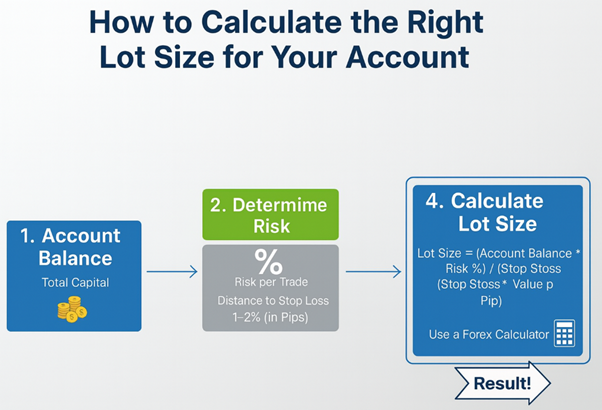
Calculating your lot size is less about guesswork and more about discipline. It’s the bridge between what you want to risk and what you actually risk when the market moves. Many traders overlook this, yet it’s arguably one of the most important habits you can build.
Here’s the basic formula used by professionals:
Lot Size = (Account Balance × Risk %) ÷ (Stop-loss in pips × Pip Value)
This tells you exactly how big your position should be, based on how much of your account you’re willing to lose if the trade goes wrong.
Let’s put that into a real-world example.
Imagine you have a £2,000 trading account and you decide to risk 2% per trade, that’s £40 of potential loss. Your chosen trade on GBP/USD has a 50-pip stop loss, and each pip on a micro lot (0.01) is worth roughly £0.08.
So:
Lot Size = (£2,000 × 0.02) ÷ (50 × £0.08)
Lot Size = £40 ÷ £4 = 0.10 lots
That means your ideal position size would be 0.10 lots, or one mini lot. If you trade any larger, you’ll be risking more than your defined 2% per trade. Many traders find that once they run this calculation consistently, their risk management improves dramatically.
The tighter your spreads, the easier it is to manage risk effectively. Check out our comparison of the lowest spread forex brokers in the UK to see which platforms offer the best pricing for active traders.
Choosing the Right Lot Size for Your Trading Style
There’s no single “perfect” lot size. It depends on how you trade, how often you trade, and how much risk you’re comfortable taking. What works for a scalper on a five-minute chart rarely suits a swing trader holding positions for days.
Generally speaking, smaller lot sizes and tighter stops suit fast-moving strategies, while larger positions are better for traders with wider risk tolerance and longer time horizons. The key is consistency, sticking to your chosen risk level and letting your strategy guide the scale of each trade.
If You’re a Beginner: Small Lots, Low Leverage
Start small and focus on learning how price movements affect your account balance. Micro or even nano lots are ideal at this stage. They let you trade in real market conditions without risking serious capital. It’s fair to say that beginners who master risk control early tend to last far longer in the markets.
If you’re still choosing where to trade, it’s worth comparing the best forex trading platforms in the UK. Many offer free demo accounts, letting you practise lot sizing before risking real money.
If You’re Experienced: Focus on Risk-to-Reward Consistency
Once you’ve built confidence and a proven strategy, the goal shifts from “survival” to consistency. Professional traders use lot size as a tool to fine-tune their performance. They might trade larger positions, but every size is backed by a clear risk-to-reward plan. In practice, that means staying disciplined, whether it’s a small win, a small loss, or a setup that just doesn’t meet your criteria.
Checklist for Smarter Lot Sizing
- Always calculate your risk first
- Know your pip value for every pair you trade
- Stick to your lot size rules, even when tempted to adjust mid-trade
The Bottom Line
Lot size might sound technical, but it’s really about discipline. Every trade you place carries a direct link between size and risk, and understanding that link is what separates sustainable trading from guesswork.
Once you grasp how position size shapes your exposure, you’ll stop thinking in terms of “how much can I make?” and start focusing on “how much can I afford to risk?”, and that shift, it’s fair to say, is where most traders turn professional.
FAQs
What is 0.01 lot in forex?
A 0.01 lot, also called a micro lot, equals 1,000 units of the base currency. It’s a popular size for beginners and low-risk strategies.
How much is 1 lot of GBP/USD?
One standard lot of GBP/USD represents £100,000 of the base currency. Each pip movement is typically worth around £8 to £10 depending on your broker and account currency.
Is a higher lot size riskier?
Yes, because each pip movement has a greater financial impact. A larger lot size means higher potential gains, but equally higher losses if the market moves against you.