

- expertise:
- Platform Testing, Cryptocurrency, Retail Investing
- credentials:
- Active investor since 2013 · 11+ years experience
- tested:
- 50+ platforms · 200+ guides authored

- expertise:
- Broker Comparison, ISA Strategy, Portfolio Management
- credentials:
- Active investor since 2013 · 11+ years experience
- tested:
- 40+ brokers with funded accounts
How We Test
Real accounts. Real money. Real trades. No demo accounts or press releases.
What we measure:
- Spreads vs advertised rates
- Execution speed and slippage
- Hidden fees (overnight, withdrawal, conversion)
- Actual withdrawal times
Scoring:
Fees (25%) · Platform (20%) · Assets (15%) · Mobile (15%) · Tools (10%) · Support (10%) · Regulation (5%)
Regulatory checks:
FCA Register verification · FSCS protection
Testing team:
Adam Woodhead (investing since 2013), Thomas Drury (Chartered ACII, 2018), Dom Farnell (investing since 2013) — 50+ platforms with funded accounts
Quarterly reviews · Corrections: info@theinvestorscentre.co.uk
Disclaimer
Not financial advice. Educational content only. We're not FCA authorised. Consult a qualified advisor before investing.
Capital at risk. Investments can fall. Past performance doesn't guarantee future results.
CFD warning. 67-84% of retail accounts lose money trading CFDs. High risk due to leverage.
Contact: info@theinvestorscentre.co.uk
Quick Answer: Is Bitpanda Safe?
Yes — Bitpanda is among the safer crypto platforms available to UK users. It is FCA-registered via Bitpanda Broker UK Ltd (FRN 925234), holds ISO 27001 certification for information security, and has no publicly reported security breaches in over 10 years of operation. The majority of user funds are held in cold storage — offline, and therefore inaccessible to the kind of attack that has compromised other exchanges. One important caveat: a safe platform is not the same as a safe investment. The crypto you hold can fall significantly in value — that is a separate risk from platform security, and outside the scope of this page.
What Do I Mean When I Say Bitpanda Is "Safe"?
Before getting into specifics, it's worth defining what "safe" actually means in this context — because it covers two very different things that users frequently conflate.
Platform safety asks: is my money protected from hacks, theft, or the platform misusing my funds? This is what this page covers.
Investment safety asks: will my crypto hold its value? That is entirely outside any platform's control, and not something I can assess here.
Plenty of platforms are technically secure but the assets held on them can still fall 80% in a market downturn. I'm only evaluating the former. If you want to understand the investment risk side, that's a conversation about crypto markets — not about Bitpanda specifically.
Is Bitpanda Registered and Regulated in the UK?
Yes — Bitpanda can be used by UK residents, and it operates under a specific UK regulatory framework.
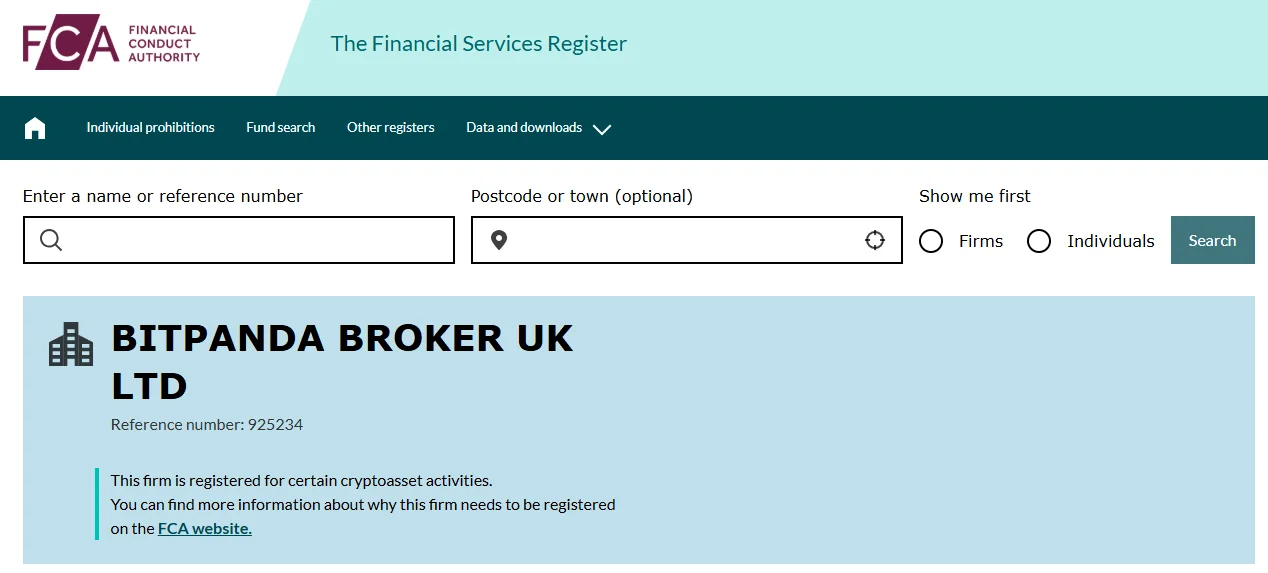
Bitpanda is FCA-registered for cryptoasset services — not FCA-regulated. This distinction matters:
- FCA-registered means Bitpanda has passed anti-money laundering and Know Your Customer checks and appears on the FCA's official crypto register. It is permitted to offer cryptoasset services to UK users.
- FCA-regulated is a higher standard that applies to financial products such as ISAs, pensions, and investment funds. Cryptocurrency does not yet meet this threshold in the UK.
For margin trading specifically, the entity is Bitpanda Broker UK Ltd (FCA FRN 925234) — a separate UK-incorporated entity with its own FCA registration. I verified this directly on the FCA register during my March 2026 testing session.
Two important protections that do not apply:
- The Financial Services Compensation Scheme (FSCS) does not cover crypto investments — if Bitpanda fails, there is no government-backed compensation
- The Financial Ombudsman Service (FOS) cannot handle complaints relating to cryptoasset services from this firm
Beyond the UK, Bitpanda holds a MiCA licence in Germany (January 2025) — a significant step as EU crypto regulation matures — and is regulated by the Austrian Financial Market Authority (FMA) in its home market. This multi-jurisdiction regulatory track record is a meaningful signal about the company's commitment to compliance.
When I signed up, I was required to complete an FCA-mandated appropriateness test — 8 multiple choice questions on crypto risk and market mechanics. This is not optional and cannot be skipped. It took me roughly 5 minutes and acts as a regulated investor-protection gateway before any trading can begin.
Has Bitpanda Ever Been Hacked?
No. As of March 2026, there are no publicly reported security breaches in Bitpanda's 10+ year history. That is a genuinely strong record in an industry where major hacks are not uncommon.
For context, consider what has happened to other exchanges over the same period:
- Mt. Gox (2014): $450 million in user funds lost — the event that defined early crypto risk
- Coincheck (2018): $530 million stolen in a single attack
- Bybit (February 2025): $1.4 billion lost in what became the largest crypto hack on record
Bitpanda launched in 2014 — the same year as the Mt. Gox collapse — and has operated through every major market cycle and security environment since then without a reported breach. That doesn't guarantee future security, but it is a meaningful data point.
The primary reason cold-storage exchanges tend to avoid the kind of catastrophic losses seen above is their custody model. The majority of user funds on Bitpanda are held in cold wallets — offline storage that is physically disconnected from the internet. The attack vector that enables most exchange hacks (compromising internet-connected hot wallets) simply doesn't apply to cold-stored funds.
Bitpanda also publishes proof-of-reserves reports periodically, demonstrating that their crypto liabilities are backed 1:1 by actual assets. I'd recommend checking their current report on the Bitpanda website — I'm not linking directly here as report URLs change; search "Bitpanda proof of reserves" on their site.
What Security Features Does Bitpanda Use to Protect My Funds?
When I opened my account and deposited £99 on 13 March 2026, here is the security infrastructure I was operating within — and what each element actually means in practice.
Cold Wallet Storage
The majority of user funds are held offline — not connected to the internet. Bitpanda doesn't disclose the exact cold/hot split publicly, but states the majority is cold-stored. This is the single most important security feature for protecting against exchange-level hacks.
Two-Factor Authentication (2FA)
Available and strongly recommended. I'd specifically recommend using an authenticator app — Google Authenticator or Authy — rather than SMS-based 2FA. SMS is vulnerable to SIM-swap attacks, where an attacker convinces your mobile carrier to transfer your number to their device.
Session Management
During my testing, I reviewed the active sessions screen. It shows every device currently logged into your account, including browser type, approximate location, and last active time. You can terminate any session remotely. I'd recommend checking this periodically.
Email Confirmation for Sensitive Actions
Every withdrawal attempt, password change, and new device login triggers an email alert. This gives you a secondary notification layer — if you receive a confirmation email for an action you didn't take, you have time to act.
ISO 27001 Certification
This is the international standard for information security management systems. It doesn't just cover technology — it covers the processes, policies, and people involved in managing security risks. To maintain the certification, Bitpanda undergoes annual independent audits. It's one of the more meaningful security signals a platform can hold, and notably, most of Bitpanda's competitors do not hold it.
ISO 27018 Certification
A separate standard specifically governing the handling of personal data in cloud environments. This covers how your ID documents, financial data, and KYC information are stored and processed — relevant given the amount of personal data Bitpanda holds during onboarding.
Regular Penetration Testing
External security teams attempt to find vulnerabilities in Bitpanda's systems before attackers do. Not all platforms invest in this — it's a signal of a security-first culture rather than a reactive one.
Here's how Bitpanda's security infrastructure compares to key competitors:
| Security Feature | Bitpanda | Coinbase | Kraken | Binance |
|---|---|---|---|---|
| Cold storage | ✓ (majority) | ✓ (98%+) | ✓ (95%+) | ✓ |
| ISO 27001 certified | ✓ | ✗ | ✗ | ✗ |
| 2FA available | ✓ | ✓ | ✓ | ✓ |
| Session management | ✓ | ✓ | ✓ | ✓ |
| Proof of reserves | ✓ | ✓ | ✓ | ✓ |
| Known hack history | None | None | None | 2019 breach ($40m) |
| FCA registered (UK) | ✓ | ✓ | ✓ | ✗ (not accepting new UK users) |
Data as of March 2026. Verify at each platform's security page before trading.
What Did I Actually Experience When Testing Bitpanda's Security?
The sections above cover Bitpanda's stated security infrastructure. Here's what I found when I actually used the platform with real money.
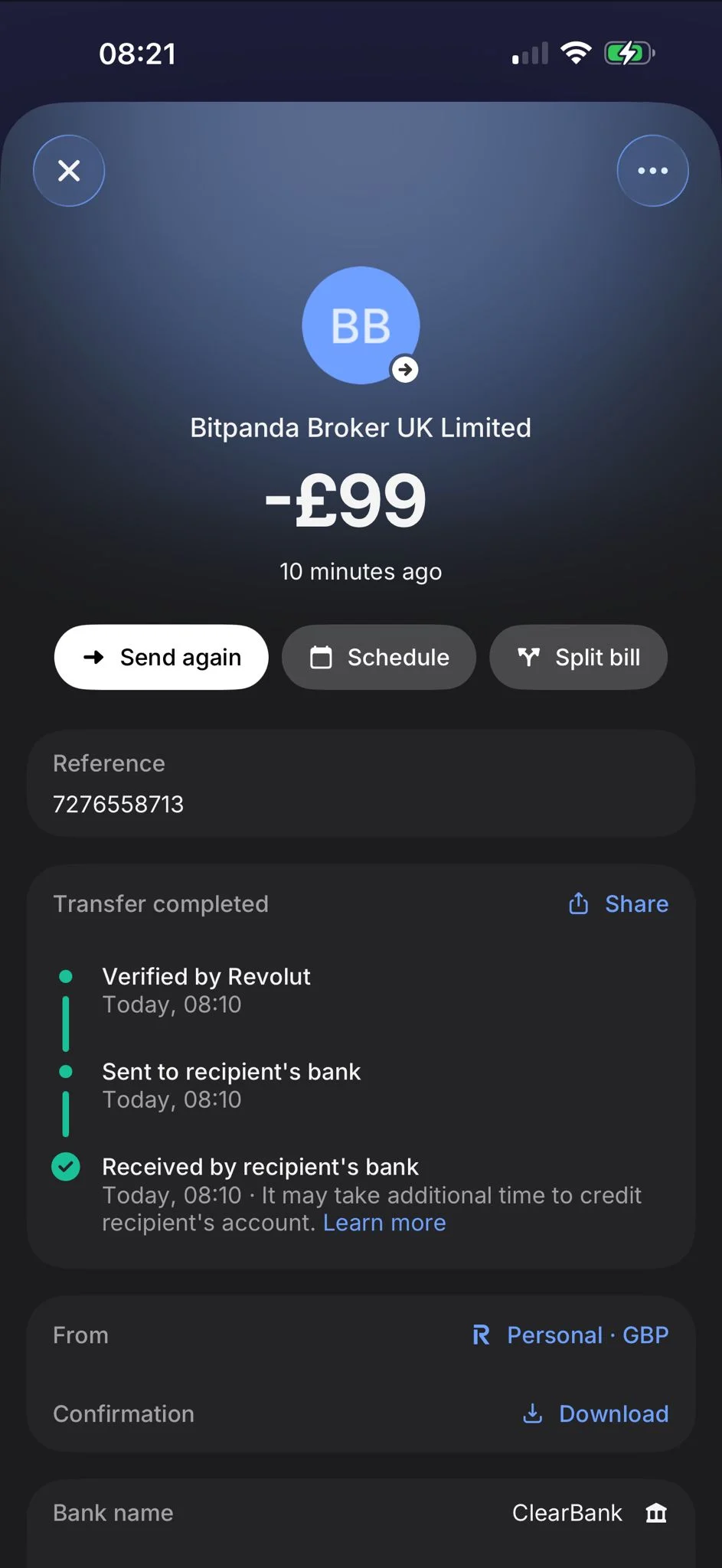
On 13 March 2026, I deposited £99 via Revolut into Bitpanda Broker UK Ltd. The transfer arrived within the same minute — 08:10 — with an email confirmation at 08:20. No funds were delayed, held unexpectedly, or unaccounted for at any point.
Before I could trade, I had to pass the FCA appropriateness test — 8 multiple choice questions on how crypto markets work and what the risks are. It took roughly 5 minutes. This is not optional, and it's worth understanding what it represents: it's a regulated investor-protection mechanism built into the onboarding flow, not an afterthought. Platforms that don't require this test are less regulated, not more convenient.
I then opened a 3x leveraged ETH position via Bitpanda Broker UK Ltd. My stop-loss, take-profit level, and liquidation threshold were all clearly displayed before I confirmed the trade. The risk parameters were transparent — I knew exactly what I stood to lose before I committed capital.
One thing worth flagging from a usability perspective: the 'Try It Now' button on the margin trading modal failed to load on desktop. I switched to the mobile app, where the full process worked without issue. This is a UX bug rather than a security concern — but it's worth knowing before your first attempt, as it could cause confusion.
I have not yet completed a full withdrawal test on this account. When I do, I'll update this section with timing and confirmation data. For now I can confirm the deposit side of the process was smooth and consistent with Bitpanda's stated processes.
Is My Personal Data Safe with Bitpanda?
Yes — and this is an area where Bitpanda's certifications are specifically relevant.
Bitpanda is UK GDPR-compliant and holds ISO 27018 certification, which governs the handling of personal data in cloud environments. In practice, this means:
- Sensitive data is encrypted in transit and at rest
- Passwords are stored using secure hashing algorithms — not in plain text
- New device logins trigger automatic email alerts
- Your account can be locked immediately if you suspect unauthorised access
What data does Bitpanda collect — and why?
During KYC onboarding, Bitpanda collects:
- A government-issued photo ID (passport or driving licence)
- A facial scan or short video verification
- Proof of address
This is not optional or unique to Bitpanda — it is required by UK Anti-Money Laundering regulations as a condition of FCA registration. Every FCA-registered crypto firm is obligated to collect this data. Under GDPR, Bitpanda is legally required to hold it securely, cannot sell it, and can only disclose it to required regulatory bodies.
What Happens to My Money If Bitpanda Goes Bust?
This is the question most safety guides avoid — and the one that matters most if things go wrong. Here is a frank assessment.
The bad news first: crypto investments are not covered by the FSCS. If Bitpanda fails and your crypto is unrecoverable, there is no government-backed compensation scheme. This is a genuine risk of holding assets on any crypto exchange, and you should size your holdings accordingly.
The structural protections that do exist:
For fiat (GBP) held on the platform:
Bitpanda holds user fiat funds in segregated accounts at regulated banks — separate from Bitpanda's own corporate funds. This means in an insolvency, your fiat is treated as client money and cannot be used to pay Bitpanda's creditors. It is not FSCS-protected, but it is ring-fenced.
For crypto held on the platform:
Bitpanda holds user crypto in trust on behalf of its users. Under UK law, this structure provides a degree of protection in insolvency — your crypto is not considered a Bitpanda asset and should not be available to creditors. Recovery is not guaranteed, but the legal structure is meaningfully different from an unsecured creditor claim.
Proof of reserves:
Bitpanda publishes regular proof-of-reserves reports demonstrating that their crypto liabilities are backed 1:1 by actual assets — they are not fractionally reserved. This is a meaningful transparency signal.
What you can do to reduce custodial risk:
For significant long-term holdings, the most effective protection is moving crypto off the exchange entirely into a self-custody hardware wallet (Ledger or Trezor are the established options). Bitpanda supports crypto withdrawals to external wallet addresses. What you don't hold on an exchange cannot be lost if the exchange fails.
The practical approach many experienced users take: keep only what you need for active trading on the exchange; move long-term holdings to cold storage.
Are There Any Hidden Fees on Bitpanda?
Transparency is one area where Bitpanda performs well. The fee structure is spread-based — built into the quoted price — and is displayed clearly before you confirm any trade.
| Fee Type | Rate | Notes |
|---|---|---|
| Crypto spread | From 0.99% | Up to 2.49% on smaller coins |
| Deposit | Free | All methods — card, bank transfer, Apple/Google Pay, PayPal |
| Withdrawal (fiat) | Free | All methods |
| Withdrawal (crypto) | Network fee only | Paid to the blockchain, not Bitpanda — variable |
| Inactivity fee | None | No charge for dormant accounts |
For reference: Good Money Guide independently tested a £100 crypto buy on Bitpanda and was charged £2.52 — consistent with the lower end of the stated spread range, and corroborating our own testing data. Hidden fees are a hallmark of less trustworthy platforms; that Bitpanda's third-party-tested results align with their stated rates is a positive trust signal.
Trustpilot rating: 4.0/5 based on 14,806 reviews (March 2026).
What Can I Do to Stay Safe on Bitpanda?
Bitpanda provides strong security infrastructure, but the most common source of account compromise is user behaviour rather than platform vulnerabilities. Here's what I do and what I'd recommend:
Enable 2FA immediately — and use an authenticator app, not SMS. Set this up before you make your first deposit.
Use a strong, unique password — not one you've used anywhere else. A password manager makes this straightforward.
Review active sessions regularly — Bitpanda's session management screen lets you see every device logged into your account. Check it periodically and terminate any you don't recognise.
Phishing awareness — Bitpanda's official domains are bitpanda.com and bitpanda.com/en-gb. Be alert to lookalike domains in emails, fake mobile apps, and social media impersonation accounts. Bitpanda will never ask for your password or 2FA code via email or chat.
Don't store more than you need to trade — for long-term holdings, consider transferring to a hardware wallet. Bitpanda supports withdrawals to external addresses.
Stay updated — monitor Bitpanda's security blog and Trust Center for announcements. If you receive an email about a security event, act through the official app or website, not via links in the email.
Final Verdict — Is Bitpanda Safe for UK Investors?
Yes — with the caveats that apply to all crypto platforms clearly understood.
Bitpanda has operated for over 10 years without a recorded security breach. It holds ISO 27001 certification (which most competitors do not), keeps the majority of user funds in cold storage, and operates under FCA registration via Bitpanda Broker UK Ltd (FRN 925234). The mandatory FCA appropriateness test adds a layer of regulated investor protection at onboarding that many platforms skip.
The structural protections — segregated fiat accounts, crypto held in trust, proof-of-reserves reporting — mean that even in a worst-case insolvency scenario, users have more protection than they would with an unregulated or less structured exchange.
The honest caveats: FSCS does not apply. A safe platform is not the same as a safe investment. And for large long-term holdings, self-custody remains the gold standard.
For the majority of UK users who want a well-regulated, security-focused entry point into crypto, Bitpanda is a solid and well-evidenced choice. For a full assessment of fees, features and the overall platform experience, see our full Bitpanda review.
Don't invest unless you're prepared to lose all the money you invest. This is a high-risk investment and you should not expect to be protected if something goes wrong. Take 2 mins to learn more. This marketing communication does not constitute investment advice, a solicitation, or an offer to buy or sell any cryptoassets. In no way are performance or results guaranteed. You should keep yourself informed and understand the risks involved in buying and holding cryptoassets.
FAQs
References

Don’t invest unless you’re prepared to lose all the money you invest. This is a high-risk investment and you should not expect to be protected if something goes wrong. Take 2 mins to learn more