

- expertise:
- Platform Testing, Cryptocurrency, Retail Investing
- credentials:
- Active investor since 2013 · 11+ years experience
- tested:
- 50+ platforms · 200+ guides authored

- expertise:
- Broker Comparison, ISA Strategy, Portfolio Management
- credentials:
- Active investor since 2013 · 11+ years experience
- tested:
- 40+ brokers with funded accounts
How We Test
Real accounts. Real money. Real trades. No demo accounts or press releases.
What we measure:
- Spreads vs advertised rates
- Execution speed and slippage
- Hidden fees (overnight, withdrawal, conversion)
- Actual withdrawal times
Scoring:
Fees (25%) · Platform (20%) · Assets (15%) · Mobile (15%) · Tools (10%) · Support (10%) · Regulation (5%)
Regulatory checks:
FCA Register verification · FSCS protection
Testing team:
Adam Woodhead (investing since 2013), Thomas Drury (Chartered ACII, 2018), Dom Farnell (investing since 2013) — 50+ platforms with funded accounts
Quarterly reviews · Corrections: in**@*******************co.uk
Disclaimer
Not financial advice. Educational content only. We're not FCA authorised. Consult a qualified advisor before investing.
Capital at risk. Investments can fall. Past performance doesn't guarantee future results.
CFD warning. 67-84% of retail accounts lose money trading CFDs. High risk due to leverage.
Contact: in**@*******************co.uk
What's the Quick Verdict on Coinbase?
Coinbase earns 4.3 stars from us. It's ideal for beginners seeking an intuitive platform and fast crypto purchases. While fees can be higher than competitors, its 250+ coin selection, staking, robust security, and FCA registration (FRN 900635) make it a solid choice for most casual UK traders. Note: crypto held on Coinbase is not protected by the FSCS.

Don’t invest unless you’re prepared to lose all the money you invest. This is a high-risk investment and you should not expect to be protected if something goes wrong. Take 2 mins to learn more
My Coinbase Experience — Tested with Real Money in March 2026
I ran a full end-to-end test on Coinbase in March 2026 — deposit, buy, and withdrawal to an external wallet — to give you an honest, first-hand account of what using the platform actually feels like for a UK investor today.
Depositing: UK Bank Transfer Friction
The deposit was the first friction point. I attempted a £100 bank transfer and hit a problem straight away: both Barclays and Revolut blocked the payment. Revolut was the bigger surprise — it's generally one of the more crypto-friendly UK banks. I had to contact Revolut via live chat and request specific permission before the transfer would go through. Once approved, the deposit arrived quickly and Coinbase charged no deposit fee. If you bank with Barclays, HSBC, NatWest, or Santander, be prepared for the same friction — this is a UK banking issue rather than a Coinbase problem, but it's worth knowing before your first deposit.
Buying Bitcoin via Coinbase Advanced
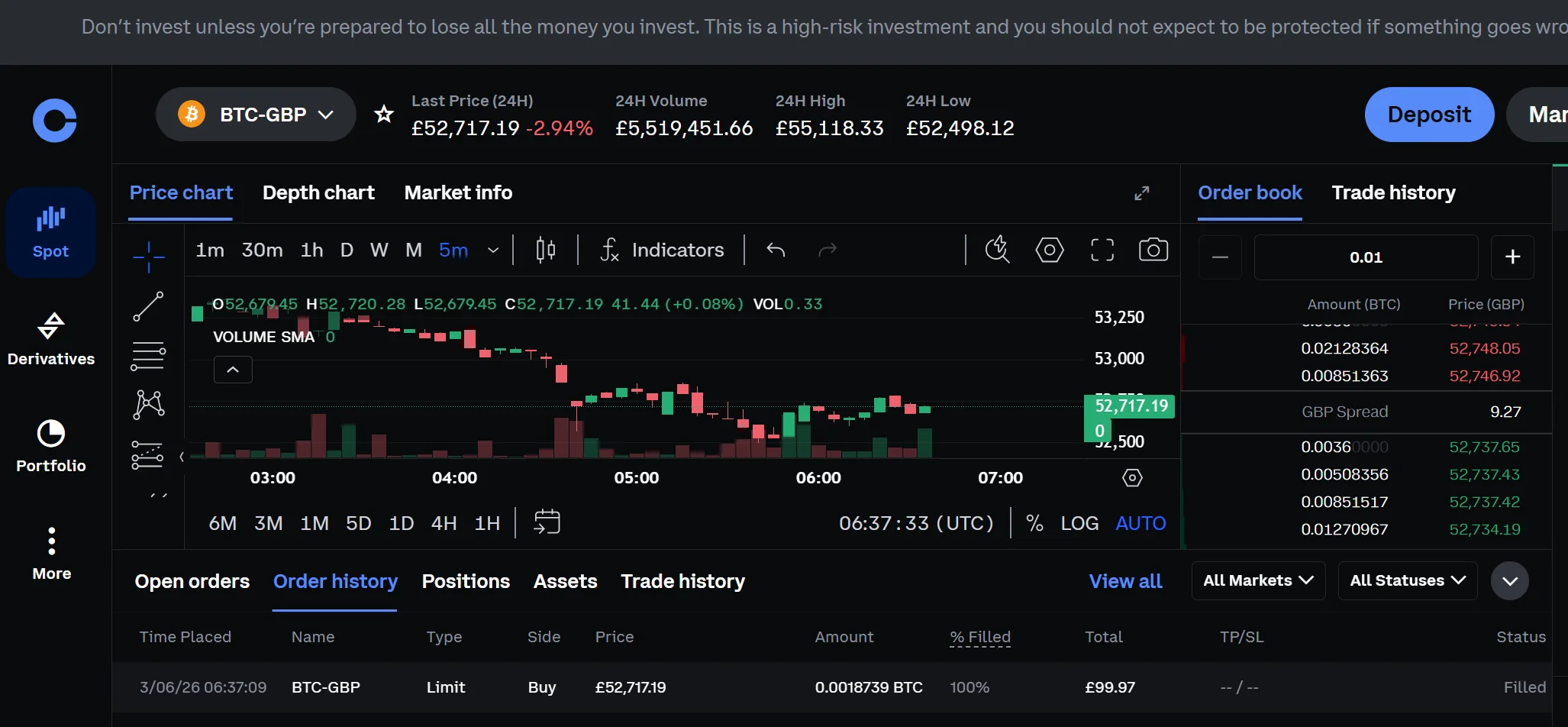
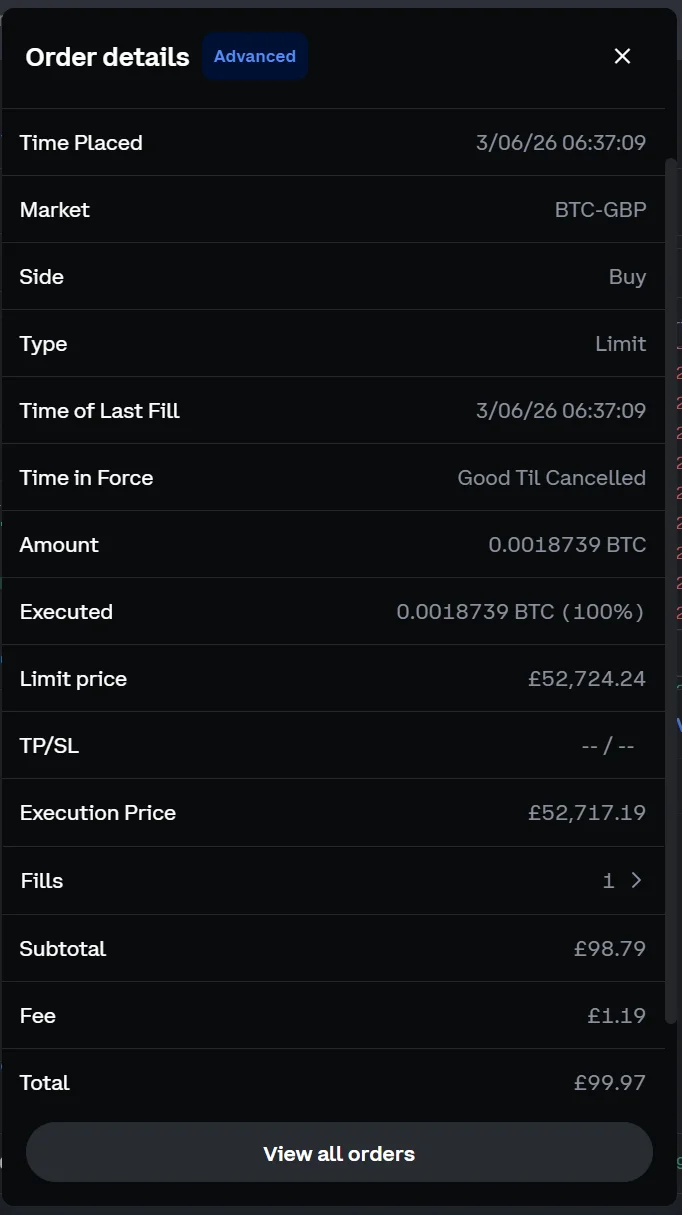
I used Coinbase Advanced for the actual purchase rather than the standard simple interface — more on why below. I placed a limit buy order on the BTC-GBP pair on 6th March 2026. The order filled instantly at £52,717.19 per Bitcoin. I received 0.0018739 BTC for a total outlay of £99.97, with a fee of £1.19 — an effective rate of 1.19%. That's significantly cheaper than the standard Coinbase platform would have charged on the same order size.
Sending Bitcoin to My MetaMask Wallet
To test the full withdrawal flow, I sent Bitcoin from Coinbase to my personal MetaMask wallet. The network fee came to approximately £0.23 — the Bitcoin network's own miner fee, not a Coinbase charge. The transaction completed the same morning (transaction hash 41343d...769abb, verifiable on the Bitcoin block explorer). Coinbase placed no obstacles on the withdrawal and displayed a clear irreversible transaction warning on the confirmation screen before I approved the send.
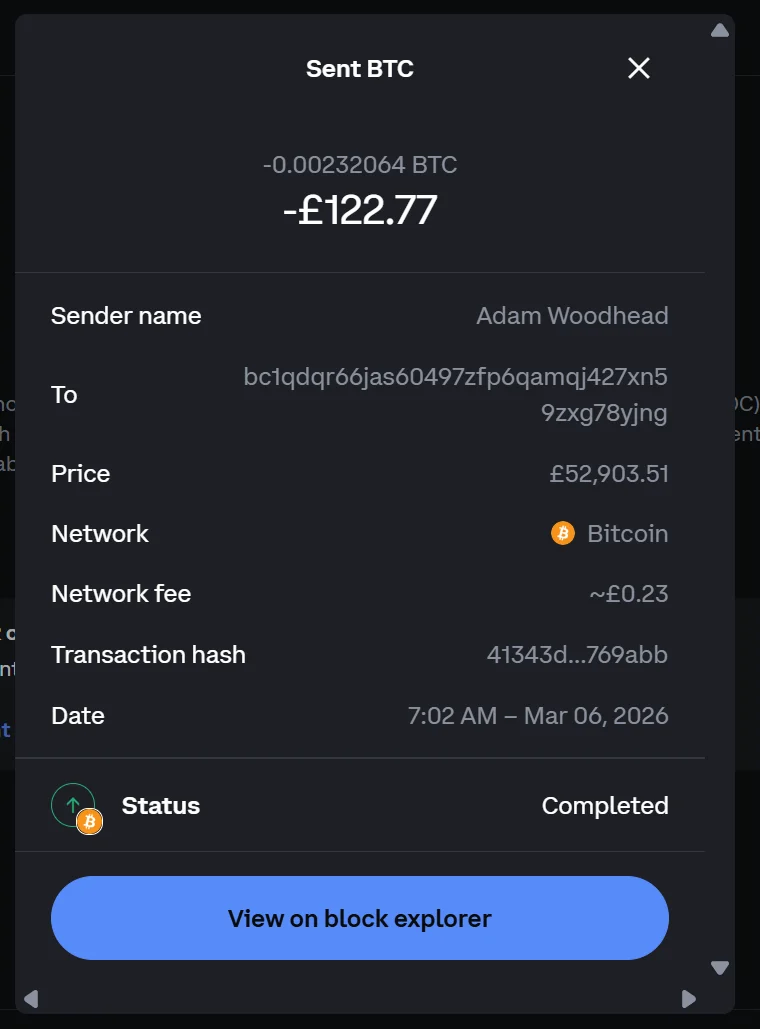
The full cycle — deposit, buy, and withdrawal to self-custody — completed in a single morning. Bank friction aside, Coinbase itself performed cleanly at every step.
Do UK Banks Block Coinbase Transfers?
Yes — and it happens more often than Coinbase's documentation suggests. In my March 2026 test, both Barclays and Revolut blocked my initial bank transfer to Coinbase. This is one of the most common friction points for new UK users, yet rarely gets addressed in reviews.
Which UK Banks Are Most Likely to Block Coinbase?
Banks with a known history of restricting crypto transfers include Barclays, HSBC, NatWest, Santander, and Halifax. Policies change without notice. Monzo and Starling have historically been more permissive, but no UK bank guarantees unrestricted access. Even Revolut — generally crypto-friendly — required live chat approval in my March 2026 test before the transfer was permitted.
What Should You Do If Your Bank Blocks the Transfer?
Contact your bank directly via their app chat or customer service and request permission for the specific transaction. In my experience with Revolut, this resolved the issue within minutes. Some banks may ask you to confirm the funds are yours and that you understand the risks involved. If your bank repeatedly blocks transfers, using a more crypto-permissive account such as Monzo as a secondary option for funding is a practical workaround.
Again, this is a UK banking issue — not a Coinbase problem. But it's worth factoring into your planning, particularly if you're making a time-sensitive purchase during a market move.
How Easy Is It to Open and Use a Coinbase Account?
Is Signing Up Quick and Hassle-Free?
Opening a Coinbase account is fast. Most users complete signup, identity checks, and KYC in under 10 minutes. Uploading a photo ID and verifying your phone are standard steps. Approval is usually instant, though it may take a few hours if Coinbase needs additional checks.
Is the User Interface Friendly for Crypto Newbies?
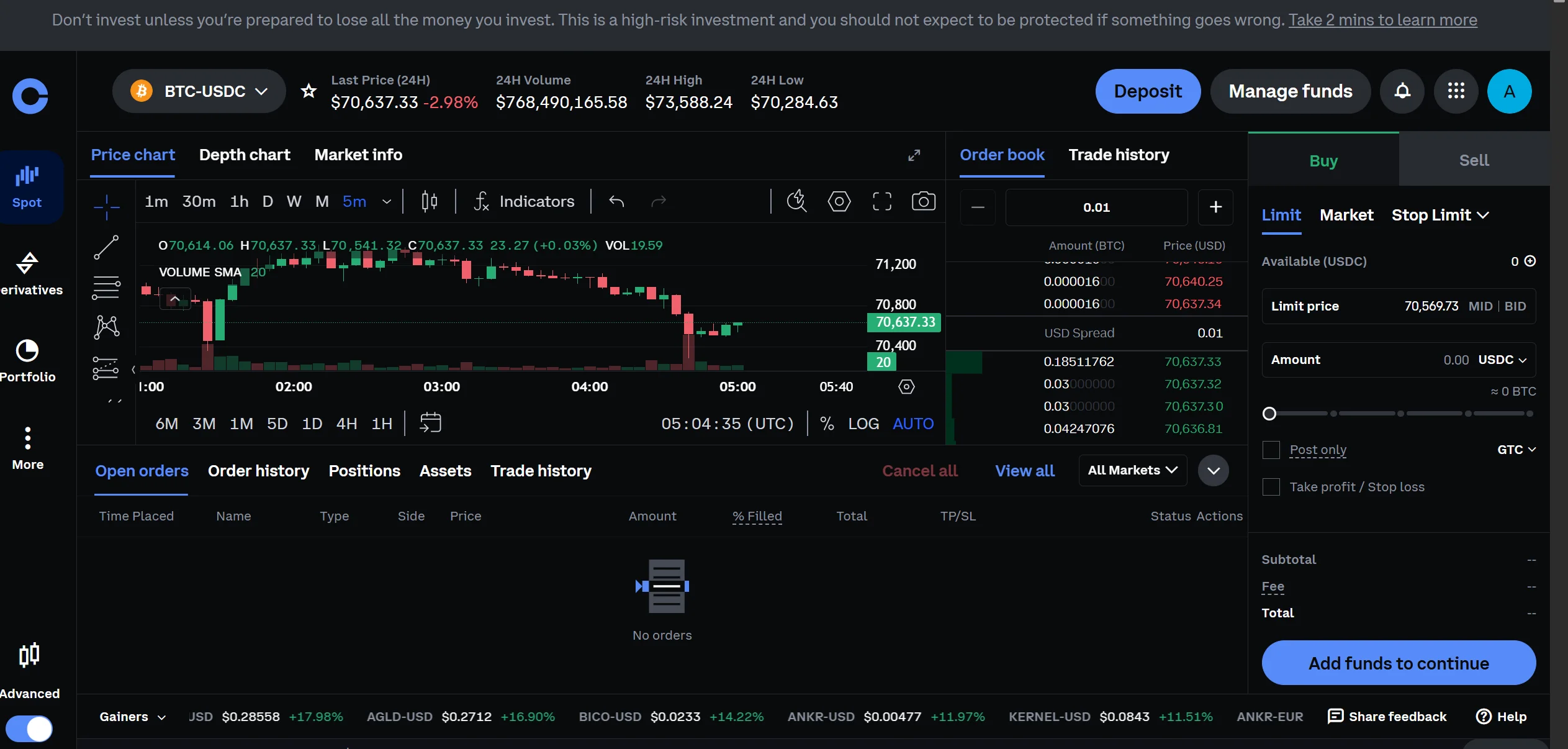
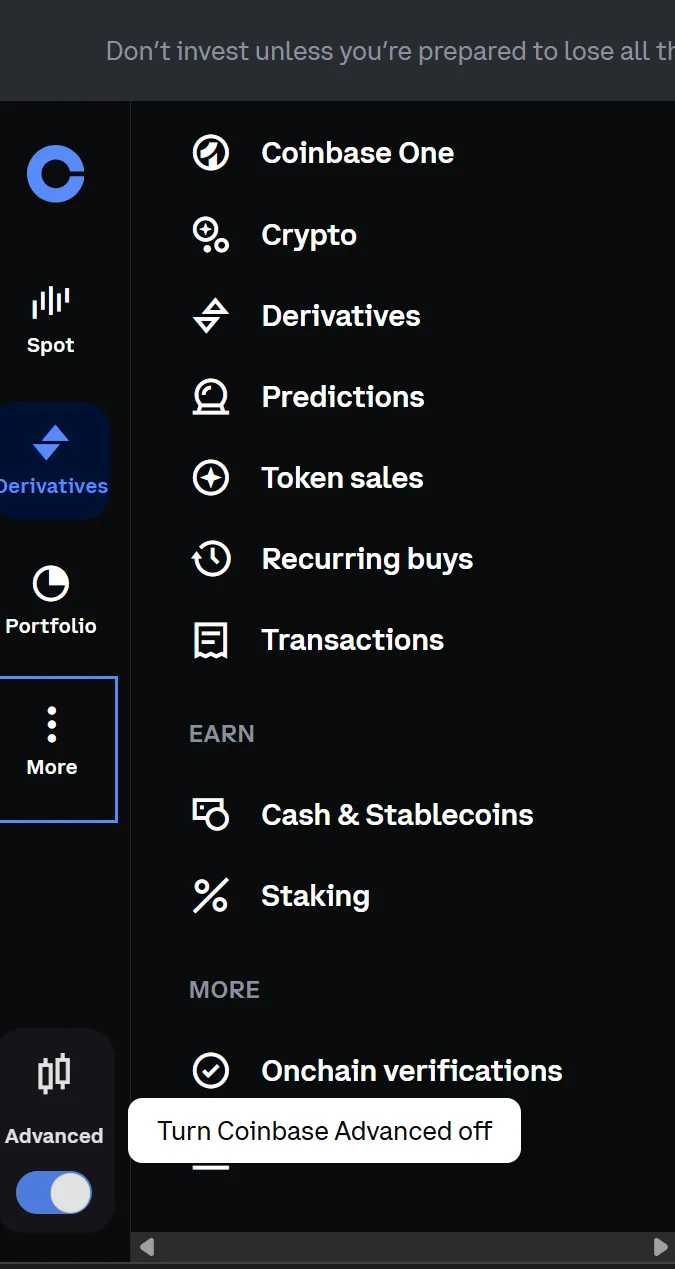
Yes. Coinbase's main dashboard is beginner-focused, showing balances, easy buy/sell buttons, and clear price charts. Coinbase Advanced adds pro-level tools like limit orders and deeper analytics. Switching between them is seamless — a single toggle in the bottom-left of the app — making it friendly for both first-time buyers and more experienced traders.
What Deposit Options and Minimums Should You Know?
UK users can fund a Coinbase account via bank transfer (Faster Payments), debit card, or wire transfer. There is no required deposit minimum, and trades start at just £2. Faster Payments bank transfers are free and typically arrive within minutes once your bank approves them. Debit card purchases are instant but carry higher fees than bank transfers.
How Fast and Smooth Are Withdrawals?
GBP withdrawals to your UK bank account typically arrive in one to three working days via Faster Payments. Crypto sent to external wallets is processed on-chain — in my March 2026 test, a Bitcoin withdrawal to my MetaMask wallet completed the same morning with a network fee of approximately £0.23. GBP deposits and withdrawals via Faster Payments are free.
What Features Stand Out for Getting Started?
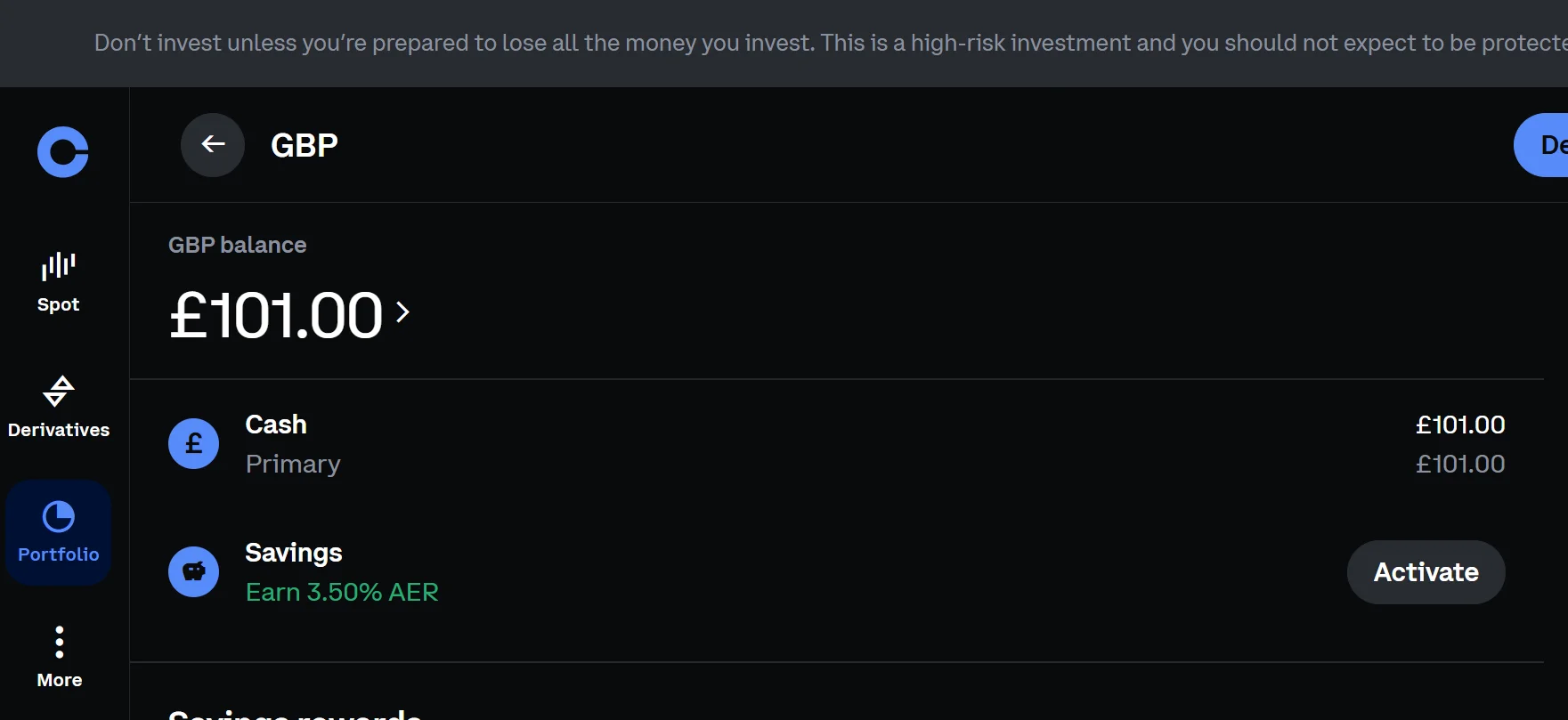
Coinbase's Learn & Earn lets you watch short videos to earn small crypto amounts. The mobile app supports price alerts and quick swaps between coins. The GBP wallet also offers an optional Savings account paying 3.50% AER on idle cash balances — a feature worth activating if you're holding GBP on the platform between purchases rather than converting immediately.
Which Version of Coinbase Should I Use?
Choose the standard Coinbase interface for simplicity if you're buying occasionally and want the straightforward experience. Switch to Coinbase Advanced if you trade regularly or want lower fees — it's free to access and immediately cuts your costs. Consider Coinbase One if you trade at high enough volume for the zero-fee benefit to outweigh the subscription cost, or if you specifically want boosted staking rewards.
How Do They Differ?
Coinbase is built for beginners who want simple crypto purchases with minimal setup. Coinbase Advanced offers lower fees, advanced charting, and flexible order types for more active buyers. Coinbase One is a paid subscription removing trading fees while adding higher staking yields, priority support, and partner benefits for frequent investors.
Our Expert Says
"In my experience, Coinbase stands out for its clean interface and smooth onboarding. I'd recommend the standard platform for absolute beginners, Coinbase Advanced for anyone buying more than occasionally — the fee saving is immediate and it costs nothing extra — and Coinbase One for frequent traders who also want boosted staking rewards. The UK bank blocking issue is real and worth knowing about upfront, but once your bank approves the transfer, the platform itself is one of the most straightforward available to UK investors."
Adam Woodhead, Co-founder, The Investors Centre. Investing since 2013. Tested Coinbase with a funded account, March 2026.
What Is Coinbase Advanced and How Does It Work?
Coinbase Advanced (formerly Coinbase Pro) is the lower-fee, professional trading interface built directly into your existing Coinbase account. There's no separate registration and no extra verification required — just a single toggle in the bottom-left of the app or web platform to switch between standard and Advanced.
Why Use Coinbase Advanced Instead of the Standard Platform?
The fee difference is the main reason. The standard Coinbase interface charges a spread of approximately 0.5% plus a variable convenience fee that can reach 3.99% on debit card purchases. Coinbase Advanced uses a maker-taker model with base fees starting at 0.4%–1.2%, dropping further as your monthly volume increases.
In my March 2026 test, I bought £99.97 of Bitcoin via Coinbase Advanced for a fee of £1.19 — an effective rate of 1.19%. The same purchase on the standard interface would likely have cost £2.00–£4.00 depending on payment method. Over a year of regular buying, that fee gap compounds significantly.
How Do You Switch to Coinbase Advanced?
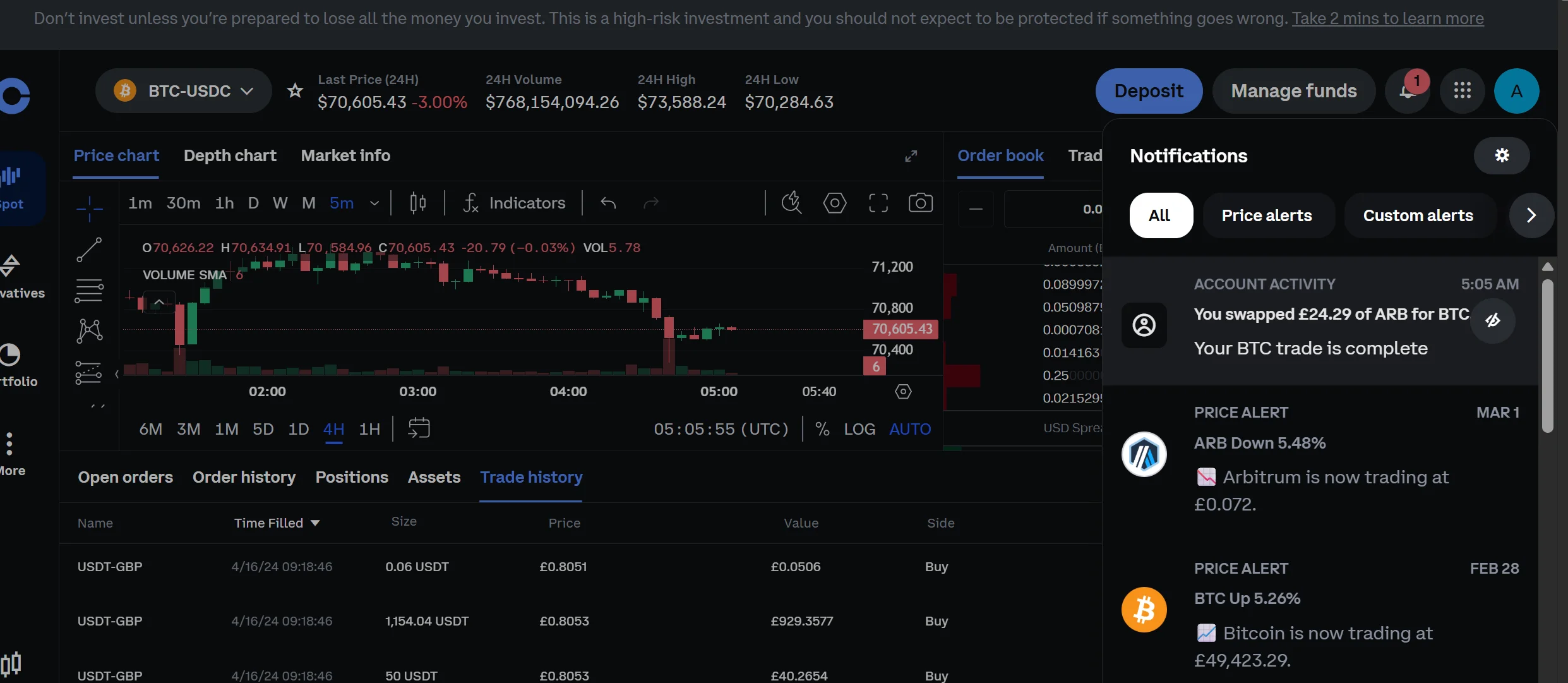
On mobile, scroll to the bottom of the left-hand navigation and tap the Advanced toggle. On desktop, look for the toggle in the lower-left sidebar. Once active, the toggle will show "Turn Coinbase Advanced off" — confirming you're on the lower-fee interface. For a full breakdown of what's included, see our guide on whether Coinbase Advanced is free. For a direct comparison of both interfaces, see our Coinbase vs Coinbase Advanced breakdown.
How Much Does Coinbase Charge in Fees?
Are Coinbase's Fees Transparent?
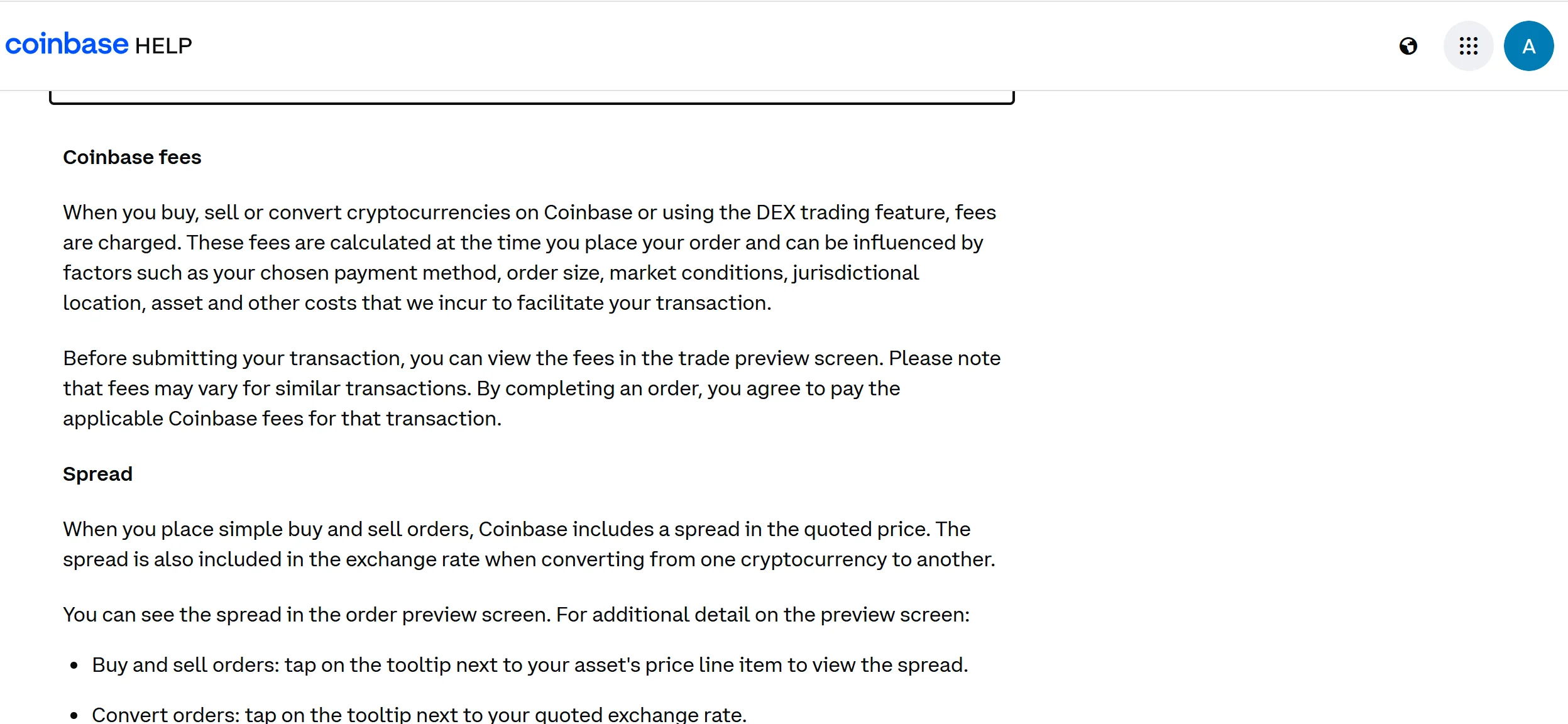
Coinbase shows fees at checkout before you confirm, which is positive — but the overall structure is complex. You pay a spread (built into the quoted price) plus a separate transaction fee that varies by payment method and order size. The exact cost isn't obvious until the final confirmation screen, which makes upfront budgeting tricky for new users.
What Did Coinbase Actually Charge in My March 2026 Test?
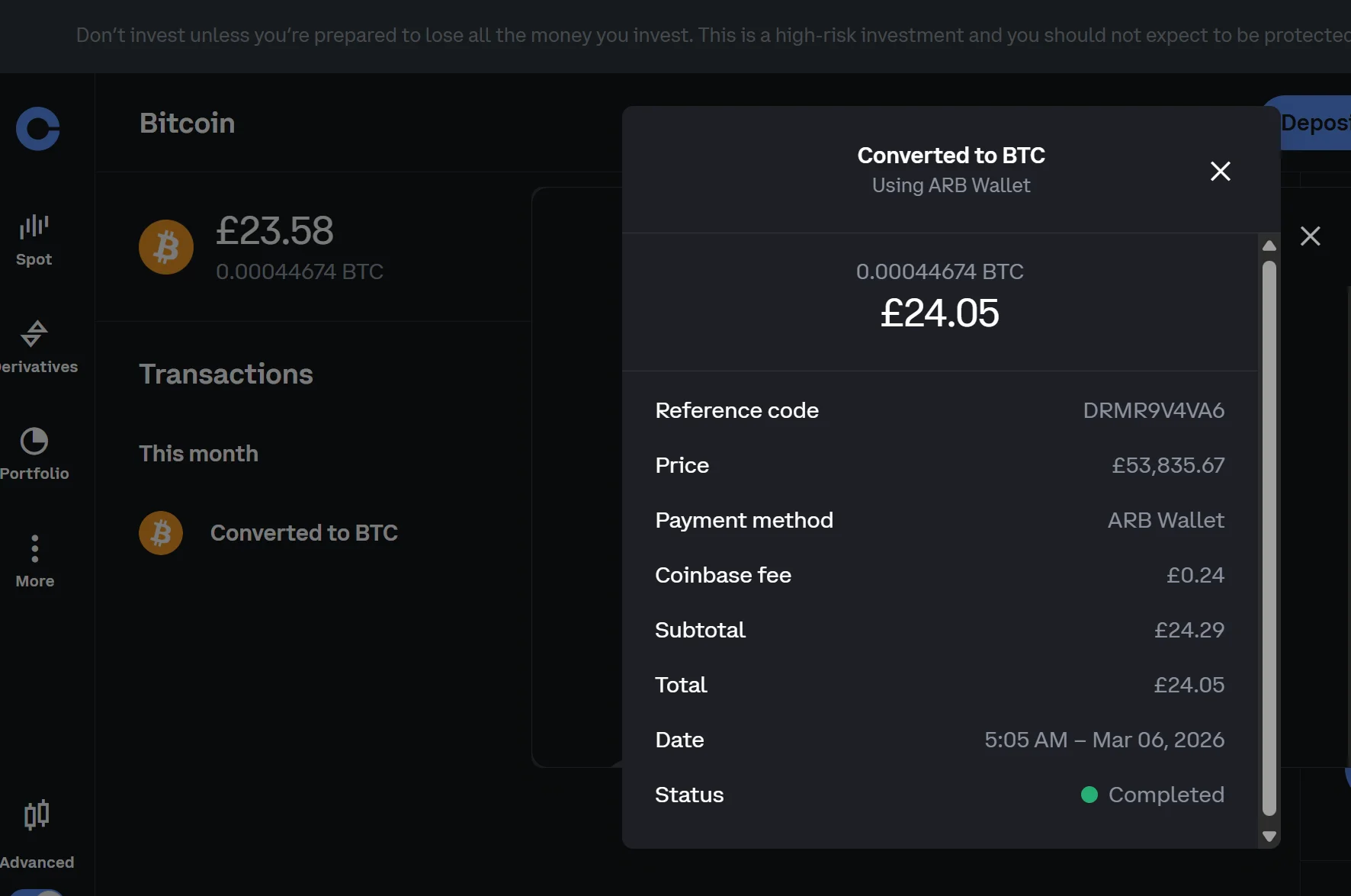
On 6th March 2026 I bought £99.97 of Bitcoin via Coinbase Advanced using a UK bank transfer. The fee was £1.19 — an effective rate of 1.19%. I also converted £24.29 of ARB (Arbitrum) to Bitcoin on the same day; that conversion cost £0.24. For the Bitcoin withdrawal to my MetaMask wallet, the network fee was approximately £0.23 — charged by the Bitcoin network itself, not by Coinbase. All fees were shown clearly before I confirmed each transaction.
Coinbase UK Fee Breakdown (as of March 2026)
| Transaction Type | Effective Fee | Notes |
|---|---|---|
| Standard platform — bank transfer | ~1.49%–1.99% | Spread + convenience fee |
| Standard platform — debit card | ~3.99% | Higher for instant purchases |
| Coinbase Advanced — bank transfer (tested) | 1.19% (£1.19 on £99.97) | March 2026 actual fee |
| Coinbase Advanced — maker order (high volume) | From 0.4% | Drops with monthly volume |
| Coinbase One — simple trades | 0% | ~$29.99/month subscription applies |
| Crypto-to-crypto conversion (tested) | ~0.99% (£0.24 on £24.29) | ARB to BTC, March 2026 |
| Bitcoin network withdrawal fee | ~£0.23 | Bitcoin network fee — not a Coinbase charge |
| GBP deposit — Faster Payments | Free | Standard UK bank transfer |
| GBP withdrawal — Faster Payments | Free | 1–3 working days to UK bank |
Fees correct as of March 2026. Coinbase may update its fee schedule without notice. Always confirm at checkout before placing an order.
How Does Coinbase Compare on Fees vs Other UK Crypto Exchanges?
| Platform | Typical Fees | Minimum Trade | Notes |
|---|---|---|---|
| Coinbase Advanced | 1.19% tested (0.4%–1.2% range) | £2 | Free to access; lower than standard |
| Coinbase Standard | ~0.5% spread + 1.5%–3.99% | £2 | Fees shown at checkout |
| Kraken Pro | 0.16%–0.26% | £10 | Cheaper for active traders |
| Crypto.com | 0.075%–0.2% | £1 | Lower fees for CRO holders |
What Learning Tools and Extras Does Coinbase Offer?
How Does Coinbase's Learn & Earn Actually Work?
Coinbase's Learn & Earn pays you small amounts of crypto for watching short videos and answering quizzes. It's a practical way to explore new coins without risking your own money. Rewards vary by promotion and are deposited directly into your Coinbase wallet.
Can You Practise with Demo or Simulator Features?
Coinbase doesn't offer demo or paper trading. However, because trades start at just £2, it's straightforward to test the platform with real small stakes. This lets beginners experiment at minimal cost, though it lacks the risk-free sandbox that some traditional brokers provide.
What Stands Out in Their Crypto Education?
Beyond Learn & Earn, Coinbase offers articles, market explainers, and a Crypto News feed in-app. You can set price alerts for any coin you're tracking. The educational resources are beginner-focused, covering blockchain basics and market trends directly inside the trading dashboard.
What Are the Downsides of Using Coinbase?
Are the Fees Too High for Frequent Traders?
On the standard platform, yes. Fees can reach 3.99% on debit card purchases — well above what Kraken Pro or Crypto.com charge. Even Coinbase Advanced starts at 0.6%–1.2%, which is pricier than the cheapest alternatives. If you trade regularly or in large amounts, the gap versus lower-cost platforms is meaningful over time. The practical fix is simple: switch to Coinbase Advanced, which is free to access and immediately reduces your costs.
Does Customer Support Fall Short?
Customer support is mixed. Live chat starts with automated responses, and reaching a human takes persistence. Email replies arrived within a day in my tests, but urgent resolution is harder. Coinbase One subscribers receive priority support — for standard users, patience is required during busy periods.
Are There Any Red Flags on Transparency or Trust?
Coinbase faced SEC scrutiny over staking and asset classifications, though key cases were dismissed in early 2025. In 2025, Coinbase also disclosed a data breach in which its customer support team was compromised, with data relating to approximately 69,000 customers exposed. Coinbase handled this transparently — going public with the incident and warning affected users. As a NASDAQ-listed company subject to mandatory audited financial disclosures, its accountability standards remain well above most crypto exchanges.
What Are the Main Cons?
- Higher fees than most UK crypto exchanges on the standard platform
- Fee structure not fully clear until checkout
- UK banks may block deposits — manual approval required in some cases
- Customer support requires persistence to reach a human
- No demo or paper trading available
- Crypto is not protected by the FSCS
- Derivatives restricted for UK retail users under FCA rules
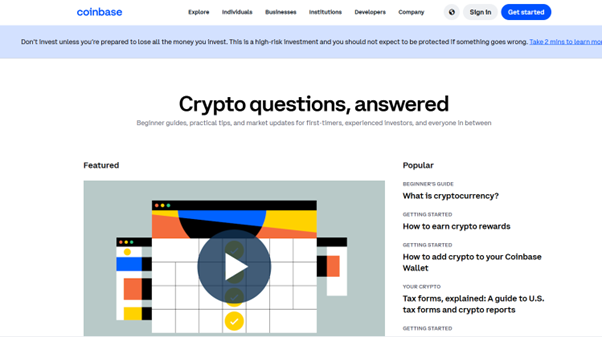
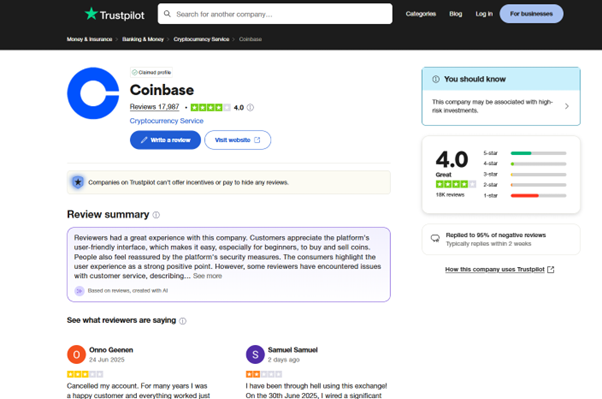
What Do Our Community Traders Think?
Real ratings and reviews from verified traders in The Investors Centre community.
Community Rating
What Traders Say
 kingpin_479
Contributor
kingpin_479
Contributor
I've been using coinbase for more than 5years now and all i can say is EXCELLENT!!!!!!
 Drama_queen
Regular
Drama_queen
Regular
Security wise no one is coming closer
 Wallet_Wizard
Contributor
Wallet_Wizard
Contributor
Coinbase is one of the best crypto exchanges available for UK users. The convenience and ease of use make it worth considering, even if the fees are slightly higher than some competitors.
Is Coinbase Safe and Regulated in the UK?
Is Coinbase Regulated by the FCA?
Yes. CB Payments Ltd — Coinbase's UK operating entity — is registered with the Financial Conduct Authority under reference number 900635. You can verify this directly on the FCA register. This is an AML/MLR registration under the Money Laundering Regulations — not full FCA authorisation. This means Coinbase must comply with UK anti-money laundering rules and conduct KYC checks on all users, but it does not carry the same investor protections as a fully FCA-authorised firm. For a dedicated deep-dive, see our Is Coinbase Safe review.
Is Your Crypto Protected by the FSCS?
No. Cryptocurrency held on Coinbase — or any UK crypto exchange — is not covered by the Financial Services Compensation Scheme (FSCS). The FSCS protects eligible cash deposits at UK-authorised banks up to £85,000. It does not extend to crypto assets. If Coinbase became insolvent, your recovery would depend on Coinbase's own insurance policies and insolvency proceedings, not a government-backed compensation scheme. This applies to all UK crypto exchanges, not just Coinbase.
What Security Measures Protect Your Crypto?
Approximately 98% of customer crypto is held offline in cold storage. Coinbase uses mandatory two-factor authentication (2FA), AES-256 encryption, device verification, and 24/7 account monitoring. It is a NASDAQ-listed public company subject to mandatory audited financial disclosures — a higher transparency standard than virtually any offshore exchange. GBP cash balances may have some protection via partner bank arrangements, but crypto holdings carry no equivalent guarantee.
What Was My Personal Security Experience?
In my March 2026 test, 2FA was required at login, at the point of purchase, and again before the Bitcoin withdrawal was confirmed. Email notifications arrived promptly at each stage. Coinbase displayed a clear "crypto transactions are irreversible" warning on the send confirmation screen — good practice that protects against accidental transfers. The withdrawal to MetaMask completed without any holds or flags on the account.
How Can You Check an Exchange's Safety?
Verify FCA registration on the FCA register, review proof-of-reserves audits, check public financial filings, and research any past security incidents. Coinbase's transparency reports and NASDAQ-listed status help confirm credibility, unlike smaller exchanges that provide little public detail on how they secure customer assets.
UK Tax on Coinbase Profits — What You Need to Know
Using Coinbase in the UK has tax implications many first-time buyers overlook. HMRC treats cryptocurrency as a capital asset, not currency, meaning disposals are subject to Capital Gains Tax (CGT).
Does Coinbase Report to HMRC?
Yes. Under the UK's Crypto-Asset Reporting Framework (CARF), Coinbase and other major exchanges operating in the UK are required to share transaction data with HMRC. This means HMRC will have visibility of your trading activity — it remains your responsibility to calculate and report any gains on your self-assessment tax return.
What Counts as a Taxable Event on Coinbase?
Any disposal of cryptocurrency is a taxable event for UK CGT purposes. This includes selling crypto for GBP, exchanging one cryptocurrency for another (for example, the ARB-to-BTC conversion I made in March 2026), using crypto to pay for goods or services, and gifting crypto to someone other than a spouse or civil partner. Simply holding crypto on Coinbase, or moving it between your own wallets, is not a disposal and does not trigger a CGT liability.
How Do You Report Coinbase Gains to HMRC?
Coinbase provides a downloadable transaction history CSV from the Reports section of your account. The UK CGT annual allowance for 2024/25 is £3,000. Gains above this threshold are taxable at 18% (basic rate) or 24% (higher rate) for crypto assets from April 2024. For official HMRC guidance, see HMRC's cryptoassets guidance. Specialist crypto tax tools such as Koinly and CoinTracker can help calculate your liability from the Coinbase CSV export.
How Does Coinbase Compare to Other Crypto Platforms in 2026?
What Are Coinbase's Biggest Strengths?
Coinbase stands out for its 250+ cryptocurrencies, deep liquidity, clean beginner-friendly interface, and FCA registration (FRN 900635). It also offers free GBP deposits via Faster Payments, a 3.50% AER GBP Savings option, and the ability to access professional-grade tools via Coinbase Advanced without a separate account or registration.
What Do Other UK Platforms Like Kraken Do Better?
Kraken beats Coinbase on trading fees — Kraken Pro starts at 0.16%–0.26% versus Coinbase Advanced's 0.4%–1.2%. Kraken also holds dual FCA registration, offers 300+ cryptocurrencies, and has never suffered a platform-wide hack. For active traders, the fee difference is meaningful over time. For beginners who value simplicity and brand recognition, Coinbase remains the more accessible starting point. See also our Coinbase vs Crypto.com and Coinbase vs OKX comparisons.
Why Did I Personally Keep Using Coinbase?
I've kept Coinbase as one of my go-to platforms for its ease of use and speed of GBP deposits. Faster Payments means funds are available almost instantly once your bank approves the transfer. For occasional buying and long-term holding, paying 1.19% on Coinbase Advanced is a reasonable trade-off for the convenience and accountability of a NASDAQ-listed, FCA-registered exchange.
Side-by-Side Comparison Table (UK-Focused)
| Feature | Coinbase Advanced | Kraken Pro | Crypto.com |
|---|---|---|---|
| Trading Fees | 0.4%–1.2% | 0.16%–0.26% | 0.075%–0.2% |
| Cryptos Offered | 250+ | 300+ | 250+ |
| FCA Registration | Yes (FRN 900635) | Yes (dual registration) | Yes |
| GBP Faster Payments | Yes — free deposit | Yes — free deposit | Yes |
| FSCS Protection | No | No | No |
| Ease of Use | Very easy | Moderate | Moderate |
| Best For | Beginners + occasional buyers | Active traders, lower fees | CRO stakers, card users |
Is Coinbase One Worth It for UK Users?
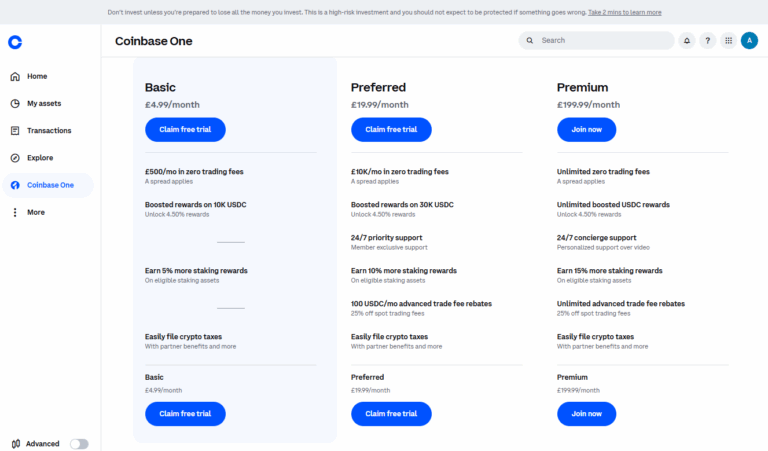
Coinbase One is a paid subscription offering enhanced trading and staking benefits. Members receive zero-fee trading, boosted staking rewards, priority support, and partner perks. It targets frequent traders and long-term holders wanting better yields and predictable costs — but does the maths work out for most UK users?
What Is Coinbase One and How Does It Work?
Coinbase One is a monthly membership (approximately $29.99/month) that removes standard trading fees up to volume limits, boosts staking returns on selected assets including Ethereum, Solana, Cardano, and Cosmos, and provides priority customer service. The subscription can be started or cancelled anytime within the Coinbase app or web dashboard.
Does Coinbase One Make Financial Sense for UK Users?
At approximately $29.99/month, you would need to trade roughly £2,500–£3,000/month on the standard Coinbase platform before the subscription breaks even on fee savings alone. If you're already using Coinbase Advanced (which is free), the additional saving from Coinbase One is smaller and the break-even threshold is higher still. For most casual UK buyers, Coinbase Advanced achieves most of the fee benefit at no cost. Coinbase One makes most sense for users who also want the boosted staking rates or the priority support access.
Coinbase vs Coinbase Advanced vs Coinbase One
| Feature | Coinbase | Coinbase Advanced | Coinbase One |
|---|---|---|---|
| Monthly Cost | Free | Free | ~$29.99/month |
| Trading Fees | Standard (up to 3.99%) | 0.4%–1.2% maker-taker | Zero on simple trades |
| Staking Rewards | Standard | Standard | Boosted |
| Customer Support | Standard | Standard | Priority live support |
| Best For | Absolute beginners | Most UK users | Frequent traders + stakers |
Pros
- Zero trading fees on simple trades
- Higher staking returns on ETH, SOL, ADA, ATOM
- Priority customer support — valuable during market volatility
- Partner discounts and exclusive offers
Cons
- Monthly cost rarely justifies subscription for light users
- Fee waiver applies to simple trades — not all Advanced order types
- Some benefits vary by region; not all perks available in the UK
- Coinbase Advanced achieves most fee savings at no cost
Should You Use Coinbase or Look Elsewhere?
My Overall Rating and Honest Verdict: Coinbase scores 4.3 stars. It's one of the most beginner-friendly crypto exchanges available to UK users — and ranks highly in our roundup of the best crypto apps in the UK for its mobile experience. Fast GBP deposits, a clean interface, and FCA registration (FRN 900635) are its core strengths. Fees are the clear downside — but switching to Coinbase Advanced immediately addresses most of that problem at no cost.
Who Will Benefit Most from Coinbase? Coinbase is ideal for first-time crypto buyers, casual investors, or anyone who values ease of use over the absolute lowest fees. It's also a strong choice for staking popular coins without complex setups. If you're new to crypto, see our dedicated guide on whether Coinbase is good for beginners.
Who Might Want to Consider Alternatives? Active traders who prioritise tight spreads should look at Kraken — Kraken Pro's 0.16%–0.26% fees are significantly cheaper than Coinbase Advanced for high volumes. Those seeking a wider altcoin selection should consider OKX.
My Final Thoughts on Coinbase (2026)
Having tested Coinbase end-to-end in March 2026 — depositing real money, buying Bitcoin via Advanced Trade, and withdrawing to a MetaMask wallet — I can say the platform delivers on its core promise: a clean, straightforward experience for UK users buying and holding crypto. The UK bank blocking friction is a genuine issue worth knowing about upfront, but Coinbase itself performed reliably at every step.
For most UK buyers, my recommendation is straightforward: use Coinbase Advanced (free, lower fees), keep an eye on your CGT position now that CARF reporting means HMRC has visibility of your trades, and remember that your crypto is not FSCS-protected regardless of which exchange you use.
What's Changed in 2026?
SEC dismissed key cases against Coinbase in early 2025 -- regulatory concerns largely resolved. Coinbase disclosed a 2025 data breach affecting approximately 69,000 customers — handled transparently. Coinbase Advanced and Coinbase One both remain available. CARF reporting now in effect — HMRC has visibility of UK user transactions. Over 250 cryptocurrencies supported. FCA registration (FRN 900635) and cold storage security unchanged.
Discuss Coinbase
Traded with Coinbase? Share your experience, ask questions, or help other traders decide. Our community earns Equity for quality contributions.
Discussion 0 comments
Be the first to start discussing this topic! Log in or create an account to share your thoughts.
Log In Create AccountFAQs
References
- FCA Register — CB Payments Ltd (FRN 900635)
- HMRC -- Tax on Cryptoassets
- SEC.gov -- SEC Announces Dismissal of Civil Enforcement Action Against Coinbase
- Coinbase boss claims SEC will drop crypto lawsuit -- BBC News
- Coinbase -- Pricing and fees disclosures
- Coinbase -- Trustpilot Reviews
- Coinbase -- Wikipedia
Don’t invest unless you’re prepared to lose all the money you invest. This is a high-risk investment and you should not expect to be protected if something goes wrong. Take 2 mins to learn more
No comments yet. Be the first to start discussing this topic!