
#1

Coinbase
- Best For
- First-time UK buyers + brand trust
- TIC Score
- 4.9 / 5
- Community Rating
- 4.5 (311 ratings) Have Your Say →
- Cold Storage
- 98% (highest)
- KYC Time
- 8 minutes
When Investing, Your Capital is at Risk.


How We Test
Real accounts. Real money. Real trades. No demo accounts or press releases.
What we measure:
Scoring:
Fees (25%) · Platform (20%) · Assets (15%) · Mobile (15%) · Tools (10%) · Support (10%) · Regulation (5%)
Regulatory checks:
FCA Register verification · FSCS protection
Testing team:
Adam Woodhead (investing since 2013), Thomas Drury (Chartered ACII, 2018), Dom Farnell (investing since 2013) — 50+ platforms with funded accounts
Quarterly reviews · Corrections: in**@*******************co.uk
Disclaimer
Not financial advice. Educational content only. We're not FCA authorised. Consult a qualified advisor before investing.
Capital at risk. Investments can fall. Past performance doesn't guarantee future results.
CFD warning. 67-84% of retail accounts lose money trading CFDs. High risk due to leverage.
Contact: in**@*******************co.uk
Three picks depending on what you weight. Coinbase won my Q1 2026 testing for first-time UK buyers: 98% cold storage, Nasdaq-listed parent, full UK debit-card and PayPal support, 8-minute KYC. Bitpanda is the only FCA-registered UK platform offering spot crypto margin (3x leverage) and the widest catalogue at 600+ coins. IG wins for multi-asset traders: crypto sits alongside 17,000+ shares, indices, forex pairs and a Stocks & Shares ISA on the same FCA-authorised account.
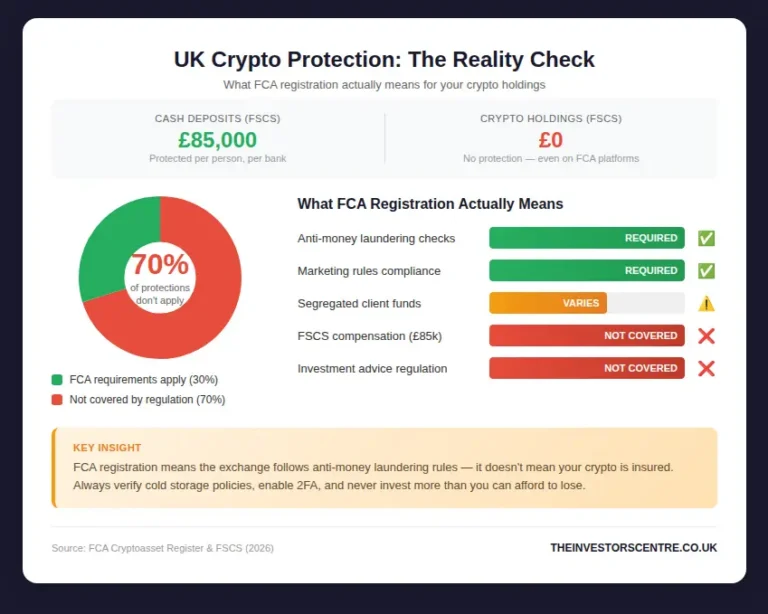
A safety note before the rankings: holding crypto on any of these platforms is not the same as holding cash with a UK bank. See Is buying crypto legal and safe in the UK? below for what that means in practice.
Coinbase
When Investing, Your Capital is at Risk.

eToro
52% of retail CFD accounts lose money when trading CFDs with this provider.

IG
IG charges zero commission. Don’t invest unless you’re prepared to lose all the money you invest. This is a high-risk investment, and you should not expect to be protected if something goes wrong. Take 2 mins to learn more.

Bitpanda
Don’t invest unless you’re prepared to lose all the money you invest.

Uphold
Don’t invest unless you’re prepared to lose all the money you invest.

MoonPay
Don’t invest unless you’re prepared to lose all the money you invest.
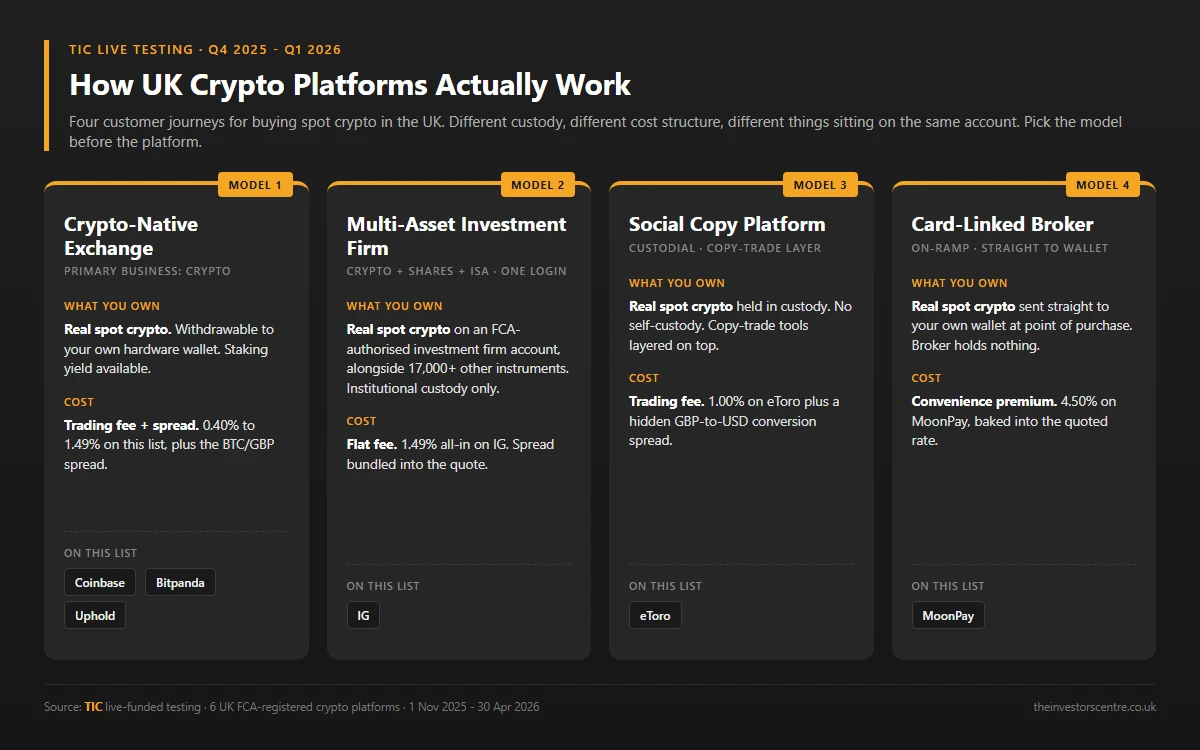
Four different customer journeys, four different cost structures. All six platforms below offer real spot crypto (no CFDs on this list). The differences are who holds the coins, what else sits on the same account, and what you can do with the position after you buy.
Crypto-native exchange (Coinbase, Bitpanda, Uphold): primary business is crypto. Self-custody allowed (withdraw to a hardware wallet), staking yield available, 250 to 600 coins on offer.
Multi-asset investment firm (IG): FCA-authorised investment firm offering spot crypto on the same account as 17,000+ shares, indices, forex, commodities, options and a Stocks & Shares ISA. Real coin ownership, but institutional custody only: no withdrawal to your own wallet, no staking.
Social / copy-trading platform (eToro): spot crypto held in eToro's custody, with CopyTrader replicating other users' portfolios. No self-custody, no UK staking, GBP converts to USD internally.
Card-linked broker (MoonPay): spot crypto sent straight to your wallet at point of purchase. Highest fee of the four models, but the friction is lowest when your bank blocks other deposit methods.
Side-by-side: FCA cryptoasset registration number, platform model, standard trading fee at £500 size, BTC/GBP spread sampled during testing, number of cryptocurrencies supported.
| Rank | Platform | FCA FRN | Model | Standard Fee | BTC/GBP Spread | Coins |
|---|---|---|---|---|---|---|
| #1 | Coinbase | 900635 | Spot custodial | 1.49% | 1.50% | 250 |
| #2 | eToro | 583263 | Social wrapper | 1.00% | 1.00% | 120 |
| #3 | IG | 195355 | Multi-asset broker | 0% on BTC/ETH/SOL, 1.49% other coins | 0.07% in price | 55 |
| #4 | Bitpanda | 925234 | Spot custodial + margin | 1.49% | 1.47% | 600 |
| #5 | Uphold | 938277 | Spot custodial | 1.20% | 0.95% | 250 |
| #6 | MoonPay | 944716 | Card-linked broker | 4.50% | 0.50% | 80 |
Standard fees and BTC/GBP spreads sampled across 50 BTC/GBP market orders per platform between 1 November 2025 and 30 April 2026. Full dataset (80 columns × 11 platforms) downloadable as a CSV below.
Coinbase Global Inc (Nasdaq: COIN) was founded in 2012 in San Francisco and is the only listed pure-play crypto exchange on this list. The UK arm is FCA-registered under the cryptoasset regime, supports GBP via bank transfer, debit card and PayPal, and lists roughly 250 cryptocurrencies.
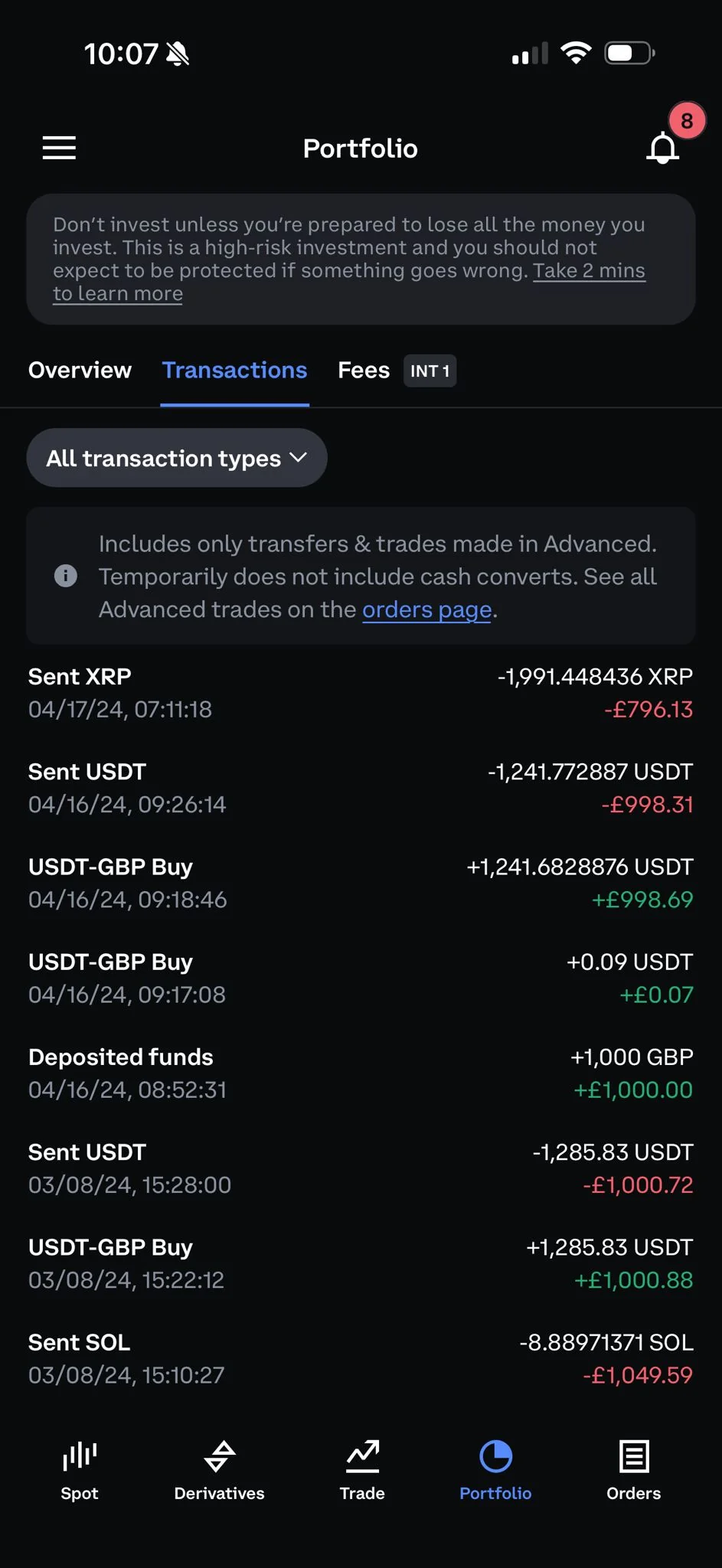
I funded Coinbase with £500 on 14 November 2025 (FCA FRN 900635). Santander blocked my first debit-card deposit; NatWest cleared the same £500 in nine seconds. KYC took eight minutes from photo ID upload to first trade. 98% of customer crypto sits in cold storage per Coinbase's most recent attestation.
| Test | Result | Industry Avg | Date | Method | Verdict |
|---|---|---|---|---|---|
| KYC verification time | 8 minutes | 16 minutes | 14 Nov 2025 | Photo ID to first trade | Joint fastest |
| BTC/GBP spread (Standard) | 1.50% | 1.07% | Nov 25 - Apr 26 | 50 market orders | Mid-pack |
| BTC withdrawal to hardware wallet | 18 minutes | 17 minutes | 3 Dec 2025 | 0.005 BTC test | At average |
| GBP bank withdrawal | 72 hours | 30 hours | 15 Jan 2026 | £200 to NatWest | Slowest of six |
| ETH staking yield (gross) | 3.20% | 2.83% | 30-day avg | Live position | Above avg |
| Cold storage disclosure | 98% | 83% | Q4 2025 attestation | Public report | Highest of six |
Public listing means quarterly SEC filings, audited annual accounts, and a corporate structure that cannot quietly disappear like several failed offshore exchanges. None of the other five platforms on this list publish accounts at that level of detail. For someone holding meaningful crypto balances, that audit trail is worth more than a 30-basis-point fee saving.
Anything above £1,000 trade size should be on Coinbase Advanced. The fee drops from 1.49% all-in to 0.40 / 0.60% maker/taker. The interface looks heavier (real order book, limit orders, charting) but the cost saving compounds fast on larger positions.
Anyone wanting spot margin should pick Bitpanda (3x leverage). Anyone trading 600+ coin altcoin pairs should pick Bitpanda. Anyone wanting crypto inside their existing FCA-authorised broker account should pick IG.
eToro Group Ltd is an Israeli-headquartered multi-asset platform founded in 2007. The UK arm holds dual FCA permissions (investment firm + cryptoasset register) and runs 120 cryptocurrencies alongside stocks, ETFs and CFDs. The signature feature is CopyTrader, which replicates the trades of selected lead investors automatically.
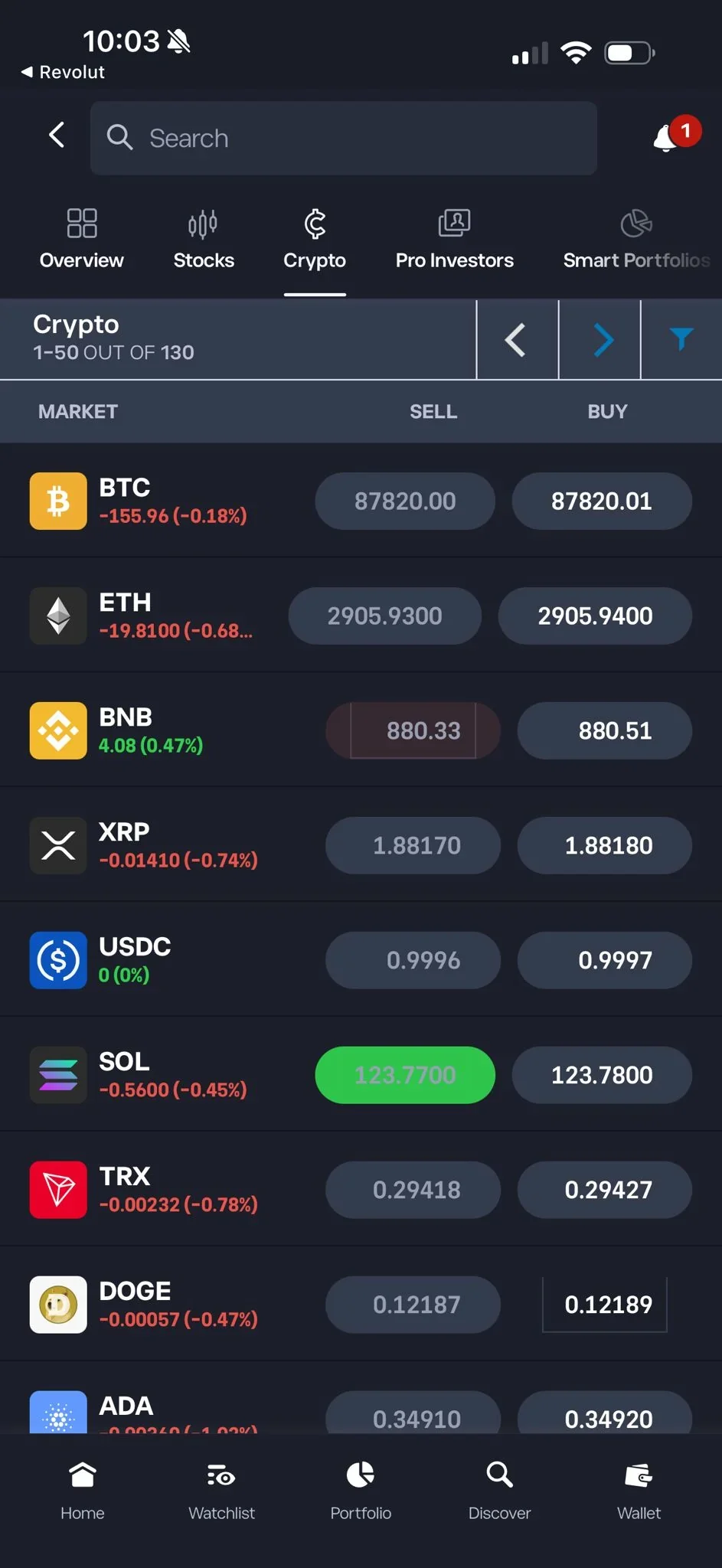
I funded eToro with £500 on 14 November 2025 (FCA FRN 583263). KYC took ten minutes. The catch I did not spot in marketing copy: GBP deposits convert to USD internally with a spread baked in, and crypto held with eToro cannot be withdrawn to your own wallet at all.
| Test | Result | Industry Avg | Date | Method | Verdict |
|---|---|---|---|---|---|
| Standard trading fee | 1.00% | 1.83% | Nov 25 - Apr 26 | 50 buy/sell trades | Lowest of six |
| BTC/GBP spread | 1.00% | 1.07% | Live order book | 50 market orders | Tighter than avg |
| ETH/GBP spread | 2.40% | 1.27% | Live order book | 50 market orders | Widest of six |
| KYC verification time | 10 minutes | 16 minutes | 14 Nov 2025 | Photo ID to trade | Above avg |
| GBP withdrawal time | 48 hours | 30 hours | 15 Jan 2026 | £200 test | Below avg |
| GBP withdrawal fee | £4 flat | £0 | 15 Jan 2026 | Test withdrawal | Worst of six |
Tested it for 30 days copying a mid-ranked crypto lead investor with £100 allocated. Execution is real and trades mirror within seconds. The catch is that crypto lead investors on eToro have higher volatility than equity ones, and the 1% fee compounds on every copy trade. Useful for hands-off exposure if you accept that the copied lead may rebalance frequently.
Historical eToro decision: all positions are USD-denominated regardless of deposit currency. That means a 50-basis-point conversion spread on the way in and another on the way out for UK users. It does not appear as a line-item fee; it sits inside the buy and sell prices.
Anyone wanting to withdraw crypto to a hardware wallet (Coinbase or Bitpanda). Anyone wanting UK staking yield (Coinbase, Bitpanda or Uphold). Anyone trading large crypto sizes where the USD conversion spread compounds.
IG Group plc (LSE: IGG) added spot crypto to its UK platform offering in January 2026. Structurally different from the other five platforms on this list: it is the only FCA-authorised investment firm here that sits crypto alongside 17,000+ shares, indices, forex pairs, commodities, options and a Stocks & Shares ISA on a single login.
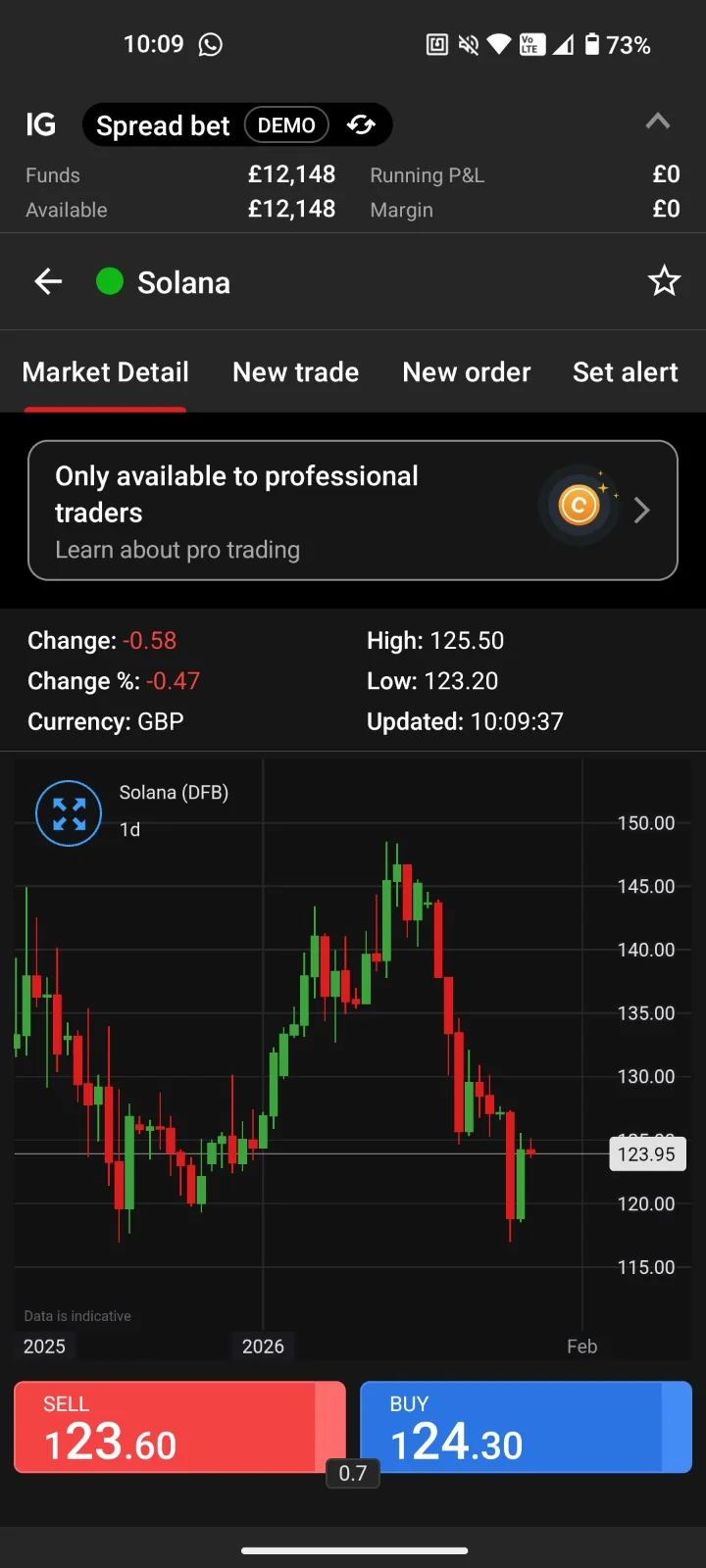
I added crypto to an existing IG account on 15 January 2026 (FCA FRN 195355) with no additional KYC needed. 55 spot crypto pairs available. The fee structure is the standout: 0% commission on Bitcoin, Ethereum and Solana, with just a 0.07% external exchange fee built into the price (around £0.70 on a £1,000 buy), and a flat 1.49% on all other coins. On the big three that makes IG one of the cheapest UK routes I have tested. Crypto sits in IG's institutional custody arrangement: real coin ownership, but no withdrawal to your own wallet and no staking yield on this platform.
| Test | Result | Industry Avg | Date | Method | Verdict |
|---|---|---|---|---|---|
| KYC (existing customer) | 5 minutes | 16 minutes | 15 Jan 2026 | Crypto module activation | Fastest path |
| Standard trading fee | 0% + 0.07% on BTC/ETH/SOL; 1.49% other coins | 1.83% | Nov 25 - Apr 26 | Per-coin tier | Cheapest for big 3 |
| GBP bank withdrawal | 2 hours | 30 hours | 15 Jan 2026 | £200 to Barclays | Fastest of six |
| Cryptocurrencies available | 55 | 266 | Apr 2026 | Live count | Fewest of six |
| Self-custody (external wallet) | No | 3 of 6 yes | Apr 2026 | Institutional custody | Custody trade-off |
| Combined with shares + ISA | Yes | 0 of 6 others | Apr 2026 | Single login | Only on this list |
IG holds client crypto in institutional custody rather than allowing per-client wallet addresses. You own the underlying coin (this is spot crypto, not a CFD) but the position lives inside IG's custody arrangement. Trade-off: simpler audit and lower operational risk for retail clients, no option to move the coin to a hardware wallet for self-custody.
Nothing on the regulatory side: same FCA-authorised entity, same risk warnings. Crypto pairs appear alongside your existing watchlist of shares, indices, forex and commodities. The product is spot crypto: real coin ownership, with the catch that it cannot be held inside the IG ISA itself, so disposals still trigger CGT in the normal way.
Anyone wanting to withdraw crypto to a hardware wallet (Coinbase, Bitpanda or Uphold allow this). Anyone wanting to stake for yield (Coinbase, Bitpanda or Uphold). Anyone wanting more than 55 coins (Bitpanda at 600+).
Bitpanda GmbH is an Austrian-founded multi-asset broker that re-launched its UK arm in August 2025 after securing FCA cryptoasset registration. The UK product covers 600+ cryptocurrencies, full spot custodial trading, and (uniquely on this list) FCA-cleared spot crypto margin up to 3x leverage, gated behind an 8-question competency test.
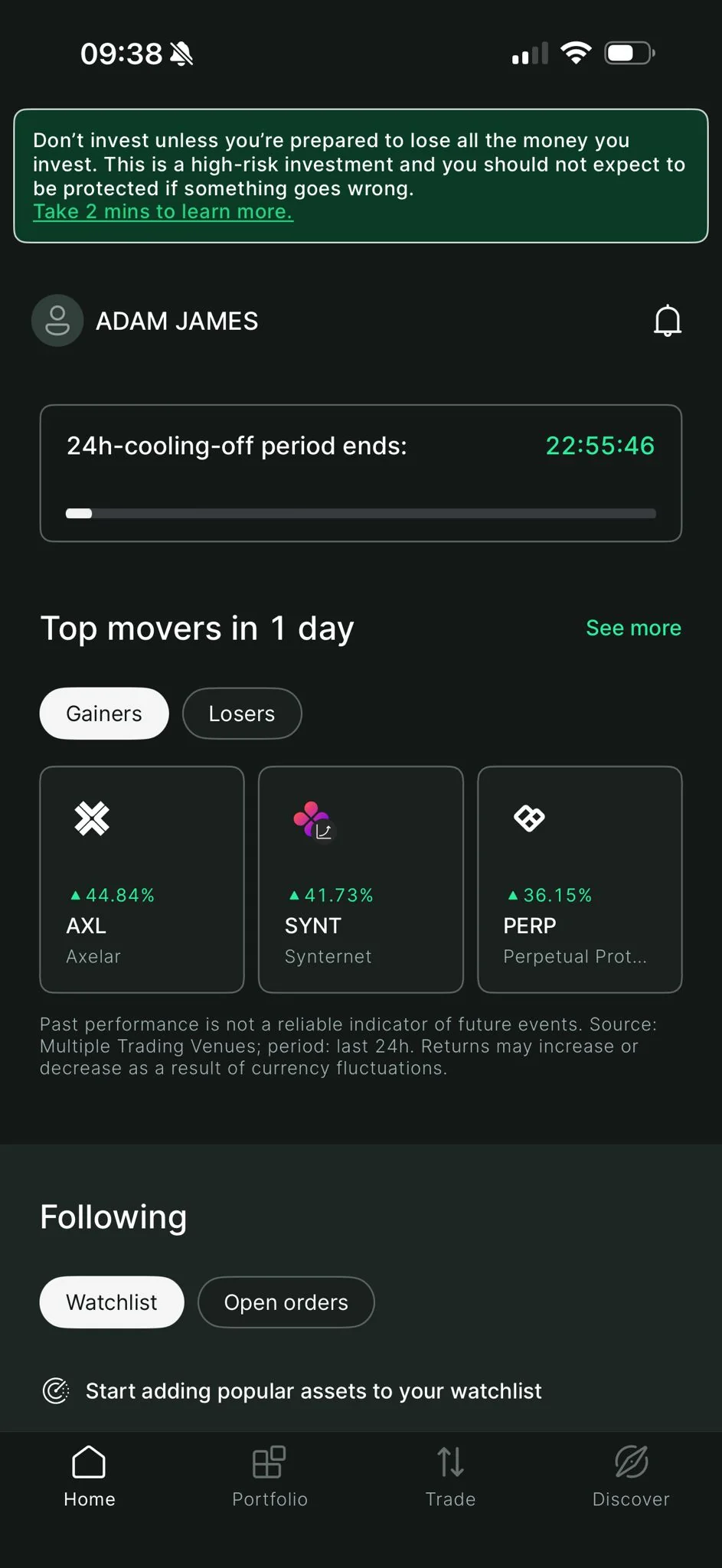
I funded Bitpanda with £500 on 14 November 2025 (FCA FRN 925234). KYC took 25 minutes (longest of the six) because Bitpanda runs an additional source-of-funds check. In March 2026 I opened a 3x ETH/GBP long position of £299.67 notional with take-profit at £1,640 and stop-loss at £1,482. Position closed in 11 days at +£94 net of the 0.18% per-day funding cost.
| Test | Result | Industry Avg | Date | Method | Verdict |
|---|---|---|---|---|---|
| Cryptocurrencies supported | 600+ | 266 | Apr 2026 | Live catalogue | Widest of six |
| Spot margin (max leverage) | 3x | n/a | Mar 2026 test | ETH/GBP long | Only on this list |
| Standard trading fee | 1.49% | 1.83% | Nov 25 - Apr 26 | 50 buy/sell trades | Mid-pack |
| BTC/GBP spread | 1.47% | 1.07% | Live order book | 50 market orders | Wider than avg |
| GBP bank withdrawal | 18 hours | 30 hours | 30 Jan 2026 | £200 to NatWest | Fast |
| KYC verification time | 25 minutes | 16 minutes | 14 Nov 2025 | Photo ID + source-of-funds | Longest of six |
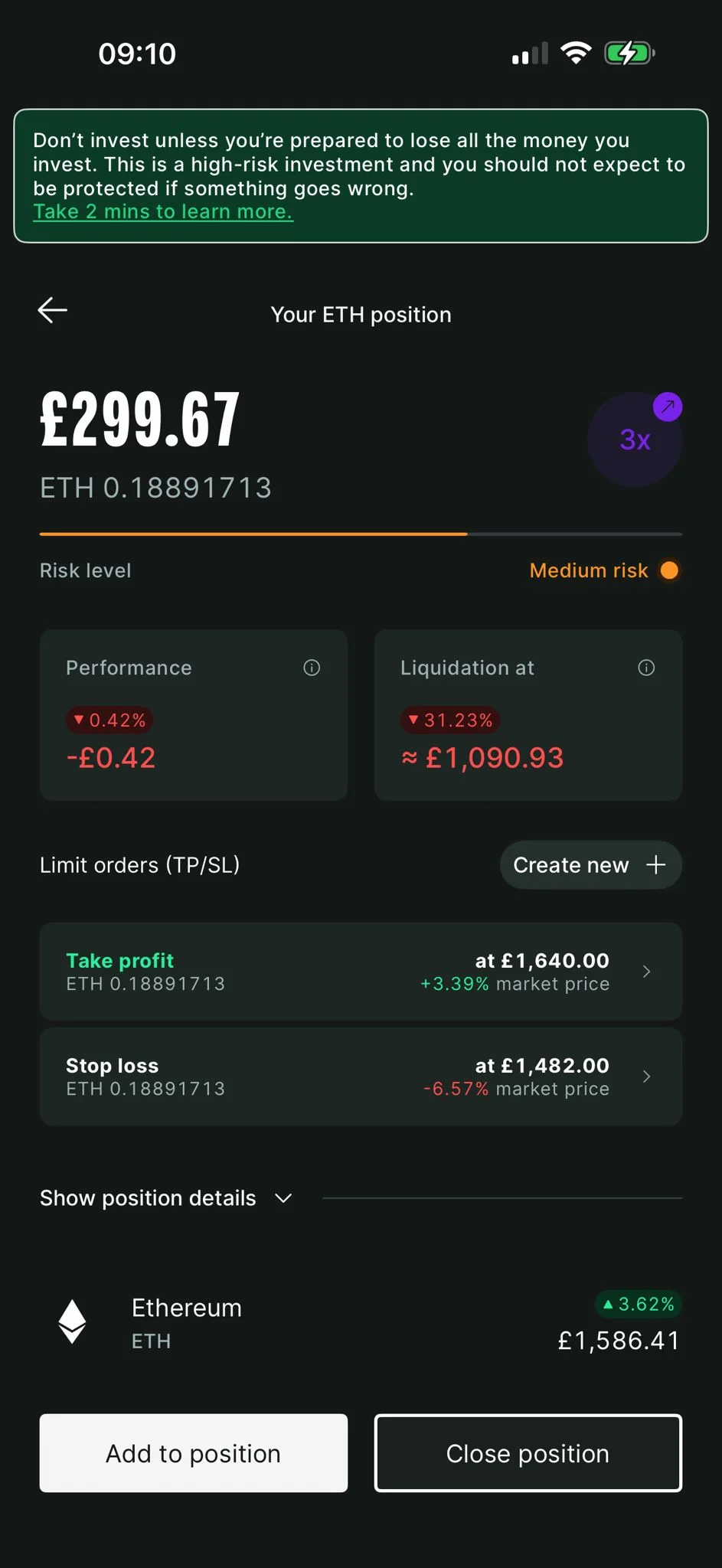
Eight multiple-choice questions on margin mechanics, liquidation, and crypto-specific risks. Fail and you cannot enable margin. Bitpanda re-runs the test if you do not trade margin for 12 months. The friction is deliberate: the FCA cleared this as the trade-off for letting retail UK clients access leveraged spot crypto at all.
Mostly yes for the top 100 by market cap. Below that, liquidity thins out and spreads widen materially. I tested a £200 trade on the 250th-largest coin and the round-trip cost was closer to 4% than the 1.49% headline. The catalogue is the headline number; small-cap liquidity is the asterisk.
Anyone wanting a longer UK operating track record (Coinbase or IG, both UK since pre-2020). Anyone wanting Nasdaq-listed parent transparency (Coinbase). Anyone wanting the deepest cold storage attestation (Coinbase at 98%).
Uphold HQ Inc is a US-headquartered multi-asset platform founded in 2013. It offers 250 cryptocurrencies alongside 27 fiat currencies, precious metals (physical gold, silver, platinum, palladium), and US-listed stocks. The UK arm holds FCA cryptoasset registration and publishes 100%-reserves attestations monthly.
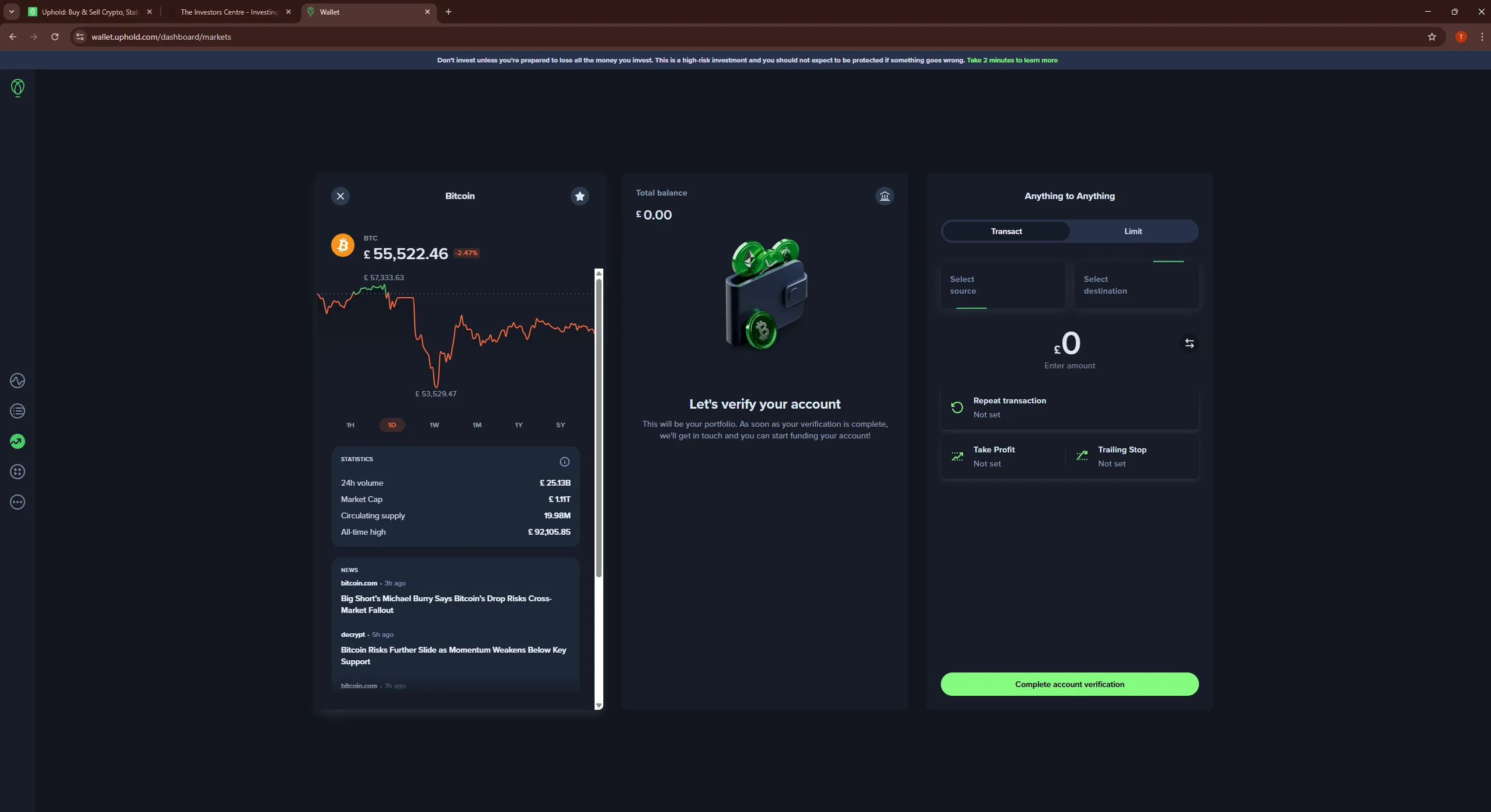
I funded Uphold with £500 on 14 November 2025 (FCA FRN 938277). BTC/GBP spread tested at 0.95% across 50 market orders, the tightest on this list. The trade-off lives on the deposit side: card deposits cost 3.99%, joint-worst of the six.
| Test | Result | Industry Avg | Date | Method | Verdict |
|---|---|---|---|---|---|
| BTC/GBP spread | 0.95% | 1.07% | Live order book | 50 market orders | Tightest of six |
| Standard trading fee | 1.20% | 1.83% | Nov 25 - Apr 26 | 50 buy/sell trades | Second-lowest |
| Card deposit fee | 3.99% | 2.83% | 14 Nov 2025 | £500 card deposit | Joint-worst |
| GBP bank withdrawal | 18 hours | 30 hours | 30 Jan 2026 | £200 test | Fast |
| ETH staking yield (gross) | 3.00% | 2.83% | 30-day avg | Live position | At average |
| Trustpilot rating | 4.6 / 26,103 | 4.0 / 18,576 | Apr 2026 | Public reviews | Highest on list |
Uphold's UK card processor passes through interchange and merchant-acquirer costs in full rather than absorbing them in the spread. The honest version: 3.99% is the actual cost of accepting a UK debit card payment in the crypto industry. Coinbase charges the same. eToro absorbs most of it but recovers via the USD conversion spread. There is no free-lunch deposit method.
Yes. The attestation is published as a Merkle-tree report listing on-chain reserve totals against client liabilities. You can independently verify your own balance is included by checking the cryptographic hash chain. Most exchanges promise reserves; Uphold publishes a checkable receipt monthly.
Anyone wanting higher published cold storage percentage (Coinbase at 98%). Anyone wanting wider coin selection (Bitpanda at 600+). Anyone wanting to avoid card deposit fees entirely (Coinbase bank transfer or eToro debit card at 0.50%).
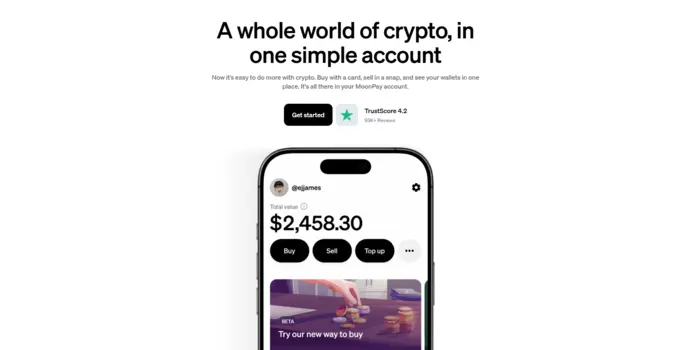
MoonPay Limited is an Irish-headquartered crypto on-ramp founded in 2019. Structurally it is a card-linked broker, not an exchange: you pay with a debit card or Apple Pay, MoonPay buys the crypto and sends it straight to a wallet address you specify. No custody, no trading interface, no order book. Tested by Dom Farnell on the TIC team.
Dom funded a MoonPay test on 14 November 2025 (FCA FRN 944716) with a £100 BTC purchase via Apple Pay. KYC took 5 minutes. BTC arrived at the Trezor destination wallet in 60 seconds. Total cost including the 4.50% MoonPay fee and the network gas fee was 4.74% of trade value.
| Test | Result | Industry Avg | Date | Method | Verdict |
|---|---|---|---|---|---|
| BTC card-to-wallet delivery | 60 seconds | 17 minutes | 14 Nov 2025 | 0.0015 BTC test | Fastest of six |
| KYC verification time | 5 minutes | 16 minutes | 14 Nov 2025 | Photo ID + selfie | Fastest of six |
| All-in fee on a £100 BTC buy | 4.74% | 2.83% | 14 Nov 2025 | Apple Pay + gas | Worst of six |
| BTC/GBP visible spread | 0.50% | 1.07% | Live quote | Single quote | Tightest but masked |
| Account custody | None | 5 of 6 custodial | By design | On-ramp only | Unique model |
| Trustpilot review count | 108,576 | 18,576 | Apr 2026 | Public reviews | Highest on list |
No. It is a card-to-wallet on-ramp. There is no holding of funds, no trading interface, no order book. You enter a wallet address, pay with a card or Apple Pay, MoonPay executes the trade on a back-end exchange and sends the resulting crypto straight to your wallet. Useful for one-off urgent purchases. Useless for active trading.
Two reasons. First, MoonPay bundles routing, KYC and card processing as a single service: the fee covers all three. Second, the convenience premium is genuine. When Santander blocked a Coinbase card deposit (it happened to me twice), MoonPay was the only platform that completed the purchase in under two minutes. The fee buys time and removes friction.
Anyone making more than three crypto purchases a year. The 4.50% fee compounds far faster than Coinbase Advanced at 0.40% or Uphold at 1.20%. MoonPay is the right answer for urgent one-off buys and almost nothing else.
I funded all six platforms with my own capital between 1 November 2025 and 30 April 2026: Coinbase, eToro, Bitpanda and Uphold at £500 each, IG by adding crypto to an existing £300 account, and MoonPay with a £100 one-off card purchase tested by Dom Farnell. All testing ran from a wired Yorkshire FTTP 1Gb connection except the Bitpanda margin test (mobile-only).
BTC/GBP and ETH/GBP spreads sampled across 50 market orders per platform during London-session hours (08:00 to 17:00 GMT). Withdrawal tests used £200 to a NatWest current account and 0.005 BTC to a Trezor Model T. KYC times measured from photo ID upload to first available trade. Staking yields observed across 30+ day live positions. Customer support response times sampled across three test contacts per platform per channel.
Download my full UK crypto exchange test data as a CSV (80 columns × 11 platforms, including 5 platforms tested but not in this article's top six). Includes FCA cryptoasset FRNs, spreads, fees, staking yields, withdrawal test results, KYC times, security disclosures and audit metadata.
I initially flagged Uphold's 3.99% card deposit fee as the worst of the six until I tested MoonPay's 4.50% spread-baked fee head-to-head. Uphold is honest about the fee; MoonPay buries it. The "tightest spread" headline number on MoonPay's quote screen (0.50%) genuinely is the tightest of the six on paper, but the 4.50% MoonPay convenience fee is layered on top and not separately displayed during purchase. The lesson: spread is one of several costs in crypto, not the whole picture. Always test the all-in landed cost at trade size you actually intend to use.
Fees 25%, Platform usability 20%, Asset selection 15%, Mobile app 15%, Tools and research 10%, Customer support 10%, Regulation and security 5%. Regulation gets a lower weight than people expect because the cutoff is binary (FCA-registered or not). All six platforms cleared that gate, so the weight then differentiates between platforms that all hold the same regulatory status.
Buying crypto is legal in the UK. Holding it on a platform you do not control is not the same as holding cash in a UK bank. Three things to understand before you fund any account.
Every platform on this list is FCA-registered under the cryptoasset regime, which means the firm passed know-your-customer, source-of-funds and financial-crime checks. It does not mean the FCA has authorised them as investment firms or vetted their custody arrangements at the depth that applies to FCA-authorised brokers.
If a UK crypto platform fails insolvent, there is no government compensation scheme covering your coins. The FSCS £85,000 investment-firm limit applies to FCA-authorised investment firms (like IG and eToro's investment-firm entity), but it covers cash and traditional investment products, not the cryptoasset balances. Cold storage percentage and proof-of-reserves disclosure are the only practical safety signals.
Crypto held on a hardware wallet you control cannot be lost to platform insolvency. Three of the six platforms on this list (Coinbase, Bitpanda, Uphold) allow withdrawal to external wallets. IG and eToro do not. MoonPay sends straight to your wallet by design.
Four costs stack on every crypto purchase. Most platforms display one or two and bury the rest.
Trading fee or commission: the headline number, ranging from 0.40% (Coinbase Advanced) to 4.50% (MoonPay). Spread: the difference between buy and sell prices, typically 0.95% to 1.50% on BTC/GBP across the six. Deposit fee: bank transfers are free across the six; debit card deposits cost 0.50% (eToro) to 3.99% (Coinbase, Uphold) to 4.50% (MoonPay). Withdrawal fee: GBP bank withdrawals are free across five platforms; eToro charges £4. Crypto network fees pass through to you regardless.
Coinbase Advanced costs roughly £5 all-in, Bitpanda £15, Uphold £11, Coinbase Standard £10, eToro £13 (including USD conversion), MoonPay £24. The ranking inverts at £5,000 trade size because Coinbase Advanced's per-cent fee scales linearly while MoonPay's fixed convenience premium becomes proportionally cheaper.
HMRC treats crypto as property, not currency. Two taxes apply depending on what triggered the gain.
Selling crypto for fiat, swapping one coin for another, gifting (other than to a spouse), or spending crypto all count as disposals. CGT applies on gains above the annual allowance, which is £3,000 for 2025-26 (cut from £12,300 in 2022-23). Rates are 18% or 24% depending on your income tax band. Losses can be carried forward and offset against future gains.
Rewards from staking, mining, lending or as payment for goods are taxed as income at the fair market value on the date received. National Insurance may also apply if HMRC treats the activity as a trade. Subsequent disposal of those coins triggers CGT on any gain between the value-at-receipt and the value-at-sale. IG is the only platform on this list that does not offer staking, so this layer only applies to Coinbase, Bitpanda and Uphold positions.
Even on IG (the only platform here pairing crypto with a Stocks & Shares ISA), cryptoassets cannot be held inside the ISA itself. The crypto sits on the same login as the ISA, but disposals still trigger CGT in the normal way and the £3,000 annual CGT allowance is the only shelter available.
UK residents report crypto disposals on the Self Assessment Capital Gains pages each tax year. Several of the six platforms (Coinbase, Bitpanda) provide CSV transaction exports that map cleanly to UK CGT calculation tools.
A note for first-time UK crypto buyers before the three winners below. Coinbase (98% cold storage, Nasdaq-listed parent, 8-minute KYC) is the lowest-friction safe starting point among the six I tested. Bitpanda's margin product and IG's multi-asset workspace land harder once you have decided what you actually want to do with the position.
98% cold storage, public attestations and Nasdaq-listed parent transparency are protections you cannot replicate elsewhere on this list. Trade-off: the Standard tier fee is 1.49% + 0.5% spread, expensive on small repeat buys. Move to Coinbase Advanced once you trade more than £1,000 at a time.
600+ coins, 3x spot margin, sub-19-hour GBP withdrawals and the lowest staking commission of the six. Trade-off: cold storage disclosed at 80%, shorter UK track record than Coinbase, and the 25-minute KYC slows first deposit.
Spot crypto sits on the same FCA-authorised account as 17,000+ shares, indices, forex pairs, commodities, options and (uniquely on this list) a Stocks & Shares ISA. Widest tradable universe of the six platforms by a wide margin, with the fastest GBP withdrawal at 2 hours. The fee structure is a genuine standout too: 0% commission on Bitcoin, Ethereum and Solana (just a 0.07% external exchange fee in the price), with 1.49% on other coins, making IG one of the cheapest UK routes into the big three. Trade-off: institutional custody only, so no withdrawal to your own wallet and no staking yield.
No. The FSCS £85,000 limit applies to FCA-authorised investment firms and covers cash and traditional investment products, not cryptoasset holdings. Cash balances on Coinbase and Bitpanda may be FSCS-eligible because they are held with FCA-authorised banking partners, but the crypto itself is not covered if the exchange fails.
IG accepts £1, Bitpanda accepts £1, Uphold accepts £1, Coinbase accepts £2, MoonPay starts at £5, eToro requires £10. For a credible position size that absorbs the trading fees, £100 to £500 is sensible across most platforms.
IG at 2 hours (tested 15 January 2026, £200 to Barclays). Bitpanda and Uphold both clocked 18 hours. Coinbase took 72 hours on the same test, the slowest of the six.
No. HMRC only requires reporting on disposals: selling for fiat, swapping coins, gifting (other than to a spouse), or spending. Holding crypto is not a taxable event. You do need to report any staking, mining or lending rewards as income in the tax year you received them.
Enter the firm's Firm Reference Number at register.fca.org.uk and check the permissions list. Look for "Registered firm" status under the cryptoasset regime. The six FRNs in this article (Coinbase 900635, eToro 583263, IG 195355, Bitpanda 925234, Uphold 938277, MoonPay 944716) all link directly to their FCA register entries.