

- expertise:
- Platform Testing, Cryptocurrency, Retail Investing
- credentials:
- Active investor since 2013 · 11+ years experience
- tested:
- 50+ platforms · 200+ guides authored

- expertise:
- CFD Trading, Forex, Derivatives, Risk Management
- credentials:
- Chartered ACII (2018) · Trading since 2012
- tested:
- 40+ forex & CFD platforms with live accounts
How We Test
Real accounts. Real money. Real trades. No demo accounts or press releases.
What we measure:
- Spreads vs advertised rates
- Execution speed and slippage
- Hidden fees (overnight, withdrawal, conversion)
- Actual withdrawal times
Scoring:
Fees (25%) · Platform (20%) · Assets (15%) · Mobile (15%) · Tools (10%) · Support (10%) · Regulation (5%)
Regulatory checks:
FCA Register verification · FSCS protection
Testing team:
Adam Woodhead (investing since 2013), Thomas Drury (Chartered ACII, 2018), Dom Farnell (investing since 2013) — 50+ platforms with funded accounts
Quarterly reviews · Corrections: in**@*******************co.uk
Disclaimer
Not financial advice. Educational content only. We're not FCA authorised. Consult a qualified advisor before investing.
Capital at risk. Investments can fall. Past performance doesn't guarantee future results.
CFD warning. 67-84% of retail accounts lose money trading CFDs. High risk due to leverage.
Contact: in**@*******************co.uk
Key UK ESG & Sustainable Investing Statistics 2026
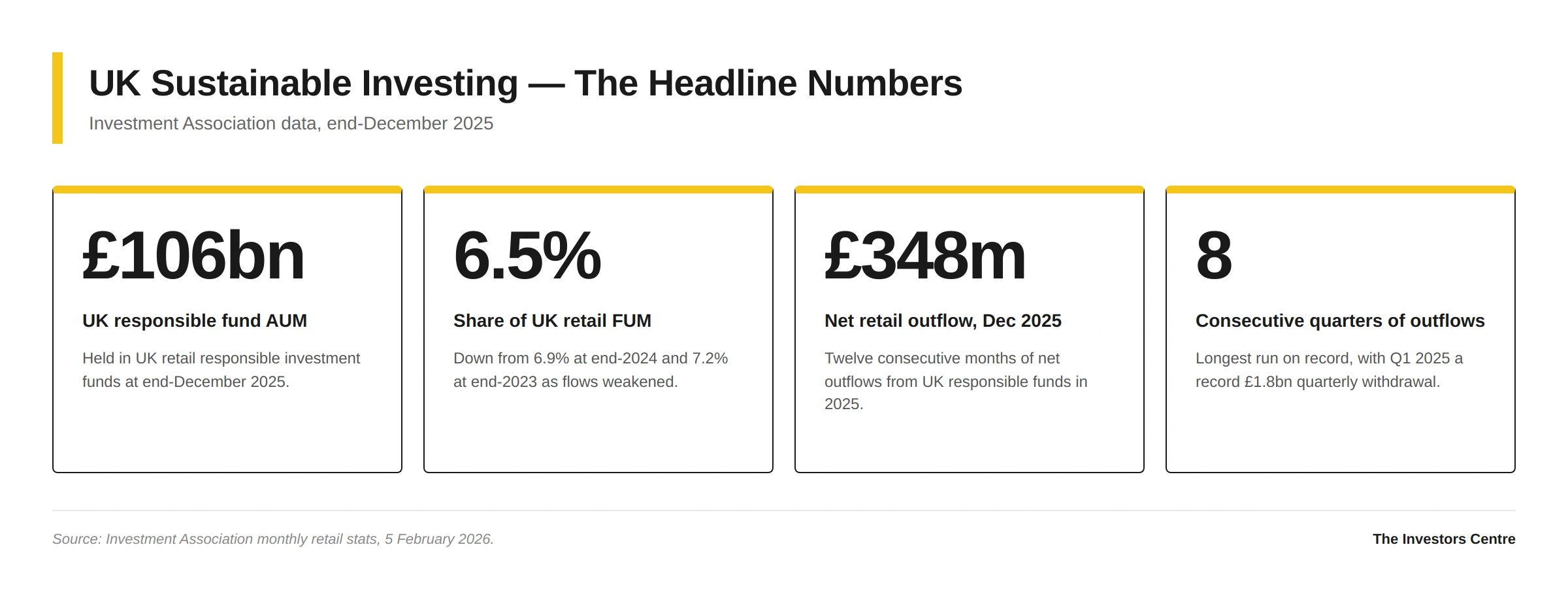
- £106 billion held in UK responsible investment funds at end-December 2025 — equal to 6.5% of total UK retail funds under management of £1.62 trillion.
- Eight consecutive quarters of net retail outflows from UK responsible funds — the longest run on record, with Q1 2025 alone seeing £1.8 billion withdrawn.
- £348 million outflow from UK responsible funds in December 2025 alone — capping a year in which every single month was net negative.
- £51 billion+ raised by the UK Government Green Financing Programme through Green Gilts and NS&I Green Savings Bonds since launch in September 2021 — the world's second-largest sovereign green debt programme.
- 72% of UK adults with investments or a defined contribution pension want their money to "do some good" as well as deliver a financial return.
- Just 18% of UK adults have ever invested in a responsible product, and only 11% actively chose to do so — a 54-percentage-point gap between intent and action.
- 69% → 53% Interest in responsible investing among UK 18–34s fell from 69% in 2022 to 53% in 2024 — by far the largest demographic decline in the FCA dataset.
- £88 billion of UK pension money is invested in fossil-fuel companies — about £3,000 per pension holder.
- 4.5 / 10 average climate-action score across the UK's 12 largest DC pension providers — Nest highest at 5.8, Royal London lowest at 3.3.
- ~330 million tonnes CO₂e total carbon footprint linked to UK pension investments per year — one of the largest carbon levers in UK personal finance.
- 31 May 2024 — the FCA anti-greenwashing rule (FG24/3) came into force, applying to every FCA-authorised firm making sustainability claims.
- ~110 funds in the UK retail SDR-labelled universe by mid-2025, after dozens of UK funds dropped "sustainable", "ESG" or "impact" from their names rather than meet the labelling criteria.

Free to use with a dofollow link back to The Investors Centre.
How Big Is the UK Sustainable Investing Market?
At the end of December 2025, UK responsible investment funds held £106 billion in assets, representing 6.5% of total UK retail funds under management of £1.62 trillion. The category has stalled compared to its 2022–23 peak, with eight consecutive quarters of net retail outflows through the end of 2025. AUM has held up because of underlying market gains, but persistent withdrawals show retail demand remained weak across the year. For broader UK UK investing data and trends, our investment statistics hub provides full context.
Source: Investment Association — Annual Retail Fund Outflows release, 5 February 2026.
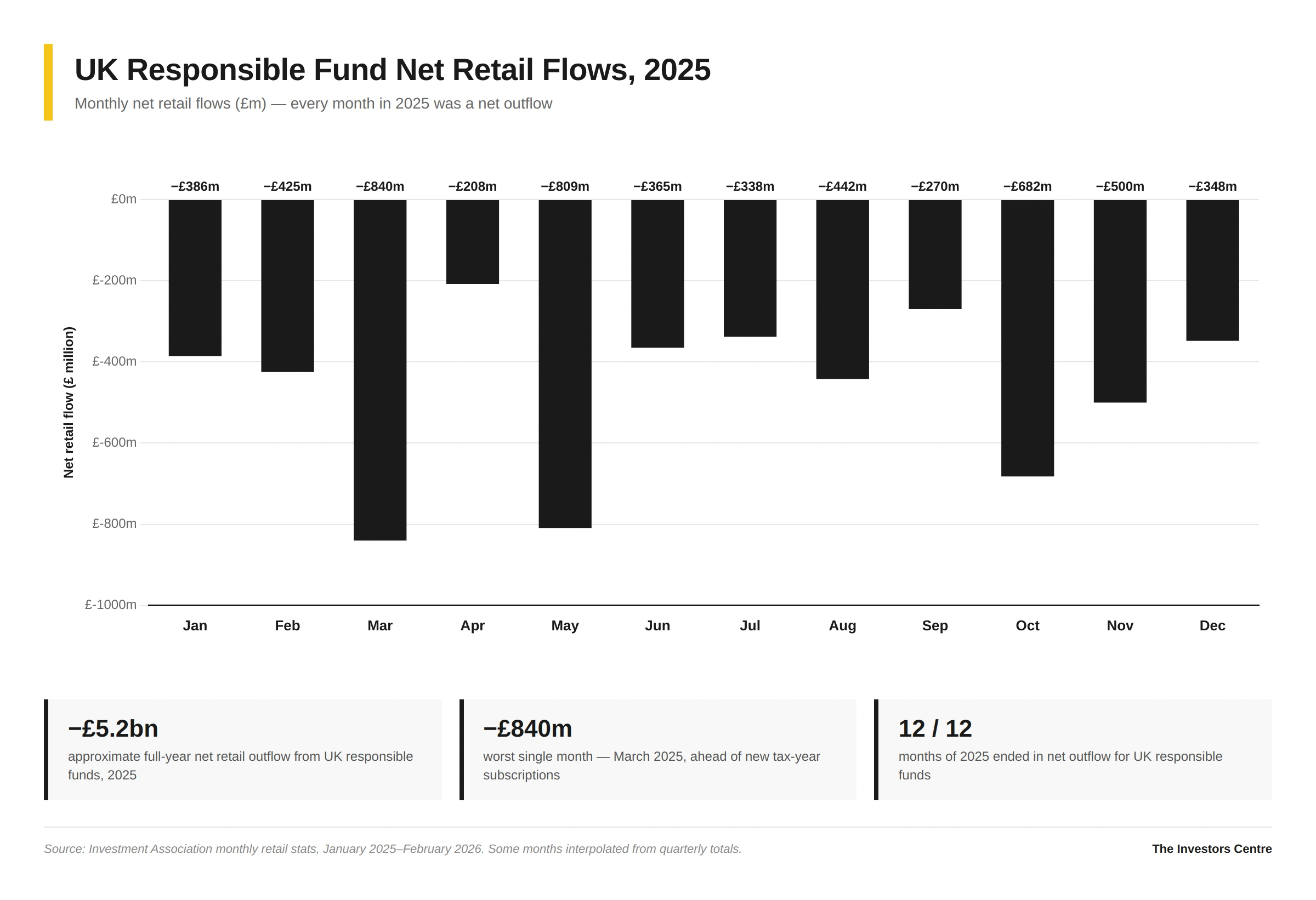
UK Responsible Fund Net Retail Flows by Month, 2025
UK responsible investment funds finished every month of 2025 in net retail outflow. The largest single month was March (−£840m); the smallest was April (−£208m). Total full-year outflows came to approximately £5.2 billion — a record annual figure for the category.
| Month (2025) | Net retail flow (£m) | AUM end-month (£bn) | Share of UK retail FUM |
|---|---|---|---|
| January | −386 | 108.4 | 7.0% |
| February | −425 (est.) | ~106 | ~6.8% |
| March | −840 | 97.3 | 6.7% |
| April | −208 | 95.9 | 6.6% |
| May | −809 | 98.8 | 6.6% |
| June | −365 | ~100 | ~6.6% |
| July | −338 | 104.2 | 6.7% |
| August | −442 | 102.4 | 6.6% |
| September | −270 | 104.0 | 6.6% |
| October | −682 (est.) | ~104 | ~6.5% |
| November | −500 (est.) | ~105 | ~6.5% |
| December | −348 | 106.0 | 6.5% |
Source: Investment Association monthly retail stats releases, January 2025 – February 2026. February, October and November interpolated from quarterly totals.

Free to use with a dofollow link back to The Investors Centre.
Why Are UK Responsible Funds in Outflow?
The Investment Association attributes the persistence of outflows to a combination of macro factors: pre-Budget tax speculation in late 2024 and again in autumn 2025, US tariff uncertainty after January 2025, and a broader investor preference for money market and mixed-asset funds during volatile equity markets. Money market funds attracted £6.9 billion of net inflows across 2025 — a record for the sector — as investors took a defensive stance.
Importantly, the Investment Association noted in May 2025 that net retail sales of FCA SDR-labelled funds were also negative in their first reported month, suggesting that even the new labelled universe has not yet stimulated fresh retail demand.
Source: Investment Association monthly retail stats commentary, January 2025 – February 2026.
UK Sustainability Disclosure Requirements (SDR): The Numbers
The FCA's Sustainability Disclosure Requirements regime (Policy Statement PS23/16) is the central UK ESG policy framework. The anti-greenwashing rule applies to every FCA-authorised firm; the four investment labels apply to UK retail funds. Investors comparing the ETF platforms used in the UK can see how providers position SDR-labelled and conventional sustainable funds.
Key SDR Implementation Dates
| Milestone | Date in force | Scope |
|---|---|---|
| Anti-greenwashing rule (FG24/3) | 31 May 2024 | All FCA-authorised firms making sustainability claims |
| SDR investment labels available | 31 July 2024 | UK retail funds opting into one of four labels |
| Naming and marketing rules | 2 December 2024 | UK retail funds using "sustainable" or related terms |
| Naming flexibility window ended | 2 April 2025 | Funds had to comply or rebrand |
| Entity-level disclosures (≥£50bn AUM) | 2 December 2025 | Largest UK asset managers |
| Entity-level disclosures (≥£5bn AUM) | 2 December 2026 | Mid-sized UK asset managers |
Source: FCA Policy Statement PS23/16; FCA SDR information page, January 2025.
The Four SDR Investment Labels
Funds opting in to the SDR regime can choose one of four labels. These are exclusive — a fund must meet at least 70% of its assets aligned to its sustainability objective, and labels cannot be combined.
| SDR Label | What it means | Example fund types |
|---|---|---|
| Sustainability Focus | ≥70% of assets meet a credible sustainability standard | Climate transition equity funds, environmental thematic funds |
| Sustainability Improvers | Assets that are not yet sustainable but on a path to becoming so | Engagement-led active strategies |
| Sustainability Impact | Pre-defined positive measurable real-world environmental or social outcome | Renewable energy, social housing impact funds |
| Sustainability Mixed Goals | ≥70% of assets meet a mix of the above three categories | Multi-theme sustainability portfolios |
Source: FCA Policy Statement PS23/16, November 2023.
How Many UK Funds Have Adopted an SDR Label?
Adoption has been steady but not rapid. The FCA confirmed in a January 2025 freedom-of-information response that it had received 43 firm notifications of intent to use an SDR label, with a further 57 funds having had pre-contractual disclosures approved. By mid-2025, Morningstar reported approximately 110 UK retail funds carrying an SDR label, rising further into the second half of the year. A range of leading UK investment platforms now surface SDR labels alongside fund risk and cost information.
Equally significant is what the regime has stripped away. Through 2025, dozens of UK funds rebranded — dropping "sustainable", "ESG", "responsible" or "impact" from their names rather than meet the labelling criteria. Morningstar tracked more than 640 European fund rebrands related to ESG-naming guidelines in the 15 months to early 2025; the UK figure is a substantial subset of that.
Sources: FCA SDR information disclosure, 16 January 2025; Morningstar Q1 2025 European Sustainable Funds Landscape; Investment Week.
Anti-Greenwashing Rule: Enforcement to Date
In its January 2025 disclosure, the FCA confirmed that the number of funds it had contacted regarding breaches of the anti-greenwashing rule was zero — and the same for the SDR naming and marketing rule. The regulator described its early approach as supervisory rather than enforcement-led.
In August 2025, the FCA announced an investigation into Drax Group concerning historical disclosures about its biomass sourcing made between January 2022 and March 2024, and the compliance of its 2021–2023 annual reports with the Listing Rules and Disclosure Guidance & Transparency Rules. The case is widely reported as the first FCA inquiry publicly linked to greenwashing claims, although the FCA itself has framed it as a market disclosure investigation rather than an SDR enforcement action.
Sources: FCA SDR information disclosure, 16 January 2025; Drax Group RNS announcement, 28 August 2025; Peters & Peters; Bioenergy Insight.
What Do UK Retail Investors Actually Think About ESG?
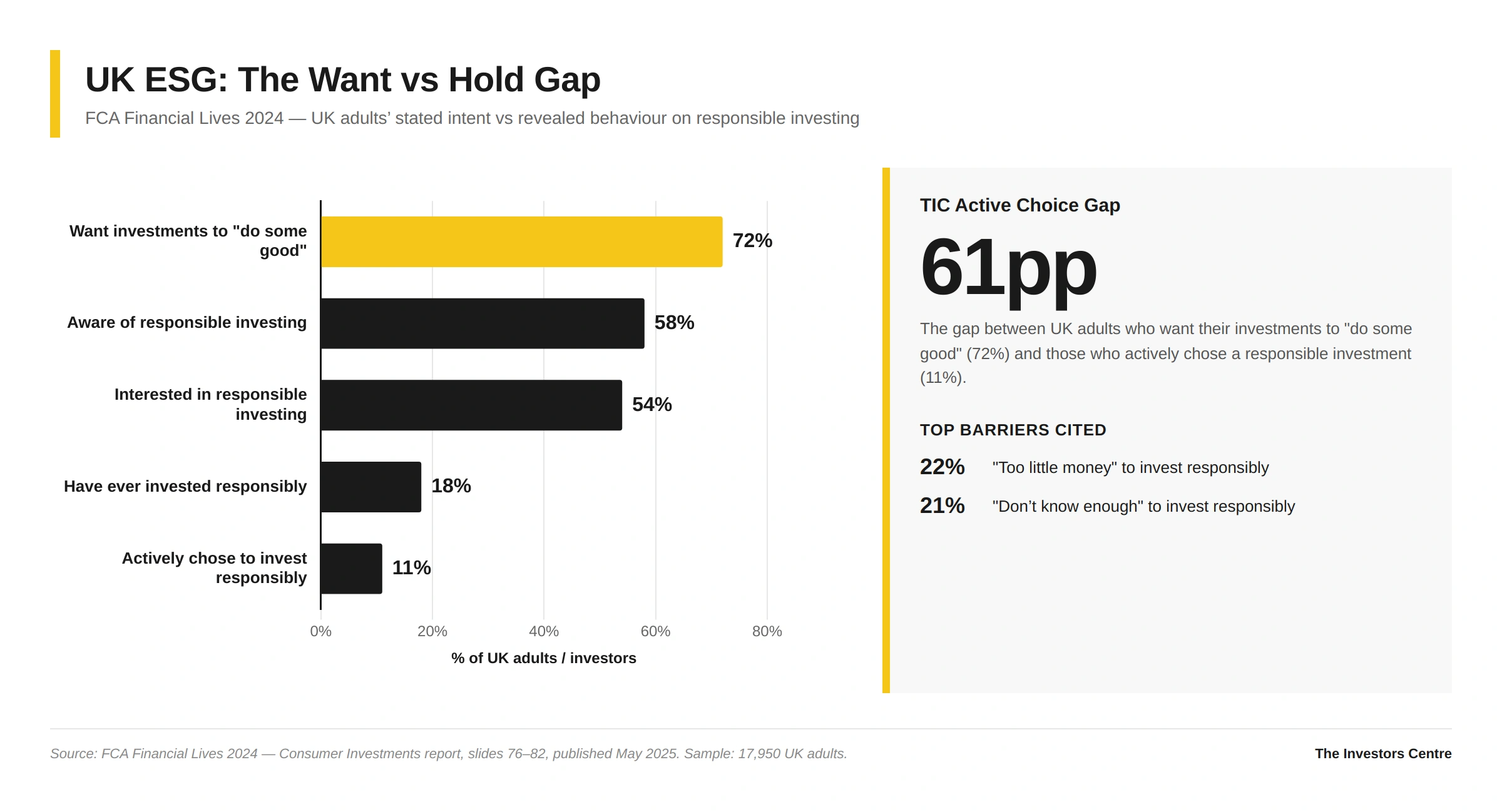
The FCA's Financial Lives 2024 survey is the most authoritative source on UK retail ESG attitudes. Fieldwork ran from 5 February to 16 June 2024 across 17,950 UK adults, and the results were published in May 2025.
| Metric | 2022 | 2024 | Direction |
|---|---|---|---|
| UK adults with any investments | 37% | 35% | Down |
| Investors aware of responsible investing | 57% | 58% | Flat |
| Investors interested in responsible investing | 61% | 54% | Down |
| 18–34s interested in responsible investing | 69% | 53% | Sharp decline |
| UK adults who have ever invested responsibly | n/a | 18% | — |
| UK adults who actively chose to invest responsibly | n/a | 11% | — |
| Investors who want their money to "do some good" | n/a | 72% | — |
Source: FCA Financial Lives 2024 — Consumer Investments slide-based report, slides 70–82, published May 2025.

Free to use with a dofollow link back to The Investors Centre.
Why the "Want vs Hold" Gap?
The two most-cited reasons UK adults give for not investing responsibly are practical, not ideological. 22% say they have "too little money" to invest responsibly, while 21% say they "don't know enough" to do so. Greenwashing scepticism is a layer on top: a high share of UK investors say it is hard to tell which funds are genuinely sustainable, and only a minority routinely check whether fund information has been independently verified.
Source: FCA Financial Lives 2024, slide 82.
The Generational Reversal in UK ESG Interest
In 2022, 18–34s were the most enthusiastic age group for responsible investing in the UK, with 69% expressing interest. By 2024, that figure had fallen to 53% — the largest decline in any demographic segment, eroding what had been a clear age skew. Interest is now broadly even across age groups, and the male/female split has also flattened (54% / 53% in 2024). Cost-of-living pressure, falling consumer climate optimism, and high-profile greenwashing controversy are the most likely drivers.
"The 16-percentage-point collapse in 18–34 interest between 2022 and 2024 is the single most important shift in UK ESG demand. The under-35s were the demographic the entire UK retail sustainable-fund proposition was built around. They have not lost their values — they have lost their disposable income, and they have stopped trusting fund branding. The product industry's response has been the opposite of what's needed: more labels, more disclosure, fewer funds named 'sustainable'."
Source: FCA Financial Lives 2024 — Consumer Investments, slides 76–80.
UK Pensions and Climate: The £3 Trillion Lever
UK pension scheme assets sit at over £3 trillion — the single largest pool of UK investor capital. How that capital is allocated has more climate impact than almost any other personal-finance lever.
Make My Money Matter Climate Action Report 2025 — UK DC Pension Provider Rankings
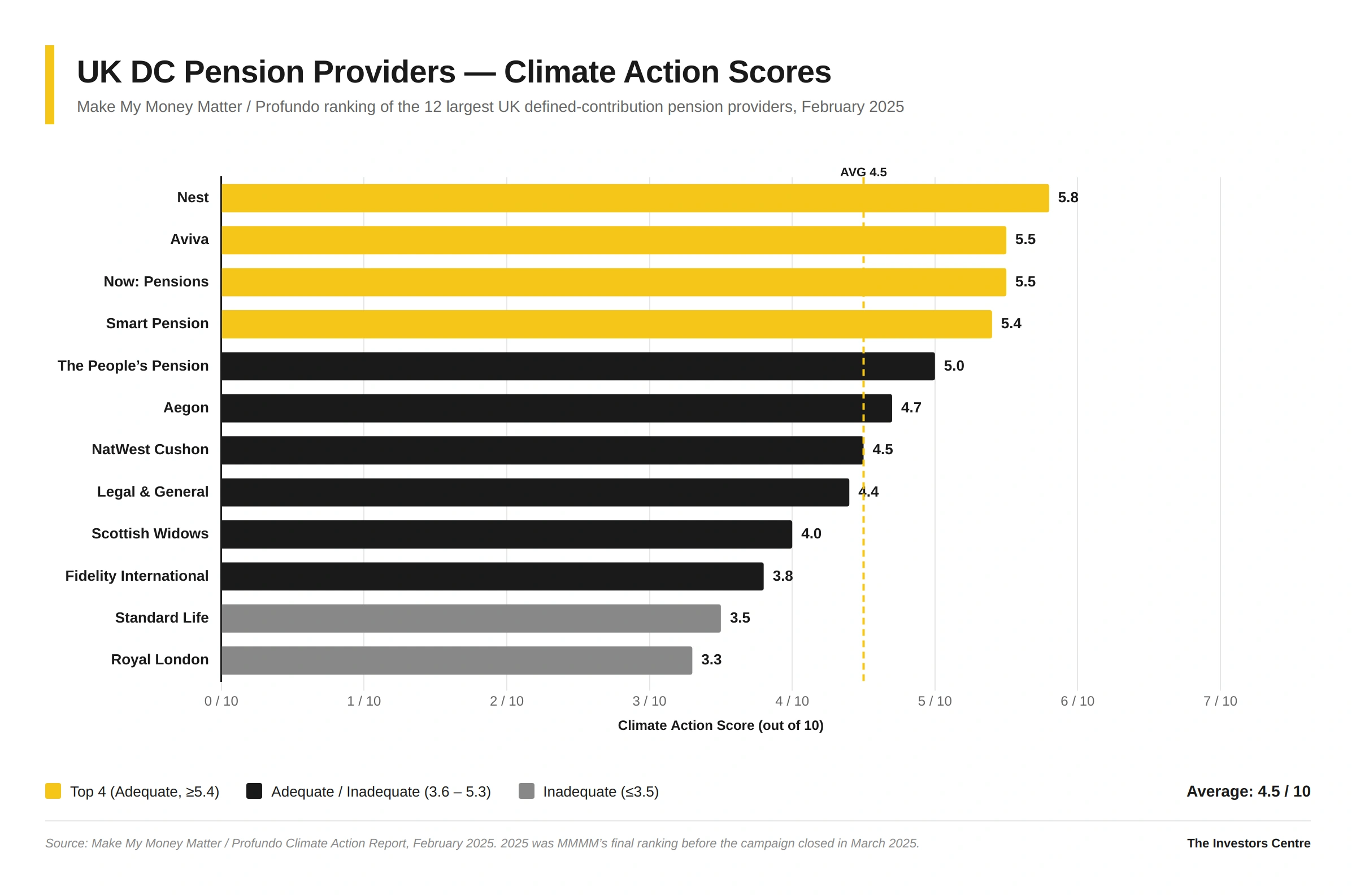
The 2025 Climate Action Report (Make My Money Matter with sustainability research provider Profundo, published February 2025) ranks the 12 largest UK defined-contribution pension providers on climate plans. The 2025 report was Make My Money Matter's final ranking; the campaign closed in March 2025 after five years of work, having helped at least 60 UK pension schemes representing £1.5 trillion+ in assets adopt net-zero targets.
| Rank | Provider | Score / 10 | Rating |
|---|---|---|---|
| 1 | Nest | 5.8 | Adequate |
| 2 (joint) | Aviva | 5.5 | Adequate |
| 2 (joint) | Now: Pensions | 5.5 | Adequate |
| 4 | Smart Pension | 5.4 | Adequate |
| — | Average across 12 providers | 4.5 | Inadequate |
| 11 | Standard Life | 3.5 | Inadequate |
| 12 | Royal London | 3.3 | Inadequate |
Source: Make My Money Matter / Profundo Climate Action Report, February 2025.

Free to use with a dofollow link back to The Investors Centre.
Where UK Pension Money Sits
Make My Money Matter's final research found £88 billion of UK pension savings invested in fossil-fuel companies — about £3,000 per pension holder. A further £300 billion is invested in companies with high deforestation risk. Seven of the twelve largest UK DC providers (Aegon, Aviva, Fidelity International, Legal & General, Royal London, Standard Life and Scottish Widows) confirmed exposure to ExxonMobil, despite each having committed to halving emissions by 2030.
On stewardship, Aviva and Legal & General voted with management at 44 of 45 Shell and BP AGM resolutions in 2024 — including on executive pay packages — undermining the influence pension funds could otherwise wield as major shareholders.
Source: Make My Money Matter Climate Action Report, February 2025.
Pension TCFD Reporting in the UK
Climate-related financial disclosure has been mandatory for large UK occupational pension schemes since October 2021 (schemes with assets above £5 billion plus master trusts) and October 2022 (schemes above £1 billion), under the Occupational Pension Schemes (Climate Change Governance and Reporting) Regulations 2021. The Pensions Regulator reviewed approximately 290 second-wave TCFD reports in its 2024 review.
Enforcement has begun. In 2024 the Pensions Regulator issued fines of £8,000 to the GKN Group Pension Scheme and £5,000 to the Prudential Staff Pension Scheme for failure to publish climate-change reports — the first such penalties under the climate disclosure regime.
Sources: The Pensions Regulator climate guidance; TPR Compliance and Enforcement Bulletin, January–June 2024.
UK Green Gilts and Sovereign Green Debt
The UK Government Green Financing Programme, launched in September 2021, is now the second-largest sovereign green debt programme in the world. As of March 2026, the programme has raised more than £51 billion through Green Gilts (issued by the Debt Management Office) and NS&I Green Savings Bonds.
UK Green Gilt Issuance Lines (April 2026)
| Gilt line | Coupon / maturity | Cumulative issuance | Notes |
|---|---|---|---|
| First Green Gilt 2033 | 0⅞% / 31 Jul 2033 | £39.8 billion | Inaugural line, syndicated Sept 2021 |
| Long Green Gilt 2053 | 1½% / 31 Jul 2053 | £30.4 billion | Long-dated, syndicated Oct 2021 |
| Mid Green Gilt 2037 | 4⅝% / 7 Mar 2037 | New line, March 2026 | Syndication week of 9 March 2026 |
| NS&I Green Savings Bonds | Retail, fixed-term | £1.8 billion+ | Retail product launched October 2021 |
Sources: UK Debt Management Office press release, 6 March 2026; HM Treasury Debt Management Report 2025-26; UK Government Green Financing Allocation Report 2024.
Planned Issuance and Framework Update
The UK government plans to issue £10.0 billion (cash) of green gilts in financial year 2025-26, confirmed at Spring Statement 2025 and reconfirmed at Budget 2025. The UK Government Green Financing Framework was updated in 2025 and rated "Dark Green" by S&P — the highest possible rating in S&P's sustainable finance second-party opinion methodology.
Sources: HM Treasury Debt Management Report 2025-26; UK Government Green Financing Framework 2025, gov.uk; S&P Global Ratings second-party opinion, November 2025.
TIC Analysis: The UK ESG "Want vs Hold" Gap
There is a 54-percentage-point gap between UK adults who want their investments to "do some good" (72%) and those who have ever held a responsible investment (18%). This is the widest such gap in any major UK personal-finance preference category — wider than the savings-vs-cash gap, and wider than the pension-engagement gap.
The implication: there is no shortage of UK retail interest in ESG — there is a translation problem. The two leading reasons UK adults give for not investing responsibly are "too little money" (22%) and "don't know enough" (21%). Both are addressable through better product design and clearer communication; neither is about scepticism of ESG itself.
"A 54-point want-vs-hold gap and a 61-point active-choice gap is not a demand problem — it is a translation problem. UK retail ESG fund flows have been net negative for eight quarters not because UK investors don't want sustainable investments, but because the available products feel too expensive, too opaque, and too uncertain to act on. SDR labels are part of the answer; clearer cost and outcome reporting is the bigger half."
Source: TIC analysis of FCA Financial Lives 2024 — Consumer Investments report, slides 76–82.
Frequently Asked Questions
How much money is invested in UK ESG funds?
UK responsible investment funds held £106 billion in assets at the end of December 2025, equal to 6.5% of all UK retail funds under management. This is according to Investment Association data published on 5 February 2026.
Are UK ESG funds in outflow or inflow?
UK responsible funds were in net retail outflow in every month of 2025, totalling around £5 billion of withdrawals over the year. The largest single quarter was Q1 2025 with £1.8 billion of outflows — a record quarterly figure for the category.
What is the FCA SDR?
The Sustainability Disclosure Requirements (SDR) are the FCA's rules for sustainability claims, in force from 2024. They include an anti-greenwashing rule applying to all FCA-authorised firms (since 31 May 2024), four investment labels for UK retail funds (Focus, Improvers, Impact, Mixed Goals), and naming and marketing restrictions on use of words like "sustainable" and "ESG" in fund names (since 2 December 2024).
How many UK funds have an SDR sustainability label?
By mid-2025 around 110 UK retail funds carried an SDR label according to Morningstar, with adoption rising through the second half of the year. The FCA confirmed in January 2025 it had received 43 firm notifications of intent and approved pre-contractual disclosures for 57 further funds.
What is the UK Green Gilt programme?
The UK Government Green Financing Programme has raised more than £51 billion since launch in September 2021 through Green Gilts and NS&I Green Savings Bonds. The Debt Management Office plans to issue £10 billion of green gilts in FY 2025-26, with a new 4⅝% Green Gilt 2037 launched in March 2026.
Do UK pensions invest in fossil fuels?
Yes. Make My Money Matter's final Climate Action Report (February 2025) found £88 billion of UK pension savings invested in fossil-fuel companies — about £3,000 per pension holder. Seven of the twelve largest UK defined-contribution pension providers confirmed direct exposure to ExxonMobil despite their stated 2030 emissions-halving commitments.
Which UK pension provider is best for climate action?
Nest scored highest at 5.8 out of 10 in the February 2025 Make My Money Matter / Profundo ranking of the 12 largest UK DC pension providers. Aviva and Now: Pensions tied for second at 5.5. Royal London scored lowest at 3.3, with Standard Life at 3.5. The average across all 12 providers was just 4.5 out of 10.
Do UK retail investors want sustainable investments?
Yes — most do. According to the FCA Financial Lives 2024 survey, 72% of UK investors and DC pension holders want their investments to "do some good" as well as provide a financial return. However, only 18% have ever held a responsible investment and just 11% actively chose to do so. The gap between intent and action is the widest in UK retail finance.
Is interest in ESG investing falling among young UK investors?
Yes. Interest in responsible investing among UK 18–34s fell from 69% in 2022 to 53% in 2024 according to FCA Financial Lives 2024 — by far the largest demographic decline. By 2024, interest was broadly even across age groups and between men (54%) and women (53%).
Has the FCA taken any greenwashing enforcement action?
As of January 2025 the FCA had not contacted any firms regarding breaches of the anti-greenwashing rule. In August 2025 the FCA opened an investigation into Drax Group concerning biomass sourcing disclosures from 2022–2024, widely reported as the first FCA enquiry publicly linked to greenwashing claims, although the FCA has framed the inquiry as a market disclosure case under the Listing Rules and Disclosure Guidance.
What does the anti-greenwashing rule actually require?
The FCA anti-greenwashing rule (FG24/3, in force 31 May 2024) requires that any sustainability-related claim made by an FCA-authorised firm must be fair, clear and not misleading, and that the claim is consistent with the actual sustainability characteristics of the product or service. It applies regardless of whether the firm uses an SDR label.
How much carbon is linked to UK pensions?
Make My Money Matter estimates total carbon emissions linked to UK pensions at around 330 million tonnes of CO₂-equivalent per year. The campaign's 2021 modelled study (with Aviva and Route 2) found that switching a pension to a sustainable option could be roughly 21 times more carbon-impactful than going vegetarian, giving up flying and switching energy supplier combined — although this is a modelled 2021 estimate that has not been updated since.