

- expertise:
- Platform Testing, Cryptocurrency, Retail Investing
- credentials:
- Active investor since 2013 · 11+ years experience
- tested:
- 50+ platforms · 200+ guides authored

- expertise:
- Broker Comparison, ISA Strategy, Portfolio Management
- credentials:
- Active investor since 2013 · 11+ years experience
- tested:
- 40+ brokers with funded accounts
How We Test
Real accounts. Real money. Real trades. No demo accounts or press releases.
What we measure:
- Spreads vs advertised rates
- Execution speed and slippage
- Hidden fees (overnight, withdrawal, conversion)
- Actual withdrawal times
Scoring:
Fees (25%) · Platform (20%) · Assets (15%) · Mobile (15%) · Tools (10%) · Support (10%) · Regulation (5%)
Regulatory checks:
FCA Register verification · FSCS protection
Testing team:
Adam Woodhead (investing since 2013), Thomas Drury (Chartered ACII, 2018), Dom Farnell (investing since 2013) — 50+ platforms with funded accounts
Quarterly reviews · Corrections: in**@*******************co.uk
Disclaimer
Not financial advice. Educational content only. We're not FCA authorised. Consult a qualified advisor before investing.
Capital at risk. Investments can fall. Past performance doesn't guarantee future results.
CFD warning. 67-84% of retail accounts lose money trading CFDs. High risk due to leverage.
Contact: in**@*******************co.uk
Quick Answer: Is Coinbase Safe?
Yes — Coinbase is one of the safest crypto exchanges available to UK users. It is FCA registered (CB Payments Ltd, FRN 900635), NASDAQ-listed with mandatory audited financials, and stores approximately 98% of customer crypto in offline cold storage. It is not, however, a risk-free platform: crypto losses from hacking are not covered, and no crypto held on any UK exchange is protected by the FSCS. Always use 2FA, and consider a hardware wallet for large holdings.
| Category | Verdict |
|---|---|
| Overall Safety Rating | 4.4 / 5 |
| FCA Registration | Yes — CB Payments Ltd, FRN 900635 |
| FSCS Protection | No — crypto is not FSCS-covered |
| Cold Storage | ~98% of crypto held offline |
| 2FA | Yes — mandatory |
| NASDAQ Listed | Yes — mandatory audited disclosures |
| Platform Hack History | No platform-wide breach to date |
| 2025 Security Incident | Support team breach — ~69,000 customers affected, handled transparently |

Don’t invest unless you’re prepared to lose all the money you invest. This is a high-risk investment and you should not expect to be protected if something goes wrong. Take 2 mins to learn more
My Personal Security Experience — Tested March 2026
I ran a full end-to-end test on Coinbase in March 2026 — deposit, purchase, and withdrawal to an external wallet — to give you a first-hand account of what the platform's security actually looks like in practice.
What Security Steps Did Coinbase Require?
2FA was required at three separate points: logging in, confirming the Bitcoin purchase, and authorising the withdrawal to my MetaMask wallet. Email confirmations arrived promptly at each stage. Before the withdrawal was processed, Coinbase displayed a clear on-screen warning that crypto transactions are irreversible — useful protection against accidental sends to the wrong address.
Did the Withdrawal to an External Wallet Complete Without Issues?
Yes. I sent Bitcoin from Coinbase to my MetaMask wallet. The network fee was approximately £0.23 (Bitcoin network fee, not a Coinbase charge). The transaction completed the same morning — transaction hash 41343d...769abb, verifiable on the Bitcoin block explorer. Coinbase placed no holds, no flags, and no obstacles on the withdrawal.
What About the UK Bank Transfer?
The only friction I encountered was on the deposit side: both Barclays and Revolut initially blocked my bank transfer to Coinbase. This is a UK banking issue rather than a Coinbase security problem. Revolut required live chat approval before permitting the transfer. Once approved, the funds arrived quickly and with no deposit fee.
How Does Coinbase Protect Your Funds?
Platform Security
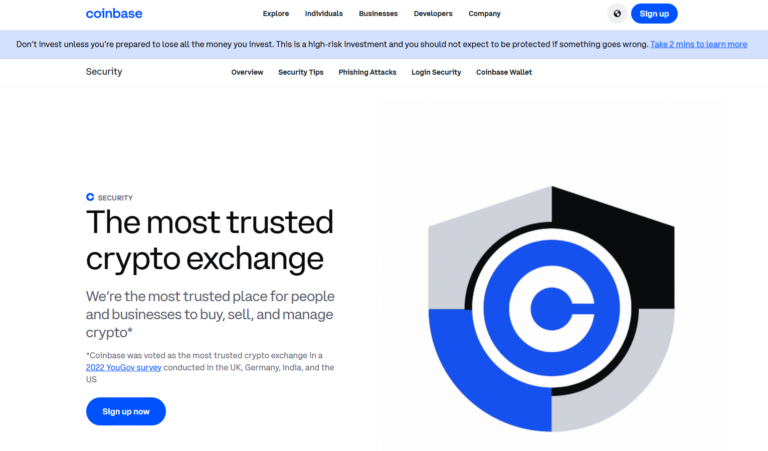
Coinbase uses AES-256 encryption, stores approximately 98% of customer crypto in offline cold storage, and runs continuous security audits. It employs 24/7 threat detection and is a NASDAQ-listed public company (COIN) subject to mandatory audited financial disclosures — a much higher transparency standard than virtually any offshore or unregulated exchange.
Account-Level Security
Every account is protected by mandatory two-factor authentication (2FA), device verification, and biometric login on mobile. You can also set up withdrawal address whitelists — only approved wallet addresses can receive funds from your account. Suspicious activity alerts are sent by email and push notification. In my March 2026 test, 2FA was enforced at login, purchase, and withdrawal without exception.
Is Coinbase Regulated by the FCA?
Yes. CB Payments Ltd — Coinbase's UK operating entity — is registered with the Financial Conduct Authority under reference number 900635. You can verify this directly on the FCA register at register.fca.org.uk. This is an Anti-Money Laundering registration under the Money Laundering Regulations (MLR) — not full FCA authorisation. It means Coinbase must comply with UK AML rules and conduct KYC checks on all users, but it does not carry the same investor protections as a fully FCA-authorised firm.
Is Crypto on Coinbase Protected by the FSCS?
No. This is important for all UK crypto investors to understand: cryptocurrency held on Coinbase — or on any UK crypto exchange — is not covered by the Financial Services Compensation Scheme. The FSCS protects eligible cash deposits at UK-authorised banks up to £85,000. It does not extend to crypto assets. If Coinbase became insolvent, your crypto recovery would depend on Coinbase's own insurance policies and insolvency proceedings, not a government-backed scheme.
Security Overview
| Security Aspect | What Coinbase Offers | Why It Matters |
|---|---|---|
| Platform Security | AES-256 encryption, ~98% cold storage, continuous audits | Protects against large-scale hacks and systemic breaches |
| Account Protection | Mandatory 2FA, device verification, withdrawal whitelists | Reduces risk of unauthorised account access |
| FCA Registration | CB Payments Ltd, FRN 900635 (MLR/AML) | Compliance with UK anti-money laundering rules; KYC required |
| NASDAQ Listed | Public company, mandatory audited financials | Higher transparency than unregulated exchanges |
| FSCS Protection | Not applicable to crypto | No government-backed compensation for crypto losses |
| Cash Balance Insurance | GBP held via partner banks may have limited protection | Cash deposits only — crypto holdings carry no equivalent guarantee |
Has Coinbase Ever Been Hacked?
Coinbase's core platform has never suffered a catastrophic breach draining its reserves — which distinguishes it from several other major exchanges. However, it has faced security incidents worth knowing about.
The 2025 Data Breach
In 2025, Coinbase disclosed that its customer support team had been compromised in a social engineering attack. Approximately 69,000 customers had personal data — names, contact details, and partial account information — exposed. No funds were stolen and no passwords or 2FA credentials were accessed. Coinbase handled the incident transparently: it went public quickly, notified affected users, and offered credit monitoring. This is the most recent significant security event at Coinbase.
Individual Account Compromises
Historically, some individual accounts have been compromised through phishing attacks, SIM swap scams, and credential theft — none of which represent failures in Coinbase's core platform security. In 2021, a phishing vulnerability affecting thousands of customers prompted Coinbase to reimburse affected users. These incidents highlight why strong personal security practices matter as much as platform security.
What Scams Should Coinbase Users Watch For?
The most common threats are fake emails and login pages impersonating Coinbase, fake customer support calls requesting 2FA codes, and social engineering attempts via social media. Never share your password or 2FA codes with anyone. Always verify you're on coinbase.com — not a lookalike domain — before logging in.
Is Coinbase Wallet Safer Than Keeping Funds on the Exchange?
The question of exchange vs self-custody comes down to what risk you're managing. Keeping crypto on Coinbase's exchange means the platform holds your private keys — easier recovery if something goes wrong on your end, but exposure to any platform-side failure. Coinbase Wallet is non-custodial: only you hold the keys, which eliminates exchange risk but means permanent loss if you lose your recovery phrase.
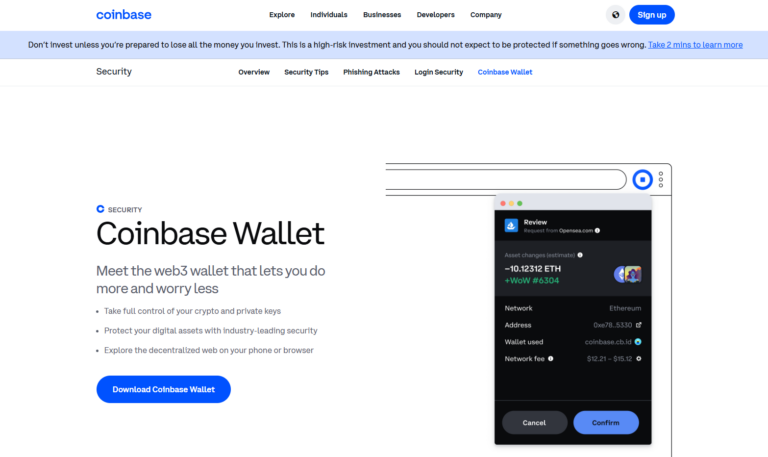
For small amounts used for active trading, keeping funds on the exchange is convenient. For larger long-term holdings, a hardware wallet is the most secure option. For a full review of Coinbase's self-custody option, see our Is Coinbase Wallet Safe? guide.
What to Do If You Hold Significant Crypto
- Enable 2FA on your Coinbase account (mandatory, but verify it's active).
- Set up withdrawal address whitelists for addresses you regularly send to.
- For holdings you don't intend to trade actively, consider transferring to a hardware wallet.
- Store your recovery phrase offline, in a secure physical location — never digitally.
Is Coinbase Safe and Legal for UK Users?
Yes. Coinbase is legally operating in the UK, registered with the FCA (CB Payments Ltd, FRN 900635), and compliant with UK Anti-Money Laundering regulations. It is one of the better-regulated options available to UK crypto investors. That said, UK-specific points to understand:
- FCA registration is AML/MLR only — not full authorisation. Coinbase isn't regulated in the same way as a UK bank or investment firm.
- No FSCS protection — your crypto holdings have no government-backed compensation scheme.
- CARF reporting — Coinbase now shares transaction data with HMRC under the Crypto-Asset Reporting Framework. Your trades are visible to HMRC; CGT reporting remains your responsibility.
- FCA derivatives restriction — UK retail users cannot access crypto derivatives on Coinbase under FCA rules.
What Are the Risks of Using Coinbase?
Crypto Market Risk
The most significant risk with any crypto exchange isn't the platform — it's the asset. Crypto prices are highly volatile. Coinbase's security infrastructure protects your account, but it can't protect the value of your holdings.
Custodial Risk
Keeping crypto on any exchange means trusting that exchange with your assets. Coinbase's NASDAQ listing and transparency reduce this risk compared to unregulated alternatives — but it isn't eliminated. If Coinbase were to fail, crypto recovery would depend on insolvency proceedings.
Fees and Spreads
Standard Coinbase fees can reach 3.99% on debit card purchases. The practical solution is Coinbase Advanced (free to access, lower fees). For a full fee breakdown, see our Is Coinbase Advanced Free? guide.
Customer Support Limitations
Support response times are a consistent point of criticism. Reaching a human takes persistence, particularly during high market activity. Coinbase One subscribers receive priority access — for standard users, this remains a limitation worth knowing about.
Pros & Cons: Coinbase Security
Pros
- FCA registered (FRN 900635), NASDAQ-listed, mandatory audited financials
- ~98% of crypto held in offline cold storage
- Mandatory 2FA, device verification, withdrawal whitelists
- No platform-wide hack to date
- 2025 breach handled transparently
Cons
- Crypto holdings not FSCS protected
- FCA registration is AML/MLR only — not full authorisation
- Customer support slow to reach during busy periods
- Can freeze accounts during compliance reviews
How to Maximise Your Coinbase Security
Coinbase's platform security is strong — but your account security depends substantially on your own practices. Following these steps closes the most common gaps.
Essential Security Steps
- Enable 2FA using an authenticator app (not SMS, which is vulnerable to SIM swap).
- Set up withdrawal whitelists — only approved addresses can receive funds from your account.
- Use a unique, strong password for Coinbase not used on any other site.
- Never share 2FA codes or passwords — Coinbase support will never ask for these.
- Keep software updated — outdated apps and operating systems are a common attack vector.
- Monitor your account — enable email alerts for logins and withdrawals you don't recognise.
For Larger Holdings
For substantial balances, transfer to a hardware wallet. This keeps your private keys offline and removes the exchange as a single point of failure. Store your recovery phrase physically and securely — never digitally, never in the cloud, never photographed.
Final Verdict: Should You Trust Coinbase in 2026?
Coinbase is one of the safest and most accountable crypto exchanges available to UK users. Its NASDAQ listing, FCA registration (FRN 900635), cold storage practices, and mandatory 2FA place it well above most alternatives in terms of platform security. It has never suffered a platform-wide hack.
The honest caveats: crypto losses from hacking are not covered by insurance, no crypto is FSCS-protected, and the 2025 support team breach is a reminder that no platform is entirely risk-free. Used with sensible personal security practices — strong 2FA, withdrawal whitelists, hardware wallet for large holdings — Coinbase is a solid and trustworthy choice for UK investors.
For a full review of fees, features, and our March 2026 live test, see our in-depth Coinbase Review. To compare against alternatives, see our Coinbase vs Kraken and Coinbase vs Crypto.com comparisons, or our roundup of the best UK crypto exchanges.
Don't invest unless you're prepared to lose all the money you invest. This is a high-risk investment and you should not expect to be protected if something goes wrong.
Discuss Coinbase
Used Coinbase to buy or store crypto? Share your experience of its security, ask questions, or help other UK users decide. Our community earns Equity for quality contributions.
Discussion 0 comments
Be the first to start discussing this topic! Log in or create an account to share your thoughts.
Log In Create AccountFAQs
References
Don’t invest unless you’re prepared to lose all the money you invest. This is a high-risk investment and you should not expect to be protected if something goes wrong. Take 2 mins to learn more
No comments yet. Be the first to start discussing this topic!