

- expertise:
- CFD Trading, Forex, Derivatives, Risk Management
- credentials:
- Chartered ACII (2018) · Trading since 2012
- tested:
- 40+ forex & CFD platforms with live accounts

- expertise:
- Platform Testing, Cryptocurrency, Retail Investing
- credentials:
- Active investor since 2013 · 11+ years experience
- tested:
- 50+ platforms · 200+ guides authored
How We Test
Real accounts. Real money. Real trades. No demo accounts or press releases.
What we measure:
- Spreads vs advertised rates
- Execution speed and slippage
- Hidden fees (overnight, withdrawal, conversion)
- Actual withdrawal times
Scoring:
Fees (25%) · Platform (20%) · Assets (15%) · Mobile (15%) · Tools (10%) · Support (10%) · Regulation (5%)
Regulatory checks:
FCA Register verification · FSCS protection
Testing team:
Adam Woodhead (investing since 2013), Thomas Drury (Chartered ACII, 2018), Dom Farnell (investing since 2013) — 50+ platforms with funded accounts
Quarterly reviews · Corrections: in**@*******************co.uk
Disclaimer
Not financial advice. Educational content only. We're not FCA authorised. Consult a qualified advisor before investing.
Capital at risk. Investments can fall. Past performance doesn't guarantee future results.
CFD warning. 67-84% of retail accounts lose money trading CFDs. High risk due to leverage.
Contact: in**@*******************co.uk
IG or Coinbase for crypto in the UK?
The cleanest way to split them: IG tells you the price before you walk in, Coinbase tells you at the till. On Bitcoin, Ethereum and Solana, IG charges 0% commission plus a 0.07% external fee, about 70 pence per £1,000, shown in the quote before you confirm. Coinbase's simple buy discloses its fee at trade time, and its published rates have historically stacked a spread plus a size-based flat fee on top; the cheap routes are Advanced Trade (0.60% taker at entry level) or paying £4.99 a month for Coinbase One. Coinbase answers back with what a dedicated exchange does best: hundreds of coins, staking yield, self-custody withdrawals and a genuine pro venue, none of which IG offers today. Buy-and-hold the majors: IG. Live in crypto: Coinbase.

Spread bets and CFDs are complex instruments and come with a high risk of losing money rapidly due to leverage. 70% of retail investor accounts lose money when trading spread bets and CFDs with this provider. You should consider whether you understand how spread bets and CFDs work, and whether you can afford to take the high risk of losing your money.
Why is the fee comparison harder than it should be?
Comparing IG with Kraken or eToro is straightforward because everyone publishes a rate card. Coinbase is different, and that difference is half the story of this comparison.
IG: one number, visible before you buy
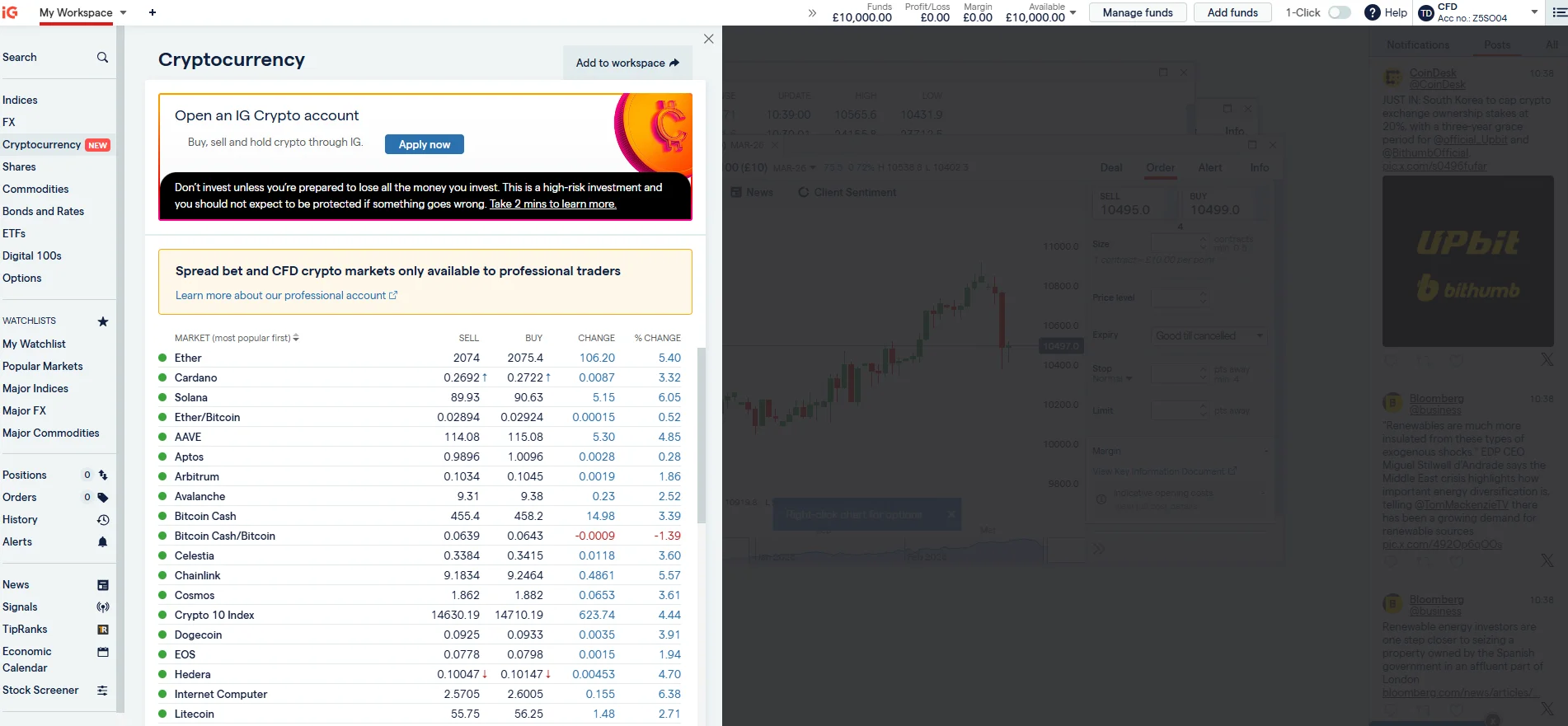
IG's pricing fits in a sentence: 0% commission plus a 0.07% external exchange fee from its liquidity partner on Bitcoin, Ethereum and Solana, and a flat 1.49% on everything else, shown inside the quote before you confirm. Whatever else you think of a focused coin list, you always know what a trade costs before you place it, and the number never depends on which interface you happened to use.
Coinbase: disclosed at trade time
Coinbase's simple buy and sell no longer publishes a clean UK fee schedule; fees are shown on the preview screen when you trade. Its historic disclosures combined a spread of around 0.5% with a flat fee that scaled with purchase size, running from about a dollar on the smallest buys to a few dollars at the £150 mark and percentage-based above that, so small purchases on the simple route have long been the expensive way in. Coinbase's own answer is to move you to Advanced Trade or to sell you the fix as a subscription, and both deserve a proper look rather than a sneer.
Advanced Trade: the real Coinbase price
Coinbase's pro venue prices like an exchange should: maker and taker fees starting at 0.40% and 0.60% for anyone trading under $10,000 a month, stepping down through 0.25%/0.40% and onward with volume, all the way to 0.00%/0.04% for institutional-scale flow, with the tier recalculated hourly from your trailing 30-day volume. Stablecoin pairs trade nearly free. For anyone comfortable with an order book, this is the number to compare against IG, not the simple-buy screen.
Coinbase One: paying to remove the fees
Coinbase One's Basic tier costs £4.99 a month (or £49.99 a year) and removes trading fees on simple buys and sells up to a monthly volume cap, with the spread still applying and Advanced Trade excluded; there is a 7-day trial, and higher tiers exist for bigger volumes. If you buy little and often, the subscription can genuinely pay for itself against the standard route. It is also a model IG simply does not need: there is no subscription because there is no high headline fee to remove on the big three.
What does a £1,000 Bitcoin buy cost on each?
Taking the routes a normal UK buyer would actually use, this is how the same purchase compares.
| Route | Fee structure | Approx. cost on £1,000 of BTC |
|---|---|---|
| IG (BTC, ETH, SOL) | 0% commission + 0.07% external fee | ~£0.70 |
| IG (other coins) | Flat 1.49% | £14.90 |
| Coinbase simple buy | Spread (~0.5% historically) + size-based fee, shown at trade time | Roughly £15 or more |
| Coinbase Advanced Trade | 0.60% taker / 0.40% maker at entry tier | £4 to £6 |
| Coinbase One Basic | £4.99/month; no trading fee on simple buys (spread applies, volume caps) | Spread only + the subscription |
On the majors, IG's 70 pence undercuts every Coinbase route by a wide margin, including Advanced Trade at any retail volume tier. The picture flips on the long tail, where IG's flat 1.49% meets Coinbase Advanced at a third of that price for anyone comfortable with a pro interface, and flips again for the little-and-often buyer, for whom Coinbase One's flat subscription can beat everything except IG's big-three rate.
What does Coinbase offer that IG does not?
Plenty, because this is a dedicated exchange against a broker with a focused crypto sideline, and it would be a strange exchange if it did not win on depth.
Coins, staking and your own wallet
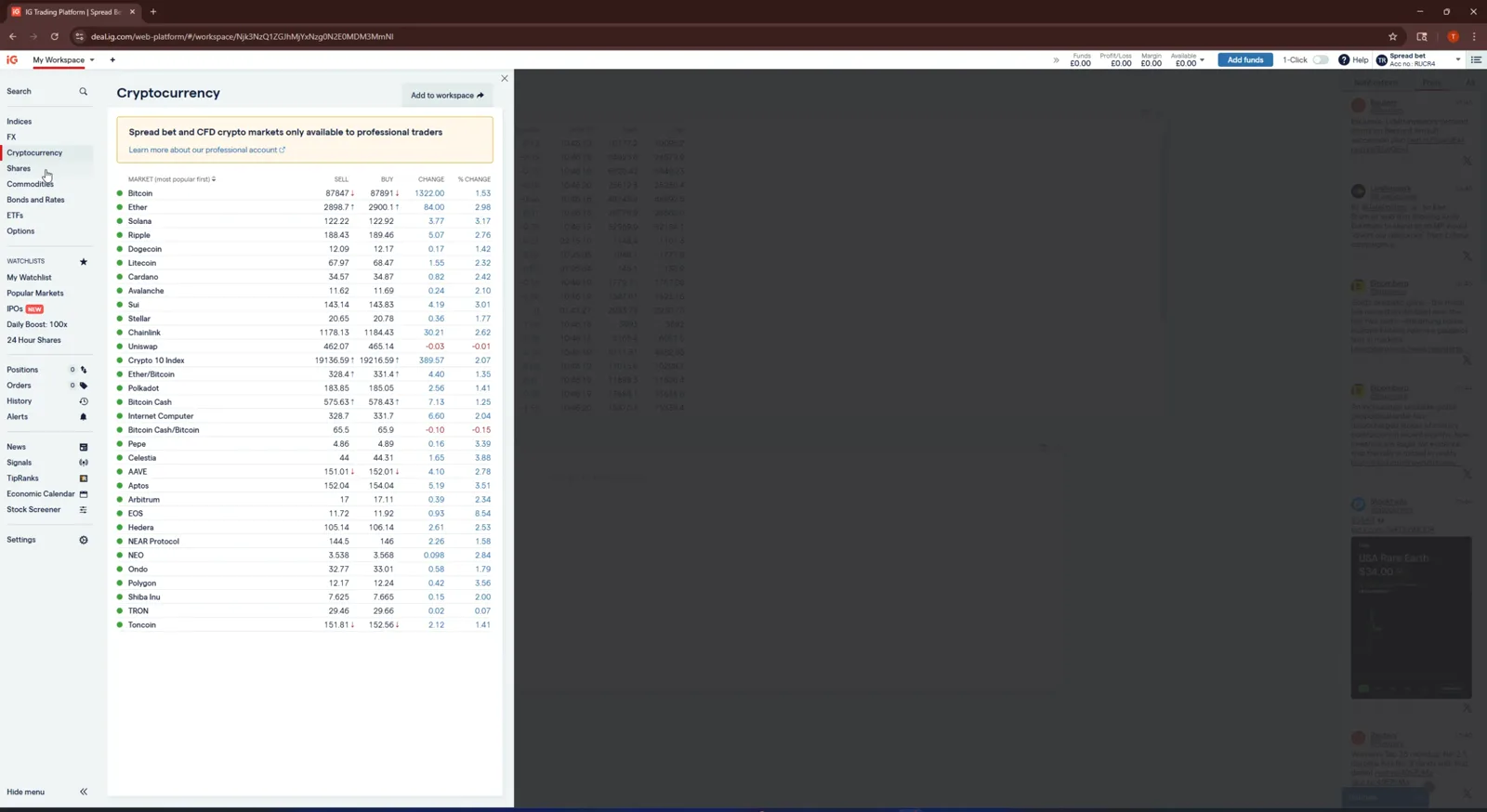
Coinbase lists hundreds of cryptocurrencies against IG's 100 or so, runs staking for UK customers on major proof-of-stake coins (with boosted rewards for Coinbase One members), and lets you withdraw crypto to your own self-custody wallet whenever you like. IG can match none of those today: no staking at all, and external wallet withdrawals still on its roadmap rather than in the product. If earning on your coins or controlling your own keys matters to you, Coinbase is simply playing a game IG has not entered.
A pro venue when you outgrow simple buys
Advanced Trade gives Coinbase users order books, limit orders and the volume-tiered fees above, falling well below IG's altcoin rate for anyone with real turnover. IG's spot crypto, by contrast, currently executes at market price only, with limit orders and stop losses still in development. Active traders will feel that difference inside a week.
How do they compare on regulation and custody?
Both clear the UK bar properly, and the detail is worth a paragraph each because "regulated" is doing different work in each case.
The regulatory positions, precisely
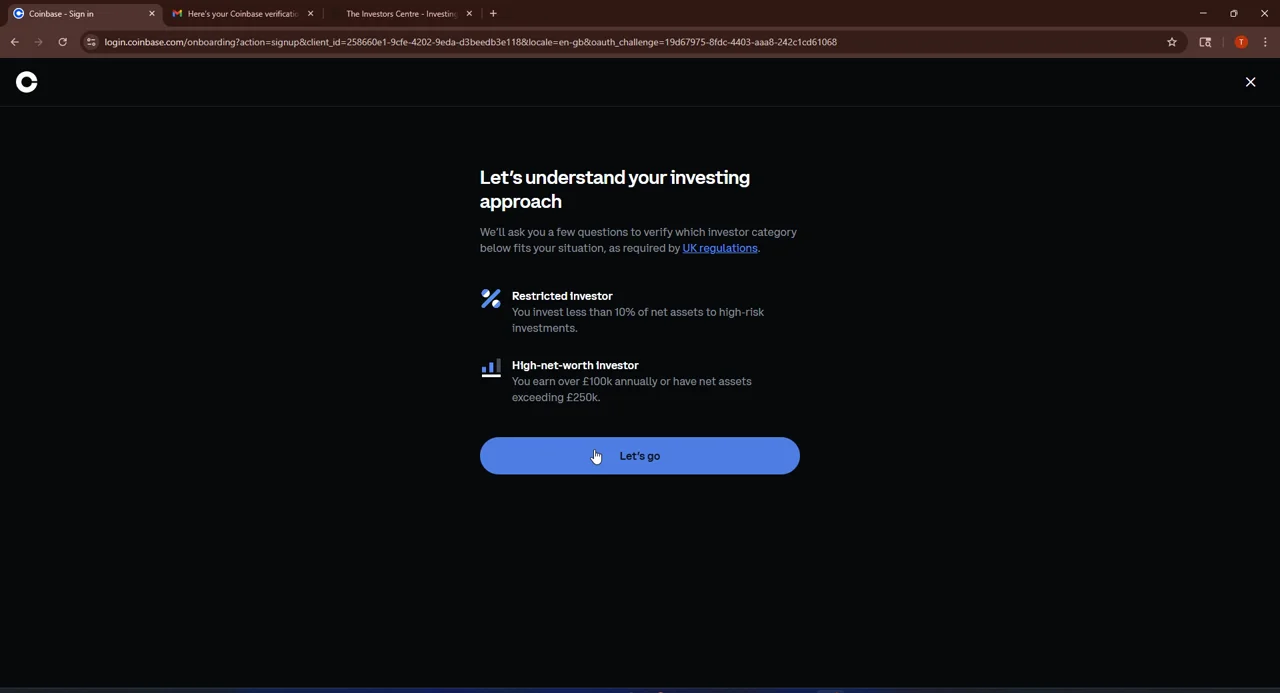
IG is an FCA-authorised broker that added FCA cryptoasset registration in October 2025, the first UK-listed broker to do so. Coinbase operates in the UK through CB Payments Ltd, an FCA-authorised e-money institution (register number 900635) with cryptoasset registration under the money laundering regulations, adding a VASP registration in February 2025 with UK customers migrated onto that entity in April 2025. Different corporate shapes, same practical headline: both are inside the UK perimeter for crypto, and on neither platform does FSCS protection extend to the coins themselves.
Who holds the coins
Coinbase keeps 98% or more of customer assets in cold storage through Coinbase Custody Trust Company, a NYDFS-regulated custodian, and is explicit that customer assets remain the customer's. IG holds customers' coins in their beneficial interest with an institutional custodian, and it is a genuinely pleasing detail of this comparison that the custodian IG names is Coinbase Prime, the institutional arm of the company on the other side of this page. Buy on either platform and, at the custody layer, your Bitcoin may well be sitting on the same rails.
Which one should you use?
If your crypto plan is owning the majors alongside the rest of your investments, IG wins on the numbers and the simplicity: 70 pence per £1,000 on Bitcoin, the fee visible before you buy, one login for everything, no subscription required. If crypto is the destination rather than a holding, Coinbase's coin range, staking, self-custody withdrawals and Advanced Trade make it the fuller platform, provided you steer around the simple-buy pricing that catches casual users, either by learning Advanced Trade or by letting Coinbase One earn its £4.99.
For the rest of the picture, see my walkthrough of buying Bitcoin on IG, my full IG crypto fee analysis, and my comparisons with Kraken and eToro.
FAQs
References
- IG: crypto fees
- Coinbase: Advanced Trade fee tiers
- Coinbase: Coinbase One tiers
- The Investors Centre: my full IG crypto fee analysis