

- expertise:
- Platform Testing, Cryptocurrency, Retail Investing
- credentials:
- Active investor since 2013 · 11+ years experience
- tested:
- 50+ platforms · 200+ guides authored

- expertise:
- Broker Comparison, ISA Strategy, Portfolio Management
- credentials:
- Active investor since 2013 · 11+ years experience
- tested:
- 40+ brokers with funded accounts
How We Test
Real accounts. Real money. Real trades. No demo accounts or press releases.
What we measure:
- Spreads vs advertised rates
- Execution speed and slippage
- Hidden fees (overnight, withdrawal, conversion)
- Actual withdrawal times
Scoring:
Fees (25%) · Platform (20%) · Assets (15%) · Mobile (15%) · Tools (10%) · Support (10%) · Regulation (5%)
Regulatory checks:
FCA Register verification · FSCS protection
Testing team:
Adam Woodhead (investing since 2013), Thomas Drury (Chartered ACII, 2018), Dom Farnell (investing since 2013) — 50+ platforms with funded accounts
Quarterly reviews · Corrections: in**@*******************co.uk
Disclaimer
Not financial advice. Educational content only. We're not FCA authorised. Consult a qualified advisor before investing.
Capital at risk. Investments can fall. Past performance doesn't guarantee future results.
CFD warning. 67-84% of retail accounts lose money trading CFDs. High risk due to leverage.
Contact: in**@*******************co.uk
Quick Answer: Is XTB Good for Day Trading?
For intraday CFD trading on forex, indices and commodities, yes. XTB quotes EUR/USD from 0.8 pips, takes no commission on those CFDs, and settles trades on xStation 5 with one-click execution and no minimum deposit. Two things will decide it for you. There is no MT4, no MT5 and no API, so if your strategy runs on an Expert Advisor or an external bot, XTB cannot host it. And if you day trade US shares rather than CFDs, the 0.5% currency conversion applies on every leg, which on frequent round trips costs more than the commission you saved.
74% of retail investor accounts lose money when trading CFDs with this provider. You should consider whether you can afford to take the high risk of losing your money.
What Actually Matters When You Day Trade
Day trading punishes small costs because you pay them repeatedly. A swing trader holding for three weeks pays the spread twice. Someone taking eight intraday positions pays it sixteen times. So the questions worth asking about any broker are narrow ones: what does the spread cost at the hours I trade, how fast does the order fill, what happens to that fill when news lands, and what does the platform charge me for the privilege of being active.
XTB answers three of those four well. The fourth, execution speed, needs a caveat I will come back to.
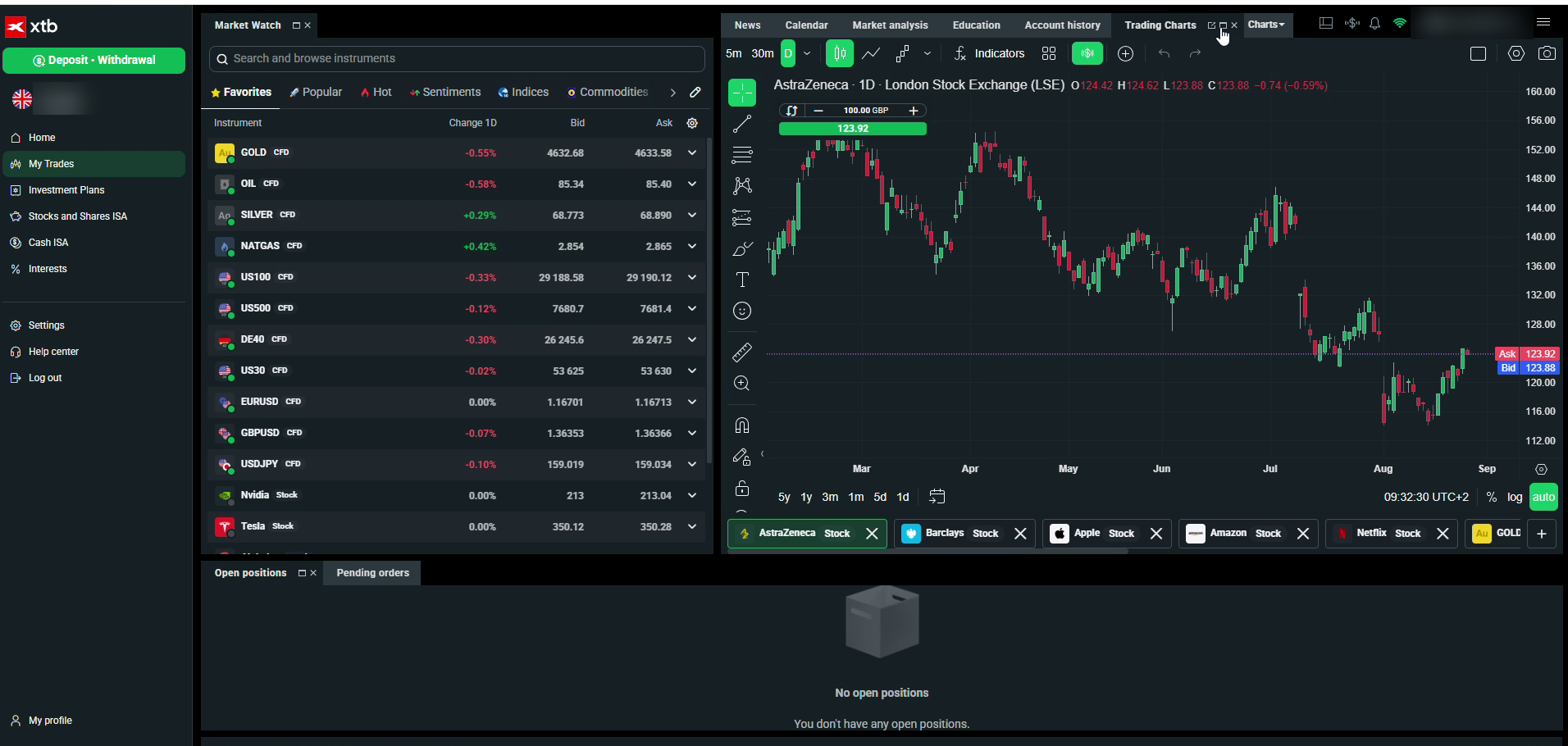
Its published comparison table, dated 13 January 2026, quotes EUR/USD at 0.8 pips, US100 at 0.9 and gold at 0.30. Those are the headline numbers rather than an all-day average, and every broker publishes its best hour, so treat them as a starting point and not a promise. On CFDs there is no separate commission, so the spread is the cost. That makes the maths refreshingly simple compared with brokers running a raw-spread-plus-commission model, where you need two numbers and a calculator before you know what a trade costs.
Execution Speed and What the Numbers Mean
XTB's own August 2026 figure puts the median fill at 85ms, and it publishes a quote-delay figure of 4ms on EUR/USD and 5ms on DE30. Those two numbers measure different things and it is worth separating them, because brokers rarely do.
Quote delay is how quickly a price reaches your screen. Fill time is how long the round trip takes from you clicking to the position appearing. A 4ms quote feed with a slow fill is still a slow broker. XTB's 85ms median sits in the middle of the UK CFD field: on our own timed round of 50 market orders per broker, run from a London office between October 2025 and January 2026, Capital.com filled at a median 24ms and Spreadex at 110ms. XTB was not part of that timed round, so its 85ms is not directly comparable and I have not treated it as though it were. For the ranked results, see our CFD broker latency test.
The practical read: XTB is fast enough for discretionary intraday trading on liquid instruments. If you are scalping the first ten minutes of the London open and counting milliseconds, you should be looking at the brokers that were timed rather than taking a published sample on trust.
What a Day of Trading Actually Costs
Take a trader running six EUR/USD round trips a day at one standard lot. At 0.8 pips, each round trip costs roughly £6.30 at current rates. Six of those is about £38 a day, or £190 across a five-day week, before any overnight funding. Nothing else is deducted: no commission, no ticket charge, no platform fee, and no inactivity fee unless the account sits untouched for a year.
Position sizing goes down to 0.01 lots, which matters more than it sounds. A trader testing a new intraday setup can run it at a hundredth of normal size for a fortnight and get real fills, real slippage and real emotional feedback for a few pounds of spread. Demo accounts do not teach you what it feels like to be wrong with money on the line. Microlots do, cheaply.
Where the costs stop being simple
Day trading real US shares on XTB is a different proposition to trading CFDs. Share dealing is commission-free up to the equivalent of EUR 100,000 of monthly turnover, and 0.2% with a £10 minimum above that. For a day trader, that threshold arrives faster than you would think: six round trips a day at £3,000 a position clears it inside a month.
The bigger drag is the 0.5% currency conversion on non-GBP instruments. Buy and sell a US share the same day and you have converted twice. On a £3,000 position that is £30 of conversion against £0 of commission. The commission-free headline is real, but it describes the part of the cost that is easy to see.
Trading Intraday on xStation 5
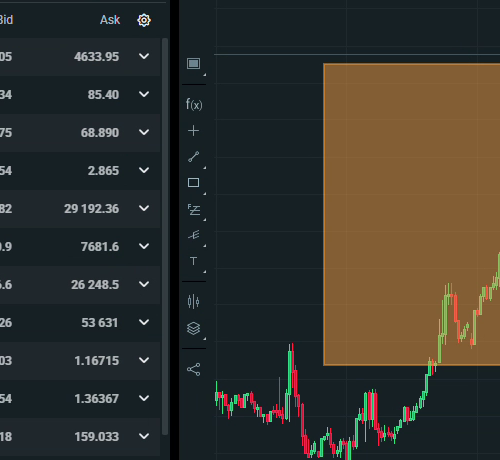
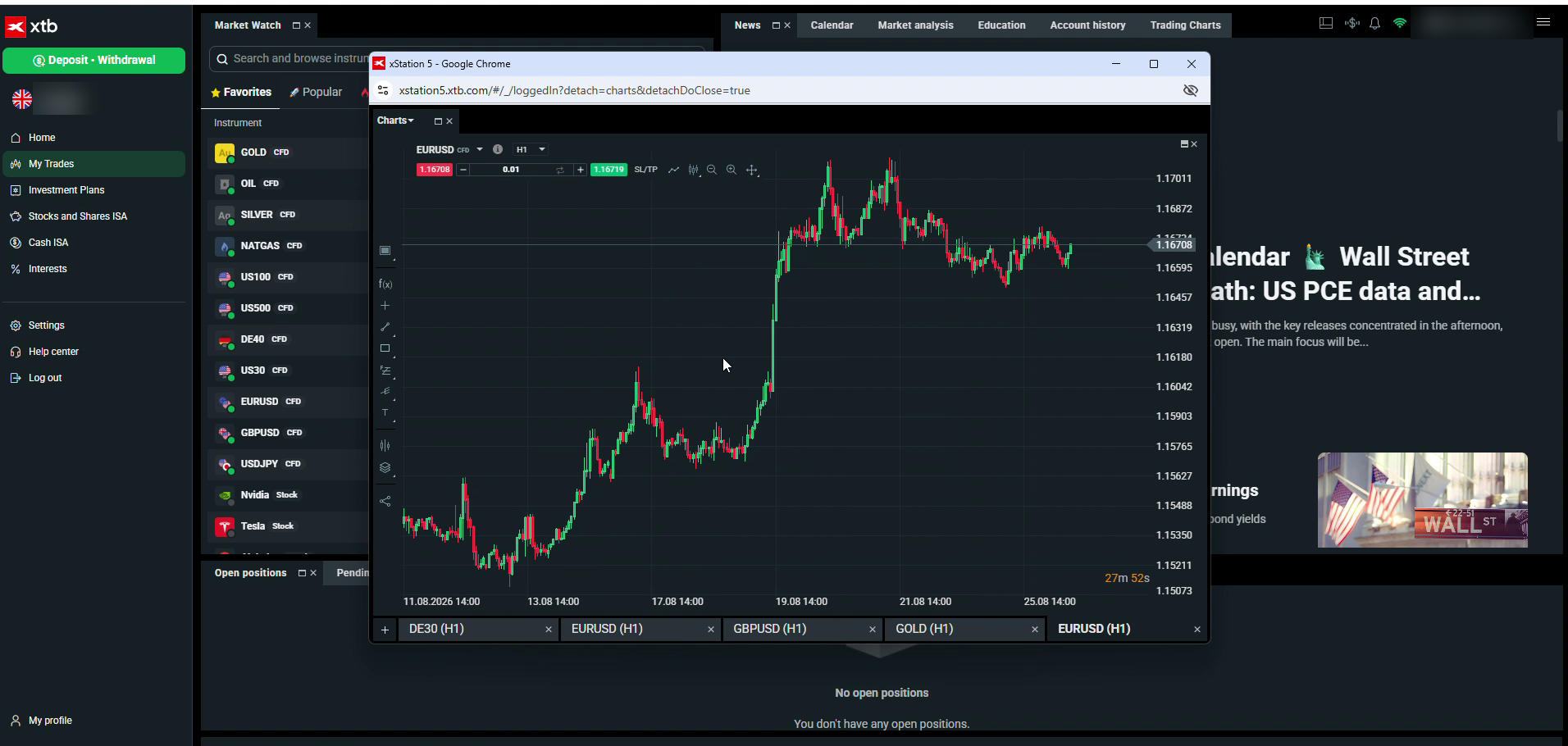
xStation 5 is the only platform XTB offers. Desktop, web and mobile all run the same account, and there is no third-party option. Whether that is a problem depends entirely on how you already work.
For a discretionary trader who wants a chart, a ticket and a position list, it is quick and uncluttered. Order types cover market, limit, stop, and stop-loss and take-profit attached at entry, which is what most intraday strategies need. The mobile app is genuinely usable for managing an open position rather than just watching one, and carries 4.7 on the App Store and 4.5 on Google Play.
For an automated trader it is a dead end. There is no MT4, no MT5, no TradingView integration and no public retail API. If your process depends on an Expert Advisor, a Python bridge or a signal service that writes into a terminal, XTB cannot run it and no workaround exists. That is not a criticism of the platform so much as a hard boundary on who it suits, and it is the single most common reason a day trader will rule XTB out.
What I would want changed
Depth of market is thinner than a dedicated futures or DMA platform would give you. If your entries key off order-book imbalance rather than price action, you will feel the gap. And because one-click execution defaults to off, a trader coming from another platform will fumble their first few entries until they find the setting.
Risk Controls and Leverage Intraday
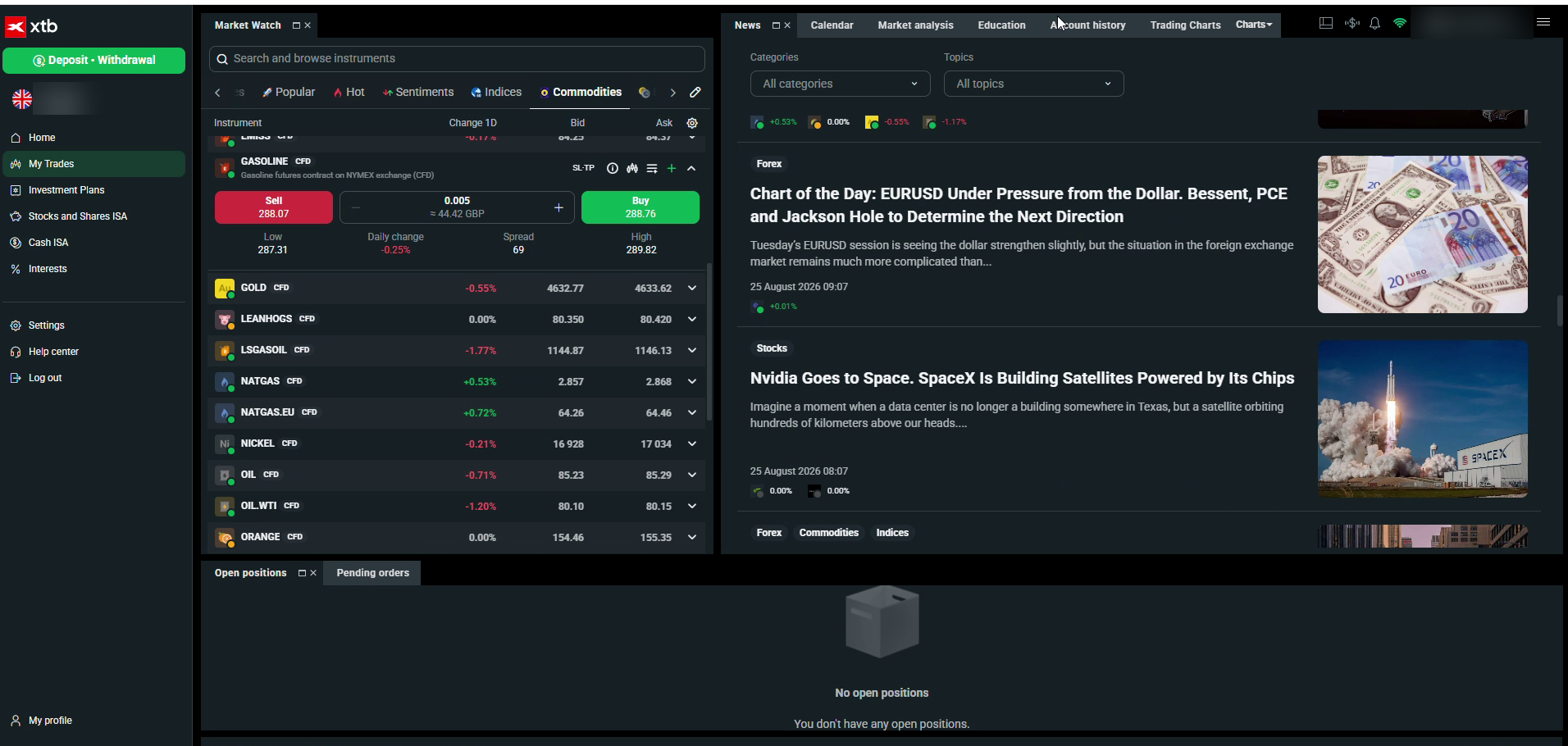
UK retail clients are capped at 30:1 on major currency pairs, 20:1 on major indices and gold, and 10:1 on other commodities. Those limits are regulatory rather than broker-set, so they apply at XTB exactly as they apply everywhere else with an FCA licence. Negative balance protection comes as standard, which matters more intraday than people assume: a gap through your stop on a leveraged index position is precisely the scenario it exists for.
Stop-loss and take-profit attach at the point of entry rather than as a second action afterwards. That sounds trivial and is not. A trader who has to place the stop as a separate order will eventually forget one, and it will be on the position that gaps. Guaranteed stops are not offered, so in a fast market your stop is subject to slippage like anyone else's.
The daily loss limit and position-size defaults are worth setting before your first session rather than after a bad one. xStation lets you fix a default order size, which quietly removes one of the more expensive fat-finger risks in intraday trading.
Who XTB Suits for Day Trading, and Who It Does Not
It suits a discretionary intraday trader working liquid forex, indices and commodities on CFDs, who wants one clear cost per trade and no platform fee. The microlot minimum and the absence of a minimum deposit make it unusually cheap to start properly rather than start on demo. Around 70 currency pairs is enough for any intraday FX strategy that is not hunting exotics.
It does not suit an automated trader, for the reasons above. It does not suit anyone who day trades US shares in size, because the conversion cost compounds. And it does not suit a trader who wants to run intraday positions inside a spread-bet wrapper for tax reasons, because XTB does not offer spread betting at all in the UK. If that is what you are after, our spread betting platform comparison covers the brokers that do.
For where XTB places against the field on cost and execution overall, see our best day trading platforms guide.
What I Did Not Test
XTB was not part of our timed execution round of October 2025 to January 2026, so the 85ms figure quoted above comes from XTB rather than from our own timed round. I have not re-run the 50-order test on XTB, and until I do, the comparison with Capital.com at 24ms and Spreadex at 110ms is indicative rather than like for like.
I have not tested XTB's fills during a scheduled news release, which is where execution quality separates most. I have not held positions overnight in size, so I cannot comment usefully on swap costs at scale. And the spread figures here come from XTB's published comparison table dated 13 January 2026, not from my own tick capture, so they represent the broker's stated pricing rather than a measured average across a session.
Spreads, interest rates and promotional terms all move. Everything above was checked against xtb.com on 26 August 2026.
FAQs
Does XTB charge commission on day trades?
Not on CFDs. The spread is the whole cost, quoted from 0.8 pips on EUR/USD. On real shares and ETFs there is 0% commission up to the equivalent of EUR 100,000 in monthly turnover, then 0.2% with a £10 minimum, plus 0.5% currency conversion on anything not priced in sterling.
Can I run an Expert Advisor or a bot on XTB?
No. XTB runs xStation 5 only, with no MT4, no MT5 and no public retail API. There is no supported route for automated execution.
Is there a minimum deposit for day trading with XTB?
No. Account opening is free, there is no minimum deposit, and deposits and withdrawals are free. Position sizes start at 0.01 lots.
Is XTB regulated in the UK?
Yes. XTB is authorised and regulated by the FCA under firm reference number 522157. You can confirm that on the FCA register before you deposit.
How many currency pairs can I day trade?
Around 70, which covers every major and minor pair plus the more liquid exotics. If your strategy needs thin exotic crosses, check the market list first.
Discussion 0 comments
Be the first to start discussing this topic! Log in or create an account to share your thoughts.
Log In Create Account
No comments yet. Be the first to start discussing this topic!