

- expertise:
- Platform Testing, Cryptocurrency, Retail Investing
- credentials:
- Active investor since 2013 · 11+ years experience
- tested:
- 50+ platforms · 200+ guides authored

- expertise:
- Broker Comparison, ISA Strategy, Portfolio Management
- credentials:
- Active investor since 2013 · 11+ years experience
- tested:
- 40+ brokers with funded accounts
How We Test
Real accounts. Real money. Real trades. No demo accounts or press releases.
What we measure:
- Spreads vs advertised rates
- Execution speed and slippage
- Hidden fees (overnight, withdrawal, conversion)
- Actual withdrawal times
Scoring:
Fees (25%) · Platform (20%) · Assets (15%) · Mobile (15%) · Tools (10%) · Support (10%) · Regulation (5%)
Regulatory checks:
FCA Register verification · FSCS protection
Testing team:
Adam Woodhead (investing since 2013), Thomas Drury (Chartered ACII, 2018), Dom Farnell (investing since 2013) — 50+ platforms with funded accounts
Quarterly reviews · Corrections: in**@*******************co.uk
Disclaimer
Not financial advice. Educational content only. We're not FCA authorised. Consult a qualified advisor before investing.
Capital at risk. Investments can fall. Past performance doesn't guarantee future results.
CFD warning. 67-84% of retail accounts lose money trading CFDs. High risk due to leverage.
Contact: in**@*******************co.uk
Quick Answer: which CFD trading platform is best for UK beginners in 2026?
Capital.com is the strongest CFD trading platform for UK beginners across the five FCA-regulated brokers I funded and tested in January 2026. It onboards fastest (under eight minutes to first demo trade), carries the lowest minimum deposit on this list (£20), and the order ticket shows pound-denominated profit and loss before you confirm a trade.
- Best overall for UK beginners: Capital.com
- Best for learning by watching other traders: eToro
- Best for trying CFDs and spread betting side by side: Spreadex
- Best for in-platform CFD education: IG
- Best for execution-quality benchmarking: Pepperstone
For the wider field across all experience levels, see my full CFD platform rankings.
The five best CFD platforms for UK beginners — at a glance

Capital.com
- Best For
- New CFD traders
- TIC Score
- 4.8 / 5
- Community Rating
- 4.3 (205 ratings) Have Your Say →
- Min Deposit
- £20
- Demo
- Unlimited
61% of Retail CFD Accounts Lose Money

eToro
- Best For
- Learning via copy-trading
- TIC Score
- 4.5 / 5
- Community Rating
- 4.3 (266 ratings) Have Your Say →
- Min Deposit
- $100 (~£80)
- Demo
- Unlimited $100k
52% of retail CFD accounts lose money when trading CFDs with this provider.

Spreadex
- Best For
- Spread betting + CFDs
- TIC Score
- 4.3 / 5
- Community Rating
- 4.3 (232 ratings) Have Your Say →
- Min Deposit
- £0
- Demo
- Unlimited
65% of retail CFD accounts lose money.

IG
- Best For
- In-platform CFD education
- TIC Score
- 4.0 / 5
- Community Rating
- 4.3 (275 ratings) Have Your Say →
- Min Deposit
- £250 suggested
- Demo
- Unlimited
69% of retail CFD accounts lose money.

Pepperstone
- Best For
- Execution-quality benchmarking
- TIC Score
- 3.8 / 5
- Community Rating
- 4.4 (281 ratings) Have Your Say →
- Min Deposit
- £0
- Demo
- Unlimited proprietary
72.9% of retail CFD accounts lose money.
Beginner CFD platform comparison
FCA registration, demo type, beginner-readable interface rating, support response time and how long each broker has been operating.
| Rank | Broker | FCA FRN | Min Deposit | Demo | Beginner UI | Support Reply | Year Established |
|---|---|---|---|---|---|---|---|
| #1 | Capital.com | 793714 | £20 | Unlimited | Excellent | 1 min 12 sec | 2016 |
| #2 | eToro | 583263 | $100 | Unlimited | Good | 3 min 40 sec | 2007 |
| #3 | Spreadex | 190941 | £0 | Unlimited | Good | 2 min 05 sec | 1999 |
| #4 | IG | 195355 | £250 | Unlimited | Complex | 2 min 15 sec | 1974 |
| #5 | Pepperstone | 684312 | £0 | Unlimited (proprietary) | Mixed | 1 min 30 sec | 2010 |
FCA reference numbers link directly to the FCA Register. FSCS protection covers eligible claimants up to £85,000 per person, per firm. Beginner UI: Excellent = navigable on day one without a guide; Complex = needs a structured course; Mixed = depends on platform variant. Support reply times: one identical question (“how do I set a stop-loss on UK 100?”) sent during testing.
Capital.com — best overall CFD platform for UK beginners
- Onboarding
- 5.0
- Demo
- 4.8
- Education
- 4.5
- Support
- 5.0
- FCA
- 5.0
Capital.com is the platform I would put in front of a friend who had never traded a CFD before. Two things explain the ranking: the onboarding finished in under eight minutes from registering to placing my first demo trade, and the order ticket displays pound-denominated profit and loss before you click confirm — the single most useful interface choice on this list for someone sizing leverage for the first time. The market range is smaller than IG’s (~5,000 instruments versus ~19,000), but for a UK beginner’s first six to twelve months that range covers everything you would realistically trade.

Pros
- Fastest onboarding on this list (~8 minutes to first demo trade)
- Order ticket shows pound P&L before you confirm
- £20 minimum deposit — lowest on this comparison
- No commission, no deposit/withdrawal/inactivity fees
Cons
- Smaller market range than IG (~5,000 vs ~19,000)
- No direct market access for share CFDs
- Demo spreads slightly tighter than live (0.8 vs 1.0 on UK 100)
Why does Capital.com’s order ticket matter for a UK beginner?
The web platform loads into a clean dashboard with six labelled icons and no ticker tape. Placing a demo trade takes three clicks. The order ticket is the difference: before you confirm, the screen shows the pound P&L for a one-point move and the margin requirement for the position size you have selected. A beginner sees what £20 of margin actually controls before risking it — a clarity none of the other four platforms in this comparison provide as cleanly. On a £200 account running 10 trades a month, total spread cost was about £6.40 (the cheapest of the five), with no commission and no deposit or withdrawal fees.

Capital.com specifications
| Metric | Value |
|---|---|
| FCA FRN | 793714 |
| Year established | 2016 |
| Indices available | ~25 |
| FTSE 100 spread (test) | ~1.0 pts |
| EUR/USD spread (test) | ~0.6 pips |
| Spread betting | Yes |
| Demo account | Unlimited, mirrors live |
| Platforms | Proprietary, MT4, TradingView |
| Min. deposit | £20 |
eToro — best for learning via copy-trading
- Onboarding
- 4.5
- Demo
- 5.0
- Education
- 4.5
- Support
- 3.8
- FCA
- 5.0
eToro is where I started trading in 2018, and where most UK beginners I have spoken to placed their first leveraged trade. The platform’s social feed sits front and centre, and CopyTrader — the feature that mirrors another trader’s positions automatically — is genuinely useful as a learning tool when treated as research rather than passive income. The honest caveat: feed-watching is not the same as learning, and the most-copied traders during my testing carried 12-month returns that looked attractive on the surface but came with drawdowns of 15–25% along the way.

Pros
- CopyTrader as a research tool for risk-tolerance and strategy
- Unlimited demo with $100k virtual balance, no expiry
- Cleanest mobile experience of the five
- Strong FCA + multi-jurisdiction regulation
Cons
- ~53% wider CFD spreads than Capital.com on like-for-like instruments
- No spread betting (CFDs only, profits sit under CGT)
- Proprietary platform only — no MT4/MT5
- Slowest support response of the five (3 min 40 sec)
How should a UK beginner use eToro’s CopyTrader without falling into the trap?
The trap is reading the social feed as a strategy recommendation. The use is treating it as anthropology — allocating a small amount to copy a trader, observing their entries and drawdowns, and trying to articulate why they took each trade. If you cannot articulate the reasoning, the trader is not teaching you anything you can repeat. Costs are the other concern: EUR/USD averaged 1.0 pips on eToro versus 0.6 pips on Capital.com, and UK 100 averaged 1.5 points versus 1.0. Over the same 10-trade pattern, eToro cost about £9.80 in spreads — roughly 53% more than the cheapest broker on this list.
eToro specifications
| Metric | Value |
|---|---|
| FCA FRN | 583263 |
| Year established | 2007 |
| Indices available | ~20 |
| FTSE 100 spread (test) | ~1.5 pts |
| EUR/USD spread (test) | ~1.0 pips |
| Spread betting | No |
| Demo account | Unlimited, $100,000 virtual |
| Platforms | Proprietary only |
| Min. deposit | $100 (~£80) |
Spreadex — best for trying spread betting and CFDs side by side
- Onboarding
- 4.2
- Demo
- 4.0
- Education
- 3.8
- Support
- 4.5
- FCA
- 5.0
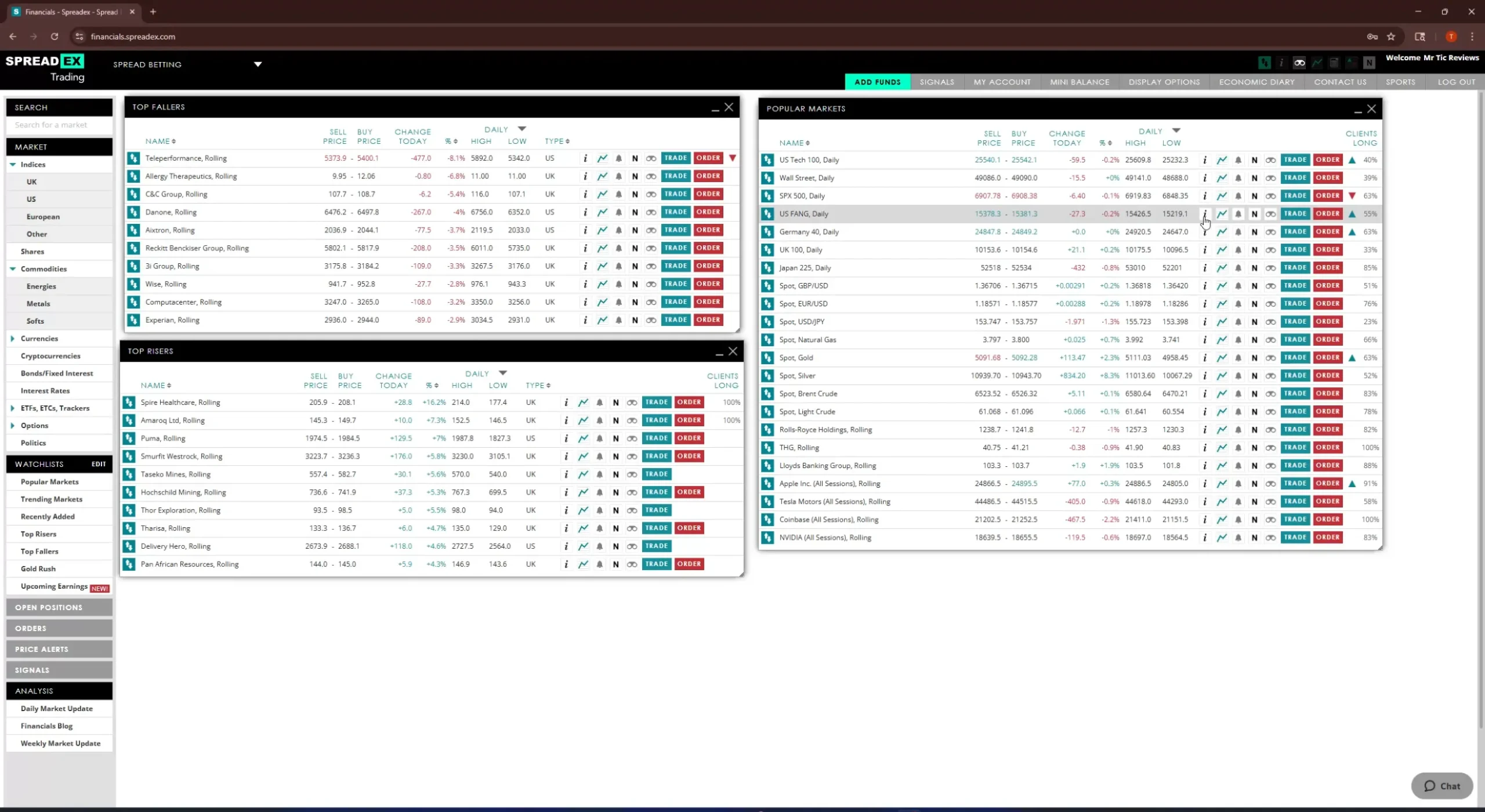
Spreadex is the only broker on this list — and one of the few in the UK — that lets a trader hold a tax-free spread bet and a CFD on the same instrument from a single login. For a UK beginner trying to decide between the two products before committing, this is a genuinely useful learning environment. The firm has been operating since 1999, the parent company is listed on the London Stock Exchange, and the £0 minimum deposit is the joint-lowest on this comparison.
Pros
- Dual spread-bet + CFD account from one login
- £0 minimum deposit (joint-lowest)
- 25+ years UK operating history, LSE-listed parent
- No deposit/withdrawal/inactivity fees
Cons
- No MetaTrader support
- Mobile app less polished than Capital.com’s
- In-platform education thinner than IG Academy
Why does Spreadex stand out for UK beginners weighing CFDs versus spread betting?
Spreadex is the practical answer to the most common question a UK beginner asks: should I use CFDs or spread betting? Once verified, you can hold a £1-per-point spread bet on UK 100 alongside a £5-notional CFD on the same instrument and watch the difference in profit-and-loss treatment, tax exposure and execution behaviour in real time. No other broker on this list lets you compare the two products that directly. Spreads were comparable to Capital.com on most pairs — UK 100 around 1.0 points, EUR/USD around 0.6 pips — with no commission, no deposit fees and no inactivity fees on the standard account. Total monthly cost across the 10-trade pattern was roughly £7.20.
Spreadex specifications
| Metric | Value |
|---|---|
| FCA FRN | 190941 |
| Year established | 1999 |
| LSE-listed parent | Yes |
| Indices available | ~30 |
| FTSE 100 spread (test) | ~1.0 pts |
| GBP/USD spread (test) | ~0.9 pips |
| Spread betting | Yes (alongside CFDs in one account) |
| Demo account | Unlimited |
| Platforms | Proprietary, TradingView |
| Min. deposit | £0 |
IG — best for in-platform CFD education
- Onboarding
- 3.8
- Demo
- 4.5
- Education
- 5.0
- Support
- 4.2
- FCA
- 5.0
IG is the UK’s most established CFD broker — nearly 50 years of operating history and around 19,000 markets. I ranked IG fourth for beginners specifically because the platform is more complex than necessary for a first trade and the £250 suggested minimum is the highest on this list. The reason to keep IG in the comparison is IG Academy: the strongest free structured CFD education available to UK retail traders, accessible from a free demo account before you have funded anything.

Pros
- IG Academy — deepest free structured beginner education on this list
- Broadest market range (~19,000 instruments)
- TradingView integrated directly since late 2025
- 50-year operating history, FTSE-listed
Cons
- £250 suggested minimum — highest on this comparison
- Multi-panel default layout overwhelms first-time traders
- Slowest sign-up of the five (~18 minutes)
Why open an IG demo even if you trade elsewhere?
IG Academy lives behind the demo account login. The course library moves from foundational concepts (“What is a financial market?”) through to advanced technical analysis, with quizzes throughout and progress tracking. A UK beginner can complete the early modules in two or three evenings and arrive at their first live trade — on whatever platform they end up using — with a much firmer grasp of leverage, margin and risk than they would have without it. The IG sign-up itself is the slowest on this list at around 18 minutes, and the multi-panel default layout is more than a beginner needs on day one. None of that matters if the demo is open purely for the courses.
IG specifications
| Metric | Value |
|---|---|
| FCA FRN | 195355 |
| Year established | 1974 |
| Indices available | ~80 |
| FTSE 100 spread (test) | ~1.0 pts |
| EUR/USD spread (test) | ~0.6 pips |
| Spread betting | Yes |
| Demo account | Unlimited, £10,000 virtual |
| Platforms | Proprietary, MT4, ProRealTime, TradingView, L2 Dealer |
| Min. deposit | £250 suggested |
Pepperstone — best for execution-quality benchmarking
- Onboarding
- 3.5
- Demo
- 4.5
- Education
- 4.0
- Support
- 4.2
- FCA
- 5.0
Pepperstone has the tightest raw spreads on this list — 0.4 points on S&P 500 on the Razor account — and the most realistic demo of the five (within 0.1 pips of live execution). I still ranked it fifth for beginners because the platform asks too many questions before placing a first trade. Standard or Razor account type. Then proprietary web, MT4, MT5, cTrader or TradingView. For a beginner who does not yet know the difference between Standard and Razor pricing, this is decision fatigue at the worst moment.

Pros
- Tightest raw spreads on this list (S&P 500 ~0.4 pts on Razor)
- Most accurate demo-to-live replication (within 0.1 pips)
- Strong structured video education
- £0 minimum deposit
Cons
- Five platform choices before your first trade
- Standard vs Razor account-type decision needs prior knowledge
- MT4/MT5 demos expire after 30–60 days
Why does Pepperstone’s onboarding ask too much of a UK beginner?
Pepperstone’s strengths only show up once you know what you are looking at — a beginner placing their first ten trades is unlikely to notice that EUR/USD costs 0.6 pips on Capital.com versus an effective 0.45 pips on Pepperstone Razor. What they will notice is the platform asking them to choose between Standard and Razor pricing, then between five trading platforms, before placing a single demo order. Pepperstone earns its place on this list as the broker a UK beginner graduates to once they have built a stable trading routine and start optimising for execution quality — not as the platform to start on. The free demo is worth keeping open in parallel even if you fund elsewhere first, because the demo-to-live spread replication is the most realistic on this list.
Pepperstone specifications
| Metric | Value |
|---|---|
| FCA FRN | 684312 |
| Year established | 2010 |
| Indices available | ~25 |
| FTSE 100 spread (test) | ~1.0 pts |
| S&P 500 spread (test) | ~0.4 pts (Razor) |
| Spread betting | Yes |
| Demo account | Unlimited proprietary; 30–60 day MT4/MT5 |
| Platforms | Proprietary, MT4, MT5, cTrader, TradingView |
| Min. deposit | £0 |
What every UK beginner needs to know about trading CFDs
How much money does a UK beginner need to start trading CFDs?
Minimum deposits on this list range from £0 (Spreadex, Pepperstone) to £250 (IG suggested), but the regulatory minimum is rarely the practical minimum. With £50 in an account, a single losing trade can erase 20–30% of the balance at retail leverage — a difficult emotional environment for a beginner to learn in. A more workable starting balance is £200–£500, ideally after spending time on a demo first — for practice environments side by side, see my testing of the best trading demo accounts. The FCA caps retail leverage at 30:1 for major forex pairs, 20:1 for major indices, 10:1 for commodities, 5:1 for individual shares and 2:1 for crypto CFDs — ceilings, not targets. On a £200 account, full 30:1 leverage means a 3.3% adverse move closes the entire balance. For a walkthrough of how the close-out mechanic actually fires, see what is a margin call.

What FCA protections do UK beginners get on these CFD platforms?
All five brokers clear the same regulatory floor: segregated client funds, negative balance protection (the platform must close positions before your balance goes below zero), FCA leverage caps applied automatically to retail accounts, and FSCS coverage up to £85,000 per person, per firm if the broker fails. Verify any broker’s status directly on the FCA Register — every FRN in the comparison table above links straight there.
Should a UK beginner choose CFDs or spread betting?
Both products give you leveraged exposure to the same instrument and the on-screen mechanics are nearly identical. What changes is HMRC’s tax treatment.
How are CFDs and spread betting taxed for UK retail traders?
CFDs are priced in the underlying asset’s currency. Profits sit under Capital Gains Tax with a £3,000 annual allowance for 2025/26; above the allowance, basic-rate taxpayers pay 18% and higher-rate taxpayers 24%. Losses can be offset against other capital gains. Spread betting is priced in pounds per point and is currently exempt from CGT and stamp duty for most UK retail traders, because HMRC classifies it as gambling rather than investment — but losses cannot be offset against other gains. Capital.com, Spreadex, IG and Pepperstone offer both products; eToro offers CFDs only. Spreadex is the only one of the five that lets you hold a spread bet and a CFD on the same instrument from a single login. For the broader spread-betting shortlist see best spread-betting brokers; for the side-by-side mechanics see spread betting vs CFDs. None of this is tax advice — speak to an accountant if your circumstances are unusual.
Why aren’t certain CFD brokers on this list for UK beginners?
Plus500 (FRN 509909) is heavily advertised but stripped down — no MT4, no TradingView, narrow analytical tooling. CMC Markets (FRN 173730) is a strong platform whose interface complexity matches IG’s, with a steeper learning curve than Capital.com’s. City Index (FRN 446717) is capable but does not perform best on any of the beginner axes — for the safety question see our is City Index safe review. Interactive Brokers assumes meaningful prior experience. XTB withdrew from the UK retail market in 2024.
How I tested these CFD platforms
I opened live funded accounts with all five brokers between October 2025 and January 2026, ran an identical 10-trade pattern across UK 100, EUR/GBP and EUR/USD on each one, and re-ran the new-user onboarding as a beginner. Each broker was scored against five axes — onboarding, demo realism, in-platform education, support response, and FCA protections — weighted 1–5 to produce the Beginner Score in each profile. The Trustpilot rating is a separate third-party score, shown alongside so you can see where my scoring agrees with retail consensus. For full methodology, deposit and withdrawal receipts, and support-chat transcripts, see my How We Test page.
References
- Financial Conduct Authority — Contract for differences | FCA
- Financial Conduct Authority — FCA Register. Available at: register.fca.org.uk
- FCA Policy Statement PS19/18 — Restrictions on the sale of CFDs to retail clients
- HM Revenue & Customs — Capital Gains Tax rates and allowances
- Financial Services Compensation Scheme — Protection limits
- Capital.com — Fee schedule and risk disclosure
- eToro — Fee schedule and CopyTrader terms
- IG — Fee schedule and IG Academy
- Pepperstone — Fee schedule and platform options
- Spreadex — Fee schedule and account terms
Discuss UK CFD Platforms for Beginners
New to CFDs? Share which broker felt clearest on costs, what your first funded trade looked like, and where the platform helped or got in the way. Our community earns Equity for quality contributions.
Discussion 0 comments
Be the first to start discussing this topic! Log in or create an account to share your thoughts.
Log In Create Account
No comments yet. Be the first to start discussing this topic!