

- expertise:
- CFD Trading, Forex, Derivatives, Risk Management
- credentials:
- Chartered ACII (2018) · Trading since 2012
- tested:
- 40+ forex & CFD platforms with live accounts

- expertise:
- Platform Testing, Cryptocurrency, Retail Investing
- credentials:
- Active investor since 2013 · 11+ years experience
- tested:
- 50+ platforms · 200+ guides authored
How We Test
Real accounts. Real money. Real trades. No demo accounts or press releases.
What we measure:
- Spreads vs advertised rates
- Execution speed and slippage
- Hidden fees (overnight, withdrawal, conversion)
- Actual withdrawal times
Scoring:
Fees (25%) · Platform (20%) · Assets (15%) · Mobile (15%) · Tools (10%) · Support (10%) · Regulation (5%)
Regulatory checks:
FCA Register verification · FSCS protection
Testing team:
Adam Woodhead (investing since 2013), Thomas Drury (Chartered ACII, 2018), Dom Farnell (investing since 2013) — 50+ platforms with funded accounts
Quarterly reviews · Corrections: in**@*******************co.uk
Disclaimer
Not financial advice. Educational content only. We're not FCA authorised. Consult a qualified advisor before investing.
Capital at risk. Investments can fall. Past performance doesn't guarantee future results.
CFD warning. 67-84% of retail accounts lose money trading CFDs. High risk due to leverage.
Contact: in**@*******************co.uk
A Margin Call Means You've Already Lost Control
A margin call isn't a warning. It's a consequence. By the time your broker sends that email — or more likely, by the time you notice the alert buried in your platform notifications — the market has already moved against you, your account equity has already dropped below the required level, and your positions are already at risk of being closed without your input.
I've seen traders treat margin calls like a nudge to top up and carry on. That's the wrong instinct. A margin call is your broker telling you the buffer between your open positions and a forced close-out has shrunk to almost nothing. If you're getting started with day trading or using leveraged products for the first time, understanding this mechanism before it fires is what separates controlled risk-taking from gambling.
Here's the plain answer. A margin call occurs when the equity in your trading account — your deposited cash plus or minus any unrealised profits or losses — falls below the margin your broker requires to keep your positions open. In the UK, this typically means your equity has dropped to 100% of your total margin requirement. If it keeps falling to 50%, your broker starts closing positions automatically. That 50% threshold is mandated by the FCA under rules made permanent on 1 August 2019 (PS19/18).
The word "call" is misleading. Decades ago, a dealer would phone and ask you to wire funds. Today, it's automated. Some brokers email at 100%, again at 75%, then auto-liquidate at 50%. If your equity drops from above 100% to below 50% within seconds — which absolutely can happen during a flash crash — you won't receive any notification before your trades are gone.
How Margin Works in UK Spread Betting and CFDs
Two types of margin apply to every leveraged trade in the UK.
Deposit margin (initial margin) is what you put up to open a position. To spread bet on the FTSE 100 at £5 per point with the index at 8,200, your total exposure is £41,000. At the FCA's 5% margin rate for major indices, you'd need £2,050.
Maintenance margin is what your broker needs you to keep in the account to hold that position open. If your equity drops below this because the FTSE falls and your unrealised loss grows, you're on margin call.
Both spread bets and CFDs carry identical margin mechanics, but spread betting profits are currently exempt from Capital Gains Tax and Stamp Duty under HMRC rules. If you've compared spread betting brokers, the margin call process is the same across both products — but the tax treatment of your losses and recoveries differs.
The Maths Behind a Margin Call — A GBP Worked Example
Most guides use hypothetical round numbers. Here's a realistic FTSE 100 spread bet example using GBP.
You open a long spread bet at £5 per point. The FTSE is at 8,200.
| Detail | Value |
|---|---|
| Total exposure | £5 × 8,200 = £41,000 |
| Margin required (5%) | £2,050 |
| Account balance | £3,000 |
| Opening margin level | (£3,000 ÷ £2,050) × 100 = 146% |
The FTSE drops 200 points to 8,000. Loss: £5 × 200 = £1,000. Your equity is now £2,000 and your margin level is 97.6% — margin call triggered.
You do nothing. The FTSE hits 7,795. Loss: £5 × 405 = £2,025. Your equity is now £975 and your margin level is 47.6% — automatic close-out.
You've lost £2,025 from a £3,000 account. The entire move — 8,200 to 7,795 — is a 4.9% decline. That's a bad day, not a crash. But with 20:1 effective leverage, a 4.9% index drop wiped out 67.5% of your capital.

What Happens When You Get a Margin Call
The FCA's rules create a standardised process for retail clients:
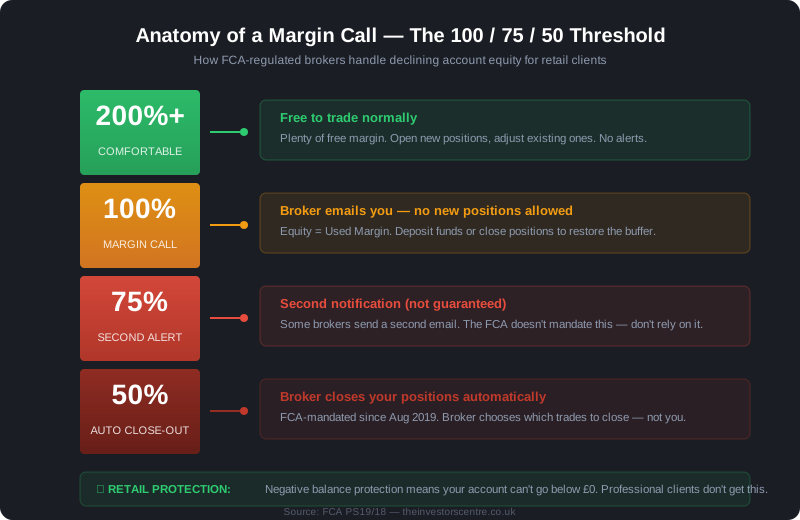
100% — First alert. Your equity equals your used margin. Most brokers send an email. You can't open new positions, but existing ones stay open. This is your window to act.
75% — Second alert. Some brokers send another notification. The FCA doesn't mandate this step — don't rely on receiving it.
50% — Automatic close-out. Your broker liquidates positions to bring your account back above the required level. They choose which positions to close, not you.
One detail most guides skip: the 50% rule applies to your total margin across all open positions, not individual trades. A losing FTSE spread bet can trigger a close-out that also kills your profitable GBP/USD position if combined equity falls below 50% of the combined margin. Traders running correlated positions — long FTSE, long GBP/USD, long a UK bank stock — are particularly vulnerable. When the UK market sells off, all three move against you simultaneously.
The FCA Rules That Protect You (and Their Limits)
In 2018, ESMA introduced temporary restrictions on CFDs and spread bets sold to retail clients. The FCA made these permanent from 1 August 2019. Three protections matter:
Leverage caps. 30:1 on major forex pairs, 20:1 on non-major forex/gold/major indices, 10:1 on other commodities, 5:1 on individual equities, 2:1 on cryptocurrencies. Before 2018, some brokers offered 200:1 or higher. At 500:1 leverage, a 0.2% adverse move wipes your entire margin.
The 50% margin close-out rule. Brokers must begin closing positions when retail client equity falls to 50% of the total margin requirement, calculated per-account.
Negative balance protection. Your account can't go below zero. If the market gaps through your close-out level, the broker absorbs the excess loss.

Professional clients get none of this. If you qualify for professional status — meeting at least two of three criteria: sufficient trading frequency, portfolio size over €500,000, or relevant financial services experience — you gain higher leverage but lose the close-out protection and the negative balance guarantee. Most retail traders chasing professional status are doing it for the wrong reason. The extra leverage isn't an advantage without the risk discipline to survive without a safety net.
The Swiss Franc Crisis — When Margin Calls Fail
On 15 January 2015, the Swiss National Bank removed its three-year-old cap on the franc's value against the euro. EUR/CHF, defended at a floor of 1.20, collapsed below 0.85 within minutes — an 18%+ move in a market that normally fluctuates by fractions of a percent daily.
UK traders short the franc were obliterated. Stop losses didn't execute because there were no buyers at intermediate prices. Margin calls fired, but the close-out system couldn't act fast enough. Alpari UK, FCA-regulated and based in London, announced insolvency on 16 January 2015. The company stated that client losses had exceeded their deposits, creating debts it couldn't recover. KPMG was appointed as special administrator on 19 January.
For anyone shorting stocks in the UK or holding leveraged positions, the lesson is blunt: margin calls assume orderly markets. When the market gaps, the entire mechanism breaks. That's precisely why the FCA introduced negative balance protection — but it only prevents you owing your broker money. It doesn't stop you losing everything in your account.
How to Avoid a Margin Call
Don't use all your margin. If you deposit £3,000 and open a position requiring £2,050 in margin, your free margin is just £950. Never use more than 50% of your account equity as margin for open positions.
Size positions properly. Risk 1-2% of your total account per trade. On a £5,000 account, that's £50-£100 of risk. Work backwards from your stop loss distance to determine position size.
Use stop losses on every trade. A stop loss won't prevent a margin call if the market gaps, but in normal conditions it closes a losing position before your equity deteriorates to danger. Pay for a guaranteed stop if you want certainty.
Avoid correlated positions. Three long positions on the FTSE, a UK bank stock, and GBP/USD means you're tripling your exposure to "UK does badly." When correlation kicks in, your margin level drops three times faster than expected.
Monitor margin level, not just P&L. Above 200% is comfortable. Between 100-200%, actively manage. Below 100%, you're already in trouble.
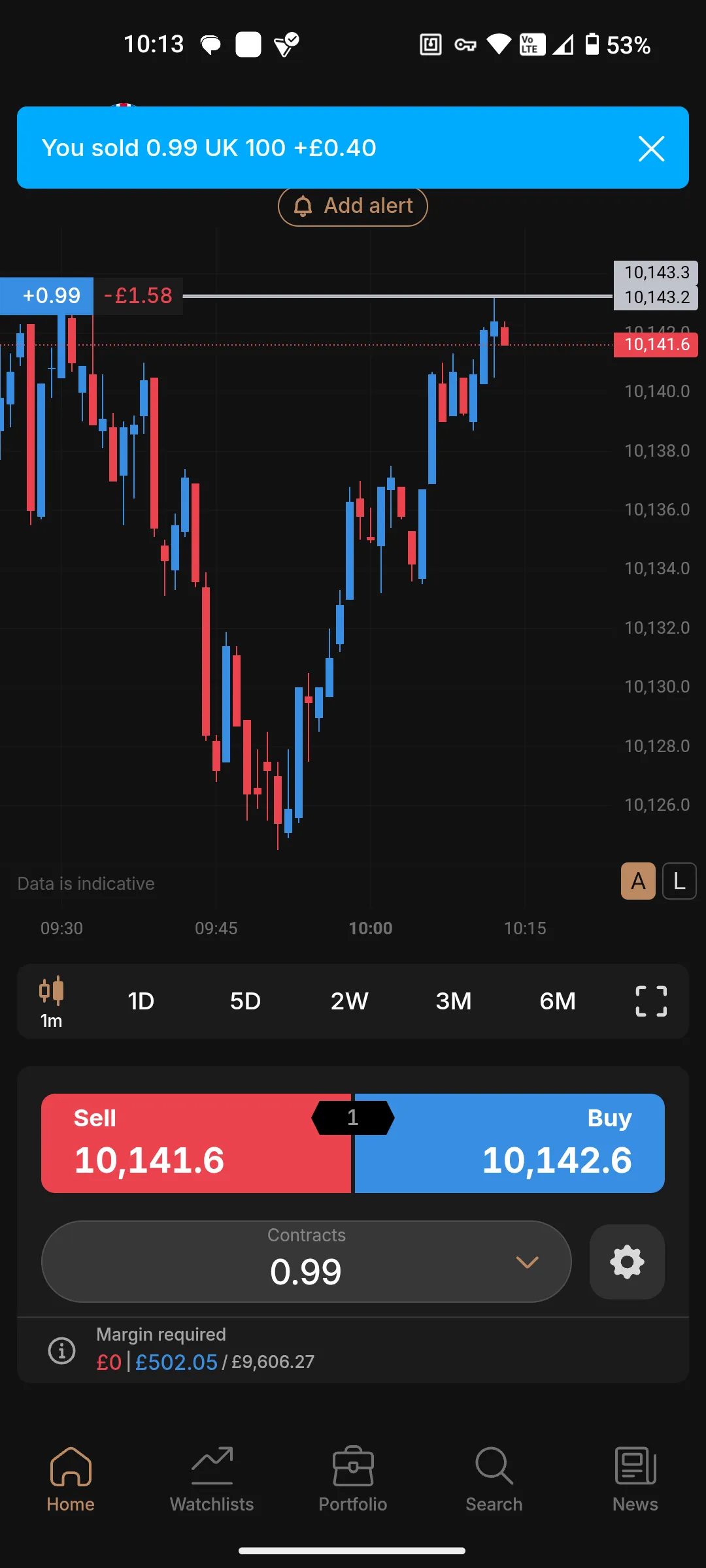
If you're not yet confident, practise with a demo account first — every major UK broker offers one. For a more systematic approach to entries, a solid pattern recognition guide helps you place stop losses logically, reducing the chance of being margin called by normal market noise.
Discuss Margin Calls
Ever hit a margin call? Share what triggered it, how your broker handled it, and what you changed afterwards. Our community earns Equity for quality contributions.
Discussion 0 comments
Be the first to start discussing this topic! Log in or create an account to share your thoughts.
Log In Create AccountFAQs
References
- FCA PS19/18: Restricting contract for difference products sold to retail clients — Full text of the FCA's permanent CFD and spread betting restrictions, including leverage caps, the 50% margin close-out rule, and negative balance protection.
- FCA Press Release: Permanent restrictions on CFDs and CFD-like options (1 July 2019) — Summary of the rules effective 1 August 2019.
- ESMA: Product Intervention Measures FAQ — Explains the original ESMA restrictions that the FCA adopted and made permanent.
- HMRC: Spread Betting Tax Treatment (BIM22017) — HMRC guidance on the tax treatment of spread betting profits and losses.
- Alpari UK Insolvency Announcement — Hedgeweek (16 January 2015) — Coverage of Alpari UK's insolvency following the Swiss franc crisis.
No comments yet. Be the first to start discussing this topic!