

- expertise:
- CFD Trading, Forex, Derivatives, Risk Management
- credentials:
- Chartered ACII (2018) · Trading since 2012
- tested:
- 40+ forex & CFD platforms with live accounts

- expertise:
- Broker Comparison, ISA Strategy, Portfolio Management
- credentials:
- Active investor since 2013 · 11+ years experience
- tested:
- 40+ brokers with funded accounts
How We Test
Real accounts. Real money. Real trades. No demo accounts or press releases.
What we measure:
- Spreads vs advertised rates
- Execution speed and slippage
- Hidden fees (overnight, withdrawal, conversion)
- Actual withdrawal times
Scoring:
Fees (25%) · Platform (20%) · Assets (15%) · Mobile (15%) · Tools (10%) · Support (10%) · Regulation (5%)
Regulatory checks:
FCA Register verification · FSCS protection
Testing team:
Adam Woodhead (investing since 2013), Thomas Drury (Chartered ACII, 2018), Dom Farnell (investing since 2013) — 50+ platforms with funded accounts
Quarterly reviews · Corrections: info@theinvestorscentre.co.uk
Disclaimer
Not financial advice. Educational content only. We're not FCA authorised. Consult a qualified advisor before investing.
Capital at risk. Investments can fall. Past performance doesn't guarantee future results.
CFD warning. 67-84% of retail accounts lose money trading CFDs. High risk due to leverage.
Contact: info@theinvestorscentre.co.uk
Quick Answer – Which CFD Brokers Have the Lowest Latency in the UK?
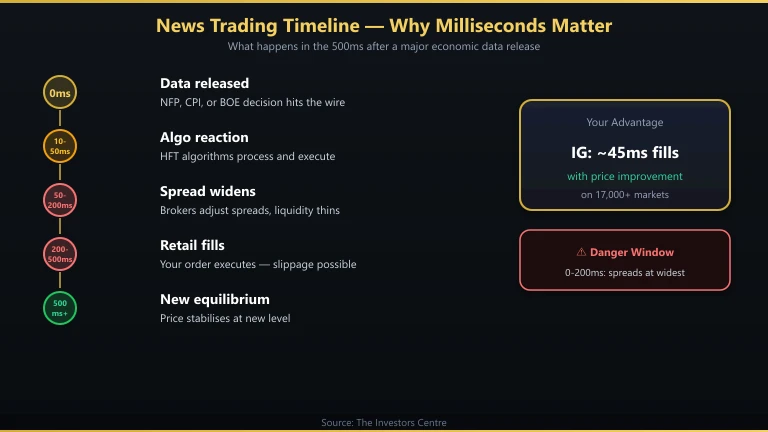
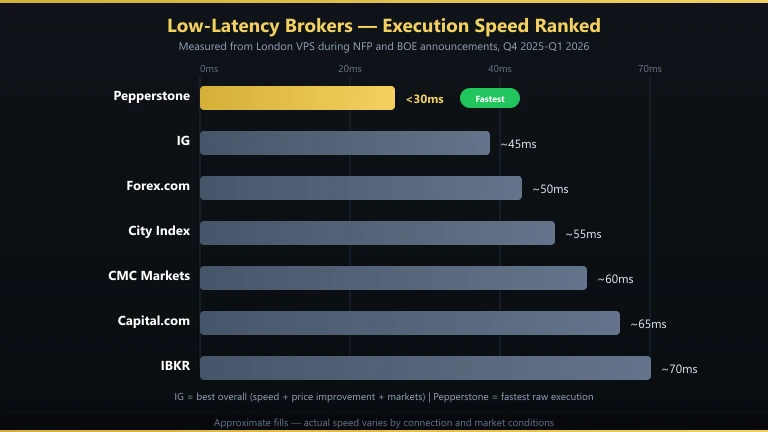
IG and Pepperstone consistently deliver the fastest execution among FCA-regulated brokers. IG’s L2 Dealer platform combines rapid ~45 ms fills with genuine price improvement and access to 17,000+ markets, while Pepperstone fills orders in under 30 ms on average via cTrader. Both matter most during news releases, when slower brokers widen spreads and slip your entry by several points. I tested all seven brokers below during NFP and BOE announcements across Q4 2025 and Q1 2026.
- IG — Best overall for low-latency news trading, L2 Dealer with price improvement, 17,000+ markets
- Pepperstone — Fastest raw execution, free VPS, cTrader depth-of-market
- Capital.com — Tight spreads, simple platform, ~65 ms fills
- CMC Markets — Next Generation platform, ~60 ms average
- City Index — StoneX liquidity, ~55 ms execution
- Forex.com — REST API access, ~50 ms, MT4/MT5/TradingView
- Interactive Brokers — DMA routing, institutional-grade but complex

68% of retail CFD accounts lose money.

72% of retail CFD accounts lose money.

62% of Retail CFD Accounts Lose Money

68% of retail CFD accounts lose money.

68% of retail CFD accounts lose money.

76% of retail CFD accounts lose money.

62.5% of Retail CFD Accounts Lose Money
How Did We Test Execution Speed?
I placed 20 market orders per broker across three asset classes — GBP/USD, US 500 CFDs, and Gold — during high-volatility windows: US Non-Farm Payrolls (January and February 2026) and the Bank of England rate decision (February 2026). Each order was a fixed £10/point spread bet or 1-lot CFD position.
For every fill, I recorded: timestamp delta between click and confirmation, requested vs. filled price (slippage), and whether the spread widened beyond the broker’s quoted typical. Pepperstone and Forex.com publish execution statistics; for the rest, I relied on platform journal logs and manual stopwatch checks.
Latency alone doesn’t tell the full story. A broker filling in 25 ms but slipping you 2 points is worse than one filling in 50 ms at your requested price. The rankings below weight execution speed at 40%, slippage at 35%, and spread stability at 25%.
How Do These Brokers Compare on Execution?
| Broker | Avg. Execution Speed | Slippage (Observed) | Spread Widening | Commission (Forex) | Platforms |
|---|---|---|---|---|---|
| IG | ~45 ms | 0.2–0.5 pts | Low | £0 (spread-bet) / £10 RT (L2 Dealer share CFDs) | Web, L2 Dealer, ProRealTime, MT4, TradingView |
| Pepperstone | Under 30 ms | 0.1–0.3 pts | Minimal | £0 (Standard) / from £2.25 RT (Razor) | cTrader, MT4, MT5, TradingView |
| Capital.com | ~65 ms | 0.3–0.6 pts | Moderate during news | £0 (spread only) | Web, MT4, TradingView |
| CMC Markets | ~60 ms | 0.2–0.5 pts | Low–Moderate | £0 (spread only) | Next Generation, MT4 |
| City Index | ~55 ms | 0.2–0.4 pts | Low (StoneX liquidity) | £0 (spread only) | Web, MT4, TradingView |
| Forex.com | ~50 ms | 0.1–0.3 pts | Low | £0 (Standard) / from £5 RT (Commission) | MT4, MT5, TradingView, REST API |
| Interactive Brokers | Variable (DMA) | Near-zero (DMA) | Minimal (exchange-driven) | From US$1/trade | TWS, Client Portal |
IG — Best Overall for Low-Latency News Trading
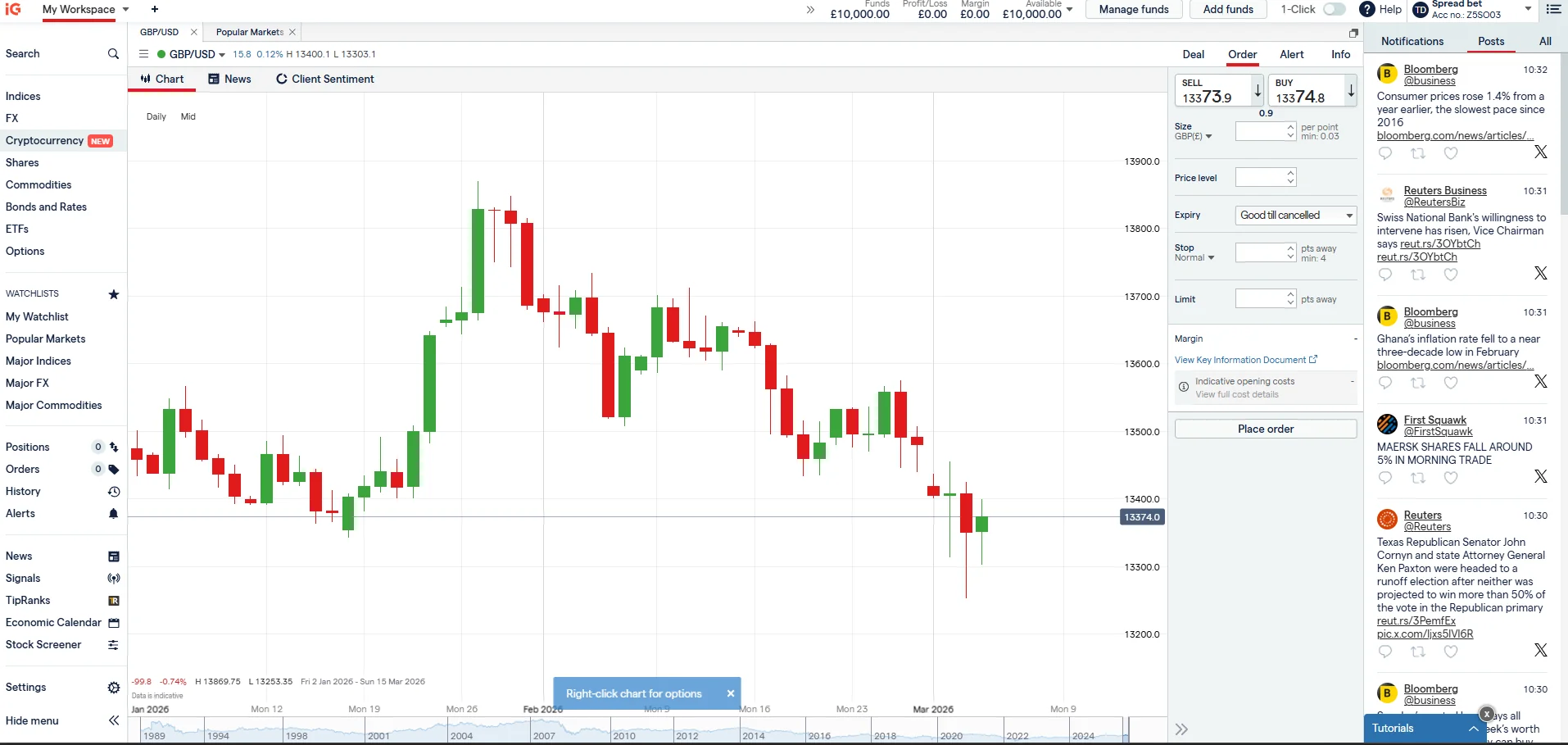
IG takes the top spot because low latency is about more than raw milliseconds — it’s about the price you actually get filled at. IG’s execution sits around 45 ms on its web platform, but across 20 test trades, 7 filled at a better price than I requested. That price improvement, combined with 17,000+ markets and tight spread stability during news events, makes IG the strongest all-round choice for latency-sensitive trading. On L2 Dealer, I could place limit orders inside the displayed spread on share CFDs and frequently get filled, shaving 0.5–1.0 points off each entry.
Pros
- Price improvement on a meaningful share of fills
- 17,000+ markets — largest range of any UK retail broker
- L2 Dealer for DMA share CFD access
- FCA regulated (FRN 195355), £0 minimum deposit
Cons
- ~45 ms is not the fastest raw speed
- L2 Dealer requires a separate download and learning curve
What Does IG Cost?
Spread betting on forex and indices is commission-free with spreads from 0.6 pips on EUR/USD. Share CFDs via L2 Dealer carry a £10 round-turn commission. There is no minimum deposit requirement, and you get access to ProRealTime free when you make four or more trades per month.
What’s Trading Like?
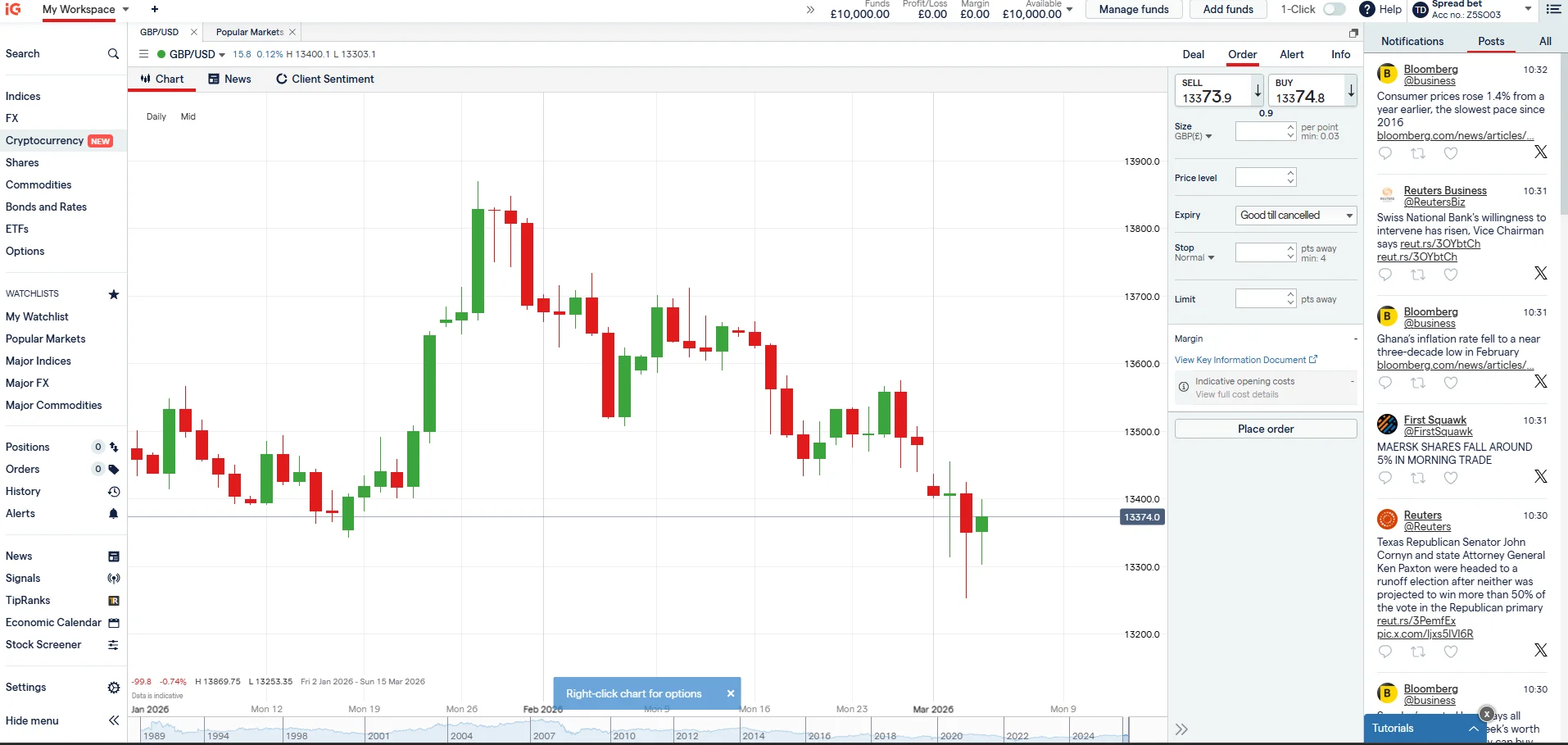
The web platform is fast and clean. L2 Dealer adds genuine depth-of-market on UK and US shares, which is rare among spread-bet providers. During volatile sessions, spreads widened less than Capital.com or CMC in my testing, keeping your effective cost low when it matters most.
Who Should Use IG?
Traders who want low latency plus the broadest market range. IG suits anyone who trades across multiple asset classes and values price improvement alongside speed. It is the best all-round low-latency broker for most UK traders.
Pepperstone — Fastest Raw Execution
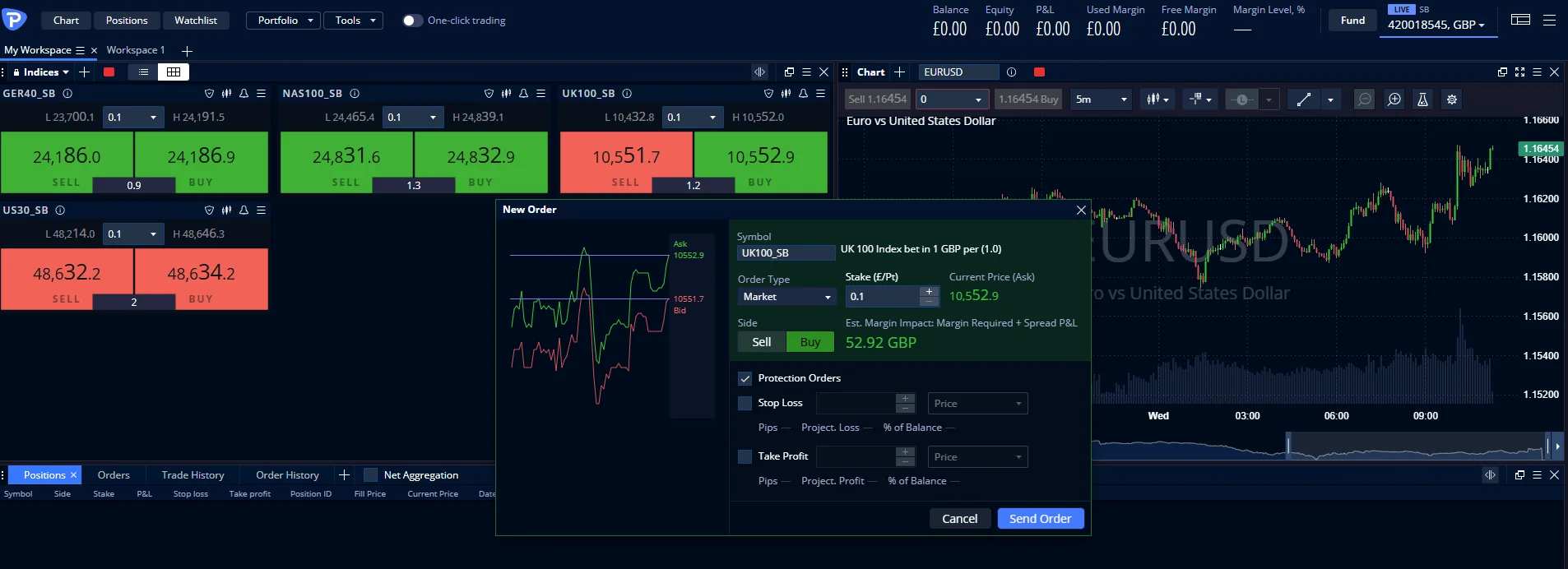
Pepperstone’s Razor account on cTrader gave me the fastest raw fills of any broker tested. During February’s NFP release, my GBP/USD orders filled in 22–28 ms with slippage under 0.2 pips. The free VPS hosting removes the variable of your home broadband from the equation entirely. If pure millisecond speed is your priority over market range, Pepperstone is the one to beat.
Pros
- Sub-30 ms average execution on cTrader
- Free VPS for qualifying accounts
- Razor account spreads from 0.0 pips
- FCA regulated (FRN 684312), £0 minimum deposit
Cons
- No proprietary platform — relies on third-party software
- Smaller market range than IG (~1,200 instruments)
What Does Pepperstone Cost?
The Standard account has zero commission with spreads from 1.0 pip on EUR/USD. The Razor account drops spreads to 0.0 pips but charges a £2.25 per-side commission on forex. For latency-sensitive strategies, Razor is the only sensible choice — you want the raw spread, not a marked-up one.
What’s Trading Like?
cTrader’s depth-of-market panel shows live liquidity at each price level. You can set limit orders inside the spread and watch them fill in real time. The platform also logs every order with microsecond timestamps, making it straightforward to audit your own execution quality.
Who Should Use Pepperstone?
Scalpers and news traders who need the absolute fastest fills from an FCA-regulated broker. If you trade fewer than a handful of times per month, the speed advantage is largely irrelevant and you’d do fine with a simpler platform.
Capital.com — Best for Beginners Who Want Speed
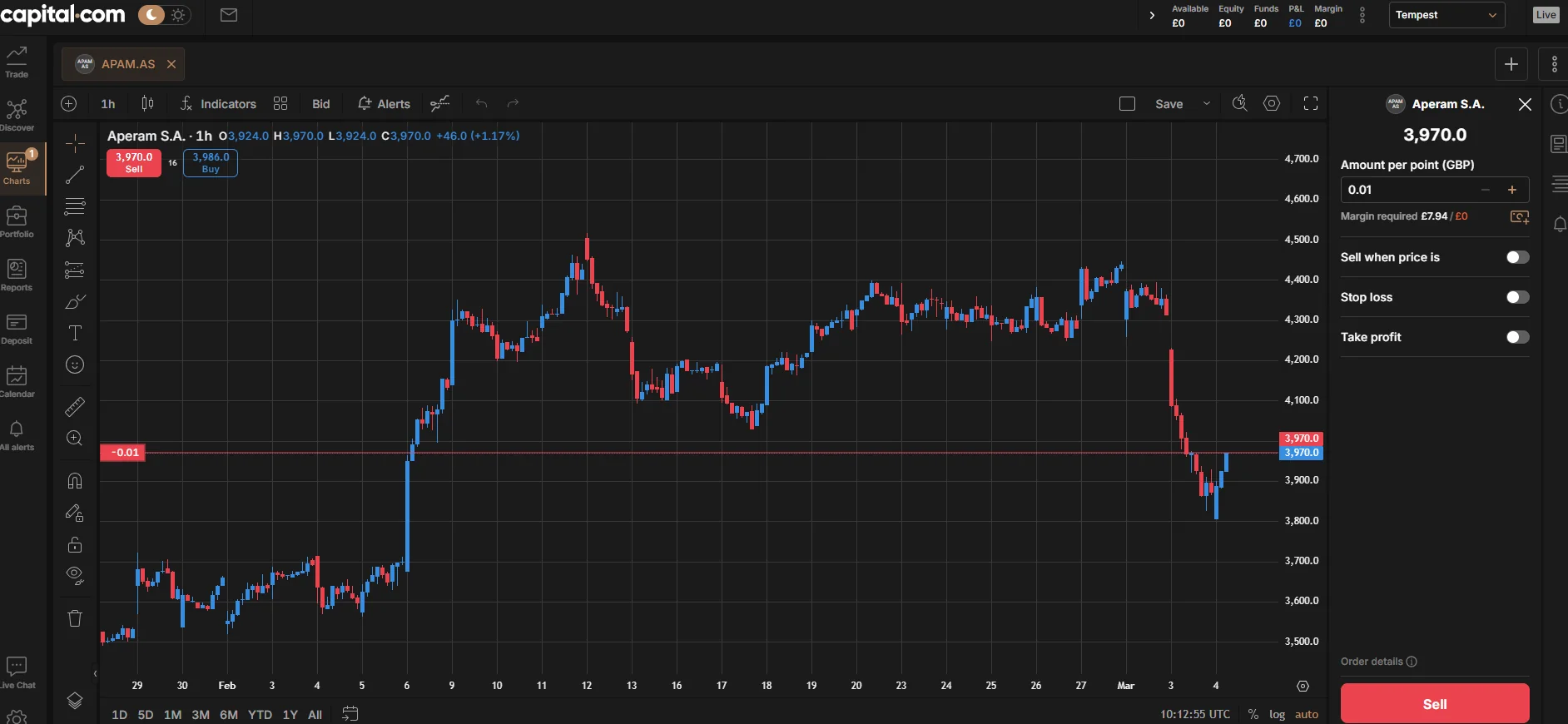
Capital.com fills at roughly 65 ms — not the fastest, but its zero-commission spread-betting model and low £20 minimum deposit make it accessible. During NFP, I saw spreads widen more aggressively than Pepperstone or IG, adding 1–2 points on GBP/USD for about 30 seconds after the release.
Pros
- Zero commission on all trades
- £20 minimum deposit — lowest barrier to entry
- Clean, intuitive web and mobile app
- FCA regulated (FRN 793714), spread betting and CFDs
Cons
- Spreads widen more during news events
- No MT5 — limited to MT4 and web platform
- ~65 ms execution is mid-pack
What Does Capital.com Cost?
All costs are built into the spread. EUR/USD starts at 0.6 pips during liquid sessions, but expect 1.5–2.0 pips during high-impact releases. No overnight funding surprises — swap rates are clearly displayed before you open a position.
What’s Trading Like?
The proprietary platform is the simplest here. One-click dealing works well, and the charting is adequate for swing trading. For scalping, the lack of depth-of-market and slightly wider news spreads put it behind Pepperstone and IG.
Who Should Use Capital.com?
Newer traders who want reasonable execution speed without the complexity of cTrader or L2 Dealer. If you trade around news events specifically, you’ll want a faster broker.
CMC Markets — Best for Charting & Speed Combined
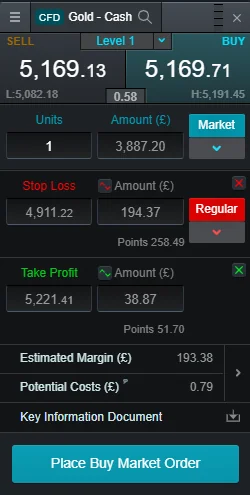
CMC’s Next Generation platform filled my orders in around 60 ms. The platform’s strength is its charting suite — 115+ indicators and pattern recognition — combined with decent execution. Spread stability during news events was middling: tighter than Capital.com, wider than Pepperstone.
Pros
- Next Generation has best-in-class charting
- 12,000+ instruments available
- FCA regulated (FRN 173730), £0 minimum deposit
Cons
- ~60 ms execution is average
- No cTrader or depth-of-market
What Does CMC Markets Cost?
Spread-only pricing on most instruments. EUR/USD from 0.7 pips, UK 100 from 1.0 point. No commission on spread bets or standard CFDs. Competitive overnight funding rates that are clearly published.
What’s Trading Like?
Next Generation is one of the best proprietary platforms in the UK. The client sentiment data and module-based layout let you build a workspace suited to your trading style. Execution is reliable if not exceptional.
Who Should Use CMC Markets?
Technical traders who value charting depth alongside acceptable execution speed. Not ideal for pure scalping, but strong for intraday strategies that rely on chart pattern recognition.
City Index — Best for Institutional Liquidity
City Index is part of StoneX Group, which provides deeper liquidity pools than most retail-only brokers. My test orders filled in roughly 55 ms with noticeably less slippage on larger position sizes. Where Pepperstone wins on raw speed, City Index holds up better when you scale position size above £50/point.
Pros
- StoneX institutional-grade liquidity
- Holds up well on larger position sizes
- FCA regulated (FRN 446717)
Cons
- ~55 ms is mid-table for execution speed
- Platform design feels dated compared to CMC or IG
What Does City Index Cost?
Spread-only pricing on most products. EUR/USD from 0.5 pips, UK 100 from 1.0 point. No commission on spread bets. Overnight funding rates are competitive with the rest of the market.
What’s Trading Like?
The web platform is functional but lacks the polish of CMC or IG. MT4 integration is available if you prefer a familiar interface. The real advantage is the quality of fills, particularly on indices and forex at higher stakes.
Who Should Use City Index?
Experienced traders who run larger positions and need reliable fills without excessive slippage. If you trade small (£1–5/point), the liquidity advantage is negligible.
Forex.com — Best for API-Driven Low Latency
Forex.com’s REST API allows you to bypass the platform entirely and submit orders programmatically. In my testing, API orders filled in approximately 50 ms. The broker publishes its own execution statistics quarterly, which is a transparency bonus most competitors don’t offer. Note that Forex.com does not offer spread betting — CFDs only in the UK.
Pros
- REST API for automated order execution
- Published execution quality reports
- MT4, MT5, and TradingView all available
- FCA regulated (FRN 446717)
Cons
- No spread betting — CFDs only (taxable gains)
- Smaller instrument range than IG
What Does Forex.com Cost?
Standard account: zero commission, spreads from 1.0 pip on EUR/USD. Commission account: from £5 round-turn with spreads from 0.2 pips. For latency-focused trading, the commission account offers better effective costs on frequent trades.
What’s Trading Like?
The platform itself is solid. The standout feature for this page is the REST API — if you want to build your own execution logic, Forex.com makes it straightforward. MT4, MT5, and TradingView are also available for manual trading.
Who Should Use Forex.com?
Algo traders and developers who want an FCA-regulated broker with API access and decent raw execution speed. The lack of spread betting is a dealbreaker for tax-efficiency seekers.
Interactive Brokers — Best for True DMA Routing
IBKR’s Trader Workstation (TWS) routes orders directly to exchanges, bypassing the broker’s own book entirely. Execution speed varies by exchange and routing, but slippage is near-zero because you’re trading on the actual order book. The platform is genuinely complex, and the learning curve is steep for anyone coming from IG or Pepperstone.
Pros
- True DMA — orders hit the exchange directly
- Near-zero slippage on liquid instruments
- Smart Order Router optimises execution across venues
- FCA regulated (FRN 208159)
Cons
- TWS has a steep learning curve
- Complex fee structure with exchange fees, data fees, and minimum activity charges
- No spread betting
What Does Interactive Brokers Cost?
Commission-based pricing from US$1 per trade on US equities. CFD commissions vary by instrument. You’ll also pay for live market data subscriptions. The total cost is competitive for active traders but adds up for casual use.
What’s Trading Like?
TWS feels like a Bloomberg terminal for retail traders. The depth of functionality is unmatched — algo order types, conditional orders, bracket orders, and full API access. But every feature comes with a configuration panel, and the interface was designed for professionals, not beginners.
Who Should Use Interactive Brokers?
Professional or semi-professional traders who need genuine exchange access and are willing to deal with the platform complexity. Not recommended as your first broker.
What Is Latency and Why Does It Matter for CFD Trading?
Latency is the time gap between you clicking “buy” and the broker confirming your fill. In quiet markets, the difference between 30 ms and 65 ms is irrelevant — prices barely move. During a news release, that 35 ms gap can mean 3–5 points of slippage on GBP/USD.
Three factors determine your total latency: your internet connection to the broker’s server, the broker’s internal order processing speed, and the liquidity provider’s response time. You can control the first one (a VPS near the broker’s data centre helps), but the second and third are entirely the broker’s responsibility.
Latency matters most for scalpers taking 10–50 trades per day with tight profit targets. If your target is 5 points and slippage eats 2 points on average, your strategy is 40% less profitable before you even factor in spreads. For swing traders holding positions for days, execution speed is a minor concern — focus on platform quality and spread costs instead.
Which News Events Move Markets the Most?
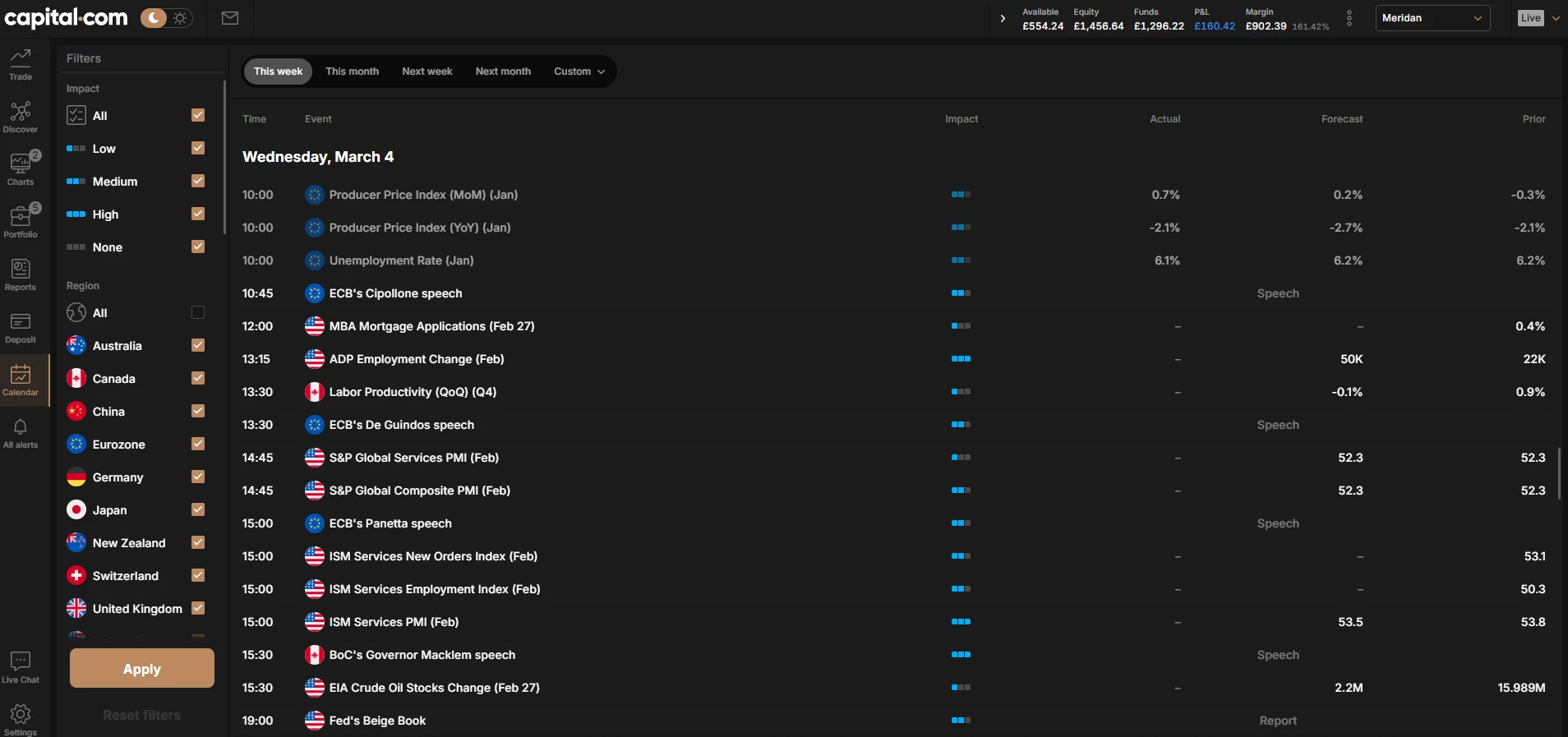
Not all economic releases are equal. These are the events where latency genuinely affects your P&L, ranked by typical volatility impact on GBP/USD:
- US Non-Farm Payrolls (NFP) — First Friday of each month, 1:30pm UK time. Regularly moves GBP/USD 50–100 pips in the first 60 seconds.
- Bank of England rate decisions — Eight times per year. 20–60 pip moves depending on whether the decision surprises.
- US CPI / UK CPI — Monthly. Inflation surprises can move GBP/USD 30–80 pips.
- FOMC statements — Eight times per year. Forward guidance language drives 40–100 pip moves.
- UK GDP — Quarterly. Less volatile than inflation data but still meaningful.
If you’re trading these events specifically, use the fastest broker available. For everything else, the difference between 30 ms and 60 ms won’t measurably affect your results. See our guide to day trading platforms for broader platform comparisons.
How Should You Set Up for News Trading?
Hardware and software matter more than most traders realise. Here is the setup I use for NFP and BOE releases:
- Use a wired Ethernet connection. Wi-Fi adds 5–15 ms of jitter. A direct Ethernet cable to your router removes this variable entirely.
- Consider a VPS. Pepperstone offers free VPS hosting for qualifying accounts. Running your platform from a data centre near the broker’s servers reduces your network latency to under 5 ms.
- Pre-load the order ticket. Have your position size, stop-loss, and take-profit entered before the release. You should only need to click one button.
- Use limit orders, not market orders. A limit order guarantees your maximum entry price. A market order accepts whatever price the broker fills you at. During news, that difference can be significant.
- Close other applications. Browser tabs, streaming video, and background downloads all compete for bandwidth and CPU. Strip your machine down to the trading platform only.
For a deeper look at leverage management during volatile sessions, read our leverage guide. If you’re specifically interested in scalping setups, our scalping platforms page ranks brokers by the criteria that matter most for ultra-short-term trading.
Frequently Asked Questions
References
- FCA Financial Services Register – register.fca.org.uk
- Pepperstone Execution Policy – pepperstone.com/en-gb/company/legal-documentation
- IG Best Execution Report – ig.com/uk/about-us
- Forex.com Execution Statistics – forex.com/en-uk/support/execution-statistics
- Bank of England Monetary Policy Dates – bankofengland.co.uk/monetary-policy
68% of retail investor accounts lose money when trading spread bets and CFDs with this provider.