

- expertise:
- CFD Trading, Forex, Derivatives, Risk Management
- credentials:
- Chartered ACII (2018) · Trading since 2012
- tested:
- 40+ forex & CFD platforms with live accounts

- expertise:
- Broker Comparison, ISA Strategy, Portfolio Management
- credentials:
- Active investor since 2013 · 11+ years experience
- tested:
- 40+ brokers with funded accounts
How We Test
Real accounts. Real money. Real trades. No demo accounts or press releases.
What we measure:
- Spreads vs advertised rates
- Execution speed and slippage
- Hidden fees (overnight, withdrawal, conversion)
- Actual withdrawal times
Scoring:
Fees (25%) · Platform (20%) · Assets (15%) · Mobile (15%) · Tools (10%) · Support (10%) · Regulation (5%)
Regulatory checks:
FCA Register verification · FSCS protection
Testing team:
Adam Woodhead (investing since 2013), Thomas Drury (Chartered ACII, 2018), Dom Farnell (investing since 2013) — 50+ platforms with funded accounts
Quarterly reviews · Corrections: in**@*******************co.uk
Disclaimer
Not financial advice. Educational content only. We're not FCA authorised. Consult a qualified advisor before investing.
Capital at risk. Investments can fall. Past performance doesn't guarantee future results.
CFD warning. 67-84% of retail accounts lose money trading CFDs. High risk due to leverage.
Contact: in**@*******************co.uk
Quick Answer: What Is the Best Platform for Trading Commodities UK?
I’ve traded commodities through five of these platforms on funded accounts, and for 2026 Pepperstone is the one I keep coming back to. The raw gold spreads (from 0.05 points) were the tightest I measured, and because MT4, MT5 and cTrader all run off the same account, I was never fighting the platform to get a strategy live. It won’t suit everyone - the commodity range is deliberately narrow - but for pure execution it’s hard to beat.
After that, it comes down to what you actually want. Spreadex is my pick if keeping profits tax-free matters to you, and you can get going with just £1. IG gives you more ways to trade a single commodity than anyone else - CFDs, spread bets, futures, options and ETFs from one login. Capital.com is the easy-to-learn choice for commission-free CFDs (other fees apply), though at 0.75 points its gold spread is wider than I’d like. And if you more or less live inside your charts, CMC Markets and its 115+ indicators will feel like home.

Pepperstone
- Best For
- Overall Commodity Trading
- TIC Rating
- 4.9 / 5
- Community Rating
- 4.4 (209 ratings) Have Your Say →
72.9% of retail CFD accounts lose money.
Spreadex
- Best For
- Tax-Free Commodity Spread Betting
- TIC Rating
- 4.8 / 5
- Community Rating
- 4.3 (175 ratings) Have Your Say →
65% of retail CFD accounts lose money.

IG
- Best For
- Commodity Market Range
- TIC Rating
- 4.7 / 5
- Community Rating
- 4.3 (208 ratings) Have Your Say →
69% of retail CFD accounts lose money.

Capital.com
- Best For
- Commission-Free Commodity CFDsOther fees apply
- TIC Rating
- 4.7 / 5
- Community Rating
- 4.3 (158 ratings) Have Your Say →
61% of Retail CFD Accounts Lose Money

CMC Markets
- Best For
- Technical Analysis & Charting
- TIC Rating
- 4.4 / 5
- Community Rating
- 4.2 (130 ratings) Have Your Say →
68% of retail CFD accounts lose money.
XTB
- Best For
- Metals, Energies and Softs in One Commodity List
- TIC Rating
- 4.3 / 5
- Community Rating
- 3.7 (56 ratings) Have Your Say →
74% of Retail CFD Accounts Lose Money

Trading.com
- Best For
- MT5 Commodity Trading
- TIC Rating
- 3.9 / 5
- Community Rating
- 3.1 (40 ratings) Have Your Say →
70.6% of retail CFD accounts lose money.
What Is the Best Platform for Trading Commodities UK?
Brokers count “total commodities” differently, with some including every contract expiry as a separate market, so treat the totals below as a guide rather than a like-for-like figure.
| Rank | Broker | Best For | Gold Spread | Total Commodities | Min Deposit | FCA FRN |
|---|---|---|---|---|---|---|
| 1 | Pepperstone | MT4/MT5 traders | ~0.05 pts (raw) | 40 | £0 | 684312 |
| 2 | Spreadex | Tax-free spread betting | ~0.30 pts | 30+ | £1 | 202473 |
| 3 | IG | Market range and flexibility | ~0.30 pts | 100+ | £0 | 195355 |
| 4 | Capital.com | Low-cost commodity CFDs | ~0.75 pts | 65+ | £20 | 793714 |
| 5 | CMC Markets | Technical analysis | ~0.30 pts | 100+ | £0 | 173730 |
| 6 | XTB | Metals, energies and softs | 0.30 pts (published) | Metals, energy & softs | £0 | 522157 |
| 7 | Trading.com | MT5 gold & oil CFDs | Not in this test round | Metals, energy & ags | — | 705428 |
*Where we note “no commission” or commission-free trading, this refers to dealing commission only. Other costs may still apply – typically the spread, overnight financing on leveraged positions held past market close, and currency-conversion fees. Check each broker’s current charges before trading.
Best UK Commodities Brokers 2026: Ranked & Tested
Pepperstone – Best Overall for Commodity Trading
- Fees & Spreads
- 4.1
- Platform & Tools
- 4.4
- Customer Service
- 4.2
- Ease of Use
- 3.9
- Mobile App
- 4.3
Pros
- Raw spreads from 0.05 points on gold (plus commission)
- MT4, MT5, cTrader, TradingView – platform choice most brokers can’t match
- No inactivity fees
Cons
- Commission on Razor account adds to costs for small positions
- Commodity range is narrower than IG or CMC
- No proprietary beginner platform – you’re using MT4/5 or cTrader
What Makes Pepperstone Good for Commodity Trading?
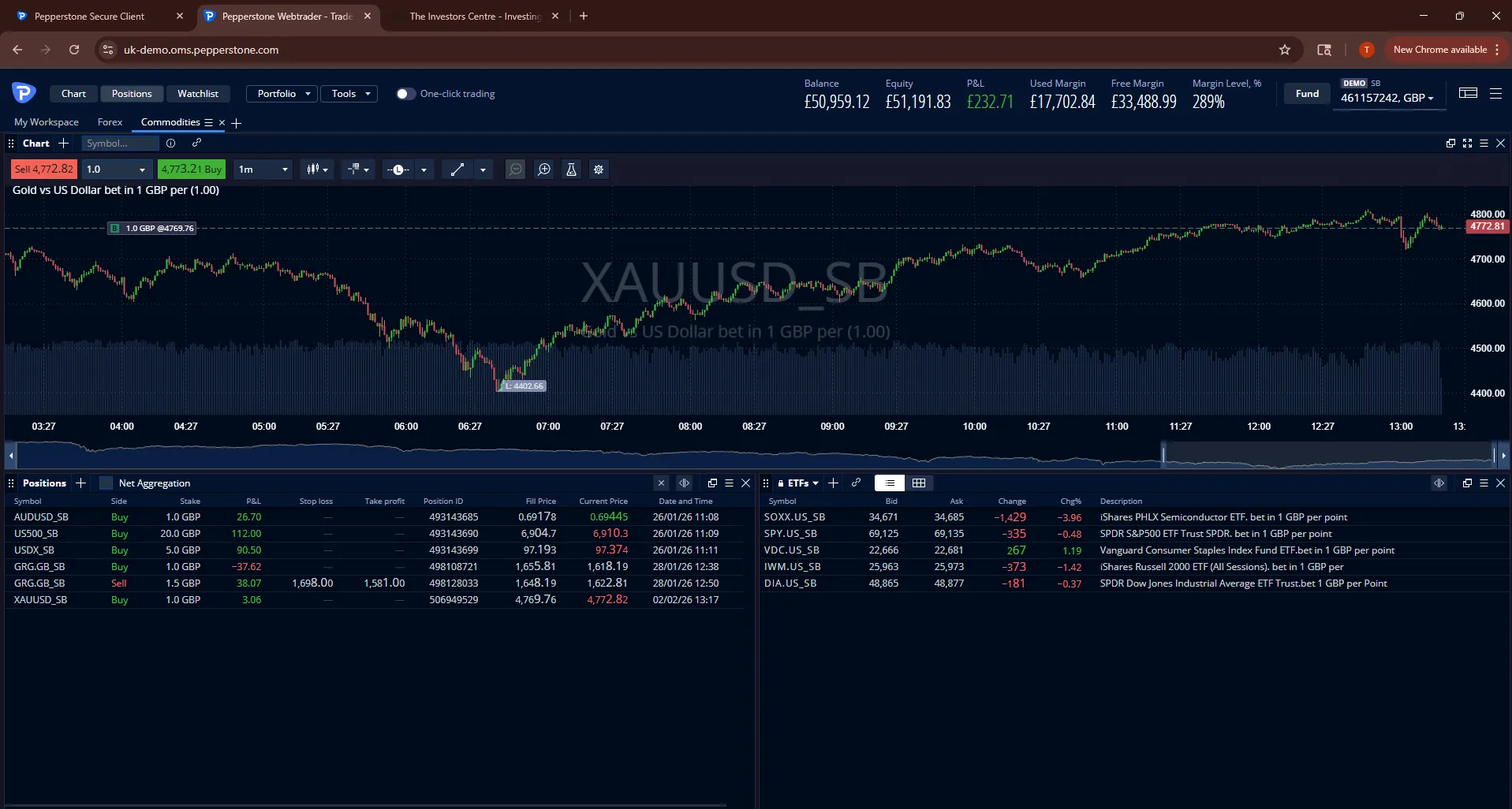
Pepperstone is built for traders who care about execution above all else, and that’s exactly how it felt in testing. On the Razor account I was seeing raw gold spreads from 0.05 points plus £2.25 in commission, which works out cheaper than spread-only pricing once your position size grows. What I rate most is the platform freedom - MT4, MT5, cTrader and TradingView all hang off the same account, so I never had to compromise on the tools I trade with. The commodity range is tighter than IG or CMC, but honestly it covers the markets I actually trade day to day.
What Are Pepperstone’s Commodity Trading Costs?
Razor account: gold from 0.05 points plus £2.25 per lot per side. Standard account: gold from 1.0 point, no commission.* No deposit, withdrawal, or inactivity fees – refreshing given how many brokers sneak these in.
Who Should Use Pepperstone?
If you’re an MT4/MT5 trader, run EAs, or scalp gold and oil, this is the one I’d point you to first - raw spreads and fast fills are exactly what it’s built for. Where I’d steer you elsewhere is if you want a hand-held, beginner-friendly interface or need access to 100+ commodity markets; Pepperstone keeps things lean on purpose.
Spreadex – Best for Tax-Free Commodity Spread Betting
- Fees & Spreads
- 4.5
- Platform & Tools
- 4.2
- Customer Service
- 4.7
- Ease of Use
- 4.2
- Mobile App
- 4.1
Pros
- Tax-free spread betting on commodities – profits typically exempt from CGT
- Competitive gold spreads from 0.3 points
- FCA-regulated UK broker with strong client service
- Simple, straightforward platform for commodity trading
Cons
- Proprietary platform only – no MT4/MT5 or cTrader
- Narrower commodity range than IG or CMC Markets
- Smaller global footprint compared to larger competitors
What Makes Spreadex Good for Commodity Trading?
What I like about Spreadex is that it does one thing really well: tax-free spread betting on commodities at prices that hold up against far bigger names. Gold spreads sat around 0.3 points in my testing, and the platform keeps things refreshingly simple across metals, energy and the main agricultural markets. It’s an FCA-regulated UK broker, and the client service has always been quick to respond when I’ve needed it - not something I can say for every firm on this list.
What Are Spreadex’s Commodity Trading Costs?
Gold from 0.3 points, crude oil competitive with major brokers. No commission on spread bets.* Overnight financing applies to leveraged positions held past market close. No inactivity fees – a plus for traders who don’t trade every month.
Who Should Use Spreadex?
Spreadex is my go-to recommendation for UK traders who want to keep profits tax-free through spread betting without paying over the odds on spreads. I wouldn’t choose it if you need MT4/MT5 or want to roam across 100+ commodity markets - that’s where IG or CMC pull ahead.
IG – Best for Commodity Market Range
- Fees & Spreads
- 4.2
- Platform & Tools
- 4.5
- Customer Service
- 3.8
- Ease of Use
- 4.1
- Mobile App
- 4.2
Pros
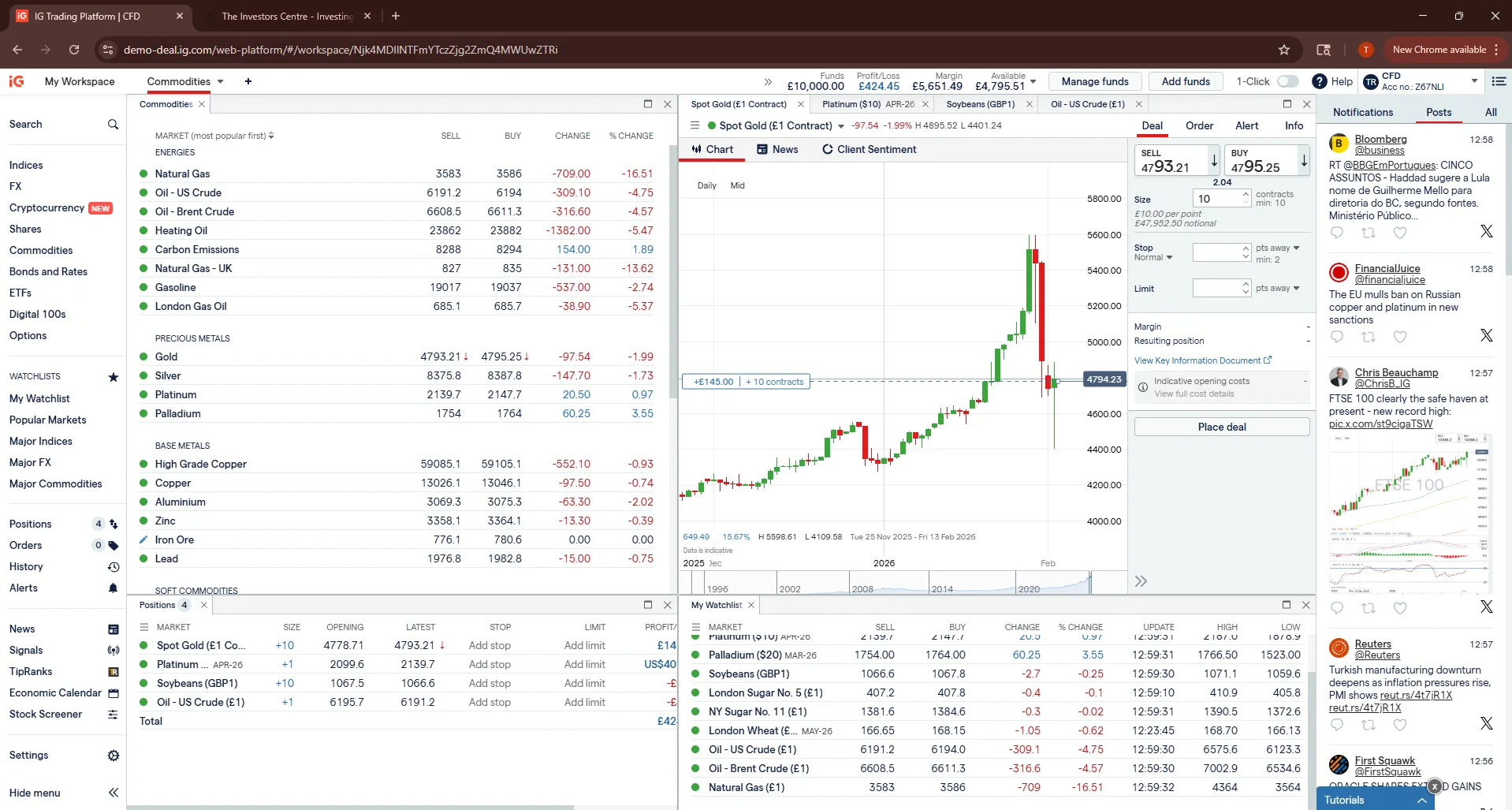
- More ways to trade commodities than any competitor – CFDs, spread bets, futures, options, ETFs
- Weekend gold trading when other brokers are closed
- ProRealTime charting included at no extra cost for active traders
- 50 years in business, publicly listed, properly capitalised
Cons
- Spreads run slightly wider than specialist low-cost brokers
- Platform depth can overwhelm if you just want simple trades
- £12/month inactivity fee after 24 months
What Makes IG Good for Commodity Trading?
IG’s real edge is flexibility, and it’s the broker I reach for when I want options. You can trade gold as a CFD, spread bet it tax-free, buy futures with fixed expiries, trade options around it, or hold a gold ETF in an ISA - all from one account. The weekend gold market is genuinely useful too; I’ve been glad of it more than once when news broke on a Saturday. Spreads sit around 0.3 points, in line with the other majors, but it’s the multi-asset access from a single login that keeps IG on my shortlist.
What Are IG’s Commodity Trading Costs?
Gold spreads from 0.3 points, Brent crude from 2.8 points. No commission on spread bets or index CFDs*. Share CFDs carry commission. Overnight funding applies to leveraged positions. The £12 monthly inactivity fee only kicks in after 24 months – easy to avoid if you trade even occasionally.
Who Should Use IG?
IG is the one I’d pick if you value having options. If you might spread bet gold tax-free one week, hold a gold ETF in your ISA the next, and trade crude futures when it suits, IG covers all of it from one place. It’s overkill if all you want is cheap gold CFDs - Capital.com or CMC will save you money on the spread.
Capital.com – Best for Commission-Free Commodity CFDs
Other fees apply.
- Fees & Spreads
- 4.4
- Platform & Tools
- 4.4
- Customer Service
- 4.5
- Ease of Use
- 4.8
- Mobile App
- 4.9
Pros
- Wide commodity range, from gold to orange juice to lean hogs
- No commission (other fees apply)
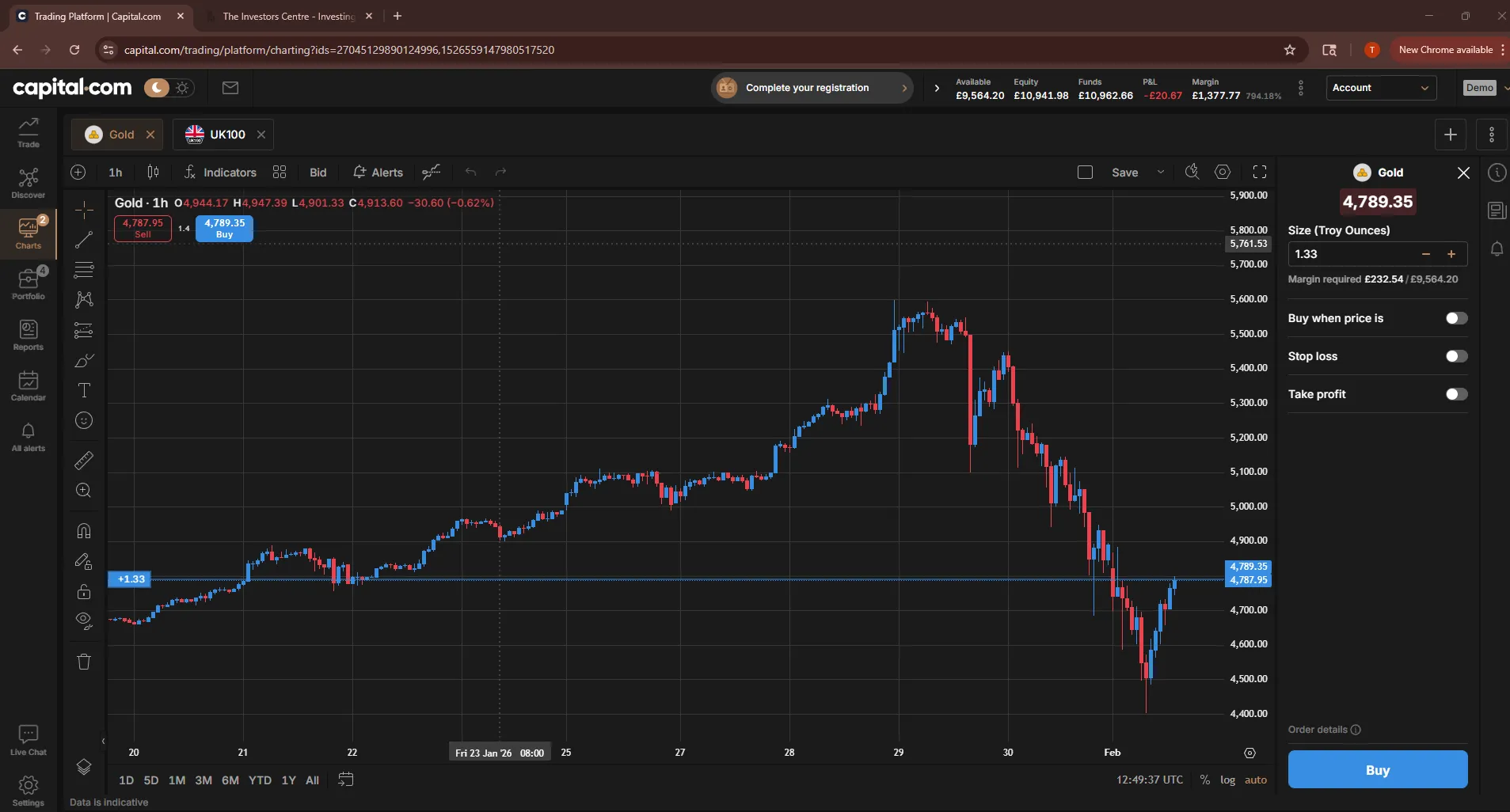
- User-friendly interface that’s easy to navigate for new traders
- MT4 and TradingView integration for those who want third-party platforms
Cons
- Can’t trade physical commodity futures – CFDs only
- Charting tools are decent but not CMC-level
- No cTrader for automated strategy runners who prefer that platform
What Makes Capital.com Good for Commodity Trading?
Capital.com covers more commodity markets than most traders will ever touch - 65+ CFDs across precious metals, energy and agriculture. Gold spreads came in around 0.75 points in London hours during my testing, which is wider than I’d like, but the trade-off is a genuinely clean, beginner-friendly platform. Order entry is quick and uncluttered, and nothing about the layout gets in your way - which is exactly why I keep recommending it to people just starting out.
What Are Capital.com’s Commodity Trading Costs?
No commission (other fees apply). Costs come through the spread: gold around 0.75 points, Brent crude around 3 points, natural gas around 0.03. Overnight financing applies if you hold positions past market close – rates are displayed on the order ticket before you commit, which is helpful for calculating multi-day holding costs.
Who Should Use Capital.com?
I’d look at Capital.com if you want broad access to commodity CFDs on an interface that feels clean and modern, and you’d rather have a straightforward layout than a screen buried in complex charts. Just bear in mind it doesn’t support exchange-listed futures or cTrader - so if you need heavy-duty technical tools or run automated strategies, it isn’t the one for you.
CMC Markets – Best for Technical Analysis & Charting
- Fees & Spreads
- 4.2
- Platform & Tools
- 4
- Customer Service
- 4
- Ease of Use
- 3.8
- Mobile App
- 3.9
Pros
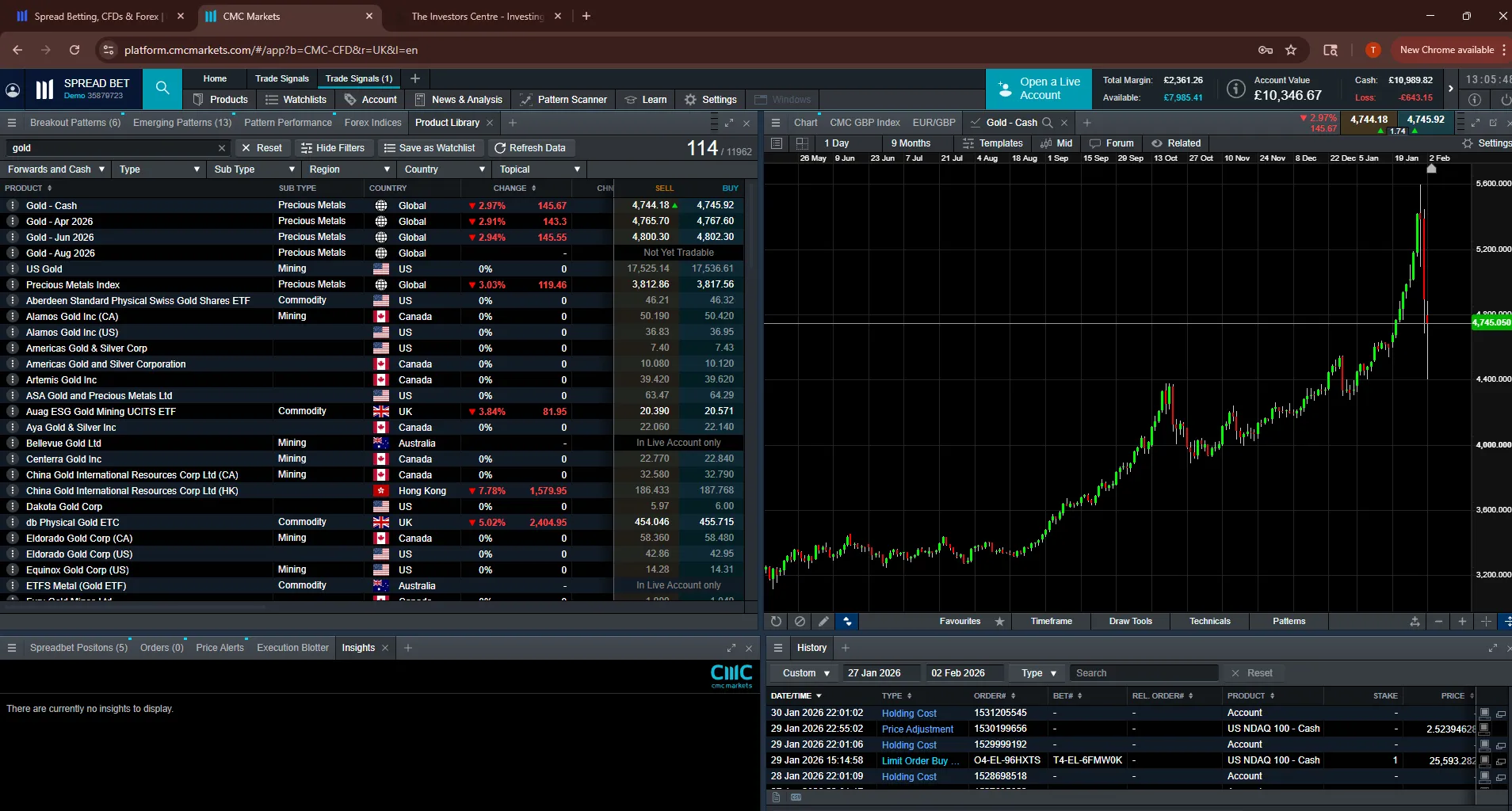
- Next Generation platform has serious charting depth (115+ indicators)
- Competitive gold spreads from 0.3 points
- Commodity indices let you trade entire sectors in one position
- Pattern recognition that’s actually useful, not just decorative
Cons
- Panel-based interface has a steeper learning curve than competitors
- £10/month inactivity fee after 12 months
- Not ideal for traders who want simplicity over depth
What Makes CMC Markets Good for Commodity Trading?
CMC is the platform I lean on when I want to do real analysis. Spreads are competitive - gold from 0.3 points - but the draw is the Next Generation platform: 115+ technical indicators, pattern recognition that’s actually useful rather than decorative, and commodity indices that let you take a view on “energy” or “precious metals” as whole sectors. The panel-based layout takes a while to click, and I won’t pretend the learning curve isn’t real, but the analytical depth earns its keep once you’re settled in.
What Are CMC Markets’ Commodity Trading Costs?
Gold from 0.3 points, crude oil from 3.5 points. No commission on CFDs or spread bets.* Overnight holding costs apply. The £10 monthly inactivity fee kicks in after 12 months without a trade, which catches people who trade seasonally.
Who Should Use CMC Markets?
CMC is for traders who put charting and analysis first. If you trade often, want competitive spreads, and like serious analytical tools at your fingertips, this is the platform I’d steer you towards. I’d skip it if you want a gentle learning curve or only trade now and then - that £10 inactivity fee will start to nag.
XTB – Metals, Energies and Softs in One Commodity List
- Fees & Spreads
- 4.2
- Platform & Tools
- 4.4
- Customer Service
- 3.2
- Ease of Use
- 3.7
- Mobile App
- 3.3
Pros
- Gold at a published 0.30 spread
- Oil from 0.03 and silver from 0.039
- Metals, energies and softs across the CFD range
- Microlots from 0.01, commission-free
Cons
- Commodity spread figures use XTB's published pricing and should be compared on that basis
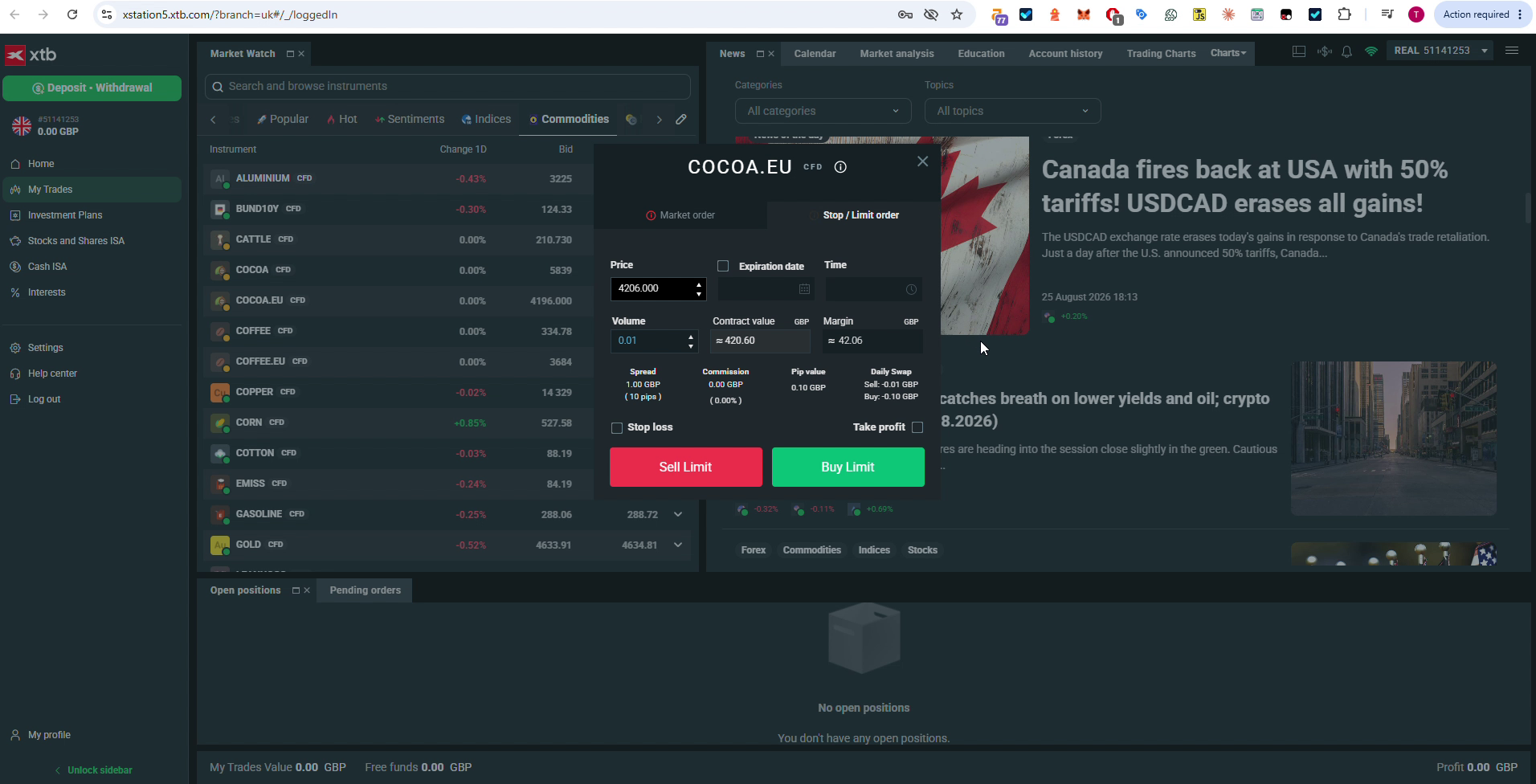
- xStation 5 is the only platform, so no MT4, MT5 or third-party charting integration
- No commodity spread betting, CFDs only
- Demo account limited to 30 days (extendable on request)
What Does XTB Offer for Commodity Trading?
XTB lists metals, energies and softs alongside its 2,600+ other leveraged CFD instruments, all through one platform, xStation 5. On XTB’s own comparison table (dated 13 January 2026, verified on xtb.com), gold is priced from a published 0.30 spread, oil from 0.03 and silver from 0.039. Microlots start at 0.01, and the CFD range carries no dealing commission. These figures use XTB's published pricing basis for a complete like-for-like product comparison.
What Are XTB’s Commodity Trading Costs?
Published spreads run from 0.30 points on gold, 0.03 on oil and 0.039 on silver, with microlots from 0.01 and no commission on the CFD range. There is no minimum deposit and no account opening or maintenance fee. Overnight financing (swap) still applies to positions held past market close, so check the rate on the order ticket before holding a commodity position overnight.
Who Should Use XTB?
XTB suits traders who want gold, oil, silver and other metals, energies and softs available from one account, alongside its wider stock, ETF and ISA range, and who are comfortable working from published rather than funded-tested spreads until our next round. If you want a measured, funded-tested gold spread today, Pepperstone’s Razor account remains the proven pick on this list.
Trading.com – A Newer FCA-Regulated MT5 Option (Added After Our Test Round)
- Fees & Spreads
- 4.2
- Platform & Tools
- 4.5
- Customer Service
- 3.8
- Ease of Use
- 4.1
- Mobile App
- 4.2
Pros
- Trades gold, oil and other commodity CFDs on MetaTrader 5
- TradingView-powered charts on its own WebTrader
- £10,000 no-expiry demo to test a strategy first
- FCA-regulated (FRN 705428) and FSCS-protected
Cons
- Commodity pricing is shown on a published-terms basis
- Younger UK track record than the five tested brokers
- No UK spread-betting account – CFDs only
- No exchange-traded futures or options
What We Tested on Trading.com
Trading.com offers gold, oil and other commodity CFDs on MetaTrader 5 alongside its own WebTrader, with a £10,000 no-expiry demo to develop and forward-test a strategy. Its comparison is presented on the provider's published terms, alongside the live observations used for the five funded brokers.
Is Trading.com Safe for Commodity Traders?
Trading.com Markets UK Limited is FCA-authorised under FRN 705428 (the rebranded UK arm of XM, authorised since 2016), which we verified on the FCA Register. UK client money is held in segregated accounts under FCA CASS rules and covered by FSCS up to £85,000 per eligible claim. Negative balance protection applies to retail accounts, which matters when commodities gap on news.
Who Should Use Trading.com?
Trading.com suits traders who want to trade commodities through MetaTrader 5 on a simple, FCA-regulated platform, and who value a no-expiry demo to rehearse a strategy first. If you need the tightest measured gold spread today, the tested Pepperstone Razor account is the proven pick until we publish Trading.com’s own figures.
Are These Commodity Brokers Safe and Regulated?
All seven brokers on this list are FCA-authorised and offer the same core protections for UK traders:
| Protection | What It Means |
|---|---|
| FCA Regulation | Each broker is authorised by the Financial Conduct Authority – verify on register.fca.org.uk |
| Segregated Funds | Client money held separately from company funds |
| Negative Balance Protection | Retail accounts can’t lose more than deposited |
Notable differences:
- IG and CMC Markets are publicly listed on the London Stock Exchange, adding financial transparency through published accounts
- Spreadex is FCA-regulated with financial trading conducted separately from its sports betting division
- Pepperstone holds dual FCA and ASIC (Australia) regulation
- XTB (X-Trade Brokers UK branch, FRN 522157) also offers a Flexible Stocks and Shares ISA alongside its commodity CFD range
- CMC Markets offers guaranteed stop-loss orders on commodities – useful for capping maximum loss during gaps
- Trading.com is FCA-regulated (FRN 705428) as the rebranded UK arm of XM, with FSCS protection up to £85,000
Being regulated doesn’t eliminate trading risk. Most retail CFD accounts lose money. The protections above cover broker failure, not trading losses.
What Is Commodity Trading and How Does It Work?
Commodity trading means speculating on price movements of raw materials – gold, oil, wheat, natural gas – without owning the physical asset. Most UK retail traders use CFDs: you’re betting on price direction with leverage, which amplifies both gains and losses.
Other access methods include spread betting (tax-efficient in the UK since profits typically avoid Capital Gains Tax), futures (exchange-traded contracts with fixed expiries), ETFs (for longer-term exposure), and options (for hedging or directional bets with defined risk). CFDs dominate because they’re flexible, accessible, and most brokers offer them.
What Is the Difference Between Spot and Futures Commodity Trading?
Spot (or “cash”) commodity trading gives you exposure to current prices with no expiry date. You’ll pay overnight financing if you hold positions – small daily costs that add up over weeks.
Futures trading uses contracts with fixed expiry dates. Spreads tend to be wider, but there’s no daily financing cost. For positions held several weeks, futures often work out cheaper. For day trades or short swings, spot is usually more cost-effective.
Most UK retail traders stick with spot CFDs for flexibility. IG offers both if you want the choice.
Is Commodity Spread Betting Tax-Free in the UK?
Yes. Spread betting profits are typically free from Capital Gains Tax because HMRC classifies it as gambling rather than investing. This makes spread betting attractive for profitable commodity traders compared to CFDs where gains are taxable.
The flip side: you can’t offset spread betting losses against other capital gains. And tax treatment depends on individual circumstances – if commodity trading becomes your primary income, HMRC may take a different view. Worth checking your specific situation.
How Do You Choose the Right Commodities Trading Platform?
My advice is to start with spreads and platform fit - they have the biggest day-to-day impact on your results. The gap between 0.05 points (Pepperstone raw) and 0.75 points (Capital.com) on gold works out to roughly £7.00 per standard lot per trade, and that compounds fast once you’re trading actively.
- Commodity range: Does it cover what you want to trade? Gold and oil are everywhere; orange juice and lumber, less so.
- Spreads: Gold typically ranges from 0.05 points (Pepperstone raw) to 0.75 points (Capital.com). For active traders, this difference compounds.
- Platform fit: MT4/MT5 users need Pepperstone. Beginners might prefer Capital.com. Chart-heavy traders want CMC. Tax-free spread betting suits Spreadex.
- Costs beyond spreads: Overnight financing, inactivity fees, withdrawal charges. These catch people out.
- FCA regulation: Verify on the FCA register before depositing. Every broker on this list is FCA-authorised.
What Commodities Can You Trade in the UK?
Gold and crude oil account for the vast majority of UK retail commodity trading volume. According to the World Gold Council, gold remains the most liquid commodity market globally, with daily trading volumes exceeding $130 billion. Beyond the majors, UK platforms typically offer silver, platinum, natural gas, and agricultural commodities like wheat, corn, and coffee. CMC Markets and IG have the widest range; Pepperstone focuses on the most-traded markets only.
What Are the Risks of Commodity Trading?
Commodity prices can move sharply. Oil regularly swings 3-5% on inventory data; during genuine supply shocks, 10%+ single-day moves happen. Gold tends to be calmer but still reacts strongly to Fed decisions and geopolitical stress.
Leverage amplifies this. A 5% move against a 10:1 leveraged position wipes out half your margin. Most retail CFD accounts lose money – the exact percentages vary by broker, but the pattern is consistent.
Managing the risks:
- Use stop-losses. Always.
- Size positions so a single loss doesn’t cripple your account – 1-2% risk per trade is a common guideline
- Understand overnight costs before holding positions for days
- Start with a demo account if commodity markets are new to you
Recent example: Gold and silver plunge after market losses
A recent BBC report highlighted how gold and silver fell sharply after broader market losses, as investors rapidly moved into cash. Even assets seen as safe havens can drop fast when large traders de-risk and unwind positions.
For CFD and spread betting traders, this is where risk escalates:
- Moves are news-driven, not technical.
- Liquidity encourages larger position sizes.
- Leverage turns a routine drop into a margin threat.
The key lesson: commodities don’t just react to supply and demand - they react to sentiment, positioning, and liquidity. When those shift suddenly, price moves can be swift and unforgiving for leveraged traders.
So Which One Should You Choose?
It really comes down to how you trade. If you want the tightest raw spreads and you’re running strategies on MT4, MT5 or cTrader, Pepperstone is the one I’d start with - it came out on top across our testing for a reason. Prefer to keep your profits tax-free? Spreadex’s spread betting is the obvious route, and you can open an account with just £1. And if you want every way of accessing commodities under one roof - CFDs, spread bets, futures, options and ETFs - IG gives you the widest reach of anyone here.
From there it’s about the details. Capital.com is worth a look if commission-free CFDs (other fees apply) and a clean, beginner-friendly platform matter most to you, and CMC Markets is the pick if you live in your charts and want serious technical tools. Whichever you land on, remember that commodities move fast on news, economic data and supply shocks - so use stop-losses, size your positions sensibly, and don’t let leverage talk you into a bigger bet than you’re comfortable with. Every platform above is FCA-regulated and capable; the biggest variable is how you manage your own risk.
FAQs
References
- Capital.com UK – FRN 793714, commodities pricing, MT4/TradingView integration
- Spreadex UK – FRN 202473, FCA-regulated, tax-free spread betting on commodities
- IG UK – FRN 195355, 100+ commodity markets, multi-asset access
- Pepperstone UK – FRN 684312, 40 commodity markets, spreads from 0.05pts gold
- CMC Markets UK – FRN 173730, 100+ commodities, spreads from 0.3pts gold
- XTB UK – FRN 522157, published commodity CFD spreads (gold, oil, silver), Flexible Stocks and Shares ISA
- FCA Financial Services Register – Broker authorisation verification
- FSCS Deposit Protection – £85,000 protection per eligible person
- World Gold Council – Global gold trading volume statistics ($130B+ daily)
Spread data sourced from broker websites as of January 2026. Spreads are variable and may differ during volatile market conditions. All brokers verified on FCA register.