

- expertise:
- Platform Testing, Cryptocurrency, Retail Investing
- credentials:
- Active investor since 2013 · 11+ years experience
- tested:
- 50+ platforms · 200+ guides authored

- expertise:
- CFD Trading, Forex, Derivatives, Risk Management
- credentials:
- Chartered ACII (2018) · Trading since 2012
- tested:
- 40+ forex & CFD platforms with live accounts
How We Test
Real accounts. Real money. Real trades. No demo accounts or press releases.
What we measure:
- Spreads vs advertised rates
- Execution speed and slippage
- Hidden fees (overnight, withdrawal, conversion)
- Actual withdrawal times
Scoring:
Fees (25%) · Platform (20%) · Assets (15%) · Mobile (15%) · Tools (10%) · Support (10%) · Regulation (5%)
Regulatory checks:
FCA Register verification · FSCS protection
Testing team:
Adam Woodhead (investing since 2013), Thomas Drury (Chartered ACII, 2018), Dom Farnell (investing since 2013) — 50+ platforms with funded accounts
Quarterly reviews · Corrections: in**@*******************co.uk
Disclaimer
Not financial advice. Educational content only. We're not FCA authorised. Consult a qualified advisor before investing.
Capital at risk. Investments can fall. Past performance doesn't guarantee future results.
CFD warning. 67-84% of retail accounts lose money trading CFDs. High risk due to leverage.
Contact: in**@*******************co.uk
Key UK CFD Trading Statistics 2026
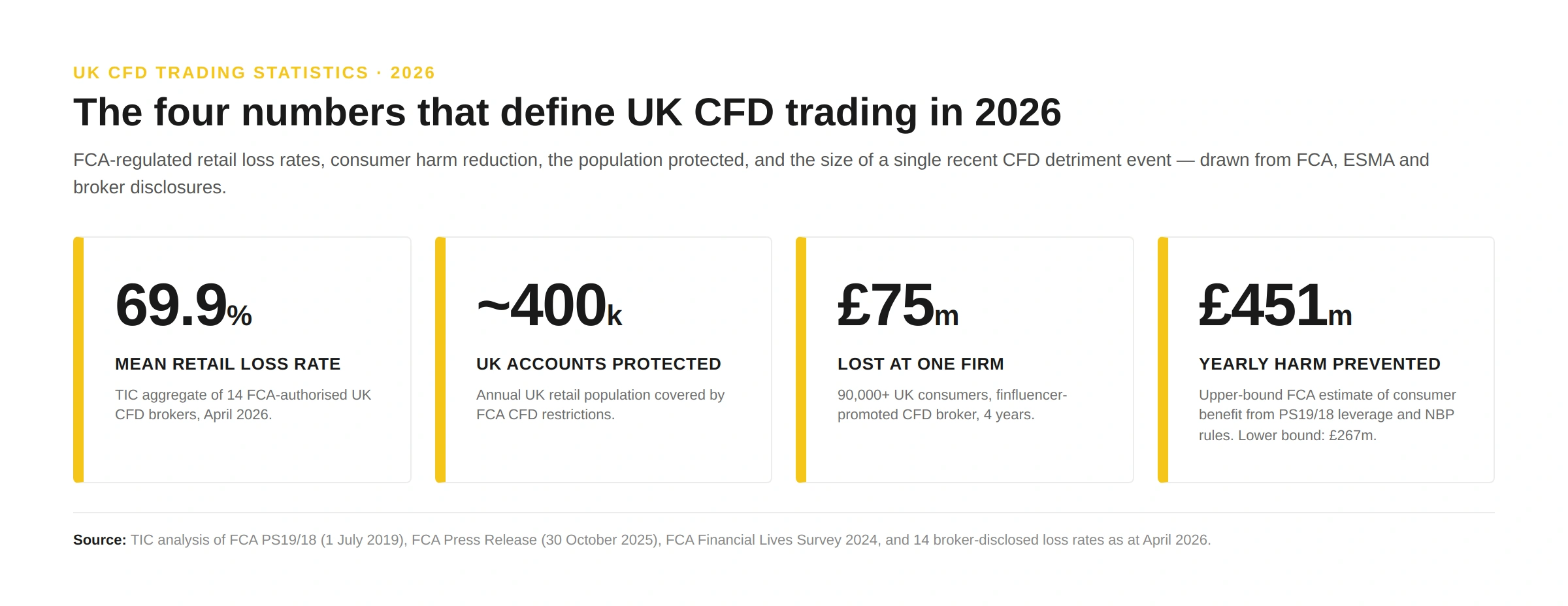
- 69.9% mean retail loss rate across 14 FCA-authorised UK CFD brokers as at April 2026 — TIC aggregate of mandated risk-warning disclosures.
- ~400,000 UK consumers a year are protected by the FCA's permanent CFD restrictions.
- £75 million was lost by more than 90,000 UK consumers at a single CFD firm promoted by finfluencers over four years.
- £267m to £451m a year in retail consumer harm prevented by the FCA's 2019 leverage caps and negative balance protection.
- 78% of UK retail CFD accounts were loss-making in the FCA's 2017 pre-intervention dataset covering ~65% of the UK CFD market.
- 0.7% of UK adults (~380,000) held a CFD in 2024, up from 0.6% in 2022.
- £879.8 million was lost to UK investment fraud in 2025 — equivalent to £2.4 million every day, with cryptocurrency and CFD/forex-style scams dominating reports.
- 30:1 max leverage on major FX, 5:1 on individual equities, 2:1 on cryptocurrencies. Crypto-CFDs banned for UK retail since 6 January 2021.
- £384.9 million IG Markets Limited (UK CFD entity) net trading revenue in FY25, up from £343.0m in FY24.
- 0 of 100 EEA CFD firms that entered the UK Temporary Permissions Regime in January 2021 have obtained permanent FCA authorisation as of December 2024.
- 31 percentage-point spread across UK CFD brokers — eToro UK at 51% to ActivTrades at 82%. Four brokers report rates of 75% or higher.
- £1.07 billion annualised UK retail CFD losses pre-intervention (2017) — implying the scale of harm before FCA leverage caps came in.

Free to use with a dofollow link back to The Investors Centre.
How Many People Trade CFDs in the UK?
The FCA estimates that around 400,000 UK consumers a year are active in retail CFD-style products served by FCA-regulated firms. The Financial Lives Survey 2024 puts current CFD holding at 0.7% of UK adults — roughly 380,000 individuals — making CFDs one of the smallest but highest-loss-rate retail investment products in the UK.
CFD penetration is dwarfed by mainstream retail investing. The FCA's Financial Lives Survey 2024 found that 8.4% of UK adults (around 4.6 million) held any high-risk investment in 2024 — including cryptoassets, unlisted shares, peer-to-peer lending and innovative finance ISAs alongside CFDs. CFDs alone represented just 0.7% of UK adults, while cryptoassets dominated the high-risk category at 4.3% (FLS methodology) or 12% (FCA/YouGov methodology).
| Metric | Latest figure | Source |
|---|---|---|
| Active UK retail CFD-style accounts (FCA estimate) | ~400,000 per year | FCA PR, 30 Oct 2025 |
| UK adults holding a CFD (2024) | 0.7% (~380,000) | FCA FLS 2024 |
| UK adults holding a CFD (2022) | 0.6% (~330,000) | FCA FLS 2022 |
| UK adults holding any HRI (2024) | 8.4% (~4.6m) | FCA FLS 2024 |
| UK adults using a trading app (May 2024) | ≥3% (~1.6m) | FCA Complex ETPs paper, 2025 |
| UK funded retail CFD accounts pre-intervention | 800,000+ | FCA CP18/38, 2018 |
| UK monthly active CFD accounts (Aug–Oct 2017) | ~279,000 | FCA CP18/38, 2018 |
Source: FCA Financial Lives Survey 2024 (May 2025); FCA CP18/38 (December 2018); FCA PR 30 October 2025.
69.9% of UK Retail CFD Traders Lose Money — TIC April 2026 Aggregate
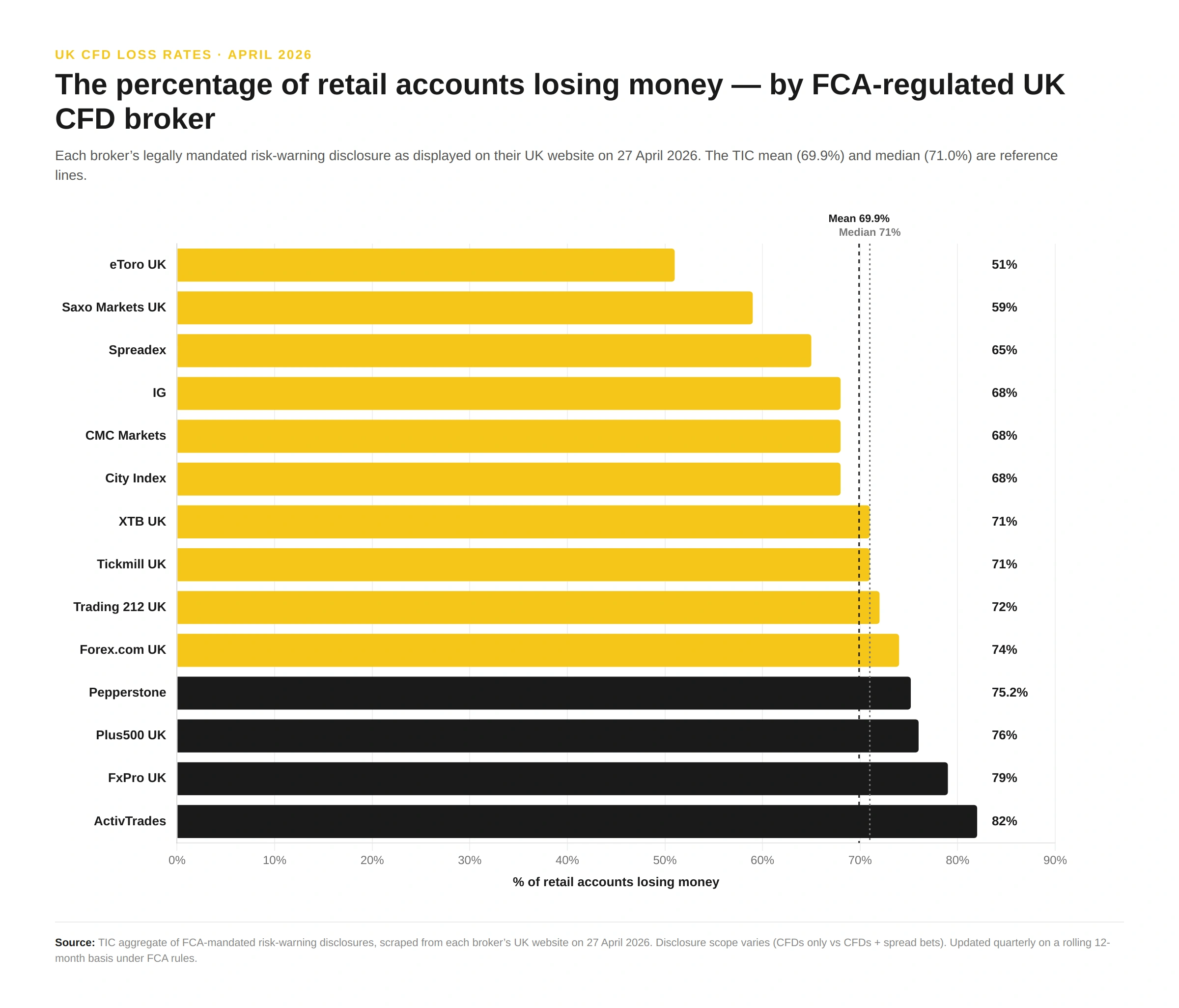
The FCA does not publish a single up-to-date UK aggregate loss rate. Instead, every authorised CFD provider must display a rolling 12-month, firm-specific loss-rate disclosure under FCA rules. We pulled the disclosures from 14 of the largest FCA-authorised CFD brokers serving UK retail clients on 27 April 2026.
The TIC aggregate is 69.9% mean and 71.0% median, with a spread of 31 percentage points between the lowest (eToro UK at 51%) and the highest (ActivTrades at 82%). Four brokers report rates of 75% or higher. For readers comparing the major regulated venues, our shortlist of leading UK CFD brokers ranks them on spreads, platform tools and asset coverage.
| Broker (UK FCA entity) | % retail accounts losing money | Disclosure scope |
|---|---|---|
| eToro UK | 51% | CFDs only |
| Saxo Markets UK | 59% | CFDs & rolling spot FX |
| Spreadex | 65% | Spread bets + CFDs |
| IG | 68% | Spread bets + CFDs |
| CMC Markets | 68% | Spread bets + CFDs |
| City Index | 68% | CFDs only |
| XTB UK | 71% | CFDs only |
| Tickmill UK | 71% | CFDs only |
| Trading 212 UK Ltd | 72% | CFDs only |
| Forex.com UK | 74% | CFDs only |
| Pepperstone | 75.2% | Spread bets + CFDs |
| Plus500 UK | 76% | CFDs only |
| FxPro UK | 79% | CFDs + spread betting |
| ActivTrades | 82% | CFDs only |
| TIC mean (n=14) | 69.9% | Aggregate |
| TIC median (n=14) | 71.0% | Aggregate |
Source: TIC aggregate of FCA-mandated loss-rate disclosures, scraped from each broker's UK website on 27 April 2026. Each disclosure is updated quarterly on a rolling 12-month basis under FCA rules (COBS 22.5).

Free to use with a dofollow link back to The Investors Centre.
"The FCA's 2018 leverage cap and negative balance protection moved the headline loss rate from 78% to 69.9% — a meaningful eight-point shift, but the floor below which retail CFD outcomes don't go without banning the product. The persistence of the 31-point spread between brokers (eToro UK 51% vs ActivTrades 82%) tells you the rules have set a regulatory minimum, but broker product mix, client recruitment and trading culture do most of the remaining work."
How Much Do UK CFD Traders Actually Lose?
UK retail CFD client losses totalled £268.4 million across just three months (August–October 2017) in the FCA's pre-intervention sample of 63 firms — implying an annualised loss of around £1.07 billion before the FCA introduced leverage caps and negative balance protection. The FCA estimated that its 2019 measures save UK retail consumers between £267 million and £451 million each year.
More recent firm-level disclosures show the harm has not disappeared. The FCA confirmed in October 2025 that more than 90,000 UK consumers lost approximately £75 million over four years at a single CFD firm promoted by finfluencers — an implied average loss of £833 per affected client at that one firm alone.
| Loss measure | Figure | Period | Source |
|---|---|---|---|
| UK retail CFD client losses, 63-firm sample | £268.4m | Aug–Oct 2017 | FCA CP18/38 |
| Annualised UK retail CFD losses (pre-intervention) | ~£1.07bn/year | 2017 | FCA CP18/38 |
| FCA estimate of yearly consumer benefit from PS19/18 | £267m–£451m | Per year, post-2019 | FCA PS19/18 |
| Leverage-cap component | £259m–£443m | Per year | FCA PS19/18 |
| Negative-balance-protection component | £6m | Per year | FCA PS19/18 |
| UK retail loss reduction (3-month ESMA temp ban) | £77m | Aug–Oct 2018 | FCA PS19/18 |
| Single firm consumer detriment (finfluencer-promoted) | £75m / 90,000+ clients | 4 years to 2025 | FCA PR Oct 2025 |
| Implied average loss at that single firm | ~£833 per client | 4 years | TIC calc |
| ESMA pan-EU average loss range per client | €1,600–€29,000 | Pre-2018 sample | ESMA, 2018 |
Source: FCA CP18/38 (December 2018); FCA PS19/18 (1 July 2019); FCA Press Release 30 October 2025; ESMA Press Release 27 March 2018.
How Did the FCA Cap CFD Leverage in 2019?
Before August 2018, UK retail CFD traders could routinely access leverage of up to 500:1 on major FX pairs, ~200:1 on indices, ~100:1 on commodities and ~50:1 on single-stock equities. Different brokers offered different maxima — there was no statutory cap. The FCA inherited and made permanent ESMA's temporary product intervention, with one notable divergence: government bond CFDs are capped at 30:1 in the UK (5:1 in the EU). For a deeper explainer of how leverage works against the retail trader see our piece on leveraged trading explained in detail.
| Asset class | Pre-Aug 2018 (typical) | Current FCA cap |
|---|---|---|
| Major FX pairs (e.g. GBP/USD) | Up to ~500:1 | 30:1 |
| Non-major FX, gold, major indices | Up to ~200:1 | 20:1 |
| Other commodities & minor indices | Up to ~100:1 | 10:1 |
| Individual equities (e.g. Tesla CFD) | Up to ~50:1 | 5:1 |
| Government bonds | Largely uncapped | 30:1 (FCA) / 5:1 (ESMA) |
| Cryptocurrencies | Up to ~50:1 | Banned for UK retail (6 Jan 2021) |
Source: FCA CP18/38 (December 2018); FCA PS19/18 (1 July 2019); FCA PS20/10 (6 October 2020).
The FCA also requires firms to close out a retail client's position at 50% of the margin needed to maintain it, mandates negative balance protection on a per-account basis, bans monetary and non-monetary incentives to trade, and applies a standardised risk warning. Since December 2022, all CFD financial promotions also fall under the high-risk investment rules in PS22/10, which add a 24-hour cooling-off period for first-time investors and a stronger appropriateness test.
UK CFD Loss Rates Over Time
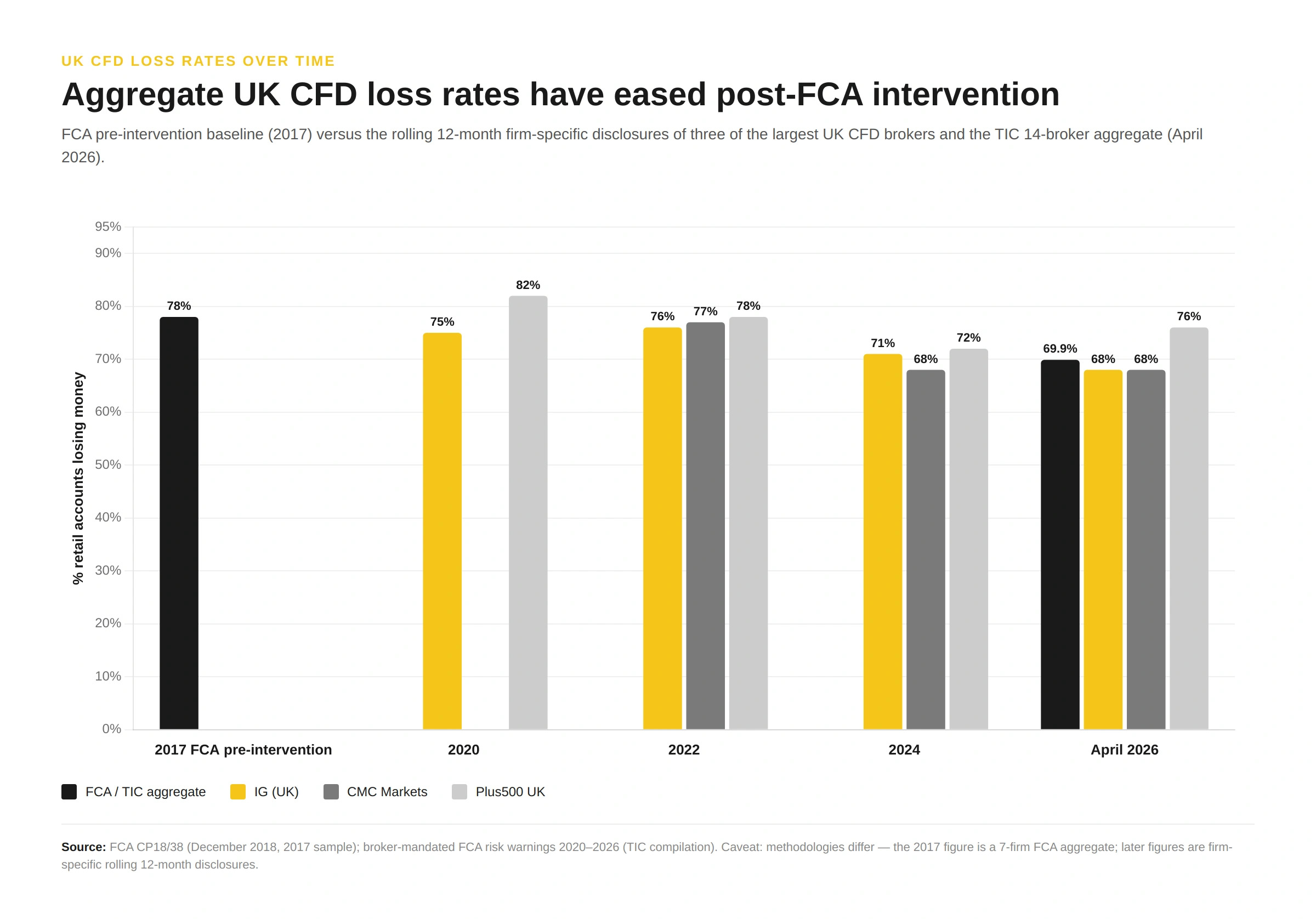
Direct comparison is methodologically difficult — the 2017 FCA figure aggregates active retail accounts across 63 firms in a single sample, while current broker disclosures are firm-specific rolling 12-month measures. But the trend direction is clear: aggregate UK retail loss rates have fallen from 78% pre-intervention to a TIC-measured mean of 69.9% across 14 brokers in April 2026.

Free to use with a dofollow link back to The Investors Centre.
What Asset Classes Do UK CFD Traders Use?
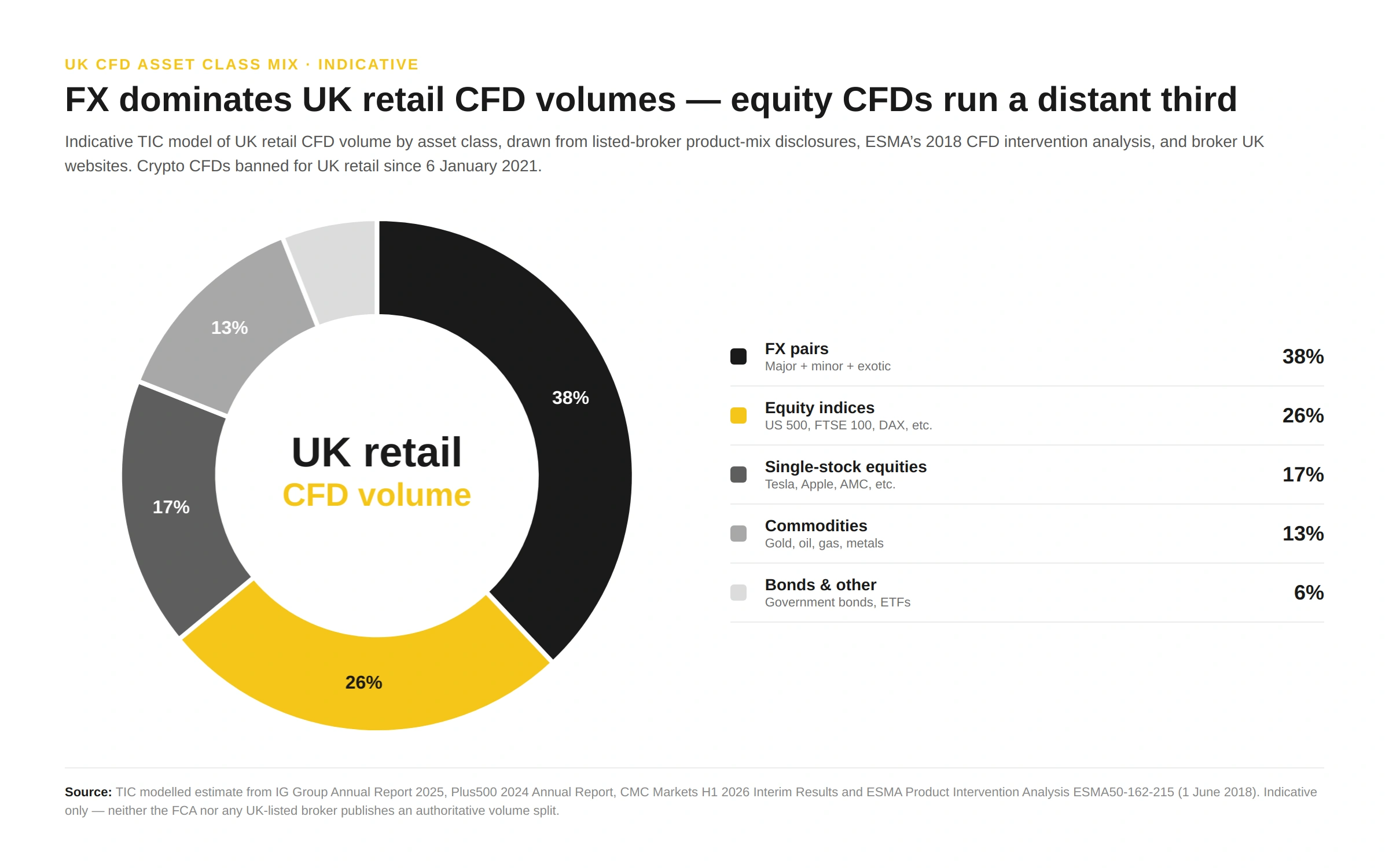
Neither the FCA, ESMA, nor any UK-listed broker publishes a quantitative breakdown of UK retail CFD volume by asset class. What we can observe from broker product universes and qualitative regulatory commentary: CFDs are predominantly traded on FX pairs, equity indices, single-stock equities, commodities (especially gold and oil), and government bonds. Crypto CFDs were banned for UK retail clients on 6 January 2021.
ESMA's 2018 product-intervention analysis found that retail CFD positions on non-equity underlyings are predominantly intra-day, while equity CFDs are typically held for several days. A 2021 academic study of a post-MiFID II European broker dataset found roughly 10.5% of retail CFD clients held no overnight positions — pure same-day traders.
| Broker | Underlying instruments | Primary asset classes |
|---|---|---|
| IG | ~19,000 markets | FX, indices, single stocks, commodities, bonds |
| Plus500 | ~2,500 instruments | FX, indices, equities, commodities, ETFs |
| CMC Markets | 10,000+ instruments | Shares, indices, FX, commodities, treasuries |
| Saxo Markets UK | 70,000+ instruments | Multi-asset including CFDs |
| Spreadex | 10,000+ markets | FX, indices, single stocks, commodities, bonds |
Source: IG Group Annual Report 2025; Plus500 2024 Annual Report; CMC Markets H1 2026 Interim Results; broker UK websites April 2026.

Free to use with a dofollow link back to The Investors Centre.
Who Are UK CFD Traders? Age, Gender and Income
The Financial Lives Survey samples too few CFD-only holders to publish demographic cross-tabs for that group alone. The closest robust proxy is the high-risk investment (HRI) cohort, which combines CFDs with cryptoassets, unlisted shares and peer-to-peer lending.
| Demographic dimension | HRI holding rate (2024) |
|---|---|
| Age 18–24 | 9% |
| Age 25–34 | 11% |
| Age 35–44 | 10% |
| Age 45–54 | 9% |
| Age 55–64 | 8% |
| Age 65–74 | 6% |
| Age 75+ | 5% |
| Men | 12% |
| Women | 5% |
| Household income £50k+ | 14% |
| Household income £30k–<£50k | 8% |
| Household income <£15k | 5% |
| Self-employed | 13% |
| Employed | 10% |
| Asian & Asian British | 13% |
| White | 8% |
Source: FCA Financial Lives Survey 2024, Consumer Investments deck slide 32 (May 2025). Base: all UK adults (n=17,950). HRI = any high-risk investment held.
Trading-app penetration is more sharply gendered than HRI holdings overall. The FCA reported in its 2025 review of complex exchange-traded products that 5% of UK men and 1% of UK women had used a trading app in May 2024 — a 5-to-1 male skew. Concentration risk among UK HRI holders is also elevated: around a third had more than 10% of their money in high-risk investments, and 26% of HRI holders said they had very low or no willingness to take investment risk — a clear product-to-tolerance mismatch.
TIC Analysis: The TIC CFD Loss Index — April 2026
The TIC CFD Loss Index aggregates the FCA-mandated risk-warning disclosures of FCA-authorised UK CFD brokers into a single rolling indicator. The April 2026 reading sits at 69.9% (mean) and 71.0% (median) across 14 brokers, with a 31 percentage-point spread.
The Index has three editorial uses: a single citable UK loss-rate number (the FCA does not publish one); a quarterly tracker showing whether the post-intervention improvement is durable or eroding; and a benchmark for journalists pricing-up CFD harm in financial reporting. The 2017 FCA pre-intervention sample (CP18/38) found 78% of UK retail CFD accounts loss-making, weighted across 7 firms covering ~65% of the UK CFD market. The TIC April 2026 reading of 69.9% (mean) suggests an aggregate ~8 percentage-point reduction post-FCA intervention.
UK CFD Trading Fraud and Unauthorised Firms
UK investment fraud losses are at a record high. City of London Police reported £879.8 million lost in 2025 — a 35% rise on 2024 — equivalent to £2.4 million every day. Cryptocurrency dominates the report mix at 66%, with CFD-style and forex-style trading scams as the second-largest category. Around 36% of all 2024 reports were linked to a social media platform.
| Year | Investment fraud reports | Total losses | Avg loss per victim |
|---|---|---|---|
| 2023 | 30,130 | £612 million | £25,110 |
| 2024 | 25,843 | £649.1 million | Not disclosed |
| 2025 | 34,673 | £879.8 million | £25,612 |
Source: City of London Police (Action Fraud) annual figures, 2024–2026. Action Fraud was rebranded the Report Fraud service in December 2025.
The FCA has taken direct enforcement action in the CFD market. In 2025 it fined Dinosaur Merchant Bank Limited £338,000 for market-abuse surveillance failures over its single-stock CFD direct-market-access platform: 2,194 trades worth $3.05 billion went unmonitored, generating 2,916 retrospective alerts. The FCA also led a June 2025 international finfluencer crackdown resulting in 3 arrests, 7 cease-and-desist letters and 50 warning alerts. Recovery-room scams targeting prior CFD victims are a second harm vector — between August 2023 and August 2024 the FCA received 7,220 consumer enquiries about recovery-room scams.
UK CFD Broker Financials — IG, CMC, Plus500, Spreadex
The four largest publicly visible UK CFD operators between them serve well over a million active accounts globally and generated more than £2.2 billion in combined revenue in their most recent reporting periods.
| Broker (latest period) | Revenue | Active clients | Notable UK figures |
|---|---|---|---|
| IG Group plc, FY25 (May 2025) | £1,075.9m | 820,000 group / 362,800 organic | IG Markets Ltd UK net trading rev £384.9m; IG Index Ltd £228.3m |
| CMC Markets plc, FY25 (Mar 2025) | £340.1m | 52,290 trading + 238,656 investing | UK segment net operating income £104.6m; ARPU £4,761 |
| Plus500 Ltd, FY24 | $768.3m | 254,138 active / 118,010 new | ARPU $3,023; ~56m total customer trades |
| Spreadex Ltd, FY24 (May 2024) | £103.27m group | Not disclosed | Pre-tax profit £42.2m; includes sports spread betting |
Source: IG Group Holdings plc Annual Report 2025; CMC Markets plc Annual Report 2025; Plus500 Preliminary Unaudited Results FY 2024; Spreadex Ltd Companies House filings (Co. No. 03720378).
"The clearest evidence of the CFD business model's structural reliance on client losses is in the per-client revenue numbers. CMC's £4,761 ARPU and Plus500's $3,023 are extracted from a population where roughly 70% lose money in any 12-month window. The economics of the regulated CFD sector hold together because of, not despite, that loss rate."
How the UK CFD Market Compares Internationally
The UK is part of a tightening international regulatory consensus on retail CFDs. ESMA, ASIC, BaFin and the Central Bank of Ireland have all imposed leverage caps, negative balance protection, margin close-out rules and standardised risk warnings broadly aligned with the FCA model. The United States bans OTC CFDs for retail clients entirely under Section 742 of the Dodd-Frank Act. CFDs are not the same as spread bets, which differ in tax treatment and legal form.
| Jurisdiction | Headline retail CFD loss rate | Source |
|---|---|---|
| UK (TIC aggregate, April 2026) | 69.9% mean / 71.0% median | TIC, n=14 |
| UK (FCA pre-intervention, 2017) | 78% | FCA CP18/38 |
| EU (ESMA pan-EU range, 2018) | 74%–89% | ESMA |
| Spain (CNMV, 2015–2016) | 82% | CNMV / Boletín Internacional |
| Ireland (Central Bank, 2017) | 76% | Central Bank of Ireland |
| Germany Turbo certificates (BaFin, 2025) | 74% (€3.4bn aggregate loss) | BaFin |
| Australia (ASIC, 2024 update) | 68% (A$458m loss) | ASIC 26-004MR |
| United States | OTC retail CFDs banned | Dodd-Frank Section 742 |
International figures use different sample windows and methodologies — they are directional comparators, not a like-for-like league table.
Frequently Asked Questions
What percentage of UK retail CFD traders lose money?
The TIC aggregate of 14 FCA-authorised UK CFD brokers as at April 2026 shows a mean retail loss rate of 69.9% and a median of 71.0%. The FCA's 2017 pre-intervention dataset put the figure at 78%.
Are CFDs legal in the UK?
Yes. CFDs are legal for UK retail clients but are restricted under FCA rules: leverage is capped, negative balance protection is mandatory, every firm must display a standardised risk warning, and crypto-asset CFDs have been banned for UK retail clients since 6 January 2021.
What is the maximum CFD leverage in the UK?
30:1 on major FX pairs, 20:1 on non-major FX/gold/major indices, 10:1 on other commodities and minor indices, 5:1 on single-stock equities, and 2:1 on cryptocurrencies (where permitted). Crypto CFDs are banned for UK retail. These caps were introduced by FCA PS19/18 in 2019.
How many UK adults hold CFDs?
The FCA's Financial Lives Survey 2024 found 0.7% of UK adults (around 380,000 individuals) held a CFD in 2024, up from 0.6% in 2022. The FCA also estimates around 400,000 UK consumers a year are protected by its CFD restrictions.
How much do UK CFD brokers make from UK clients?
IG's UK CFD entity (IG Markets Limited) reported £384.9 million of net trading revenue in FY25, and IG Index Limited (UK spread betting) added £228.3 million. CMC Markets disclosed £104.6 million of UK segment net operating income for FY25.
Are CFD losses tax-deductible in the UK?
CFD profits are subject to UK Capital Gains Tax, and losses can be offset against capital gains for UK tax purposes. Spread betting profits and losses, by contrast, are exempt from CGT and Stamp Duty under HMRC guidance BIM22015 and BIM22017.
What is the difference between CFDs and spread betting in the UK?
Both are leveraged derivatives offered by the same UK brokers. CFDs are taxable under CGT but allow loss offset; spread bets are tax-free but losses cannot be offset. CFDs are regulated as MiFID financial instruments; spread bets are regulated as gambling for tax purposes but as financial instruments under FCA conduct rules.
Has the FCA banned crypto CFDs in the UK?
Yes. Under FCA Policy Statement PS20/10, the sale of derivatives and exchange-traded notes referencing unregulated transferable cryptoassets to UK retail clients was banned with effect from 6 January 2021. The estimated retail harm prevented is £19m–£101m per year.
What protection do UK CFD traders have if a broker goes bust?
FCA-authorised CFD providers must hold client money in segregated accounts and are covered by the Financial Services Compensation Scheme up to £85,000 per eligible claimant per firm. EEA firms operating under the Temporary Permissions Regime have not yet completed the move to permanent FCA authorisation.
How much does the FCA estimate UK consumers save from CFD rules?
The FCA's impact assessment in PS19/18 (July 2019) estimated annual consumer benefit of £267 million to £451 million from leverage caps and negative balance protection combined.
What is the FCA's standardised CFD risk warning?
All FCA-authorised CFD providers must display the words 'CFDs are complex instruments… [XX]% of retail investor accounts lose money when trading CFDs with this provider…' where the percentage is the firm's own rolling 12-month figure, updated at least quarterly. New firms without 12 months of data must use the standard ESMA-derived 74%–89% range.
How big is the UK CFD market?
Pre-intervention, the FCA estimated 800,000+ funded UK retail CFD accounts holding £1.5bn+ in client money across ~100 specialist CFD providers (CP18/38, 2018). The FCA's current working estimate is around 400,000 active UK retail CFD-style accounts a year.
What demographic groups are most exposed to CFD-style products?
Among UK holders of any high-risk investment in 2024: 12% of men vs 5% of women; 14% of households earning £50k+ vs 5% of those earning under £15k; 13% of self-employed vs 10% of employees; and Asian & Asian British UK adults at 13% (highest ethnic group). 5-to-1 male skew on trading-app use.
How much was lost to UK investment fraud in 2025?
City of London Police reported £879.8 million lost across 34,673 investment-fraud reports in 2025 — a 35% rise on 2024. Cryptocurrency accounted for 66% of reports; CFD/forex-style trading scams featured prominently in the remainder.
Do UK CFD traders typically hold positions overnight?
ESMA's 2018 analysis found UK and EU retail CFD positions on non-equity underlyings are predominantly intra-day, while equity CFDs are typically held for several days. A 2021 academic study found around 10.5% of retail CFD clients held no overnight positions at all.