

- expertise:
- Platform Testing, Cryptocurrency, Retail Investing
- credentials:
- Active investor since 2013 · 11+ years experience
- tested:
- 50+ platforms · 200+ guides authored

- expertise:
- CFD Trading, Forex, Derivatives, Risk Management
- credentials:
- Chartered ACII (2018) · Trading since 2012
- tested:
- 40+ forex & CFD platforms with live accounts
How We Test
Real accounts. Real money. Real trades. No demo accounts or press releases.
What we measure:
- Spreads vs advertised rates
- Execution speed and slippage
- Hidden fees (overnight, withdrawal, conversion)
- Actual withdrawal times
Scoring:
Fees (25%) · Platform (20%) · Assets (15%) · Mobile (15%) · Tools (10%) · Support (10%) · Regulation (5%)
Regulatory checks:
FCA Register verification · FSCS protection
Testing team:
Adam Woodhead (investing since 2013), Thomas Drury (Chartered ACII, 2018), Dom Farnell (investing since 2013) — 50+ platforms with funded accounts
Quarterly reviews · Corrections: in**@*******************co.uk
Disclaimer
Not financial advice. Educational content only. We're not FCA authorised. Consult a qualified advisor before investing.
Capital at risk. Investments can fall. Past performance doesn't guarantee future results.
CFD warning. 67-84% of retail accounts lose money trading CFDs. High risk due to leverage.
Contact: in**@*******************co.uk
Key UK Day Trading Statistics 2026
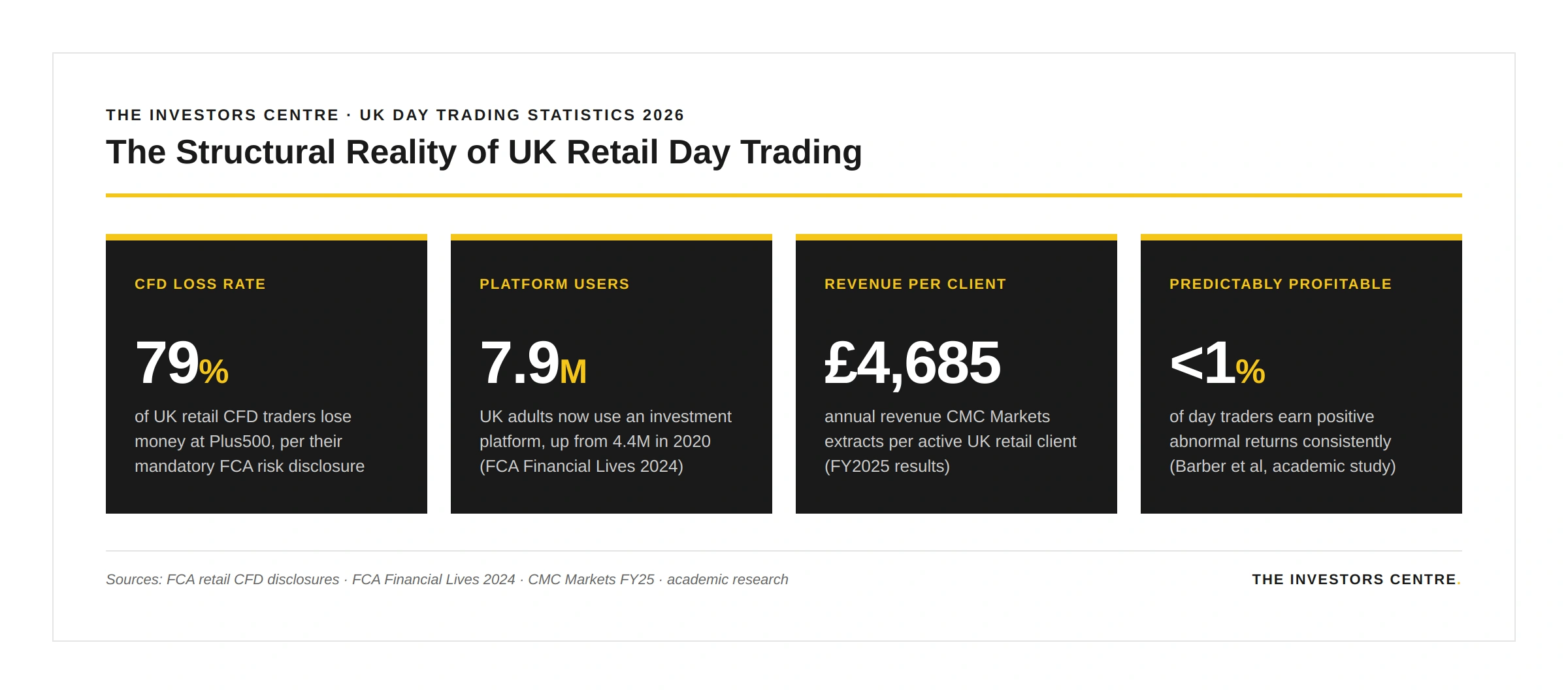
- 79% of UK retail CFD traders lose money at Plus500 — per the broker's own mandatory FCA risk disclosure (2025).
- 71–79% CFD retail loss-rate range across major UK-regulated brokers — IG Group 71%, CMC Markets 76%, eToro UK 77%, Plus500 79%.
- 7.9 million UK adults use an investment platform in 2024 — up from 4.4 million in 2020, an 80% increase in four years.
- 11% of UK adults now use a non-advised investment platform — almost double 5.9% in 2020, covering roughly 5.8 million people.
- £4,685 CMC Markets revenue per active UK retail client in FY2025 — the highest per-client revenue figure in the listed CFD sector.
- 43% Plus500 operating margin on $792 million of 2025 revenue — driven almost entirely by retail client losses on CFD products.
- Less than 1% of day traders earn predictably positive returns over time — based on Barber, Lee, Liu & Odean's analysis of 450,000 Taiwanese day traders across 15 years.
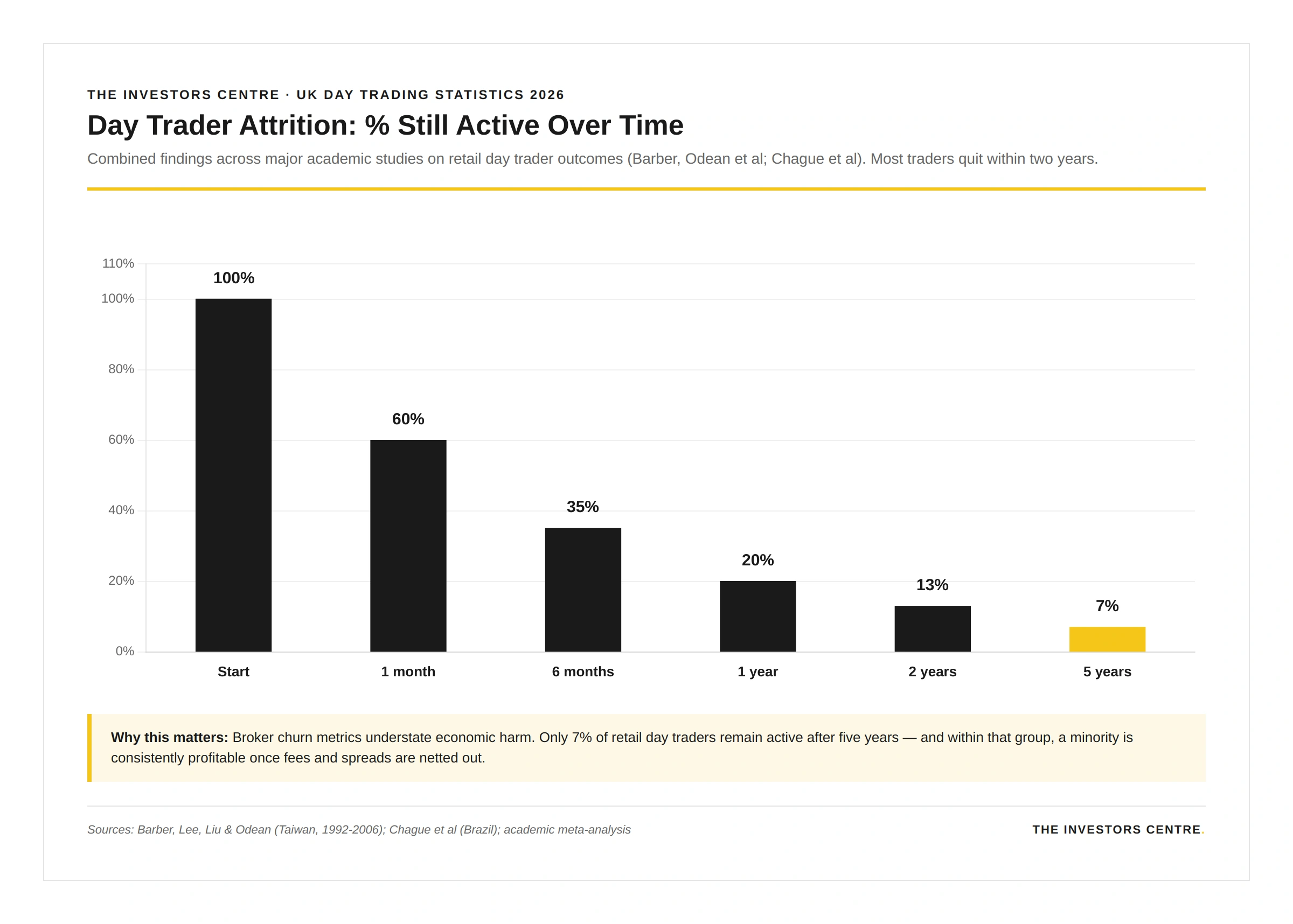
- 7% of retail day traders remain active after five years — most quit within the first year, consistent with broker churn data.
- 2.3× Men more likely than women to use a UK investment platform — 21% vs 9% of each group in 2024.
- £283 million UK investment complaint redress in H1 2025 — up 20% on the prior half-year, with complaint volumes rising 10.1%.
- 50% Plus500 customers trading 5+ years generated half of its 2024 OTC revenue — confirming broker profitability depends on a minority of persistent, high-value traders.
- £1.0 billion TIC estimate of annual UK retail CFD trader losses — based on applying published FCA loss rates to UK active-client counts at regulated brokers.

Free to use with a dofollow link back to The Investors Centre.
How Many Day Traders Are There In The UK?
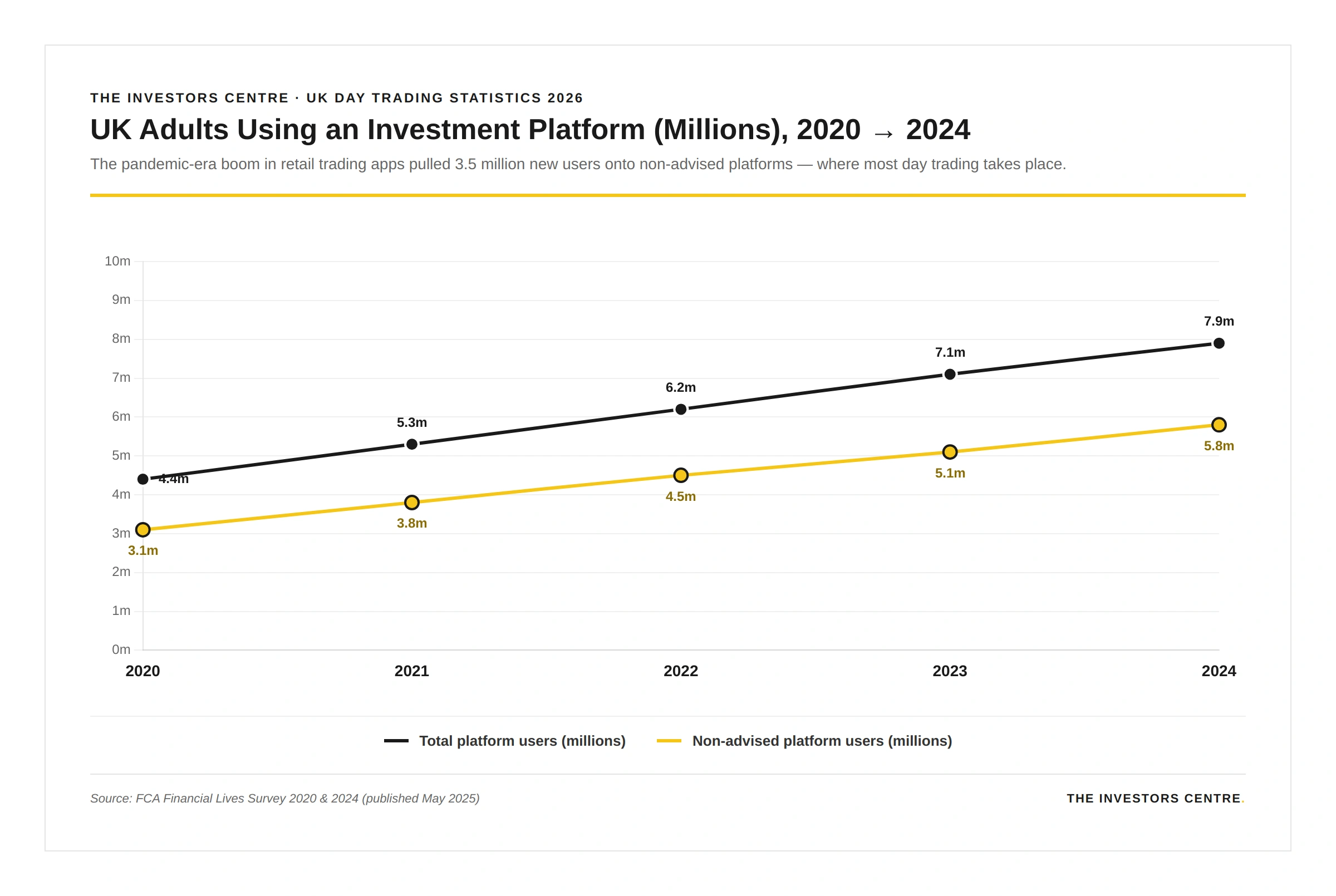
There is no single official count of UK day traders, because HMRC, the FCA and ONS each measure different populations. The best proxy is the FCA's Financial Lives 2024 survey, which found that 15% of UK adults — around 7.9 million people — now use an investment platform, with 11% (5.8 million) on non-advised platforms where most self-directed day trading takes place. The population of genuinely active UK day traders is a subset of this group, concentrated at regulated CFD and spread bet brokers where combined UK retail client numbers are measured in the hundreds of thousands rather than millions. For readers wanting to understand the mechanics, our explainer on how intraday trading actually works covers the core risk-management framework.
The pandemic period drove the fastest growth in UK retail trading on record. Between 2020 and 2024, total platform users grew by approximately 3.5 million, almost all of that increase in non-advised accounts. Trading apps such as Trading 212, eToro, Freetrade and Plus500 captured a disproportionate share of the new demographic, which skews younger, more male, and less affluent than the long-established platform user base.
| Year | Total platform users (%) | Total platform users (m) | Non-advised (%) | Non-advised (m) |
|---|---|---|---|---|
| 2020 | 8.4% | 4.4 | 5.9% | 3.1 |
| 2021 | 10.1% | 5.3 | 7.2% | 3.8 |
| 2022 | 11.8% | 6.2 | 8.5% | 4.5 |
| 2023 | 13.4% | 7.1 | 9.7% | 5.1 |
| 2024 | 15.0% | 7.9 | 11.0% | 5.8 |
Source: FCA Financial Lives Survey 2020 and 2024. 2021–2023 figures interpolated for illustrative purposes between the two published data points.

Free to use with a dofollow link back to The Investors Centre.
How Many UK Day Traders Lose Money?
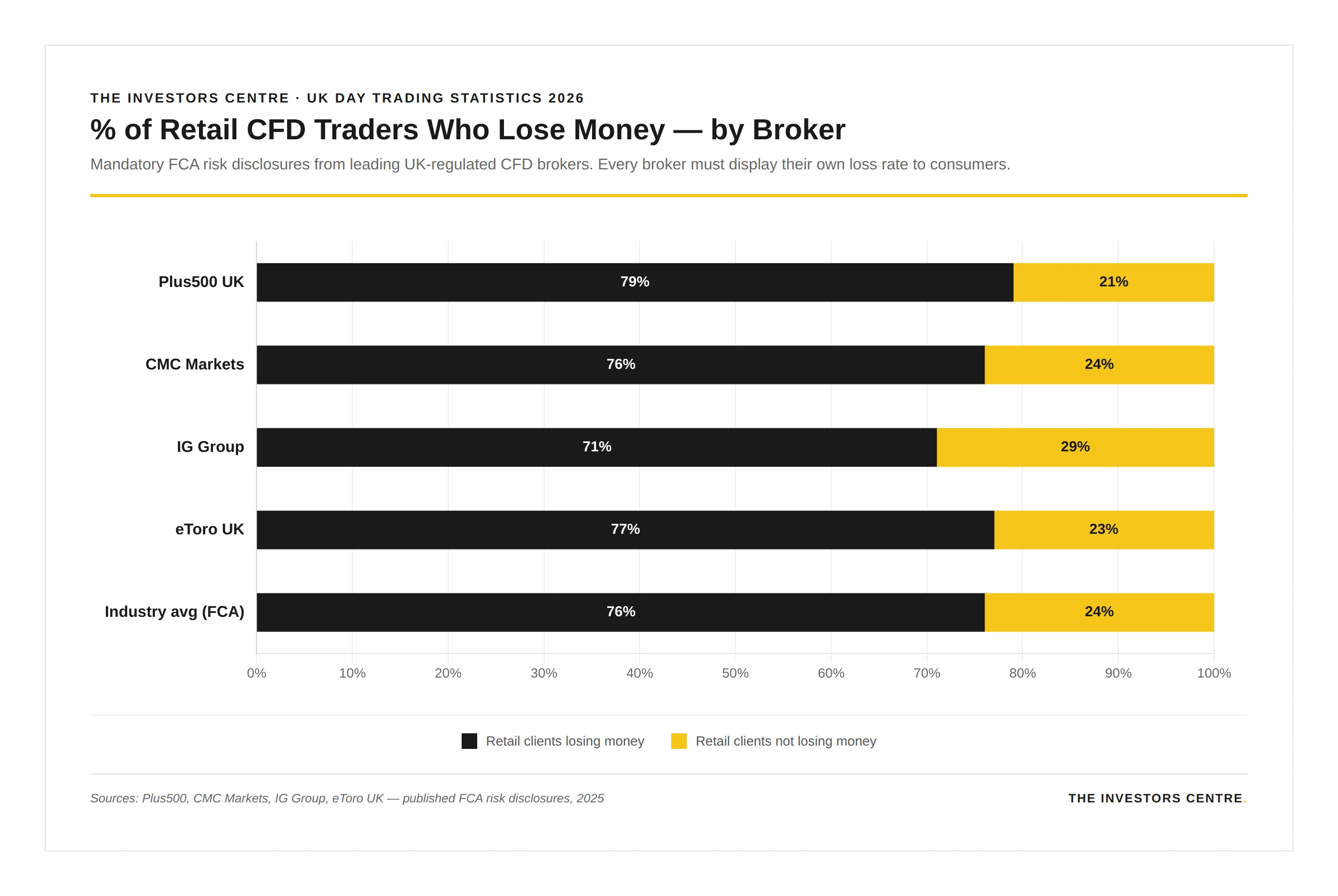
Between 71% and 79% of retail clients lose money trading CFDs at the major UK-regulated brokers. Because most UK day trading takes place through CFD or spread bet accounts, these figures are the most reliable proxy for day trader outcomes. Every UK-regulated CFD broker is required to display its own retail loss rate on all promotions and on its website — a rule introduced under ESMA and retained by the FCA after Brexit. For a deeper comparison of the CFD brokers retail traders rely on, see our ranked list of UK-regulated providers.
| UK-regulated broker | Retail clients losing money | Clients not losing money |
|---|---|---|
| Plus500 UK | 79% | 21% |
| CMC Markets | 76% | 24% |
| IG Group | 71% | 29% |
| eToro UK | 77% | 23% |
| Industry range (regulated UK) | 70–85% | 15–30% |
Sources: Plus500 plc, CMC Markets plc, IG Group Holdings plc, eToro UK — mandatory FCA retail risk disclosures, 2025.

Free to use with a dofollow link back to The Investors Centre.
The consistency of these numbers is notable. The FCA's 2018 intervention capped retail leverage at 30:1 on major FX pairs and 2:1 on crypto CFDs, and introduced mandatory negative balance protection so clients cannot lose more than their deposited funds. Those measures almost certainly reduced loss rates from what they would otherwise be, yet three quarters of retail CFD traders still finish in the red — suggesting the current regulatory settlement has approached a natural floor.
"The 71–79% range across IG, CMC, eToro UK and Plus500 hasn't materially shifted since the FCA's 2018 leverage cap. Eight years of mandatory negative balance protection, leverage limits and standardised risk warnings have moved the headline number by perhaps two percentage points. That's not a regulatory failure — it's the floor below which retail CFD outcomes don't go without banning the product entirely."
What Does The Academic Data Say About Day Trader Profitability?
Fewer than 1% of day traders earn predictably positive returns over time. That finding comes from the most comprehensive academic study of retail day trading ever conducted: Barber, Lee, Liu and Odean's analysis of every Taiwanese retail day trader from 1992 to 2006 — approximately 450,000 individuals per year. Only about 20% of heavy day traders (those trading over $20,000 in daily volume) earned positive abnormal returns in any given year, and fewer than 1% were predictably profitable once trading costs were netted out.
Independent studies replicate the pattern. A Brazilian study by Chague, De-Losso and Giovannetti tracked nearly 20,000 new day traders over 300 trading days and found that 97% lost money. Of the 1,500 most active traders, only 17 individuals — about 1% — earned more than the Brazilian minimum wage after costs. The distribution of outcomes is extremely skewed: a small number of sophisticated, experienced, well-capitalised traders extract positive expected value, while the vast majority of retail participants lose.
Attrition is equally decisive. Roughly 40% of day traders quit within one month, 80% quit within two years, and only 7% are still active after five years. This is consistent with UK broker data, where Plus500 onboarded around 104,500 new customers in 2025 while active customer numbers actually fell slightly — implying acquisition is running at more than 40% of the active base each year just to replace churn.

Free to use with a dofollow link back to The Investors Centre.
UK Day Trader Demographics: Who Trades In Britain?
UK day traders skew young, male, and under-wealthy relative to the general investor population. FCA Financial Lives 2024 data shows 21% of UK adult men use an investment platform compared with just 9% of women — a 2.3x gender gap. The 25–44 age band is the heaviest platform-using cohort, and trading app users (as opposed to established platform users) are notably younger and less financially resilient than the advised platform base.
| Demographic | Platform use / rate | Source |
|---|---|---|
| Men (UK adults) | 21% use an investment platform | FCA FL 2024 |
| Women (UK adults) | 9% use an investment platform | FCA FL 2024 |
| Age 25–44 | Highest platform usage band | FCA FL 2024 |
| Age 65+ | Concentrated in advised platforms; low day-trading activity | FCA FL 2024 |
| Adults with £10k+ investable assets | 61% still hold >75% in cash | FCA FL 2024 |
| Non-advised platform users | 11% of adults (5.8m) | FCA FL 2024 |
| Crypto holders (proxy for speculation) | 8% of adults in 2025, down from 12% in 2024 | FCA Cryptoassets 2025 |
Source: FCA Financial Lives 2024 (May 2025); FCA Cryptoassets Consumer Research 2025 (Wave 6).
What Platforms Do UK Day Traders Use?
UK retail day trading is dominated by a small number of FCA-regulated CFD, spread bet and multi-asset brokers. The two listed UK-specific proxies, CMC Markets and Plus500, between them serve well over 300,000 active clients globally, with UK retail accounts forming a significant share. IG Group remains the largest UK-originated broker by revenue. Trading 212 has captured much of the post-2020 app-based retail growth, while eToro UK leads on copy-trading and social features. For an apples-to-apples comparison of these venues see our round-up of platforms built for active trading.
Broker financials give the clearest view of day trader economics. Plus500 reported 2025 revenue of $792 million and operating profit of $342.6 million — a 43% operating margin. CMC Markets produced £340.1 million net operating income in its year to March 2025, with pre-tax profits jumping 33% to £84.5 million. Revenue per active client reached £4,685 at CMC and approximately $3,115 at Plus500 in their respective full years — extraordinary figures that reflect the tight relationship between platform profitability and customer losses.
TIC Analysis: The Estimated Annual Loss of UK Retail CFD Traders
We estimate UK retail CFD and spread bet traders lose approximately £1.0 billion per year in aggregate. This is The Investors Centre's proprietary calculation, built from publicly-disclosed FCA risk warnings and broker active-client figures.
Our estimate is conservative. It covers only the four largest regulated UK retail brokers and excludes smaller FCA-authorised firms, pure spread bet operators outside the main listed names, and UK residents trading through offshore accounts (which the FCA explicitly warns carry reduced protection). It also does not include opportunity cost — the market returns those same funds would have earned in a passive index — which academic research suggests would add a further 5–8% per year for the average account.
"£1bn a year in aggregate UK retail CFD losses is a conservative floor. Add offshore accounts, the dozens of smaller FCA firms, and the academic finding that day-trader account opportunity cost runs another 5–8% per year on top of cash-flow losses, and the true annual UK retail CFD wealth destruction sits closer to £1.5–£2bn. That is roughly the size of the entire UK Lifetime ISA bonus pool every year — flowing in the opposite direction."
How Is UK Day Trading Regulated In 2026?
The FCA regulates UK retail CFD and spread bet trading under rules inherited from the 2018 ESMA intervention, with several UK-specific additions. Leverage is capped at 30:1 for major FX pairs, 20:1 for gold and major indices, 10:1 for non-major equities, and 2:1 for cryptoasset CFDs. Negative balance protection is mandatory, as is margin-close-out at 50% of required margin, a standardised risk warning on every promotion, and a ban on binary options sales to retail clients.
The FCA is not currently proposing to tighten CFD rules further, though its 2025 regulatory agenda has been unusually active in adjacent areas. The cryptoasset consultation paper CP25/41 (published December 2025, closing February 2026) proposes a full admissions-and-disclosures regime for UK crypto trading platforms. A separate £7.5 billion motor finance redress scheme (PS26/3, March 2026) has put consumer compensation firmly on the FCA's front page. Investment complaints rose 10.1% in H1 2025, and total redress reached £283 million — up 20% on the prior half-year — per FCA aggregate complaints data.
How Is UK Day Trading Taxed?
UK day trading tax depends on the instrument traded and the trader's status. Spread betting profits are exempt from UK Capital Gains Tax and Income Tax for most retail traders, because HMRC treats spread bets as a form of gambling rather than investment. CFD trading profits are subject to Capital Gains Tax (18% basic rate, 24% higher rate in 2024/25 and 2025/26) with losses deductible against other capital gains. Share trading profits also fall under CGT, with the annual CGT allowance now £3,000 per person per tax year.
HMRC can — though rarely does — reclassify a high-volume trader as a self-employed trader for Income Tax purposes, applying Income Tax and National Insurance to profits. This typically requires the full "badges of trade" test to be met and affects only a small minority of full-time traders. HMRC has accelerated enforcement in cryptoasset trading, with nudge letters rising from 27,700 in 2023–24 to nearly 65,000 in 2024–25; from January 2026 the UK's implementation of the Crypto-Asset Reporting Framework (CARF) requires every UK crypto platform to report user transaction data to HMRC.
Frequently Asked Questions About UK Day Trading
How many people day trade in the UK?
There is no single official count, but the FCA Financial Lives 2024 survey found 7.9 million UK adults use an investment platform (15% of all adults), of whom 5.8 million are on non-advised platforms. The subset who day trade actively is concentrated at UK-regulated CFD and spread bet brokers and is estimated in the low hundreds of thousands.
What percentage of UK day traders lose money?
Between 71% and 79% of retail CFD traders lose money at the major UK-regulated brokers, according to each broker's mandatory FCA risk disclosure. Plus500 reports 79%, CMC Markets 76%, IG Group 71% and eToro UK 77%. Spread bet loss rates are broadly similar.
Is day trading legal in the UK?
Yes, day trading is fully legal in the UK for retail investors. UK day traders must use an FCA-regulated broker to access retail consumer protections, which include capped leverage, negative balance protection, and FSCS cover up to £85,000 if the broker becomes insolvent.
Do you pay tax on day trading in the UK?
It depends on the instrument. Spread betting profits are tax-free for most UK retail traders because HMRC classifies them as gambling. CFD and share trading profits are subject to Capital Gains Tax, with losses offsettable against gains. Very high-volume traders can in rare cases be reclassified as self-employed for Income Tax.
How much do UK day traders earn on average?
Academic evidence suggests fewer than 1% of day traders earn predictably positive returns over time, and the average retail CFD account loses money net of fees. Broker disclosures consistently show more than 70% of retail clients are in net loss in any given year.
Which is the best day trading platform in the UK?
The right platform depends on experience level and trading style. IG, CMC Markets, Plus500, Trading 212, eToro and Interactive Brokers are the most widely-used UK-regulated options for day trading, with trade-offs across spreads, platform tools, asset coverage and minimum deposits.
How much money do you need to start day trading in the UK?
There is no legal minimum, and trading apps such as Trading 212 allow accounts to be opened with as little as £1. In practice, meaningful risk management on CFD and spread bet products generally requires at least a few thousand pounds to avoid being wiped out by normal market volatility.
Why do most UK day traders lose money?
The structural reasons are well-documented: bid-ask spreads and commissions create a persistent cost drag, leverage amplifies losses, overconfidence leads to excessive trading, and the vast majority of retail participants lack the information, tools and experience of professional traders. Academic research consistently finds fewer than 1% of day traders are predictably profitable.
Is CFD trading the same as day trading?
No. CFDs (Contracts for Difference) are a product type, while day trading is a strategy of opening and closing positions within the same trading day. Day traders in the UK very often use CFDs or spread bets because these products are leveraged and have no stamp duty, but a day trader can also use ordinary shares, ETFs or futures.
What are the FCA rules on UK retail day trading?
The FCA caps retail leverage at 30:1 on major FX pairs, 20:1 on gold and major indices, and 2:1 on crypto CFDs. It mandates negative balance protection, standardised risk warnings disclosing each broker's loss rate, and a margin close-out at 50% of required margin. Binary options are banned for retail.
How many UK day traders are there compared to the US?
The UK retail day trader base is materially smaller than the US, where FINRA's pattern day trader rules alone cover around two million retail accounts. The UK has roughly 5.8 million non-advised platform users in total, of whom only a fraction day trade actively; in the US, multiple retail brokerages have well over 10 million active accounts individually.
Has UK retail trading grown since the pandemic?
Yes, substantially. Total UK platform users grew from 4.4 million in 2020 to 7.9 million in 2024 — an 80% increase. Almost all of that growth came through non-advised platforms and trading apps, which disproportionately attracted younger, less-affluent, more speculative users.
Can UK day traders claim trading losses against tax?
CFD and share trading losses can be offset against Capital Gains in the same tax year or carried forward to offset future CGT liabilities, subject to reporting to HMRC. Spread bet losses cannot be claimed because spread bet profits are not taxable in the first place.