

- expertise:
- Platform Testing, Cryptocurrency, Retail Investing
- credentials:
- Active investor since 2013 · 11+ years experience
- tested:
- 50+ platforms · 200+ guides authored

- expertise:
- CFD Trading, Forex, Derivatives, Risk Management
- credentials:
- Chartered ACII (2018) · Trading since 2012
- tested:
- 40+ forex & CFD platforms with live accounts
How We Test
Real accounts. Real money. Real trades. No demo accounts or press releases.
What we measure:
- Spreads vs advertised rates
- Execution speed and slippage
- Hidden fees (overnight, withdrawal, conversion)
- Actual withdrawal times
Scoring:
Fees (25%) · Platform (20%) · Assets (15%) · Mobile (15%) · Tools (10%) · Support (10%) · Regulation (5%)
Regulatory checks:
FCA Register verification · FSCS protection
Testing team:
Adam Woodhead (investing since 2013), Thomas Drury (Chartered ACII, 2018), Dom Farnell (investing since 2013) — 50+ platforms with funded accounts
Quarterly reviews · Corrections: in**@*******************co.uk
Disclaimer
Not financial advice. Educational content only. We're not FCA authorised. Consult a qualified advisor before investing.
Capital at risk. Investments can fall. Past performance doesn't guarantee future results.
CFD warning. 67-84% of retail accounts lose money trading CFDs. High risk due to leverage.
Contact: in**@*******************co.uk
Key UK Forex Trading Statistics 2026
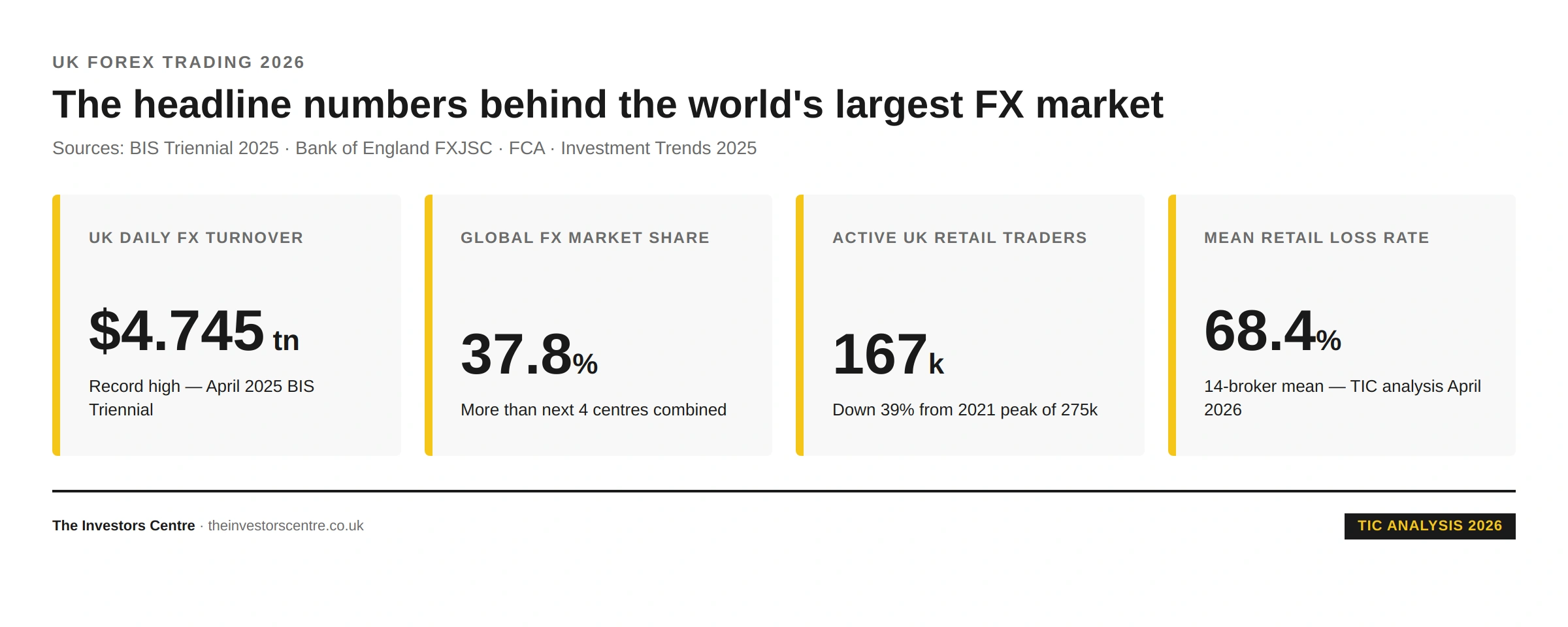
- $4.745 trillion UK average daily FX turnover in April 2025 — the highest on record.
- 37.8% The UK now captures more than the next four global FX centres combined.
- 167,000 active UK retail leverage traders (forex + CFDs + spread bets) in May 2025 — a 39% decline from the 2021 COVID-era peak of 275,000.
- 50% to 76% retail loss disclosures across 14 major UK-authorised brokers — mean 68.4%, median 71.5%.
- 30:1 max leverage on major currency pairs, with mandatory 50% margin close-out and negative balance protection (FCA PS19/18, August 2019).
- 10.2% Sterling appeared on one side of just 10.2% of global FX trades in April 2025 — its lowest share in five surveys, down from 12.9% in 2022.
- FX swaps 48% of UK turnover ($1.84 trillion/day) — the largest single instrument category.
- EUR/USD remains the most-traded pair in UK turnover at 23–25% of daily volume.
- 74 FCA-regulated firms hold permission to offer CFDs to UK retail clients; 2,547 firms hold any CFD/spread-bet/rolling-spot-FX permission.
- £267m–£451m annual savings for UK retail consumers from FCA leverage rules — protecting nearly 400,000 traders a year.
- 2.06× more FX traded in London than New York; 3.20× more than Singapore; 11× more than Tokyo.
- 78–82% → 68–70% Pre-FCA-intervention loss rates have fallen to a 68–70% mean today — an 8–14 percentage-point improvement.

Free to use with a dofollow link back to The Investors Centre.
London Is the World's Largest Forex Trading Centre
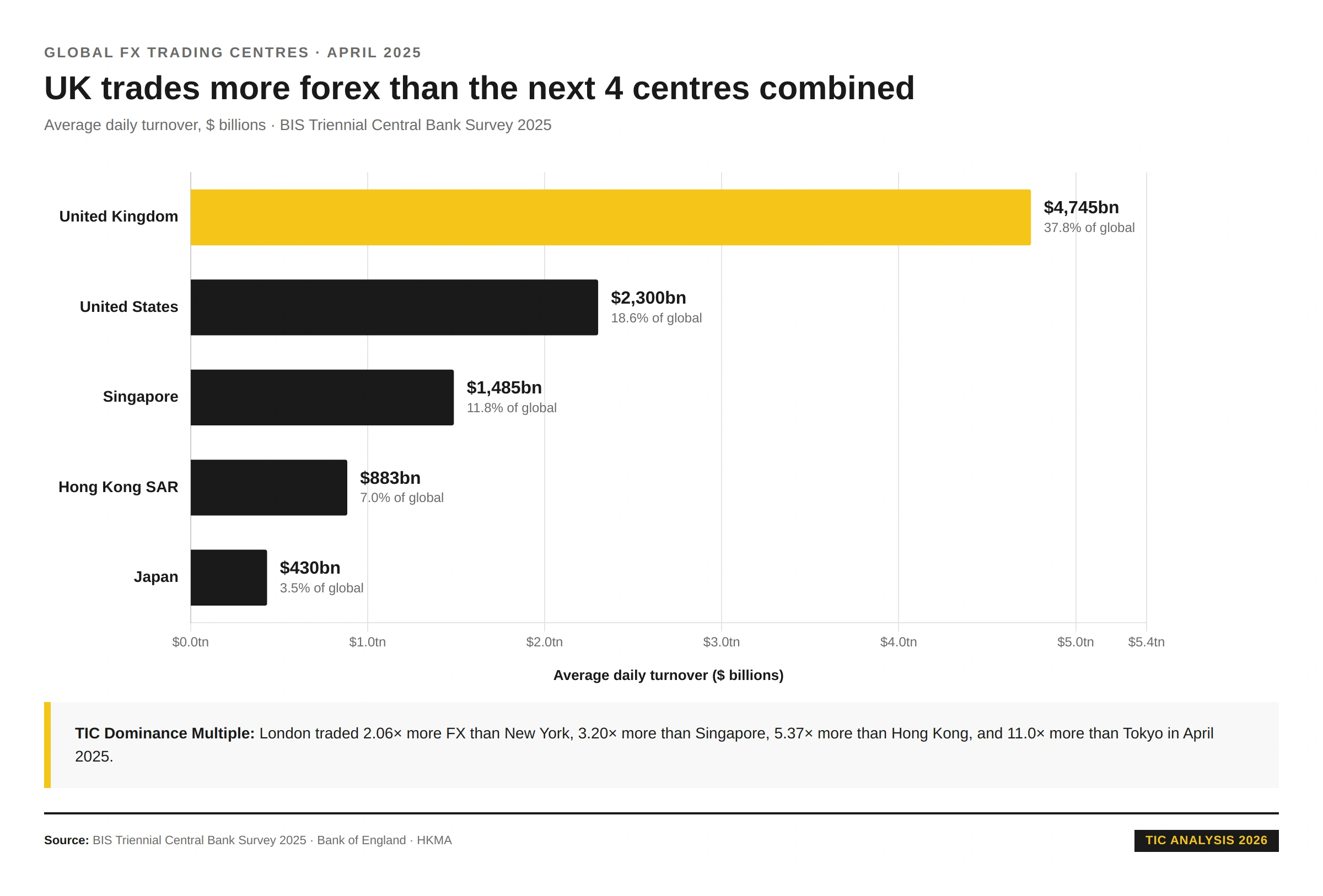
London handled $4.745 trillion of average daily foreign exchange turnover in April 2025 — equivalent to 37.8% of the global market and more than the combined turnover of New York, Singapore, Hong Kong and Tokyo. The figure comes from the Bank for International Settlements Triennial Central Bank Survey, the world's most authoritative FX dataset, conducted every three years across 52 reporting jurisdictions.
UK dominance is structural. London's share has held at 37–43% across the last four Triennial surveys, anchored by deep dealer balance sheets, time-zone advantage between Asian and US sessions, and the world's largest concentration of FX prime-brokerage relationships. The 2025 figure represents a marginal slip from 38.0% in 2022 and 43.1% in 2019 — but a clear gap over the runner-up United States at roughly 18.6%.
Top Five Global FX Trading Centres, April 2025
| Centre | Daily turnover ($bn) | Global share | Multiple vs UK |
|---|---|---|---|
| United Kingdom | 4,745 | 37.8% | 1.00× |
| United States | ~2,300 | ~18.6% | 0.49× |
| Singapore | 1,485 | 11.8% | 0.31× |
| Hong Kong SAR | 883 | 7.0% | 0.19× |
| Japan | ~430 | ~3.5% | 0.09× |
Source: BIS Triennial Central Bank Survey, September 2025; Hong Kong Monetary Authority, 30 September 2025. TIC calculation for "Multiple vs UK" column.

Free to use with a dofollow link back to The Investors Centre.
UK Daily Forex Turnover Hit $4 Trillion for the First Time in 2025
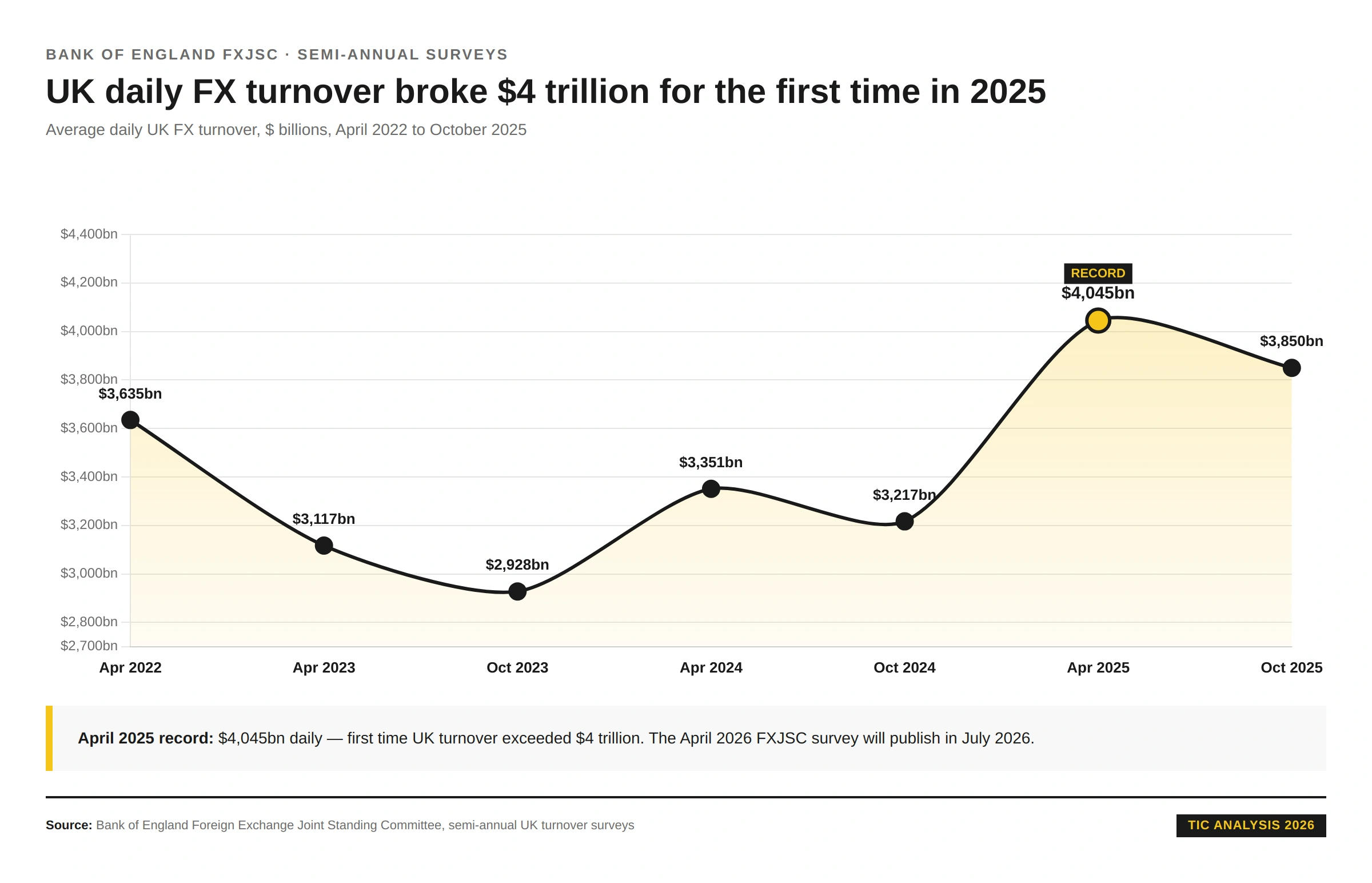
The Bank of England's Foreign Exchange Joint Standing Committee runs a UK-specific semi-annual turnover survey covering 25 of the largest banks and brokers operating in London. The most recent reading, from October 2025, recorded $3.85 trillion in average daily turnover — a 5% pullback from the April 2025 record of $4.045 trillion but a 20% year-on-year increase versus October 2024.
The April 2025 result was the first time UK daily FX turnover exceeded $4 trillion in the FXJSC survey. The 26% year-on-year jump that survey recorded was driven by elevated FX volatility, increased macro hedging demand, and a structural shift toward shorter-tenor FX swaps as global rate differentials widened.
| Survey period | Daily turnover ($bn) | YoY change |
|---|---|---|
| April 2022 | 3,635 | — |
| April 2023 | 3,117 | −14% |
| October 2023 | 2,928 | −3% |
| April 2024 | 3,351 | +11% |
| October 2024 | 3,217 | +10% |
| April 2025 | 4,045 | +26% (record) |
| October 2025 | 3,850 | +20% |
Source: Bank of England Foreign Exchange Joint Standing Committee semi-annual surveys, April 2022 to October 2025. The April 2026 survey is due for publication in July 2026.

Free to use with a dofollow link back to The Investors Centre.
What Instruments Make Up UK Forex Turnover?
UK forex turnover is dominated by FX swaps, which made up 48% of October 2025 volume at $1.84 trillion per day — an 18% jump from the April 2025 survey. FX spot accounted for $1.06 trillion (28%), while outright forwards and FX options made up the remaining ~24%. Globally the picture is similar: BIS data shows FX swaps at 42%, spot at 31%, outright forwards at 19%, and FX options at 7% of the $9.6 trillion daily total.
FCA Rules Cap Retail Forex Leverage at 30:1
UK retail forex traders operate under the most restrictive leverage regime in the developed world, codified in FCA Policy Statement PS19/18 which came into force on 1 August 2019 and remains effectively unchanged through April 2026. The rules apply to every FCA-authorised provider offering contracts for difference, rolling spot forex, or financial spread bets to retail clients in the UK.
FCA Retail Leverage Caps by Asset Class
| Asset class | Maximum retail leverage | Margin requirement |
|---|---|---|
| Major currency pairs (EUR/USD, GBP/USD, USD/JPY etc.) | 30:1 | 3.33% |
| Non-major FX pairs, gold, major equity indices | 20:1 | 5.00% |
| Commodities (excluding gold), non-major equity indices | 10:1 | 10.00% |
| Individual equities and other reference values | 5:1 | 20.00% |
| Cryptocurrencies (effectively banned for retail) | 2:1 | 50.00% |
Source: FCA Policy Statement PS19/18 — "Restricting contract for difference products sold to retail clients," in force 1 August 2019. Crypto-derivative sales to UK retail clients banned outright under FCA PS20/10, in force 6 January 2021.
In addition to the leverage caps, every FCA-authorised provider must apply three further retail safeguards:
- 50% margin close-out rule: firms must close out positions when client funds fall to 50% of the minimum required margin — preventing slow-burn account erosion.
- Negative balance protection: a retail client can never lose more than the total funds in their CFD or forex trading account, even during severe market gapping.
- Standardised retail loss disclosure: every UK provider must display the percentage of its retail accounts that lost money over the past 12 months, refreshed quarterly.
The FCA estimates that PS19/18 delivers £267 million to £451 million in annual consumer savings, protecting roughly 400,000 UK traders a year from losses exceeding their original stake.
How Many UK Forex Traders Lose Money?
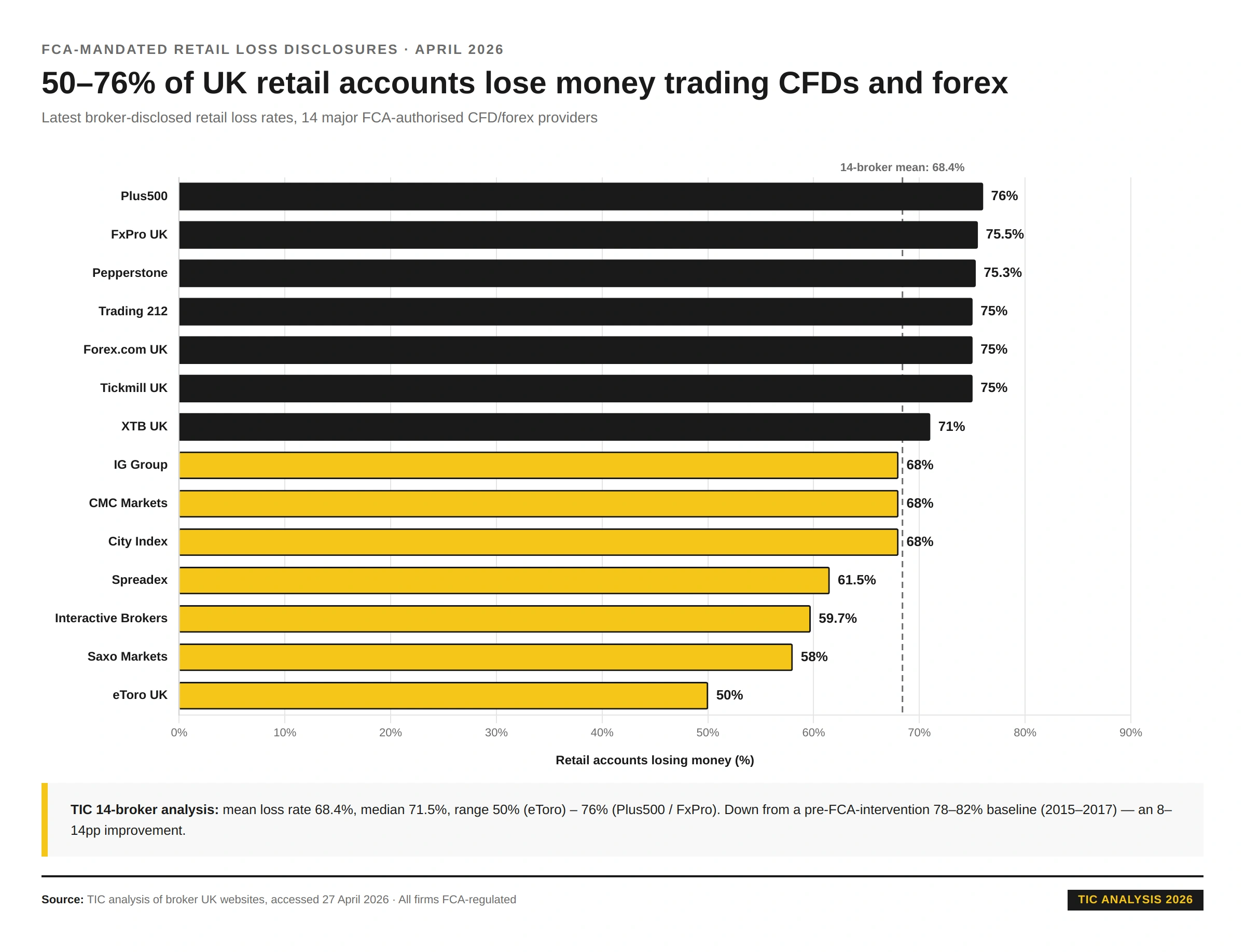
Across the 14 largest FCA-authorised CFD and forex brokers operating in the UK, the FCA-mandated retail loss disclosure ranges from 50% at eToro to 76% at Plus500 and FxPro, with a 14-broker mean of 68.4% and median of 71.5%. Excluding eToro (whose stock-buy accounts dilute the CFD-specific ratio), the unweighted mean rises to 70.0%.
These figures, refreshed quarterly and verified at each broker's UK website on 27 April 2026, represent the cleanest publicly available view of UK retail forex outcomes. Brokers offering both spread bets and CFDs typically combine the two products in their headline figure, while pure-CFD brokers (Plus500, Interactive Brokers, Tickmill) report CFD-only ratios. For an apples-to-apples comparison of the major regulated venues see our shortlist of the leading FCA-regulated forex platforms for UK traders.
| Broker (UK entity) | Retail loss % | EUR/USD typical spread | FCA FRN |
|---|---|---|---|
| IG Group | 68% | 0.6 pips | 195355 |
| CMC Markets | 68% | ~0.7 pips | 173730 |
| Saxo Markets UK | 57–59% | 0.6–0.9 pips | 551422 |
| Plus500 UK | 76% | ~0.8 pips | 509909 |
| Pepperstone UK | 75.3% | 1.0 pips Standard | 684312 |
| Trading 212 UK | 75% | ~1.6 pips | 609146 |
| City Index (StoneX) | 68% | 0.5 pips | 446717 |
| FxPro UK | 74–76% | 1.2 pips Standard | 509956 |
| Spreadex | 61–62% | 0.6 pips | 190763 |
| Forex.com UK | 75% | 0.7 pips | 446717 |
| eToro UK | 50% | ~1.0 pip | 583263 |
| XTB UK | 71% | 0.8–1.4 pips | 522157 |
| Interactive Brokers UK | 59.7% | 0.2 pips | 208159 |
| Tickmill UK | 75% | 1.6 pips Classic | 717270 |
Source: TIC analysis of broker UK websites, accessed 27 April 2026. All firms FCA-authorised; retail clients FSCS-protected up to £85,000.

Free to use with a dofollow link back to The Investors Centre.
"Pepperstone disclosed a 75.3% retail loss rate against IG's 68% — a seven-point gap that reflects different client recruitment, asset mix and platform sophistication rather than any difference in underlying market conditions. The lesson for journalists is that the FCA-mandated single-firm number is the cleanest public retail-outcome metric in UK financial services, more reliable than any aggregated industry estimate. Read our independent Pepperstone analysis for the full breakdown of why their figure runs above the median."
TIC Analysis: The Pre vs Post FCA Intervention Loss Delta
To measure how much the 2018–2019 FCA intervention has actually changed retail forex outcomes, TIC compared FCA pre-intervention findings to today's broker-disclosed loss rates across the 14-broker panel. The result: a meaningful but incomplete improvement.
The improvement is real, but the headline message is that a clear majority of UK retail forex and CFD accounts still lose money. The FCA's leverage caps have removed the worst-case account-blowup scenarios; they have not converted retail forex into a profitable activity for most participants.
TIC London FX Dominance Multiple
A second proprietary calculation: how many times larger is London's daily FX turnover than the next four global centres? Based on BIS Triennial 2025 data, London trades:
- 2.06× more FX than New York ($4,745bn vs $2,300bn).
- 3.20× more than Singapore ($4,745bn vs $1,485bn).
- 5.37× more than Hong Kong ($4,745bn vs $883bn).
- 11.0× more than Tokyo ($4,745bn vs $430bn).
Source: TIC calculation based on BIS Triennial Central Bank Survey 2025, September 2025.
Who Trades Forex in the UK?
UK retail forex trading is a small, demographically narrow slice of the wider UK investing public. The FCA Financial Lives 2024 survey found that 8.4% of UK adults held any high-risk investment in May 2024 (down from 11% in 2022), and only 0.7% held CFDs directly. Trading-app penetration was 3% of UK adults — roughly 1.6 million people — of whom 8% had traded forex and 6% had traded CFDs in the previous 12 months.
The 2025 Investment Trends UK Leverage Trading Report — based on a 10,927-respondent survey — places the active leverage-trader population (forex + CFDs + spread bets) at 167,000, down 39% from the 2021 COVID-era peak of 275,000. The decline has been driven by fewer new and returning traders rather than attrition in the core, with the previously-active cohort stabilising at around 124,000.
| Year | Active leverage traders | YoY change |
|---|---|---|
| 2020 | ~145,000 | — |
| 2021 | 275,000 (peak) | +90% |
| 2022 | ~234,000 | −15% |
| 2023 | ~196,000 | −16% |
| 2024 | 173,000 | −12% |
| 2025 | 167,000 | −3% |
Source: Investment Trends 2025 UK Leverage Trading Report (17th edition), published 30 June 2025, based on a survey of 10,927 traders.
Demographic Skew: Young, Male, London-Centred
UK forex trading skews heavily male and young. FCA Financial Lives 2024 found that 47% of UK trading-app users are aged 18–34, with only 18% aged 55 or over. Trading-app penetration is 5% of UK men versus 1% of UK women — a 5× gender gap. Among non-advised platform users trading FX, commodities, crypto or CFDs, 11% of men participate versus 5% of women.
Geographic concentration is sharp. Capital.com's May 2025 UK client data placed 34% of clients in London, 11.7% in the South East, 9.9% in the North West, and 9.0% in the West Midlands — broadly aligning with where younger, higher-income professionals are clustered. Tax-efficient alternatives such as tax-efficient spread betting accounts remain a UK-specific option for active retail traders.
FCA Enforcement Has Intensified in 2024–2026
The FCA issued its updated CFD Portfolio Letter on 13 December 2024, setting a two-year supervisory strategy focused on Consumer Duty compliance, market abuse, halo firms, and operational resilience. Enforcement activity stepped up alongside it.
| Date | Firm / action | Outcome |
|---|---|---|
| August 2024 | Forex TB Limited (FXTB) | £276,100 fine for retail client mistreatment |
| December 2024 | CFD Portfolio Letter (Dear CEO) | Two-year supervisory strategy issued |
| June 2025 | International finfluencer week of action | 3 arrests, 7 cease-and-desist letters, 50 warnings |
| 2025 | Infinox Capital Limited | £99,200 fine — first MiFIR transaction-reporting case |
| November 2025 | CFD multi-firm price and value review | Industry-wide Consumer Duty concerns raised |
| April 2026 | Finfluencer week of action (recurring) | Coordinated international enforcement |
Source: FCA Final Notices, press releases and supervisory communications, 2024–2026.
The FCA disclosed that one CFD firm promoted by finfluencers caused approximately 90,000 retail investors to lose around £75 million over four years — a key data point underpinning its November 2025 Consumer Duty multi-firm review, which found that some CFD providers may be failing to deliver fair value through inadequately disclosed overnight funding charges and double-charging on matched long/short positions.
Frequently Asked Questions
How big is the UK forex market?
The UK is the world's largest forex trading centre with $4.745 trillion in average daily FX turnover in April 2025, equal to 37.8% of the global market. The Bank of England's separate FXJSC survey recorded UK turnover of $3.85 trillion per day in October 2025. Source: BIS Triennial 2025 and Bank of England FXJSC.
How many UK retail forex traders are there?
There are approximately 167,000 active UK retail leverage traders (forex, CFDs and spread bets combined) as of May 2025, down 39% from the 2021 peak of 275,000. The FCA also references roughly 400,000 UK CFD traders per year benefiting from regulatory protections. Source: Investment Trends 2025 UK Leverage Trading Report; FCA, October 2025.
What is the maximum forex leverage in the UK?
The FCA caps retail leverage at 30:1 on major currency pairs, 20:1 on non-major pairs, gold and major equity indices, 10:1 on commodities and non-major indices, 5:1 on individual equities, and effectively 2:1 on cryptocurrencies (which are subject to a separate retail derivative ban). These caps come from FCA Policy Statement PS19/18, in force since 1 August 2019.
What percentage of UK forex traders lose money?
FCA-mandated disclosures across the 14 largest UK-authorised brokers range from 50% at eToro to 76% at Plus500 and FxPro, with a mean of 68.4% and median of 71.5%. Excluding eToro (where stock-buy accounts dilute the ratio), the mean rises to 70.0%. Source: TIC analysis of broker UK websites, April 2026.
Is forex trading legal in the UK?
Yes. Retail forex trading is legal and regulated in the UK by the Financial Conduct Authority. Providers must hold FCA authorisation, comply with PS19/18 leverage caps, offer negative balance protection, and apply 50% margin close-out. Retail client funds are protected by the Financial Services Compensation Scheme up to £85,000.
How many FCA-regulated forex brokers are there?
74 FCA-regulated firms hold permission to offer CFDs to UK retail clients as of December 2025, with 105 firms in the wider CFD portfolio and 2,547 firms holding any CFD, spread-bet or rolling-spot-forex permission. Source: FCA Freedom of Information disclosure, December 2025.
What is the most-traded currency pair in the UK?
EUR/USD is the most-traded pair in UK FX turnover, accounting for 23–25% of daily volume. GBP/USD is the dominant sterling pair. Sterling itself appeared on one side of just 10.2% of global FX trades in April 2025, down from 12.9% in 2022. Source: Bank of England FXJSC October 2025; BIS Triennial 2025.
How does FCA leverage compare to other countries?
UK retail leverage caps mirror those of the EU under ESMA and are among the strictest in the world. By contrast, retail traders in Australia (ASIC) face similar 30:1 limits as of 2021, while traders in offshore jurisdictions can access 500:1 or higher — though those venues are not authorised to onboard UK retail clients.
Has the FCA intervention reduced retail forex losses?
Yes, but only partially. Pre-intervention loss rates of 78–82% (FCA, 2015–2017) have fallen to a current 14-broker mean of 68–70% — an 8 to 14 percentage-point improvement. The FCA estimates the rules deliver £267–£451 million in annual consumer savings and protect roughly 400,000 UK traders per year. A clear majority of retail accounts still lose money.
What is FX swap turnover in the UK?
FX swaps were the largest single instrument in UK turnover in October 2025, accounting for $1.84 trillion per day (48% of UK total). FX spot accounted for $1.06 trillion (28%); outright forwards and FX options made up the remaining ~24%. Source: Bank of England FXJSC, October 2025.
How is forex trading taxed in the UK?
Forex trading via spread betting is exempt from Capital Gains Tax and Stamp Duty for UK residents (HMRC treats it as betting). Forex trading via CFDs is subject to Capital Gains Tax above the annual exempt amount. Forex profits from spot trading on a non-leveraged basis can be subject to either CGT or income tax depending on activity level — professional advice is strongly recommended.
What are the FCA enforcement priorities for forex brokers?
The FCA's December 2024 CFD Portfolio Letter set out priorities including Consumer Duty compliance, market abuse surveillance, halo firms, distributor and appointed-representative networks, and operational resilience. The November 2025 multi-firm price and value review identified concerns over overnight funding charges and matched-position double-billing.