

- expertise:
- Platform Testing, Cryptocurrency, Retail Investing
- credentials:
- Active investor since 2013 · 11+ years experience
- tested:
- 50+ platforms · 200+ guides authored

- expertise:
- CFD Trading, Forex, Derivatives, Risk Management
- credentials:
- Chartered ACII (2018) · Trading since 2012
- tested:
- 40+ forex & CFD platforms with live accounts
How We Test
Real accounts. Real money. Real trades. No demo accounts or press releases.
What we measure:
- Spreads vs advertised rates
- Execution speed and slippage
- Hidden fees (overnight, withdrawal, conversion)
- Actual withdrawal times
Scoring:
Fees (25%) · Platform (20%) · Assets (15%) · Mobile (15%) · Tools (10%) · Support (10%) · Regulation (5%)
Regulatory checks:
FCA Register verification · FSCS protection
Testing team:
Adam Woodhead (investing since 2013), Thomas Drury (Chartered ACII, 2018), Dom Farnell (investing since 2013) — 50+ platforms with funded accounts
Quarterly reviews · Corrections: in**@*******************co.uk
Disclaimer
Not financial advice. Educational content only. We're not FCA authorised. Consult a qualified advisor before investing.
Capital at risk. Investments can fall. Past performance doesn't guarantee future results.
CFD warning. 67-84% of retail accounts lose money trading CFDs. High risk due to leverage.
Contact: in**@*******************co.uk
Key UK Options Trading Statistics 2026
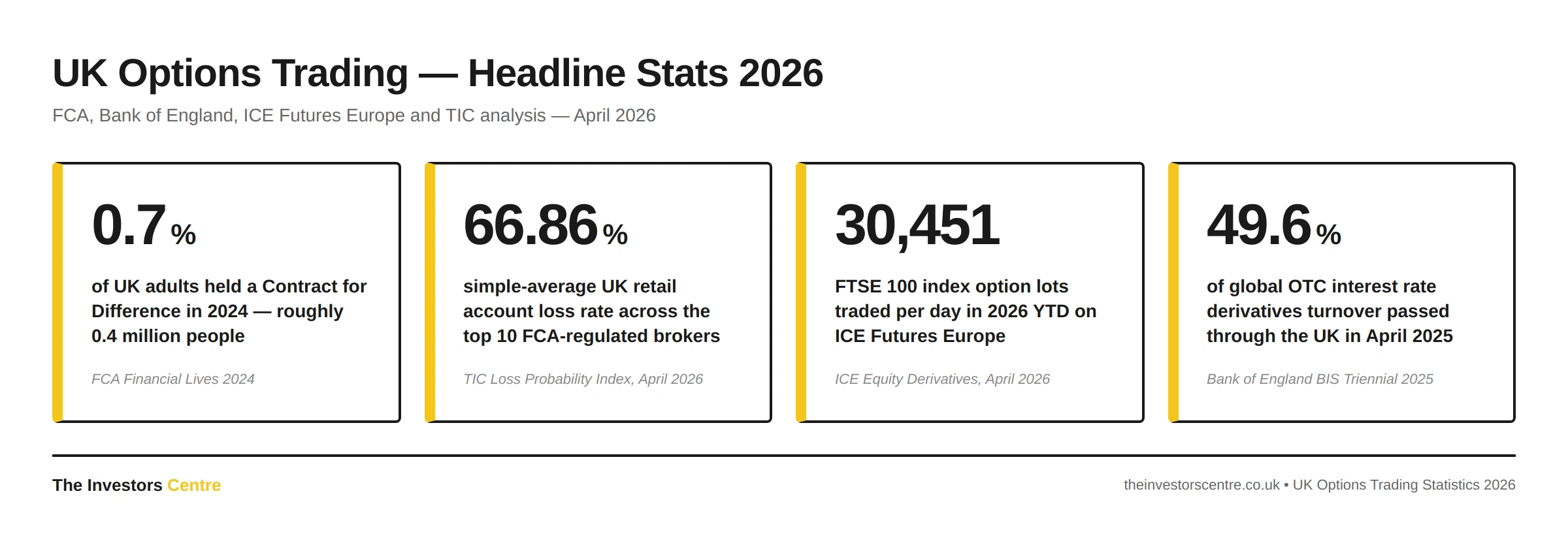
- 49.6% of global OTC interest rate derivatives turnover passed through the UK in April 2025 — the largest share of any single jurisdiction.
- $4,745 billion in average daily UK FX turnover made London the world's largest FX trading centre with 37.8% of global volume.
- 0.7% of UK adults held a Contract for Difference in 2024 — approximately 0.4 million people, unchanged from 0.6% in 2022.
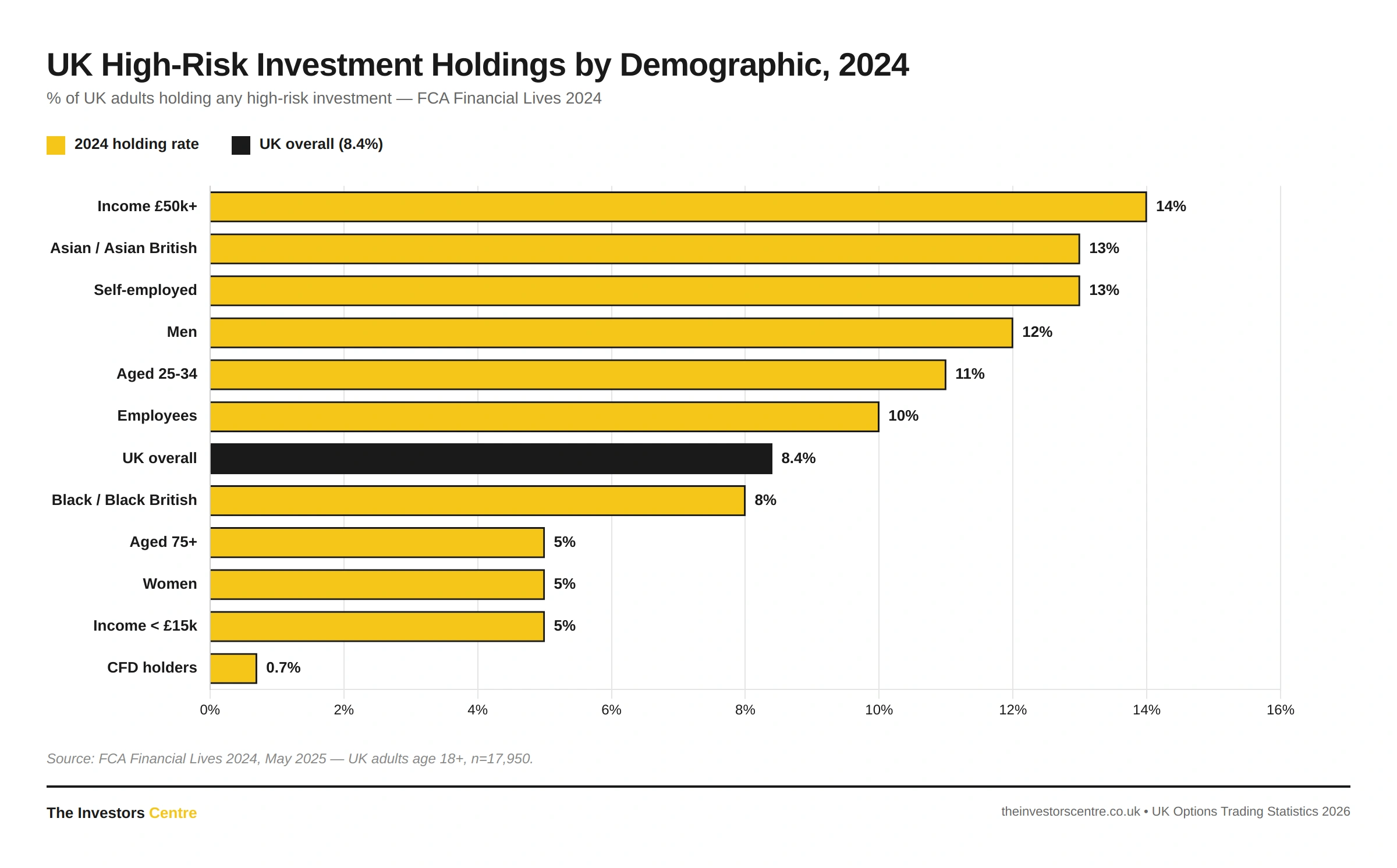
- 8.4% of UK adults held a high-risk investment in 2024 — down from 11% in 2022, the first decline recorded by the survey.
- 167,000 active UK leverage traders in 2025 — down from 275,000 at the 2021 pandemic-era peak.
- 50% to 76% of UK retail derivatives accounts lose money across the ten largest FCA-regulated brokers, with a TIC simple-average of 66.86%.
- 30,451 lots average daily FTSE 100 index option volume on ICE Futures Europe in 2026 year-to-date — with 1,113,403 lots open interest equivalent to roughly £100 billion of notional exposure.
- 105,095 contracts traded on Cboe Europe Derivatives in 2024 — up 123% on 46,971 in 2023 as continental retail demand expanded.
- 12.2 billion contracts cleared by the OCC in 2024 — the highest annual total in OCC's 51-year history and roughly 50% retail-driven.
- £649 million lost to UK investment fraud in 2024 from 25,843 reports — losses up 13% year-on-year despite a 7% drop in case volume.
- £176 million in FCA fines issued in calendar 2024 with 19,766 financial promotions amended or withdrawn, up 97.5% on 2023.
- Binary options banned for UK retail since 2 April 2019, and crypto-derivatives since 6 January 2021. Both bans remain permanent.

Free to use with a dofollow link back to The Investors Centre.
How Many People Trade Options in the UK?
Roughly 167,000 UK adults actively trade leveraged products including options-style exposure in 2025, with around 0.4 million holding a CFD specifically. The FCA's Financial Lives Survey 2024 — the largest UK consumer finance survey, with 17,950 respondents and fieldwork from 5 February to 16 June 2024 — does not publish a standalone figure for adults trading exchange-listed options. The closest direct measure is CFD ownership, recorded at 0.7% of UK adults in 2024 against 0.6% in 2022.
The active leveraged-trading population is best measured by Investment Trends, whose UK Leverage Trading Report tracks margin FX, CFD and spread-bet traders. Numbers peaked at 275,000 in 2021 during the pandemic-era surge, then fell each subsequent year to 167,000 in 2025. Around 124,000 of those are continuing-active traders, with dormancy at a five-year low. Independent Finder.com research suggests roughly 500,000 Britons — about 1% of the adult population — have ever traded a CFD, with average lifetime losses of £2,200.
| Year | Active leverage traders (UK) | Context |
|---|---|---|
| 2021 | 275,000 | Pandemic-era peak; lockdown trading boom |
| 2022 | 236,000 | First post-peak decline |
| 2023 | 199,000 | FCA Consumer Duty introduction |
| 2024 | 176,000 | Continued normalisation |
| 2025 | 167,000 | Lowest active count since 2020 |
Source: Investment Trends UK Leverage Trading Report 2025, summarised by Finance Magnates.
Who Are UK Options and Derivatives Traders?
UK derivatives users are predominantly male, aged 25 to 44, and concentrated in higher-income households. Among UK adults holding high-risk investments, 12% are men and 5% are women — a more-than-twofold gender gap. The highest holding rate sits in the 25-34 age band at 11%, declining steadily with age to 5% among the 75-plus group. By household income, 14% of those earning £50,000 or more hold a high-risk investment, against 5% of those on under £15,000. Self-employed adults (13%) outpace employees (10%).

Free to use with a dofollow link back to The Investors Centre.
Risk Awareness Among UK Derivatives Holders
The risk-awareness data raises real concerns. Among UK high-risk investment holders in 2024, 26% described their willingness to take risk as none or very low — up from 23% in 2022 — and just 17% rated themselves moderate to high. Around 31% of holders had more than 10% of their investible assets in high-risk products, and 32% said a significant loss would impact their finances, rising to 66% among those with a quarter or more of investible assets exposed.
Information sources skew digital. Among UK investors, 29% used Google searches for investment information, 19% used social media, 14% used YouTube, and 6% used Reddit or forums, against 21% who used a financial adviser. Some 41% of high-risk investment holders recalled seeing advertising before investing, rising to 57% among 18 to 34-year-olds.
UK Options Trading Volumes Have Held Steady on ICE Futures Europe
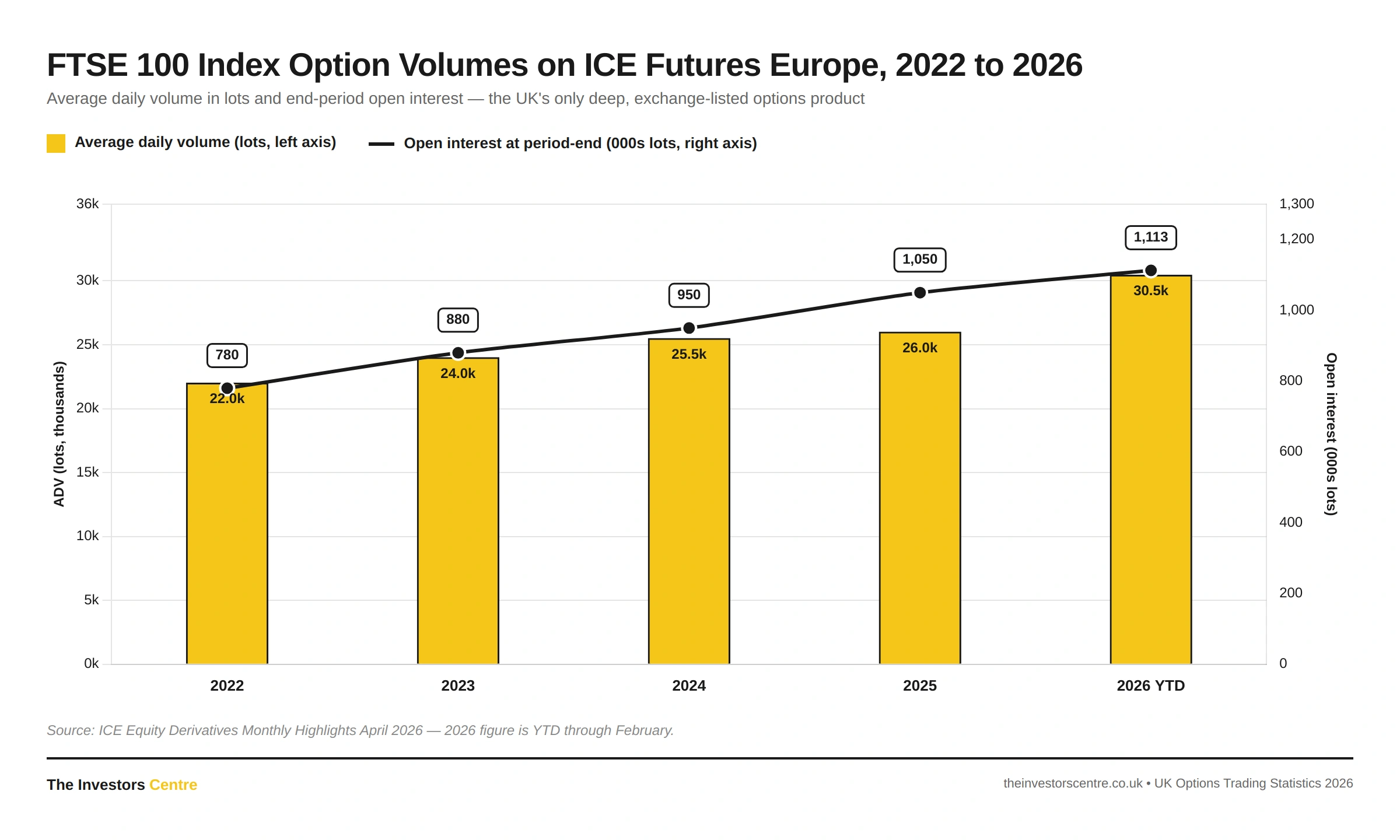
The FTSE 100 index option averaged 30,451 lots per day in 2026 year-to-date, with open interest above 1.1 million lots. The FTSE 100 index option remains the only deep, exchange-listed UK options product, and it trades almost exclusively on ICE Futures Europe. Mid-2025 average daily volume sat at around 26,000 lots; the 2026 year-to-date figure of 30,451 represents a meaningful uplift on a multi-year base. FTSE 100 index futures trade alongside the option at roughly 93,000 lots ADV in 2025, with 400,000 lots open interest.
| Metric | Latest figure | Source | Date |
|---|---|---|---|
| FTSE 100 index option ADV (2026 YTD) | 30,451 lots | ICE Futures Europe | April 2026 |
| FTSE 100 index option open interest | 1,113,403 lots | ICE Futures Europe | February 2026 |
| FTSE 100 index futures ADV | ~93,000 lots | ICE Futures Europe | 2025 average |
| Cboe Europe Derivatives total volume | 105,095 contracts | Cboe Europe | Full year 2024 |
| Cboe Europe Derivatives YoY growth | +123% | Cboe Europe | 2023 to 2024 |
| Eurex equity options total volume | 302 million contracts | Eurex (UK single-stock options now clear here) | Full year 2025 |
| UK FX turnover | $4,745 billion per day | Bank of England BIS Triennial | April 2025 |
| UK OTC interest rate derivatives turnover | $4,320 billion per day | Bank of England BIS Triennial | April 2025 |
Sources: ICE Equity Derivatives Monthly Highlights April 2026; Cboe Europe Derivatives 2024 Recap January 2025; Eurex January 2026; Bank of England September 2025.

Free to use with a dofollow link back to The Investors Centre.
Cboe Europe Derivatives, launched in September 2021 and clearing on Cboe Clear Europe, is the fastest-growing UK-relevant venue. Total CEDX volume reached 105,095 contracts in 2024, up 123% on 46,971 in 2023, with equity options responsible for 78,783 lots. January 2025 alone delivered 11,640 lots, up 112% year-on-year. The Bank of England granted Cboe Clear Europe permanent UK recognition in Q1 2023.
UK single-stock equity options now overwhelmingly trade on Eurex, with London Stock Exchange Derivatives Market liquidity having migrated continental during the early 2020s. Eurex holds an estimated 83% pan-European single-stock options market share against Euronext's 17%. The London Stock Exchange's interest-rate venue, CurveGlobal Markets, closed on 28 January 2022 after failing to dislodge ICE and Eurex.
How Many UK Brokers Offer Options Trading?
74 firms hold FCA permission to offer CFDs to UK retail clients, but only Saxo Markets UK and Interactive Brokers UK offer FCA-regulated direct exchange-listed options to UK retail in any meaningful way. The remainder provide options exposure through OTC spread bets, CFDs, or by routing UK clients to overseas entities outside the FCA perimeter. Around 23 FCA-regulated brokers handle the dominant share of activity, with combined monthly trading volumes above $9.3 trillion. For an apples-to-apples comparison see our shortlist of UK platforms equipped for active derivatives strategies.
The market has consolidated since the post-Brexit Temporary Permissions Regime closed: none of the roughly 100 EEA CFD firms in the regime obtained permanent FCA authorisation. Recent UK exits include Gain Capital, AETOS, ADSS and GMI Markets. After 27 October 2025, IG Markets UK stopped offering direct-market-access US futures and options; UK clients seeking listed US options through the IG group are now routed to tastytrade Inc, a US-regulated broker that is not FCA-authorised and offers no FSCS protection.
UK Retail Derivatives Brokers — Loss Disclosure Percentages
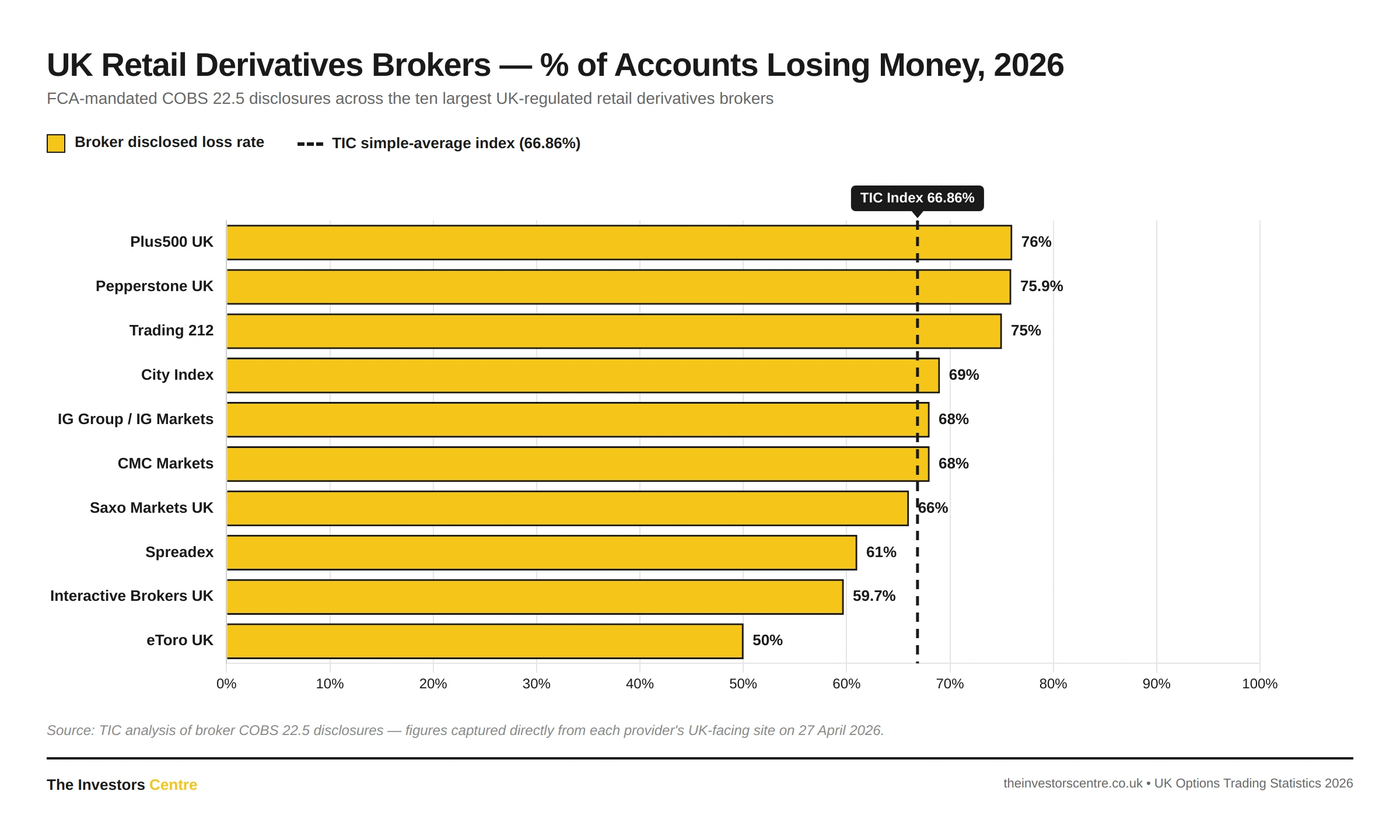
The FCA-mandated risk-warning percentages disclosed by the ten largest UK retail derivatives brokers — required under COBS 22.5 and refreshed every quarter from a rolling 12-month base — currently range from 50% to 76%. The figures below were captured directly from each provider's UK-facing site on 27 April 2026.
| Broker | % UK retail accounts losing money | Product scope |
|---|---|---|
| eToro UK | 50% | CFDs |
| Interactive Brokers UK | 59.7% | CFDs |
| Spreadex | 61% | Spread bets and CFDs |
| Saxo Markets UK | 66% | CFDs |
| IG Group / IG Markets | 68% | Spread bets and CFDs |
| CMC Markets | 68% | Spread bets and CFDs |
| City Index | 69% | CFDs |
| Trading 212 | 75% | CFDs |
| Pepperstone UK | 75.9% | Spread bets and CFDs |
| Plus500 UK | 76% | CFDs |
Source: each broker's homepage and risk-disclosure pages, fetched 27 April 2026; compiled in the Good Money Guide UK loss-percentages tracker.

Free to use with a dofollow link back to The Investors Centre.
The FCA's own official aggregate figure, repeated as recently as November 2025, remains around 80% — drawn from its 2018-19 econometric work and reaffirmed in the multi-firm CFD review.
What Are the FCA Rules for Retail Options Trading?
UK rules for retail derivatives are tighter than equivalent US norms and have been stable since 2019. Vanilla exchange-listed options are not banned and not subject to specific leverage caps for retail. Binary options have been permanently banned for UK retail consumers since 2 April 2019 under FCA Policy Statement PS19/11. Crypto-derivatives — including crypto options, futures and exchange-traded notes — were permanently banned for UK retail under PS20/10 from 6 January 2021, although the FCA opened a consultation in April 2025 on lifting the ban for crypto exchange-traded notes specifically.
FCA Mandatory Initial Margin Requirements (COBS 22.5)
| Asset class | Initial margin | Maximum leverage |
|---|---|---|
| Major currency pairs | 3.33% | 30:1 |
| Major equity indices and gold | 5% | 20:1 |
| Minor FX pairs, non-major equity indices, commodities other than gold | 10% | 10:1 |
| Individual equities and other reference values | 20% | 5:1 |
| Restricted speculative options without volatility-mitigating features | 50% | 2:1 |
Source: FCA PS19/18 — restricting CFD products sold to retail clients, in force since 1 August 2019.
Retail clients are protected by per-account negative-balance protection — losses cannot exceed account funds — and a mandatory 50% margin close-out rule that forces firms to close positions when account equity falls to half the initial margin. Monetary and non-monetary inducements to trade CFDs are prohibited. The FCA estimates these protections deliver £267 million to £451 million of consumer benefit per year. For a deeper explainer of how leverage amplifies derivatives exposure, see our companion piece.
FCA Enforcement and Promotions Activity
Enforcement has tightened. FCA fines reached £176 million in calendar 2024 and £186 million in financial year 2024-25, with 37 Final Notices issued and 1,456 firm authorisations cancelled. Notable derivatives cases include the £276,100 fine against Cyprus-based Forex TB Limited in December 2024 for unfair CFD treatment and false professional-client opt-ups, and the £99,200 fine against Infinox Capital in March 2025 — the first UK MiFIR transaction-reporting fine — for failing to submit 46,053 single-stock CFD transaction reports.
The FCA issued 2,240 alerts on unauthorised firms in 2024 and amended or withdrew 19,766 financial promotions, up 97.5% on 10,008 in 2023. The November 2025 multi-firm review of CFD providers' price and value found mixed practice on overnight funding charge disclosure, with a forthcoming consultation on tightening client-categorisation rules to curb elective-professional opt-ups.
How Does UK Options Trading Compare With the US?
UK retail options trading is more than four orders of magnitude smaller than the US on a per-adult basis, despite the UK dominating wholesale derivatives. Cboe estimates retail traders are now responsible for close to 50% of total US options volume in 2025, implying roughly 6.9 billion retail-driven contracts on a projected 13.8 billion-contract year. The US has tens of millions of options-enabled brokerage accounts; the UK has fewer than 200,000 active leverage traders across all derivative product types combined.
| Region | Retail participation proxy | Daily options volume | Market structure |
|---|---|---|---|
| UK | 0.7% (CFD ownership proxy) | 30,451 lots/day | FTSE 100 options dominate |
| US | ~50% of options volume retail-driven | ~55 million contracts/day | Single-stock and SPX dominate |
| Eurozone | Mixed — Eurex retail growing | 1.2 million contracts/day | Eurex dominant venue |
| Global (exchange-traded) | n/a | 153 billion contracts/year (2024) | 85% of all derivatives are options |
Sources: FCA Financial Lives 2024; OCC January 2025; Cboe State of the Options Industry Q3 2025; Eurex; World Federation of Exchanges FY 2024 Market Highlights.
Global OTC derivatives notional outstanding reached $846 trillion at end-June 2025, up 16% year-on-year — the largest annual increase since the 2008 crisis. Global equity-linked OTC derivatives notional sat at $8.9 trillion at end-2024, up 14.4% year-on-year. The Americas dominate single-stock options at 61% of global volume, ahead of APAC at 25% and EMEA at 14%.
"The UK is the largest wholesale derivatives hub in the world and one of the smallest developed retail options markets. Those two facts coexist because UK retail policy has converged towards CFDs and spread bets — leveraged synthetic exposure delivered OTC, not direct exchange-listed options. The 30,451 FTSE 100 lots/day figure tells you UK exchange-listed retail options are essentially a single-product market, while the 6.9 billion US retail-driven contracts/year tells you what an alternative future could look like."
UK Investment Fraud and Options Trading Scams
Action Fraud recorded 25,843 UK investment-fraud reports in 2024 with total losses of £649 million — losses up 13% year-on-year despite a 7% drop in case volume. Cryptocurrency accounted for 66% of investment-fraud reports, and crypto plus trading (unspecified) together made up 75% of all commodity types reported. Celebrity-impersonation deepfakes — featuring Martin Lewis, Elon Musk and Jeremy Clarkson — caused over £10 million in losses in 2024.
Victims aged 35 to 44 are most likely to be targeted; victims aged 55 to 64 suffer the largest individual losses. UK Finance's Annual Fraud Report 2025 puts investment fraud losses through Authorised Push Payment channels at £144.4 million in 2024, up 34% year-on-year despite a 24% reduction in cases — the largest APP-fraud loss category by value. Financial Ombudsman Service complaints reached 305,726 in 2024-25, the highest in six years and up 54% on 198,798 in 2023-24.
TIC Analysis: The UK Retail Options Loss Probability Index
The TIC UK Retail Options Loss Probability Index returns a simple-average of 66.86% and a median of 68.5% across the ten largest UK-regulated retail derivatives brokers. The index sits below the FCA's official 80% headline (drawn from 2018-19 work and reaffirmed in November 2025) but above the lowest individual broker disclosure of 50%, providing a defensible UK retail benchmark for marketing materials, journalist citations and consumer-facing risk communication.
TIC Calculation: UK Versus US Retail Options Trading Gap
Applying the Cboe estimate that retail accounts for around 50% of US options volume to OCC's 12.2 billion 2024 contracts implies roughly 6.1 billion US retail-driven contracts in 2024. Against perhaps 25,000 to 30,000 UK retail-driven contracts implied by the niche Saxo Markets UK and Interactive Brokers UK direct-listed-options channels, the UK figure is more than four orders of magnitude smaller. On a per-adult basis, US retail trades approximately 22 cleared options contracts per adult per year against under 0.001 in the UK.
TIC Calculation: FTSE 100 Options Premium Decay Model
At 27 April 2026, with the FTSE 100 trading near 10,000 and the FTSE 100 Volatility Index near 11 to 12, an at-the-money 30-day FTSE 100 call option at £10 per index point carries an indicative theoretical premium of roughly 140 index points, decaying to approximately 95 at 60 days and 50 at 90 days under standard Black-Scholes assumptions.
| Time to expiry | Theoretical premium | Decay vs baseline |
|---|---|---|
| 30 days to expiry | 140 points | Baseline ATM premium |
| 60 days to expiry | 95 points | 32% decay vs 30-day |
| 90 days to expiry | 50 points | 64% decay vs 30-day |
Source: TIC calculation using Black-Scholes assumptions, FTSE 100 ~10,000, VFTSE ~11.5%, risk-free rate 4.25%, no dividends. April 2026.
Holders of long at-the-money positions surrender roughly a third of premium value across each successive 30-day window in a low-volatility environment, with theta exposure rising sharply in the final 30 days.
FTSE 100 Implied Volatility Has Stayed Near Multi-Year Lows
The FTSE 100 Volatility Index (VFTSE) closed at 10.96 on 27 June 2025, near multi-year lows. Outside spike events the index has held a 52-week range of 10.27 to 11.54. Two volatility shocks defined the year: the VIX hit 60.13 on 7 April 2025 during the tariff-driven selloff (the highest reading since the 2020 pandemic), and the index spiked again to 27.8 on 20 November 2025 over US tech valuations. The long-run mean for VFTSE since 2000 sits at roughly 21.5% on the 30-day measure, with extremes of 9% in calm periods and 84.8% during October 2008.
UK Broker Profitability: Active Customer Counts Are Surging
IG Group reported 820,000 total active customers at end-FY25, up 137% year-on-year following its acquisition of Freetrade. The Freetrade deal completed on 1 April 2025. IG Markets Ltd alone — the UK OTC derivatives entity — generated net trading revenue of £384.9 million and £131.2 million profit, with IG Index Ltd (UK spread betting) adding £228.3 million revenue and £92.7 million profit.
ARPU divergence remains wide across the UK retail derivatives sector. Plus500 reported ARPU of $3,268 for FY 2025 with average customer deposits of around $26,900 — a record. IG Group runs at roughly $3,240; CMC Markets at $1,350; XTB at $350.
Frequently Asked Questions
Is options trading legal in the UK?
Yes, options trading is legal in the UK and regulated by the FCA. Vanilla exchange-listed options are not banned and not subject to specific FCA leverage caps for retail clients. Binary options have been permanently banned for UK retail consumers since 2 April 2019 under FCA Policy Statement PS19/11.
How many UK adults trade options?
The FCA does not publish a standalone figure for UK adults trading exchange-listed options. The closest measure is CFD ownership, recorded at 0.7% of UK adults (approximately 0.4 million people) in 2024. Investment Trends estimates 167,000 active UK leverage traders across all derivative product types combined in 2025.
What percentage of UK retail derivatives traders lose money?
FCA-mandated risk warnings disclosed by the ten largest UK retail derivatives brokers in April 2026 ranged from 50% (eToro) to 76% (Plus500), with a TIC simple-average of 66.86%. The FCA's official aggregate figure remains around 80%, drawn from its 2018-19 econometric work.
Which UK brokers offer options trading?
Saxo Markets UK and Interactive Brokers UK are the principal FCA-regulated brokers offering direct exchange-listed options to UK retail clients. Most other UK retail brokers offer options-style exposure through CFDs or spread bets rather than direct exchange-listed options. After 27 October 2025, IG Markets UK stopped offering direct-market-access US futures and options.
What is the FCA leverage limit for UK retail derivatives?
The FCA caps retail leverage at 30:1 for major currency pairs, 20:1 for major equity indices and gold, 10:1 for minor FX and non-major indices, 5:1 for individual equities, and 2:1 for restricted speculative options without volatility-mitigating features. These limits have been in force since 1 August 2019 under PS19/18.
Are binary options legal in the UK?
No. Binary options have been permanently banned for UK retail consumers since 2 April 2019. The FCA's standing position is that any firm offering binary options services to retail consumers is likely to be a scam.
What is the FTSE 100 options trading volume?
The FTSE 100 index option averaged 30,451 lots per day in 2026 year-to-date on ICE Futures Europe, with open interest of 1,113,403 lots — equivalent to roughly £100 billion of notional exposure at £10 per index point. The FTSE 100 index option is the only deep, exchange-listed UK options product.
How does UK options trading compare with the US?
US retail trades approximately 22 cleared options contracts per adult per year against under 0.001 in the UK — a maturity gap of more than four orders of magnitude. US retail accounts for around 50% of total US options volume; the OCC cleared 12.2 billion options contracts in 2024, with 2025 on track for 13.8 billion.
Are crypto options legal for UK retail traders?
No. Crypto-derivatives — including crypto options, futures and exchange-traded notes — have been permanently banned for UK retail under FCA Policy Statement PS20/10 since 6 January 2021. The FCA opened a consultation in April 2025 on lifting the ban for crypto exchange-traded notes specifically.
What protections do UK retail derivatives traders have?
UK retail clients are protected by per-account negative-balance protection (losses cannot exceed account funds), a mandatory 50% margin close-out rule, and standardised FCA risk warnings. Monetary and non-monetary inducements to trade CFDs are prohibited. The FCA estimates these protections deliver £267 million to £451 million of consumer benefit per year.
How much is lost to UK investment fraud each year?
Action Fraud recorded UK investment-fraud losses of £649 million from 25,843 reports in 2024, with losses up 13% year-on-year. Cryptocurrency accounted for 66% of investment-fraud reports. UK Finance separately recorded £144.4 million in investment-fraud losses through Authorised Push Payment channels in 2024.
What is the FCA's role in UK options trading?
The Financial Conduct Authority is the UK's principal financial regulator and oversees options brokers, sets leverage limits, mandates risk disclosures, and enforces consumer protections. FCA fines reached £176 million in calendar 2024, with 37 Final Notices and 19,766 financial promotions amended or withdrawn (up 97.5% on 2023).
Can I claim FSCS protection on UK options trading losses?
FSCS protection generally covers up to £85,000 if an FCA-authorised broker fails — but it does not cover trading losses. UK clients trading through non-FCA-authorised entities (for example IG group US-options clients routed to tastytrade Inc after October 2025) have no FSCS protection. Always confirm a broker's FCA authorisation before opening an account.
What is the UK share of global options trading?
The UK is the world's largest wholesale derivatives hub but a niche retail options market. London handled 49.6% of global OTC interest rate derivatives turnover and 37.8% of global FX turnover in April 2025. Retail options activity sits overwhelmingly with US venues — the UK does not feature in the global retail options volume rankings.
How fast is UK options trading growing?
Cboe Europe Derivatives total volume reached 105,095 contracts in 2024, up 123% on 46,971 in 2023, suggesting rapid early-stage growth from a small base. FTSE 100 options ADV on ICE Futures Europe rose to 30,451 lots in 2026 YTD from approximately 26,000 lots in mid-2025. The active UK leverage trader population, however, has fallen from a 2021 peak of 275,000 to 167,000 in 2025.