

- expertise:
- Platform Testing, Cryptocurrency, Retail Investing
- credentials:
- Active investor since 2013 · 11+ years experience
- tested:
- 50+ platforms · 200+ guides authored

- expertise:
- CFD Trading, Forex, Derivatives, Risk Management
- credentials:
- Chartered ACII (2018) · Trading since 2012
- tested:
- 40+ forex & CFD platforms with live accounts
How We Test
Real accounts. Real money. Real trades. No demo accounts or press releases.
What we measure:
- Spreads vs advertised rates
- Execution speed and slippage
- Hidden fees (overnight, withdrawal, conversion)
- Actual withdrawal times
Scoring:
Fees (25%) · Platform (20%) · Assets (15%) · Mobile (15%) · Tools (10%) · Support (10%) · Regulation (5%)
Regulatory checks:
FCA Register verification · FSCS protection
Testing team:
Adam Woodhead (investing since 2013), Thomas Drury (Chartered ACII, 2018), Dom Farnell (investing since 2013) — 50+ platforms with funded accounts
Quarterly reviews · Corrections: in**@*******************co.uk
Disclaimer
Not financial advice. Educational content only. We're not FCA authorised. Consult a qualified advisor before investing.
Capital at risk. Investments can fall. Past performance doesn't guarantee future results.
CFD warning. 67-84% of retail accounts lose money trading CFDs. High risk due to leverage.
Contact: in**@*******************co.uk
Key UK Spread Betting Statistics 2026
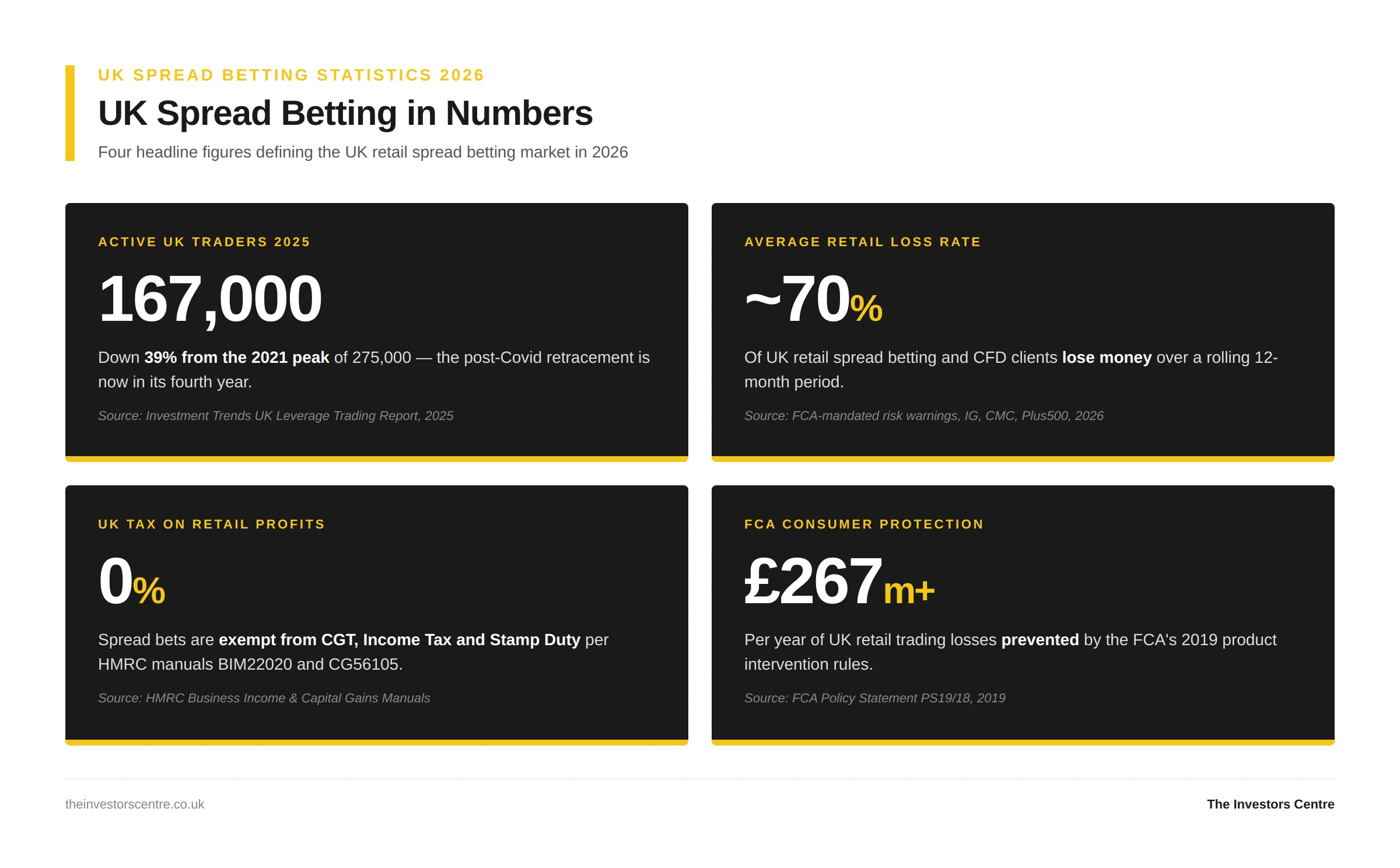
- 167,000 UK adults held an active leveraged trading account in May 2025 — down 39% from the 275,000 Covid-era peak in 2021.
- 68–76% of retail clients lose money at the major UK FCA-regulated spread betting brokers (IG 68%, CMC 68%, Pepperstone 72%, Capital.com 76%, Spreadex 64%).
- £4 billion in UK betting and gaming duties is forecast for 2025-26 — equivalent to roughly £140 per household.
- 74 FCA-permissioned firms can offer spread bets and CFDs to UK retail clients (December 2025).
- 0% CGT, 0% Stamp Duty, 0% Income Tax applies to UK retail spread bet profits, per HMRC manuals BIM22020 and CG56105.
- 3% General Betting Duty is the operator-side tax on net stake receipts from financial spread bets — versus 10% on non-financial spread bets and 15% on fixed-odds betting.
- £267m–£451m per year — the FCA's estimate of UK retail trading losses prevented by its 2019 product intervention rules.
- 30:1 leverage cap on major FX, 5:1 on individual equities, 2:1 on cryptocurrencies — the FCA leverage limits in force since August 2019.
- £1.075bn IG Group revenue for FY25 (year to 31 May 2025), with 820,000 active customers globally. IG Index Limited (UK spread betting unit) generated £228.3m net trading revenue.
- 44% market share held by the top three UK leveraged trading providers — IG, CMC and a Saxo/Pepperstone tier.
- ~80% → ~70% of UK CFD clients lost money pre-2019 versus ~70% today — the FCA estimates its rules prevent nearly 400,000 people per year from losing more than their original stake.
- UK + Ireland only — spread betting is illegal in the United States and offered as a regulated retail derivative only in two countries — making the UK the world's largest financial spread betting market by definition.

Free to use with a dofollow link back to The Investors Centre.

65% of retail investor accounts lose money when trading CFDs with this provider. You should consider whether you can afford to take the high risk of losing your money.
How Many People Spread Bet in the UK?
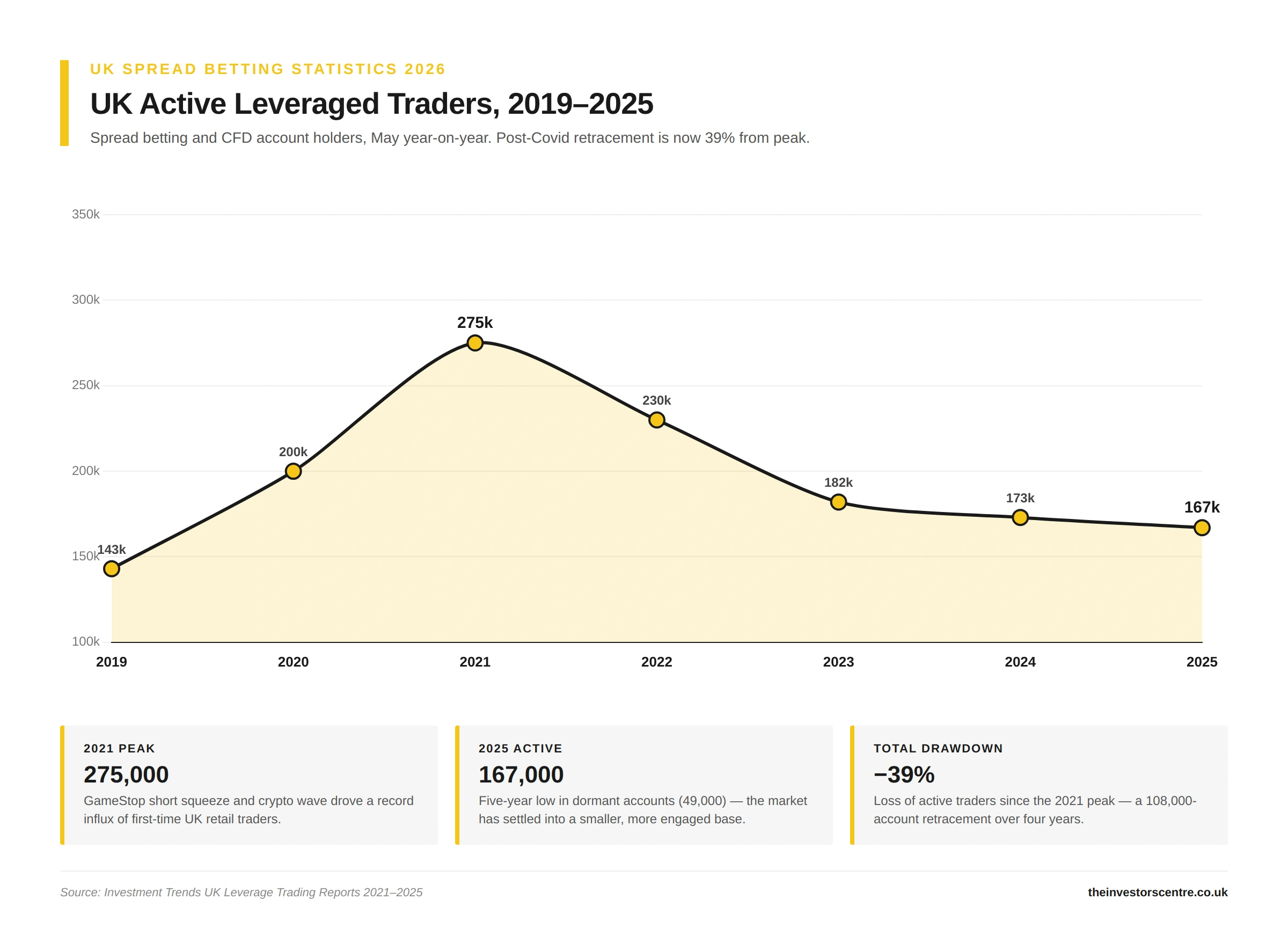
Approximately 167,000 UK adults held an active leveraged trading account — covering both spread bets and CFDs — in May 2025, according to Investment Trends, the industry-standard UK retail trading data source.
That figure represents a sharp retracement from the Covid-era boom. Active leveraged trader numbers surged from a 2019 baseline of around 143,000 to a peak of 275,000 in 2021 — an inflow driven by lockdown-era home trading, the GameStop short squeeze, and the cryptocurrency wave. Five years on, dormant accounts sit at a five-year low (49,000), and the active population has settled at the level you would expect for a mature, regulated retail derivatives market. For an explainer of the mechanics, our piece on how spread betting actually works walks through bet sizing, point values, margin and tax rules.
UK Active Leveraged Traders — 5-Year Trend
| Year | Active UK leveraged traders | Notes | Year-on-year change |
|---|---|---|---|
| 2019 | 143,000 | Pre-Covid baseline | — |
| 2020 | 200,000 | Lockdown surge begins | +40% |
| 2021 | 275,000 | Peak — GameStop & crypto wave | +38% |
| 2023 | 182,000 | Post-Covid retracement | −34% (vs 2021) |
| 2024 | 173,000 | Continued cool-down | −5% |
| 2025 | 167,000 | 5-year low in dormant accounts (49k) | −3.5% |
Source: Investment Trends UK Leverage Trading Report 2021–2025; consolidated data via Finance Magnates.

Free to use with a dofollow link back to The Investors Centre.
How Common Is Spread Betting Among UK Adults?
Spread betting is a niche retail derivative product, not a mainstream form of investing. The 167,000 active leveraged traders represent roughly 0.3% of the UK adult population — and that figure aggregates spread bets and CFDs together, since the FCA does not separately publish account totals for the two products. Two further data points anchor that scarcity: Finder's national consumer survey indicates around 1% of UK adults — about 500,000 people — have ever traded CFDs; and the Gambling Commission's pre-2023 participation surveys placed past-four-weeks spread betting participation at 0.3% in 2023, 1.1% in 2022 and a Covid-era spike of 1.9% in 2020-21.
Who Dominates the UK Spread Betting Market?
Two FTSE-listed firms — IG Group and CMC Markets — anchor the UK retail leveraged trading market, and Investment Trends data confirms the top three providers control approximately 44% of all UK leveraged trading volume. IG Group, founded in 1974, is the world's first and largest financial spread betting firm and a FTSE 100 constituent. The full broker shortlist is in our top-rated UK spread betting platforms guide.
| Broker | Total revenue (FY) | UK spread bet revenue | Active clients | Reporting period |
|---|---|---|---|---|
| IG Group | £1,075.9m | £228.3m (IG Index Ltd) | 820,000 (group) | Year to 31 May 2025 |
| CMC Markets | £340.1m | £27.4m (CMC Spreadbet plc) | ~291,000 | Year to 31 March 2025 |
| Spreadex | Privately held | UK spread betting & sports | Not disclosed | Year to 31 Mar 2024 |
Source: IG Group Annual Report 2025; CMC Markets Annual Report 2025; broker investor materials.
FCA-Authorised Firms by Permission Type
There are 74 firms with FCA permissions to offer CFDs and spread bets to UK retail clients as of December 2025, sitting inside a wider portfolio of 105 supervised CFD firms and 2,547 firms with any permission to deal in CFDs, rolling spot FX or spread bets as principal or agent. That 74-firm retail-facing total has shrunk meaningfully since the FCA tightened oversight. Approximately 20% of UK CFD/spread bet brokers are what the regulator calls "halo firms" — entities holding FCA authorisation but conducting little UK regulated activity, existing largely to lend FCA reputation to overseas group entities. Of the 100 EEA-authorised CFD firms that entered the UK Temporary Permissions Regime on 1 January 2021, zero achieved permanent FCA authorisation by December 2024.
How Many UK Spread Betters Actually Make Money?
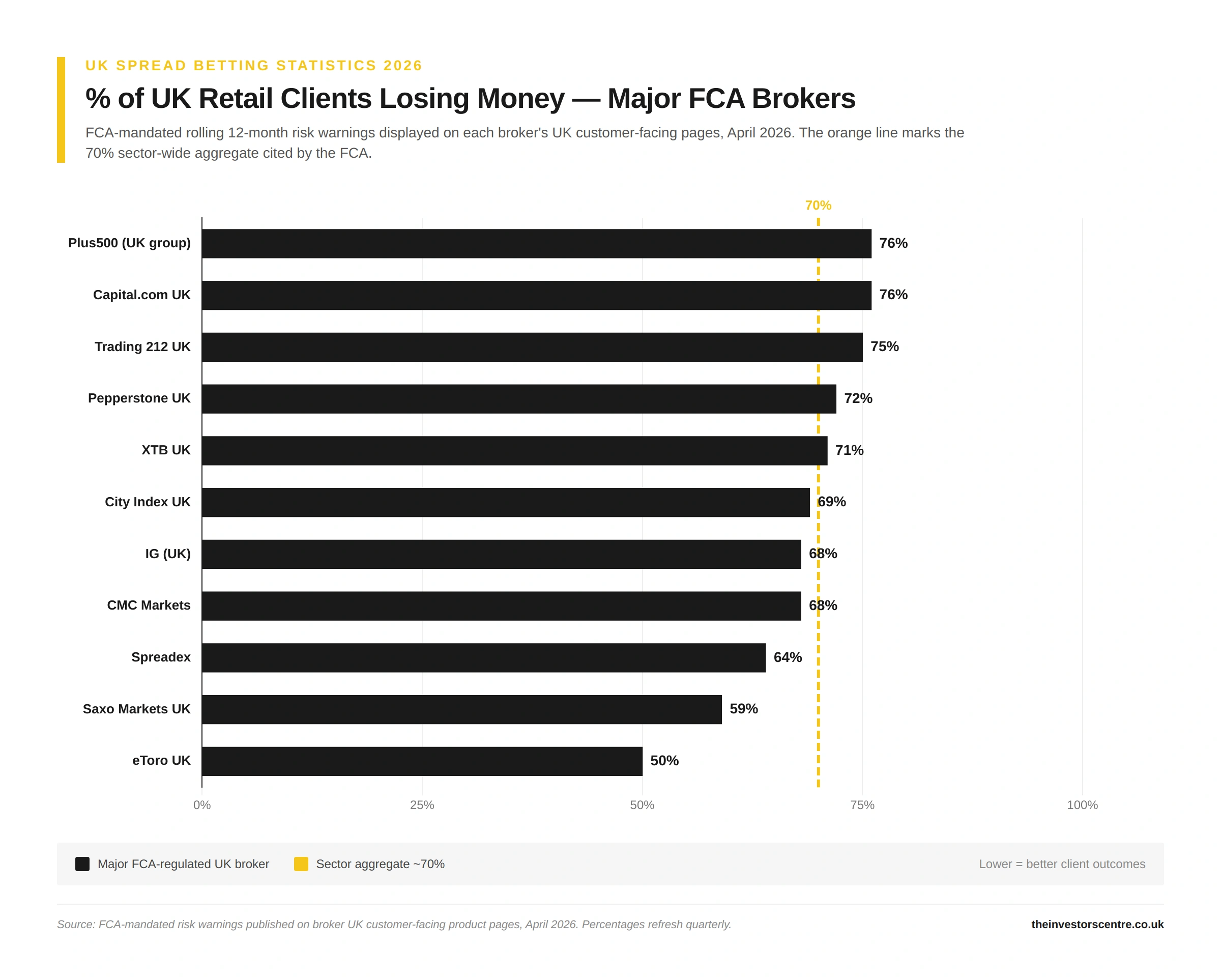
Around 30% of UK retail spread betting and CFD clients are profitable in any given 12-month period — meaning approximately 70% lose money. This is the rolling 12-month average across the major FCA-regulated brokers, derived from each firm's mandatory FCA risk-warning disclosure.
Those firm-by-firm percentages are the most reliable retail loss data available anywhere in UK financial services. Because the FCA requires every CFD and spread betting provider to publish the share of retail clients that lose money over a rolling 12-month window, in standardised wording, on every product page, the disclosures function as effective regulatory data — even though they are displayed on commercial websites.
| Broker | % retail accounts losing money | Implied % profitable |
|---|---|---|
| eToro UK | 50% | 50% |
| Saxo Markets UK | 59% | 41% |
| Spreadex | 64% | 36% |
| IG (UK) | 68% | 32% |
| CMC Markets | 68% | 32% |
| City Index (StoneX) UK | 69% | 31% |
| XTB UK | 71% | 29% |
| Pepperstone UK | 72% | 28% |
| Trading 212 UK | 75% | 25% |
| Capital.com UK | 76% | 24% |
Source: FCA-mandated risk warnings published on each broker's UK customer-facing product pages, April 2026. Percentages reflect the rolling 12-month period and refresh quarterly.

Free to use with a dofollow link back to The Investors Centre.
Why Are UK Spread Betting Profits Tax-Free?
UK retail spread betting profits are exempt from Capital Gains Tax, Income Tax and Stamp Duty Reserve Tax because HMRC classifies spread bets as wagers rather than trades. The position is set out in HMRC's internal manuals BIM22020, BIM22015, BIM56900 and CG56105 — the foundation documents that have made the UK the world's largest retail spread betting market.
| Tax | Spread betting | CFD trading | Direct share dealing |
|---|---|---|---|
| Capital Gains Tax | 0% — exempt | 18% basic / 24% higher (2025/26) | 18% basic / 24% higher |
| Income Tax on profits | 0% — exempt | 0% (gains are CGT, not income) | 0% (gains are CGT, not income) |
| Stamp Duty Reserve Tax | 0% — exempt | 0% (no shares acquired) | 0.5% on UK share purchases |
| CGT annual exempt amount | Not applicable | £3,000 (2025/26) | £3,000 (2025/26) |
| Dividend tax | Not applicable | Not applicable (dividend adjustment) | 8.75% / 33.75% / 39.35% |
| Operator-side duty | 3% General Betting Duty | Standard corporation tax | Standard corporation tax |
Source: HMRC Business Income Manual BIM22020, BIM22015, BIM56900; HMRC Capital Gains Manual CG56105; HMRC Excise Notice 451a; gov.uk/tax-buy-shares (2025/26 tax year).
The Tax Rule in HMRC's Own Words
- BIM22020 (Spread Betting): "To be taxable, the spread betting wins must come not merely from an opportunity presented by a trade, they must arise from the carrying on of that trade." This establishes that retail profits are outside the scope of Income Tax.
- CG56105 (Capital Gains): "No assets are acquired or disposed of and no chargeable gains or allowable losses arise from spread betting." This is HMRC's explicit confirmation that spread bet gains are exempt from CGT.
- BIM22017 (Professional traders): "The fact that a taxpayer has a system by which they place their bets, or that they are sufficiently successful to earn a living by gambling, does not make their activities a trade." This applies even to full-time professional spread bettors.
TIC Analysis: The UK Spread Betting Tax Saving Index
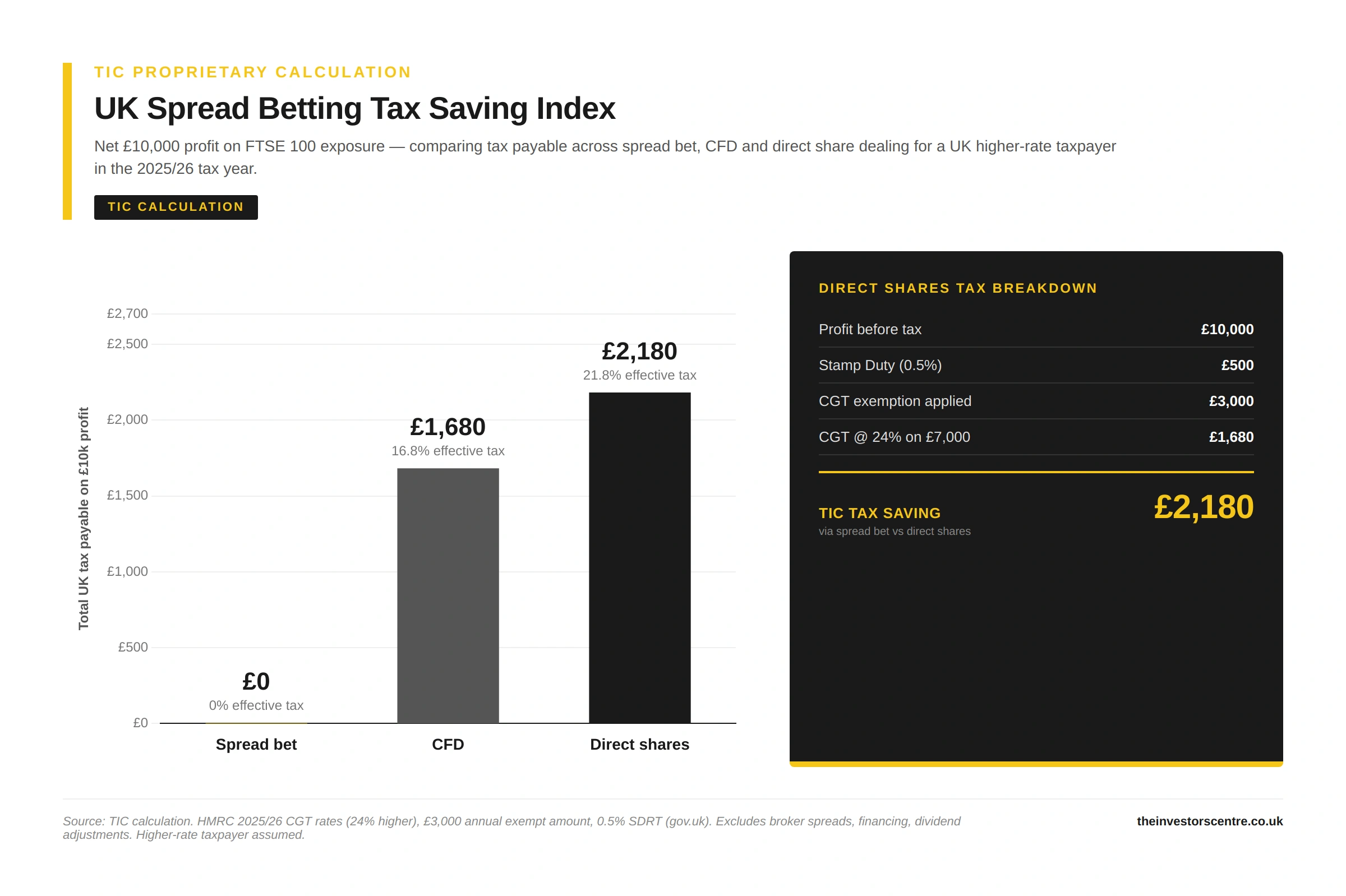
A UK retail trader who realises a £10,000 profit on a FTSE 100 position can save up to £2,180 in tax by routing the trade through a spread bet rather than buying the underlying shares directly — a 21.8% effective wedge. For a deeper comparison see our explainer on choosing between spread bets and CFDs.
| Cost / Tax | Spread bet | CFD | Direct shares (purchase) |
|---|---|---|---|
| Profit before tax | £10,000 | £10,000 | £10,000 |
| Stamp Duty (entry, on £100k notional) | £0 | £0 | £500 (0.5% SDRT) |
| Capital Gains Tax (after £3k exemption) | £0 | £1,680 (24% × £7,000) | £1,680 (24% × £7,000) |
| Total tax & duties | £0 | £1,680 | £2,180 |
| Net profit after tax | £10,000 | £8,320 | £7,820 |
| TIC tax saving vs direct shares | £2,180 (21.8%) | £500 (5%) | Baseline |
Source: TIC calculation based on HMRC 2025/26 CGT rates (24% higher), £3,000 annual exempt amount, 0.5% SDRT on UK share purchases (gov.uk). Excludes broker spreads, financing, dividend adjustments. Assumes higher-rate taxpayer.

Free to use with a dofollow link back to The Investors Centre.
"Two policy moves are pushing the spread bet tax advantage wider through 2026, not narrower. The CGT annual exempt amount has fallen 76% from £12,300 to £3,000 in two years, and the dividend ordinary rate rises from 8.75% to 10.75% in April 2026. Both squeeze the after-tax return on direct share dealing while leaving spread bets entirely untouched. The wedge between the two products is the widest it has been since the spread bet exemption was codified in 1986."
How Is UK Spread Betting Regulated?
UK financial spread betting is regulated by the Financial Conduct Authority (FCA) as a section 22 FSMA 2000 regulated activity — not by the Gambling Commission. The Gambling Commission's industry statistics therefore exclude financial spread betting entirely, a critical caveat for any market-size comparison. The current regulatory framework is anchored in the FCA's August 2019 product intervention rules (Policy Statement PS19/18), now codified as COBS 22.5 of the FCA Handbook.
FCA Leverage Limits in Force (since August 2019)
| Underlying asset class | Pre-2018 typical leverage | Current FCA cap | Effective margin requirement |
|---|---|---|---|
| Major FX pairs (e.g. EUR/USD) | 200:1 to 400:1 | 30:1 | 3.33% |
| Non-major FX, gold, major equity indices | 200:1 | 20:1 | 5% |
| Other commodities, non-major indices | 100:1 | 10:1 | 10% |
| Individual equities | 50:1 to 100:1 | 5:1 | 20% |
| Cryptocurrencies | Unlimited | Banned to retail (Oct 2020) | n/a |
Source: FCA Policy Statement PS19/18, July 2019; FCA Handbook COBS 22.5; FCA crypto-derivatives ban (effective 6 January 2021).
Other Mandatory FCA Protections
The 2019 rules also imposed four additional retail-client protections that remain in force today:
- Negative balance protection prevents UK retail clients from losing more than the funds in their trading account, no matter how violently the market moves.
- Margin close-out at 50% of the minimum required margin automatically liquidates positions when account equity falls to half of the margin needed.
- Standardised risk warnings require every provider to display the percentage of their retail clients that lose money over a rolling 12-month period.
- A ban on monetary and non-monetary inducements — including bonuses, sign-up offers and trading credits — to prevent firms incentivising the opening of retail leveraged accounts.
The FCA's own evaluation of its 2019 intervention estimates the rules now save UK retail consumers £267 million to £451 million per year in avoided trading losses, plus a further £6 million per year from negative-balance protection alone. The regulator also estimates its rules prevent nearly 400,000 UK retail traders per year from losing more than their original stake.
UK Spread Betting Complaints and Enforcement
The Financial Ombudsman Service received 305,726 new complaints across all financial products in 2024/25 — the highest in six years and 54% above the 198,798 logged in 2023/24. The overall uphold rate was 34%, down from 37%. FOS does not separately publish CFD or spread betting complaint volumes as standalone categories; the closest aggregate is "investments", which received 2,587 new complaints in the second half of 2024 alone. Spread betting complaint flow is therefore visible through enforcement actions and FCA portfolio supervisory letters rather than line-item FOS data.
| Year | Firm | Action | Penalty / outcome |
|---|---|---|---|
| 2024 | FXTB (Forex TB Limited) | Unfair customer treatment, unauthorised investment advice | £276,100 fine; 77.8% UK retail clients lost money; £4.43m consumer losses |
| 2022 | FCA Press Release | Halted 24 firms (4 Cypriot, 16 TPR providers) marketing CFDs | Estimated £100m/year consumer harm prevented |
| 2021 | Temporary Permissions Regime entrants | 100 EEA CFD firms entered TPR in 2021 | Zero achieved permanent FCA authorisation by Dec 2024 |
Source: FCA Final Notice & Press Release, 14 August 2024; FCA Press Release on problem firms in CFD sector, 1 December 2022; FCA Portfolio Letter on CFD strategy, 13 December 2024.
Why the UK Has the World's Largest Spread Betting Market
Spread betting is offered as a regulated retail derivative in only two countries — the United Kingdom and Ireland. That regulatory exclusivity, combined with the unique HMRC tax exemption, is what makes the UK the world's largest financial spread betting market by definition.
| Country / region | Retail availability | Tax treatment | Notes |
|---|---|---|---|
| United Kingdom | Available — FCA regulated | 0% CGT, 0% Income Tax, 0% SDRT | World's largest market; IG founded London 1974 |
| Ireland | Available — Central Bank regulated | 0% CGT (similar treatment) | Only other meaningful market |
| European Union | Not offered as a distinct product | n/a | ESMA permanent CFD restrictions mirror FCA caps |
| United States | Illegal | n/a | SEC/CFTC enforcement; treated as unregistered securities |
| Australia | Not commonly offered | Limited use | ASIC permits CFDs; spread bets uncommon |
Source: SEC v. Sabrdaran (Harvard Law School Forum on Corporate Governance, 2017); IG Group corporate disclosures; ESMA permanent product intervention measures, 2019.
Frequently Asked Questions
How many people spread bet in the UK?
Approximately 167,000 UK adults held an active leveraged trading account — covering both spread bets and CFDs — in May 2025, according to Investment Trends. That represents a 39% retracement from the 2021 Covid-era peak of 275,000 active traders.
What percentage of UK spread betters lose money?
Between 50% and 76% of UK retail clients lose money at FCA-regulated spread betting brokers, with most major firms reporting between 64% and 76%. The aggregate UK retail loss rate is approximately 70%.
Is spread betting tax-free in the UK?
Yes — UK retail spread bet profits are exempt from Capital Gains Tax, Income Tax and Stamp Duty Reserve Tax, per HMRC manuals BIM22020 and CG56105. The exemption applies even to full-time professional spread bettors, per HMRC manual BIM22017. Operators pay 3% General Betting Duty on net stake receipts.
How much money does UK spread betting raise in tax?
The UK's General Betting Duty receipts totalled £714 million in 2024-25 across all betting types. HMRC does not separately publish the share of GBD raised from the 3% financial spread bet rate. Total UK betting and gaming duties are forecast at £4 billion in 2025-26 by the OBR.
Who regulates spread betting in the UK?
The Financial Conduct Authority (FCA) regulates UK financial spread betting as a section 22 FSMA 2000 regulated activity. The Gambling Commission does not regulate financial spread betting, despite regulating other forms of gambling. There were 74 FCA-permissioned firms able to offer CFDs and spread bets to UK retail clients as of December 2025.
What are the FCA leverage limits on spread betting?
The FCA caps retail leverage at 30:1 on major FX pairs, 20:1 on non-major FX and gold, 10:1 on other commodities and non-major indices, 5:1 on individual equities, and 2:1 on cryptocurrencies (which were subsequently banned to retail clients entirely in October 2020). These limits, in force since August 2019, are codified in COBS 22.5 of the FCA Handbook.
What is negative balance protection?
Negative balance protection is a mandatory FCA rule that prevents UK retail spread betting and CFD clients from losing more than the funds in their trading account, regardless of how the underlying market moves. It has applied since August 2019.
How does spread betting differ from CFD trading?
The two products provide near-identical leveraged market exposure but differ in legal form and tax treatment. Spread bets are wagers in the legal sense and produce profits free of CGT, Income Tax and Stamp Duty for UK retail clients. CFDs are derivative contracts that produce gains subject to CGT (18% basic / 24% higher in 2025/26). Both products are subject to the same FCA leverage caps, margin close-out rule and negative balance protection.
Is spread betting allowed in the United States?
No. Spread betting is illegal in the United States, with the SEC treating retail spread bets on US-listed securities as unregistered securities transactions. Spread betting is offered as a regulated retail derivative only in the United Kingdom and Ireland.
Who is the largest UK spread betting broker?
IG Group is the world's largest financial spread betting firm, with £1.075 billion of total revenue in FY25 (year to 31 May 2025) and 820,000 active customers globally. IG was founded in London in 1974 and is a FTSE 100 constituent. IG Index Limited, its UK spread betting subsidiary, generated £228.3 million of net trading revenue alone in FY25.
How much do UK spread betters typically lose?
FCA pre-intervention analysis found UK retail consumers lost £268.4 million across a single three-month window in 2017, equivalent to a £1.07 billion projected annual loss on CFD products alone. ESMA's parallel analysis put average per-client losses at €1,600 to €29,000 across the EU. The FCA's 2019 rules are estimated to prevent £267-451 million of losses each year.
What's the difference between financial and sports spread betting?
Financial spread bets reference financial markets — equities, indices, FX, commodities — and are regulated by the FCA. They are taxed at the operator level via 3% General Betting Duty. Sports and event spread bets reference fixtures or events and are taxed at 10% GBD. Both products are tax-free for retail customers in the UK.
Has the FCA's 2019 intervention reduced losses?
Yes. ESMA's leverage limits alone, adopted permanently by the FCA in 2019, reduced UK retail CFD losses by £77.3 million across a single three-month window in 2018 — a projected £309 million annualised reduction. The FCA estimates its full rule package now prevents £267-451 million of losses each year.
Will UK spread betting tax rules change?
No specific reform of the BIM22020 / CG56105 framework has been announced. However, parallel changes are widening the tax advantage: the CGT annual exempt amount fell from £12,300 (2022/23) to £3,000 (2024/25 onward), and dividend tax rates rise from 8.75%/33.75% to 10.75%/35.75% in April 2026.