

- expertise:
- CFD Trading, Forex, Derivatives, Risk Management
- credentials:
- Chartered ACII (2018) · Trading since 2012
- tested:
- 40+ forex & CFD platforms with live accounts

- expertise:
- Broker Comparison, ISA Strategy, Portfolio Management
- credentials:
- Active investor since 2013 · 11+ years experience
- tested:
- 40+ brokers with funded accounts
How We Test
Real accounts. Real money. Real trades. No demo accounts or press releases.
What we measure:
- Spreads vs advertised rates
- Execution speed and slippage
- Hidden fees (overnight, withdrawal, conversion)
- Actual withdrawal times
Scoring:
Fees (25%) · Platform (20%) · Assets (15%) · Mobile (15%) · Tools (10%) · Support (10%) · Regulation (5%)
Regulatory checks:
FCA Register verification · FSCS protection
Testing team:
Adam Woodhead (investing since 2013), Thomas Drury (Chartered ACII, 2018), Dom Farnell (investing since 2013) — 50+ platforms with funded accounts
Quarterly reviews · Corrections: in**@*******************co.uk
Disclaimer
Not financial advice. Educational content only. We're not FCA authorised. Consult a qualified advisor before investing.
Capital at risk. Investments can fall. Past performance doesn't guarantee future results.
CFD warning. 67-84% of retail accounts lose money trading CFDs. High risk due to leverage.
Contact: in**@*******************co.uk
Trading 212 made investing accessible for millions of UK users—commission-free shares, a slick mobile app, and a low barrier to entry. But when it comes to CFD trading specifically, the platform has real limitations that become obvious once you start trading actively. I noticed it myself after a few months: the instrument range felt narrow, there was no MT4 or MT5 support, no guaranteed stop-losses, and charting tools that couldn’t keep up with what I needed for short-term positions.
If you’re in the same position—comfortable with Trading 212 for investing but frustrated by its CFD offering—this guide covers three FCA-regulated alternatives I’ve tested that handle CFD trading significantly better.
What Are the Best Trading 212 Alternatives for CFD Trading in the UK?
Spreadex is the best Trading 212 alternative for CFD trading in the UK for 2026—it combines financial spread betting with CFDs, offers guaranteed stop-loss orders for gap protection, charges no minimum deposit, and provides competitive spreads on major markets. The dual spread betting and CFD access gives you flexibility that Trading 212 simply doesn’t offer.
Capital.com matches Trading 212’s commission-free approach* but with a much deeper CFD instrument range (5,000+ markets), TradingView integration for professional charting, and guaranteed stop-loss orders that Trading 212 lacks entirely. Pepperstone is the best choice for active CFD traders who want raw spreads, MT4/MT5/cTrader access, and the lowest possible trading costs.
*other fees may apply.
Best UK Trading 212 CFD Alternatives Brokers 2026: Ranked & Tested

Spreadex
- Best For
- Trading 212 CFD Alternatives trading
- TIC Rating
- 4.8 / 5
- Community Rating
- 4.3 (247 ratings) Have Your Say →
61% of retail CFD accounts lose money.

Capital.com
- Best For
- Free Trading 212 Alternative
- TIC Rating
- 4.7 / 5
- Community Rating
- 4.3 (218 ratings) Have Your Say →
65% of Retail CFD Accounts Lose Money

Pepperstone
- Best For
- Trading 212 CFD Alternatives trading
- TIC Rating
- 4.6 / 5
- Community Rating
- 4.4 (299 ratings) Have Your Say →
73.6% of retail CFD accounts lose money.
How Do These Trading 212 Alternatives Compare for CFDs?
Why Do CFD Traders Look Beyond Trading 212?
Trading 212 is genuinely excellent for buying shares and ETFs commission-free. I still use it for my long-term ISA holdings. But CFD trading is a different discipline, and the platform wasn’t built with active CFD traders in mind. Here’s what I found limiting after several months of CFD trading on the platform.
Limited CFD instrument range: Trading 212 offers CFDs across indices, forex, commodities, and shares, but the selection is noticeably thinner than dedicated CFD brokers. Capital.com covers 5,000+ markets, Pepperstone gives you access to major and minor forex pairs plus commodities on professional platforms, and Spreadex covers indices, shares, forex, and commodities through both CFDs and spread bets.
No guaranteed stop-losses: Trading 212 offers standard stop-losses, but these can slip during fast-moving markets or overnight gaps. Spreadex and Capital.com both offer guaranteed stop-loss orders (GSLOs) that execute at your specified price regardless of gaps—a meaningful risk management advantage for anyone holding CFD positions through volatile events.
No MT4/MT5 or third-party platform support: If you want to run automated strategies via Expert Advisors, use advanced charting tools, or trade through cTrader, Trading 212 doesn’t support any of this. Pepperstone offers MT4, MT5, cTrader, and TradingView. Capital.com offers MT4 alongside TradingView and its proprietary platform.
No spread betting option: Trading 212 doesn’t offer spread betting. For UK traders, spread betting profits are typically free from Capital Gains Tax and Stamp Duty—a genuine tax advantage. Spreadex was built around spread betting, and both Capital.com and Pepperstone offer it as an alternative to CFDs.
How Do These Alternatives Compare on Key CFD Features?
The table below compares features that matter most when switching from Trading 212 for CFD trading.
| Feature | Trading 212 | Spreadex | Capital.com | Pepperstone |
|---|---|---|---|---|
| FCA Regulated | Yes (FRN 609146) | Yes (FRN 190941) | Yes (FRN 793714) | Yes (FRN 684312) |
| Spread Betting | No | Yes | Yes | Yes |
| Guaranteed Stops | No | Yes (GSLO) | Yes (GSLO) | No |
| MT4/MT5 Support | No | No | MT4 + TradingView (no MT5) | Yes (MT4, MT5, cTrader) |
| Commission | None* | None* | None* | None* (Standard) / From £2.25/lot (Razor) |
| Min. Deposit | £1 | None | £20 | None |
| Overnight Financing | Variable | Benchmark + 2.5% | Benchmark + markup (varies) | Tom-next/Benchmark + 2.5-3% |
*other fees may apply. Spreads and overnight charges still apply.
How We Tested These Trading 212 Alternatives
We opened live, funded accounts with Spreadex, Capital.com, and Pepperstone—alongside our existing Trading 212 account—and placed real CFD trades across each platform over several weeks. This wasn’t a surface-level feature comparison. We traded the same instruments on multiple platforms simultaneously so we could compare execution, pricing, and platform behaviour under identical market conditions.
Spreads and costs: We monitored live FTSE, EUR/USD, and gold CFD spreads across all four platforms during peak UK hours and outside core sessions. We recorded overnight financing charges on positions held for multiple days to compare the real cost of holding trades beyond a single session.
Risk management tools: We tested guaranteed stop-loss orders on Spreadex and Capital.com, checking how premiums were displayed, whether execution matched the guaranteed level, and how the order process compared to Trading 212’s standard stops. On Pepperstone, we tested trailing stops and standard stop-loss behaviour across MT4, MT5, and cTrader.
Platform quality: We evaluated charting depth, order ticket clarity, mobile app responsiveness, and how quickly each platform loads and refreshes pricing. For Capital.com, we specifically tested the TradingView integration. For Pepperstone, we tested Expert Advisor execution on MT4 and MT5.
Regulation and safety: We verified each broker’s FCA authorisation on register.fca.org.uk, confirmed FSCS coverage, and checked that negative balance protection was active on retail accounts. We also reviewed each broker’s client money segregation policies in their legal documentation.
Here Are The Top 3 Trading 212 Alternatives Reviewed
Each review focuses on what the broker does better than Trading 212 for CFD trading specifically, covering platform quality, costs, risk tools, and the overall trading experience.
1. Spreadex — Best Overall Trading 212 Alternative for CFDs
2. Capital.com — Best Commission-Free Trading 212 Alternative
3. Pepperstone — Best for Active CFD Traders Leaving Trading 212
Spreadex — Best Overall Trading 212 Alternative for CFDs
- Fees & Spreads
- 4.5
- Platform & Tools
- 4.2
- Customer Service
- 4.7
- Ease of Use
- 4.2
- Mobile App
- 4.1
Pros
- Spread betting and CFDs from one account—choose the most tax-efficient route per trade
- Guaranteed stop-loss orders for gap protection (something Trading 212 lacks entirely)
- No minimum deposit—same low barrier as Trading 212
- UK-based broker operating since 1999—established track record
Cons
- No MT4/MT5—uses proprietary platform plus TradingView
- No commission-free share dealing like Trading 212’s Invest account
- Smaller CFD instrument range than Capital.com or Pepperstone
What Makes Spreadex Better Than Trading 212 for CFDs?
The biggest upgrade is the dual spread betting and CFD access. On Trading 212, every CFD profit is subject to Capital Gains Tax once you exceed your annual allowance. On Spreadex, you can place the same trade as a spread bet instead, and profits are typically tax-free. Over a year of active trading, this difference alone can amount to hundreds or even thousands of pounds depending on your volume.
Guaranteed stop-loss orders are the other standout. I’ve been caught out by overnight gaps on Trading 212 where a standard stop slipped well past my intended exit. Spreadex’s GSLOs execute at the exact price you set, regardless of gaps. You pay a small premium for this, but it’s worth it when holding positions through earnings or economic releases.
How Does the Platform Compare?
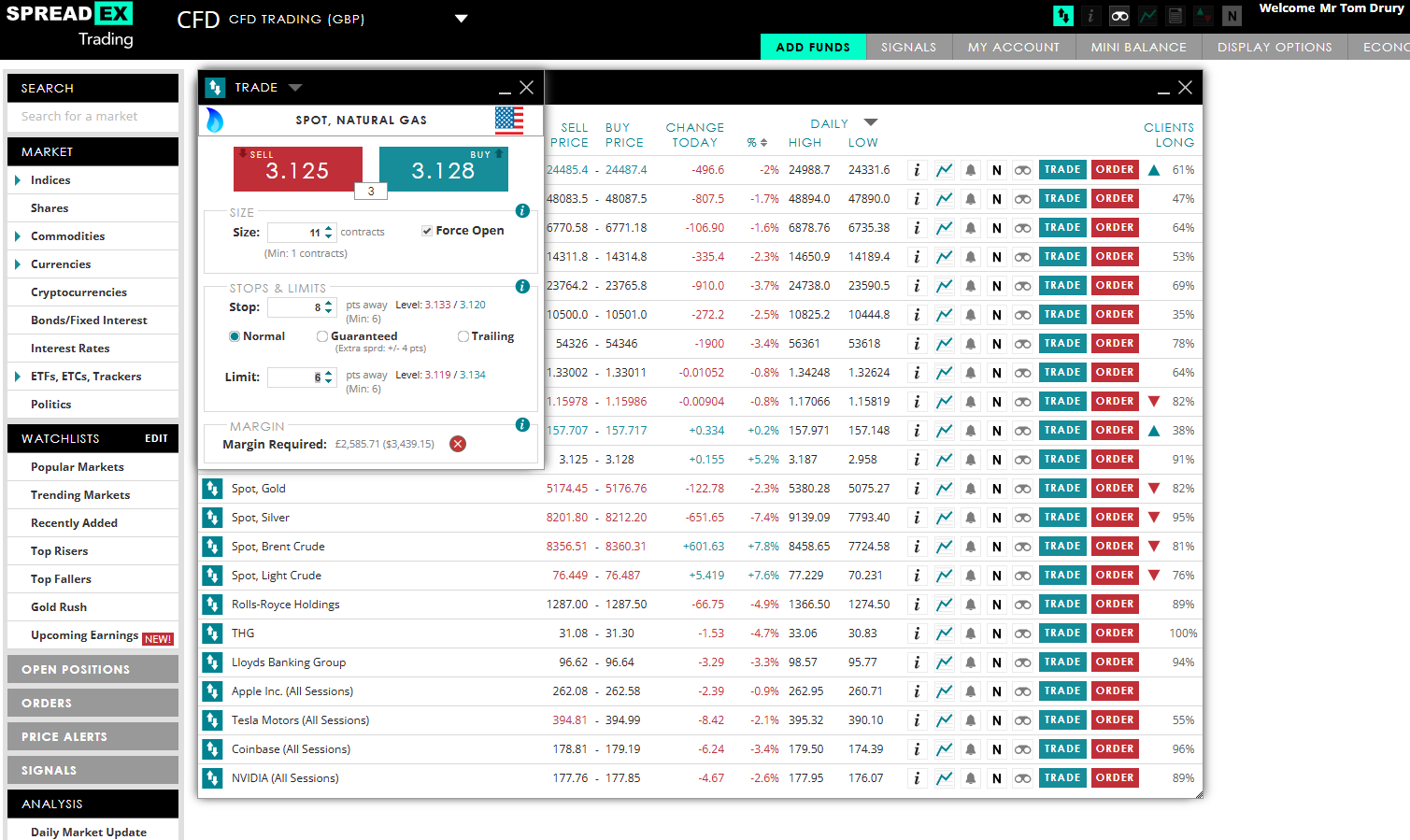
Spreadex’s proprietary platform is more focused than Trading 212’s app-first approach. It’s designed for traders, not investors, so the layout prioritises order management, live pricing, and position tracking rather than portfolio visualisation. The learning curve is gentle if you’re already familiar with CFD trading. Mobile access is solid—not quite as polished as Trading 212’s app, but functionally more capable for active trading.
What Does It Cost?
No commission on spread bets or CFDs*—costs are built into the spread, similar to Trading 212’s model. Overnight financing at benchmark rate plus 2.5% for long positions. No minimum deposit, no inactivity fees. GSLO premiums vary by instrument and are displayed before you confirm the order.
*other fees may apply.
Capital.com — Best Commission-Free Trading 212 Alternative
- Fees & Spreads
- 4.4
- Platform & Tools
- 4.4
- Customer Service
- 4.5
- Ease of Use
- 4.8
- Mobile App
- 4.9
Pros
- No commission on CFDs*—same pricing model Trading 212 users are accustomed to
- 5,000+ CFD markets—significantly broader than Trading 212’s CFD range
- TradingView integration for professional-grade charting
- Guaranteed stop-loss orders available for gap protection
Cons
- No MT5—limited to proprietary platform, MT4 and TradingView
- £20 minimum deposit (Trading 212 allows £1)
- No share dealing ISA—CFDs and spread bets only
What Makes Capital.com Better Than Trading 212 for CFDs?
Capital.com feels like what Trading 212’s CFD platform should have become. The commission-free model is identical in principle—you pay through spreads rather than explicit fees—but the execution is considerably more refined. Over 5,000 CFD markets means you’re rarely searching for an instrument that isn’t available. I switched several positions from Trading 212 to Capital.com specifically because the latter offered CFDs on smaller-cap UK shares that T212 didn’t cover.
The educational resources are well structured too. Capital.com provides clear explanations of each instrument alongside the deal ticket, which is helpful when exploring markets outside your usual comfort zone. The platform also displays overnight financing costs before you confirm any trade—a transparency feature I wish Trading 212 offered more prominently.
How Does the Platform Compare?
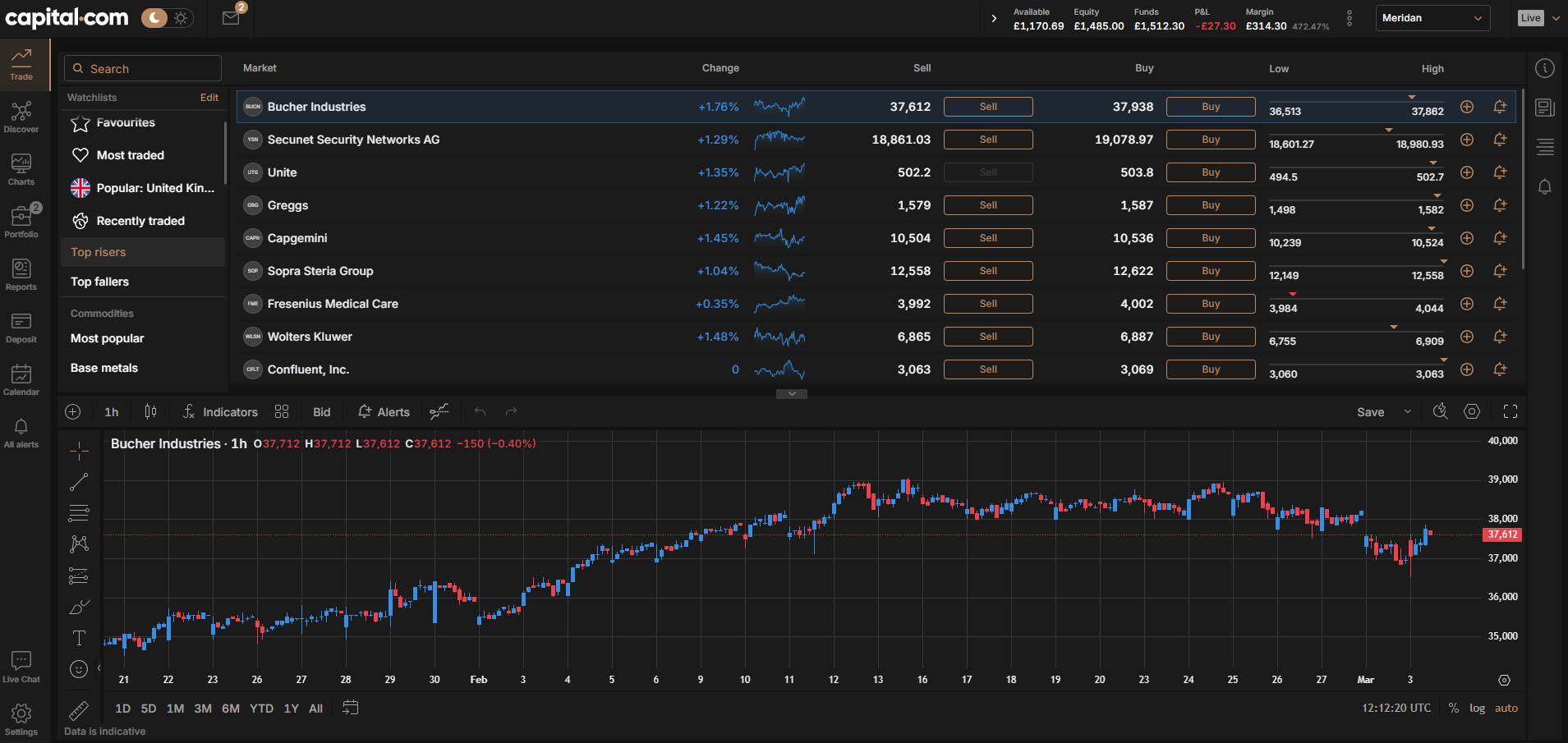
The proprietary platform is clean and modern—Trading 212 users will feel at home immediately. MT4 is also available for traders who prefer it, and the TradingView integration is the real upgrade: full access to TradingView’s charting toolkit, indicators, and drawing tools directly within your trading account. This is a significant step up from Trading 212’s built-in charts, which are adequate for checking prices but limited for technical analysis.
What Does It Cost?
No commission on any CFD trades*. Forex spreads from 0.6 pips, index spreads from 0.4 points. Guaranteed stop-loss order premiums vary by instrument and are displayed on the deal ticket before you place the order. Overnight funding charges apply to positions held past market close—benchmark rate plus a markup that varies by market and trade direction.
*other fees may apply.
Pepperstone — Best for Active CFD Traders Leaving Trading 212
- Fees & Spreads
- 4.1
- Platform & Tools
- 4.4
- Customer Service
- 4.2
- Ease of Use
- 3.9
- Mobile App
- 4.3
Pros
- Raw spreads from 0.0 pips on the Razor account—dramatically tighter than Trading 212
- MT4, MT5, cTrader, and TradingView—the platform choice Trading 212 users dream about
- No inactivity fees, no deposit or withdrawal fees
- Spread betting available for UK clients for tax-efficient trading
Cons
- No guaranteed stop-loss orders—standard stops can slip during gaps
- Razor account commission (£2.25/lot per side) adds up on small positions
- Steeper learning curve with MT4/MT5—not as beginner-friendly as Trading 212
What Makes Pepperstone Better Than Trading 212 for CFDs?
If you’re leaving Trading 212 because you’ve outgrown its capabilities, Pepperstone is likely where you’ll end up. The difference in spread quality is immediately obvious. On Trading 212, I regularly saw EUR/USD spreads above 1.0 pip during normal hours. On Pepperstone’s Razor account, the same pair typically shows 0.0–0.3 pips plus the £2.25 per lot commission. For active traders placing multiple trades per day, this adds up to a significant cost reduction.
The platform choice is the other major upgrade. MT4 and MT5 support means you can run Expert Advisors for automated strategies—something completely impossible on Trading 212. cTrader offers advanced order types and algorithmic trading capabilities. Having four professional platforms to choose from versus Trading 212’s single app is a transformative difference for anyone who takes CFD trading seriously.
How Does the Platform Compare?
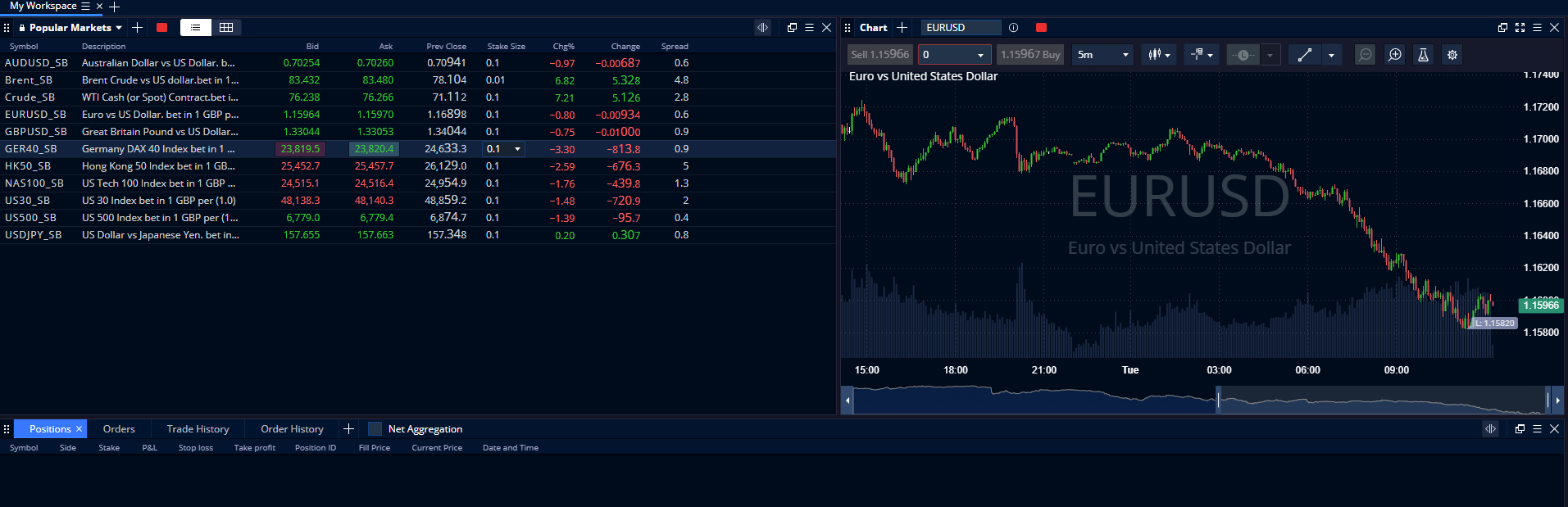
Pepperstone doesn’t have its own beginner-friendly app like Trading 212. You’re trading through MT4, MT5, cTrader, or TradingView—all powerful platforms with steeper learning curves. In my experience, the transition takes a week or two to get comfortable, but once you’re familiar with the layout, you won’t want to go back. The depth of charting, order management, and customisation is on a completely different level.
What Does It Cost?
Standard account: spreads from 1.0 pip, no commission*. Razor account: raw spreads from 0.0 pips plus £2.25 per lot per side. No deposit, withdrawal, or inactivity fees. Overnight swap rates use tom-next or benchmark rate plus 2.5-3%, varying by instrument. Spread betting available for UK clients with no commission.
*other fees may apply.
Are These Trading 212 Alternatives Safe and Regulated?
All three alternatives carry the same FCA protections as Trading 212. Here’s what that means in practice:
| Protection | What It Means |
|---|---|
| FCA Regulation | Each broker is authorised by the Financial Conduct Authority—verify on register.fca.org.uk |
| Segregated Funds | Client money held separately from company funds |
| FSCS Protection | Up to £85,000 covered per person if the broker fails |
| Negative Balance Protection | Retail accounts can’t lose more than deposited |
Additional credibility factors:
- Spreadex has been operating since 1999—over 25 years in the UK market
- Capital.com is authorised by both the FCA and CySEC, with over 827,000 accounts worldwide
- Pepperstone holds dual FCA and ASIC (Australia) regulation and won multiple industry awards
Important: Regulation protects against broker failure, not trading losses. CFD trading carries significant risk—between 51% and 82% of retail investor accounts lose money when trading CFDs with these providers. Make sure you understand how CFDs work and whether you can afford the risk of losing your money.
Which Trading 212 Alternative Is Right for You?
The best choice depends on what frustrated you about Trading 212 in the first place.
Choose Spreadex if: You want the flexibility of spread betting alongside CFDs, value guaranteed stop-losses for risk management, and prefer a straightforward UK-based broker. The typically tax-free spread betting profits are a genuine advantage that Trading 212 simply cannot offer.* Best for traders who want a well-rounded CFD and spread betting platform without the complexity of MT4/MT5.
Choose Capital.com if: You liked Trading 212’s commission-free model but want more markets, better charting, and guaranteed stops. The transition is seamless—the interface feels similar, just more capable. Best for traders who want the easiest switch from Trading 212 with the biggest improvement in CFD-specific features.
Choose Pepperstone if: You’re a serious active trader who wants raw spreads, professional platforms, and the ability to run automated strategies. The cost savings on tight spreads compound significantly over hundreds of trades. Best for traders who have outgrown beginner platforms entirely and want institutional-grade execution.
*Tax laws can change and depend on individual circumstances.
Final Thoughts
Trading 212 remains a solid platform for commission-free share investing—I still use it for that purpose. But for CFD trading, the limitations are real: no guaranteed stops, no spread betting, no MT4/MT5, and a narrower instrument range than dedicated CFD brokers.
Spreadex addresses the most common complaints by offering both spread betting and CFDs with guaranteed stop-losses, all with no minimum deposit. Capital.com delivers the closest experience to Trading 212’s commission-free model but with materially better charting, more markets, and proper risk management tools. Pepperstone is the clear choice for traders ready to step up to professional-grade platforms with raw spreads.
Whichever you choose, all three are FCA-regulated with FSCS protection up to £85,000. The switch itself is straightforward—you can keep your Trading 212 account for investing while using a dedicated broker for CFDs. That’s what I do, and it works well.
CFD trading carries significant risk. Between 51% and 82% of retail investor accounts lose money when trading CFDs. Only trade with money you can afford to lose.
Discuss Trading 212 CFD Alternatives
Looked beyond Trading 212 for CFDs? Share which alternatives won on spreads, leverage, and platform stability. Our community earns Equity for quality contributions.
Discussion 0 comments
Be the first to start discussing this topic! Log in or create an account to share your thoughts.
Log In Create AccountFAQs
References
Broker Websites (Primary Sources):
- Spreadex UK — FRN 190941, spread betting and CFD trading
- Capital.com UK — FRN 793714, commission-free CFDs, TradingView integration
- Pepperstone UK — FRN 684312, raw spreads, MT4/MT5/cTrader
- Trading 212 — FRN 609146, comparison reference
Regulatory Sources:
- FCA Financial Services Register — Broker authorisation verification
- FSCS Investment Protection — £85,000 per eligible person
- HMRC — Spread betting tax treatment guidance
Features, spreads, and costs verified from broker websites, February–March 2026. Overnight financing rates are variable and depend on prevailing benchmark rates. All brokers verified on FCA register.
No comments yet. Be the first to start discussing this topic!