

- expertise:
- CFD Trading, Forex, Derivatives, Risk Management
- credentials:
- Chartered ACII (2018) · Trading since 2012
- tested:
- 40+ forex & CFD platforms with live accounts

- expertise:
- Broker Comparison, ISA Strategy, Portfolio Management
- credentials:
- Active investor since 2013 · 11+ years experience
- tested:
- 40+ brokers with funded accounts
How We Test
Real accounts. Real money. Real trades. No demo accounts or press releases.
What we measure:
- Spreads vs advertised rates
- Execution speed and slippage
- Hidden fees (overnight, withdrawal, conversion)
- Actual withdrawal times
Scoring:
Fees (25%) · Platform (20%) · Assets (15%) · Mobile (15%) · Tools (10%) · Support (10%) · Regulation (5%)
Regulatory checks:
FCA Register verification · FSCS protection
Testing team:
Adam Woodhead (investing since 2013), Thomas Drury (Chartered ACII, 2018), Dom Farnell (investing since 2013) — 50+ platforms with funded accounts
Quarterly reviews · Corrections: in**@*******************co.uk
Disclaimer
Not financial advice. Educational content only. We're not FCA authorised. Consult a qualified advisor before investing.
Capital at risk. Investments can fall. Past performance doesn't guarantee future results.
CFD warning. 67-84% of retail accounts lose money trading CFDs. High risk due to leverage.
Contact: in**@*******************co.uk
Testing Note
Our trading team compared seven TradingView-connected brokers. Six completed the original three-month live-account test, while Trade Nation was reviewed separately in August 2026 using its TradingView connection and published fixed-spread schedule.
Quick Answer: What Is the Best Spread Betting Broker That Works with TradingView?
Pepperstone is the best spread betting broker for TradingView users in the UK - spread bets placed directly from TradingView charts, raw spreads from 0.0 pips on the Razor account, and FCA regulation (FRN 684312). Spreadex remains the fixed-spread specialist: spreads from 0.6 pips on major pairs, tax-free spread betting, FCA regulation (FRN 190941), and three months of free TradingView Premium when you deposit £500. For traders seeking commission-free CFDs, Capital.com is the top pick (*other fees apply), while IG remains unmatched for sheer market breadth with over 17,000 instruments.
How Do the Best TradingView Spread Betting Brokers Compare?
| Rank | Broker | Best For | Markets | EUR/USD Spread | FCA Regulated |
|---|---|---|---|---|---|
| 1 | Pepperstone | High-volume forex | 1,200+ | 0.0 pips (Razor) / 0.6 pips (Std) | Yes (684312) |
| 2 | Spreadex | Beginners & spread betting | 10,000+ | 0.6 pips (fixed) | Yes (190941) |
| 3 | Trade Nation | Fixed spreads inside TradingView | ~1,000 | 0.5 pips main session (published) | Yes (525164) |
| 4 | IG | Market range | 17,000+ | 0.6 pips | Yes (114059) |
| 5 | Capital.com | Commission-free CFDs (*other fees apply) | 5,000+ | 0.6 pips | Yes (793714) |
| 6 | CMC Markets | Advanced charting | 20,000+ | 0.7 pips | Yes (173730) |
| 7 | Saxo | Professional trading | 9,000+ | 0.6 pips | Yes (551422) |
Note: All brokers listed below are FCA regulated and support TradingView integration.

Pepperstone
- Best For
- High-volume traders
- TIC Rating
- 4.9 / 5
- Community Rating
- 4.4 (213 ratings) Have Your Say →
72.9% of retail CFD accounts lose money.

Spreadex
- Best For
- Beginners & spread betting
- TIC Rating
- 4.8 / 5
- Community Rating
- 4.3 (175 ratings) Have Your Say →
65% of retail CFD accounts lose money.

Trade Nation
- Best For
- Spread betting through TradingView on fixed spreads
- TIC Rating
- 4.4 / 5
- Community Rating
- 3.5 (56 ratings) Have Your Say →
73.7% of retail CFD accounts lose money.
69% of retail CFD accounts lose money.

Capital.com
- Best For
- Commission-free CFDs *other fees apply
- TIC Rating
- 4.7 / 5
- Community Rating
- 4.3 (161 ratings) Have Your Say →
61% of Retail CFD Accounts Lose Money

CMC Markets
- Best For
- Advanced charting
- TIC Rating
- 4.4 / 5
- Community Rating
- 4.2 (134 ratings) Have Your Say →
68% of retail CFD accounts lose money.

Saxo
- Best For
- Professional trading
- TIC Rating
- 4.1 / 5
- Community Rating
- 3.5 (48 ratings) Have Your Say →
64% of retail CFD accounts lose money.
Here are the Top TradingView Spread Betting Brokers Reviewed:
- Pepperstone – Lowest fees for high-volume traders
- Spreadex – Best for beginners & spread betting
- Trade Nation: Fixed spreads inside TradingView
- IG – Best for market range
- Capital.com – Best for commission-free CFDs (*other fees apply)
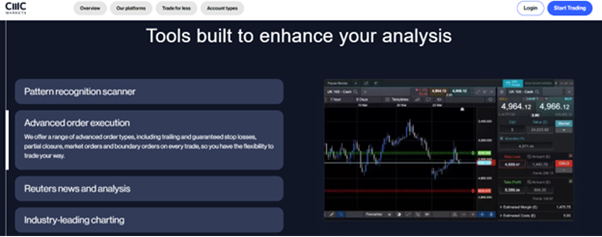
- CMC Markets – Best for advanced charting
- Saxo – Best for professional trading
Pepperstone - Best for High-Volume Forex Traders
- Fees & Spreads
- 4.1
- Platform & Tools
- 4.4
- Customer Service
- 4.2
- Ease of Use
- 3.9
- Mobile App
- 4.3

Pros
- Razor account raw spreads starting from 0.0 pips
- Lowest per-trade cost for forex (roughly £5.50 total per lot)
- Integrates directly with TradingView charts
Cons
- Limited to around 1,200 instruments
- Privately held (less public financial transparency)
- Doesn't offer guaranteed stop-loss orders
Where Pepperstone Beats the Competition
Pepperstone's Razor account beats IG for high-frequency forex traders on pure cost. The raw spread plus commission model (£4.50 round-trip) works out roughly 10% cheaper per trade at high volumes. If forex is all you trade and you're doing serious size, Pepperstone makes perfect sense.
Spreadex - Best for Beginners & TradingView Spread Betting
- Fees & Spreads
- 4.5
- Platform & Tools
- 4.2
- Customer Service
- 4.7
- Ease of Use
- 4.2
- Mobile App
- 4.1
Pros
- Fixed spreads from 0.6 pips on major forex pairs
- Three months free TradingView Premium with £500 deposit
- Tax-free spread betting with no commission
- FCA regulated (FRN 190941) with FSCS protection
Cons
- No demo account available
- Fewer exotic markets than larger multi-asset brokers
- Not designed for high-frequency professional strategies
Why Does Spreadex Come Out on Top for TradingView?
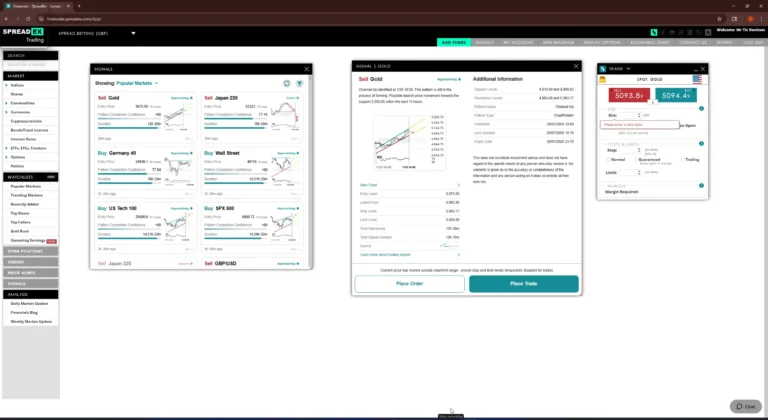
Spreadex combines the two things TradingView users care about most: seamless chart-based trading and transparent pricing. The TradingView integration works natively, letting you analyse markets with advanced indicators and execute trades directly from the chart without switching tabs. Orders filled in under a second during our testing. Add in the free TradingView Premium offer (three months free when you deposit £500) and you get access to professional-grade charting tools at no extra cost, something no other broker on this list matches.
What Makes Spreadex's Pricing Stand Out?
Spreadex uses fixed spreads with no separate commission, which keeps costs predictable and simple. EUR/USD holds steady at 0.6 points through the London session, matching the advertised minimum. Because spread betting profits are tax-free in the UK, Spreadex effectively offers one of the lowest all-in costs for retail traders. Overnight financing applies if you hold past market close, but the platform shows charges clearly before you confirm any trade.
What Markets Does Spreadex Cover?
Spreadex covers over 10,000 markets including forex, UK and international shares, indices, commodities, bonds, and interest rates. The platform focuses on quality over quantity, with reliable pricing across every instrument. During testing, FTSE 100 shares, major forex pairs, and gold all loaded without lag or pricing gaps. While it lacks the 17,000+ instruments IG offers, Spreadex covers everything most UK traders actually need.
Trade Nation: Fixed-Spread Betting Inside TradingView
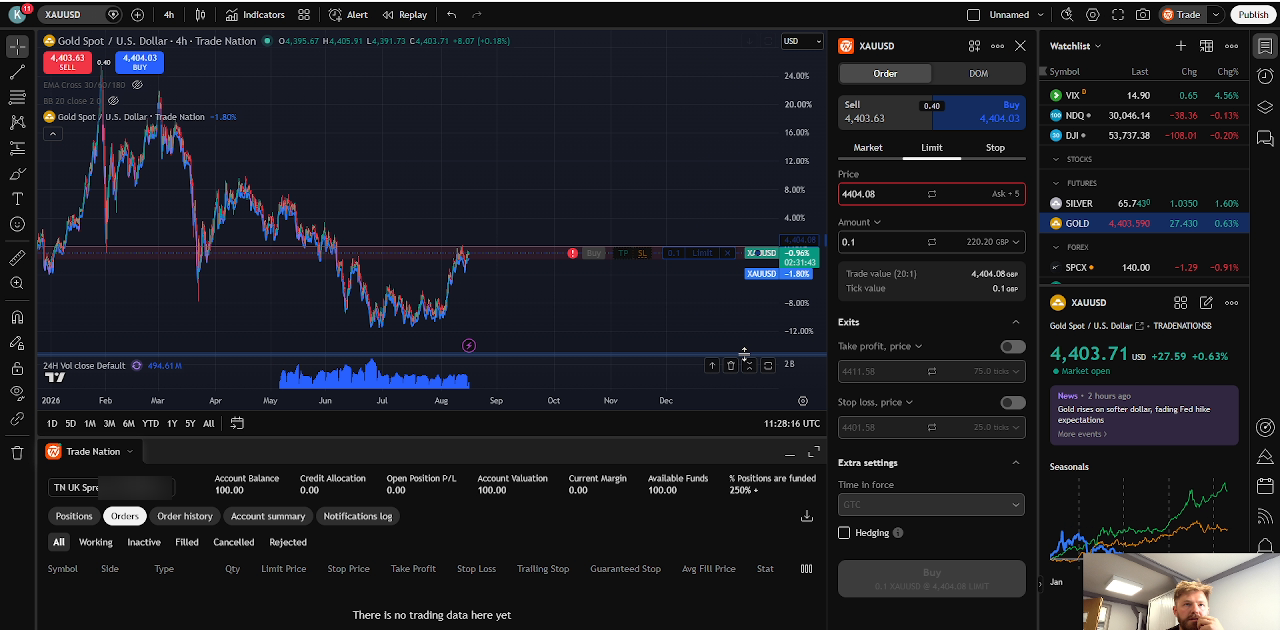
Trade Nation is one of the relatively small group of FCA-regulated brokers that lets UK clients place spread bets directly through TradingView. Its published TN Trader fixed-spread bands also carry across to the TradingView connection, including EUR/USD at 0.5 pips during the main session.
Trade Nation holds Platinum status and a 4.8 rating in TradingView’s broker directory. The connection suits experienced TradingView users who want chart-led spread betting without moving to a separate order platform.
Pros
- Spread betting available directly inside TradingView
- Fixed published spreads carry over to the connection
- Platinum-rated in TradingView’s broker directory
- Spread-betting tax treatment is preserved, subject to individual circumstances
Trade-offs
- Better suited to experienced TradingView users than beginners
- No MT5
- No share dealing or ISA
Do Fixed Spreads Apply Inside TradingView?
Yes. Trade Nation states that its fixed spreads are available on TN Trader and TradingView. The bands change at published times, so traders should check the active session before entry.
Who Should Use This Connection?
It best suits traders already comfortable with TradingView who want to keep analysis and spread-bet execution in the same workspace.

IG - Best for Market Range
- Fees & Spreads
- 4.2
- Platform & Tools
- 4.5
- Customer Service
- 3.8
- Ease of Use
- 4.1
- Mobile App
- 4.2
Pros
- Access to over 17,000 instruments (69 indices)
- Tight spreads on major pairs (0.6 pips EUR/USD)
- FTSE 250 listed, highly credible and transparent
- Structured education via IG Academy with unlimited demo
Cons
- Cryptocurrency spread bets can't be placed through TradingView
- Charges a 0.10% commission on share CFDs
- Occasional syncing issues reported on TradingView charts
Why Is IG Still a Top Pick?
IG gives you access to over 17,000 instruments, which includes 69 indices for spread betting, thousands of individual shares across global exchanges, and a full range of forex and commodities. Running a diversified approach across asset classes means you can do it all from one account rather than juggling multiple brokers. Furthermore, they match or beat competitors on pricing for major instruments and carry the credibility of a FTSE 250 listing with over fifty years of operating history.
Capital.com - Best for Commission-Free CFDs
- Fees & Spreads
- 4.4
- Platform & Tools
- 4.4
- Customer Service
- 4.5
- Ease of Use
- 4.8
- Mobile App
- 4.9
Pros
- No commission on spread betting or CFDs *other fees apply
- Competitive spreads from 0.6 pips on EUR/USD
- TradingView compatibility for chart-based analysis and trading
- FCA regulated (FRN 793714) with FSCS protection
Cons
- Smaller market range (5,000+) than IG or CMC
- No guaranteed stop-loss orders
- Fewer advanced charting tools than specialist platforms
Why Choose Capital.com for TradingView?
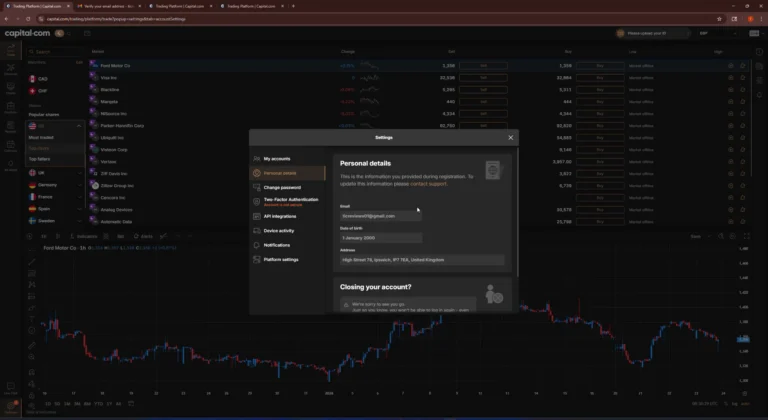
Capital.com stands out for TradingView users who want commission-free trading (*other fees apply) combined with a modern, intuitive platform. The TradingView integration lets you connect your account and trade directly from charts, while Capital.com's proprietary web platform and mobile app provide a clean, fast alternative when you need it. With no commission on any trades and spreads from 0.6 pips, the all-in cost is genuinely competitive.
What Does Capital.com Cost?
Capital.com charges zero commission on all trades *other fees apply. EUR/USD spreads start from 0.6 pips, and pricing held consistent during London hours testing. There are no deposit fees, no withdrawal fees, and no inactivity fees, making it cost-effective for traders of all activity levels. Overnight financing applies to leveraged positions held past market close.
What Markets Does Capital.com Offer?
Capital.com provides access to over 5,000 markets across CFD and spread betting, covering forex, indices, commodities, shares, and cryptocurrencies. The range is smaller than IG or CMC, but sufficient for most trading strategies. Available platforms include the proprietary web and mobile apps, MT4, and TradingView, giving you flexibility in how you access markets.
CMC Markets - Best for Advanced Charting
- Fees & Spreads
- 4.2
- Platform & Tools
- 4
- Customer Service
- 4
- Ease of Use
- 3.8
- Mobile App
- 3.9
Pros
- Offers over 20,000 instruments
- FTSE 250 listed, providing top-tier regulatory security
- Spread-only pricing model on shares
Cons
- Spread betting accounts cannot currently connect to TradingView (only CFD/FX Active)
- Spreads (0.7 pips EUR/USD) are slightly wider than IG and Pepperstone
A Solid Institutional Alternative
CMC Markets sits at roughly 20,000 instruments. Its TradingView connection is centred on CFD Trading and FX Active accounts rather than native spread betting, so it serves a different product route from Trade Nation, Spreadex and Pepperstone.
Saxo - Best for Professional Trading
- Fees & Spreads
- 3.5
- Platform & Tools
- 4
- Customer Service
- 3.1
- Ease of Use
- 3.3
- Mobile App
- 2.7
Pros
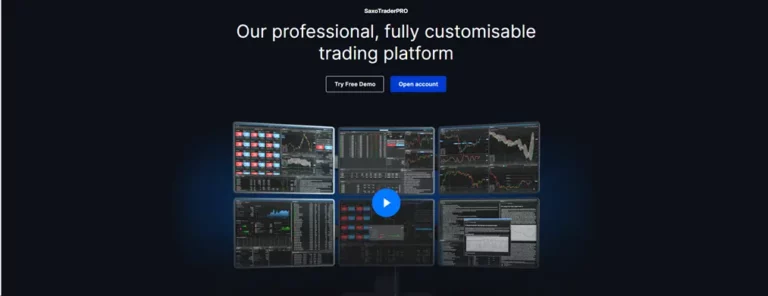
- Professional-grade SaxoTraderPRO platform with DMA access
- Over 9,000 instruments across multiple asset classes
- Strong in-house research and analysis tools
- FCA regulated (FRN 551422) with institutional backing
Cons
- £500 minimum deposit required
- Platform complexity can overwhelm beginners
- Higher fees for smaller accounts
- TradingView integration is less seamless than rivals
Why Consider Saxo for TradingView?
Saxo suits experienced traders and professionals who need institutional-grade execution alongside TradingView charting. The SaxoTraderPRO platform provides direct market access (DMA) and a depth of analytical tools that simpler brokers cannot match. TradingView charting is available within the Saxo ecosystem, allowing you to analyse markets with advanced indicators while accessing Saxo's broad product range covering stocks, ETFs, bonds, forex, futures, and options.
What Does Saxo Cost?
Saxo requires a £500 minimum deposit, which positions it firmly at the professional end of the market. Forex spreads are competitive, starting from around 0.6 pips on major pairs. Commissions vary depending on the market traded and account tier. Custody fees may apply on certain investments, and inactivity fees can be charged if the account is unused for an extended period.
Who Should Choose Saxo?
Saxo is best suited to serious investors and professional traders who want access to a wide, multi-asset portfolio from a single platform. If you have larger starting capital and need bonds, options, and futures alongside spread betting, Saxo delivers. Beginners or traders seeking a simple, low-cost setup should look at Spreadex or Capital.com instead.
Which Spread Betting Broker Has the Lowest Fees on TradingView?
Pepperstone Razor has the lowest per-trade cost for forex at around £5.50 per standard lot. But Spreadex offers better value for most traders because its fixed 0.6 pip spread is predictable, you get tax-free spread betting, and the free TradingView Premium offer saves you the subscription cost. The cost saving from Pepperstone only becomes meaningful if you're trading fifty-plus lots monthly on major pairs.
Breaking Down the Cost Differences
Spread betting costs come from two places: the spread itself (the gap between buy and sell price) and overnight funding if you hold positions past 10pm UK time. Commission-based accounts like Pepperstone Razor add a separate per-trade charge but offer tighter raw spreads in exchange.
On a standard lot of EUR/USD (worth about £100,000 notional), here's what each broker costs:
- Pepperstone Razor: 0.0-0.1 pip spread plus £4.50 round-trip commission = roughly £5.50 total
- Spreadex: 0.6 pip fixed spread, no commission = roughly £6.00 total
- Capital.com: 0.6 pip spread, no commission (*other fees apply) = roughly £6.00 total
- IG: 0.6 pip spread, no commission = roughly £6.00 total
- Pepperstone Standard: 0.6 pip spread, no commission = roughly £6.00 total
- Saxo: 0.6 pip spread = roughly £6.00 total
- CMC Markets: 0.7 pip spread = roughly £7.00 total
The gap between Spreadex and Pepperstone Razor is about 50p per lot. Trade ten lots a month and you're saving £5. Trade a hundred lots and it's £50. Whether that saving justifies giving up fixed spreads and the free TradingView Premium depends on your trading style.
Overnight Funding Matters for Swing Traders
If you hold positions overnight, funding charges apply. These are calculated based on the relevant interbank rate (SONIA for sterling instruments) plus a broker markup, typically around 2.5% annually. On a £10,000 position, that works out to about 70p per night.
Can I Spread Bet Forex Directly from TradingView Charts?
Yes. Spreadex, Trade Nation, Capital.com, IG, Pepperstone, CMC Markets, and Saxo all let you place spread bets directly from TradingView charts. You connect your account through TradingView's broker panel, then you can trade, set stops and targets, and manage positions without switching platforms.
How the Integration Actually Works
TradingView connects to your broker via API. Once you've linked your account (takes about two minutes), you can place orders by clicking on the chart or using TradingView's order panel. Your positions, pending orders, and account balance sync between the platforms, usually within a few seconds.
The order types available through TradingView include market orders, limit orders, stop orders, stop-limits, and OCO (one-cancels-other) setups. You can also set bracket orders with built-in stop-loss and take-profit levels attached to your entry.
Known Problems with the Integration
IG's TradingView connection carries a 4.8/5 rating from users who've reviewed it on TradingView's broker page. The common complaints:
- Some instruments randomly become untradable through TradingView while still working on IG's own platform.
- Open positions sometimes don't display on certain charts, particularly NASDAQ and US indices.
- Crypto spread bets aren't available through TradingView at all - IG's platform only.
- Connection drops during volatile market periods, requiring re-login.
These aren't dealbreakers for most users, but they mean you should keep your broker's native platform bookmarked as a fallback.
Which TradingView Broker Has the Tightest Index Spreads?
Most of the seven brokers charge broadly comparable spreads on major indices, although Trade Nation uses published time-banded fixed pricing. IG's advantage isn't tighter spreads - it's access to 69 index markets for spread betting compared with smaller ranges at competitors.
Extended Hours Trading
IG offers trading on US indices from 11pm Sunday through 10pm Friday UK time, with short daily breaks. During out-of-hours periods, expect spreads to widen by 2-4 points on major markets. Liquidity is thinner, so larger orders may see more slippage.
What's the Best TradingView Broker for Spread Betting as a Beginner?
Spreadex is the best option for beginners thanks to its fixed spreads, straightforward pricing, and free TradingView Premium offer. The fixed spread model removes the uncertainty of variable pricing, and the TradingView integration makes chart-based trading accessible from day one. IG Academy provides more structured courses if formal education is a priority, but Spreadex's simplicity and UK-based phone support make it the easiest starting point.
Why Guaranteed Stops Matter for New Traders
A guaranteed stop closes your position at exactly the price you set, even if the market gaps straight through it. Normal stop-losses can slip during fast moves or when markets reopen after weekends. For a new trader still figuring out position sizing and risk management, guaranteed stops provide a hard ceiling on potential losses. Spreadex, IG and CMC charge a small premium for guaranteed stops - the cost shows up as a slightly wider spread on the trade. Pepperstone doesn't offer them at all.
How Are UK Spread Betting Brokers Regulated?
All UK spread betting brokers must hold authorisation from the Financial Conduct Authority (FCA). FCA rules require segregated client funds, negative balance protection for retail traders, and standardised leverage limits. IG and CMC Markets carry additional oversight as FTSE 250 listed companies with public reporting requirements. FSCS covers eligible deposits up to £120,000 - raised from £85,000 in December 2025.
What the FCA Requires
- Segregate client money: Your funds sit in separate accounts at regulated banks, not mixed with the broker's operating cash.
- Provide negative balance protection: Retail accounts can't go below zero - if a position blows up faster than the broker can close it, they absorb the loss.
- Apply leverage caps: 30:1 maximum on major forex, 20:1 on minors and gold, 10:1 on commodities, 5:1 on shares, 2:1 on crypto.
- Disclose loss rates: Every broker must show what percentage of retail clients lose money, updated quarterly.
IG and CMC being FTSE 250 constituents means they file audited accounts, face governance requirements, and get scrutinised by analysts. You can read IG's annual report yourself and see their financials. Pepperstone and Capital.com, as private companies, don't offer that same level of visibility, though both remain fully FCA regulated.
Conclusion: Which Broker Wins for TradingView Spread Betting?
Pepperstone is the best choice for most UK spread bettors using TradingView. Spreadex remains the strongest all-round alternative, while Trade Nation is the standout for published fixed spread bands inside TradingView. Capital.com suits traders who want commission-free CFDs (*other fees apply), and IG remains unmatched for market breadth.
72.9% of retail investor accounts lose money when trading spread bets and CFDs with this provider.
FAQs
References
- FCA Financial Services Register - Broker authorisation verification
- FSCS - Deposit protection limit increase, November 2025
- Bank of England PRA - Deposit protection announcement, November 2025
- IG Group Holdings plc - Annual Report and Accounts 2024
- CMC Markets plc - Investor relations and Annual Report FY2025
- Investment Trends - UK Leverage Trading Report 2024
- TradingView - IG broker integration reviews (1,000+ ratings)
- Spreadex - Platform specifications and product documentation
- Trade Nation Financial UK Ltd - FCA reference number 525164
- Capital.com - Platform and pricing documentation
- IG - Platform specifications and product documentation
- Pepperstone UK - Spread betting product information
- CMC Markets - Platform and pricing documentation
- Saxo - Platform specifications and product documentation
- London Stock Exchange - IG Group (IGG) company information
- London Stock Exchange - CMC Markets (CMCX) company information