

- expertise:
- CFD Trading, Forex, Derivatives, Risk Management
- credentials:
- Chartered ACII (2018) · Trading since 2012
- tested:
- 40+ forex & CFD platforms with live accounts

- expertise:
- Broker Comparison, ISA Strategy, Portfolio Management
- credentials:
- Active investor since 2013 · 11+ years experience
- tested:
- 40+ brokers with funded accounts
How We Test
Real accounts. Real money. Real trades. No demo accounts or press releases.
What we measure:
- Spreads vs advertised rates
- Execution speed and slippage
- Hidden fees (overnight, withdrawal, conversion)
- Actual withdrawal times
Scoring:
Fees (25%) · Platform (20%) · Assets (15%) · Mobile (15%) · Tools (10%) · Support (10%) · Regulation (5%)
Regulatory checks:
FCA Register verification · FSCS protection
Testing team:
Adam Woodhead (investing since 2013), Thomas Drury (Chartered ACII, 2018), Dom Farnell (investing since 2013) — 50+ platforms with funded accounts
Quarterly reviews · Corrections: in**@*******************co.uk
Disclaimer
Not financial advice. Educational content only. We're not FCA authorised. Consult a qualified advisor before investing.
Capital at risk. Investments can fall. Past performance doesn't guarantee future results.
CFD warning. 67-84% of retail accounts lose money trading CFDs. High risk due to leverage.
Contact: in**@*******************co.uk
Quick Answer
Yes, you can trade on weekends in the UK—but only with one broker. IG is the only major UK platform offering weekend trading on forex pairs (GBP/USD, EUR/USD, USD/JPY), global indices (FTSE 100, Wall Street, DAX), and spot gold. Other brokers like Pepperstone and CMC Markets close on Friday night and only offer cryptocurrency trading over the weekend.
Best UK Weekend Trading Brokers 2026: Ranked & Tested

IG
- Best For
- The Only UK Broker for Weekend Forex & Indices
- TIC Rating
- 4.7/ 5
- Community Rating
- 4.3 (207 ratings) Have Your Say →
69% of retail CFD accounts lose money.
Weekend Trading by Broker
How We Researched This
Our editorial team verified weekend trading availability across 8 FCA-regulated UK brokers in January 2026. We cross-referenced IG's weekend market offerings against their official documentation and confirmed FCA registration numbers via the FCA Register.
We reviewed competitor trading hours on Pepperstone, CMC Markets, IC Markets, and Saxo, and tested weekend market availability on IG's demo account to verify the instruments, hours, and pricing mechanics described in this guide.
IG Weekend Trading Hours (UK Time)
| Weekend Market | Duration | Opens | Closes |
|---|---|---|---|
| Weekend UK 100 | 38h 40m | Saturday 8am | Sunday 10:40pm |
| Weekend Wall Street | 38h 40m | Saturday 8am | Sunday 10:40pm |
| Weekend GBP/USD | 36h 40m | Saturday 8am | Sunday 8:40pm |
| Weekend Spot Gold | 38h 40m | Saturday 8am | Sunday 10:40pm |
In This Guide
1. IG — The only UK broker for weekend forex, indices & gold trading
IG — The Only UK Broker for Weekend Forex & Indices
- Fees & Spreads
- 4.2
- Platform & Tools
- 4.5
- Customer Service
- 3.8
- Ease of Use
- 4.1
- Mobile App
- 4.2
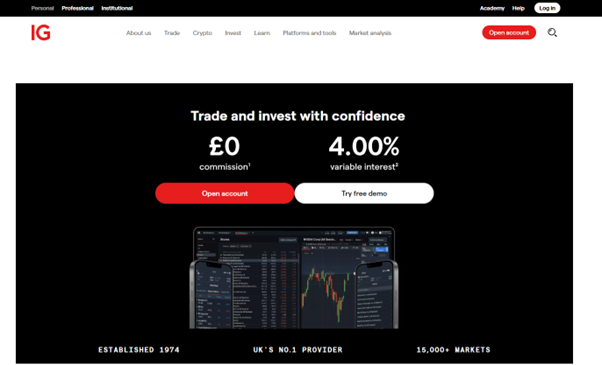
The forex market closes at 10pm on Friday and doesn't reopen until 9pm on Sunday. For most UK traders, that means no trading for nearly 48 hours—unless you have an account with IG. IG pioneered weekend trading in the UK and remains the only regulated broker offering it on traditional markets, giving traders up to 47 additional hours of trading time each week.
Pros
- Only UK broker with weekend forex & indices trading
- FCA regulated with 50+ years history (FTSE 250 listed)
- Tax-free profits via spread betting for UK residents
- Free demo account with £10,000 virtual funds
Cons
- Weekend spreads are wider than weekday (lower liquidity)
- Synthetic pricing — IG creates prices, not exchange-based
- Limited weekend markets (3 forex pairs, 5 indices, gold only)
Weekend Markets Available
Weekend indices: FTSE 100 (Weekend UK 100), Dow Jones (Weekend Wall Street), DAX (Weekend Germany 40), Nasdaq (Weekend US Tech 100), and Hang Seng (Weekend HS50). Weekend forex: GBP/USD, EUR/USD, and USD/JPY only. Weekend commodities: Spot gold only. Cryptocurrency trading is available 24/7 with IG (and most other brokers).
How Weekend Pricing Works
The underlying markets are closed on weekends, so there's no live price data. IG generates weekend prices based on client activity, news flow, and volatility expectations. "Weekend GBP/USD" is a different market from weekday "GBP/USD"—your weekday positions aren't affected by weekend price movements until rollover. If you keep a weekend position open past Sunday's closing time, it automatically rolls into a weekday position with stops and limits carried over.
Safety & Regulation
FCA regulated: IG Index Ltd (Register number 114059) for spread betting, IG Markets Ltd (Register number 195355) for CFDs. FTSE 250 company: IG Group Holdings plc is publicly listed on the London Stock Exchange (LON: IGG). 50+ year track record: Founded in 1974. Client fund protection: Client money held in segregated accounts at regulated banks. FSCS protection applies to eligible claims up to £120,000 for investments.
| Metric | Value |
|---|---|
| FCA Registration (CFDs) | #195355 |
| FCA Registration (Spread Betting) | #114059 |
| Founded | 1974 |
| Listed | FTSE 250 (LON: IGG) |
| Total Markets | 17,000+ |
| Weekend Trading Hours | Sat 8am – Sun 10:40pm |
| Retail Loss Rate | 67% |
Is the Forex Market Open on Weekends?
No, the standard forex market is closed on weekends. The interbank forex market operates from 9pm Sunday to 10pm Friday (UK time), running continuously through Sydney, Tokyo, London, and New York sessions. During Saturday and Sunday, the underlying market is completely closed—no banks are trading, no liquidity providers are quoting prices, and no official exchange rates are being set.
However, IG offers "weekend forex" on three major pairs: GBP/USD, EUR/USD, and USD/JPY. These are synthetic markets where IG creates prices based on news flow, client activity, and volatility expectations. You're not trading the live interbank market—you're trading IG's assessment of where the market should be.
The practical implication: if you want to trade forex on Saturday or Sunday in the UK, IG is your only regulated option. All other FCA-authorised brokers—Pepperstone, CMC Markets, Saxo, IC Markets—close their forex desks at 10pm Friday and don't reopen until Sunday evening.
Can You Trade the FTSE 100 on Weekends?
Yes, but only through IG's "Weekend UK 100" market. The London Stock Exchange is closed on Saturdays and Sundays, so there's no live FTSE 100 index being calculated. IG creates a weekend version that tracks where they expect the index to open on Monday, available from 8am Saturday to 10:40pm Sunday (UK time).
According to The Investors Centre's January 2026 broker comparison, IG is the only UK platform offering weekend trading on the FTSE 100. Pepperstone, CMC Markets, City Index, and Saxo all close their index markets on Friday night.
Key points for weekend FTSE trading:
- Trading hours: Saturday 8am → Sunday 10:40pm UK time
- Instrument name: Search for "Weekend UK 100" in IG's platform
- Spreads are wider than weekday trading (lower liquidity)
- Positions automatically roll into weekday UK 100 at Sunday close
- Available via spread betting (tax-free for UK residents) or CFDs
What Markets Can You Trade on Weekends in the UK?
IG offers weekend trading on three asset classes: forex, indices, and gold. Each has specific trading hours and operates as a separate market from its weekday equivalent.
Weekend indices available: FTSE 100 (Weekend UK 100), Dow Jones (Weekend Wall Street), DAX (Weekend Germany 40), Nasdaq (Weekend US Tech 100), and Hang Seng (Weekend HS50).
Weekend forex pairs: GBP/USD, EUR/USD, and USD/JPY only. Other currency pairs are not available.
Weekend commodities: Spot gold only. Other commodities like oil and silver are not offered on weekends.
Cryptocurrency trading is available 24/7 with IG (and most other brokers), running continuously from Saturday morning through to Friday night with only brief maintenance breaks.
Does Pepperstone Have Weekend Trading?
No, Pepperstone does not offer weekend trading on forex, indices, or commodities. According to The Investors Centre's January 2026 testing, Pepperstone's forex and index markets close at 10pm Friday (UK time) and don't reopen until approximately 9pm Sunday. The only exception is cryptocurrency, which Pepperstone offers 24/7.
This is consistent across all major UK brokers except IG. Pepperstone, CMC Markets, City Index, IC Markets, and Saxo all close their traditional markets over the weekend. If you hold positions through the weekend with these brokers, you cannot adjust stops, take profits, or close trades until Sunday evening.
For traders who specifically need weekend access to GBP/USD, EUR/USD, FTSE 100, or gold, IG remains the only regulated UK option. Pepperstone's strength lies elsewhere—tight spreads during market hours and excellent MetaTrader integration—but weekend trading is not part of their offering.
Do Other UK Brokers Offer Weekend Trading?
For forex and indices, no. IG is the only FCA-regulated broker offering weekend trading on these markets. Other major UK brokers close on Friday night and reopen Sunday evening.
If your only interest is cryptocurrency trading, any major broker will work—crypto markets run 24/7 regardless of provider. But if you want to trade GBP/USD, the FTSE 100, or gold on a Saturday morning, IG is your only regulated UK option.
IG vs Pepperstone for Weekend Trading
IG is the clear winner for weekend trading—Pepperstone doesn't offer it at all. If you specifically need to trade forex, indices, or gold on Saturdays and Sundays, IG is your only option among major UK brokers. Pepperstone's markets are completely closed from Friday night until Sunday evening.
| Feature | IG | Pepperstone |
|---|---|---|
| Weekend Forex | Yes — 3 pairs | Closed |
| Weekend Indices | Yes — 5 indices | Closed |
| Weekend Gold | Yes | Closed |
| Weekend Crypto | Yes — 24/7 | Yes — 24/7 |
| Weekday EUR/USD Spread | 0.6 pips | 0.0–0.1 pips (Razor) |
| FCA Regulated | Yes — #195355 | Yes — #684312 |
| Total Markets | 17,000+ | 1,200+ |
That said, Pepperstone has advantages during normal market hours. Their Razor account offers raw spreads from 0.0 pips on EUR/USD (plus commission), compared to IG's 0.6 pips spread-only pricing. For high-volume forex traders who don't need weekend access, Pepperstone can be more cost-effective.
Choose IG if: You need weekend trading on forex/indices/gold, want one broker for everything, or value the security of a FTSE 250 company.
Choose Pepperstone if: Weekend trading isn't important to you, you prioritise the lowest possible spreads during market hours, or you prefer MetaTrader platforms.
Why Would You Want to Trade on Weekends?
Weekend trading isn't for everyone, but there are specific situations where it's genuinely useful:
React to Breaking News
Geopolitical events, central bank comments, or corporate news often break on weekends. Act immediately instead of waiting for Monday's gap.
Hedge Existing Positions
Hold a weekday FTSE position and worried about gap risk? Open an opposite weekend position to offset potential losses.
Trade Around Your Schedule
Work 9-5 Monday to Friday? Weekends may be your only time to actively watch charts and manage positions.
Hedging example: You're long on FTSE 100 during the week. On Friday evening, unexpected political news suggests markets may fall on Monday. Rather than close your position (crystallising any losses or missing potential recovery), you open a short position on "Weekend UK 100." If markets do fall, your weekend short profits offset your weekday losses.
How Does IG Weekend Pricing Actually Work?
This is where honesty matters. Weekend markets work differently from weekday markets, and understanding the mechanics helps you trade more effectively.
Important: IG Creates Weekend Prices — The underlying markets are closed on weekends, so there's no live price data. IG generates weekend prices based on client activity, news flow, and volatility expectations. You're trading IG's assessment of fair value, not a live market.
Separate Instruments
"Weekend GBP/USD" is a different market from weekday "GBP/USD." Your weekday positions aren't affected by weekend price movements until rollover.
Rollover at Sunday Close
If you keep a weekend position open past Sunday's closing time (10:40pm for indices, 8:40pm for forex), it automatically rolls into a weekday position. Stops and limits carry over.
Wider Spreads
Lower liquidity during weekends typically means wider spreads than during normal market hours. IG doesn't publish specific weekend spread data, but expect costs to be higher than peak liquidity periods.
Price Alignment
Weekend prices may not exactly match where the weekday market opens on Sunday night. There can be a gap when the regular market resumes.
What Are the Risks of Weekend Trading?
Weekend trading has genuine uses, but it's not without drawbacks:
Higher costs: Wider spreads mean each trade costs more than the same trade during normal hours. For frequent traders, this adds up.
Synthetic pricing: You're trading IG's prices, not exchange prices. While IG is regulated and reputable, some traders prefer exchange-based pricing.
Potential gap on rollover: If the weekday market opens significantly different from where the weekend market closed, your rolled-over position may be affected.
Limited markets: Only select forex pairs (three), indices (five), and gold. If you trade exotic currencies, oil, or stocks, weekend trading doesn't help.
Not ideal for beginners: Lower liquidity and wider spreads make weekend markets more challenging. The educational content IG provides is excellent, but practice on a demo account first.
Is IG Safe for Weekend Trading?
IG is one of the most established trading providers in the world. Key safety credentials:
FCA regulated: IG Index Ltd (Register number 114059) for spread betting, IG Markets Ltd (Register number 195355) for CFDs. Both authorised and regulated by the Financial Conduct Authority.
FTSE 250 company: IG Group Holdings plc is publicly listed on the London Stock Exchange (LON: IGG), subject to UK corporate governance and financial reporting requirements.
50+ year track record: Founded in 1974, IG pioneered spread betting and has operated continuously through multiple market crises.
Client fund protection: Client money held in segregated accounts at regulated banks. FSCS protection applies to eligible claims up to £120,000 for investments.
Risk warning: 67% of retail investor accounts lose money when trading spread bets and CFDs with IG. This is standard for the industry and a required disclosure.
How Do I Start Trading on Weekends with IG?
- Open an IG account — Choose spread betting (tax-free profits for UK residents) or CFD trading. Application takes about 10 minutes online. You'll need to verify your identity.
- Deposit funds — Minimum deposit depends on your chosen payment method. Bank transfer, debit card, and PayPal are available. No deposit fees.
- Wait for Saturday 8am (UK time) — Weekend markets open at 8am Saturday. They're not available during Friday night or early Saturday morning.
- Search for "Weekend" markets — In IG's platform, search for "Weekend UK 100" or "Weekend GBP/USD"—they appear as separate instruments from weekday markets.
- Place your trade — Set your position size, stops, and limits as normal. Remember: if you keep the position open past Sunday close, it rolls into a weekday position.
Demo account available: IG offers a free demo account with £10,000 virtual funds. Weekend markets are available on demo, so you can practice before trading with real money.

Is Weekend Trading Worth It?
For most traders, weekend trading is a useful tool for specific situations rather than a primary strategy.
Weekend trading makes sense if you:
- Work full-time and weekends are your only time to actively trade
- Want to hedge existing positions against weekend gap risk
- Need to react immediately to breaking news rather than waiting for Monday
- Trade the specific markets available (FTSE, Wall Street, GBP/USD, gold)
Weekend trading is less suitable if you:
- Prioritise tight spreads and low costs above all else
- Trade markets not available on weekends (most forex pairs, stocks, oil)
- Are a beginner still learning the fundamentals
- Prefer exchange-based pricing over broker-generated prices
Discuss UK Weekend Trading
Trading on weekends through these UK brokers? Share your gap-risk experiences, weekend spread widening, and platform availability. Our community earns Equity for quality contributions.
Discussion 0 comments
Be the first to start discussing this topic! Log in or create an account to share your thoughts.
Log In Create AccountFAQs
References
69% of retail investor accounts lose money when trading spread bets and CFDs with this provider.
No comments yet. Be the first to start discussing this topic!