


Quick Answer: Can You Really Buy Property for £1,000?
Yes. A REIT is a stock-market-listed company that owns buildings and pays at least 90% of its rental profits to shareholders as dividends. For income it stacks up genuinely well: a 5–7% yield with every landlord cost already deducted, tax-free inside an ISA, and zero admin. The catch is what you own: not £1,000 of bricks at a fair price, but £1,000 of shares in a landlord, and the market decides what those are worth, minute by minute. Right now UK REITs trade roughly 25% below the stated value of their buildings, and they’ve been “cheap” like that since 2022. Undervalued doesn’t mean it goes up.

Spread bets and CFDs are complex instruments and come with a high risk of losing money rapidly due to leverage. 70% of retail investor accounts lose money when trading spread bets and CFDs with this provider. You should consider whether you understand how spread bets and CFDs work, and whether you can afford to take the high risk of losing your money.
What Is a REIT, in Plain English?
You’ve probably seen the pitch: “you don’t need a deposit; you can own property from just £1,000.” It’s the standard sales line for REITs, and it’s technically true. But there’s a catch buried in that sentence, and it’s the difference between owning a building and owning an opinion about a building. We’ll get to it, but the basics first.
A REIT (Real Estate Investment Trust) is a company whose entire job is owning buildings and collecting rent: offices, warehouses, supermarkets, GP surgeries, student flats. It’s listed on the stock exchange, so instead of buying a building, you buy shares in the landlord. The money flows like this:
- You buy shares in the REIT, from £1 to £1,000, like any stock.
- The REIT owns hundreds of properties and rents them out.
- Tenants pay rent to the REIT every month.
- The REIT pays most of that rent to you as dividends.
The deal that makes a REIT a REIT is the 90% rule: UK REITs must pay out at least 90% of their rental profits to shareholders as dividends, and in exchange they pay no corporation tax on that rental income. You also get instant liquidity (sell in seconds, no estate agents, no chains) and instant diversification, because £1,000 buys a sliver of hundreds of buildings rather than a bet on one.
You already walk past these companies
REITs sound abstract until you realise you use their buildings every week. Supermarket Income REIT owns Tesco and Sainsbury’s superstores and rents them back to the supermarkets, so your weekly shop pays its dividend. Primary Health Properties is landlord to over a thousand GP surgeries and NHS-linked health centres. Segro owns the giant warehouses your next-day deliveries pass through, including the Slough Trading Estate. Land Securities owns Bluewater and the Piccadilly Lights. Unite is the UK’s biggest student landlord, and Tritax Big Box rents mega-warehouses to Amazon and Ocado.
If you want the practical step-by-step (choosing a platform, individual REITs vs REIT ETFs, and placing your first order), we cover it in our guide on how to invest in REITs.
The Income: REITs vs Buy-to-Let
Here’s where REITs genuinely shine, and it comes down to one word: net. A REIT’s dividend yield is what actually lands in your account: management, maintenance, empty periods and debt costs are all deducted before you’re paid. A buy-to-let’s headline yield is the number before the letting agent, the boiler and the empty months take their cut.
| UK REITs | Buy-to-let (residential) | |
|---|---|---|
| Headline yield | ~5–6% average; income names ~7% (Supermarket Income, LondonMetric, Primary Health) | ~5.5–7% gross nationally; 9%+ in parts of the North East, 3–4% in London |
| What comes off | Almost nothing more; costs are already deducted before the dividend. 0% tax inside an ISA | Agent fees (10–15% of rent), maintenance, voids, insurance; typically 25–40% of the gross |
| Realistic net yield | ~5–7% | ~3.5–5% |
If you’re holding REITs for income, the wrapper matters as much as the pick: inside a Stocks and Shares ISA the dividends are sheltered from UK tax. We compare the best Stocks and Shares ISAs if you don’t have one set up yet.
A Worked Example: £63,000 Down Each Path
A £200,000 rental flat with a 25% deposit actually needs about £63,000 in cash once you add stamp duty (£11,500 with the 5% second-home surcharge) and legal fees. So let’s send £63,000 down each path for a year, assuming a 6% gross rental yield, a 5% interest-only buy-to-let mortgage, and 3% price growth on both.
| Year one | The buy-to-let flat | The REIT portfolio |
|---|---|---|
| Rent / dividends in | +£12,000 rent | +£3,780 dividends (net) |
| Costs out | −£4,840 (agent, maintenance, voids, insurance) −£7,500 mortgage interest | −£200 platform fee |
| Cash flow | −£340 | +£3,580 |
| Value growth (3%) | +£6,000 (on the full £200k) | +£1,890 |
| Year-one total | ≈ £5,700 (~9%) | ≈ £5,200 (~8%) |
| Your time | 3–6 months to buy, hours every month after | Ten minutes, then nothing |
Strikingly similar totals, but look at how differently they’re built. The flat’s return leans entirely on leverage: £50,000 controls £200,000 of property, so 3% growth becomes 12% on your deposit. That’s the genuine advantage of direct property, and it cuts both ways: a 10% price fall wipes out £20,000, which is 40% of your deposit, and you still owe the bank £150,000. The REIT’s return needs no debt, no solicitor and no phone calls about the boiler.
So REITs win, then? On income and convenience, honestly, yes. But there’s one thing the comparison above quietly assumes: that the REIT’s share price tracks the value of its buildings. It doesn’t have to. And that’s the part most articles skip.
The Catch: You’re Buying a Share Price, Not a Property Price
When you buy a tokenised or fractional slice of a building (a niche product; most UK platforms that tried it have closed), you buy at a stated price tied to one valuation. A REIT is different: its price is set minute by minute by the stock market, and it can drift a long way from what the buildings are actually worth.
Right now, that drift is enormous. Research from fund manager Gravis, using EPRA data, put the average UK REIT at a 26.9% discount to net asset value, against a ten-year average of 17.5%. Winterflood’s research breaks it down by sector: commercial property REITs around 19% below asset value, logistics 17%, healthcare 18%, and residential REITs at a remarkable 37% discount.
“Buying £1 of property for 75p” sounds like the bargain of the decade. So here’s the uncomfortable question: if it’s so cheap, why has it stayed cheap for four years?
A Ten-Year Case Study: The UK’s Biggest Residential Landlord
Grainger plc is the UK’s largest listed residential landlord: over 11,000 rental homes, a REIT since 2022, and the cleanest ten-year record in the sector. We took real monthly share prices and every dividend the company paid over the last decade, and asked: what happened to £10,000 invested in July 2016?
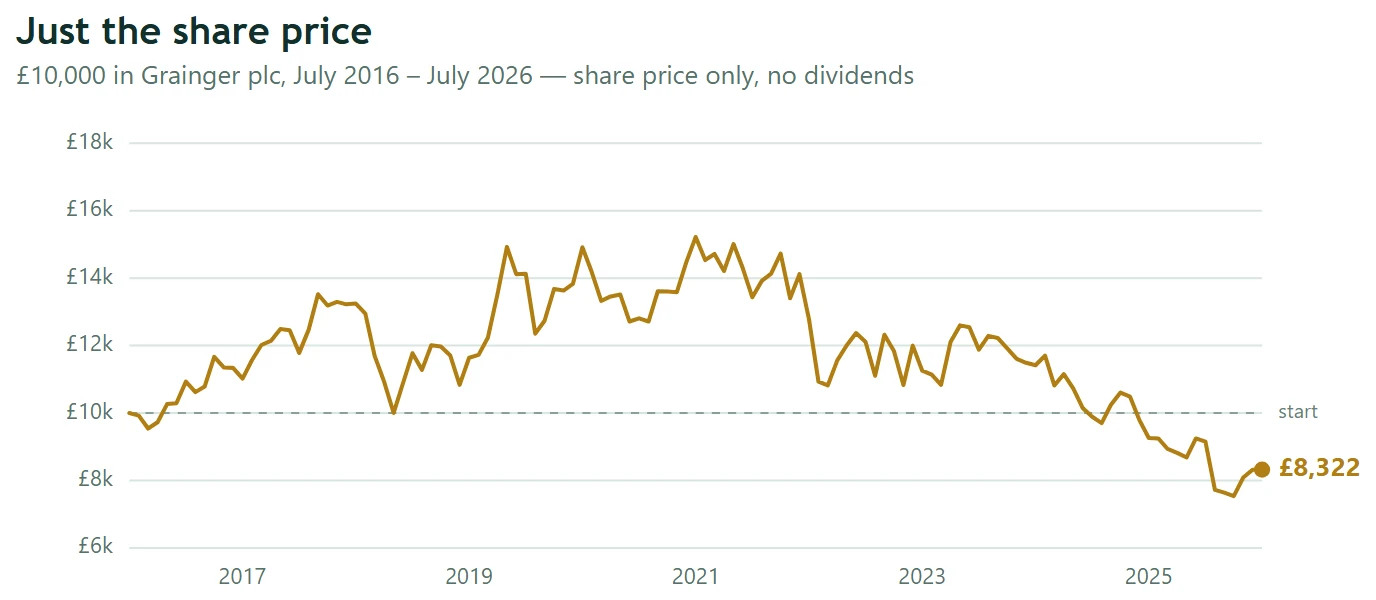
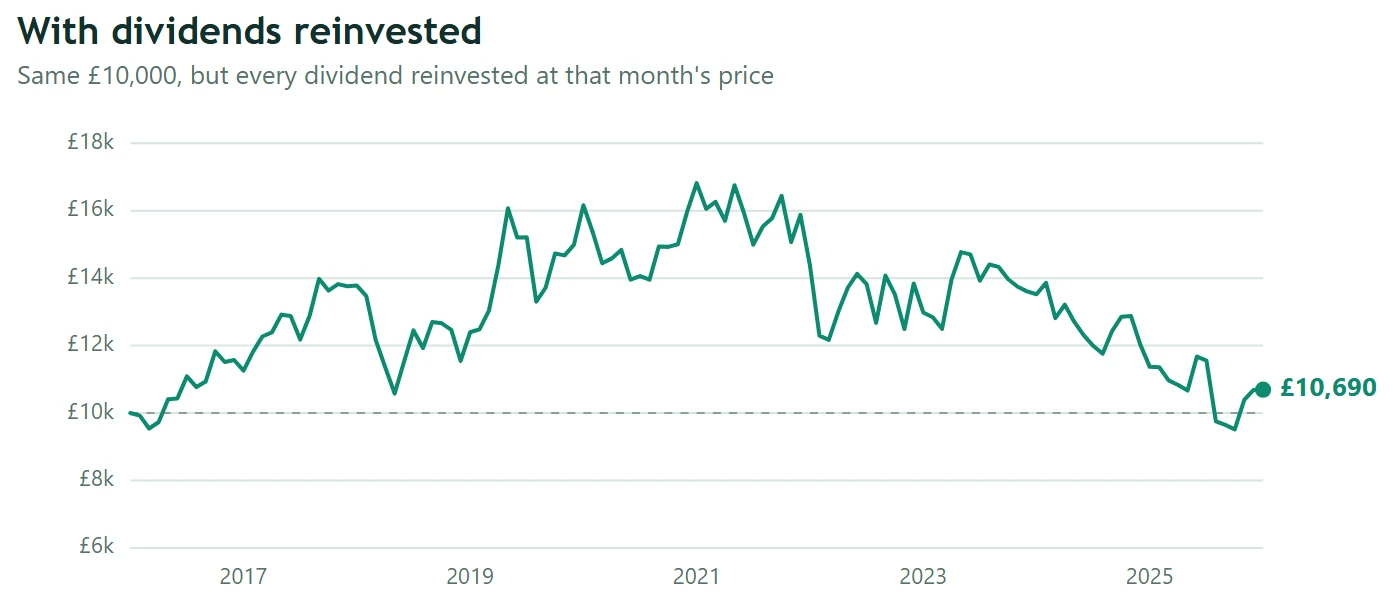
Now here’s the part that matters. Was Grainger a bad landlord? No. Its portfolio held its value remarkably well. The problem was what the market was willing to pay for it:
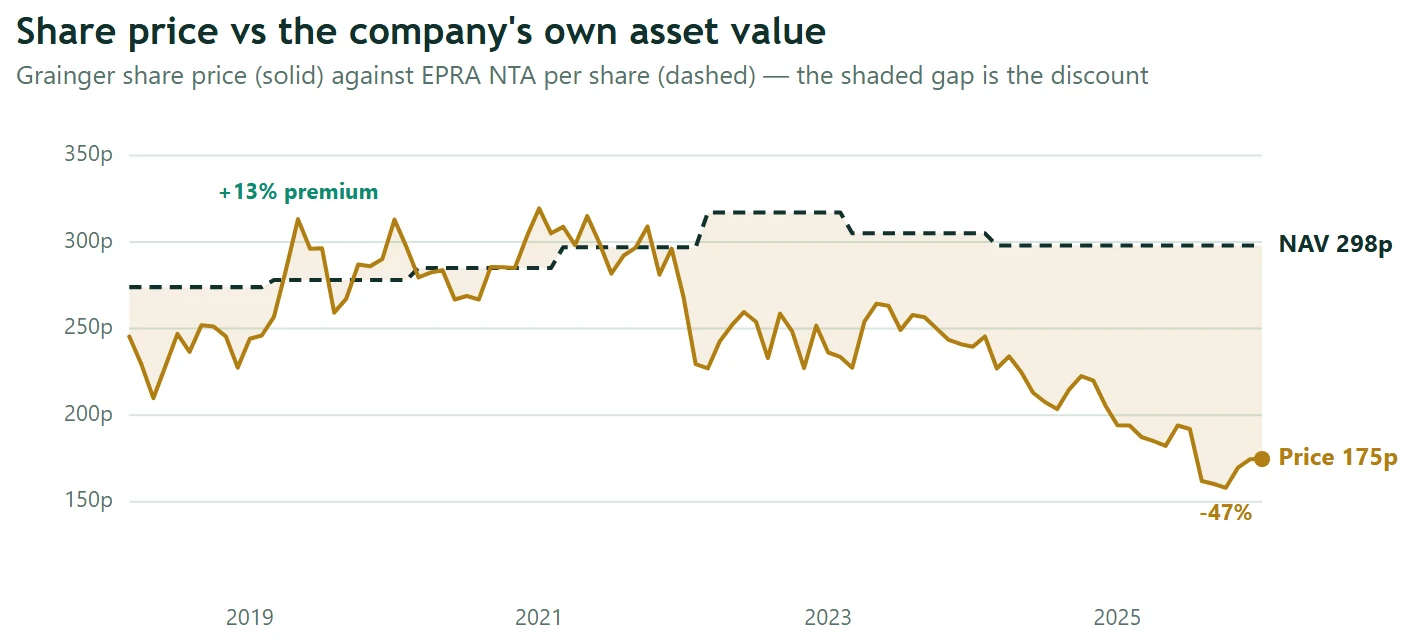
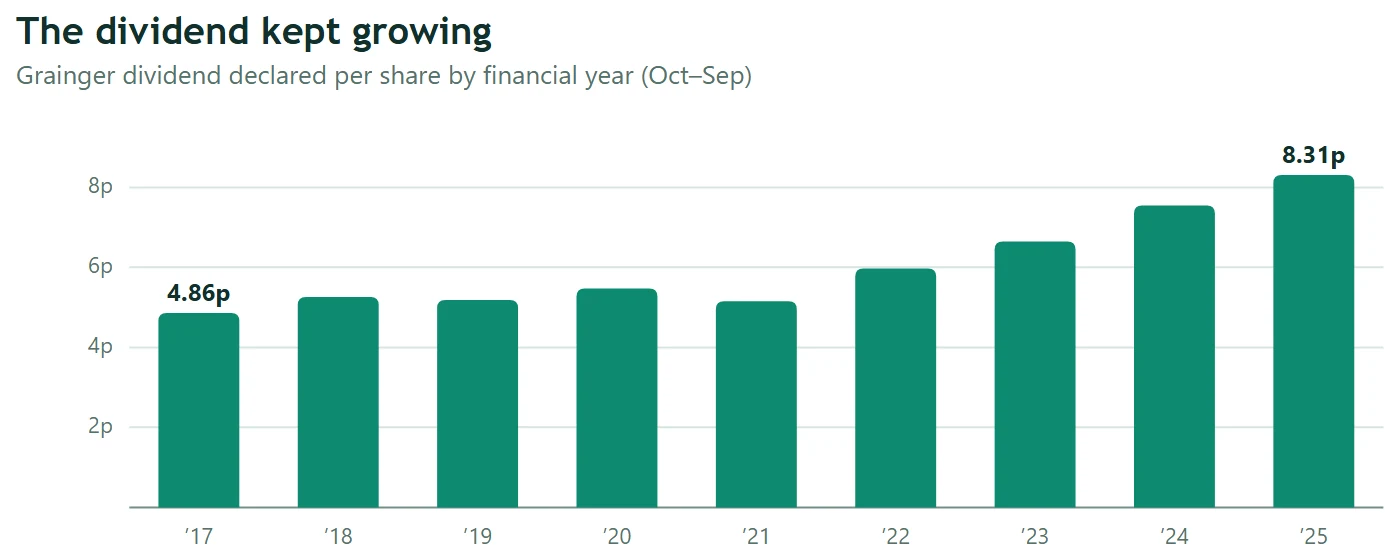
Let that sink in: the houses held their value, the dividend grew seventy percent, and the shares still lost money. The only thing that collapsed was the market’s opinion, from a 13% premium to a 41% discount. That’s what you’re actually buying with a REIT: the buildings, yes, but priced through the stock market’s mood.
So Is “Undervalued” a Buying Opportunity?
Maybe, but be clear-eyed about how these discounts have actually been closing. Not by share prices recovering, but by takeovers, often below asset value. Blackstone bought Warehouse REIT for £470m at roughly a 17% discount to its net disposal value. KKR circled Assura when it traded 21% below NAV. Of the 82 REITs listed in London five years ago, more than half have been acquired or wound up. Private equity is buying the buildings cheap; existing shareholders are being bought out below the asset value they were promised.
The fair summary is this:
- As an income investment, REITs stack up well. A genuine 5–7% net yield, tax-free in an ISA, with zero landlord admin, beats like-for-like buy-to-let for most people with £1,000 to £50,000 to invest.
- As a “cheap property” trade, be careful. A discount is an opinion, not a coupon. UK REITs have been “cheap” since 2022 and mostly stayed cheap, and residential, the sector most people associate with property, is where listed property has worked worst.
- Undervalued doesn’t mean it goes up. If the discount closes, it may close via a takeover below NAV rather than a recovery you get to enjoy.
The bottom line: yes, you can buy property exposure for £1,000, and for income it’s a genuinely good tool. Just know what you own. It’s not £1,000 of bricks at a fair price; it’s £1,000 of shares in a landlord, and the market decides what that’s worth, minute by minute.
This is not financial advice. Your capital is at risk: investments can go down as well as up, and past performance (including the ten-year figures above) is not a guide to future results. Tax treatment depends on individual circumstances and may change. If you’re unsure, speak to a regulated financial adviser.
Discuss: Would You Buy the Discount?
REITs at 25% below asset value: bargain or value trap? And would you take a 7% hands-off yield over a buy-to-let? Ask below: the team and community are in here every day, and helpful contributions earn Equity.
Discussion 0 comments
Be the first to start discussing this topic! Log in or create an account to share your thoughts.
Log In Create AccountFAQs
References
- Gravis Advisory: UK REITs: does the resurgence still have legs? (average discount 26.9% vs 17.5% ten-year average, EPRA data, April 2025)
- The AIC / Citywire: Winners and losers from the REIT revival (Winterflood sector discounts, January 2026)
- Grainger case study: monthly closing prices via Yahoo Finance (GRI.L), Jul 2016 – Jul 2026; dividends via DividendMax and Grainger’s FY21 results, reinvested at each month’s close; EPRA NTA per share from Grainger’s annual results (FY18 274p → FY25 298p). Chart values are our own calculations.
Ready to act on it? Start with our guide on how to invest in REITs. For more on tax wrappers, see our guide to the best Stocks and Shares ISAs, or explore our full investing hub.
No comments yet. Be the first to start discussing this topic!