

- expertise:
- CFD Trading, Forex, Derivatives, Risk Management
- credentials:
- Chartered ACII (2018) · Trading since 2012
- tested:
- 40+ forex & CFD platforms with live accounts

- expertise:
- Broker Comparison, ISA Strategy, Portfolio Management
- credentials:
- Active investor since 2013 · 11+ years experience
- tested:
- 40+ brokers with funded accounts
How We Test
Real accounts. Real money. Real trades. No demo accounts or press releases.
What we measure:
- Spreads vs advertised rates
- Execution speed and slippage
- Hidden fees (overnight, withdrawal, conversion)
- Actual withdrawal times
Scoring:
Fees (25%) · Platform (20%) · Assets (15%) · Mobile (15%) · Tools (10%) · Support (10%) · Regulation (5%)
Regulatory checks:
FCA Register verification · FSCS protection
Testing team:
Adam Woodhead (investing since 2013), Thomas Drury (Chartered ACII, 2018), Dom Farnell (investing since 2013) — 50+ platforms with funded accounts
Quarterly reviews · Corrections: in**@*******************co.uk
Disclaimer
Not financial advice. Educational content only. We're not FCA authorised. Consult a qualified advisor before investing.
Capital at risk. Investments can fall. Past performance doesn't guarantee future results.
CFD warning. 67-84% of retail accounts lose money trading CFDs. High risk due to leverage.
Contact: in**@*******************co.uk
Quick Answer: What is the equivalent of a Roth IRA in the UK?
There's no exact UK version of a Roth IRA. However, the Stocks and Shares ISA comes closest, offering tax-free investment growth and withdrawals. A SIPP, meanwhile, provides upfront tax relief. Many UK savers combine both to achieve benefits similar to an American Roth IRA.
Many UK investors look for something like America's Roth IRA, known for tax-free growth and withdrawals in retirement. While there's no identical account here, the UK offers Stocks and Shares ISAs and SIPPs, which together can deliver similar tax advantages tailored to UK tax rules.
Roth IRA UK Equivalent 2026: Ranked & Tested

eToro
- Best For
- UK Roth IRA Equivalents
- TIC Rating
- 4.8 / 5
- Community Rating
- 4.2 (452 ratings) Have Your Say →
55% of retail CFD accounts lose money when trading CFDs with this provider.

Interactive Investor
- Best For
- UK Roth IRA Equivalents
- TIC Rating
- 4.8 / 5
- Community Rating
- 3.5 (51 ratings) Have Your Say →
When Investing, Your Capital is at Risk.

Trading 212
- Best For
- UK Roth IRA Equivalents
- TIC Rating
- 4.5 / 5
- Community Rating
- 4 (1 rating) Have Your Say →
Sponsored link. Terms apply.

IG
- Best For
- UK Roth IRA Equivalents
- TIC Rating
- 4.2 / 5
- Community Rating
- 4.3 (462 ratings) Have Your Say →
70% of retail CFD accounts lose money.

Interactive Brokers
- Best For
- UK Roth IRA Equivalents
- TIC Rating
- 4.5 / 5
- Community Rating
- 3.1 (46 ratings) Have Your Say →
62.5% of Retail CFD Accounts Lose Money

Saxo
- Best For
- UK Roth IRA Equivalents
- TIC Rating
- 4.2 / 5
- Community Rating
- 3.5 (48 ratings) Have Your Say →
64% of retail CFD accounts lose money.
Why isn't there a Roth IRA in the UK?
There's no direct UK equivalent to a Roth IRA, but the Stocks and Shares ISA comes closest. It lets you invest after-tax income, grow your money tax-free, and withdraw without paying a penny in tax. A SIPP, on the other hand, offers upfront tax relief with withdrawals taxed later. Many UK investors in 2026 combine both to replicate the key benefits of a Roth IRA within the British tax system.
What's the closest UK equivalent to a Roth IRA?
The closest UK alternative to a Roth IRA is a Stocks and Shares ISA, which uses after-tax money, grows tax-free, and withdrawals stay tax-free. A SIPP gives upfront tax relief but taxes withdrawals. Many UK investors combine both to replicate Roth benefits.
How does a Stocks and Shares ISA work?
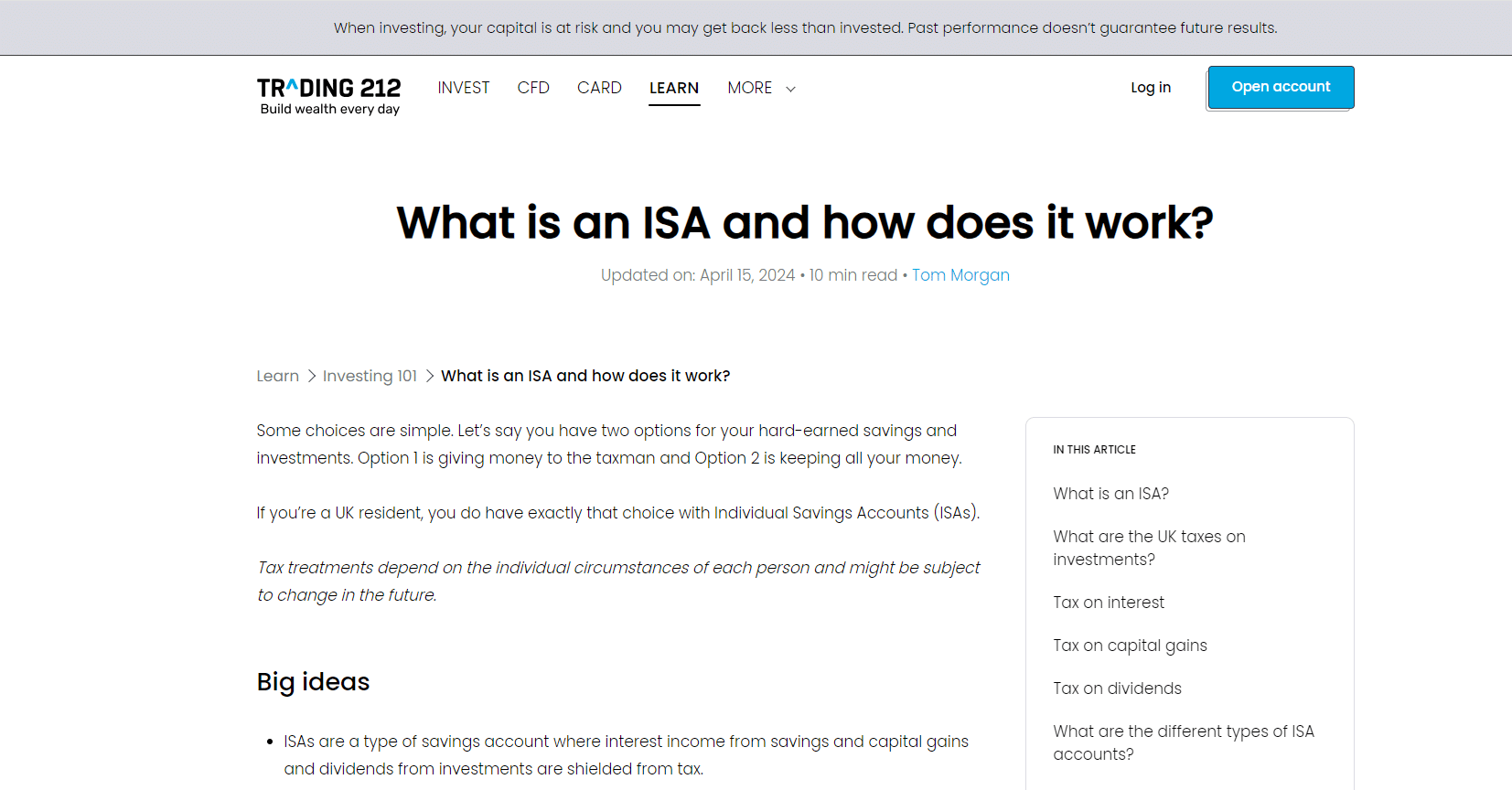
A Stocks and Shares ISA lets you invest after-tax money into shares, funds, and bonds. Your investments grow free from UK income or capital gains tax. Withdrawals are also tax-free, making it a flexible, long-term way to build wealth without future tax worries.
What can you invest in?
Inside a Stocks and Shares ISA, you can hold individual stocks, ETFs, mutual funds, investment trusts, and bonds. All dividends, interest, and capital gains earned are shielded from UK tax, allowing your investments to compound more effectively over time without annual tax bills.
How much can you put in each year?
For 2025/26, you can contribute up to £20,000 across all your ISAs combined. This allowance resets every April. Unlike pensions, there's no employer input or lifetime limit, letting you steadily build substantial tax-free investments year after year, regardless of your total income.
When and how can you take money out?
You can withdraw from a Stocks and Shares ISA anytime, completely tax-free. There are no penalties, no minimum age restrictions, and funds usually settle in a few working days, offering far more flexibility than pensions or US retirement accounts tied to retirement age.
Who can open one?
Any UK resident aged 18 or over can open a Stocks and Shares ISA. There's no income cap, so both high and low earners can take full advantage of the £20,000 annual allowance to grow investments sheltered from UK income and capital gains tax.
Could a SIPP be a better Roth IRA alternative?
A SIPP offers upfront tax relief on contributions, tax-free investment growth, and withdrawals taxed later. It's more like a traditional US IRA but remains a powerful retirement tool. Many UK investors combine SIPPs with ISAs to balance immediate tax breaks and long-term tax-free access.
How does SIPP tax relief work?
When you pay into a SIPP, the government adds 20% basic-rate tax relief automatically. Higher-rate taxpayers can claim more through their tax return. This means a £100 investment only costs £80 upfront, giving your retirement savings an instant boost and reducing your current tax bill.
What can you invest in through a SIPP?
SIPPs give access to a wide range of investments: individual stocks, ETFs, mutual funds, bonds, and REITs. Like ISAs, all growth and income inside the SIPP are sheltered from UK tax, maximising compounding until you eventually withdraw funds in retirement.
When can you withdraw?
You can start taking money from a SIPP at age 55 (rising to 57 by 2028). The first 25% you take out is usually tax-free, while the remaining 75% is taxed as income, offering both a tax-efficient lump sum and future retirement income.
How do ISAs, SIPPs, and Roth IRAs compare?
ISAs, SIPPs, and Roth IRAs all grow investments tax-free, but differ on when tax is paid, how much you can contribute, and withdrawal rules. Understanding these differences helps you balance immediate tax perks, long-term growth, and flexible access to suit your personal goals.
| Feature | Stocks & Shares ISA | SIPP | Roth IRA (US) |
|---|---|---|---|
| Tax on contributions | Paid upfront, no relief | Tax relief now (reduces taxable income) | Paid upfront, no relief |
| Tax on growth | Tax-free | Tax-free | Tax-free |
| Tax on withdrawals | Tax-free anytime | 25% usually tax-free, rest taxed as income | Tax-free after 59½ and 5 years |
| Contribution limit | £20,000/year, no income cap | Up to earnings (£60,000 cap) plus relief | $7,000/year, phases out for high earners |
| Withdrawal rules | Anytime, no penalties | From age 55 (57 by 2028) | From 59½, with exceptions |
| Best for | Medium/long-term flexible investing | Focused retirement saving with tax breaks | Tax-free US retirement income |
When are taxes paid?
With ISAs and Roth IRAs, you invest after paying tax, then enjoy tax-free growth and withdrawals. SIPPs work differently: you get tax relief upfront, but withdrawals in retirement are taxed as income. This shifts your tax bill to later, possibly at a lower rate.
How do contribution limits differ?
ISAs allow up to £20,000 each tax year, with no income restrictions. SIPPs let you contribute up to your earnings (capped at £60,000), with added tax relief. Roth IRAs are stricter, limiting contributions to $7,000 and phasing out for higher earners under US tax rules.
Which is more flexible?
ISAs are by far the most flexible — you can access your money anytime, tax-free. SIPPs lock funds until at least age 55, making them purely for retirement. Roth IRAs also restrict early withdrawals, typically requiring you to wait until 59½ for tax-free access.
Can UK residents open a Roth IRA or transfer one?
UK residents can't open or directly transfer into a Roth IRA, as it's a US-specific retirement account. However, existing Roth IRAs can usually be kept, with withdrawals often tax-free under the US-UK tax treaty. ISAs and SIPPs remain the UK's main options.
Can I transfer a Roth IRA to an ISA or SIPP?
No — you can't directly transfer a Roth IRA into a UK ISA or pension. Roth IRAs are governed by US tax law and stay under IRS rules. Instead, most expats keep their Roth intact in the US while using ISAs or SIPPs locally.
Which Stocks and Shares ISA Platform Is Best for UK Investors?
If you're looking to grow your investments tax-efficiently, check out our in depth guide to the best Stocks and Shares ISAs in the UK to find the top platforms for UK investors.
| Rank | Platform | Fees (est.) | Range of Investments | Best For | Key Features |
|---|---|---|---|---|---|
| 1 | eToro | Low | Stocks, ETFs, Crypto | Beginners, social trading fans | Copy portfolios, simple interface |
| 2 | Interactive Investor | Flat monthly fee | Stocks, funds, investment trusts, bonds | Larger portfolios, buy-and-hold investors | Flat-fee pricing, wide fund range, SIPP & ISA |
| 3 | Trading 212 | Zero direct share dealing | Stocks, ETFs, Pies | Fee-sensitive passive investors | Auto-invest, fractional shares |
| 4 | IG | Medium | Shares, funds, options | Experienced traders | Huge market access, professional tools |
| 5 | IBKR | Low to medium | Global markets, funds | Active global investors | Depth, algo support, robust research |
| 6 | Saxo | Higher | Wide global coverage | Large portfolios, professionals | Premium service, extensive tools |
eToro – Best Overall Stocks and Shares ISA Platform
eToro is one of the most widely used investment platforms globally, and its beginner-friendly approach makes it a strong choice for UK investors opening their first Stocks and Shares ISA. The platform offers access to thousands of stocks, ETFs, and crypto assets — all within a clean, intuitive interface designed to make investing feel accessible rather than intimidating. With £0 commission* on real stock trades, social trading features like CopyTrader, and ISA access through its Moneyfarm partnership, eToro delivers a straightforward route into tax-free investing for those prioritising simplicity and community-driven insights.
*£0 / commission-free refers to dealing commission only. Other costs may still apply – for example the FX-conversion fee on non-GBP holdings, spreads, and withdrawal or inactivity fees (see the fee table below). Check eToro's current charges before investing.
What are the Fees?
| Fee Type | Cost |
|---|---|
| Platform Fee | £0 |
| Stock Dealing | £0 commission* on real stocks |
| FX Conversion | 0.5% (reduced from 1.5%) |
| Withdrawal Fee | $5 flat fee |
| Minimum Deposit | £50 |
How Easy is it to Use?
eToro's platform is purpose-built for simplicity. The mobile app is among the cleanest we've tested, with intuitive navigation and a social feed that lets you follow and copy experienced investors. It's ideal for first-time investors who want a straightforward way to start building a portfolio without being overwhelmed by complex tools.
How to Get Started
- Visit the eToro website or download the app and create an account.
- Complete identity verification — typically approved within minutes.
- Deposit funds via bank transfer or debit card.
- Search for stocks, ETFs, or use CopyTrader to mirror experienced investors' portfolios.
eToro is a multi-asset investment platform. The value of your investments may go up or down. Your capital is at risk. CFDs are complex instruments and come with a high risk of losing money rapidly due to leverage. 55% of retail investor accounts lose money when trading CFDs with this provider. You should consider whether you understand how CFDs work, and whether you can afford to take the high risk of losing your money.
Interactive Investor – Best for Larger Portfolios and Buy-and-Hold Investors
Interactive Investor (ii) is one of the UK's largest investment platforms, well suited to investors who want a wide choice of assets alongside predictable, flat-fee pricing. Its Stocks and Shares ISA gives access to thousands of UK and global shares, funds, investment trusts, and bonds — all growing free from UK income and capital gains tax. With a single flat monthly subscription rather than percentage-based charges, ii becomes increasingly cost-effective as your portfolio grows, making it a strong choice for committed, long-term ISA investors.
What are the Fees?
| Fee Type | Cost |
|---|---|
| Platform Fee | Flat monthly subscription (plan dependent) |
| UK Share Dealing | £3.99 per trade (one free trade/month on some plans) |
| Fund Dealing | £3.99 per trade |
| Minimum Deposit | £0 |
How Easy is it to Use?
Interactive Investor's platform is clean and well-organised, with a strong research suite, watchlists, and portfolio analysis tools. It suits investors who want depth and control rather than a stripped-back app experience, and is available on both desktop and mobile.
How to Get Started
- Visit the Interactive Investor website and select the Stocks and Shares ISA.
- Choose your subscription plan and complete the online application.
- Verify your identity and fund your account via bank transfer.
- Browse and invest across shares, funds, investment trusts, and bonds within your ISA wrapper.
Trading and investing involve risk. The value of your investments can go up or down, and you may lose all or part of your capital. These products may not be suitable for all investors. Please ensure you fully understand the risks involved
Discuss UK Roth IRA Equivalents
Trying to replicate the Roth IRA tax wrapper in the UK? Share which ISA or SIPP combination you're using and how it compares for your tax situation. Our community earns Equity for quality contributions.
Discussion 0 comments
Be the first to start discussing this topic! Log in or create an account to share your thoughts.
Log In Create AccountFAQs
Can I transfer a Roth IRA to the UK?
No. You can't directly transfer a Roth IRA into a UK ISA or pension. However, you can keep it in the US. Speak with a cross-border specialist to understand tax implications if you're a US citizen living in the UK.
Are Roth IRA withdrawals taxed in the UK?
Usually not. Thanks to the US-UK tax treaty, Roth IRA withdrawals generally remain tax-free in the UK if they're tax-free in the US. But personal circumstances vary, so it's wise to confirm with a tax adviser experienced in expat rules.
How much can I put into ISAs each year?
For 2025/26, you can invest up to £20,000 across all your ISAs. There's no income cap on eligibility, so high and low earners alike can use the full allowance to grow investments free from UK income or capital gains tax.
Is a SIPP still good if retiring abroad?
Often yes. You still receive tax relief on UK contributions, but withdrawals might be taxed by the country where you retire. It's crucial to understand local tax laws and whether there's a double-taxation agreement with the UK to avoid unexpected charges.
Final thoughts on building a Roth-style strategy in the UK
While the UK doesn't have a Roth IRA, pairing a Stocks and Shares ISA with a SIPP can deliver a similar outcome. The ISA offers flexible, tax-free access at any time, while the SIPP provides valuable upfront tax relief for long-term retirement planning. Together, they give UK investors in 2026 a powerful toolkit to grow wealth efficiently, manage their tax burden, and work towards their financial goals with confidence.
55% of retail CFD accounts lose money when trading CFDs with this provider.
No comments yet. Be the first to start discussing this topic!