

- expertise:
- CFD Trading, Forex, Derivatives, Risk Management
- credentials:
- Chartered ACII (2018) · Trading since 2012
- tested:
- 40+ forex & CFD platforms with live accounts

- expertise:
- Platform Testing, Cryptocurrency, Retail Investing
- credentials:
- Active investor since 2013 · 11+ years experience
- tested:
- 50+ platforms · 200+ guides authored
How We Test
Real accounts. Real money. Real trades. No demo accounts or press releases.
What we measure:
- Spreads vs advertised rates
- Execution speed and slippage
- Hidden fees (overnight, withdrawal, conversion)
- Actual withdrawal times
Scoring:
Fees (25%) · Platform (20%) · Assets (15%) · Mobile (15%) · Tools (10%) · Support (10%) · Regulation (5%)
Regulatory checks:
FCA Register verification · FSCS protection
Testing team:
Adam Woodhead (investing since 2013), Thomas Drury (Chartered ACII, 2018), Dom Farnell (investing since 2013) — 50+ platforms with funded accounts
Quarterly reviews · Corrections: info@theinvestorscentre.co.uk
Disclaimer
Not financial advice. Educational content only. We're not FCA authorised. Consult a qualified advisor before investing.
Capital at risk. Investments can fall. Past performance doesn't guarantee future results.
CFD warning. 67-84% of retail accounts lose money trading CFDs. High risk due to leverage.
Contact: info@theinvestorscentre.co.uk
Should You Choose IG or Capital.com?
IG and Capital.com are two of the most popular FCA-regulated brokers for UK traders. Having tested both with real money over the past two years, I can tell you they serve different types of traders. IG offers unmatched market depth with 17,000+ instruments and options trading. Capital.com delivers native TradingView integration and no inactivity fees.
Choose IG if you want maximum market range, ISA/SIPP accounts, or options trading. Choose Capital.com if you prioritise TradingView integration, lower minimum deposits, or want to avoid inactivity fees. Both are FCA-regulated with identical EUR/USD spreads from 0.6 pips.
| Feature | IG | Capital.com |
|---|---|---|
| Founded | 1974 | 2016 |
| FCA Regulated | Yes (FRN: 195355) | Yes (FRN: 793714) |
| Min Deposit | £0 (cards), £250 suggested | £20 |
| EUR/USD Spread | From 0.6 pips | From 0.6 pips |
| Platforms | Web, Mobile, MT4, ProRealTime | Web, Mobile, MT4, TradingView |
| Spread Betting | Yes | Yes |
| ISA/SIPP | Yes | No |
| Crypto Access | Via Uphold partnership | Professional clients only (UK) |
| TIC Score | 4.6/5 | 4.35/5 |
 Top Rated
Spread bets and CFDs are complex instruments and come with a high risk of losing money rapidly due to leverage. 68% of retail investor accounts lose money when trading spread bets and CFDs with this provider. You should consider whether you understand how spread bets and CFDs work, and whether you can afford to take the high risk of losing your money.
 Best CFD & Spread Betting
Spread bets and CFDs are complex instruments and come with a high risk of losing money rapidly due to leverage. 62% of retail investor accounts lose money when trading spread bets and CFDs with this provider. You should consider whether you understand how spread bets and CFDs work and whether you can afford to take the high risk of losing your money.
Which Broker Has Lower Fees and Spreads?
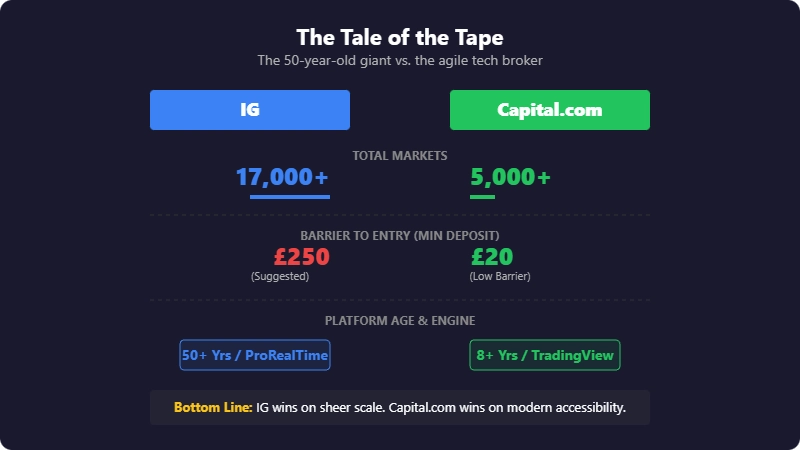
Both brokers match on core forex spreads at 0.6 pips for EUR/USD. The differences emerge in secondary costs. IG charges a £12 monthly inactivity fee after 24 months of no trades. Capital.com charges nothing for inactivity. Share CFD commission also differs: IG charges from £3 per trade whilst Capital.com uses spread-only pricing.
| Cost Type | IG | Capital.com | Winner |
|---|---|---|---|
| EUR/USD Spread | From 0.6 pips | From 0.6 pips | Tie |
| GBP/USD Spread | From 0.9 pips | 1.3 pips | IG |
| UK 100 Spread | 1 point | 1 point | Tie |
| Share CFD Commission | From £3/trade | Spread only | Capital.com |
| FX Conversion | 0.5% | 0.7% | IG |
| Overnight Funding | Varies by instrument | 4% + benchmark | IG |
| Inactivity Fee | £12/month after 24 months | None | Capital.com |
| Withdrawal Fee | None | None | Tie |
My personal experience with IG's costs
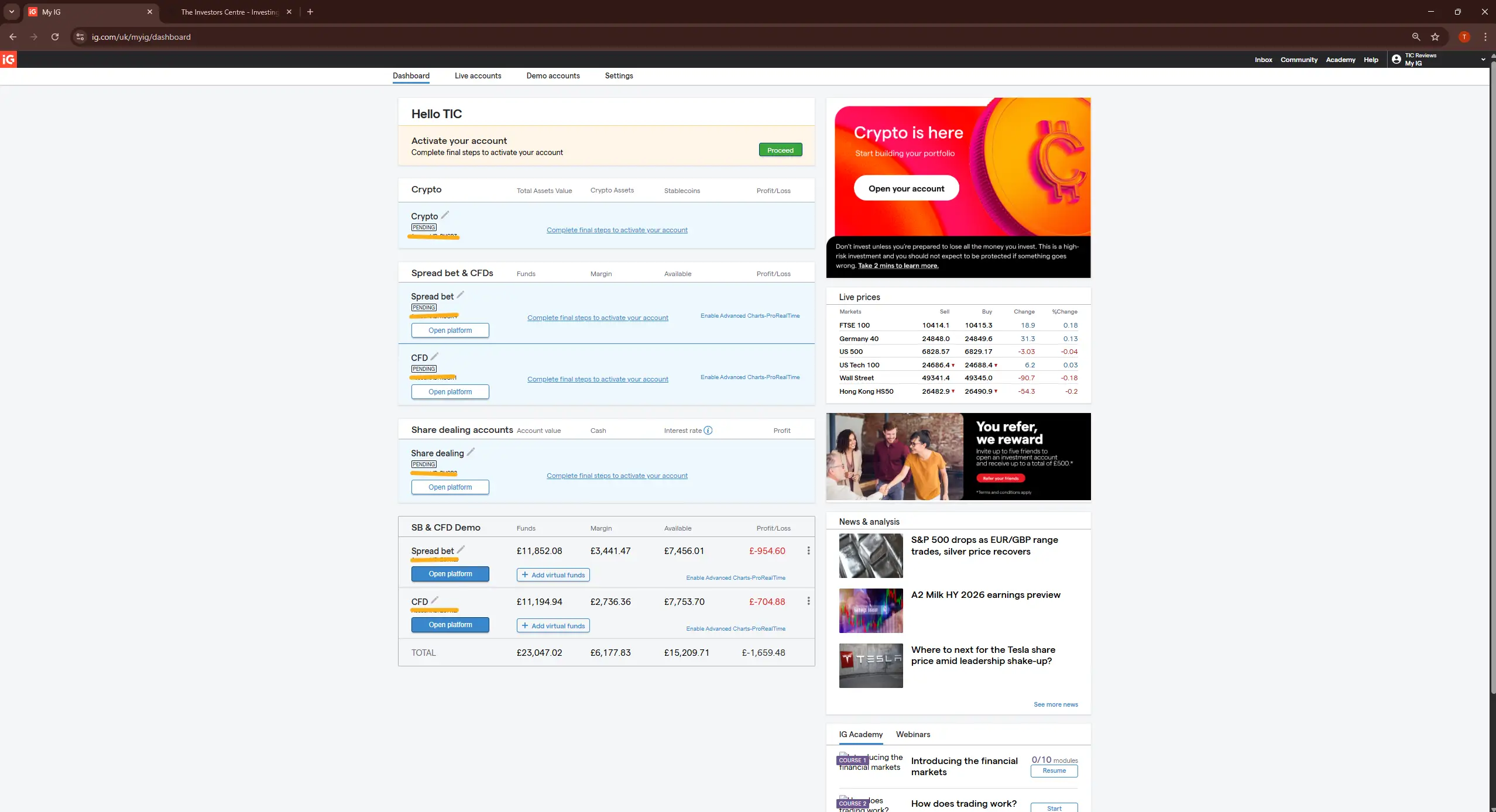
Trading GBP/USD during London sessions, I paid roughly 0.9 pip spreads consistently. The share CFD commission adds up for frequent traders. I appreciated the lack of deposit fees but got caught with the inactivity charge when I took a break.
My personal experience with Capital.com's costs
The spread-only model made cost calculation simpler. Forex spreads matched IG on majors. The 0.7% FX conversion fee bit into profits when trading USD-denominated instruments from my GBP account. No surprise inactivity fees after my three-month hiatus.
Which Platform Is Easier to Use?
Capital.com wins for modern interface design and TradingView integration. IG wins for platform variety and depth of features. Both mobile apps performed reliably during my testing. Execution speed was comparable at under 0.05 seconds for both.
My personal experience with IG's platform
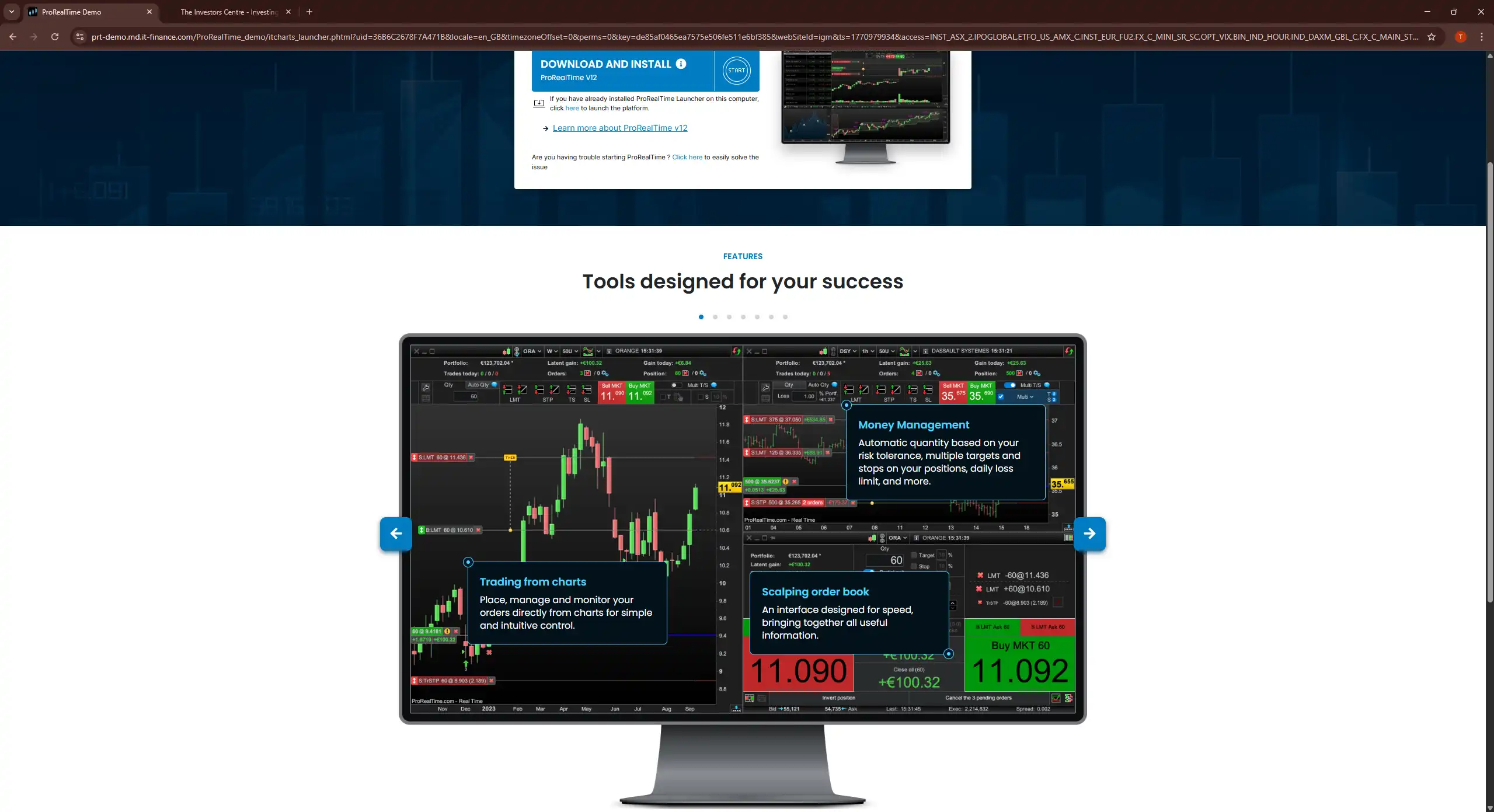
IG's web platform feels comprehensive but overwhelming initially. ProRealTime charting is excellent for technical analysis. The mobile app mirrors web functionality well. I needed two weeks to feel comfortable navigating all features.
My personal experience with Capital.com's platform
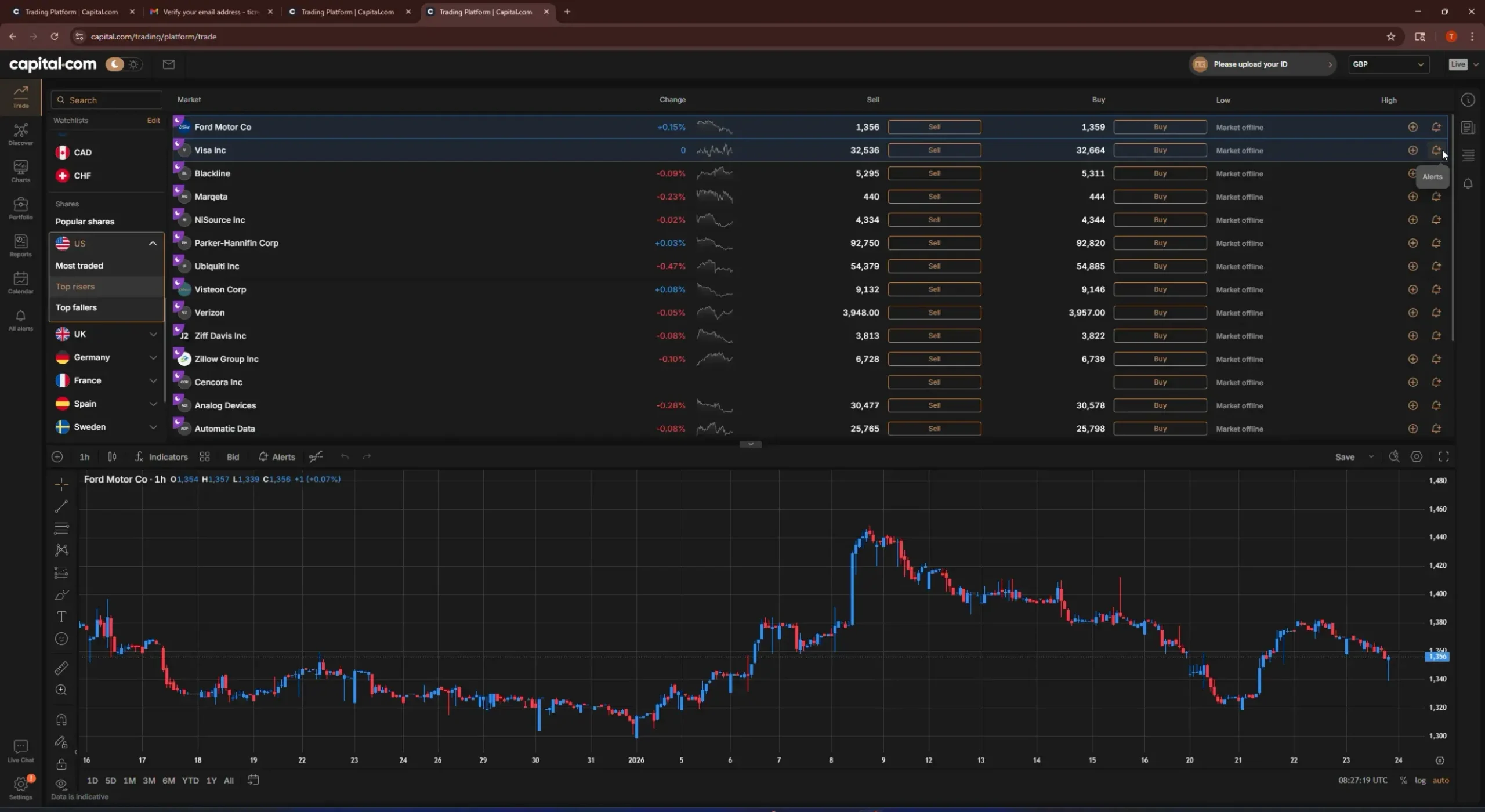
Capital.com's interface is cleaner and more intuitive. The native TradingView integration means I can trade directly from charts I already know. Their 0.014-second average execution speed impressed during volatile sessions. Setup took one afternoon.
Which Broker Has Better TradingView Integration?
Capital.com wins decisively. Capital.com offers native TradingView integration, allowing you to trade directly from TradingView's charts with full indicator access. IG does not support TradingView. IG offers ProRealTime as an alternative, which is powerful but requires a separate learning curve. For technical traders already using TradingView, Capital.com is the obvious choice.
Which Broker Is Safer for UK Traders?
Both brokers maintain top-tier safety standards. IG edges ahead due to 50+ years of operation and public listing on the London Stock Exchange. Capital.com is multi-regulated across FCA, CySEC, ASIC, SCB, and SCA jurisdictions. Both offer FSCS protection up to £85,000 and segregated client accounts.
| Safety Feature | IG | Capital.com | Winner |
|---|---|---|---|
| FCA Regulated | Yes (FRN: 195355) | Yes (FRN: 793714) | Tie |
| FSCS Protection | Up to £85,000 | Up to £85,000 | Tie |
| Segregated Accounts | Yes | Yes | Tie |
| Negative Balance Protection | Yes | Yes | Tie |
| Years Operating | 50+ years | 8+ years | IG |
| Publicly Listed | Yes (LSE: IGG) | No | IG |
Learn more about Capital.com’s safety credentials or read my in-depth look at whether IG is safe for UK traders.
Which Broker Is Better for Beginners?
Capital.com wins for beginners. The £20 minimum deposit lowers the barrier to entry significantly compared to IG’s suggested £250. Capital.com’s Investmate app provides bite-sized lessons under three minutes. The platform’s cleaner interface creates a gentler learning curve. IG’s Academy offers excellent content but the platform complexity can overwhelm newcomers — I cover this in more detail in my guide on whether IG suits beginners.

Which Broker Is Better for Day Trading?
IG wins for day trading breadth. Access to 17,000+ instruments means more opportunities across sessions. ProRealTime's advanced charting suits technical strategies. Capital.com's 0.014-second execution speed matches IG's performance. For pure forex day trading, both perform equally. For multi-asset day trading, IG's range wins. See my detailed analysis of Capital.com for day trading and how IG performs for day traders.
Which Broker Is Better for Spread Betting?
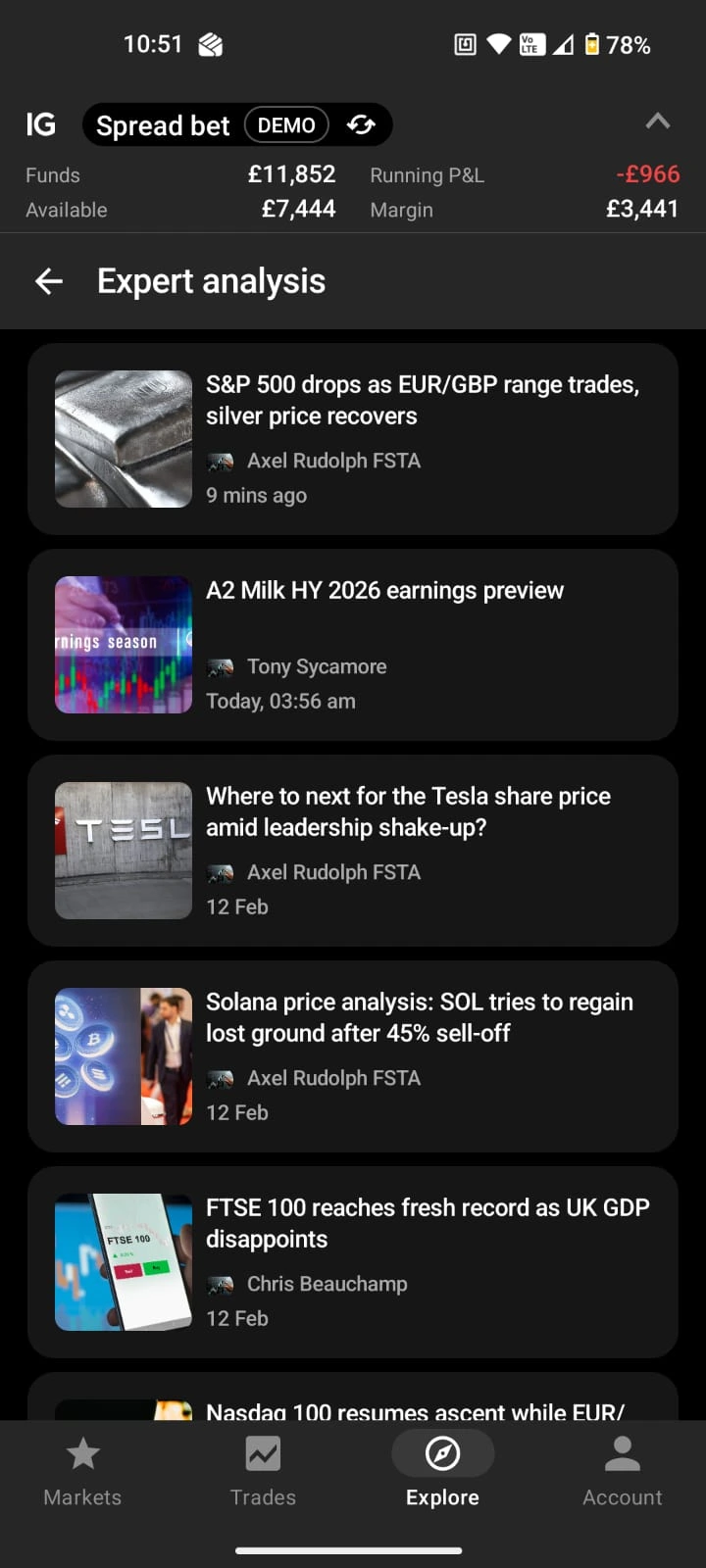
Both brokers deliver strong spread betting platforms. IG offers 4,700+ spread betting markets whilst Capital.com provides 4,700+ markets. Both platforms allow tax-free trading where profits are exempt from capital gains tax and stamp duty. Tax treatment depends on individual circumstances. IG’s longer track record in spread betting gives slight edge for this specific product. For a closer look, see my review of IG’s spread betting service.
Which Broker Is Better for Investing?
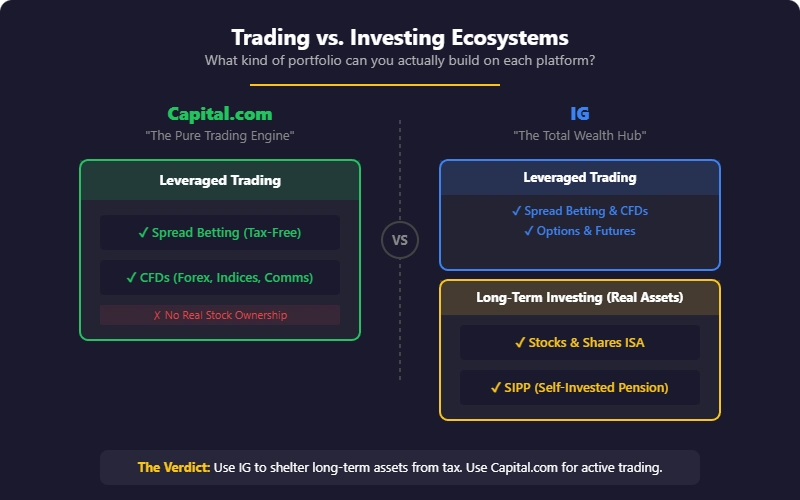
IG wins for long-term investing. IG offers ISA and SIPP accounts that Capital.com lacks entirely. These tax wrappers let you shelter gains from capital gains tax. IG's share dealing service provides access to 12,000+ stocks on major exchanges. Capital.com focuses purely on CFD and spread betting products with no share ownership. For buy-and-hold investors wanting actual stock ownership, IG is the only viable choice.
What Can You Trade on Each Platform?
IG wins comprehensively on market range. The 17,000+ instruments dwarf Capital.com's 5,000+. IG offers options and futures that Capital.com lacks entirely. Capital.com counters with 130+ forex pairs versus IG's 80+. For cryptocurrency access, IG now offers direct crypto trading through its partnership with Uphold, while Capital.com restricts crypto to professional clients in the UK.
| Asset Class | IG | Capital.com | Winner |
|---|---|---|---|
| Forex Pairs | 80+ | 130+ | Capital.com |
| Share CFDs | 16,000+ | 4,000+ | IG |
| Indices | 80+ | 20+ | IG |
| Commodities | 35+ | 25+ | IG |
| Crypto (UK Retail) | Via Uphold | Pro clients only | IG |
| ETFs | Yes | Yes | Tie |
| Options | Yes | No | IG |
| Futures | Yes | No | IG |
What Are the Pros and Cons of Each Broker?
Pros and Cons of Using IG
Pros
- 17,000+ instruments including options and futures that Capital.com lacks entirely
- 50-year track record with public listing on the London Stock Exchange
- ISA and SIPP accounts available for tax-efficient long-term investing
- Tighter GBP/USD spreads at 0.9 pips versus Capital.com’s 1.3 pips
Cons
- £12 monthly inactivity fee after 24 months catches traders who take breaks
- No native TradingView integration — must use ProRealTime or MT4 instead
- Platform complexity can feel overwhelming for newer traders
- Suggested £250 minimum deposit is higher than Capital.com’s £20
Pros and Cons of Using Capital.com
Pros
- Native TradingView integration for chart-based trading without platform switching
- No inactivity fees regardless of how long your account sits dormant
- £20 minimum deposit lowers the barrier to entry for new traders
- 0.014-second average execution speed delivers reliable fills in volatile sessions
Cons
- Younger company at 8 years versus IG’s 50+ year track record
- No ISA or SIPP accounts for tax-efficient long-term investing
- Crypto restricted to professional UK clients only
- Smaller market range at 5,000+ versus IG’s 17,000+ instruments
Compare Capital.com against other platforms: Capital.com vs Trading 212 and XTB vs Capital.com.
Full Feature Comparison Table
Here's the complete side-by-side breakdown across every key metric.
| Feature | IG | Capital.com | Winner |
|---|---|---|---|
| Regulation | FCA, ASIC, multiple | FCA, CySEC, ASIC, SCB, SCA | Tie |
| Years Operating | 50+ | 8+ | IG |
| Min Deposit | £250 suggested | £20 | Capital.com |
| EUR/USD Spread | From 0.6 pips | From 0.6 pips | Tie |
| Platform Choice | 4 options | 3 options | IG |
| TradingView | No | Yes | Capital.com |
| Spread Betting | Yes | Yes | Tie |
| ISA/SIPP | Yes | No | IG |
| Education | Excellent | Excellent | Tie |
| Inactivity Fee | £12/month (24mo) | None | Capital.com |
| Market Range | 17,000+ | 5,000+ | IG |
| Trustpilot Rating | 4.2/5 | 4.6/5 | Capital.com |
Final Verdict – Which Broker Should You Choose?
IG wins for experienced traders wanting maximum market access, options trading, or tax-wrapper accounts. Capital.com wins for cost-conscious traders, TradingView users, and beginners starting with smaller deposits. Neither is objectively better — the right choice depends entirely on your trading priorities.
| If you want… | Choose |
|---|---|
| Maximum market range | IG |
| TradingView integration | Capital.com |
| ISA or SIPP | IG |
| Lower minimum deposit | Capital.com |
| No inactivity fees | Capital.com |
| Options/futures trading | IG |
| Tax-free spread betting | Either |
| Best mobile app design | Capital.com |
| Longest track record | IG |