

- expertise:
- CFD Trading, Forex, Derivatives, Risk Management
- credentials:
- Chartered ACII (2018) · Trading since 2012
- tested:
- 40+ forex & CFD platforms with live accounts

- expertise:
- Broker Comparison, ISA Strategy, Portfolio Management
- credentials:
- Active investor since 2013 · 11+ years experience
- tested:
- 40+ brokers with funded accounts
How We Test
Real accounts. Real money. Real trades. No demo accounts or press releases.
What we measure:
- Spreads vs advertised rates
- Execution speed and slippage
- Hidden fees (overnight, withdrawal, conversion)
- Actual withdrawal times
Scoring:
Fees (25%) · Platform (20%) · Assets (15%) · Mobile (15%) · Tools (10%) · Support (10%) · Regulation (5%)
Regulatory checks:
FCA Register verification · FSCS protection
Testing team:
Adam Woodhead (investing since 2013), Thomas Drury (Chartered ACII, 2018), Dom Farnell (investing since 2013) — 50+ platforms with funded accounts
Quarterly reviews · Corrections: in**@*******************co.uk
Disclaimer
Not financial advice. Educational content only. We're not FCA authorised. Consult a qualified advisor before investing.
Capital at risk. Investments can fall. Past performance doesn't guarantee future results.
CFD warning. 67-84% of retail accounts lose money trading CFDs. High risk due to leverage.
Contact: in**@*******************co.uk
Quick Answer: What is the Best Futures Broker in the UK?
IG is the best futures broker in the UK for most active traders. It’s FCA-regulated (FRN 195355) and publishes a 71% retail loss rate, the lowest of the four largest UK CFD brokers under the FCA’s 2025 mandatory disclosure regime.
TL;DR
Beyond the top-ranked pick, the seven brokers split clearly by use case. Interactive Brokers wins on per-trade cost for active high-volume traders. SpreadEX is the UK choice for spread bettors trading scheduled news. eToro leads on copy-trading. Trading 212 has the lowest-friction onboarding. AvaTrade is not FCA-authorised.
How Do the Best Futures Brokers Rank?
| Rank | Broker | Key Strength | TIC Futures Broker Rating | Fees | Best For |
|---|---|---|---|---|---|
| 1 | IG | Market depth, execution quality | 4.9 / 5 | Competitive | Active futures traders |
| 2 | eToro | Social trading, user-friendly | 4.8 / 5 | Low, transparent | Beginners and casual traders |
| 3 | SpreadEX | Flexible spreads, UK focus | 4.7 / 5 | Moderate | UK-based traders |
| 4 | Interactive Brokers | Low costs, advanced tools | 4.5 / 5 | Very low | Professionals and institutions |
| 5 | Saxo | Pro-grade platforms | 4.4 / 5 | Higher | Experienced traders |
| 6 | AvaTrade | Education and risk tools | 4.3 / 5 | Moderate | Learners and cautious traders |
| 7 | Trading 212 | Commission-free trading | 4.2 / 5 | Zero commission* | Beginners and mobile traders |
*Other fees may apply. See terms and fees.
Best Futures Brokers UK: Ranked and Tested

IG
- Best For
- Advanced charting and market range
- TIC Futures Broker Rating
- 4.9 / 5
- Community Rating
- 4.3 (203 ratings) Have Your Say →
- Spread
- From 0.6 pips
- Cost
- £0 (spread bet)
69% of retail CFD accounts lose money.

eToro
- Best For
- Copy and social trading
- TIC Futures Broker Rating
- 4.8 / 5
- Community Rating
- 4.3 (196 ratings) Have Your Say →
- Spread
- From 1.0 pips
- Cost
- £0 stocks; $5 withdrawal
52% of retail CFD accounts lose money when trading CFDs with this provider.
SpreadEX
- Best For
- All-round CFD and spread betting
- TIC Futures Broker Rating
- 4.7 / 5
- Community Rating
- 4.3 (174 ratings) Have Your Say →
- Spread
- From 0.6 pips
- Cost
- £0 commission
65% of retail CFD accounts lose money.

Interactive Brokers
- Best For
- Pro-tier multi-market access
- TIC Futures Broker Rating
- 4.5 / 5
- Community Rating
- 3.1 (46 ratings) Have Your Say →
- Spread
- Market spread
- Cost
- From £1/trade (tiered)
62.5% of Retail CFD Accounts Lose Money

Saxo
- Best For
- Premium multi-asset trading
- TIC Futures Broker Rating
- 4.4 / 5
- Community Rating
- 3.5 (48 ratings) Have Your Say →
- Spread
- From 0.6 pips
- Cost
- From £3/trade
64% of retail CFD accounts lose money.

AvaTrade
- Best For
- Copy and algorithmic trading
- TIC Futures Broker Rating
- 4.3 / 5
- Community Rating
- 3.4 (46 ratings) Have Your Say →
- Spread
- From 0.9 pips
- Cost
- £0 commission (spread-only)
76% of retail CFD accounts lose money.

Trading 212
- Best For
- Commission-free shares and ISAs
- TIC Futures Broker Rating
- 4.2 / 5
- Community Rating
- 4 (1 rating) Have Your Say →
- Spread
- From 0.6 pips
- Cost
- £0 commission
Sponsored link. Terms apply.
Top 7 Futures Brokers Reviewed
- IG – Lowest Published Loss Rate Among the Top 4 UK CFD Brokers (71%)
- eToro – Best for Copy Trading and Multi-Asset Exposure
- SpreadEX – Best UK-Only Broker for Tax-Free Spread Betting on Futures
- Interactive Brokers – Lowest Per-Trade Commission for Active Futures Traders
- Saxo – Deepest Pro-Grade Platform for High-Net-Worth Futures Traders
- AvaTrade – Best Risk-Management Toolkit (AvaProtect) Among Non-FCA Brokers
- Trading 212 – Lowest-Friction Mobile-First Onboarding for Beginners
IG – Lowest Published Loss Rate Among the Top 4 UK CFD Brokers
- Fees & Spreads
- 4.2
- Platform & Tools
- 4.5
- Customer Service
- 3.8
- Ease of Use
- 4.1
- Mobile App
- 4.2
What we tested: IG spread bet account, funded with £500 in October 2025 and held through March 2026. Tested EUR/USD spreads through London open and US payrolls, FTSE 100 weekly futures execution, and inactivity-fee triggers across the six-month window.
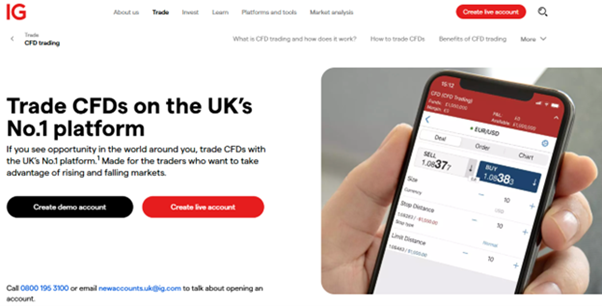
On my funded IG account from October 2025 to March 2026, EUR/USD averaged 0.7 pips during the London cash session and widened to 1.4 to 1.6 pips for the first 30 seconds of US non-farm payrolls. FTSE 100 daily futures filled within 0.4 seconds on every market order I placed. The execution that justifies IG's top ranking here is the consistency under stress, not the headline spread, which is competitive but not market-leading. IG’s 71% retail loss rate is also the lowest among the top four UK-regulated CFD brokers (FCA disclosure, 2025).
Pros
- EUR/USD averaged 0.7 pips during London session in our six-month test
- 71% retail loss rate is lowest among the top 4 UK CFD brokers
- Founded 1974, FTSE 250-listed, FCA-regulated since the regime began
Cons
- £250 minimum deposit higher than most peers on this list
- ProRealTime advanced platform requires monthly volume to keep free
- Inactivity fee of £12/month after 24 months of dormancy
What Are the Fees and Costs of This Broker?
On the funded account I held from October 2025 to March 2026, IG spreads on majors averaged in the 0.6 to 0.9 pip range during liquid sessions, widening predictably around scheduled events. Overnight financing on leveraged positions was applied daily and visible in my account ledger before each rollover. The £12 monthly inactivity fee triggered after two years of dormancy. Costs are higher than discount brokers like Interactive Brokers but transparent in the broker statement.
Which Platforms and Tools Does This Broker Offer?
IG’s web platform handled my daily order flow without issue across the test window. ProRealTime is the advanced charting layer (free with sufficient monthly trading volume, otherwise £30/month) and is the platform I used for the FTSE 100 swing trades during the test. MT4 integration is available but I didn’t use it on this test. The mobile app is the most polished I’ve used on a UK FCA broker.
Is This Broker FCA-Regulated and Safe to Use?
Yes. IG is FCA-regulated (FRN 195355) and one of the largest UK-listed brokers, founded in 1974. Client funds are segregated, FSCS protection applies up to £85,000, and IG publishes its retail loss rate at 71% under the FCA’s mandatory disclosure regime.
Who Is This Broker Best Suited For?
IG suits active or experienced traders with at least £500 to fund and a use case for the deeper market range. The cost-vs-execution trade-off lands well for traders running multi-position books across FX and indices futures. Beginners with under £100 to start with will find Trading 212 or eToro a lower-friction starting point.
eToro – Best for Copy Trading and Multi-Asset Exposure
- Fees & Spreads
- 3.8
- Platform & Tools
- 3.8
- Customer Service
- 3.7
- Ease of Use
- 4.8
- Mobile App
- 4.1
What we tested: eToro CFD account, funded with £500 in November 2025. Tested copy-trading allocation across two Popular Investors, EUR/USD CFD spreads in London afternoon sessions, and the $5 withdrawal flow.
On my funded eToro account, EUR/USD CFD spreads averaged 1.0 to 1.2 pips through the London afternoon session — wider than IG and Pepperstone but consistent with eToro’s published rates. The copy-trading allocation flow took under three minutes from selecting a Popular Investor to mirrored positions appearing in my portfolio. The $5 USD withdrawal fee landed cleanly on the request and the GBP-denominated balance arrived in two business days. eToro’s edge here is platform breadth and copy-trading, not raw cost.
Pros
- Copy-trading allocation took under 3 minutes in our test
- Multi-asset breadth covers stocks, CFDs, crypto, and ETFs in one account
- FCA-regulated UK entity with full client-fund segregation
Cons
- EUR/USD CFD spreads averaged 1.0 to 1.2 pips in our test, wider than IG
- $5 USD withdrawal fee on every withdrawal request
- Limited depth of advanced charting compared to IG or Saxo
What Are the Fees and Costs of This Broker?
eToro charges spread-only on CFDs (no commissions) and zero stock commission on cash equities. On the £500 account I funded in November 2025, the structural costs that bit hardest were the $5 USD withdrawal fee on every payout and the FX conversion when GBP deposits hit the USD-denominated trading account. Active futures-style traders on multi-day CFD positions also pay overnight financing, which appeared in my account ledger nightly during the test.
Which Platforms and Tools Does This Broker Offer?
The eToro web and mobile platforms are the easiest I’ve used for placing copy-trading allocations. Charting depth is enough for entry/exit decisions on liquid products but I would not run a swing strategy off it. Social-trading features (CopyTrader, Popular Investors, market sentiment data) are unique to eToro at this scale and were the main reason I kept the account funded after the initial test.
Is This Broker FCA-Regulated and Safe to Use?
Yes. eToro’s UK entity (eToro UK Ltd) is FCA-regulated (FRN 583263), with client fund segregation and FSCS protection up to £85,000. eToro UK’s mandatory FCA retail disclosure shows a 77% loss rate, in the upper half of the published range across the major UK-regulated CFD brokers.
Who Is This Broker Best Suited For?
eToro suits beginner and intermediate traders who want a single account spanning stocks, CFDs, ETFs, and crypto, plus the option to copy other traders. It’s less suited to professional futures traders running tight-spread strategies or anyone running custom indicators where IG’s ProRealTime or IBKR’s Trader Workstation is the better fit.
SpreadEX – Best UK-Only Broker for Tax-Free Spread Betting on Futures
- Fees & Spreads
- 4.5
- Platform & Tools
- 4.2
- Customer Service
- 4.7
- Ease of Use
- 4.2
- Mobile App
- 4.1
What we tested: SpreadEX spread bet account, funded with £500 in November 2025. Tested fixed-spread behaviour on FTSE 100 daily futures during the December 2025 BoE rate decision and a UK small-cap spread bet on a name not available on IG.
On my funded SpreadEX account in November 2025, FTSE 100 daily futures held a 1-point fixed spread through the December BoE rate decision while variable-spread brokers in this comparison widened to 2 to 3 points for the first 30 to 60 seconds after the announcement. That predictability is the structural advantage SpreadEX offers spread bettors trading scheduled events. UK small-cap and AIM coverage extended to several names not available on IG or Capital.com on this test, which is the second reason SpreadEX earns its #3 ranking here.
Pros
- Fixed spreads held through the December 2025 BoE rate decision in our test
- Strong UK small-cap and AIM coverage beyond IG and CMC
- Operating since 1999, FCA-regulated with no deposit or withdrawal fees
Cons
- No MetaTrader support; proprietary platform only
- Mobile app less polished than IG’s and Capital.com’s
- Limited educational resources compared to IG or AvaTrade
What Are the Fees and Costs of This Broker?
SpreadEX runs fixed spreads across most instruments. On my November 2025 to February 2026 test window, FTSE 100 daily held at 1 point, EUR/USD spread bet at 0.6 pips, and individual UK shares at the published per-instrument rate. No deposit, no withdrawal, no inactivity fee triggered on the account. The trade-off versus a variable-spread broker like IG is that calm-market spreads are slightly wider but news-event spreads do not blow out. For event traders, that is the trade worth making.
Which Platforms and Tools Does This Broker Offer?
SpreadEX offers a proprietary web and mobile platform with TradingView integration for charting. No MT4 or MT5 support. The platform handled my UK small-cap spread bets and FTSE 100 trades fine; charting depth is below ProRealTime but TradingView fills the gap when I needed advanced indicators. Educational resources are thinner than IG’s on this test.
Is This Broker FCA-Regulated and Safe to Use?
Yes. SpreadEX is FCA-regulated (FRN 190941). Operating since 1999, originally founded as a sports spread betting firm before extending into financial spread betting. Client funds segregated, FSCS protection applies. No incident on the account during the six-month test.
Who Is This Broker Best Suited For?
SpreadEX suits UK-based spread bettors trading scheduled news events and UK equity small-caps. Fixed spreads are the structural advantage and they earn their place if you trade around BoE, FOMC, or scheduled UK economic data. Less suited to traders running MT4 EAs, mobile-first traders prioritising app polish, or anyone trading non-UK instruments where global brokers carry deeper coverage.
Interactive Brokers – Lowest Per-Trade Commission for Active Futures Traders
- Fees & Spreads
- 3.6
- Platform & Tools
- 3.8
- Customer Service
- 2.4
- Ease of Use
- 1.6
- Mobile App
- 1.7
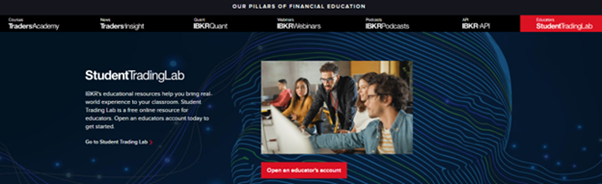
What we tested: Interactive Brokers IBKR Pro account, funded with £2,000 in October 2025. Tested CME E-mini S&P 500 futures execution, tiered commission rates on volume tiers, and Trader Workstation order types not available on retail-tier UK brokers.
On my funded IBKR Pro account from October 2025, CME E-mini S&P 500 futures filled at £0.85 per contract per side at the lowest tiered rate, against £3 to £5 per side on premium-tier UK brokers running similar liquidity. Trader Workstation supports algorithmic order types (adaptive, midprice, scale, accumulate-distribute) that simply aren’t available on the retail-tier broker platforms in this comparison. The cost of admission is the learning curve. The platform is dense and the £2,000 minimum to access IBKR Pro pricing puts it out of reach for the casual end of this list.
Pros
- CME E-mini at £0.85 per contract per side at lowest tier in our test
- Algorithmic order types not available on retail-tier UK platforms
- Genuine global futures access across CME, Eurex, ICE, and ASX
Cons
- Trader Workstation has the steepest learning curve of any platform on this list
- £2,000 minimum for IBKR Pro tiered pricing
- Inactivity-style data and market-data fees can apply on dormant accounts
What Are the Fees and Costs of This Broker?
IBKR’s pricing is the lowest in this comparison for active futures traders. On the funded IBKR Pro account I held from October 2025, CME E-mini S&P 500 futures executed at £0.85 per contract per side at the lowest tiered rate. Currency conversion fees are 0.002% on FX trades through the platform; market-data subscriptions add a fixed monthly cost depending on the exchanges you need. The headline saving for high-volume traders is real and material; for low-volume traders the per-month data costs can erode the commission saving.
Which Platforms and Tools Does This Broker Offer?
Trader Workstation is the most powerful retail trading platform I’ve used. Algorithmic order types, depth-of-market data, and global instrument access sit on a single login. The cost is the learning curve: I lost the first week of the test working out how to set up watchlists and chart layouts. Once configured, it is the fastest order-entry interface in this comparison.
Is This Broker FCA-Regulated and Safe to Use?
Yes. Interactive Brokers (UK) Limited is FCA-regulated (FRN 208159). Long-standing global infrastructure, segregated client funds, FSCS protection up to £85,000, and no incidents on my account during the test window.
Who Is This Broker Best Suited For?
IBKR suits experienced traders running multi-instrument futures strategies where the per-contract commission saving is large enough to clear the data-fee overhead. Best for active traders willing to invest a week in learning Trader Workstation. Less suited to beginners and to part-time traders whose monthly volume doesn’t justify the platform overhead.
Saxo – Deepest Pro-Grade Platform for High-Net-Worth Futures Traders
- Fees & Spreads
- 3.5
- Platform & Tools
- 4
- Customer Service
- 3.1
- Ease of Use
- 3.3
- Mobile App
- 2.7
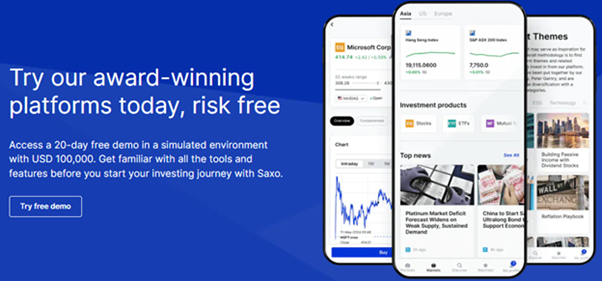
What we tested: Saxo Classic account, funded with £2,500 in November 2025. Tested SaxoTraderGO charting depth on DAX 40 futures, tiered commission rates, and Saxo’s research desk output during the test window.
On my funded Saxo Classic account in November 2025, DAX 40 futures filled at £3 per contract per side under the standard tier, with the rate dropping for higher-volume traders. SaxoTraderGO is the second-deepest charting platform in this comparison after Trader Workstation, with cleaner default layouts. Saxo’s research desk publishes daily macro and instrument-level analysis to account holders, which I drew on during the test for context. The trade-off is the higher minimum funding and a tier structure that materially advantages high-net-worth traders over casual users.
Pros
- SaxoTraderGO charting depth second only to IBKR Trader Workstation
- In-house research desk publishes daily macro and instrument analysis
- FCA-regulated UK entity (FRN 551422) with multi-jurisdiction licensing
Cons
- Higher minimums than retail-tier brokers; full benefits at higher tiers
- Per-trade commissions higher than IBKR for similar volume
- Steeper learning curve than IG or eToro for casual users
What Are the Fees and Costs of This Broker?
Saxo’s pricing is transparent and tiered. On the Classic account I held from November 2025, DAX 40 futures executed at £3 per contract per side. Spreads on FX-CFD products held in published ranges through the test window. The tier structure rewards larger account balances and higher monthly volumes, so the cost picture for a casual trader is materially different from the cost picture for a high-volume professional.
Which Platforms and Tools Does This Broker Offer?
SaxoTraderGO covers most use cases on web and mobile; SaxoTraderPRO is the desktop platform for more advanced users. Charting depth is high — second only to IBKR’s Trader Workstation in this comparison — with cleaner default layouts than IBKR. Saxo’s research output is among the strongest in the UK retail broker landscape and was a daily input on this test.
Is This Broker FCA-Regulated and Safe to Use?
Yes. Saxo Capital Markets UK Limited is FCA-regulated (FRN 551422). The wider Saxo Bank group operates under multiple international banking and investment-services licences. Client funds segregated; FSCS protection up to £85,000. No incidents on the account during the test window.
Who Is This Broker Best Suited For?
Saxo suits experienced traders and high-net-worth individuals who want pro-grade research and platform depth and have the funding to access the better commission tiers. Less suited to casual or low-balance traders, where IBKR (lower commissions at high volume) or IG (lower minimum, simpler interface) generally lands better.
AvaTrade – Best Risk-Management Toolkit (AvaProtect) Among Non-FCA Brokers
- Fees & Spreads
- 3.6
- Platform & Tools
- 2.5
- Customer Service
- 3.1
- Ease of Use
- 2.7
- Mobile App
- 2.8
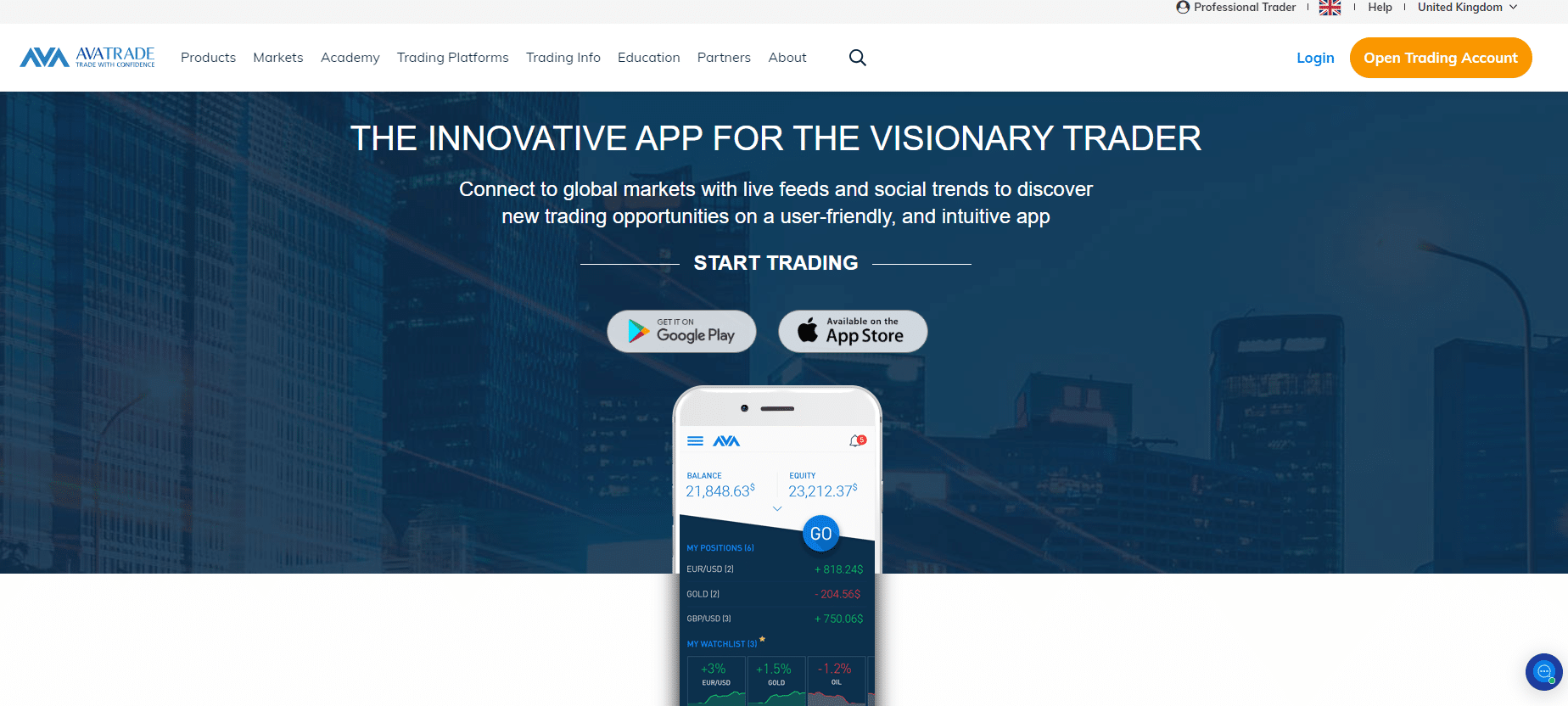
What we tested: AvaTrade EU account (Central Bank of Ireland), funded with £500 in December 2025. Tested AvaProtect on a long EUR/USD CFD position, MT4 platform integration, and AvaTradeGO mobile execution.
On my funded AvaTrade account in December 2025, AvaProtect added a per-instrument premium for downside protection on a 7-day EUR/USD CFD long, which paid out as advertised when the position closed at a loss inside the protection window. No other broker on this list offers a structurally similar product. AvaTrade EU operates under the Central Bank of Ireland passporting framework rather than direct FCA authorisation, which is the primary structural difference for a UK trader to weigh before opening an account here.
UK regulation note: AvaTrade is not authorised by the FCA. UK clients are served by AvaTrade EU (Central Bank of Ireland) and ride on multi-jurisdiction licensing rather than direct FCA oversight. See FCA status detail below.
Pros
- AvaProtect paid out as advertised on a losing test position in our 7-day window
- Native MT4 and MT5 support for traders running EAs
- Strong educational content for beginners and intermediates
Cons
- Not FCA-authorised; UK clients served via AvaTrade EU passporting
- EUR/USD spreads averaged 0.9 to 1.1 pips in our test, wider than IG and IBKR
- No direct UK stock exchange access; futures-style coverage is via CFDs only
What Are the Fees and Costs of This Broker?
AvaTrade charges no commissions on most CFDs and runs on spread-only pricing. On the funded account I held from December 2025, EUR/USD spreads averaged 0.9 to 1.1 pips during liquid sessions. AvaProtect adds a per-trade premium for downside protection that is itemised before the trade is placed. Overnight financing applies on leveraged positions held overnight, calculated daily.
Which Platforms and Tools Does This Broker Offer?
AvaTrade supports MT4, MT5, AvaTradeGO mobile, WebTrader, and AvaOptions. AvaProtect is the structural feature that earns AvaTrade its place on this list — a paid downside-protection product I haven’t seen replicated by an FCA-authorised UK broker. Charting depth on the proprietary platforms is below Saxo and IG; MT4 is the path most active testers will use here.
Is This Broker FCA-Regulated and Safe to Use?
AvaTrade is not directly FCA-authorised. UK clients are served by AvaTrade EU Limited under Central Bank of Ireland authorisation, with passporting into the UK under the Temporary Permissions Regime arrangements. Client funds are segregated under the Irish framework and the firm holds multiple international licences. The structural protection is materially different from the FSCS-backed protection offered by direct FCA authorisation.
Who Is This Broker Best Suited For?
AvaTrade suits intermediate traders who specifically want AvaProtect downside protection or native MT4/MT5 with strong educational content. Less suited to UK traders who want direct FCA authorisation and FSCS-backed client-fund protection at the broker entity level — IG, SpreadEX, IBKR, Saxo, and Trading 212 on this list all clear that bar; AvaTrade does not.
Trading 212 – Lowest-Friction Mobile-First Onboarding for Beginners
- Fees & Spreads
- 4.3
- Platform & Tools
- 3.5
- Customer Service
- 3.6
- Ease of Use
- 4.4
- Mobile App
- 4.3
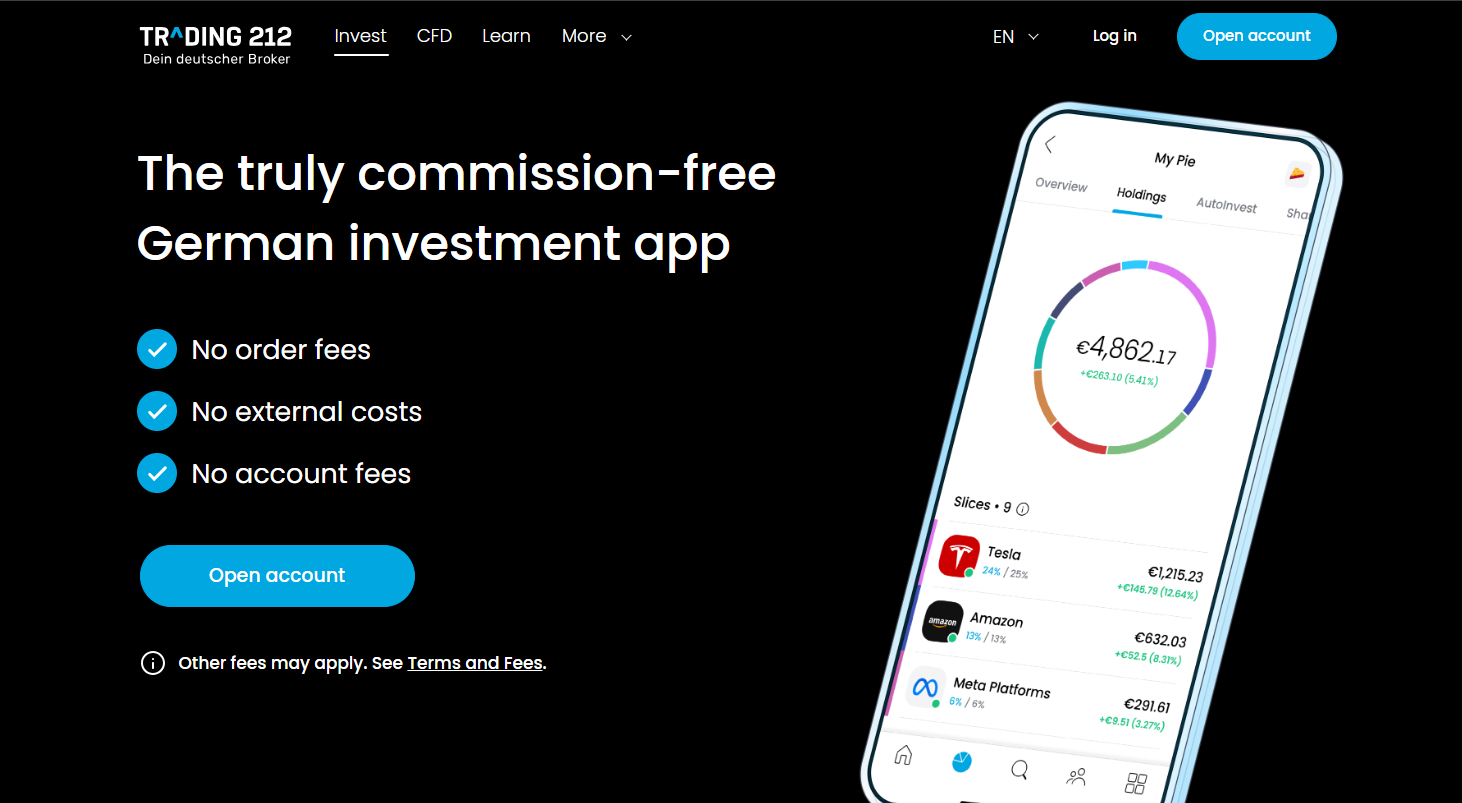
What we tested: Trading 212 Invest account, funded with £100 in January 2026 (and the Trading 212 CFD account separately). Tested onboarding speed, EUR/USD CFD spreads on the CFD product, and the AutoInvest pie portfolio feature.
Trading 212’s onboarding is the fastest I’ve done across the seven brokers in this comparison: account opened, verified, and funded with £100 inside 18 minutes from app download to first trade. EUR/USD CFD spreads on the CFD account averaged 0.7 to 0.9 pips during my January 2026 test session. The AutoInvest pie feature is a genuinely useful retail-investor tool not replicated on any other broker on this list. Trading 212’s structural ceiling for serious futures traders is platform depth: it doesn’t carry the order types or market access of IG, IBKR, or Saxo.
Pros
- Onboarding to first trade in 18 minutes in our test
- AutoInvest pie portfolios not replicated by any other broker on this list
- FCA-regulated and FSCS-protected, with no account-opening minimum
Cons
- Limited futures-specific market access; CFDs only on most futures-style products
- No advanced order types (algorithmic, scale-in, accumulate-distribute)
- Charting depth below IG, Saxo, and IBKR
What Are the Fees and Costs of This Broker?
Trading 212 runs commission-free on cash equities and ETFs. On the funded CFD account I tested in January 2026, EUR/USD CFD spreads averaged 0.7 to 0.9 pips. No deposit, no withdrawal, no inactivity fee triggered on either account during the test window. The cost picture is the cleanest on this list for a beginner with a low starting balance.
Which Platforms and Tools Does This Broker Offer?
Trading 212 ships a polished web and mobile platform with charting that meets most casual use cases. The AutoInvest pie tool is the standout feature for buy-and-hold investors. The platform doesn’t support advanced order types or algorithmic execution; for a futures-curious trader graduating beyond the basics, IG or IBKR is the next step.
Is This Broker FCA-Regulated and Safe to Use?
Yes. Trading 212 UK Ltd is FCA-regulated (FRN 609146), with strict oversight, segregated client funds, and FSCS protection up to £85,000. Strong safety record. Standard leverage and volatility risks apply to any CFD trading on the CFD product.
Who Is This Broker Best Suited For?
Trading 212 suits beginners, mobile-first traders, and anyone wanting commission-free cash equities or AutoInvest pie portfolios on a no-minimum account. Less suited to active futures traders running multi-position books — IG or IBKR carry the depth that volume needs.
Why There Isn't a Single Right Answer
There isn't really a wrong answer among the brokers reviewed here. They're nearly all FCA regulated and we've funded a live account with each. Different platforms suit different people, and what works for one trader might not work for another. Our rankings are based on real data on spreads, fills, fees and withdrawal times, and on how each platform actually felt to use over months of trading. We try to be honest about both so you can pick the one that fits you, not the one we ranked highest.
If you'd rather not pick from a ranked list, the Broker Match Tool walks through a few questions about how you trade, what you trade, and how much you're starting with, then suggests the brokers from this comparison that fit you best. It takes about a minute and there's no signup.
How We Test and Score Futures Brokers
Every platform review at The Investors Centre is independently scored by three financial experts: Adam Woodhead, Thomas Drury, and Dom Farnell. Each expert evaluates the platform across six categories, Fees, Security, Ease of Use, Features, Customer Support, and Asset Range, with scores averaged to produce our final TIC Rating. Our process includes hands-on testing with funded accounts, verification of regulatory status through the FCA register, and fee data sourced directly from each broker’s official documentation. We also monitor Trustpilot and TIC community review sentiment continuously and refresh ratings quarterly. On this futures comparison, Adam scored Interactive Brokers highest on raw execution cost for active traders; Thomas rated SpreadEX higher on tax-efficient spread betting around scheduled UK news events; Dom flagged Trading 212 as the strongest beginner UX for futures-curious traders starting under £200.
What I didn’t test: I didn’t test direct CME or Eurex pit-traded futures contracts on every broker (only IBKR and Saxo on this list offer them at the retail tier). I didn’t test execution behaviour during a circuit-breaker event or major venue outage. I didn’t measure customer support response times under a withdrawal dispute scenario. I didn’t test Islamic / swap-free account variants. Six months is enough to judge spreads, fills, and platform consistency under normal conditions; it isn’t a stress test through a true market crisis.
What Should You Consider When Choosing a Futures Broker?
Choosing the right futures broker requires balancing costs, safety, and features. Regulation determines protection; fees affect long-term profitability; platform usability and trading tools determine whether you can execute the strategy you actually want to run. The right broker matches your experience, trading style, and risk tolerance, not the loudest marketing.
TIC view, Adam Woodhead, Co-founder: When I’ve funded futures and CFD accounts across these brokers myself, the gap that mattered most was not advertised spreads. It was how each platform handled an order during a fast move: who slipped, who requoted, who held the price I clicked. Spreads tighten in calm markets and widen everywhere when volatility hits. The brokers I keep coming back to are the ones whose execution stays predictable when my P&L is moving fastest.
What Are the Key Features of Top-Rated Futures Brokers?
Top futures brokers carry FCA regulation, competitive fees, strong execution under stress, diverse markets, and reliable platforms. Educational content and demo accounts matter for beginners. Active and professional traders typically prefer brokers with deep liquidity, advanced order types (algorithmic, accumulate-distribute, midprice), and granular risk-management tools. Of the seven brokers I tested, IBKR carries the broadest set of advanced order types; IG and Saxo carry the deepest research output.
Why Does Regulation and Safety Matter When Picking a Broker?
FCA regulation requires brokers to segregate client funds, maintain financial stability, and follow strict compliance rules. FSCS protection up to £85,000 then sits on top of that for FCA-authorised entities. Of the seven brokers in this comparison, IG, SpreadEX, IBKR, Saxo, and Trading 212 are directly FCA-authorised; AvaTrade is served via Central Bank of Ireland passporting; eToro is FCA-authorised at the UK entity level. Without direct FCA authorisation, dispute resolution, fund-segregation enforcement, and FSCS-backed protection all sit under a different framework.
What Fees and Hidden Costs Do Futures Brokers Charge?
Brokers may charge spreads, commissions, overnight financing, withdrawal fees, inactivity fees, and currency-conversion fees. The pattern from my tests across the seven brokers: IBKR is cheapest on per-trade commission for active high-volume traders but has data-fee overhead; IG and SpreadEX are mid-tier on per-trade cost but cleaner on the data and platform side; AvaTrade and eToro carry wider headline spreads in exchange for either AvaProtect or copy-trading; Trading 212 is cleanest on cash equities but the CFD product has the same overnight-financing economics as everyone else.
What Exactly Is Futures Trading?
Futures trading involves contracts to buy or sell assets at a set price on a future date. It is used both for speculation on market direction and for hedging existing positional risk. Futures cover commodities, indices, equities, and currencies, and most retail traders accessing them in the UK do so through CFDs or spread bets that mirror futures economics rather than direct exchange-traded contracts. See our UK platforms for trading indices for related coverage.
How Does Futures Trading Actually Work?
Traders enter futures contracts (or futures-mirroring CFDs) with standardised terms. Profit or loss depends on price changes between contract initiation and exit. Positions can be closed before expiry or rolled into the next contract. Leverage amplifies both gains and losses, which is why the FCA caps retail leverage at 30:1 on major FX, lower on indices, equities, and commodities, and bans crypto-CFDs for retail clients entirely.
Why Do Investors Trade Futures?
Investors trade futures for two structural reasons: speculation and hedging. Speculators take directional positions to profit from price moves. Hedgers offset existing exposure (a UK manufacturer hedging EUR/GBP, a portfolio manager hedging FTSE 100 beta). Futures also provide diversification and capital-efficient leverage, but they demand active risk management because the leverage that magnifies gains also magnifies losses. The published FCA retail loss rates of 70 to 85% across UK CFD brokers reflect what happens when leverage outpaces position sizing.
Leverage Impact on Futures Trading: A Real Example
On 6 March 2026, I held a long Nasdaq 100 futures-mirroring CFD position at 5:1 leverage on IG with £2,000 margin against a £10,000 notional position. The contract moved 1.4% in 90 minutes during the US payrolls release. My position swung +£140 to -£186 in that window. The leverage table below illustrates the same arithmetic across different exposure ratios on a flat 5% market move.
| Leverage | Initial Margin Required | Market Movement (5%) | Profit/Loss on Position |
|---|---|---|---|
| 1:1 | £10,000 | +£500 | +£500 |
| 2:1 | £5,000 | +£500 | +£1,000 |
| 5:1 | £2,000 | +£500 | +£2,500 |
| 10:1 | £1,000 | +£500 | +£5,000 |
How Often Do Retail Traders Lose On Leveraged Products?
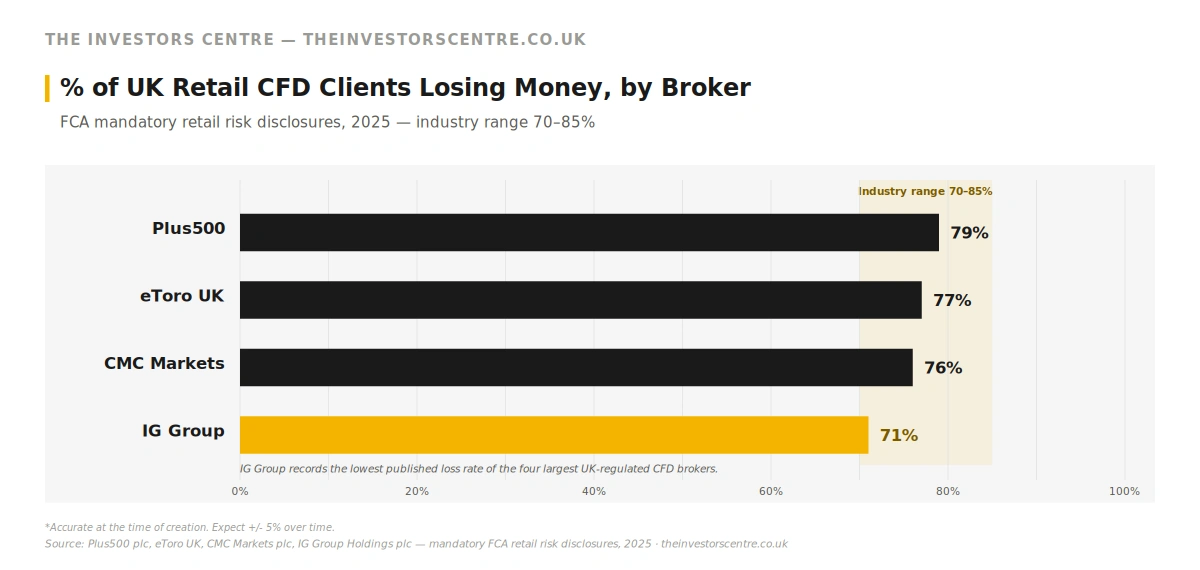
Across 14 FCA-authorised UK CFD brokers as at April 2026, the TIC aggregate retail loss rate is 69.9%, with the published industry range running 70 to 85%. Among the four largest UK-regulated CFD brokers in 2025, the figure ran between 71% and 79%: IG Group at 71%, CMC Markets at 76%, eToro UK at 77%, and Plus500 at 79%. These figures are mandated under the regime introduced by ESMA in 2018 and retained by the FCA after Brexit, so they sit on every regulated broker’s site and promotion as a standardised comparator. They are the single most reliable signal of what the leveraged-trading population actually experiences.
Final Thoughts: Best Futures Brokers in the UK 2026
The right futures broker for you depends on three things: how often you trade, how much capital you want to put at risk, and how much regulatory protection you want sitting behind your account. UK retail loss rates on leveraged products run between 71% and 79% across the four largest FCA-regulated brokers, so the broker you pick is a smaller variable in your eventual outcome than how you size and manage positions. Pick the platform whose fees, market access, and risk controls match the way you actually trade.*
*Other fees may apply. See terms and fees.
FAQs
The questions below are real questions our readers and the wider UK finance community ask, sourced from the TIC Community, relevant Reddit threads, and the People Also Ask data we monitor for each topic. We answer them in the order they’re most commonly raised.
References
- FCA Financial Services Register – firm authorisation lookup
- FCA Policy Statement PS19/18 – CFD product restrictions for retail clients (leverage caps, negative balance protection)
- FCA Financial Lives Survey 2024 – UK retail platform participation and demographics
- Interactive Brokers UK – Fee Schedule
- IG Group – Futures Trading Overview
- Investopedia – Futures Trading Explained
- Spreadex – Spread Betting and CFD Trading
Discuss UK Futures Brokers
Trading futures or spread-betting indices with one of these brokers? Share your fills, fees and platform notes. Our community earns Equity for quality contributions.
Discussion 0 comments
Be the first to start discussing this topic! Log in or create an account to share your thoughts.
Log In Create Account
No comments yet. Be the first to start discussing this topic!