

- expertise:
- CFD Trading, Forex, Derivatives, Risk Management
- credentials:
- Chartered ACII (2018) · Trading since 2012
- tested:
- 40+ forex & CFD platforms with live accounts

- expertise:
- Platform Testing, Cryptocurrency, Retail Investing
- credentials:
- Active investor since 2013 · 11+ years experience
- tested:
- 50+ platforms · 200+ guides authored
How We Test
Real accounts. Real money. Real trades. No demo accounts or press releases.
What we measure:
- Spreads vs advertised rates
- Execution speed and slippage
- Hidden fees (overnight, withdrawal, conversion)
- Actual withdrawal times
Scoring:
Fees (25%) · Platform (20%) · Assets (15%) · Mobile (15%) · Tools (10%) · Support (10%) · Regulation (5%)
Regulatory checks:
FCA Register verification · FSCS protection
Testing team:
Adam Woodhead (investing since 2013), Thomas Drury (Chartered ACII, 2018), Dom Farnell (investing since 2013) — 50+ platforms with funded accounts
Quarterly reviews · Corrections: in**@*******************co.uk
Disclaimer
Not financial advice. Educational content only. We're not FCA authorised. Consult a qualified advisor before investing.
Capital at risk. Investments can fall. Past performance doesn't guarantee future results.
CFD warning. 67-84% of retail accounts lose money trading CFDs. High risk due to leverage.
Contact: in**@*******************co.uk
IG or Saxo: which premium platform should you pick?
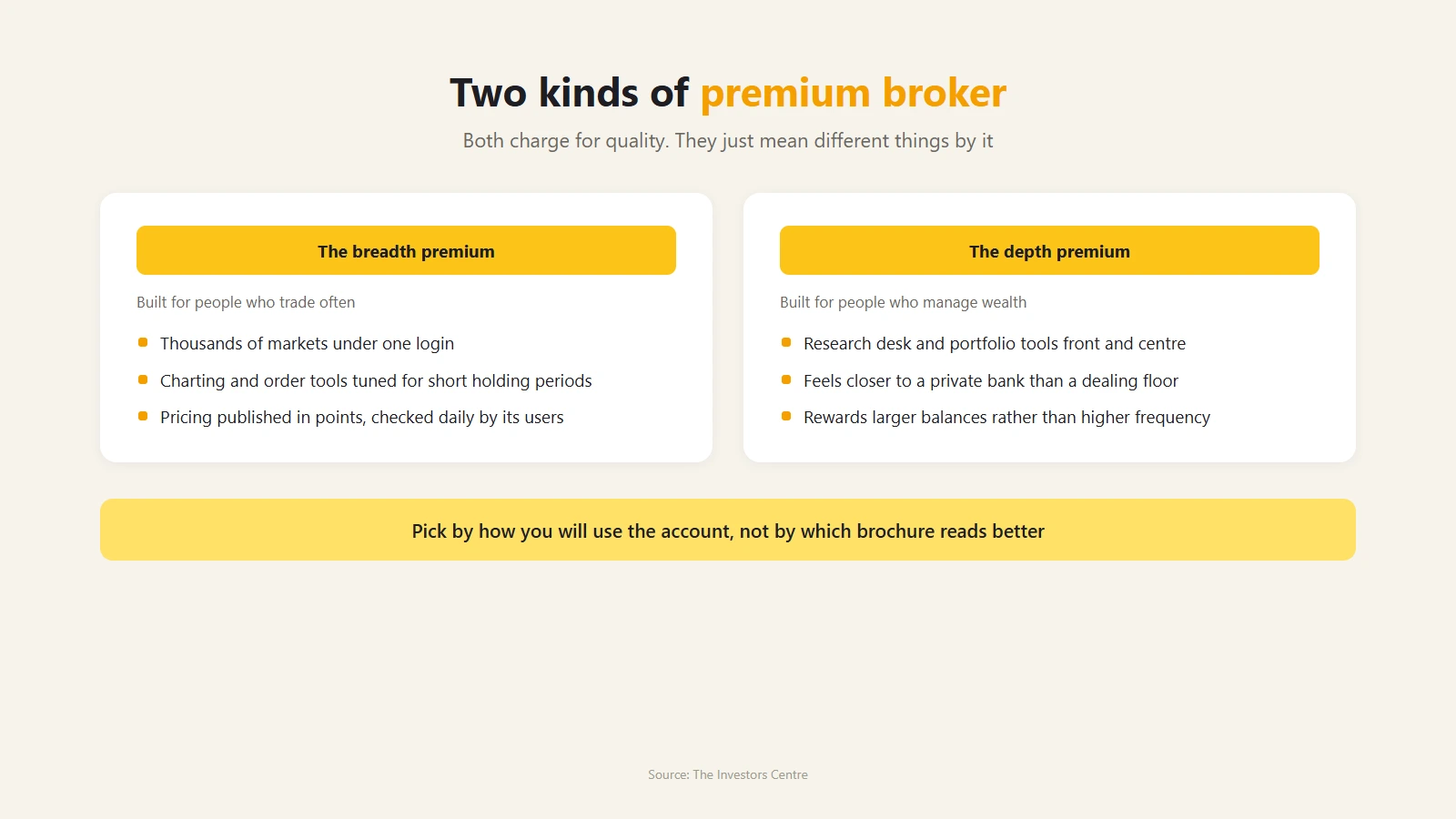
Ask what you trade, not which broker is better, because these are the two grown-up answers to different questions. Saxo is a Danish-rooted investment bank in broker's clothing: 23,000+ stocks across 50 exchanges, bonds, funds, listed options and futures, an ISA and a SIPP, with UK share commissions from just 0.08%. IG is the UK's leveraged-trading specialist: spread betting with its tax treatment, 17,000+ markets, ProRealTime charting, weekend markets and spot crypto in the same account. If your core activity is building a multi-asset portfolio and trading around it at size, Saxo earns its reputation. If you trade UK-style, with spread bets, CFDs and short timeframes, IG is the more complete home, and one detail seals the FX round for smaller accounts: Saxo adds a fixed $3 commission to FX trades under 50,000 units, which transforms the real cost of small positions.

Spread bets and CFDs are complex instruments and come with a high risk of losing money rapidly due to leverage. 70% of retail investor accounts lose money when trading spread bets and CFDs with this provider. You should consider whether you understand how spread bets and CFDs work, and whether you can afford to take the high risk of losing your money.
What does each broker actually offer?
The two stacks barely overlap once you get past the marketing. Here are the specifications side by side, taken from both firms' own UK pages on 1 September 2026.
| Specification | IG | Saxo |
|---|---|---|
| UK entity and FCA reference | IG Markets Ltd (195355); IG Index Ltd (114059) for spread bets | Saxo Capital Markets UK Ltd (551422) |
| Core offer | Spread betting and CFDs on 17,000+ markets, plus share dealing, OTC options and spot crypto | Multi-asset investing and trading: 23,000+ stocks, 7,400+ ETFs, 5,200+ bonds, funds, listed options, futures, FX, CFDs |
| Spread betting | Yes, the founding product | Not offered |
| UK share commission | Flat rate per trade | From 0.08%, no minimum commission |
| EUR/USD from | 0.6 pips, no commission (spread betting) | 0.7 pips Classic, plus $3 fixed commission under 50,000 units |
| Tax wrappers | Share dealing with ISA and SIPP options alongside the trading accounts | Stocks and Shares ISA and SIPP |
| Minimum deposit | None by bank transfer; card deposits carry a higher minimum | None, though Platinum needs £200,000 and VIP £1m |
| Platforms | IG web and apps, plus ProRealTime and L2 dealer options | SaxoInvestor and SaxoTrader, with SaxoTraderPRO for desktop power users |
The table is really a fork: Saxo does not even attempt spread betting, and IG does not attempt bonds, funds or listed derivatives. The real contest happens on the shared ground of FX, indices and shares, which is where the pricing gets interesting.
Which costs less to trade?
It flips with your trade size. The flip is worth working through properly, so start with FX, where the headline spreads look nearly identical: IG quotes EUR/USD from 0.6 pips on a spread bet, Saxo from 0.7 pips on its Classic tier. Close enough to call it a draw, until you read Saxo's rate card footnote: a fixed commission of $3 is charged on FX trades under 50,000 units of base currency.
Run the numbers on a small position. Buying 10,000 EUR/USD at Saxo costs roughly 70 cents in spread and $3 in commission, call it $3.70 all in, and the commission is more than four times the spread. A modest EUR/USD spread bet at IG's 0.6 minimum costs its spread and nothing else. The instruments are not perfectly like for like, one is a CFD and one a bet, but the shape of the cost is unmistakable: for small FX positions IG is dramatically cheaper, because Saxo's fixed fee dwarfs everything at that size. Trade 100,000 units and the picture reverses politely. Saxo's commission disappears, its Platinum and VIP tiers cut the spread to 0.6 and then 0.5 pips, and the two brokers end up within touching distance.
Shares run the same logic in Saxo's favour at the small end. Saxo charges from 0.08% on UK stocks with no minimum commission, so a £2,000 purchase costs £1.60. IG charges flat commissions per share deal, which are competitive at size but proportionally heavier on small orders. Saxo charges no platform or custody fee for UK clients, having removed its custody fee in its January 2024 fee cut, and no inactivity fee either; IG's account-level charges vary by account type, so check its charges page for the account you would actually run. On overnight funding for leveraged positions, both publish transparent formulas per market; check the instrument you actually trade rather than the marketing page.
Where does Saxo genuinely go further?
Breadth of ownership, and the economics of size. No UK broker in this comparison space matches Saxo's cash-product shelf: 23,000+ stocks across 50 exchanges, 7,400+ ETFs, 5,200+ bonds and commission-free mutual funds, all holdable inside a Stocks and Shares ISA or a SIPP. IG runs share dealing with its own wrappers too; what it does not run is the bond, fund and listed-derivative shelf to fill them with, and at 0.08% with no minimum Saxo's dealing costs suit everything from a £500 ETF top-up to a six-figure rebalance.
The tier structure rewards scale in a way IG simply does not offer. Deposit £200,000 and Platinum pricing cuts UK stock commission to 0.05% and tightens FX spreads; £1m brings VIP pricing at 0.03% with named service. Add listed options and futures, traded on exchange rather than as OTC equivalents, and Saxo's pitch to a wealthy multi-asset trader is coherent and real. I would not talk anyone with that profile out of it.
Where does IG pull ahead for UK traders?
Everywhere the word "trading" means what UK retail traders usually mean by it. The decisive row is spread betting, which Saxo does not offer at all: profits are currently free of UK capital gains tax and stamp duty for most retail traders, and for an active UK trader that wrapper can matter more than any pip comparison on this page. The trade-offs are covered in our spread betting vs CFDs guide; tax treatment depends on individual circumstances and can change.
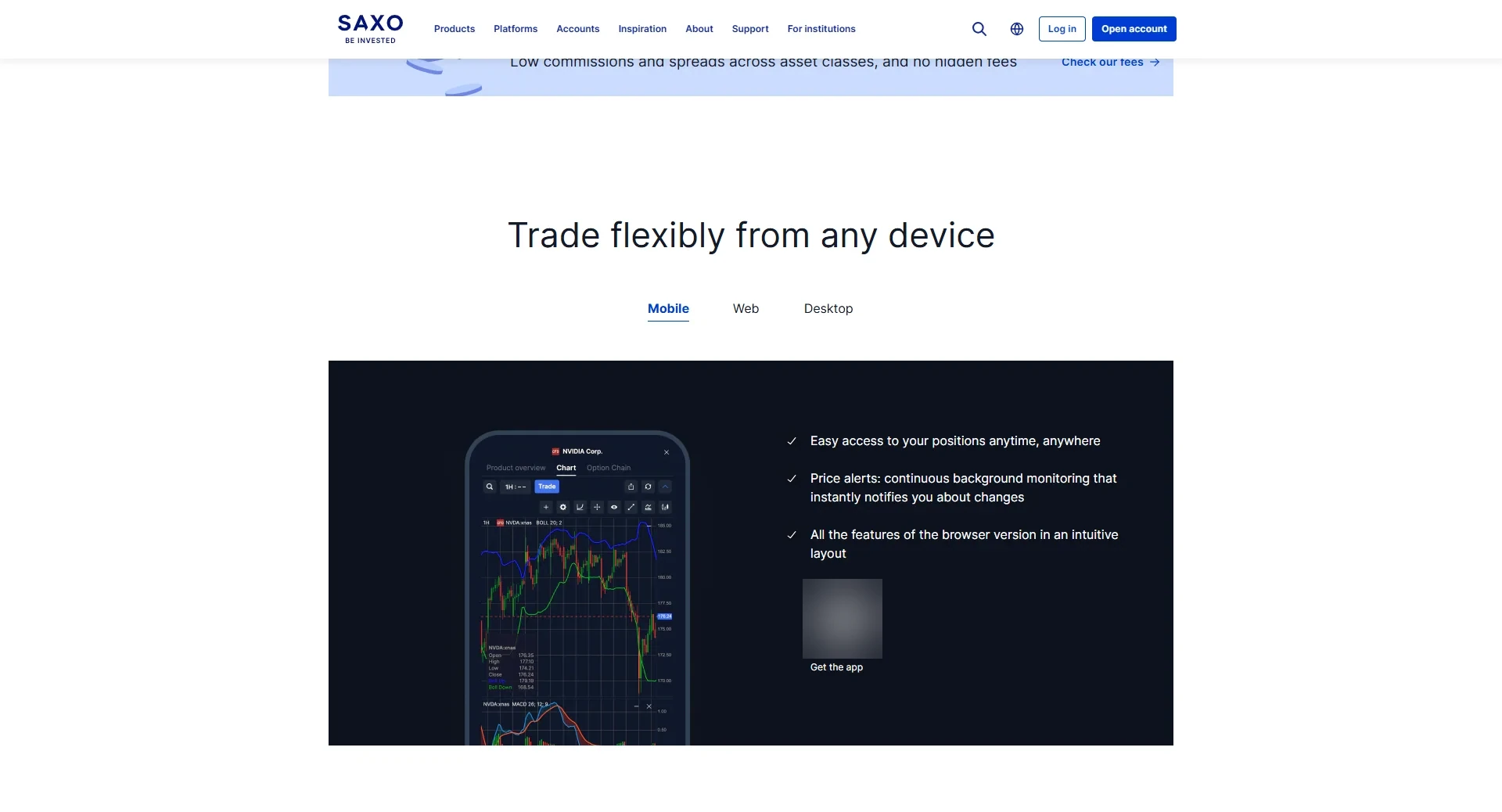
The ecosystem around the leveraged account is IG's second win. ProRealTime professional charting comes free with modest activity, weekend markets on indices, gold and GBP/USD let you trade and hedge when other books are shut, small-stake minimums make careful position sizing practical, and spot crypto on 150+ coins (as IG advertised at 1 September 2026) sits under the same login. Saxo's SaxoTrader is a serious platform, but it is built for the portfolio trader; IG's stack is built for someone who opens and closes leveraged positions weekly and wants every tool pointed at that job.
Does regulation separate them?
No, and that is what lets this comparison stay on cost and product. IG operates through IG Markets Ltd (FCA reference 195355) and IG Index Ltd (FCA reference 114059); Saxo's UK arm is Saxo Capital Markets UK Ltd (FCA reference 551422). Eligible clients of both sit behind FSCS protection of up to £85,000 for investment business, both are long-established firms rather than offshore newcomers, and both segregate client money under FCA rules. Regulation will not make this decision for you.
So which should you open?
Rule out the easy case first. If your trading is spread bets or CFDs on FX and indices with real position turnover, Saxo cannot serve you: it offers no spread betting at all, its fixed $3 commission punishes small FX positions, and everything IG builds for that life, the tax wrapper, the 0.6 pip EUR/USD floor with no fixed commission, ProRealTime free with modest activity and the weekend markets, has no Saxo equivalent. That leaves the portfolio builder, who should take Saxo: occasional trades, an ISA or SIPP, and dealing in bonds, funds and international shares are exactly the life its percentage pricing and product shelf were built for, and at £200,000 or more the tiers sweeten further. The trader who really does both could reasonably hold both accounts, though I would start with IG and add Saxo when the investing side outgrows flat-fee share dealing.
For the fuller picture of the winner on this site's beat, read my complete IG review, or see how IG fared against a closer structural rival in IG vs CMC Markets.
FAQs
References
- IG: charges and fees (spreads, ProRealTime terms; checked 1 September 2026)
- Saxo: accounts and pricing tiers, home.saxo/en-gb/accounts (Classic, Platinum and VIP thresholds, 0.08% UK stocks, no minimum deposit; checked 1 September 2026)
- Saxo: FX spreads and commissions, home.saxo/en-gb/rates-and-conditions/forex/spreads-and-commissions (EUR/USD from 0.7 pips, $3 fixed commission under 50,000 units; checked 1 September 2026)
- Saxo: UK platforms overview, home.saxo/en-gb/platforms (SaxoInvestor and SaxoTrader; checked 1 September 2026)
- FCA register: IG Markets Ltd (195355), IG Index Ltd (114059), Saxo Capital Markets UK Ltd (551422)