

- expertise:
- CFD Trading, Forex, Derivatives, Risk Management
- credentials:
- Chartered ACII (2018) · Trading since 2012
- tested:
- 40+ forex & CFD platforms with live accounts

- expertise:
- Broker Comparison, ISA Strategy, Portfolio Management
- credentials:
- Active investor since 2013 · 11+ years experience
- tested:
- 40+ brokers with funded accounts
How We Test
Real accounts. Real money. Real trades. No demo accounts or press releases.
What we measure:
- Spreads vs advertised rates
- Execution speed and slippage
- Hidden fees (overnight, withdrawal, conversion)
- Actual withdrawal times
Scoring:
Fees (25%) · Platform (20%) · Assets (15%) · Mobile (15%) · Tools (10%) · Support (10%) · Regulation (5%)
Regulatory checks:
FCA Register verification · FSCS protection
Testing team:
Adam Woodhead (investing since 2013), Thomas Drury (Chartered ACII, 2018), Dom Farnell (investing since 2013) — 50+ platforms with funded accounts
Quarterly reviews · Corrections: in**@*******************co.uk
Disclaimer
Not financial advice. Educational content only. We're not FCA authorised. Consult a qualified advisor before investing.
Capital at risk. Investments can fall. Past performance doesn't guarantee future results.
CFD warning. 67-84% of retail accounts lose money trading CFDs. High risk due to leverage.
Contact: in**@*******************co.uk
IG or XTB for UK traders?
Ignore the feature lists for a moment, because this comparison is really one question: do you want to trade markets with leverage, or own them outright? If the answer is trade, IG wins before the spreads are even compared, because XTB does not offer spread betting in the UK at all, and spread betting is the tax-efficient wrapper most UK traders should be using first. If the answer is own, XTB has a genuinely strong case: commission-free real shares and ETFs up to a generous monthly limit, a flexible Stocks and Shares ISA, and interest paid on uninvested cash. IG can do both jobs from one login, which is ultimately why it gets my overall vote, but XTB is the best pure-investing challenger I have put against it this year.

Spread bets and CFDs are complex instruments and come with a high risk of losing money rapidly due to leverage. 69% of retail investor accounts lose money when trading spread bets and CFDs with this provider. You should consider whether you understand how spread bets and CFDs work, and whether you can afford to take the high risk of losing your money.
What is the real decision here?
Whether you are a trader or an investor, because these two firms are built around different customers. IG, founded in 1974 and a FTSE 100 company since March 2026, is the heritage name in leveraged trading: spread betting through IG Index (FCA reference 114059), CFDs through IG Markets (FCA reference 195355), plus share dealing, OTC options and more across 17,000+ markets. XTB, FCA-regulated under reference 522157, has spent the last few years aggressively courting UK investors with commission-free real shares, an ISA and its excellent xStation 5 platform, and it has deliberately not built a spread betting product. So rather than a row-by-row slugfest, I have split this the way the decision actually splits: first the leveraged trading fork, then the ownership fork.
If you want to spread bet or trade CFDs, which wins?
IG, and not narrowly. The single decisive fact of this comparison sits here, so let me spell it out before the finer points.
The spread betting gap
XTB does not offer spread betting to UK clients as of August 2026. Its UK leveraged product is CFDs only, which means every profitable trade is potentially within scope of capital gains tax. IG invented spread betting and still runs it at scale, with profits currently free of UK capital gains tax and stamp duty for most retail traders (tax treatment depends on individual circumstances and can change). For a UK trader choosing a primary leveraged account, that is not a feature difference, it is a category difference, and no spread on any instrument closes it.
Platforms and pricing for the trading fork
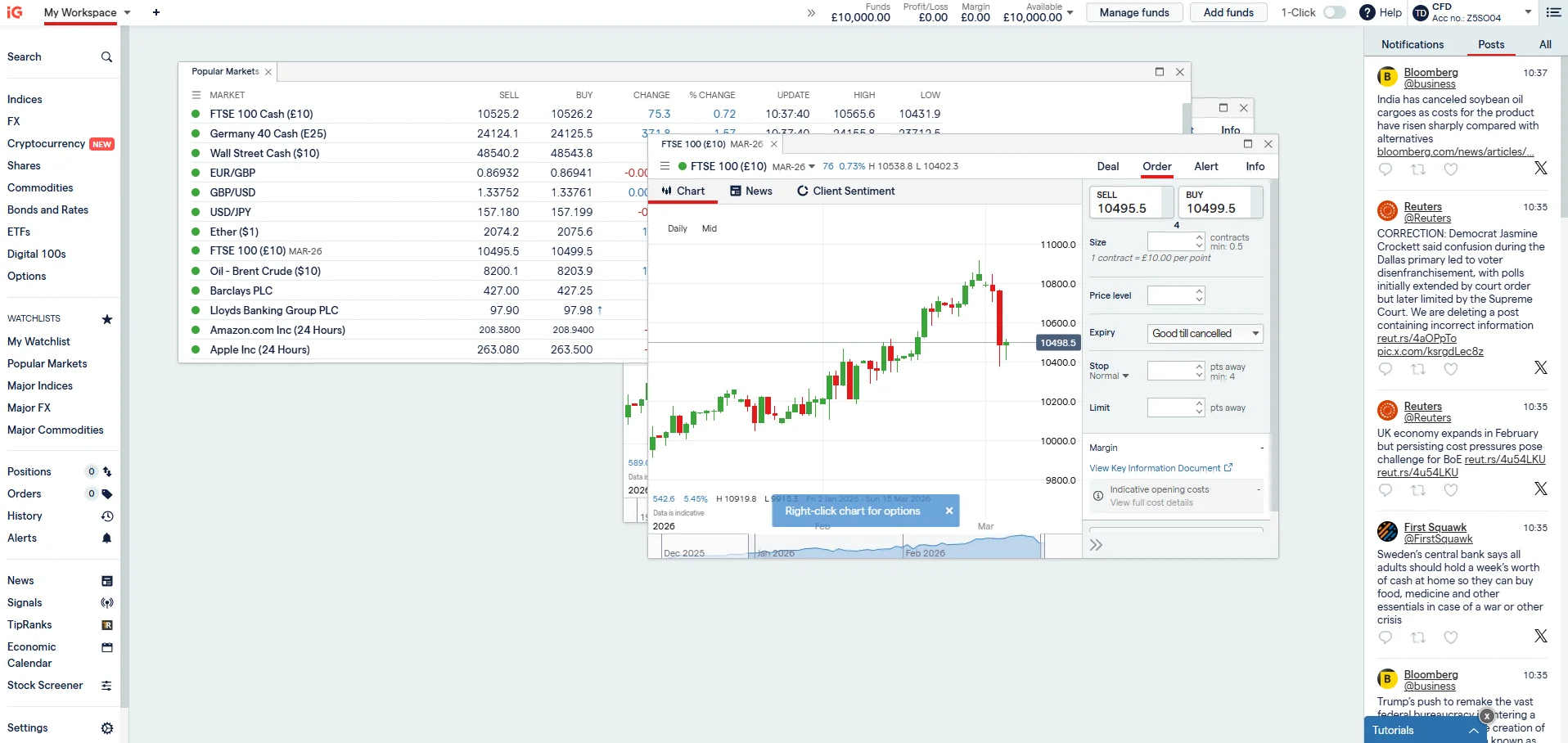
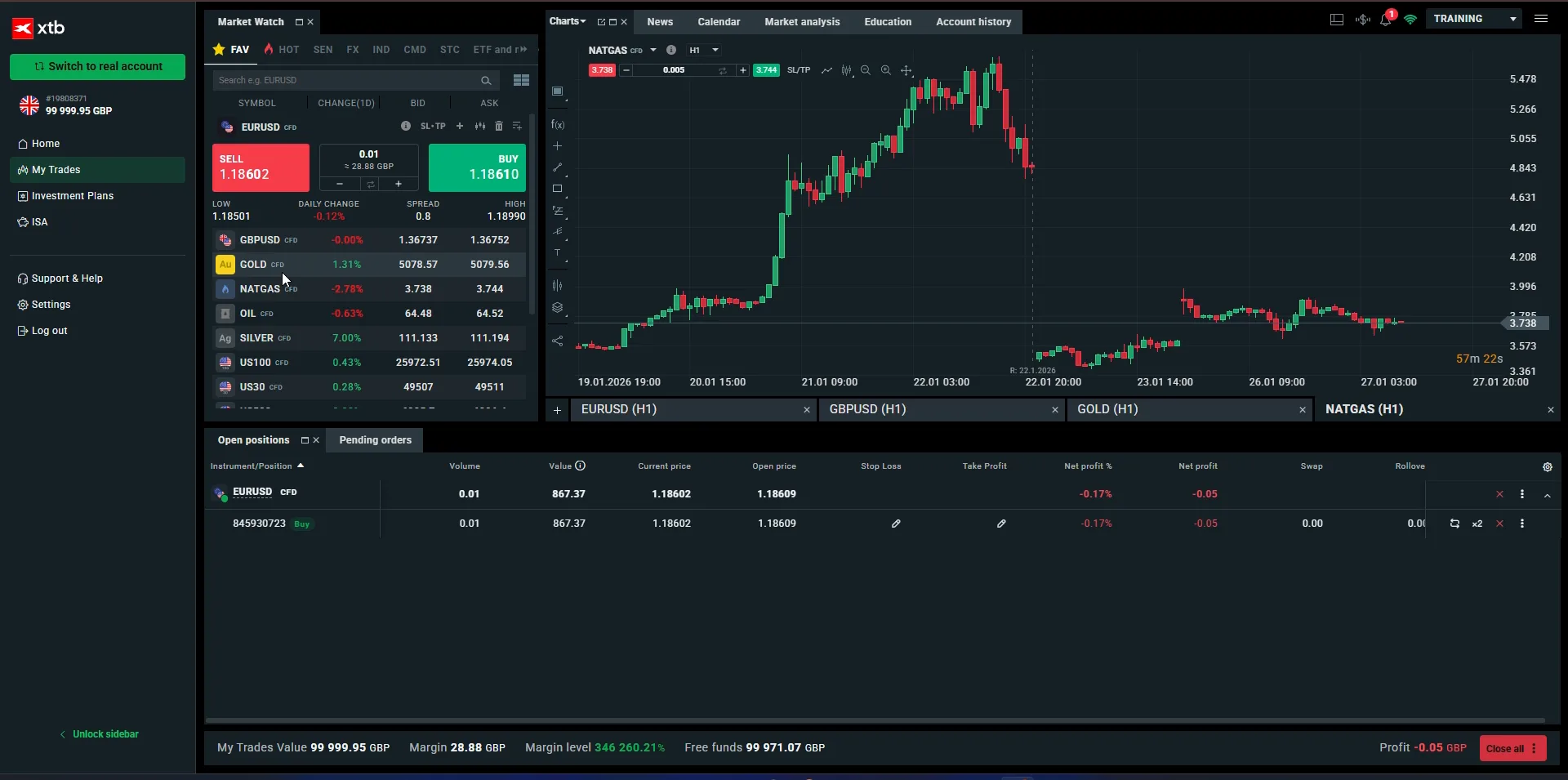
Set the tax wrapper aside and the contest tightens. xStation 5 is a genuinely good platform, fast, modern and pleasant to learn on, with built-in screeners and a clean mobile app, and I would not talk anyone out of enjoying it. IG answers with its own quick web platform, a published median execution of 85 milliseconds, EUR/USD from 0.6 pips, a 1 point FTSE 100 and 0.4 point US 500, plus free ProRealTime charting for anyone placing four or more trades a month. XTB has no MT4 and no third-party charting tier, so advanced chartists hit xStation's ceiling sooner than IG users hit ProRealTime's. On raw market count it is not close: IG's 17,000+ markets dwarf XTB's CFD range. Holding costs deserve a line too: IG publishes one transparent overnight formula for leveraged positions, an admin fee of 3.4% on spread bets or 3% on CFDs plus or minus the SONIA benchmark rate, which stood near 3.73% in August 2026, while XTB publishes swap rates per instrument, so overnight CFD traders should price their specific market on both before committing.
If you want to own real shares, which wins?
XTB, on cost, and this is where the marketing you have seen is backed by substance. Long-term investors should read this section as XTB's home ground.
What XTB gives investors
XTB charges 0% commission on real stocks and ETFs up to the equivalent of 100,000 euros of turnover a month, with 0.2% (minimum 10 pounds) only beyond that, a limit most retail investors will never touch. Its flexible Stocks and Shares ISA carries the same 0% commission and pays interest on uninvested cash, quoted at 4% AER on xtb.com in August 2026, though rates like that move and are worth rechecking on the day you open. For a monthly index-fund-and-shares investor, that package is cheaper than IG's share dealing, where commissions apply on UK share trades unless you qualify for IG's frequent-trader pricing.
IG's answer for investors
IG is not shut out of this fork, it is just not the cost leader. It runs share dealing and its own ISA across a wider universe of listed markets, and its real advantage is consolidation: real shares, spread bets, CFDs, OTC options and spot crypto on 150+ coins all sit behind one login, so the investor who later wants to hedge a portfolio or trade an index does not need a second broker. If you are certain you will only ever buy and hold, XTB's pricing wins. If there is a trader in you waiting to get out, the one-account argument is IG's strongest card.
Where do the numbers land side by side?
Here is the whole fork on one screen, with each firm's official published figures as of August 2026.
| Axis | IG | XTB |
|---|---|---|
| Spread betting | Yes, since 1974 | Not offered in the UK |
| Real shares commission | Commission applies on UK shares (frequent-trader discounts) | 0% up to 100,000 EUR turnover/month, then 0.2% |
| Interest on uninvested cash | Not a headline feature | Paid, 4% AER quoted Aug 2026 |
| Markets | 17,000+ | Thousands, CFD range plus real stocks and ETFs |
| Advanced charting | ProRealTime, free with 4+ trades/month | xStation 5 built-in tools only |
| Stocks and Shares ISA | Yes | Yes, flexible, 0% commission |
Two clean wins each, and that symmetry is honest: these are strong firms optimised for different customers, not a leader and an imitator.
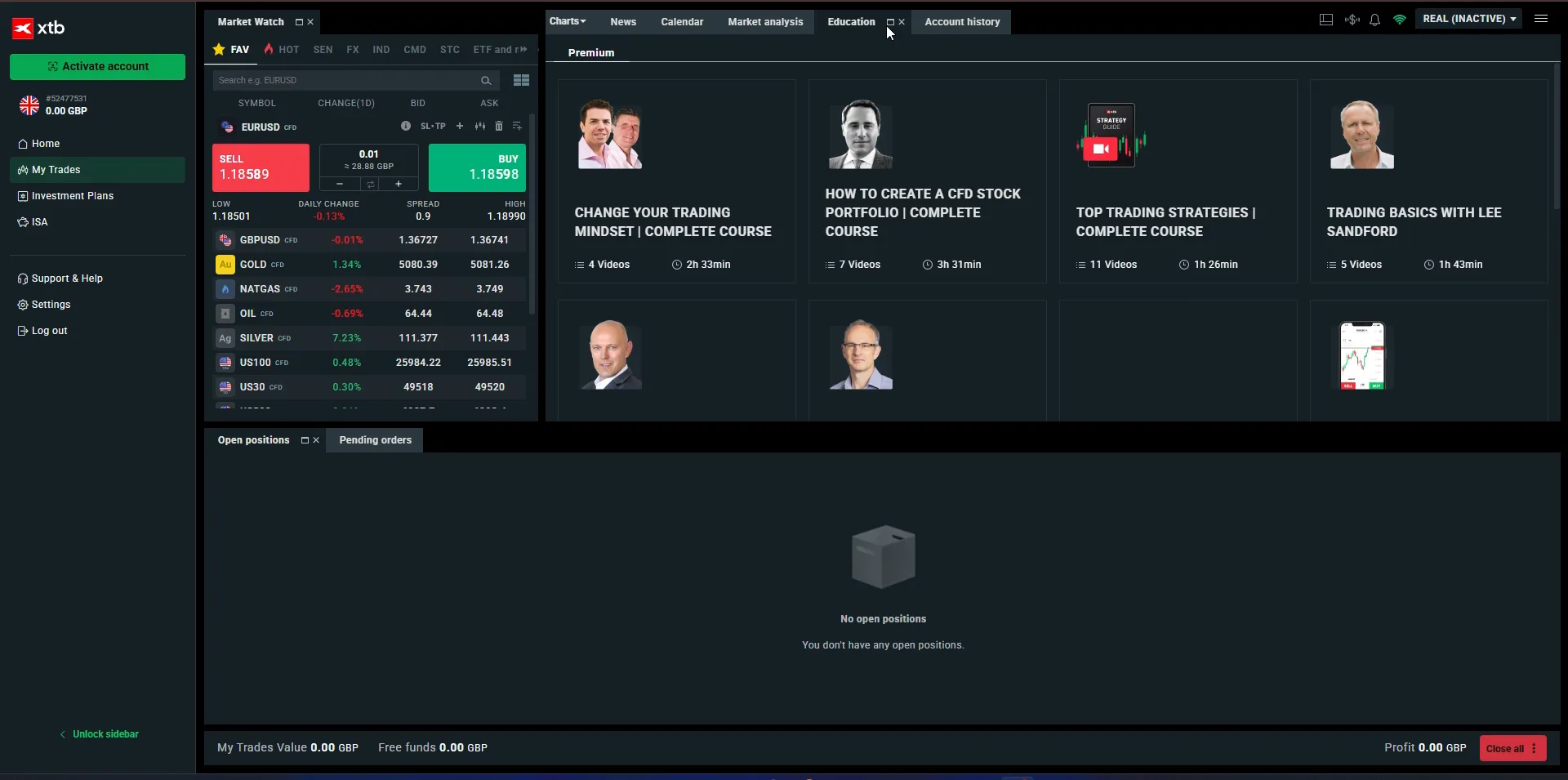
What the table cannot show is the feel of each firm. XTB pitches itself at people moving from saving into investing, and its onboarding, education content and app reflect that. IG assumes you will eventually want more than you signed up for, which is why the account you open for index bets can later hold your ISA, your options trades and your crypto without a second application. Both offer free demo accounts, so trying the two platforms side by side costs nothing but an evening.
So which account should you open?
Take the fork honestly. If your plan involves leverage at all, or might, open IG: the spread betting wrapper, ProRealTime and the 17,000+ market range settle the trading fork outright, and IG's investing side is good enough that you never need a second login. If you are a pure investor who wants the cheapest possible commission-free shares and ISA with interest on your cash, XTB is a credible choice and I will not pretend otherwise, just recheck the cash rate before you rely on it.
My testing notes on the winner are in the full IG review. For pairings fought on different ground, see my IG vs CMC Markets face-off and my Capital.com vs IG comparison.
FAQs
References
- IG: spread betting account details
- XTB: commission-free shares terms
- XTB: Stocks and Shares ISA
- The Investors Centre: the full IG review