

- expertise:
- CFD Trading, Forex, Derivatives, Risk Management
- credentials:
- Chartered ACII (2018) · Trading since 2012
- tested:
- 40+ forex & CFD platforms with live accounts

- expertise:
- Broker Comparison, ISA Strategy, Portfolio Management
- credentials:
- Active investor since 2013 · 11+ years experience
- tested:
- 40+ brokers with funded accounts
How We Test
Real accounts. Real money. Real trades. No demo accounts or press releases.
What we measure:
- Spreads vs advertised rates
- Execution speed and slippage
- Hidden fees (overnight, withdrawal, conversion)
- Actual withdrawal times
Scoring:
Fees (25%) · Platform (20%) · Assets (15%) · Mobile (15%) · Tools (10%) · Support (10%) · Regulation (5%)
Regulatory checks:
FCA Register verification · FSCS protection
Testing team:
Adam Woodhead (investing since 2013), Thomas Drury (Chartered ACII, 2018), Dom Farnell (investing since 2013) — 50+ platforms with funded accounts
Quarterly reviews · Corrections: in**@*******************co.uk
Disclaimer
Not financial advice. Educational content only. We're not FCA authorised. Consult a qualified advisor before investing.
Capital at risk. Investments can fall. Past performance doesn't guarantee future results.
CFD warning. 67-84% of retail accounts lose money trading CFDs. High risk due to leverage.
Contact: in**@*******************co.uk
Quick Answer: Is XTB Good for CFD Trading?
Yes, and the shape of the offer is easy to describe: 2,600+ CFD markets across forex, indices, commodities and shares, priced with a single all-in spread and no commission, on a platform that shows you every cost before you click. The US500 at 0.6 points and Brent oil quoted with a 0.06 spread on my screen are the kind of numbers that keep active traders here. What the product deliberately is not: a MetaTrader shop or an automation playground, and the tax-free spread betting wrapper is not part of the lineup, so this is CFD trading in its straightforward form. For a hands-on trader who wants breadth without a fee maze, it is an easy account to recommend.

74% of retail investor accounts lose money when trading CFDs with this provider. You should consider whether you can afford to take the high risk of losing your money.
What Can You Actually Trade?
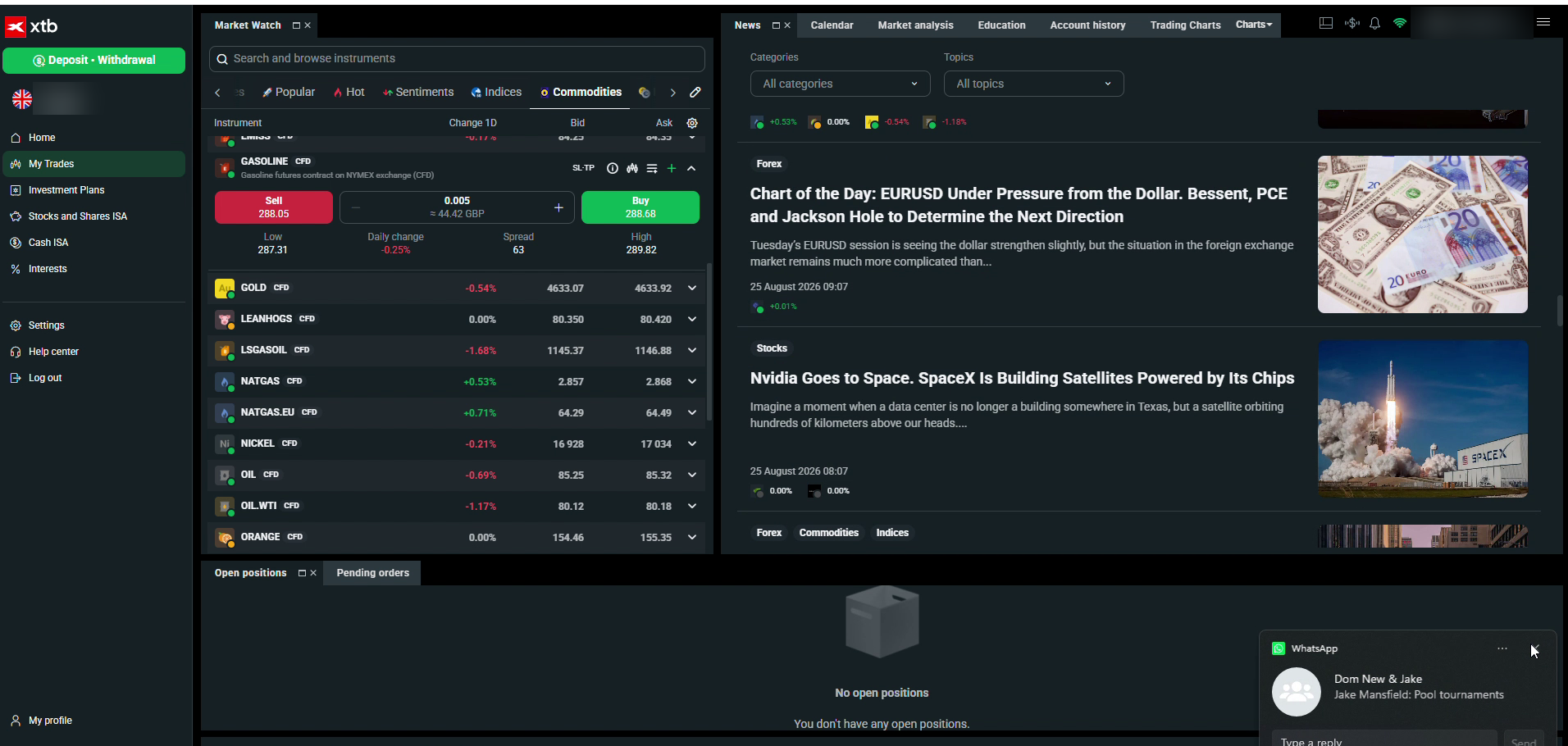
I traded and tested the account through August 2026. The CFD side spans 2,600+ instruments, and the breadth is more usable than the raw count suggests because it covers the four groups a multi-asset trader actually rotates between:
| Asset class | What you get | Example pricing |
|---|---|---|
| Forex | Around 70 pairs, majors to liquid exotics | EUR/USD 0.9 pips all-in |
| Indices | The major US, UK and European indices | US500 0.6 points, UK 100 1.8 |
| Commodities | Metals, energies and softs, from gold to cocoa and nickel | Gold 0.30 published, Brent 0.06 on my screen |
| Share and ETF CFDs | Leveraged exposure to major listed names | Spread plus overnight funding |
The commodities list is the sleeper here. Beyond the obvious gold and oil sit lean hogs, cocoa, cotton, nickel and gasoline, the kind of markets most one-stop brokers skip, and each one trades through the same ticket with the same cost transparency. For a trader who follows macro stories across asset classes, having the whole rotation behind one login is a real convenience.
How Are CFD Trades Priced?
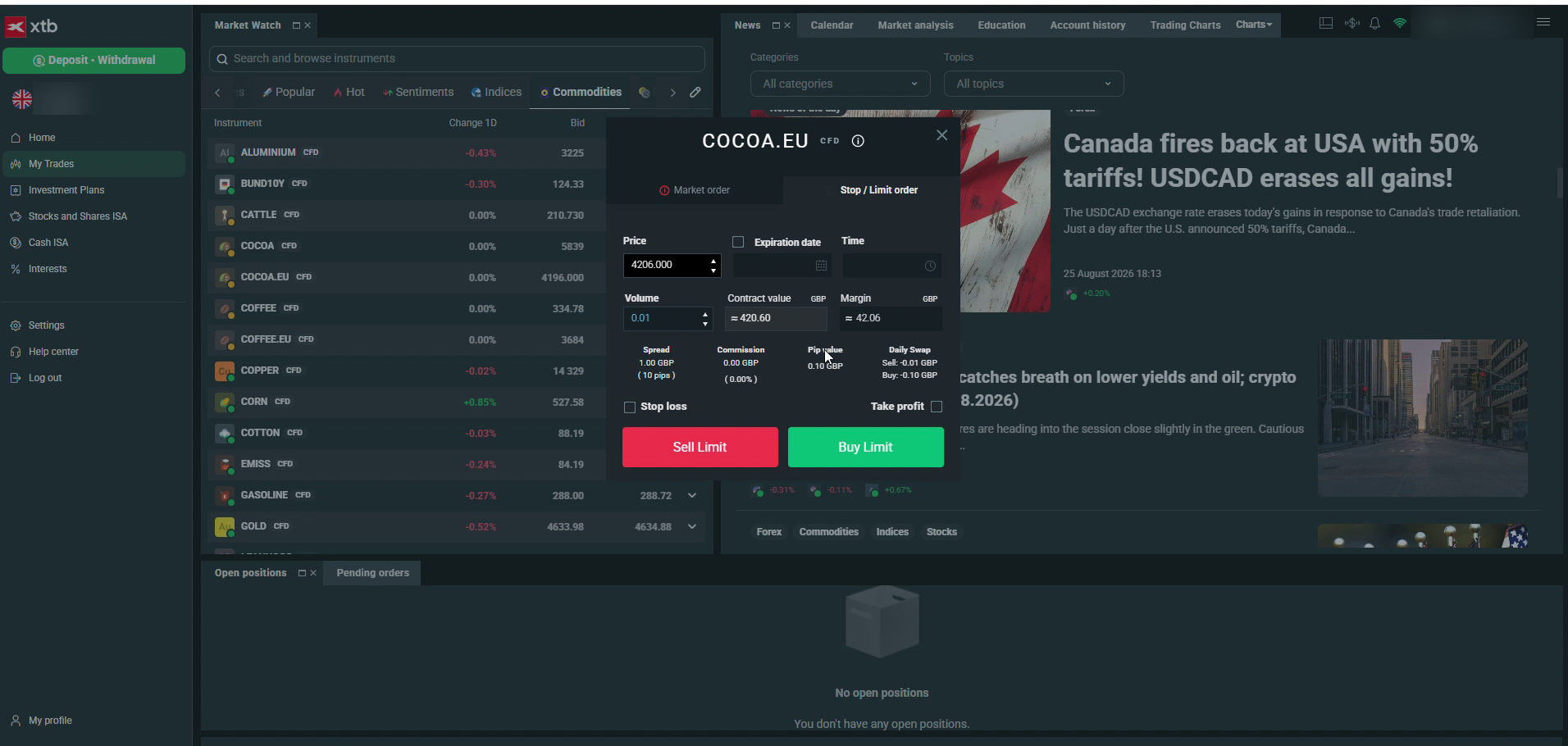
One number per trade. The spread carries the entire trading charge, commission is zero on every CFD, and the ticket converts the spread into pounds before you commit, alongside the margin requirement and the overnight swap for both directions. I keep coming back to how rare that combination is: plenty of brokers can beat any single XTB price somewhere in their range, but very few make the total cost of a trade this visible at the moment of decision.
Two costs sit beyond the spread, both standard for the product. Overnight funding applies to leveraged positions held past the daily rollover ($7.55 per lot per night on EUR/USD longs in our testing, more on gold, less on oil), and weekend holds carry the usual gap risk that comes with any leveraged market that closes on Friday and reopens on Sunday night. Day traders meet neither. The deeper pricing story, market by market, lives on our XTB spreads page.
How Does Leverage Work Here?
The caps are the FCA's, applied identically at every UK-regulated broker, so the numbers below are about the product rather than anything XTB chooses:
| Asset class | Maximum retail leverage | Margin required |
|---|---|---|
| Major forex pairs | 30:1 | 3.33% |
| Major indices and gold | 20:1 | 5% |
| Other commodities | 10:1 | 10% |
What is worth crediting to the broker is how the risk tooling wraps around those caps. Negative balance protection is automatic, stops and take-profits attach on the ticket at entry rather than as a separate step, and position sizes run down to microlots, so scaling into an idea gradually is the path of least resistance rather than a discipline you have to impose on yourself. The margin figure prints on every ticket before you trade, so the exposure on a trade is always a decision you made rather than one that crept up on you.
What Is the Day-to-Day CFD Workflow Like?
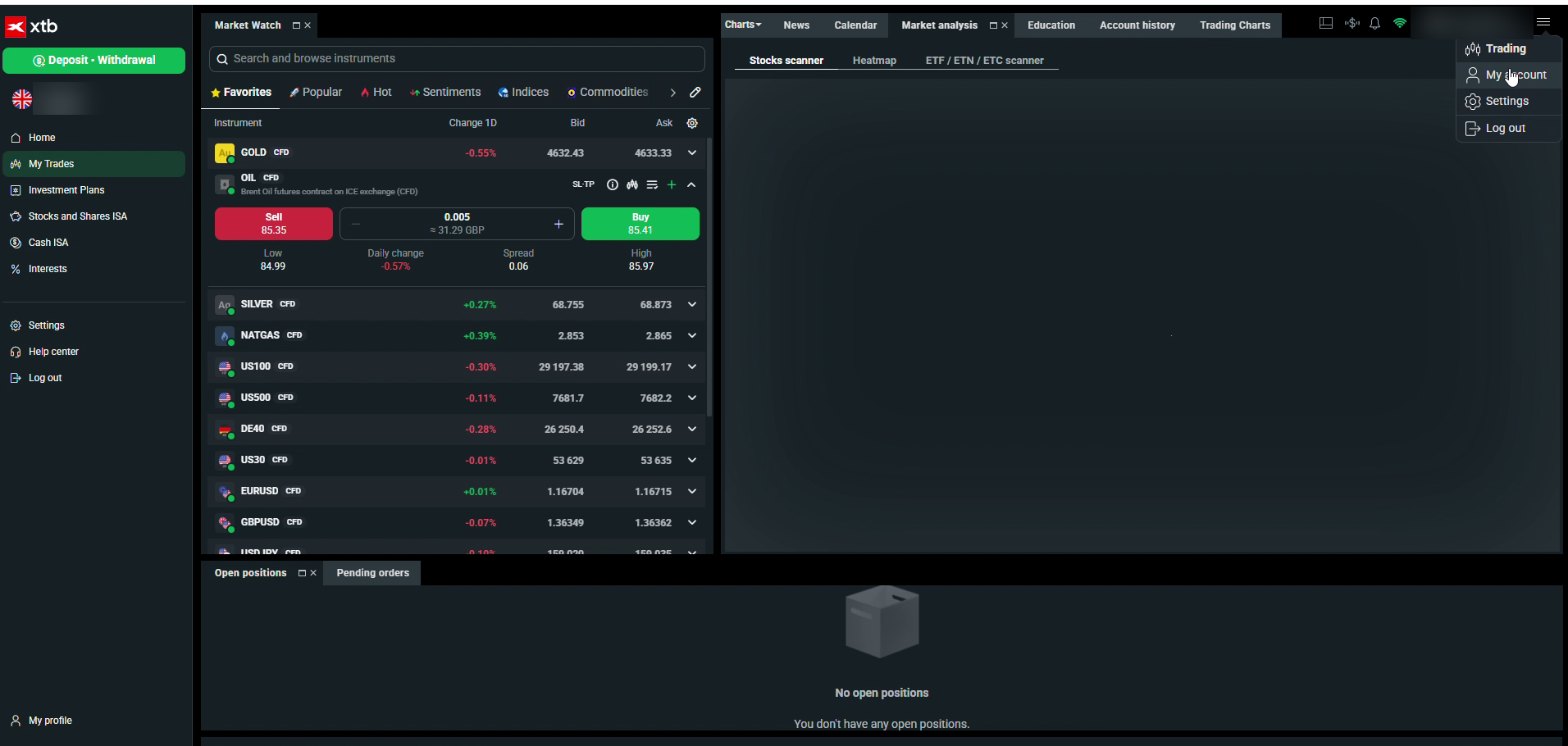
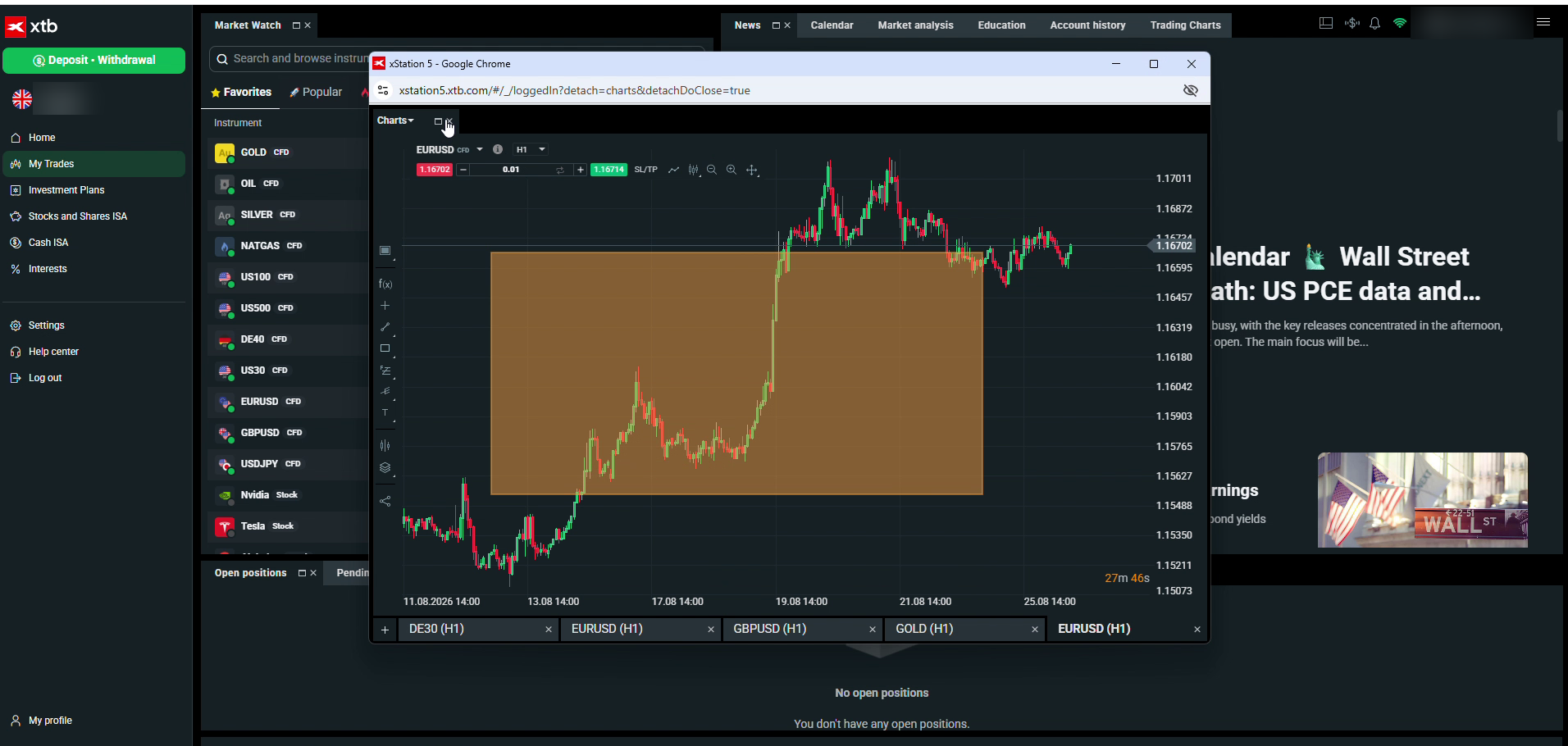
Fast and pleasantly boring, which is the highest compliment a trading workflow can earn. Charts open instantly and detach into their own windows for a multi-screen setup, the marked-up levels survive between sessions, and the news feed and economic calendar live one tab from the chart, so checking why a market is moving never breaks the flow. The mobile app carries enough of this (4.7 on the App Store, 4.5 on Google Play) that managing an open position away from the desk feels routine rather than risky.
The boundary, stated once and plainly: this is a one-platform product. Anyone whose CFD process depends on MetaTrader, TradingView integration or automated execution through an API will not find those routes here, and our CFD platform rankings cover the brokers that provide them. Manual traders, in my view, end up with the better end of that deal: one platform that does everything well beats three that do most things adequately.
What Does a Trade Look Like, Start to Finish?
Here is the full life of a position as I actually placed one. Find the market in the watch, or type it into the search bar. Expand the quote and the live spread is already showing between sell and buy. Open the ticket: volume at the top, then the panel that does the real work, showing contract value, margin, the spread in pounds and pips, commission at zero and the overnight swap for each direction. Tick stop loss and take profit, set the levels, and both attach the moment the trade opens.
From there the position sits in the panel at the bottom of the screen with live profit and loss, and the same view follows you to the mobile app if you leave the desk. Closing is one click from the position list. At no point did I meet a screen where the cost of what I was doing was unclear, and after years of reviewing platforms I do not say that lightly. The friction is so low that the discipline has to come from you, which is why I would set sensible default volumes before the first session rather than after it.
How Does It Compare With Other CFD Brokers?
Against the UK field, the honest picture is strength in three places and a conscious gap in one. On cost clarity, few rivals put spread, margin and swap on one ticket the way xStation does. On commodity breadth, the list runs deeper than most multi-asset brokers bother with. And on account friction, no minimum deposit and microlot sizing beat most of the names in our CFD platform rankings for sheer ease of starting sensibly.
The gap is platform choice. Brokers built around MetaTrader or TradingView connections serve automated and integration-hungry traders in ways a proprietary platform never will, and pretending otherwise would flatter nobody. Where you personally land depends on one question: do you place your own trades? If yes, the comparison tilts XTB's way quickly.
Who Should Trade CFDs at XTB?
The multi-asset discretionary trader most of all: someone who might be long gold, short an index and watching a currency pair in the same week, who wants every market behind one login, one cost per trade and no fee reconciliation at the end of the month. The commodity range and the on-ticket cost transparency are the standout draws, and the no-minimum, microlot structure keeps the account welcoming at any size. It also suits the trader coming over from an investing background who wants a first, careful taste of leveraged markets: the demo, the tiny position sizes and the visible costs make the learning curve about as forgiving as this product ever gets.
Traders who need automation have a clear answer elsewhere, and anyone whose priority is the tax-free wrapper should read our spread betting comparison instead, because that wrapper is a different product from CFDs. Everyone else gets one of the cleanest CFD accounts in the UK, from a firm with 20+ years behind it and FCA authorisation under reference 522157.
What Didn't I Test?
I did not test execution during a major scheduled news release, where CFD fills separate most visibly, and I did not trade the share-CFD corner of the range. The swap figures quoted come from our own testing on the markets named rather than a sweep of all 2,600 instruments, and spreads on the smaller commodities were read from the platform rather than traded in size. Everything was checked against xtb.com and the live platform on 26 August 2026, with a monthly re-check scheduled.
FAQs
How many CFD markets does XTB offer?
2,600+, spanning around 70 forex pairs, the major global indices, an unusually deep commodity list and share CFDs on major listed names.
Is there commission on CFD trades?
No. The spread is the whole trading charge, shown in pounds on the ticket before you place the trade. Overnight funding applies to leveraged positions held past the daily rollover.
Can I hedge or hold long and short at once?
You can run positions across correlated markets from the same account, with the margin for each shown at entry. Check the platform's ticket for the specific instrument, as margin treatment is per position.
What is the smallest CFD trade I can place?
Position sizing runs to fractions of a lot (0.01 on forex, with small volumes across other classes), and there is no minimum deposit, so a cautious start costs pennies in spread.
Are CFDs tax-free like spread betting?
No. CFD profits fall within Capital Gains Tax rules for UK individuals, subject to personal circumstances. The tax-free treatment belongs to a different product that is not offered here.
Do CFD positions expire?
The standard CFD markets roll daily with swap applied, rather than expiring. Keep an eye on the instrument details in the platform for any market with special conditions before holding long term.
Can I try CFD trading without risking money?
Yes. The free demo mirrors live pricing, and when you are ready, microlot positions mean the first real trades cost pennies in spread rather than pounds.
What happens to positions over the weekend?
Markets close on Friday evening and reopen Sunday night, and a position held across that gap wears whatever move happens in between, with your stop filling at the reopening price if the market jumps past it. Weekend holders should size accordingly.
Do I need a separate account for CFDs and investing?
No. One login carries the CFD markets and the real stocks, ETFs and ISA, which makes hedging or simply keeping both habits in one place unusually easy.
Discussion 0 comments
Be the first to start discussing this topic! Log in or create an account to share your thoughts.
Log In Create Account
No comments yet. Be the first to start discussing this topic!