
- expertise:
- CFD Trading, Forex, Derivatives, Risk Management
- credentials:
- Chartered ACII (2018) · Trading since 2012
- tested:
- 40+ forex & CFD platforms with live accounts

- expertise:
- Broker Comparison, ISA Strategy, Portfolio Management
- credentials:
- Active investor since 2013 · 11+ years experience
- tested:
- 40+ brokers with funded accounts
How We Test
Real accounts. Real money. Real trades. No demo accounts or press releases.
What we measure:
- Spreads vs advertised rates
- Execution speed and slippage
- Hidden fees (overnight, withdrawal, conversion)
- Actual withdrawal times
Scoring:
Fees (25%) · Platform (20%) · Assets (15%) · Mobile (15%) · Tools (10%) · Support (10%) · Regulation (5%)
Regulatory checks:
FCA Register verification · FSCS protection
Testing team:
Adam Woodhead (investing since 2013), Thomas Drury (Chartered ACII, 2018), Dom Farnell (investing since 2013) — 50+ platforms with funded accounts
Quarterly reviews · Corrections: in**@*******************co.uk
Disclaimer
Not financial advice. Educational content only. We're not FCA authorised. Consult a qualified advisor before investing.
Capital at risk. Investments can fall. Past performance doesn't guarantee future results.
CFD warning. 67-84% of retail accounts lose money trading CFDs. High risk due to leverage.
Contact: in**@*******************co.uk
Quick Answer: What Does XTB Charge?
Remarkably little, and nothing sneaky. Trading CFDs costs the spread and only the spread. Buying real stocks and ETFs costs nothing up to EUR 100,000 of monthly turnover. There are no platform, account, deposit or withdrawal fees, and GBP cash on the account earns 4% while it sits there. Exactly two charges deserve your attention: the 0.5% currency conversion on non-GBP shares, and the 0.2% commission that starts above that EUR 100k monthly threshold. Understand those two and you understand the entire fee schedule, which is more than can be said for most brokers' pricing documents.
74% of retail investor accounts lose money when trading CFDs with this provider. You should consider whether you can afford to take the high risk of losing your money.
What Are All of XTB's Fees in One Table?
Every charge on the account, checked against xtb.com on 26 August 2026 and tested on my own account in August 2026:
| Fee | Amount | Who meets it |
|---|---|---|
| CFD commission | £0 (spread only) | Nobody |
| Stock and ETF commission | 0% to EUR 100,000/month, then 0.2% (min £10) | Very active or very large share dealers |
| Currency conversion | 0.5% each way on non-GBP instruments | Anyone buying US or European shares |
| Overnight swap | Varies by market, shown on each ticket | Leveraged positions held past rollover |
| Platform, account, maintenance | £0 | Nobody |
| Deposits and withdrawals | Free | Nobody |
| Custody | Free to EUR 250,000, then 0.02% p.a. (min £10) | Portfolios above a quarter of a million euros |
| Inactivity | Only after a full year untouched | Dormant accounts |
| Account opening and demo | Free, no minimum deposit | Nobody |
Read the right-hand column and the pattern jumps out: for a typical UK user, whether trading CFDs or building a GBP share portfolio, almost every row lands on zero. The schedule has been designed to charge at two specific pressure points and nowhere else.
Which Two Fees Actually Matter?
Both charges share a useful property: they are visible at the moment you would pay them, on the ticket, rather than discovered on a statement. Here is each one in practice.
Where does the 0.5% conversion bite?
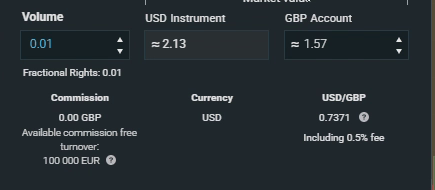
Non-GBP instruments settle in their home currency, and the conversion between pounds and that currency costs 0.5% each way. Buy £2,000 of a US share and sell it later: about £20 in conversion for the round trip, against zero commission. It is a fair charge honestly disclosed (the ticket shows it before you confirm), and my one planning tip is simple: UK stocks and GBP-priced ETFs avoid it entirely, so the GBP-heavy investor can run this account for essentially nothing.
Who actually hits the EUR 100,000 threshold?
The same logic helps with ETFs: many popular US and global index exposures trade in GBP-priced versions on the London market, which sidestep the conversion completely. Two minutes spent choosing the right listing can make a lifetime of contributions conversion-free.
Fewer people than the number suggests, because it measures monthly turnover rather than portfolio size. A £300-a-month ISA investor gets nowhere near it in a lifetime of contributions. The people who cross it are active share dealers: six round trips a day at £3,000 a position clears EUR 100k inside a month, at which point the excess trades cost 0.2% with a £10 minimum. If that describes you, price the 0.2% into your strategy; if it does not, the free tier is simply where you live.
What Do the Trading Costs Look Like in Practice?
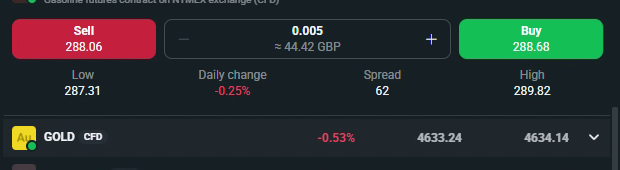
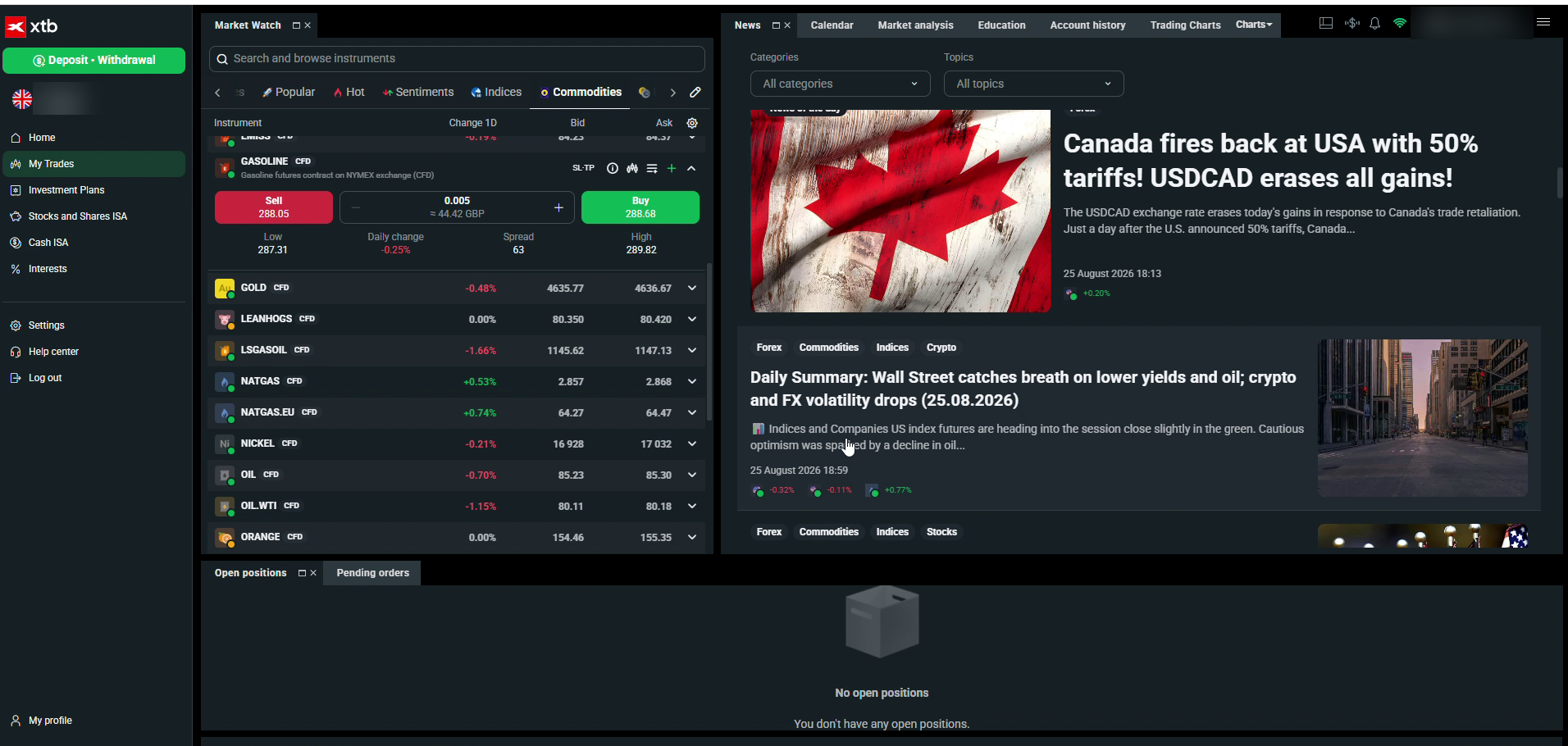
The spread carries everything on the CFD side, and the platform prints it wherever you look: on the quote panel, in the market watch and on the ticket in pounds. EUR/USD runs at 0.9 pips all-in, the US500 at 0.6 points, gold at a published 0.30. Overnight swaps apply to leveraged positions held past the daily rollover and sit on each instrument's ticket, long and short quoted separately, so the holding cost of a trade idea is checkable before the trade exists. The pounds-and-pence breakdown across markets and position sizes lives on our XTB spreads page, so I will not duplicate it here.
Does Any Money Flow the Other Way?
Unusually for a broker fee page, yes. Uninvested cash earns interest, calculated daily and paid monthly, at these rates on 26 August 2026:
| Currency | Rate (p.a., variable) |
|---|---|
| GBP | 4.00% |
| USD | 3.45% |
| EUR | 2.30% |
The rates apply automatically, with no opting in, no hoops and no cap small enough to matter to a retail account, and the interest lands as cash monthly. For a real sense of scale: £3,000 of cash averaging on the account across a year earns about £120 at the GBP rate, which for many users outweighs every fee they will pay. I struggle to name another mainstream UK broker where the fee conversation can genuinely end with the customer in credit.
What Would You Personally Pay in a Year?
| User | Typical year | Rough annual cost |
|---|---|---|
| GBP ISA investor | £500 a month into UK stocks and GBP ETFs | £0, with interest earned on waiting cash |
| US-share investor | £500 a month into US names, held long | About £30 a year in conversion |
| CFD swing trader | Three EUR/USD trades a week at 1 lot, held days | Around £1,100 in spread and swap |
| Dormant account | No activity at all for 12 months | The inactivity fee, the only one avoidable by simply logging in |
Estimates, not quotes, and the trading rows scale directly with how much you trade. The investing rows are the striking ones: a sterling-focused portfolio genuinely runs at zero, and even the US-heavy version costs less per year than a single month of a typical percentage platform fee. The dormant row is there because it is the only fee on the account that exists purely to be avoided, and avoiding it takes one login.
How Do You Keep the Account Running at Nearly Nothing?
Three habits do most of the work. Weight the portfolio towards sterling where your strategy allows, because UK stocks and GBP-priced ETFs never touch the conversion fee, and many popular US-market exposures exist as GBP-listed ETFs. Batch your currency moves rather than dripping them, since 0.5% on one larger conversion beats 0.5% on many small ones only in admin, but fewer conversions means fewer occasions to pay both directions on a change of mind. And if life pulls you away from the markets, log in once in a while: any activity inside a year keeps the inactivity fee permanently theoretical.
The corresponding trap is treating commission-free US dealing as genuinely free. It nearly is for a buy-and-hold position, and it is not for rapid trading, where the conversion toll on every round trip quietly becomes the account's biggest line. The fee schedule rewards patience, which is not the worst incentive a broker has ever built.
How Do These Fees Compare With Other UK Brokers?
Against percentage-fee investment platforms, there is barely a contest for the self-directed: an annual custody percentage on a five-figure portfolio buys nothing here that XTB charges for. Against commission-per-trade share dealers, the free tier up to EUR 100,000 of monthly turnover covers what a typical retail investor does in a busy year. And against fellow CFD brokers, the spread-only model prices the majors competitively while keeping the bill readable, which our cheapest broker comparison sets out line by line.
No broker wins every column, and XTB concedes ground to raw-spread specialists at the high-frequency extreme and to zero-conversion platforms for heavy US dealing. What it refuses to concede anywhere is clarity, and over years of reviewing broker pricing I have come to rate that above a tenth of a pip.
So, Is XTB Cheap?
For its two core audiences, yes, and by a distance. The GBP investor pays effectively nothing and earns on cash. The CFD trader pays one visible spread with no commission stacked on top. The only users with real sums to run are heavy US-share dealers, who should weigh the 0.5% conversion against the commissions they would pay elsewhere, and traders above the EUR 100k monthly threshold, who at that scale are comparing fine margins between brokers anyway. Fee schedules this short are usually hiding something; after going through this one line by line, and testing the free claims with my own deposits and withdrawals, I do not think this one is. Where XTB places against the field on total cost, our cheapest broker comparison runs the numbers side by side.
What Didn't I Test?
I did not test the 0.2% commission tier, because my dealing never crossed the EUR 100,000 monthly threshold, and I did not run a custody-fee scenario above EUR 250,000. Swap rates vary by instrument and change without notice, so treat the ticket as the source rather than any review, this one included. Rates and thresholds were read from xtb.com on 26 August 2026, and this page is re-checked monthly.
FAQs
Does XTB charge a platform or account fee?
No. Opening, holding and using the account are free, on both the trading and investing sides, and the demo costs nothing.
Are deposits and withdrawals really free?
Yes, in both directions. My test withdrawal of £500 to a card arrived in 1 business day with nothing deducted.
What is the minimum deposit?
There is none. You can open the account empty, try the demo, and fund whatever amount suits you when you are ready.
Is there an inactivity fee?
Only after a full year with no activity at all. Any trade, deposit or login activity within the year keeps the account free.
Does the ISA have different fees?
No, the same schedule applies: free to open and hold, 0% dealing to the monthly threshold, and the 0.5% conversion on non-GBP holdings. Interest on GBP cash applies inside the wrapper too.
Are there ongoing charges for holding US shares?
No holding charge applies below EUR 250,000 of custody, and the conversion fee is only taken when you trade, not while you hold. A long-term US position costs its entry and exit conversion and nothing in between.
How does XTB make money if so much is free?
From the spread on CFD trades, the conversion fee on non-GBP share dealing, commissions above the free turnover threshold and swap on leveraged overnight positions. The model charges users in proportion to how actively they trade, which is why passive investors get such a good deal.
Discussion 0 comments
Be the first to start discussing this topic! Log in or create an account to share your thoughts.
Log In Create Account
No comments yet. Be the first to start discussing this topic!