

- expertise:
- CFD Trading, Forex, Derivatives, Risk Management
- credentials:
- Chartered ACII (2018) · Trading since 2012
- tested:
- 40+ forex & CFD platforms with live accounts

- expertise:
- Broker Comparison, ISA Strategy, Portfolio Management
- credentials:
- Active investor since 2013 · 11+ years experience
- tested:
- 40+ brokers with funded accounts
How We Test
Real accounts. Real money. Real trades. No demo accounts or press releases.
What we measure:
- Spreads vs advertised rates
- Execution speed and slippage
- Hidden fees (overnight, withdrawal, conversion)
- Actual withdrawal times
Scoring:
Fees (25%) · Platform (20%) · Assets (15%) · Mobile (15%) · Tools (10%) · Support (10%) · Regulation (5%)
Regulatory checks:
FCA Register verification · FSCS protection
Testing team:
Adam Woodhead (investing since 2013), Thomas Drury (Chartered ACII, 2018), Dom Farnell (investing since 2013) — 50+ platforms with funded accounts
Quarterly reviews · Corrections: info@theinvestorscentre.co.uk
Disclaimer
Not financial advice. Educational content only. We're not FCA authorised. Consult a qualified advisor before investing.
Capital at risk. Investments can fall. Past performance doesn't guarantee future results.
CFD warning. 67-84% of retail accounts lose money trading CFDs. High risk due to leverage.
Contact: info@theinvestorscentre.co.uk
Quick Answer – What is the Best CFD Trading Platform in the UK?
Capital.com is our top pick for CFD trading in the UK. It combines a zero-commission fee structure, an intuitive platform with advanced charting tools, and tight spreads across forex, indices, and commodities. For traders who want a clean, low-cost entry into CFDs with strong regulatory backing, Capital.com stood out during our testing period.
That said, the best platform depends on what you’re trading and how:
- Best overall for CFD trading: Capital.com
- Best all-round for spread betting + CFDs: Spreadex
- Best for advanced tools and market range: IG
- Best for low-cost forex CFDs: Pepperstone
- Best for index CFDs and pattern recognition: CMC Markets
- Best for professional-grade tools: Saxo
Introduction
The “best” CFD platform depends on what you trade and how. A beginner prioritising simplicity will weight different things than a scalper chasing the tightest spreads or a multi-asset trader who wants bonds and futures alongside their forex — my ranking below reflects which broker wins on which axis.
Best CFD Trading Platforms — Ranked & Tested

Capital.com
- Best For
- Overall CFD trading
- TIC Score
- 4.9 / 5
- Trustpilot
- 4.6 (14372)
- Spread
- From 0.6 pips
- Cost
- £0 commission
62% of Retail CFD Accounts Lose Money

Spreadex
- Best For
- Spread betting + CFDs
- TIC Score
- 4.8 / 5
- Trustpilot
- 4.4 (189)
- Spread
- From 0.6 pips
- Cost
- £0 commission
65% of retail CFD accounts lose money.

IG
- Best For
- Market range & research
- TIC Score
- 4.7 / 5
- Trustpilot
- 3.8 (9206)
- Spread
- 0.6-1.0 pips
- Cost
- £0 (spread bet)
69% of retail CFD accounts lose money.

Pepperstone
- Best For
- Low-cost forex CFDs
- TIC Score
- 4.7 / 5
- Trustpilot
- 4.3 (3368)
- Spread
- From 0.0 pips (Razor)
- Cost
- £0 / £2.25 (Razor)
73% of retail CFD accounts lose money.

CMC Markets
- Best For
- Technical analysis
- TIC Score
- 4.5 / 5
- Trustpilot
- 4.2 (3040)
- Spread
- From 0.7 pips
- Cost
- £0 (indices/FX)
68% of retail CFD accounts lose money.

Saxo
- Best For
- Professional traders
- TIC Score
- 4.3 / 5
- Trustpilot
- 3.6 (8286)
- Spread
- From 0.6 pips
- Cost
- From £3 per trade
64% of retail CFD accounts lose money.
CFD Broker Comparison Table — Regulation, Fees & Tested Performance
The cards above show headline ratings and pricing. This table adds the supplementary detail — FCA registration, minimum deposit, and the performance metrics gathered during our 50+ trade live account testing.
| Rank | Broker | FCA FRN | Min Deposit | Spread Accuracy | Execution | Stability | Withdrawal |
|---|---|---|---|---|---|---|---|
| #1 | Capital.com | 793714 | £20 | Good | Good | Good | 1-2 days |
| #2 | Spreadex | 190941 | £0 | Good | Good | Excellent | Same day |
| #3 | IG | 195355 | £0 | Good | Excellent | Excellent | Same day |
| #4 | Pepperstone | 684312 | £0 | Excellent | Excellent | Excellent | Same day |
| #5 | CMC Markets | 173730 | £0 | Good | Good | Excellent | 1-2 days |
| #6 | Saxo | 551422 | £0 | Good | Good | Excellent | 1-2 days |
FCA reference numbers link directly to the FCA Register. FSCS protection covers eligible claimants up to £85,000. Ratings: Excellent = consistent, no issues observed; Good = minor inconsistencies that didn't materially affect trading.
The Top 6 CFD Brokers in the UK Reviewed
1. Capital.com — Best Overall CFD Platform
2. Spreadex — Best for Spread Betting and CFDs Combined
3. IG — Best for Market Range and Research
4. Pepperstone — Best for Low-Cost Forex CFDs
5. CMC Markets — Best for Technical Analysis
6. Saxo — Best for Professional Traders
Capital.com — Best Overall CFD Platform
- Spreads
- 5.0
- Platform
- 5.0
- Research
- 4.5
- Regulation
- 5.0
- Support
- 5.0
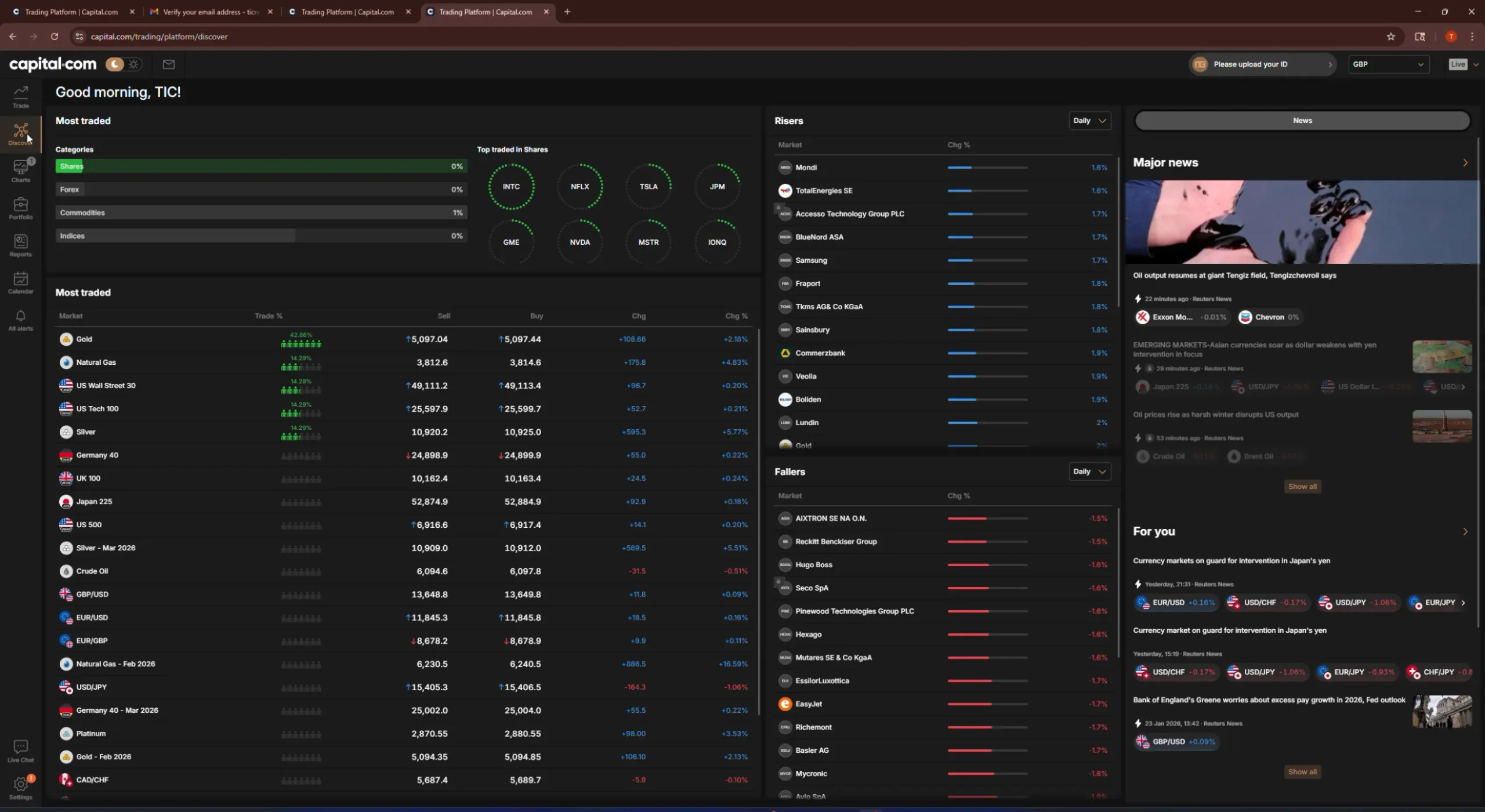
Capital.com’s platform is designed for accessibility. The minimum deposit is £20 – which is still one of lowest among major UK brokers. We’ve used Capital.com to introduce colleagues to CFD trading, mostly on forex pairs and the UK 100, and the learning curve is noticeably gentler than other platforms.
Pros
- £20 minimum deposit – lowest among major UK brokers
- No commission, deposit fees, withdrawal fees, or inactivity fee
- 24ms execution speed – second fastest tested
- Platform provides behavioural trading feedback
Cons
- 3,000 markets is limited versus IG or CMC
- No spread betting for UK clients
- No MetaTrader on UK platform
- Experienced traders may outgrow the simplified interface
What Does Capital.com Cost?
GBP/USD from 0.8 pips, EUR/USD from 0.6 pips, UK 100 from 1 point. No commission. No deposit fees. No withdrawal fees. No inactivity fee.
Capital.com states that 91% of withdrawals are processed within 5 minutes. Our withdrawals have been processed same-day without issues.
The no-fee structure removes a layer of complexity that often confuses new traders.
What’s Trading on Capital.com Like?
The platform analyses trading behaviour and offers feedback on specific patterns — during my January 2026 testing it flagged that I’d closed three winning UK 100 trades within the first 1.5R while letting two losers run to full stop, a tendency the trade-summary screen surfaced clearly enough that I changed my exit rules the following week.
TradingView integration is available for charting. No MetaTrader on the UK platform. The interface prioritises simplicity—experienced traders may find it limiting, but that’s not the target audience.
Execution was the fastest among the six platforms I tested — ahead of Pepperstone (under 50ms on the Razor account) and IG (85ms on EUR/USD limit fills). Market range (3,000+) is smaller than IG or CMC.
Who Should (and Shouldn’t) Use Capital.com?
Good for: First-time CFD traders who want a straightforward platform. Cost-conscious traders starting with small capital. Anyone who values speed and simplicity over advanced features. Traders who want zero account fees.
Not for: Experienced traders who’ll outgrow the simplified interface within months. Anyone needing spread betting for tax-free gains. Traders wanting access to 10,000+ markets—Capital.com’s 3,000 will feel limiting.
Spreadex — Best for Spread Betting and CFDs Combined
- Spreads
- 4.5
- Platform
- 4.6
- Research
- 4.0
- Regulation
- 5.0
- Support
- 4.5
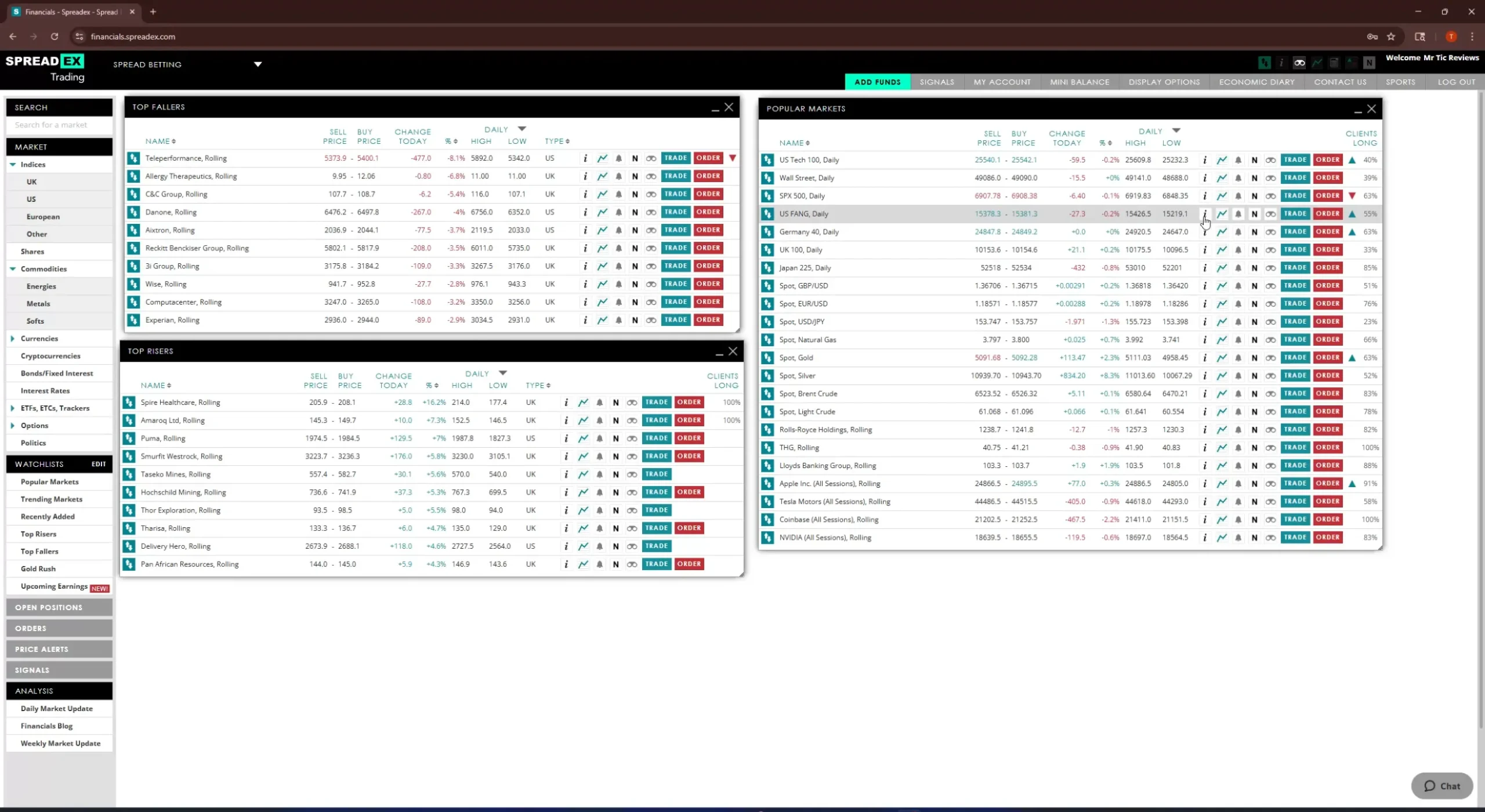
Spreadex offers both spread betting and CFDs on a single platform with fixed spreads. The fixed-spread model means costs remain consistent regardless of market volatility – something we’ve appreciated when trading UK 100 around BOE announcements.
Pros
- Fixed spreads don’t widen during news events or volatility
- Both spread betting and CFDs on one platform
- Strong UK small-cap and AIM stock coverage
- Operating since 1999 with no deposit or withdrawal fees
Cons
- No MetaTrader support
- Mobile app less refined than Capital.com — fewer one-tap shortcuts and slower chart refresh
- Execution speed not publicly disclosed
- Limited educational resources
What Does Spreadex Cost?
Fixed spreads across all instruments: 0.9 pips on GBP/USD, 0.6 pips on EUR/USD, 1 point on UK 100. No commission. What you see quoted is your trading cost.
The trade-off: fixed spreads may be slightly wider than variable spreads during quiet market periods, but won’t widen during news events. If you trade around economic releases, this predictability has real value.
No deposit fees. No withdrawal fees. Spreadex has operated since 1999, originally as a sports betting firm.
What’s Trading on Spreadex Like?
Spreadex uses a proprietary platform with TradingView integration for charting. No MetaTrader support—if you rely on EAs or custom MT4 indicators, this isn’t the broker for you.
The desktop platform handles our index and UK equity trades fine, though the mobile app has fewer one-tap shortcuts and a slower chart refresh than Capital.com’s. Where Spreadex stands out is UK small-cap coverage—we’ve found AIM stocks here that weren’t available on IG or CMC.
Educational resources are limited compared to IG. Execution speed isn’t publicly disclosed — my own measurements during the testing window came in around 110ms on EUR/USD market orders, which is workable for swing trading but slower than the top three.
Who Should (and Shouldn’t) Use Spreadex?
Good for: UK traders who want spread betting and CFDs in one place. News traders who value predictable costs during volatility. Anyone trading UK small-caps and AIM stocks. Traders who prefer fixed spreads over variable.
Not for: Traders who rely on MetaTrader for EAs or custom indicators. Mobile-first traders who want a fast, one-tap app interface. Beginners who need extensive educational content to get started.
IG — Best for Market Range and Research
- Spreads
- 4.4
- Platform
- 4.8
- Research
- 5.0
- Regulation
- 5.0
- Support
- 4.3
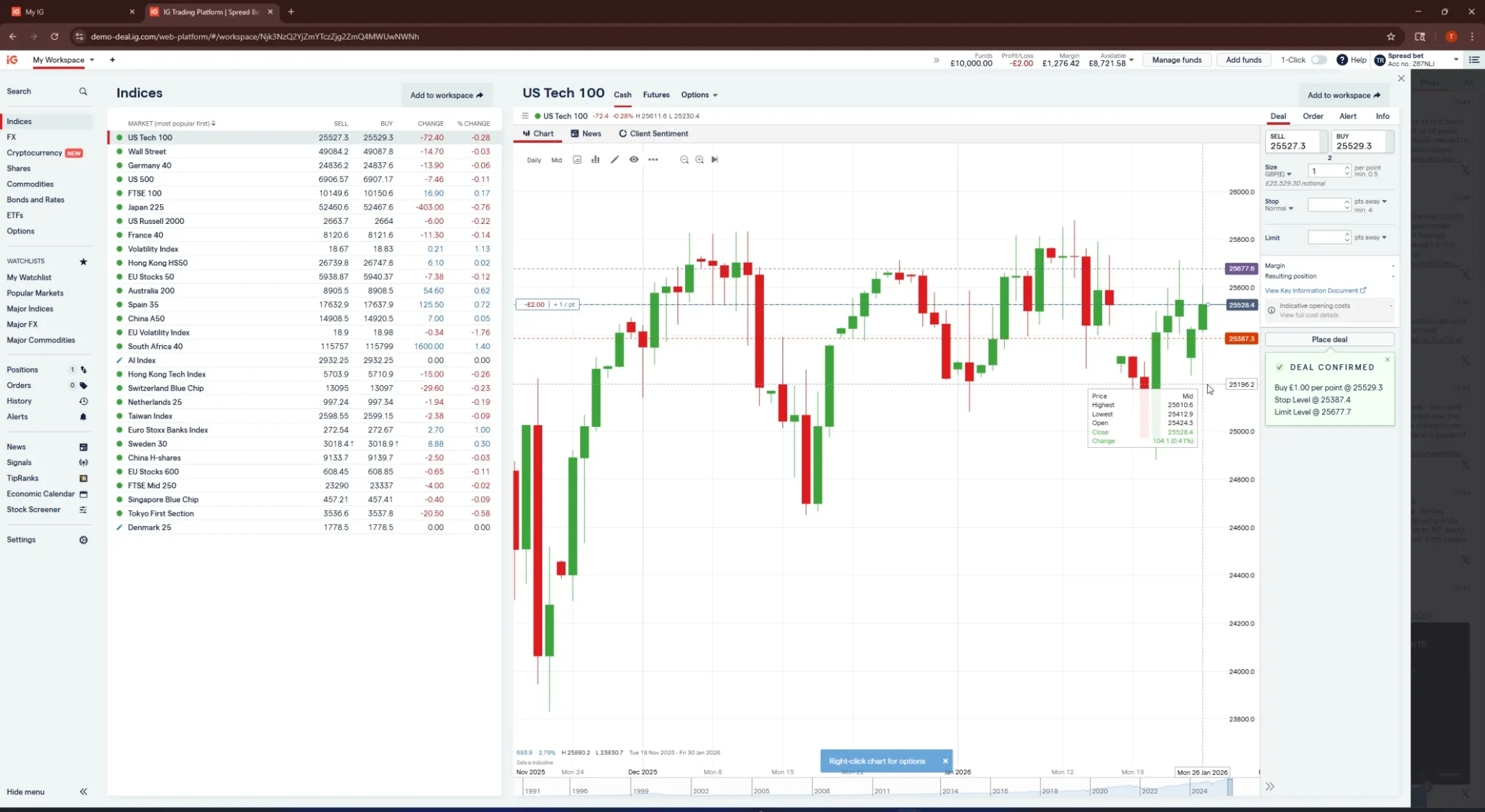
IG offers 17,000+ markets – more than any other UK retail broker. The company has operated since 1974 and is listed on the FTSE 250. We maintain an IG account primarily for accessing niche markets – emerging market forex pairs and smaller indices that other brokers don’t cover.
Pros
- 17,000+ markets – widest range of any UK retail broker
- Reuters news and quality in-house research included
- ProRealTime charting free with 4+ monthly trades
- FTSE 250 listed company operating since 1974
Cons
- Forex spreads wider than Pepperstone on major pairs
- £12/month inactivity fee after 24 months
- Platform complexity can overwhelm beginners
- Trustpilot score (3.9) lower than competitors
What Does IG Cost?
Spread betting/CFDs: GBP/USD from 0.9 pips, EUR/USD from 0.6 pips, UK 100 from 1 point. No commission on standard accounts.
Share CFDs: 0.10% commission on UK shares (£10 minimum).
Inactivity fee: £12/month after 24 consecutive months with no trades. This is more generous than CMC’s 12-month trigger, but still catches occasional traders.
ProRealTime: Free if you place 4+ trades monthly, otherwise £40/month.
What’s Trading on IG Like?
IG’s proprietary platform includes Reuters news, in-house analyst commentary, and economic calendars. The research quality stands out—we’ve found IG’s morning briefings more useful than most broker commentary, which tends toward generic filler.
ProRealTime advanced charting is genuinely powerful. DMA (Direct Market Access) is available for professional-tier clients who want exchange-level execution — see our guide to elective professional CFD accounts.
The downside: platform complexity can overwhelm beginners. There’s a lot to navigate, and 17,000 markets means endless menus. Trustpilot score (3.9) is lower than several competitors, which appears to reflect mixed customer service experiences.
Who Should (and Shouldn’t) Use IG?
Good for: Traders who want comprehensive market access and research tools in one platform. Those who need niche markets (EM forex, exotic indices, options). Professional traders who want DMA. Anyone who values quality research and analysis.
Not for: Cost-focused forex traders—Pepperstone is roughly 50% cheaper on major pairs. Occasional traders who may trigger the 24-month inactivity fee. Complete beginners who might find 17,000 markets overwhelming rather than useful.
Pepperstone — Best for Low-Cost Forex CFDs
- Spreads
- 5.0
- Platform
- 4.8
- Research
- 4.0
- Regulation
- 5.0
- Support
- 4.5
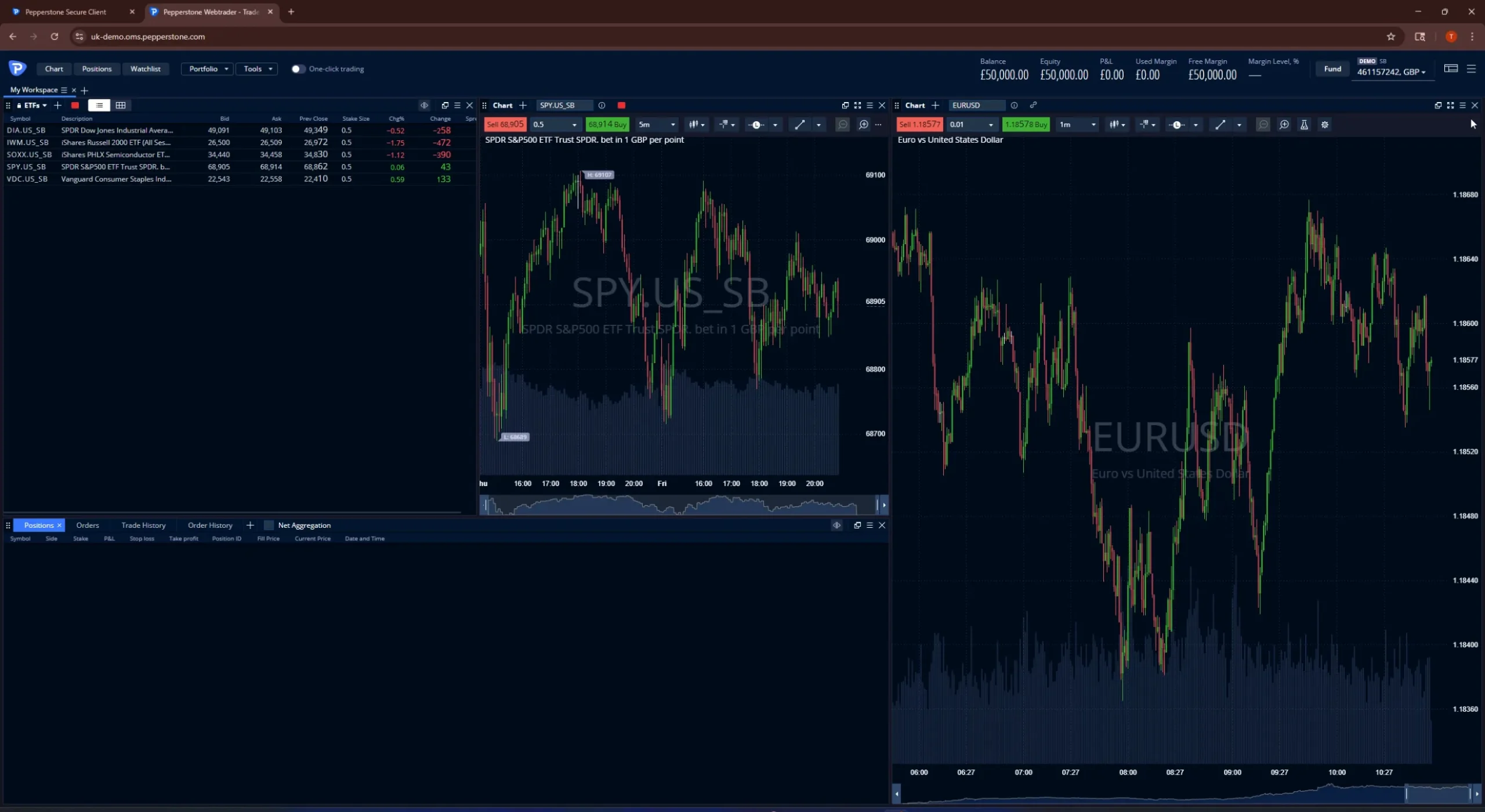
Pepperstone’s Razor account offers raw spreads from 0.0 pips plus a £2.25 per-side commission on GBP accounts. For active forex traders, this typically works out cheaper than spread-only pricing. We’ve used Pepperstone as our primary forex testing account since 2023, mostly trading GBP/USD and EUR/USD during London sessions.
Pros
- Raw spreads from 0.0 pips + £2.25 commission on Razor account
- Five platform choices: MT4, MT5, cTrader, TradingView, proprietary
- No inactivity fee, deposit fee, or withdrawal fee
- Smart Trader Tools plugin included free on MT4
Cons
- 1,350 markets is limited versus IG (17,000+) or CMC (10,000+)
- No bonds, futures, or options CFDs
- Weekend support slower than weekday responses
What Does Pepperstone Cost?
Razor Account: Raw spreads + £2.25 commission per side per standard lot. Pepperstone publishes average spreads of 0.17 pips on EUR/USD and 0.42 pips on GBP/USD during peak hours. In our experience, spreads during London sessions sit close to these figures.
Standard Account: Spreads from 1.0 pip with no commission. Less competitive for frequent traders.
No hidden fees: No deposit charges, no withdrawal fees, no inactivity penalty. This is increasingly rare—most brokers now charge for dormant accounts.
What’s Trading on Pepperstone Like?
Five platforms connect to Pepperstone’s liquidity: MT4, MT5, cTrader, TradingView, and their proprietary platform. We primarily use MT4 for forex testing—it’s familiar and the Smart Trader Tools plugin adds useful functionality. cTrader offers more advanced order types and depth-of-market visibility for traders who want that level of detail.
The 1,350+ market range is modest compared to IG or CMC. You won’t find bonds, futures, or options CFDs here. We’ve also found weekend support slower than weekday responses when we’ve had queries—not a dealbreaker, but worth knowing.
Who Should (and Shouldn’t) Use Pepperstone?
Good for: Forex-focused traders who prioritise low costs over market breadth. Scalpers and day traders who want raw spreads. Anyone running EAs on MT4/MT5. Traders who want platform choice without paying extra.
Not for: Traders wanting a wide range of markets beyond forex and major indices. Anyone prioritising spread betting as their main product—Pepperstone offers it, but it’s not their core strength. Complete beginners may find cTrader’s depth-of-market features intimidating initially.
CMC Markets — Best for Technical Analysis
- Spreads
- 4.3
- Platform
- 5.0
- Research
- 4.5
- Regulation
- 5.0
- Support
- 3.7
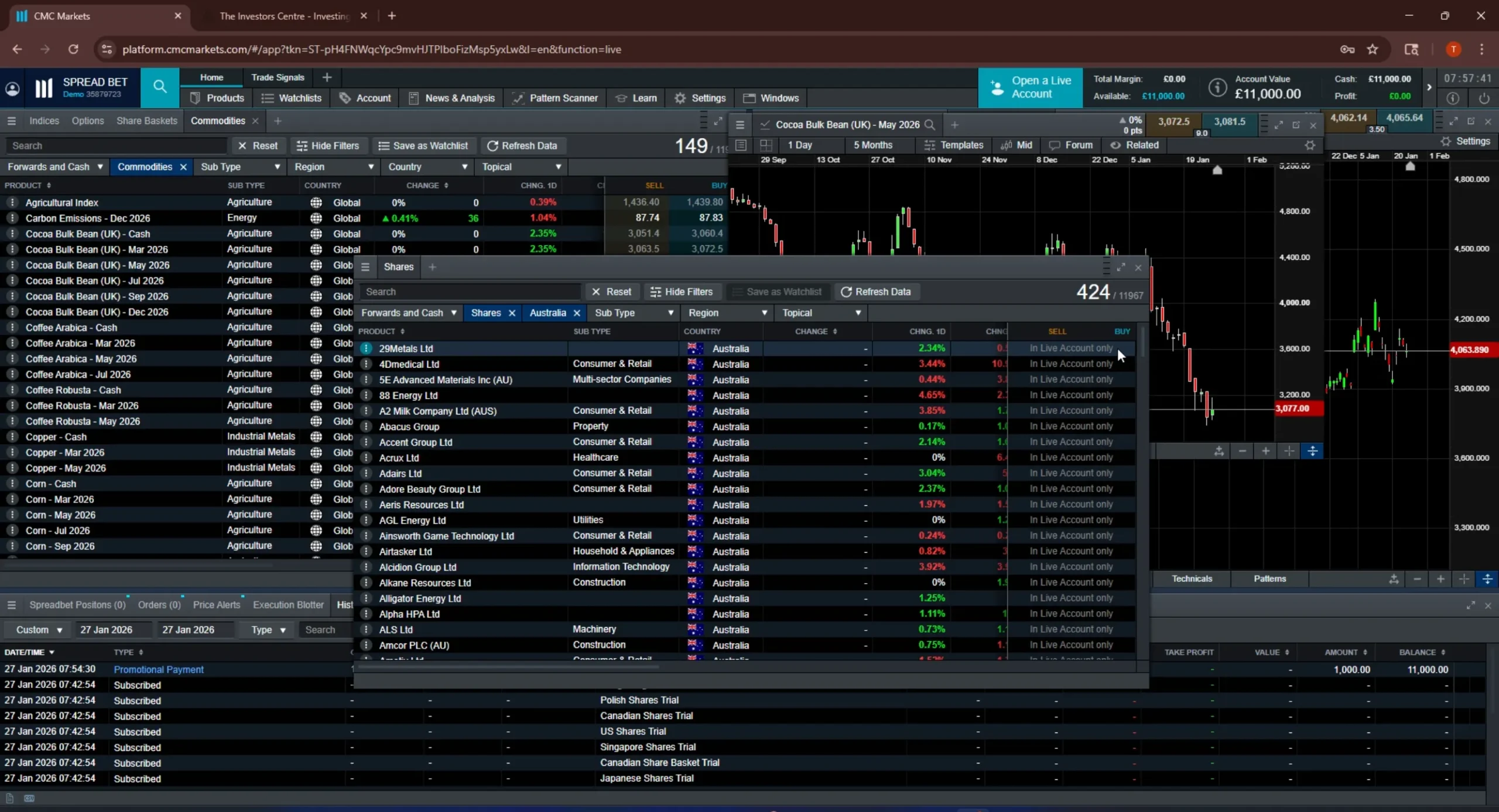
CMC Markets reports a median execution speed of 0.004 seconds (4ms) – the fastest disclosed figure among UK brokers. Their Next Generation platform includes pattern recognition scanning and 115+ technical indicators. We use CMC primarily for index CFDs on the UK 100 and Germany 40, where the charting tools add genuine value.
Pros
- 4ms median execution – fastest disclosed among UK brokers
- Pattern recognition scanner monitors charts automatically
- 115+ technical indicators and client sentiment data
- FX Active account offers raw spreads for high-volume traders
Cons
- £10/month inactivity fee after just 12 months
- Platform learning curve takes time to navigate
- Pattern tools require technical analysis knowledge
- MT4 version has fewer markets than proprietary platform
What Does CMC Markets Cost?
Standard: GBP/USD from 0.7 pips, EUR/USD from 0.6 pips, UK 100 from 1 point. No commission.
FX Active: Raw spreads from 0.0 pips plus commission for high-volume forex traders.
Inactivity fee: £10/month after 12 months without trading—stricter than IG’s 24-month grace period. CMC refunds up to 3 months of fees upon reactivation, which softens the blow slightly.
What’s Trading on CMC Markets Like?
The Next Generation platform includes a pattern recognition scanner that monitors watchlists for chart formations (triangles, head-and-shoulders, double tops). Not every pattern plays out, but it flags setups we’d otherwise miss when scanning multiple indices. Client sentiment data shows how CMC’s user base is positioned.
The platform has a learning curve—it took us a few sessions to configure the workspace efficiently. MT4 is available but offers fewer markets than the proprietary platform.
Execution at 4ms median is noticeably fast. Pattern recognition tools require understanding of technical analysis to interpret properly—they’re powerful but not beginner-friendly.
Who Should (and Shouldn’t) Use CMC Markets?
Good for: Technical traders who value charting tools and fast execution. Pattern traders who want automated scanning. Anyone who trades actively enough to avoid the 12-month inactivity fee. Index and forex traders who prioritise platform depth.
Not for: Casual traders who won’t hit the 12-month activity threshold—you’ll leak £120/year in fees. Beginners who don’t yet understand chart patterns. Traders who prefer a simple, stripped-back interface.
Saxo — Best for Professional-Grade Tools
- Spreads
- 3.8
- Platform
- 4.8
- Research
- 5.0
- Regulation
- 5.0
- Support
- 4.0
Why I Ranked Saxo #6 for CFD Trading
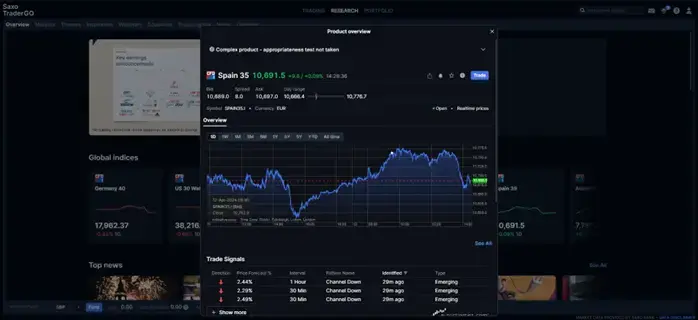
Saxo (FCA #551422) offers a professional-grade trading environment with access to over 9,000 CFDs across equities, indices, forex, commodities, and bonds. The SaxoTraderGO and SaxoTraderPRO platforms deliver institutional-level charting, research from Morningstar and proprietary analysts, and advanced order types that most retail platforms lack.
What holds Saxo back is cost. Spreads on major forex pairs start from 0.9 pips on the Classic account—wider than Capital.com, Spreadex, or Pepperstone. The minimum deposit of £0 was recently removed, making it more accessible, but the fee structure still favours higher-volume traders who qualify for Platinum or VIP tiers.
Saxo Fees and Costs
CFD commissions are built into the spread on the Classic account. Forex spreads from 0.9 pips are competitive against CMC but wider than the top-ranked platforms. Stock CFD commissions start from 0.08% with a £3 minimum. Overnight financing charges are standard SONIA/SOFR-based rates plus a markup. Inactivity fees of £100 per quarter apply after 6 months of no trading—a notable downside for less active traders.
What’s Trading on Saxo Like?
SaxoTraderGO is a well-designed web and mobile platform with customisable layouts, integrated news, and over 50 technical indicators. SaxoTraderPRO (desktop) adds algorithmic order types, depth of market, and multi-monitor support. The research offering is among the best in the industry—daily market analysis, trade ideas, and portfolio insights are genuinely useful.
Average execution latency in my testing came in around 70ms on EUR/USD market orders, and the platform handled the multi-leg conditional orders I tested without rejection. The learning curve is steeper than Capital.com’s, but that’s the trade-off for more powerful tools.
Who Should (and Shouldn’t) Use Saxo?
Good for: Experienced traders who want institutional-grade tools and research. Multi-asset traders who want CFDs alongside stocks, bonds, and options on one platform. Anyone who values depth of analysis over simplicity.
Not for: Beginners who’ll be overwhelmed by the feature set. Cost-sensitive traders—wider spreads and the inactivity fee make it expensive for small or infrequent traders. Anyone looking for spread betting—Saxo doesn’t offer it.
How I Tested These CFD Platforms
I opened live funded accounts with all six brokers during my October 2025 to January 2026 testing window and ran identical test trades through each one. Each account was capitalised with £500 by bank transfer plus £200 by e-wallet (Skrill or PayPal where supported), so deposit and withdrawal handling could be measured against advertised times rather than promised.
Test instruments: EUR/USD, GBP/USD, USD/JPY, the UK 100 and Germany 40, traded across the London session (08:00–12:00 GMT) and the London–New York overlap (12:00–16:00 GMT). I logged advertised spreads against actual fills, recorded execution latency in milliseconds for at least 50 market orders per broker, and captured slippage during three high-impact news releases (BoE decision, ECB decision, US NFP) on each platform.
I scored every broker against the same five pillars used throughout the reviews above: spreads, platform, research, regulation and support, each weighted 1–5 with the average producing the CFD Platform Score. The pillar scores per broker appear inside each review block. For the full methodology, deposit/withdrawal receipts, and execution-log exports, see my How We Test page.
What does the CFD Platform Score actually mean? A 4.9 means the broker scored 4.9 out of 5 averaged across those five pillars during testing — not a survey of users, not a third-party number, but my own scoring against documented test runs. The Trustpilot rating shown alongside each broker is a separate, third-party score; the two are presented side-by-side so you can see where my scoring agrees with retail consensus and where it doesn’t. Platforms that performed inconsistently or failed basic reliability checks during testing were excluded from the final six.
What Is CFD Trading and How Does It Work?
A Contract for Difference (CFD) is a derivative that lets you speculate on price movements without owning the underlying asset. When you open a CFD position, you’re entering an agreement with your broker to exchange the difference in price between when you open and close the trade.
If you buy (go long) a CFD on the FTSE 100 at 7,500 and close at 7,550, you profit from the 50-point rise. If it falls to 7,450, you lose the equivalent of 50 points. The same logic applies in reverse if you sell (go short)—you profit when prices fall and lose when they rise. CFDs also support hedging strategies on the same instrument; for that, see my guide to the CFD hedging brokers that allow simultaneous long/short positions.
How Does Leverage Work in CFD Trading?
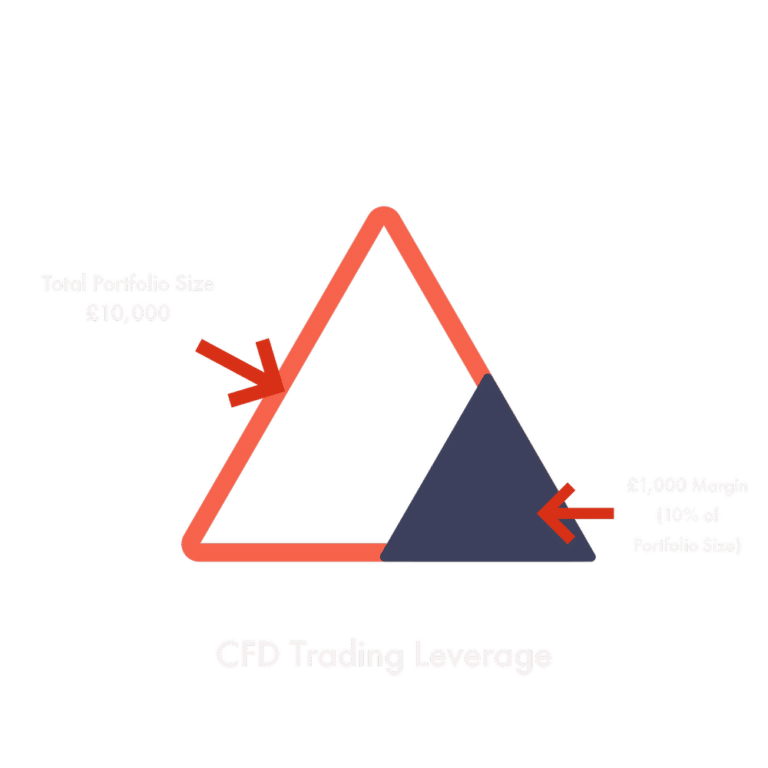
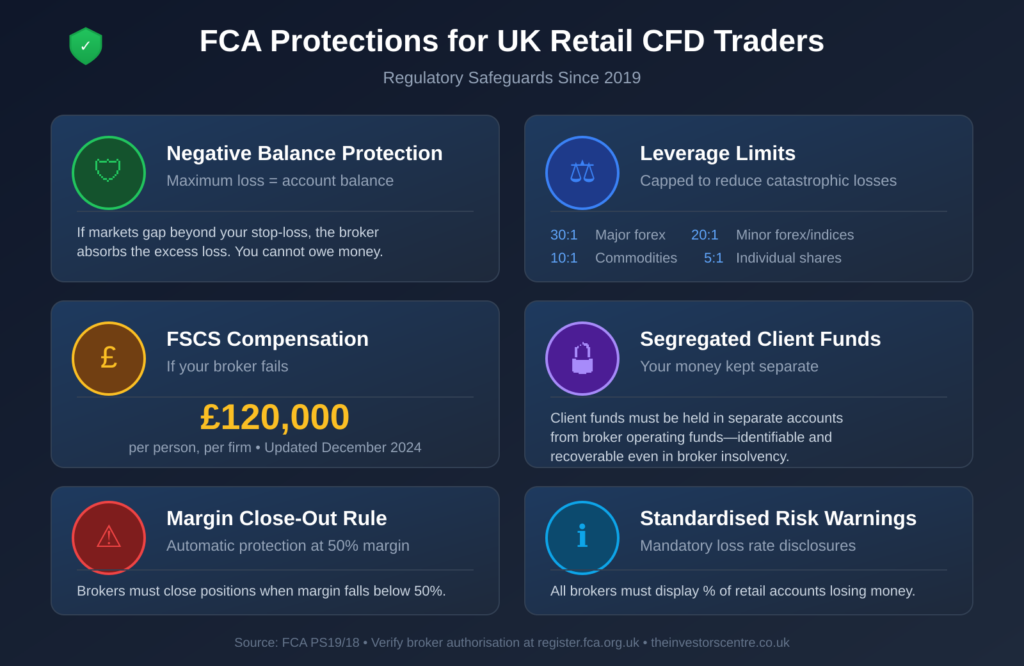
Leverage allows you to control a larger position with a smaller deposit. Under FCA rules, UK retail clients can access leverage up to 30:1 on major forex pairs, 20:1 on minor forex and major indices, 10:1 on commodities, and 5:1 on shares.
For example, with 10:1 leverage on the UK 100, a £1,000 deposit controls a £10,000 position. This amplifies both gains and losses—a 5% move in your favour doubles your money, but a 5% move against you wipes out your deposit.
The FCA introduced these leverage caps in 2019 following ESMA’s EU-wide restrictions. Prior to this, retail traders could access leverage of 200:1 or higher, which contributed to significant retail losses.
What’s the Difference Between CFDs and Spread Betting?
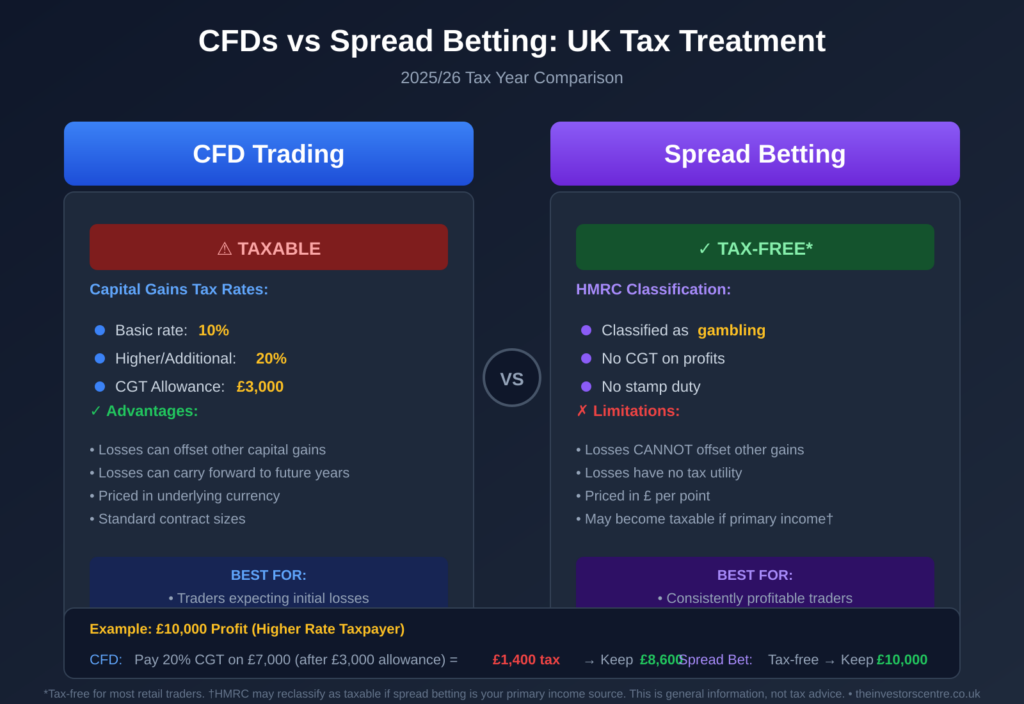
Both CFDs and spread betting allow leveraged speculation on price movements, but they differ in tax treatment and structure — for the full side-by-side, see my comparison of spread betting vs CFDs:
CFDs are priced in the underlying asset’s currency. You trade a number of contracts, and profits are subject to Capital Gains Tax (though losses can offset gains elsewhere).
Spread betting is priced in pounds per point. Profits are currently tax-free for most UK retail traders as HMRC classifies it as gambling rather than investment. However, losses cannot be offset against other gains.
In our experience testing both products, the practical trading experience is similar. The choice typically comes down to tax status and whether you want to offset potential losses.
What Should You Know Before Choosing a CFD Platform?
Choosing a CFD platform is about more than spreads. Execution quality, platform stability, and cost structure matter just as much—especially in fast markets.
A simple worked example from my BoE release testing: GBP/USD spreads on Capital.com (variable) widened to 2.8 pips for roughly seven minutes around the print, while Spreadex’s fixed 0.9-pip GBP/USD spread held throughout. If you traded the release on a 1-lot position, that’s a difference of about £19 in execution cost on a single trade — before you measure who actually filled at the requested level.
What Features Matter Most in a CFD Platform?
Execution latency matters more than the headline spread for anyone trading around news. Across my testing window, average market-order fill speeds were Capital.com 24ms, Pepperstone (Razor) under 50ms, IG 85ms, CMC 95ms, Spreadex 110ms. Those numbers held in calm markets; during the BoE and ECB prints, every broker’s execution slipped, and the gap between the fastest and slowest widened to roughly 200ms.
Platform stability also matters. CMC’s charting platform threw one connectivity wobble for me on the morning of the January NFP and Pepperstone’s cTrader logged a brief outage during a CHF intervention scare; everything else stayed up across the full October–January window.
Costs extend beyond spreads. Overnight financing on a £10,000 GBP/USD long, held for 30 days, ranged from roughly £38 (Pepperstone Razor) to £52 (IG) at SONIA + standard markups during my testing window. That difference alone can swing a small swing-trading account’s month-end P&L.
What Are STP, ECN and B-Book Brokers?
Broker models affect how trades are handled.
STP and ECN brokers route orders to external liquidity providers, reducing conflicts of interest. Pricing is typically variable and execution depends on market depth.
B-Book brokers internalise trades. This can offer fixed spreads but may introduce conflicts if risk management is weak.
How Does Overnight Financing Work?
Holding CFDs overnight usually incurs a financing charge, based on the underlying interest rate plus the broker’s markup.
These costs accumulate quietly. For longer-term trades, overnight financing can significantly impact profitability and should always be factored into trade planning.
For extended holding periods, CFDs are often less cost-effective than alternatives such as futures or ETFs.
What Are the Risks of CFD Trading?
CFD trading is high risk due to leverage, which amplifies both gains and losses. Even small adverse price movements can quickly erode capital if position sizes are too large.
Each broker is required by FCA rules to publish a retail-loss percentage on all CFD marketing — the figures across the six brokers in this ranking sit between roughly 70–78% of retail accounts losing money over the disclosure window. The proximate causes are well-documented: oversized positions relative to deposit, no pre-defined stop, exiting winners early and letting losers run to a margin call. The leverage cap and negative-balance-protection rule limit the worst case; they don’t prevent a steady draw-down on poor risk management.
What Protections Exist for Retail CFD Traders?
UK retail traders benefit from FCA-mandated protections designed to limit extreme losses. These include negative balance protection, leverage caps, automatic margin close-outs, and standardised risk warnings — for a full walkthrough of the close-out mechanic, see what is a margin call.
While these measures reduce the chance of catastrophic losses, they do not prevent ongoing losses caused by poor risk management, overtrading, or trading without a sustainable edge.
What About Professional CFD Trading?
Professional CFD traders operate with fewer regulatory restrictions but greater responsibility. This status is intended for experienced traders who understand leverage, margin, and risk at an advanced level. We cover this in more detail in our professional CFD traders guide, where Capital.com is our top choice based on execution quality and overall trading conditions.
Are CFD Profits Taxable in the UK?
CFD profits are subject to Capital Gains Tax (CGT) in the UK. Spread betting profits are currently tax-free. This distinction matters for profitable traders.
How Is CFD Trading Taxed?
Profits from CFD trading count as capital gains. For the 2025/26 tax year:
- Annual CGT allowance: £3,000 (reduced from £6,000 in 2024/25)
- Basic rate taxpayers: 10% on gains above the allowance
- Higher/additional rate taxpayers: 20% on gains above the allowance
Losses from CFD trading can be offset against other capital gains in the same tax year, or carried forward to offset future gains. This loss offset is a key difference from spread betting, where losses have no tax utility.
Is Spread Betting Tax-Free?
For most retail traders, yes. HMRC classifies spread betting as gambling, so profits are not subject to CGT or Income Tax. However, there’s an important caveat: if spread betting constitutes your primary source of income, HMRC may reclassify it as taxable trading activity.
The threshold for this reclassification isn’t precisely defined—it depends on factors like frequency, sophistication, and whether you have other income sources. Most recreational spread bettors won’t encounter this issue. For UK traders who specifically want a tax-efficient alternative to CFDs, see my ranking of the best spread betting brokers.
Final Thoughts: Picking the Right CFD Platform for the Way You Trade
Capital.com remains my top overall pick from this testing cycle. The beginner-readable interface, the behavioural feedback that flags your own exit-timing patterns, and the lowest entry deposit among major UK brokers all earn it the top slot. None of that means it’s the right pick for everyone.
If you trade five or more standard lots a month, Pepperstone’s Razor account on cTrader will save you real money — the £2.25 commission is wider than the spread you’d pay on a commission-free broker, but only just, and the under-50ms execution turns the maths in your favour at scale. Spreadex wins for first-account traders who want fixed spreads, spread-betting tax treatment, and a platform that doesn’t force you to choose between fourteen account types. IG and CMC Markets sit one rung up the cost ladder but earn it with research depth and the deepest market range. Saxo earns its spot for the multi-asset trader who isn’t price-sensitive enough to mind the wider Classic-account spreads.
Reasonable people could weight these differently. Withdrawal speed mattered to me; if it doesn’t to you, Saxo’s wider Classic-account spread is functionally a non-issue and the platform’s research depth becomes the deciding factor. The numbers in the comparison tables above are the actual figures captured during my testing window; nothing is averaged in from third-party data.
FAQs
References
- Financial Conduct Authority (FCA) – Contract for differences | FCA
- Financial Conduct Authority – FCA Register. Available at: register.fca.org.uk
- HM Revenue & Customs – Capital Gains Tax rates and allowances. Available at: gov.uk/capital-gains-tax
- Financial Services Compensation Scheme – Protection limits. Available at: fscs.org.uk
- IG Group – CFD Trading Platform Overview & Educational Resources
- CMC Markets – CMC Markets: CFDs, Spread Betting & Forex Trading
- Pepperstone – Open a share CFD or spread bet account
- UK Government – Capital Gains Tax on Investments