

- expertise:
- CFD Trading, Forex, Derivatives, Risk Management
- credentials:
- Chartered ACII (2018) · Trading since 2012
- tested:
- 40+ forex & CFD platforms with live accounts

- expertise:
- Broker Comparison, ISA Strategy, Portfolio Management
- credentials:
- Active investor since 2013 · 11+ years experience
- tested:
- 40+ brokers with funded accounts
How We Test
Real accounts. Real money. Real trades. No demo accounts or press releases.
What we measure:
- Spreads vs advertised rates
- Execution speed and slippage
- Hidden fees (overnight, withdrawal, conversion)
- Actual withdrawal times
Scoring:
Fees (25%) · Platform (20%) · Assets (15%) · Mobile (15%) · Tools (10%) · Support (10%) · Regulation (5%)
Regulatory checks:
FCA Register verification · FSCS protection
Testing team:
Adam Woodhead (investing since 2013), Thomas Drury (Chartered ACII, 2018), Dom Farnell (investing since 2013) — 50+ platforms with funded accounts
Quarterly reviews · Corrections: info@theinvestorscentre.co.uk
Disclaimer
Not financial advice. Educational content only. We're not FCA authorised. Consult a qualified advisor before investing.
Capital at risk. Investments can fall. Past performance doesn't guarantee future results.
CFD warning. 67-84% of retail accounts lose money trading CFDs. High risk due to leverage.
Contact: info@theinvestorscentre.co.uk
Hedging with CFDs protects existing positions without forcing you to sell. You keep your shares, avoid triggering capital gains tax, and use a CFD position to offset potential losses. But brokers handle hedging differently—some net opposing positions automatically, others keep both sides open. Some offer guaranteed stops that execute through gaps, others don’t. These differences determine whether your hedge actually works when you need it.
We reviewed six FCA-regulated brokers specifically for their hedging capabilities: how they handle opposing positions, what risk tools they offer, and what it costs to maintain a protective position over days or weeks.
What Is the Best Broker for CFD Hedging in the UK?
Capital.com is the best broker for CFD hedging in the UK for 2026—the dedicated hedging mode keeps long and short positions visibly separate, guaranteed stop-loss (fee applies) orders provide gap protection when needed, and no commission* keeps hedging costs low over time. The platform clearly labels each hedged position with its own entry price, margin, and P&L.
Spreadex combines financial spread betting with CFD trading, giving hedgers the flexibility to choose between tax-free spread bets and traditional CFDs depending on the strategy. IG provides the most flexibility with CFDs, spread bets, options, and futures all accessible from one account.
*other fees may apply.


62% of Retail CFD Accounts Lose Money

65% of retail CFD accounts lose money.

68% of retail CFD accounts lose money.

72% of retail CFD accounts lose money.

64% of retail CFD accounts lose money.

68% of retail CFD accounts lose money.
How Do These CFD Hedging Brokers Compare?
| # | Broker | Best For | Key Hedging Feature | FCA FRN | Get Started |
|---|---|---|---|---|---|
| 1 | Capital.com | Overall CFD hedging | Dedicated hedging mode + GSLOs | 793714 | Visit |
| 2 | Spreadex | Spread betting hedging | Spread bets + CFDs combined | 202392 | Visit |
| 3 | IG | Multi-asset hedging | Force open + options access | 195355 | Visit |
| 4 | Pepperstone | Capital efficiency | Margin on largest leg only | 684312 | Visit |
| 5 | Saxo | Portfolio hedging | Options + multi-asset view | 551422 | Visit |
| 6 | City Index | Tax-efficient hedging | Spread betting + GSLOs | 446717 | Visit |
What Should You Look For in a CFD Hedging Broker?
Hedging requires different broker capabilities than speculative trading. Before comparing platforms, understand what actually matters.
Hedging mode: Can you hold both long and short positions on the same instrument simultaneously? Some brokers automatically net opposing trades—opening a short closes your long. For hedging, you need both sides to remain open as separate positions.
Guaranteed stop-losses: Standard stops can slip if prices gap overnight. Guaranteed stop-loss orders (GSLOs) execute at your specified price regardless of gaps—essential for hedges held through volatile events. Available at Capital.com, Spreadex, IG, and City Index for a premium.
Margin treatment: Most brokers require margin on both sides of a hedged position. Pepperstone calculates margin on the “largest leg” only—a fully hedged position needs margin on one side, not both. This frees capital.
Overnight financing: Hedges often stay open for days or weeks. Daily financing charges accumulate. Lower overnight rates mean cheaper long-term protection.
Platform compatibility: If you use automated hedging strategies via Expert Advisors, you need MT4/MT5 support. Pepperstone and IG offer this; Capital.com connects via TradingView but does not offer MT4/MT5 directly.
Which CFD Broker Has the Best Hedging Features?
The table below compares hedging-specific features. Note that “hedging mode” means the ability to hold opposing positions simultaneously without automatic netting.
| Broker | Hedging Mode | Guaranteed Stops | Margin Treatment | Overnight Rate/Year | Platforms |
|---|---|---|---|---|---|
| Capital.com | Dedicated toggle | GSLO | Standard | Benchmark Rate + Markup (varies by market and trade direction) | Proprietary, TradingView |
| Spreadex | Yes | GSLO | Standard | Benchmark + 2.5% | Proprietary |
| IG | Force open | Yes | Standard | Benchmark + 2.5-3% (entity dependent) | Proprietary, MT4, ProRealTime |
| Pepperstone | Yes | No | Largest leg only | Tom-next/Benchmark +2.5-3% | MT4, MT5, cTrader, TradingView |
| Saxo | Yes | No | Portfolio-based | Benchmark + 3.5% (Classic) | SaxoTraderGO, SaxoTraderPRO |
| City Index | Yes | GSLO | Standard | Benchmark + 2.5% | Proprietary, MT4 |
Reading this table:
- Dedicated toggle/Force open: Explicit setting to enable hedging (clearer than default behaviour)
- GSLO: Guaranteed stop-loss orders available for premium
- Largest leg only: Margin calculated on bigger position only (Pepperstone advantage)
- Benchmark: Typically SONIA for GBP instruments
Here Are The Top 6 CFD Hedging Brokers Reviewed
Each review focuses on hedging-specific capabilities: how the broker handles opposing positions, what risk tools it offers, and what hedging costs over time.
1. Capital.com — Best Overall for CFD Hedging
2. Spreadex — Best for Spread Betting Hedging
3. IG — Best for Multi-Asset Hedging
4. Pepperstone — Best for Capital-Efficient Hedging
5. Saxo — Best for Portfolio-Level Hedging
6. City Index — Best for Tax-Efficient Hedging
Capital.com — Best Overall for CFD Hedging

Pros
- A broad commodity range on this list—gold to orange juice to lean hogs
- No commission*
- Clean interface that is straightforward to navigate for new traders
- MT4 and TradingView integration for those who want third-party platforms
Cons
- Can’t trade physical commodity futures—CFDs only
- Charting tools are decent but less advanced than some competitors
- No cTrader for automated strategy runners who prefer that platform
How Does Capital.com Handle Hedged Positions?
Capital.com offers a dedicated hedging mode toggle in account settings (Account > My Accounts > Trade Options > Hedging Mode). Once enabled, opening an opposite position creates a separate trade rather than closing your existing one. Each position displays independently with its own entry price, margin requirement, and profit/loss calculation. Built-in margin alerts help you monitor exposure levels, and the platform displays overnight financing costs on the order ticket before you confirm any trade.
What Risk Protection Tools Does Capital.com Offer?
Guaranteed stop-loss orders (GSLOs) are available and execute at your specified price regardless of market gaps or slippage. GSLO premiums are displayed before placing the trade and are only charged if the order is triggered, subject to instrument terms. Standard stop-losses, trailing stops, and take-profit orders are also available on all positions. Negative balance protection ensures retail accounts cannot lose more than deposited.
What Does Hedging Cost at Capital.com?
No commission on any trades*. Forex spreads from 0.6 pips, index spreads from 0.4 points. GSLO premiums vary by instrument and are displayed on the deal ticket before you place the order. Overnight funding charges apply to positions held past market close: benchmark rate plus a markup (varies by market and trade direction). The overnight charge displays on the order ticket before confirmation, allowing you to calculate multi-day costs in advance.
Ideal Hedging Scenario
Capital.com suits traders who want clear, intuitive hedging with low ongoing costs. The dedicated hedging mode makes it obvious what you’re doing, and guaranteed stops provide gap protection when needed. Best for discretionary hedgers who value simplicity and transparent pricing.
*other fees may apply.
Spreadex — Best for Spread Betting Hedging
Pros
- Combined spread betting and CFD hedging from one account
- Guaranteed stop-loss orders available for gap protection
- No minimum deposit requirement
- Competitive overnight financing rates
Cons
- Proprietary platform only—no MT4/MT5 for automated hedging
- Smaller instrument range than IG or Saxo
- Less advanced charting than some competitors
How Does Spreadex Handle Hedged Positions?
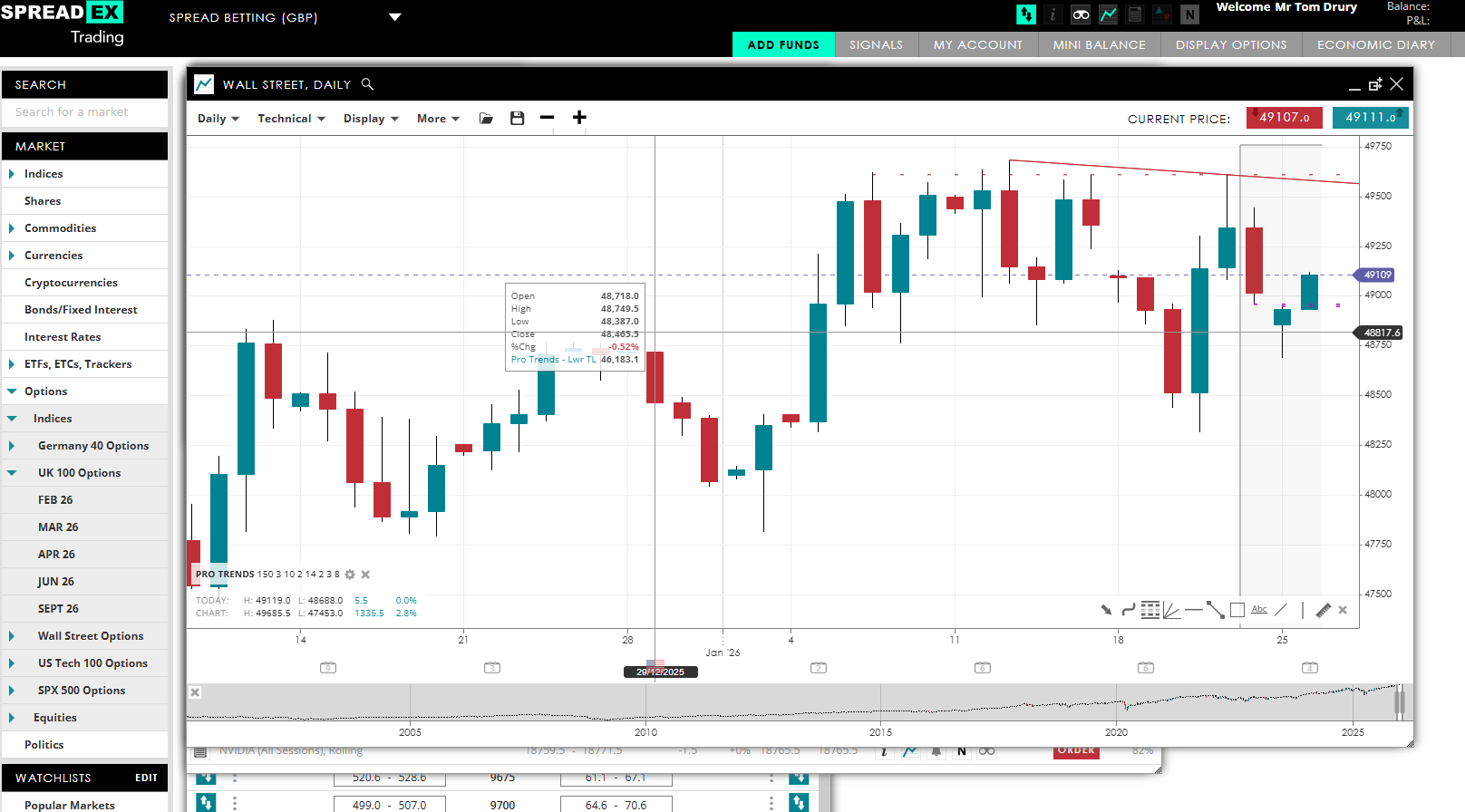
Spreadex supports simultaneous long and short positions on the same instrument without automatic netting. Both spread bets and CFDs are available for hedging, giving you the flexibility to choose the most appropriate execution method. Positions display separately with individual P&L tracking.
What Risk Protection Tools Does Spreadex Offer?
Guaranteed stop-loss orders (GSLOs) are available for premium on most markets, providing gap protection during volatile events. Standard stop-losses, trailing stops, and take-profit orders are also available. Negative balance protection applies to retail accounts.
What Does Hedging Cost at Spreadex?
No commission on spread bets or CFDs*—costs sit entirely in the spread. Overnight financing at benchmark rate plus 2.5% for long positions. GSLO premiums vary by instrument and are displayed before order confirmation. No minimum deposit requirement reduces the barrier to opening a hedging account.
Ideal Hedging Scenario
Spreadex suits traders who want the flexibility to hedge using either tax-free spread bets or traditional CFDs. The combination of guaranteed stops for gap protection and competitive financing rates makes it practical for hedges held over days or weeks. The no-minimum-deposit policy is attractive for traders testing hedging strategies.
*other fees may apply.
IG — Best for Multi-Asset Hedging

Pros
- More ways to trade commodities than any competitor—CFDs, spread bets, futures, options, ETFs
- Weekend gold trading when other brokers are closed
- ProRealTime charting included at no extra cost for active traders
- 50 years in business, publicly listed, properly capitalised
Cons
- Spreads run slightly wider than specialist low-cost brokers
- Platform depth can overwhelm if you just want simple trades
- £12/month inactivity fee after 24 months
How Does IG Handle Hedged Positions?
IG’s “force open” setting allows simultaneous long and short positions on the same instrument. Toggle this in platform settings to prevent automatic netting. Positions display separately with individual P&L tracking. If you hold shares in an IG ISA or share dealing account, you can hedge that exposure with CFDs without transferring assets between platforms—everything visible in one ecosystem.
What Risk Protection Tools Does IG Offer?
Guaranteed stops available for premium on most markets. Standard stops, trailing stops, and limit orders included. Options contracts available for defined-risk hedging strategies where maximum loss equals the premium paid. The platform shows a preview of resulting positions when placing hedged orders, making it easier to see net exposure.
What Does Hedging Cost at IG?
Spread betting: no commission*, costs in spread. CFDs: variable commission on shares, no commission* on indices/forex. Overnight financing at benchmark rate plus 2.5-3% (entity dependent) for long positions. Guaranteed stop premiums vary by market. Weekend holding costs apply to positions held over Saturday/Sunday.
Ideal Hedging Scenario
IG suits traders who need flexibility in hedge construction. CFDs for straightforward protection, spread bets for tax efficiency (profits typically avoid CGT), options for defined-risk strategies. If you might need different hedge types at different times, IG handles all of them from one account.
*other fees may apply.
Pepperstone — Best for Capital-Efficient Hedging
Pros
- Raw spreads from 0.05 points on gold (plus commission)
- MT4, MT5, cTrader, TradingView—platform choice most brokers can’t match
- No inactivity fees
Cons
- Commission on Razor account adds to costs for small positions
- Commodity range is narrower than IG
- No proprietary beginner platform—you’re using MT4/5 or cTrader
How Does Pepperstone Handle Hedged Positions?
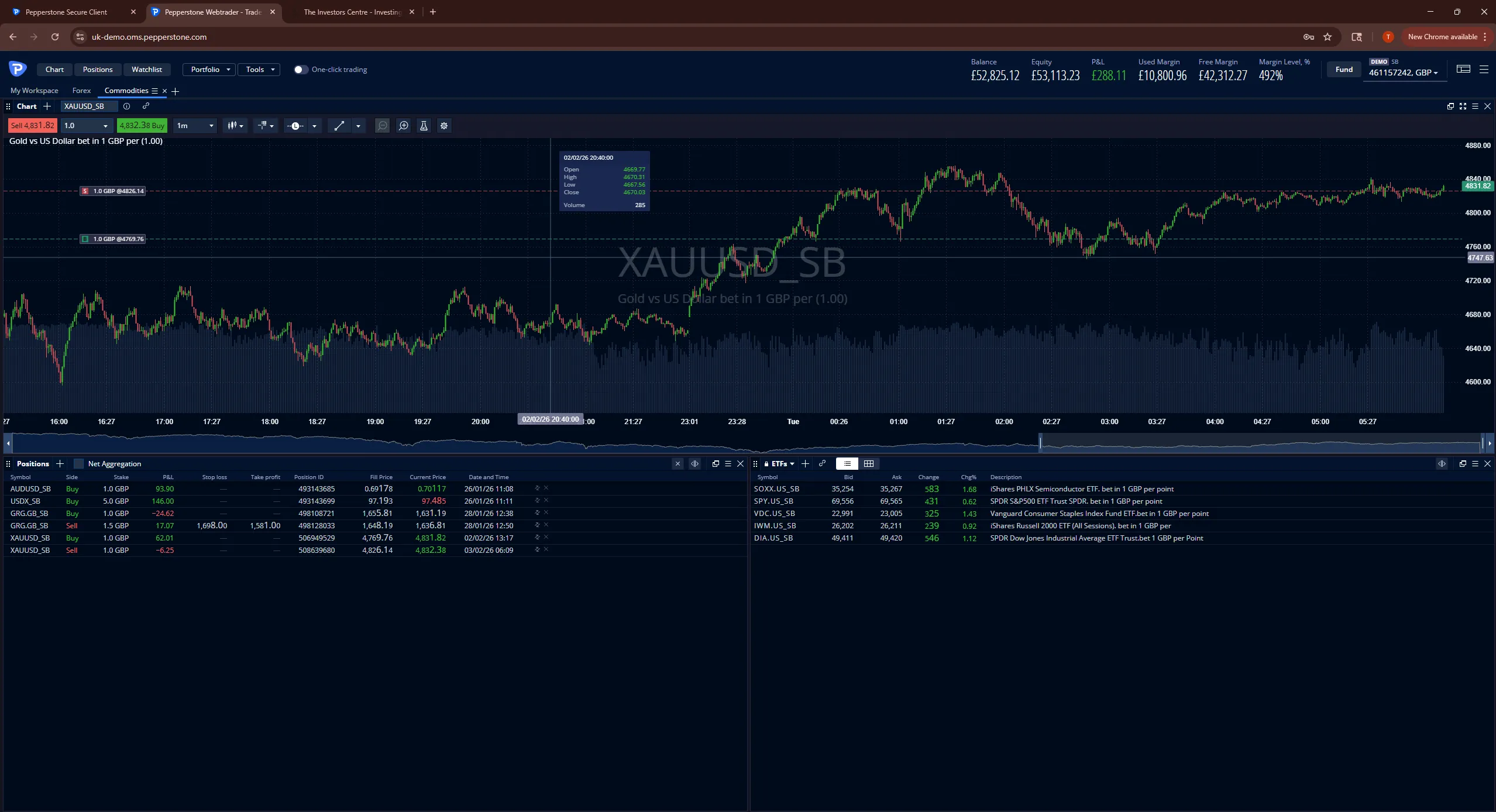
Pepperstone allows hedging across all platforms: MT4, MT5, cTrader, and TradingView. No FIFO (First In First Out) rules—you can close either leg of a hedge in any order. The “net off” feature lets you close hedged positions directly against each other. Critically, margin is calculated on the “largest leg” only—a fully hedged position requires margin on one side, not both.
What Risk Protection Tools Does Pepperstone Offer?
Standard stop-losses, trailing stops, and take-profit orders. No guaranteed stop-loss orders available—if prices gap, stops may slip. The platform advantage is execution speed and the ability to run automated hedging strategies via Expert Advisors on MT4/MT5.
What Does Hedging Cost at Pepperstone?
Razor account: spreads from 0.0 pips plus £2.25 commission per lot per side. Standard account: spreads from 1.0 pip, no commission*. Overnight swap rates calculated using tom-next or benchmark rate plus 2.5-3%, varying by instrument and displayed in the platform. No deposit, withdrawal, or inactivity fees—useful for hedges that may sit dormant between active management.
Ideal Hedging Scenario
Pepperstone suits traders who want to minimise capital tied up in margin. The largest-leg calculation means your hedge doesn’t double margin requirements. Also ideal for automated hedging strategies via MT4/MT5 Expert Advisors. Less suitable if you need guaranteed stops for gap protection.
*other fees may apply.
Saxo — Best for Portfolio-Level Hedging
Pros
- Actual exchange-traded commodity futures—not just CFDs mimicking them
- Commodity options for hedging or directional strategies
- Institutional-grade SaxoTrader platform
- Multi-asset capability if you manage broader portfolios
Cons
- Best pricing requires higher account tiers
- Platform complexity assumes existing trading experience
- More firepower than most retail traders need
How Does Saxo Handle Hedged Positions?
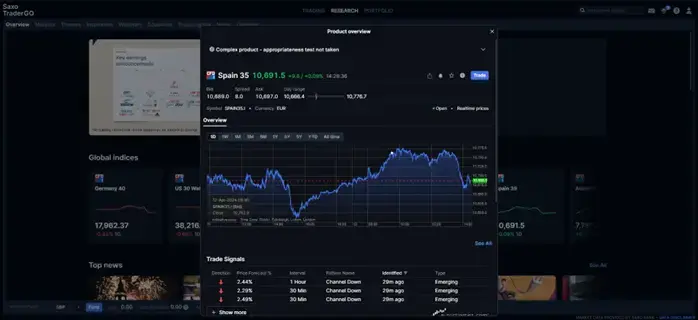
Saxo allows opposing positions on the same instrument. The SaxoTraderGO platform displays your entire portfolio—stocks, ETFs, bonds, CFDs, options, futures—in a single view. This makes it easier to assess total exposure across asset classes and identify what needs hedging. Net exposure calculations show your overall directional risk.
What Risk Protection Tools Does Saxo Offer?
Options and futures available alongside CFDs for sophisticated hedge structures. Options provide defined-risk hedging where maximum loss equals the premium paid. No guaranteed stop-loss orders on CFDs, but the ability to use options compensates for traders who want capped downside. Standard stops and limits available.
What Does Hedging Cost at Saxo?
CFD overnight financing at benchmark rate plus 3.5% markup for Classic tier accounts (lower for Platinum and VIP). Short positions on single stock CFDs incur borrowing fees (minimum 0.5%). Options and futures have separate fee structures. Tiered pricing rewards volume—frequent hedgers pay progressively less.
Ideal Hedging Scenario
Saxo suits sophisticated traders managing multi-asset portfolios who need complete visibility of overall exposure. The ability to hedge with options (defined risk) or futures (no daily financing) adds flexibility that pure CFD brokers can’t match. Higher costs and complexity make it less suitable for simple hedges.
City Index — Best for Tax-Efficient Hedging
Pros
- Copy trading lets you follow experienced commodity traders automatically
- Genuinely intuitive interface—the easiest platform on this list
- Social sentiment data on commodities
- 25+ commodities with straightforward access
Cons
- Spreads are meaningfully wider—45 pips on gold
- $5 withdrawal fee adds friction
- $10/month inactivity fee after 12 months
How Does City Index Handle Hedged Positions?
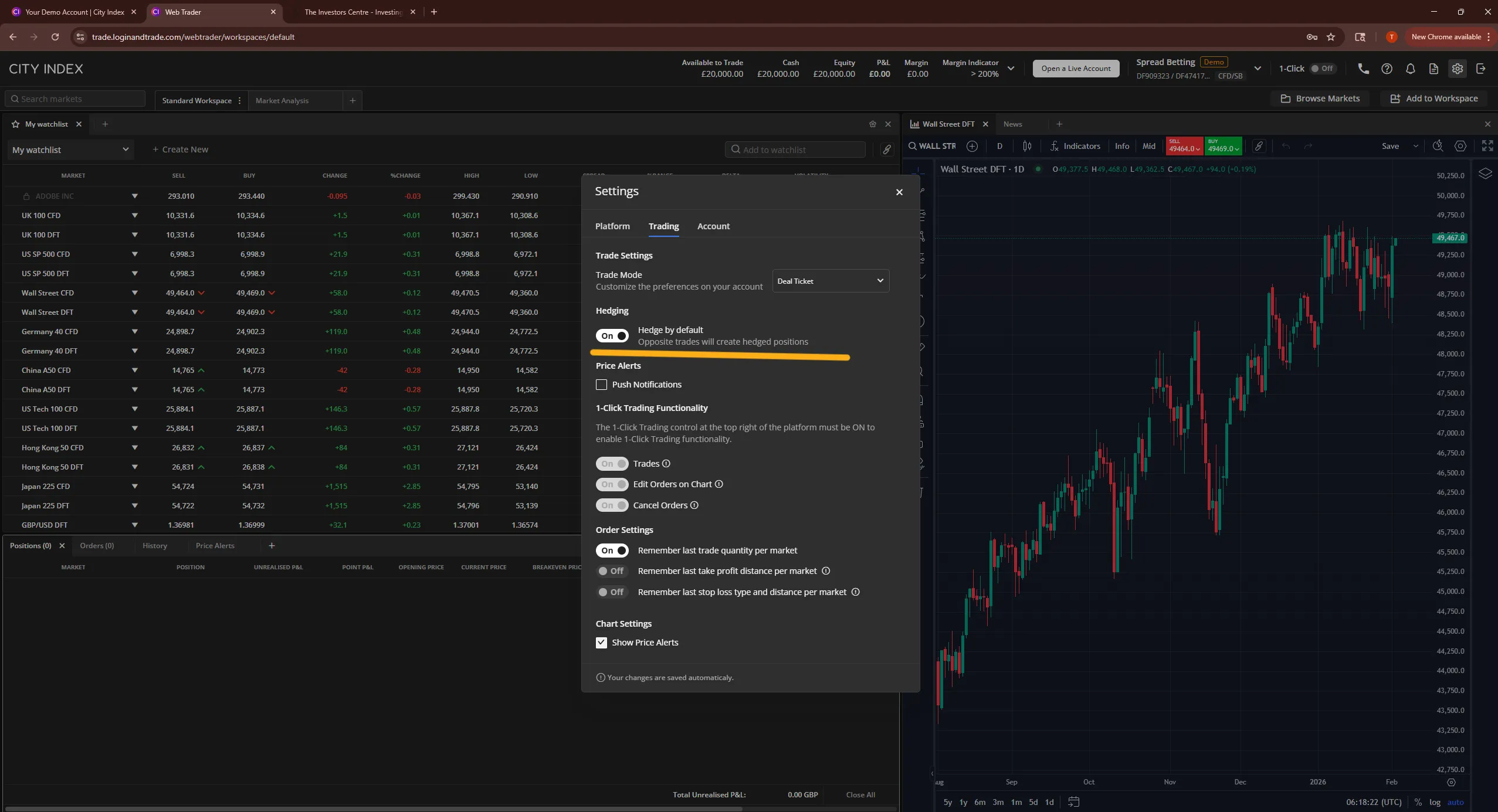
City Index allows simultaneous opposing positions without automatic netting. Both spread bets and CFDs support hedging. Positions display separately for clear tracking. Part of StoneX Group (NASDAQ-listed), providing institutional backing and stability.
What Risk Protection Tools Does City Index Offer?
Guaranteed stop-loss orders available for premium on most markets—protection against gaps. Standard stops, trailing stops, and take-profit orders included. 13,500+ markets provide flexibility for cross-asset hedging strategies.
What Does Hedging Cost at City Index?
Spread betting: no commission*, costs in spread. Overnight financing at benchmark rate plus 2.5% for long positions (minus 2.5% for shorts, though low base rates may still result in a charge). GSLO premiums vary by instrument. No commission on spread bets.
Ideal Hedging Scenario
City Index suits UK traders who want tax-efficient hedging. Spread betting profits typically avoid Capital Gains Tax, which matters if the hedge itself is profitable. Combined with guaranteed stops for gap protection, this makes City Index attractive for hedging profitable portfolios where CGT would otherwise apply.
*other fees may apply.
Are These CFD Hedging Brokers Safe and Regulated?
All six brokers are FCA-authorised with identical core protections for UK retail clients:
| Protection | What It Means |
|---|---|
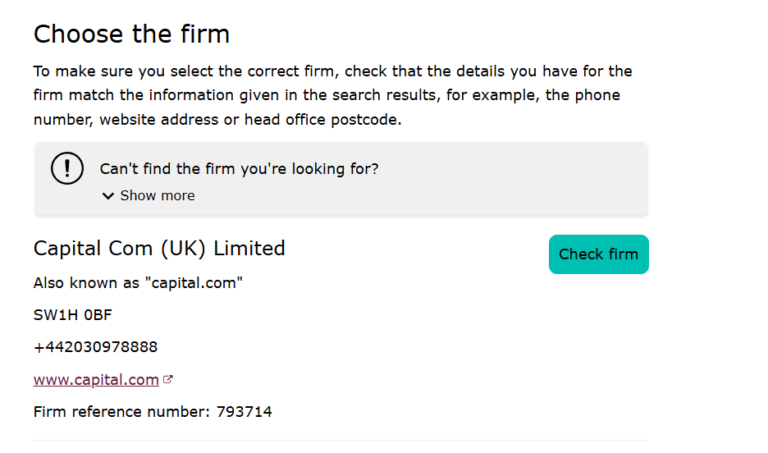
| FCA Regulation | Each broker is authorised by the Financial Conduct Authority—verify on register.fca.org.uk |
| Segregated Funds | Client money held separately from company funds |
| FSCS Protection | Up to £85,000 covered per person if the broker fails |
| Negative Balance Protection | Retail accounts can’t lose more than deposited |
Additional credibility factors:
- IG is publicly listed on the London Stock Exchange
- Spreadex is an established UK-based broker operating since 1999
- Saxo is backed by Saxo Bank A/S, a Danish-regulated bank
- City Index is part of StoneX Group, a NASDAQ-listed company
- Pepperstone holds dual FCA and ASIC (Australia) regulation
Important Note: Regulation protects against broker failure, not trading losses. Hedging reduces but doesn’t eliminate market risk.
What Does It Actually Cost to Maintain a CFD Hedge?
Hedging isn’t free. Here’s a realistic cost breakdown for maintaining a hedge over time.
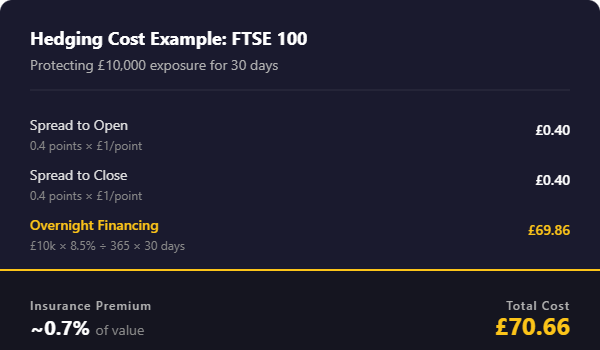
What affects hedging cost:
- Spread width: Lower spreads = cheaper entry/exit
- Overnight rate: Lower financing = cheaper long-term holds
- Commission: Adds to cost on each leg (Pepperstone Razor, Saxo)
- GSLO premium: Additional cost for guaranteed execution (Capital.com, Spreadex, IG, City Index)
Cost-saving strategies:
- Use spread bets where possible (no commission at most brokers)
- Close hedges when risk passes rather than holding indefinitely
- Compare overnight rates—they vary significantly between brokers
- Consider futures for multi-week hedges (financing built into spread, no daily charge)
How Does CFD Hedging Actually Work?
CFD hedging involves opening a position designed to profit when your existing exposure loses value.
Direct hedge example: You own £20,000 in Barclays shares. Earnings are next week, and you’re worried about a drop. You short £20,000 of Barclays via CFD. If shares fall 10%, you lose £2,000 on shares but gain approximately £2,000 on the CFD (minus costs). Net result: protected.
Proxy hedge example: You own a portfolio of UK financial stocks. Rather than hedging each individually, you short the FTSE 350 Banks index via CFD. If the sector falls, your index short gains value, offsetting portfolio losses. Less precise than direct hedging, but simpler to manage.
Partial hedge: You don’t have to hedge 100%. A 50% hedge reduces volatility while maintaining some upside participation. Many hedgers prefer partial coverage to balance protection with opportunity.

When Does CFD Hedging Make Sense?
Hedging adds cost and complexity. It makes sense in specific situations:
Managing the risks:
- Use stop-losses. Always.
- Size positions so a single loss doesn’t cripple your account—1-2% risk per trade is a common guideline
- Understand overnight costs before holding positions for days
- Start with a demo account if commodity markets are new to you
Final Thoughts
Capital.com offers the clearest hedging implementation for most UK traders—dedicated mode toggle, visible position separation, guaranteed stop-loss orders for gap protection, and no commission* to erode hedge value over time. Spreadex provides the flexibility of combined spread betting and CFD hedging with guaranteed stops and competitive financing rates. Pepperstone’s margin-on-largest-leg calculation makes hedging more capital-efficient. IG offers the most flexibility with CFDs, spread bets, options, and futures from one account.
Hedging protects existing positions but adds cost. A 30-day hedge on £10,000 costs approximately £70.66 in spread and financing—roughly 0.7% of protected value. Worth it for genuine risk reduction; expensive if used without clear purpose. Match your hedging need to the broker that handles it best.
*other fees apply.
FAQs
References
Broker Websites (Primary Sources):
- Capital.com UK — FRN 793714, hedging mode, GSLO documentation
- Spreadex UK — FRN 202392, spread betting and CFD hedging
- IG UK — FRN 195355, force open feature, options
- Pepperstone UK — FRN 684312, margin policy, hedging FAQ
- Saxo UK — FRN 551422, CFD financing rates
- City Index UK — FRN 446717, overnight funding
Regulatory Sources:
- FCA Financial Services Register — Broker authorisation verification
- FSCS Investment Protection — £85,000 per eligible person
Hedging features and costs verified from broker websites and help documentation, January 2026. Overnight financing rates are variable and depend on prevailing benchmark rates. All brokers verified on FCA register.