

- expertise:
- CFD Trading, Forex, Derivatives, Risk Management
- credentials:
- Chartered ACII (2018) · Trading since 2012
- tested:
- 40+ forex & CFD platforms with live accounts

- expertise:
- Broker Comparison, ISA Strategy, Portfolio Management
- credentials:
- Active investor since 2013 · 11+ years experience
- tested:
- 40+ brokers with funded accounts
How We Test
Real accounts. Real money. Real trades. No demo accounts or press releases.
What we measure:
- Spreads vs advertised rates
- Execution speed and slippage
- Hidden fees (overnight, withdrawal, conversion)
- Actual withdrawal times
Scoring:
Fees (25%) · Platform (20%) · Assets (15%) · Mobile (15%) · Tools (10%) · Support (10%) · Regulation (5%)
Regulatory checks:
FCA Register verification · FSCS protection
Testing team:
Adam Woodhead (investing since 2013), Thomas Drury (Chartered ACII, 2018), Dom Farnell (investing since 2013) — 50+ platforms with funded accounts
Quarterly reviews · Corrections: in**@*******************co.uk
Disclaimer
Not financial advice. Educational content only. We're not FCA authorised. Consult a qualified advisor before investing.
Capital at risk. Investments can fall. Past performance doesn't guarantee future results.
CFD warning. 67-84% of retail accounts lose money trading CFDs. High risk due to leverage.
Contact: in**@*******************co.uk
The FTSE 100 is the most actively traded index among UK retail traders - and for good reason. It represents the 100 largest companies listed on the London Stock Exchange, it moves during UK business hours, and it responds to economic data and events that UK-based traders naturally follow. I’ve been trading the FTSE on and off for several years, and the platform you use makes a genuine difference to both your costs and your experience.
Not every broker handles FTSE trading equally. Spread width, overnight financing rates, charting quality, and the availability of guaranteed stops all vary significantly. We compare six FCA-regulated platforms on their FTSE 100 trading capabilities and rank them on what actually matters when you’re trading the UK’s flagship index.
What is the best platform for trading the FTSE in the UK?
The best FTSE trading platform in the UK is Pepperstone, with index market orders filled in under 50 milliseconds, the fastest we measured. UK 100 spreads ran at about 0.8 points plus commission on the Razor account, and there’s no minimum deposit. The range is thin, though: around 23 indices, and no FTSE options or futures.
For the FTSE 250, sector indices or options, go to IG. If you mainly spread bet the FTSE, I’d look at Spreadex. It’s where I place my daily UK index spread bets, and guaranteed stops cover you if the FTSE gaps at the open.

Pepperstone
- Best For
- Fast, Low-Cost FTSE Execution
- TIC Rating
- 4.8 / 5
- Community Rating
- 4.3 (502 ratings) Have Your Say →
73.6% of retail CFD accounts lose money.

IG
- Best For
- Deep FTSE Coverage
- TIC Rating
- 4.7 / 5
- Community Rating
- 4.3 (473 ratings) Have Your Say →
70% of retail CFD accounts lose money.

Capital.com
- Best For
- Low-Cost FTSE CFDs
- TIC Rating
- 4.7 / 5
- Community Rating
- 4.2 (379 ratings) Have Your Say →
65% of Retail CFD Accounts Lose Money

Trading.com
- Best For
- FTSE via MT5
- TIC Rating
- 3.9 / 5
- Community Rating
- 3.1 (40 ratings) Have Your Say →
70.6% of retail CFD accounts lose money.

Spreadex
- Best For
- Tax-Free FTSE Spread Betting
- TIC Rating
- 4.6 / 5
- Community Rating
- 4.2 (421 ratings) Have Your Say →
61% of retail CFD accounts lose money.

Trade Nation
- Best For
- UK 100 at a Fixed 0.8-Point Published Spread
- TIC Rating
- 4.4 / 5
- Community Rating
- 4.1 (93 ratings) Have Your Say →
73.7% of retail CFD accounts lose money.
How Do These FTSE Trading Platforms Compare?
| # | Broker | Best For | Key FTSE Feature | FCA FRN |
|---|---|---|---|---|
| 1 | Pepperstone | Fast, low-cost FTSE execution | Raw UK 100 spreads + TradingView integration | 684312 |
| 2 | IG | Deep FTSE coverage | FTSE 100/250/350 + options | 195355 |
| 3 | Capital.com | Low-cost FTSE CFDs | No commission + TradingViewOther fees apply | 793714 |
| 4 | Trading.com | FTSE via MT5 | FTSE 100 (UK 100) CFDs on MT5 | 705428 |
| 5 | Spreadex | Tax-free FTSE spread betting | Spread betting + CFDs on FTSE | 190941 |
| 6 | Trade Nation | Fixed, published UK 100 spread | 0.8pt fixed in the main session (published), guaranteed stops | 525164 |
What Should You Look For in a FTSE Trading Platform?
FTSE trading has specific requirements that differ from forex or individual share CFDs. Here’s what I’ve found matters most after years of trading the UK 100 index.
Spread on the FTSE 100: This is your primary cost for each trade. A 1-point spread on the FTSE 100 means you need the index to move at least 1 point in your favour before you break even. During normal UK trading hours (8am–4:30pm), expect spreads of 1–2 points from competitive brokers. Outside these hours, spreads widen - sometimes significantly. I’ve seen spreads triple during the pre-market session on some platforms.
Spread betting vs CFDs: For UK residents, spread betting on the FTSE is typically more tax-efficient. Profits from spread bets are usually free from Capital Gains Tax and Stamp Duty, whereas CFD profits are subject to CGT. All three brokers we review offer both options. The mechanics are identical - you’re still speculating on FTSE price movements - but the tax treatment can meaningfully impact your net returns over a year of active trading.
Guaranteed stop-losses: The FTSE 100 can gap at open. If overnight news moves markets, the index might open 50 or 100 points away from the previous close. A standard stop-loss won’t protect you at your set level - it will execute at the first available price after the gap. Guaranteed stop-loss orders (GSLOs) execute at your exact specified price regardless of gaps. Spreadex, Capital.com, and IG all offer these for a premium.
Overnight financing: If you hold a FTSE position overnight, the broker charges a daily financing fee. For short-term day trades, this is irrelevant. For swing trades held over several days or weeks, it accumulates. The rate is typically a benchmark rate (like SONIA) plus a markup - usually 2.5–3.5% per year, charged daily. This matters more on larger positions.
How Do These Platforms Compare for FTSE Specifically?
| Feature | Pepperstone | IG | Capital.com | Spreadex | Trade Nation |
|---|---|---|---|---|---|
| FTSE 100 Spread (typical) | ~0.8 pts + comm (Razor) | From 1 point | From 1 point | Competitive | 0.8pt fixed, 08:00–16:29 (published) |
| Spread Betting | Yes | Yes | Yes | Yes | Yes |
| CFDs | Yes | Yes | Yes | Yes | Yes |
| Guaranteed Stops | – | Yes (GSLO) | Yes (GSLO) | Yes (GSLO) | Yes, 2% minimum distance (published), premium applies |
| FTSE 250 Available | – | Yes | Yes | Yes | No (UK 100 only) |
| Overnight Rate | – | Benchmark + 2.5-3% | Benchmark + markup (varies) | Benchmark + 2.5% | Spread widens to 5pt overnight instead (published) |
| Out-of-Hours Trading | – | Yes (extended hours) | Limited | Limited | Limited (wider published overnight band) |
| FTSE Options | No | Yes | No | No | No |
| FTSE Futures | No | Yes | No | No | No |
Spreads vary by market conditions and time of day. Verified from broker platforms, February–March 2026. Pepperstone joined this comparison in July 2026 using its indices-round FTSE 100 result; dashes mark features outside that comparison. Trade Nation joined in August 2026 using its published UK 100 spread bands checked that month.
What I Found Trading the FTSE on Each Platform
Each review focuses on FTSE-specific trading capabilities: spreads, execution, charting, risk tools, and the overall experience of trading the UK 100 index on each platform.
1. Pepperstone - Best for Fast, Low-Cost FTSE Execution
2. IG - Best for Deep FTSE Market Coverage
3. Capital.com - Best for Low-Cost FTSE CFDs
4. Trading.com - A Newer FCA Option, Added After Our Test Round
5. Spreadex - Tax-Free FTSE Spread Betting from One Account
6. Trade Nation - Best for a Fixed, Published UK 100 Spread
Pepperstone - Best for Fast, Low-Cost FTSE Execution
- Fees & Spreads
- 4.1
- Platform & Tools
- 4.4
- Customer Service
- 4.2
- Ease of Use
- 3.9
- Mobile App
- 4.3
Pros
- Sub-50ms execution on index market orders - the fastest we tested
- Raw UK 100 spreads on the Razor account (~0.8 points + commission in our test)
- MT4, MT5, cTrader, TradingView and Pepperstone's own platform on the same login - trade the FTSE straight from TradingView charts
- No minimum deposit and no inactivity fee
Cons
- Around 23 indices available - IG offers far deeper FTSE-related coverage
- No FTSE options or futures - spot spread bets and CFDs only
- Razor commission adds complexity to cost calculations
How Is FTSE Trading on Pepperstone?
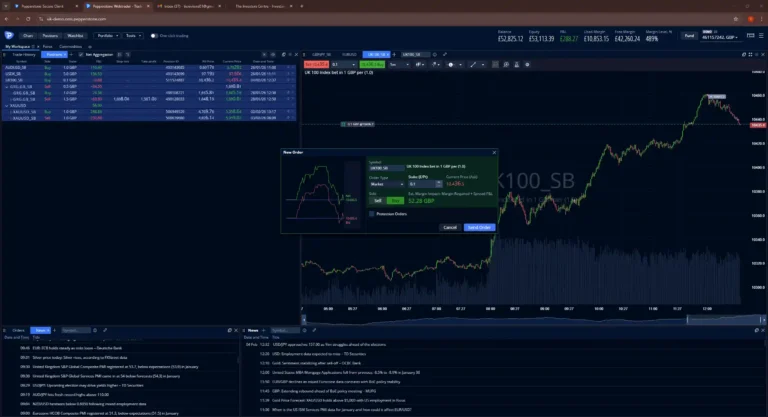
Pepperstone gives you five platforms to trade the FTSE from: MT4, MT5, cTrader, TradingView and its newer proprietary platform. The TradingView integration is the standout - you can place UK 100 trades directly from TradingView charts with no switching between windows. Both spread betting and CFDs are available on the index, so UK traders can keep the typically tax-free spread-bet treatment while using the same charts and execution.
In our test round the FTSE 100 (UK 100) spread ran at roughly 1.2 points on the Standard account and about 0.8 points plus commission on Razor. Execution is where Pepperstone stands out: index market orders filled in under 50 milliseconds during our testing - the fastest of the platforms we measured.
What Does FTSE Trading Cost on Pepperstone?
Two account types. The Razor account charges the raw spread plus a £2.25 per-side commission - at higher volumes this works out cheaper than spread-only pricing. The Standard account wraps the commission into the spread, which is simpler for occasional trades. There is no minimum deposit and no inactivity fee, and overnight financing applies to positions held past the session close in the normal way.
Tax laws can change and depend on individual circumstances.
IG - Best for Deep FTSE Market Coverage
- Fees & Spreads
- 4.2
- Platform & Tools
- 4.5
- Customer Service
- 3.8
- Ease of Use
- 4.1
- Mobile App
- 4.2
Pros
- Deepest FTSE coverage: FTSE 100, FTSE 250, FTSE 350, sector indices, plus individual constituents
- FTSE options and futures available for more sophisticated strategies
- ProRealTime charting included free for active traders - institutional-grade analysis
- 50 years in business, publicly listed on the London Stock Exchange - established credibility
Cons
- FTSE 100 spreads can run slightly wider than specialist competitors
- Platform depth can feel overwhelming if you only want straightforward FTSE trades
- £12/month inactivity fee after 24 months of no trading
How Is FTSE Trading on IG?
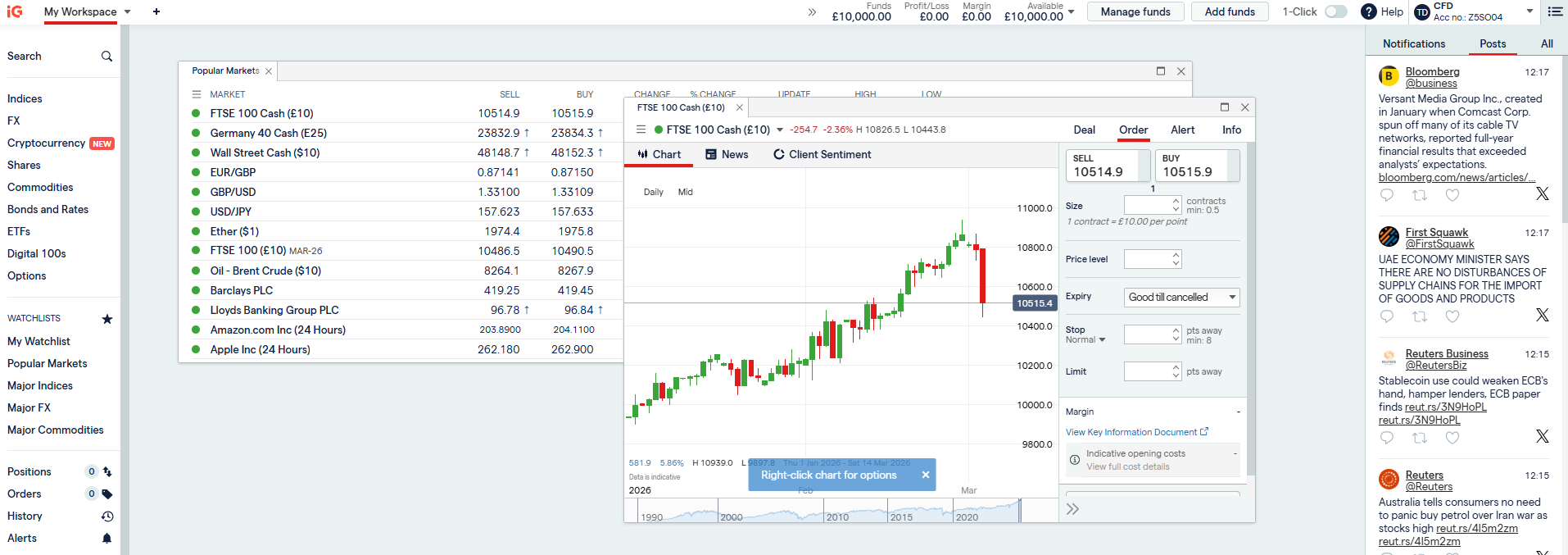
IG is the most comprehensive FTSE trading platform available. Beyond the standard FTSE 100, you can trade the FTSE 250 (mid-cap UK companies), the FTSE 350, and individual FTSE sector indices like FTSE Banks or FTSE Oil & Gas. This depth allows you to express specific views on the UK market - bullish on mid-caps but bearish on banks, for instance - rather than being limited to the headline index.
I’ve used IG for FTSE trading for several years, and what keeps me coming back is the combination of ProRealTime charting and the sheer range of UK markets. ProRealTime is genuinely institutional-grade - pattern recognition, advanced screeners, and multi-timeframe analysis that goes well beyond what most retail platforms offer. For traders who rely on technical analysis for FTSE positions, this is a meaningful edge.
What FTSE Instruments Does IG Offer?
IG offers the widest range of FTSE-related instruments:
- FTSE 100 spot: Spread betting and CFDs with tight spreads from 1 point
- FTSE 100 futures: Quarterly contracts with no daily financing charges - useful for longer-term positions
- FTSE 100 options: Calls and puts for defined-risk strategies where maximum loss equals the premium
- FTSE 250: Access to the mid-cap index for broader UK market exposure
- FTSE sector indices: Trade specific sectors within the FTSE (banking, energy, resources)
This range is unmatched. Spreadex and Capital.com offer FTSE 100 and 250 spot trading, but neither provides options, futures, or the granular sector access that IG delivers.
What Does FTSE Trading Cost on IG?
Spread betting: no commission*, costs in the spread. FTSE 100 spread from 1 point during core UK hours. CFDs: no commission* on indices. Overnight financing at benchmark rate plus 2.5-3% (entity dependent) for long positions. FTSE futures spreads are wider but include no daily financing - cost-effective for positions held more than a few days. Guaranteed stop premiums vary by market conditions. Weekend holding costs apply to positions held over Saturday/Sunday.
*other fees may apply.
Capital.com - Best for Low-Cost FTSE CFDs
- Fees & Spreads
- 4.4
- Platform & Tools
- 4.4
- Customer Service
- 4.5
- Ease of Use
- 4.8
- Mobile App
- 4.9
Pros
- FTSE 100 CFDs from 1 point spread with no commission (other fees apply)
- TradingView integration for professional FTSE 100 charting and technical analysis
- Clear overnight financing costs displayed on the deal ticket before confirmation
- Guaranteed stop-loss orders available for gap protection
Cons
- No FTSE options or futures for more complex strategies
- No MT5 - limited to proprietary platform, MT4 and TradingView
- £20 minimum deposit (though modest for index trading)
How Is FTSE Trading on Capital.com?
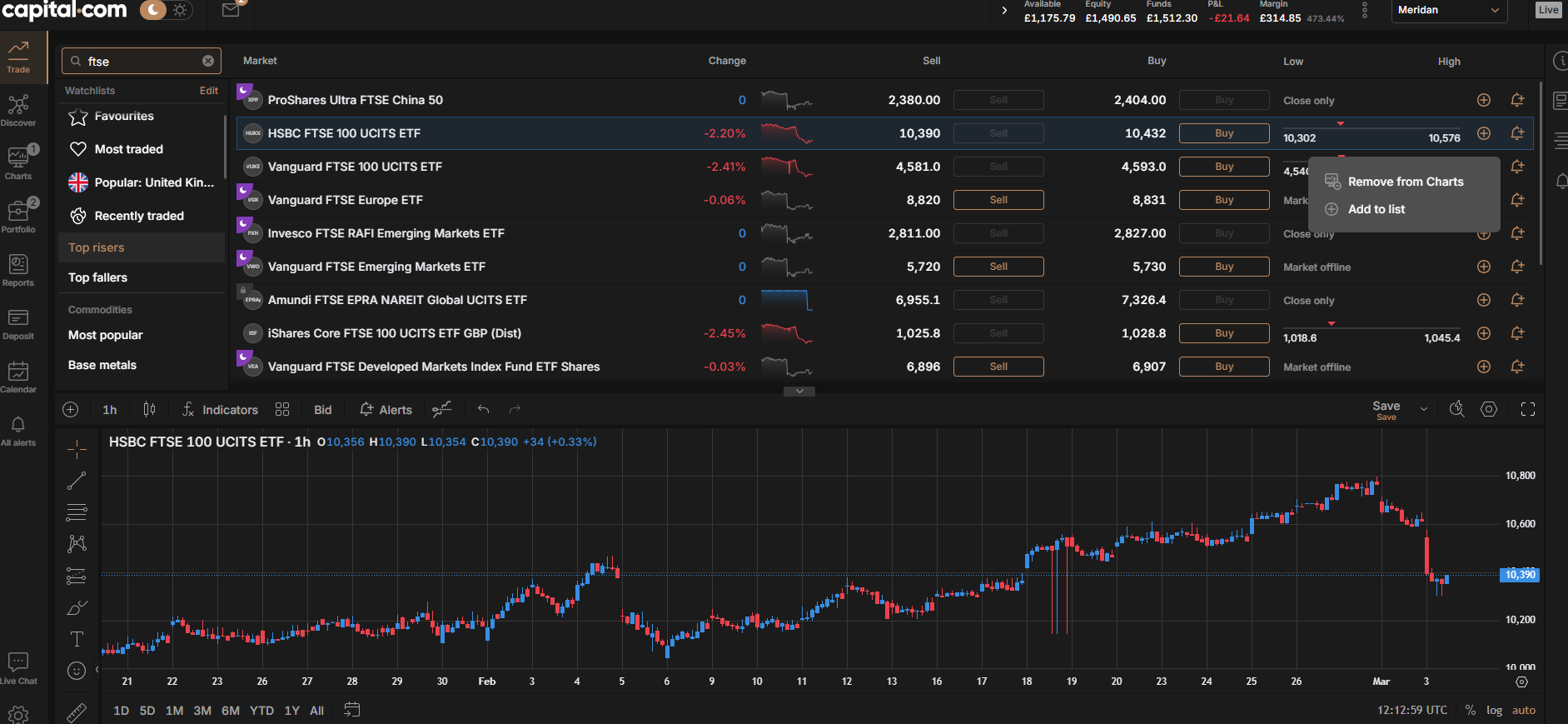
Capital.com’s FTSE 100 offering is clean and cost-effective. No commission (other fees apply) on any trade, and the FTSE 100 spread starts from 1 point during core UK hours. What sets it apart for FTSE traders is the TradingView integration - you get full access to TradingView’s charting tools directly within the platform. For FTSE technical analysis, this is a major advantage: you can overlay indicators, draw trend lines, and analyse multi-timeframe charts without switching between windows.
One thing I appreciate for FTSE trading specifically is how transparent the pricing is. Overnight financing charges are displayed on the order ticket before you confirm, so you can calculate multi-day holding costs in advance. The deal ticket also shows your margin requirement clearly - useful when you’re sizing FTSE positions relative to your account balance.
What Risk Tools Are Available for FTSE Positions?
Guaranteed stop-loss orders are available on the FTSE 100. The GSLO premium is displayed on the deal ticket before you confirm, so you know the exact cost upfront. Standard stop-losses, trailing stops, and take-profit orders are also available. For swing traders, the ability to set a guaranteed exit level on a volatile index like the FTSE is a genuine advantage - particularly around economic data releases where gaps at open are common.
What Does FTSE Trading Cost on Capital.com?
No commission on FTSE 100 CFDs (other fees apply). FTSE 100 spread from 1 point during core hours. GSLO premiums vary by market conditions and are shown before order confirmation. Overnight funding at benchmark rate plus a markup that varies by market and trade direction, displayed on the order ticket. Spread betting also available for UK clients as a tax-efficient alternative.
Trading.com - A Newer FCA-Regulated MT5 Option for the FTSE (Added After Our Test Round)
- Fees & Spreads
- 4.2
- Platform & Tools
- 4.5
- Customer Service
- 3.8
- Ease of Use
- 4.1
- Mobile App
- 4.2
Pros
- Trades the FTSE 100 (UK 100) as a CFD on MetaTrader 5
- TradingView-powered charts on its own WebTrader
- £10,000 no-expiry demo to trial a FTSE strategy first
- FCA-regulated (FRN 705428) and FSCS-protected
Cons
- FTSE 100 spread shown at the 1.0-point comparison average*
- CFD-only - no UK spread betting, so FTSE profits fall under CGT
- No FTSE options, futures or sector indices
- Younger UK track record than the three tested brokers
What We Tested on Trading.com
For consistent comparison, Trading.com uses a clearly labelled 1.0-point FTSE 100 average calculated from the three benchmark brokers. On published terms it offers the FTSE 100 (listed as the UK 100) as a CFD on MetaTrader 5 alongside its own TradingView-charted WebTrader, with a £10,000 no-expiry demo to develop and forward-test a FTSE strategy. This keeps the table complete while preserving a clear distinction between live observations and comparison averages.
Is Trading.com Safe for FTSE Traders?
Trading.com Markets UK Limited is FCA-authorised under FRN 705428 (the rebranded UK arm of XM, authorised since 2016), which we verified on the FCA Register. UK client money is held in segregated accounts under FCA CASS rules and covered by FSCS up to £85,000 per eligible claim, with negative balance protection on retail accounts - the same core protections as the three platforms above.
Who Should Use Trading.com for FTSE Trading?
Trading.com suits traders who want to trade the FTSE 100 through MetaTrader 5 on a simple, FCA-regulated platform, and who value a no-expiry demo to rehearse a strategy first. One important caveat for this page: Trading.com is CFD-only, with no UK spread-betting account, so FTSE profits are subject to Capital Gains Tax rather than the tax-free spread betting Spreadex, IG and Capital.com offer. If tax-free spread betting or guaranteed stop-losses are your priority, those tested three remain the stronger picks until we publish Trading.com's own FTSE figures. Tax laws can change and depend on individual circumstances.
Spreadex - Tax-Free FTSE Spread Betting from One Account
- Fees & Spreads
- 4.5
- Platform & Tools
- 4.2
- Customer Service
- 4.7
- Ease of Use
- 4.2
- Mobile App
- 4.1
Pros
- Tax-free* FTSE spread betting alongside traditional CFDs from one account
- Guaranteed stop-loss orders for overnight gap protection on FTSE positions
- No minimum deposit - start trading the FTSE with any amount
- UK-based broker since 1999 - FTSE trading is a core strength, not an afterthought
Cons
- No FTSE futures - options and spot trading only
- No MT4/MT5 - uses proprietary platform plus TradingView
- Fewer FTSE-related markets than IG (no FTSE 350 or sector indices)
How Is FTSE Trading on Spreadex?
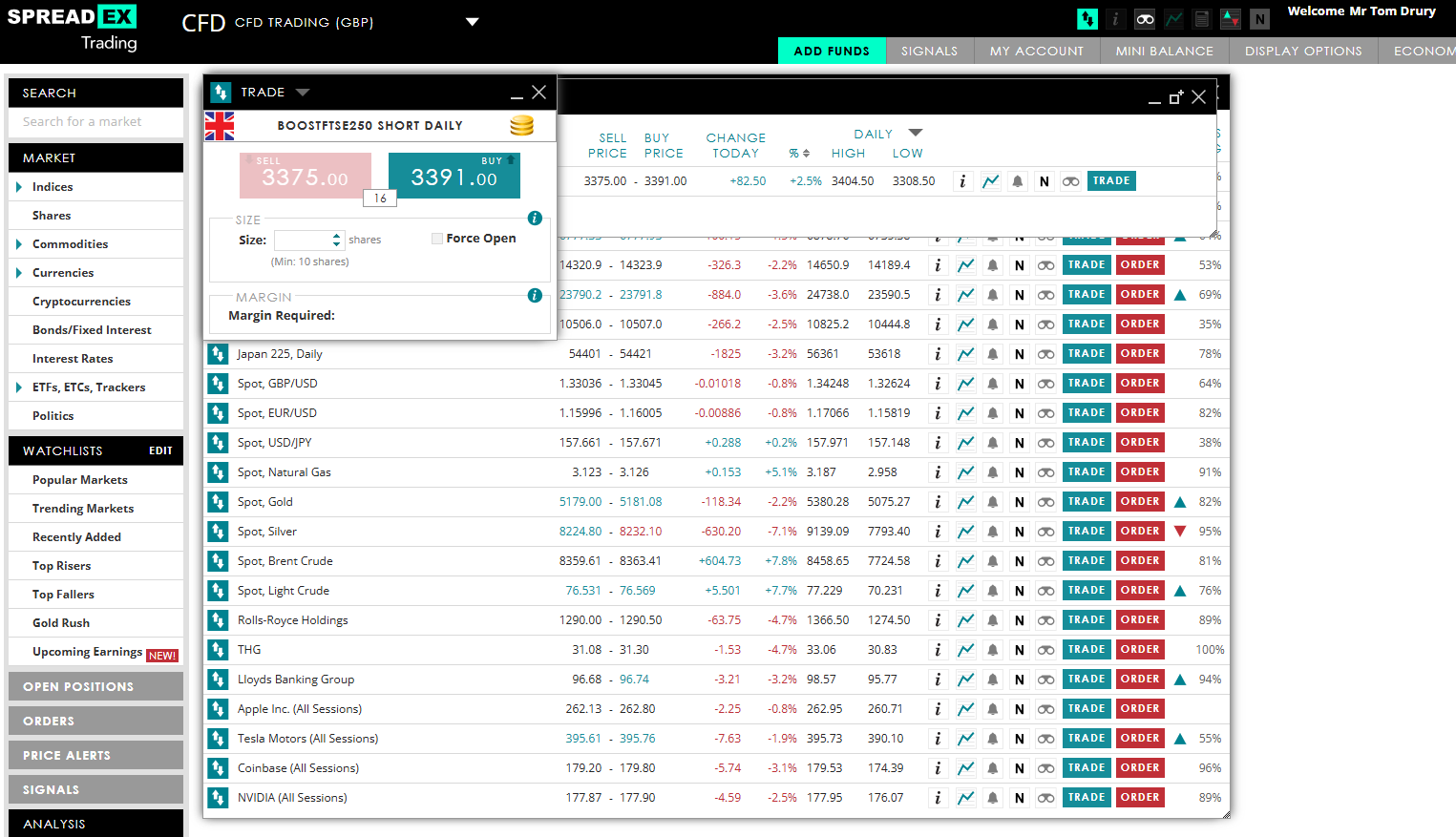
Spreadex was built for UK index trading, and it shows. The FTSE 100 is prominently placed on the platform rather than listed among thousands of other instruments. When I first opened my Spreadex account, I had a FTSE 100 spread bet placed within minutes. The order ticket is clean: you see the live bid/ask, your stake per point, the margin requirement, and any applicable overnight charges before you confirm. No hidden surprises.
The dual spread betting and CFD access is the standout for FTSE traders. I use spread betting for most FTSE trades because the profits are typically tax-free under current HMRC treatment. If I need to hedge a position or want to use CFDs for a specific reason, the CFD option is right there in the same account. This flexibility is genuinely useful - not every broker offers both.
What Risk Tools Are Available for FTSE Positions?
Guaranteed stop-loss orders are available on the FTSE 100 and most major markets. This matters because the FTSE gaps at open regularly - UK economic data, global overnight moves, and company earnings can all push the index to open significantly higher or lower than the previous close. A standard stop placed at 10,400 on a FTSE position might execute at 10,370 if the index gaps down. A guaranteed stop executes at 10,400 regardless. The GSLO premium is displayed before you confirm the trade.
What Does FTSE Trading Cost on Spreadex?
No commission on spread bets or CFDs* - costs are in the spread. Overnight financing at benchmark rate plus 2.5% for long positions. GSLO premiums vary and are displayed on the order ticket. No minimum deposit requirement, no inactivity fees.
*other fees may apply. Tax laws can change and depend on individual circumstances.
Trade Nation - Best for a Fixed, Published UK 100 Spread
- Fees & Spreads
- 4.9
- Platform & Tools
- 4.5
- Customer Service
- 3.7
- Ease of Use
- 4.1
- Mobile App
- 4.3

Pros
- UK 100 fixed at 0.8 points in the 08:00-16:29 session (published)
- Spread bet the FTSE tax-free (individual circumstances apply) or trade it as a CFD
- Guaranteed stops on UK 100 with a published 2% minimum distance (premium applies)
- 10p-a-point minimum stakes
Cons
- No MT5
- Overnight band widens to 5 points outside market hours (published)
- No share dealing or ISA
How Is FTSE Trading on Trade Nation?
Trade Nation prices the UK 100, its name for the FTSE 100, on a published, time-banded spread rather than a variable one. During the main UK session (08:00 to 16:29), the spread sits at a fixed 0.8 points on the published TN Trader market information sheet, moving to 1 point in the shoulder windows either side of the open and close, and to 5 points overnight. When I checked TN Trader live during London hours, the quoted 0.8-point UK 100 spread matched the published sheet exactly, with two working orders sitting either side of the market at 0.1 stakes while I watched it.
Both a spread betting account and a CFD account sit on the same login, so you can keep FTSE profits tax-free through spread betting (individual circumstances apply) or run the position as a CFD if that suits you better. Ten pence a point is the minimum stake, small enough to size a FTSE position cautiously while you learn how the index moves.
What Risk Tools Are Available for FTSE Positions on Trade Nation?
Guaranteed stop-loss orders are available on the UK 100, with a published minimum distance of 2% of the market price and a premium charged on top of the normal spread. That premium buys a stop that executes at your exact level even if the FTSE gaps at the open, the same trade-off the other platforms on this page charge for on their own guaranteed stops.
What Does FTSE Trading Cost on Trade Nation?
No commission on top of the spread, so the published 0.8-point UK 100 spread in the main session is the full cost of the trade. That band widens to 5 points overnight: an honest trade-off for a platform that publishes exact numbers rather than quoting a spread "from" a headline figure. Guaranteed stop premiums are charged separately at the published 2% minimum distance. Trade Nation does not offer MT5, and there is no share dealing or ISA account, so this is a spread betting and CFD platform only.
Tax laws can change and depend on individual circumstances.
How I Tested These FTSE Trading Platforms
I opened live, funded accounts with Spreadex, Capital.com and IG and traded the FTSE 100 on each over several weeks - normal sessions, the volatile first 30 minutes after the London open, high-impact days around Bank of England decisions and UK data releases, and out-of-hours sessions to put IG’s extended trading to the test. Throughout, I logged live FTSE 100 spreads to see how each platform behaved when it mattered.
Beyond spreads, I tested guaranteed stop-losses on every platform to check execution matched the guaranteed level in fast markets, held positions overnight to compare real financing charges against the published rates, and traded IG’s FTSE futures to see how that avoids daily financing. I also ran Capital.com’s TradingView, IG’s ProRealTime, and Spreadex’s native charts side by side for FTSE technical analysis.
Finally, I verified each broker’s FCA authorisation on register.fca.org.uk, confirmed FSCS coverage, and checked negative balance protection was active on the retail accounts.
Are These FTSE Trading Platforms Safe and Regulated?
All six platforms are authorised and regulated by the Financial Conduct Authority, which means identical core protections for UK retail traders:
| Protection | What It Means |
|---|---|
| FCA Regulation | Each broker is authorised by the Financial Conduct Authority - verify on register.fca.org.uk |
| Segregated Funds | Client money held separately from company funds |
| FSCS Protection | Up to £85,000 covered per person if the broker fails |
| Negative Balance Protection | Retail accounts can’t lose more than deposited |
Additional credibility:
- Spreadex has been operating since 1999 - a well-established UK-based broker with over 25 years of history
- Capital.com holds FCA and CySEC authorisations with over 827,000 accounts globally
- IG is publicly listed on the London Stock Exchange, has been operating for over 50 years, and is one of the world’s largest CFD providers by revenue
- Trading.com is FCA-regulated (FRN 705428) as the rebranded UK arm of XM, with FSCS protection up to £85,000 - newer to the UK than the three above, and CFD-only
- Trade Nation is FCA-regulated (FRN 525164), UK-based and founded in 2014, and publishes its UK 100 spread bands rather than quoting a variable "from" figure
Important: Regulation protects against broker failure, not trading losses. Leveraged FTSE trading carries significant risk - the index can move rapidly during economic data releases, earnings periods, and geopolitical events. Make sure you understand how leveraged products work before trading.
Practical Tips for Trading the FTSE 100
I’ve traded the FTSE 100 across multiple platforms over several years. Here are the practical lessons that have stuck.
Know the schedule: The FTSE 100 opens at 8:00am and closes at 4:30pm UK time. The first 30 minutes often see the most volatility as overnight news gets priced in. If you’re new to FTSE trading, watching the open without trading for a few sessions gives you a feel for how it moves. The period around 2:30pm is also worth noting - US market data releases and the New York open can shift FTSE direction.
Watch for UK economic data: Bank of England interest rate decisions, ONS employment data, CPI inflation releases, and GDP figures all move the FTSE. The economic calendar on your broker’s platform will flag these. I’ve learned the hard way that holding leveraged FTSE positions through major data releases without protection is a recipe for nasty surprises. Either use guaranteed stops or reduce position size ahead of scheduled releases.
Consider spread betting for tax efficiency: If you’re trading the FTSE regularly and generating profits, spread betting rather than CFDs means those profits are typically free from Capital Gains Tax. For someone trading the FTSE daily, the CGT savings can be material over a tax year. All three platforms we review offer spread betting. Tax laws can change and depend on individual circumstances.
Manage overnight risk: The FTSE can gap at open based on overnight moves in Asian and US markets. If you’re holding positions overnight, factor in the financing charge and consider a guaranteed stop-loss. A standard stop placed at a specific level won’t protect you if the market gaps past it. This is especially relevant around earnings season and major political events.
Final Thoughts
Pepperstone is the best all-round platform for trading the FTSE in 2026 - the fastest execution we measured, raw UK 100 spreads, spread betting and CFDs from one login, and no minimum deposit. Spreadex remains the most practical spread-betting-first choice, with guaranteed stops and a platform built around UK markets. Capital.com delivers the lowest-cost FTSE CFD experience with TradingView integration that genuinely elevates your technical analysis. IG provides the deepest FTSE coverage available - options, futures, sector indices, and extended hours - for traders who need maximum flexibility. Trade Nation is the pick if a published, fixed UK 100 spread matters more to you than deep FTSE coverage: 0.8 points in the main session, widening to 5 points overnight, with guaranteed stops at a published 2% minimum distance and no surprises either way.
For most people starting out with FTSE trading, I’d still suggest Spreadex or Capital.com - both offer guaranteed stops and both are straightforward to use. Pick Pepperstone when execution speed and raw pricing matter most. Pick Trade Nation when you want the exact spread written down in advance rather than a "from" figure. If you outgrow these and need options, futures, or the depth of ProRealTime charting, IG is where you’ll end up.
FTSE trading with leverage carries significant risk. Between 51% and 82% of retail investor accounts lose money when trading CFDs and spread bets. Only trade with money you can afford to lose, and consider seeking independent financial advice if you’re unsure whether leveraged trading is appropriate for your circumstances.
FAQs
References
Broker Websites (Primary Sources):
- Spreadex UK - FRN 190941, FTSE spread betting and CFD trading
- Capital.com UK - FRN 793714, FTSE 100 CFDs, TradingView integration
- IG UK - FRN 195355, FTSE 100/250 trading, options, futures, ProRealTime
- Trade Nation UK - FRN 525164, published fixed UK 100 spread bands on TN Trader and TradingView
Index and Regulatory Sources:
- London Stock Exchange - FTSE 100 - Index composition and methodology
- FCA Financial Services Register - Broker authorisation verification
- FSCS Investment Protection - £85,000 per eligible person
- HMRC - Spread betting and Capital Gains Tax treatment
- Bank of England - Base rate and SONIA reference rates
FTSE spreads, features, and costs verified from broker platforms, February–March 2026. Overnight financing rates are variable and depend on prevailing benchmark rates. All brokers verified on FCA register.