

- expertise:
- CFD Trading, Forex, Derivatives, Risk Management
- credentials:
- Chartered ACII (2018) · Trading since 2012
- tested:
- 40+ forex & CFD platforms with live accounts

- expertise:
- Broker Comparison, ISA Strategy, Portfolio Management
- credentials:
- Active investor since 2013 · 11+ years experience
- tested:
- 40+ brokers with funded accounts
How We Test
Real accounts. Real money. Real trades. No demo accounts or press releases.
What we measure:
- Spreads vs advertised rates
- Execution speed and slippage
- Hidden fees (overnight, withdrawal, conversion)
- Actual withdrawal times
Scoring:
Fees (25%) · Platform (20%) · Assets (15%) · Mobile (15%) · Tools (10%) · Support (10%) · Regulation (5%)
Regulatory checks:
FCA Register verification · FSCS protection
Testing team:
Adam Woodhead (investing since 2013), Thomas Drury (Chartered ACII, 2018), Dom Farnell (investing since 2013) — 50+ platforms with funded accounts
Quarterly reviews · Corrections: info@theinvestorscentre.co.uk
Disclaimer
Not financial advice. Educational content only. We're not FCA authorised. Consult a qualified advisor before investing.
Capital at risk. Investments can fall. Past performance doesn't guarantee future results.
CFD warning. 67-84% of retail accounts lose money trading CFDs. High risk due to leverage.
Contact: info@theinvestorscentre.co.uk
Quick Answer: Should You Spread Bet WTI or Brent Crude Oil?
Brent crude is the better default for most UK spread bettors. It’s the global benchmark, aligns with London trading hours, and reacts to geopolitical events widely covered by UK media. WTI suits short-term traders who are active during US sessions and want to trade around weekly EIA inventory data, which moves WTI more sharply than Brent. Both contracts carry similar spreads at most brokers — typically 2.5–3.5 points.
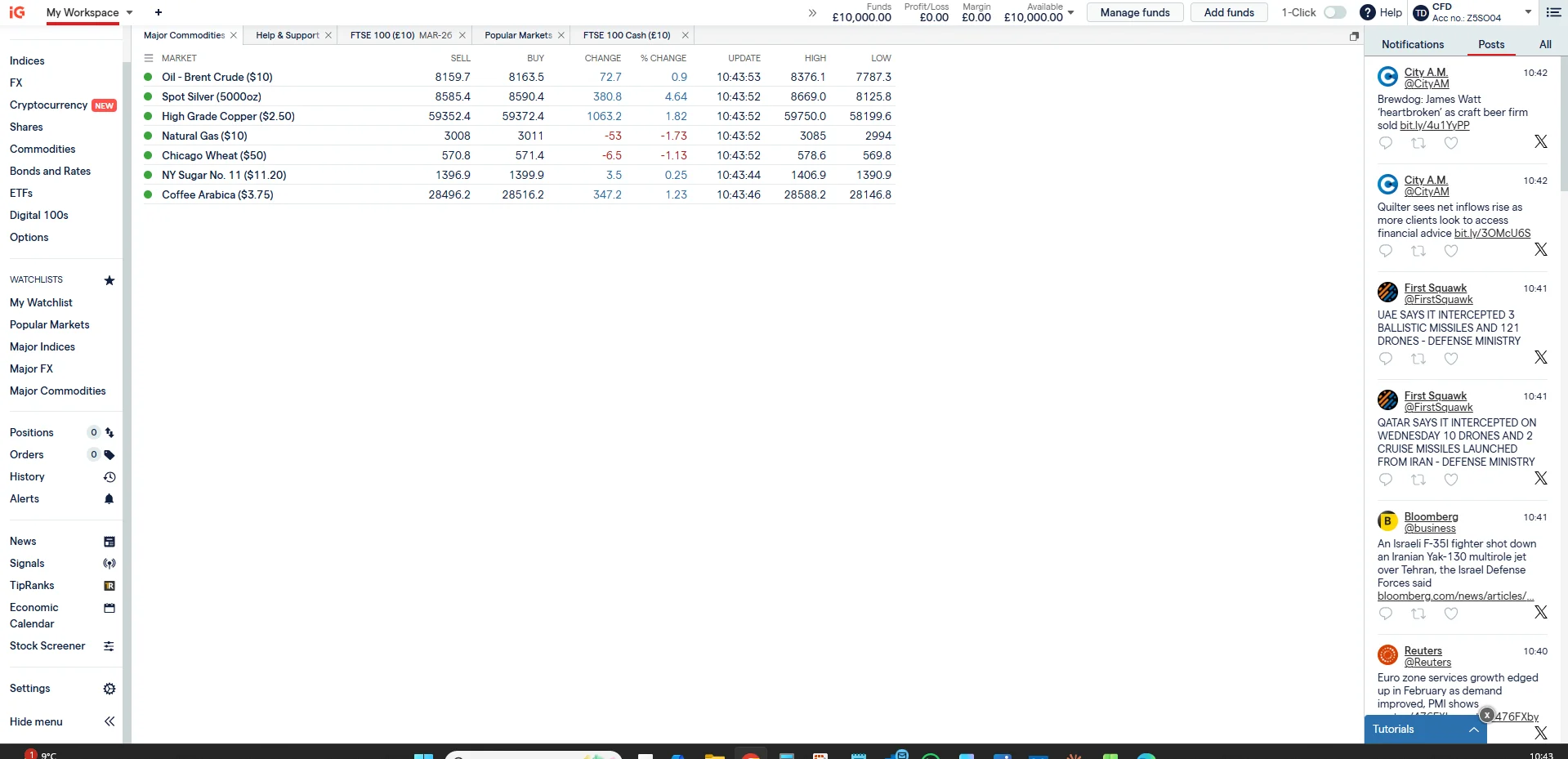

IG — Best Broker for Oil Spread Betting (WTI & Brent)
IG offers both WTI and Brent crude as spot and futures spread bets with 2.8-point spreads on each. You get ProRealTime charting, weekend oil trading, and oil options — no other UK broker matches that combination. I use IG for most of my oil spread bets because the contract detail pages clearly show expiry dates, margin requirements, and overnight funding rates before you open a position.
- FCA Regulated – Authorised and regulated by the Financial Conduct Authority (FRN 195355)
- 2.8-Point Oil Spreads – Competitive spreads on both WTI and Brent crude spot markets
- Spot & Futures – Choose daily-funded spot bets or fixed-expiry futures with no overnight charges
- Weekend Oil Trading – Trade oil outside standard market hours when geopolitical events break
68% of retail CFD accounts lose money.
What Is the Difference Between WTI and Brent Crude?
WTI (West Texas Intermediate) and Brent Crude are the two primary oil benchmarks, but they represent different physical markets with distinct price drivers.
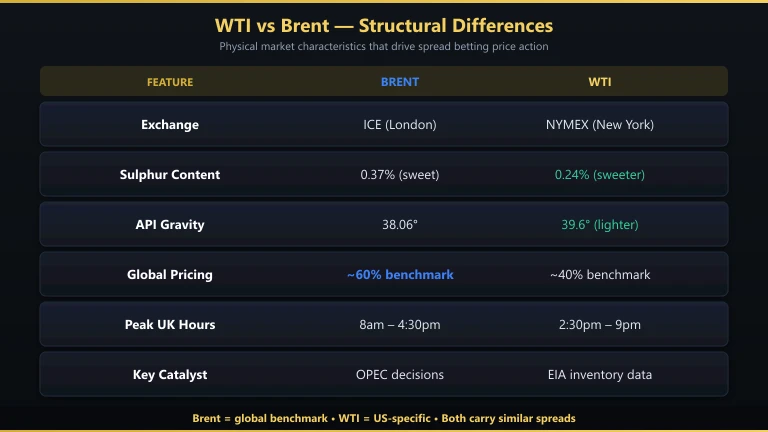
Brent Crude is extracted from the North Sea and priced on the Intercontinental Exchange (ICE) in London. It serves as the pricing benchmark for approximately 60% of global oil contracts. Brent responds strongly to OPEC production decisions, Middle Eastern supply disruptions, and European demand data. Because it’s priced in London, Brent’s most active trading hours overlap neatly with UK spread betting sessions.
WTI is a lighter, sweeter crude sourced primarily from Texas and Oklahoma. It trades on NYMEX in New York and is the benchmark for US oil pricing. WTI is more sensitive to US-specific factors: weekly EIA inventory data (released every Wednesday at 3:30pm UK time), Cushing storage levels, US refinery throughput, and hurricane disruptions to Gulf Coast production.
| Feature | Brent Crude | WTI |
|---|---|---|
| Exchange | ICE (London) | NYMEX (New York) |
| Global Pricing Share | ~60% | ~40% |
| Sulphur Content | 0.37% (sweet) | 0.24% (sweeter) |
| API Gravity | 38.06° | 39.6° (lighter) |
| Key Price Drivers | OPEC, geopolitics, global demand | EIA data, Cushing storage, US production |
| Peak Trading Hours (UK) | 8am–4:30pm | 2:30pm–9pm |
The price gap between Brent and WTI — known as the Brent–WTI spread — typically ranges from $2 to $8 per barrel. Brent usually trades at a premium because it reflects global supply-demand dynamics, while WTI can be depressed by US-specific oversupply at the Cushing delivery hub. Some traders specifically target this spread differential as a pairs trade.
Which Oil Contract Has Tighter Spreads for Spread Betting?
I compared WTI and Brent spread betting costs across six UK brokers during London session hours. The results show that WTI and Brent carry identical spreads at most brokers, with one notable exception: Capital.com charges 3.5 points on Brent versus 3 points on WTI.
| Broker | WTI Spread | Brent Spread | Spread Betting? | FCA FRN |
|---|---|---|---|---|
| IG | 2.8 pts | 2.8 pts | Yes | 195355 |
| CMC Markets | 2.5 pts | 2.5 pts | Yes | 173730 |
| Pepperstone | 3 pts | 3 pts | Yes | 684312 |
| Spreadex | 3 pts | 3 pts | Yes | 190941 |
| Capital.com | 3 pts | 3.5 pts | Yes | 793714 |
| City Index | 3 pts | 3 pts | Yes | 446717 |
Spreads are typical during London session hours (8am–4:30pm). Checked March 2026. Spreads widen during low-liquidity periods, around EIA data releases, and during OPEC announcements.
CMC Markets offers the tightest spreads at 2.5 points on both contracts. IG’s 2.8-point spread is marginally wider, but IG gives you weekend oil trading, oil options, and ProRealTime automation that CMC lacks. For pure spread cost, CMC wins. For overall oil trading capability, IG remains my top pick. See our full best oil trading platform rankings for detailed broker reviews.
One thing I noticed during testing: WTI spreads tend to widen more aggressively than Brent’s around the weekly EIA inventory release. If you regularly trade that event, factor in 1–2 points of additional spread on WTI during the 30 seconds around the data drop.
How Do Roll-Over Costs Work on Oil Spread Bets?
Oil spread bets come in two forms — spot (daily-funded) and futures (fixed expiry) — and the cost structure differs significantly between them. Understanding this distinction is essential because it directly affects how much you pay to hold an oil position.
Spot/Daily-Funded Oil Bets
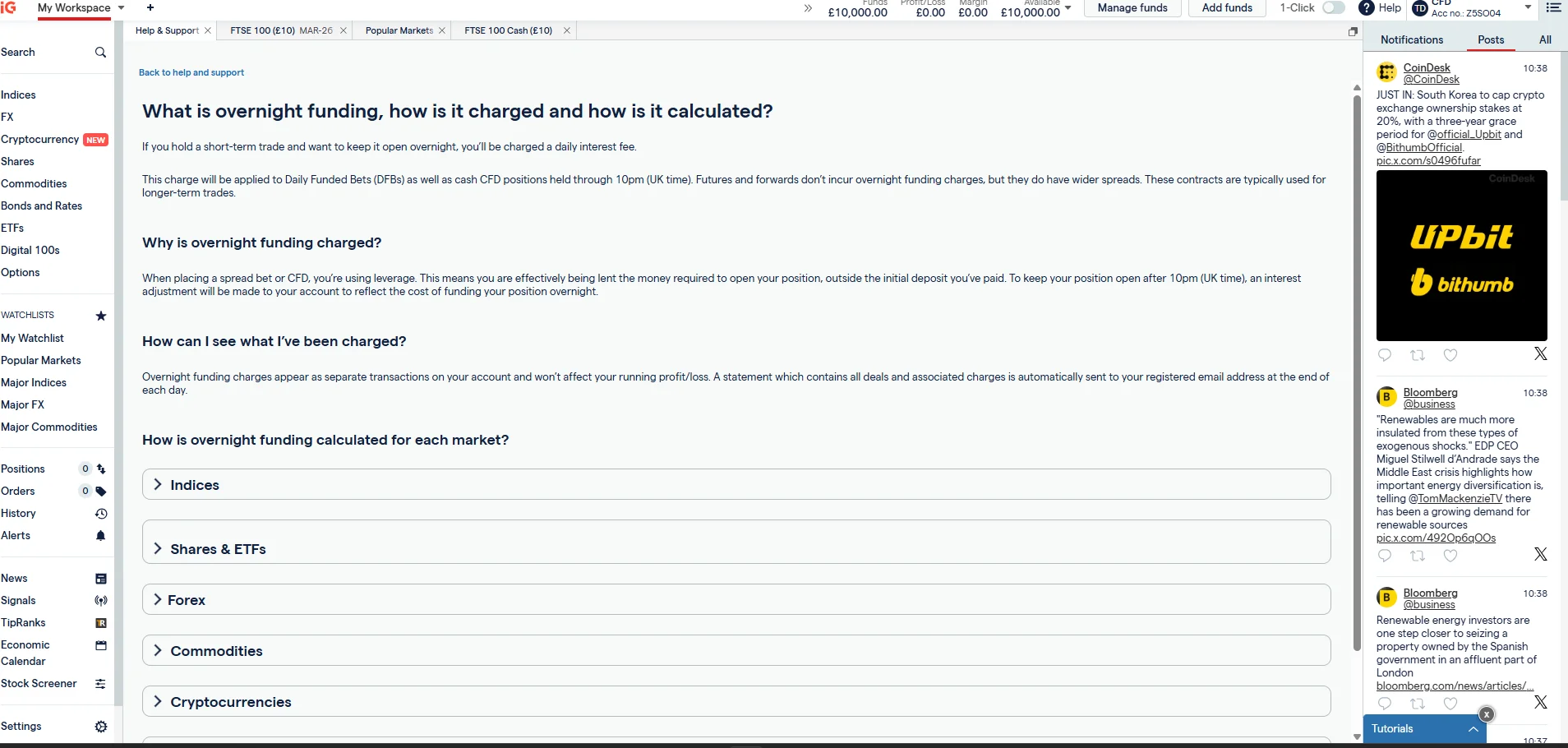
Spot oil spread bets track the current crude price and have no expiry date. You can hold them indefinitely, but your broker charges overnight funding every day you keep the position open past the daily cutoff (typically 10pm UK time). This charge is calculated using the underlying futures price curve and an interest component.
For a £1-per-point Brent long position at $80/barrel, overnight funding typically costs £0.20–£0.50 per night, depending on the broker and the shape of the futures curve. Over a week, that adds up to £1.40–£3.50 — a meaningful cost for swing traders. Day traders who close before the cutoff pay nothing beyond the spread.
Futures Oil Spread Bets
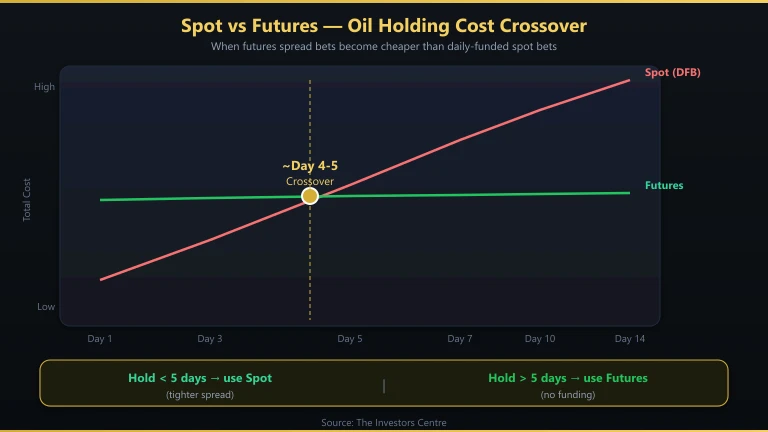
Futures spread bets have a fixed expiry date (matching the underlying NYMEX or ICE contract) and charge no overnight funding. The trade-off is wider spreads — typically 6 points on IG versus 2.8 for spot. Futures suit traders holding positions for more than 3–5 days, where cumulative overnight funding on a spot position would exceed the wider futures spread.
When a futures spread bet expires, most brokers offer automatic roll-over to the next contract month. IG rolls positions automatically unless you opt out; Spreadex and CMC Markets work similarly. The roll involves closing your current position and opening a new one at the next month’s price — there’s usually a small price difference (contango or backwardation) that affects your running P&L.
Which Should You Choose?
Use spot for day trades and short-term positions (1–3 days). Switch to futures for positions you plan to hold for a week or more. The crossover point — where futures become cheaper than spot — depends on your broker’s overnight rate, but it’s typically around 4–5 days on IG’s standard pricing. Our guide to how spread betting works covers the mechanics in more detail.
When Should You Trade WTI vs Brent?
The right contract depends on when you trade and what catalysts you follow. Each benchmark has distinct windows of peak liquidity and specific news events that drive sharp moves.
Best Times for Brent Crude
Brent’s most liquid period runs from the London open at 8am through to 4:30pm UK time. During this window, spreads are tightest, order books are deepest, and slippage is minimal. Key Brent catalysts include OPEC meetings and production quota announcements, Chinese manufacturing PMI data (released around 2:45am UK time, with Brent reacting at the London open), Middle Eastern geopolitical developments, and European refinery maintenance schedules.
Best Times for WTI
WTI trading peaks from the NYMEX open at 2:30pm UK time through to the close at 9pm. The single most important weekly event for WTI traders is the EIA Crude Oil Inventory report, released every Wednesday at 3:30pm UK time. A larger-than-expected inventory build typically pushes WTI down; a draw pushes it up. WTI also responds to the API inventory estimate (released Tuesday evenings) and Baker Hughes rig count data (Friday afternoons).
When Both Move Together
Major geopolitical events — wars, sanctions, pipeline disruptions — move both benchmarks simultaneously. OPEC production decisions affect both, though Brent tends to react first and more strongly. US Federal Reserve interest rate decisions can influence both contracts through their impact on the US dollar (oil is priced in dollars, so a weaker dollar generally supports oil prices).
For a broader view of oil trading strategies across all instrument types, see our guide on how to trade oil. If you’re new to leveraged trading, start with our leverage guide before trading oil, as crude’s volatility can amplify losses quickly.
FAQs
References
68% of retail investor accounts lose money when trading spread bets and CFDs with this provider.