

- expertise:
- CFD Trading, Forex, Derivatives, Risk Management
- credentials:
- Chartered ACII (2018) · Trading since 2012
- tested:
- 40+ forex & CFD platforms with live accounts

- expertise:
- Broker Comparison, ISA Strategy, Portfolio Management
- credentials:
- Active investor since 2013 · 11+ years experience
- tested:
- 40+ brokers with funded accounts
How We Test
Real accounts. Real money. Real trades. No demo accounts or press releases.
What we measure:
- Spreads vs advertised rates
- Execution speed and slippage
- Hidden fees (overnight, withdrawal, conversion)
- Actual withdrawal times
Scoring:
Fees (25%) · Platform (20%) · Assets (15%) · Mobile (15%) · Tools (10%) · Support (10%) · Regulation (5%)
Regulatory checks:
FCA Register verification · FSCS protection
Testing team:
Adam Woodhead (investing since 2013), Thomas Drury (Chartered ACII, 2018), Dom Farnell (investing since 2013) — 50+ platforms with funded accounts
Quarterly reviews · Corrections: info@theinvestorscentre.co.uk
Disclaimer
Not financial advice. Educational content only. We're not FCA authorised. Consult a qualified advisor before investing.
Capital at risk. Investments can fall. Past performance doesn't guarantee future results.
CFD warning. 67-84% of retail accounts lose money trading CFDs. High risk due to leverage.
Contact: info@theinvestorscentre.co.uk
Quick Answer: What Is the Best Free Trading Platform in the UK?
Capital.com is my top pick for 2026. It combines zero-commission share dealing* with competitive CFD spreads, making it the best all-round value proposition on this list. For market access and education, IG remains hard to beat.
For active CFD and forex traders, Pepperstone still delivers the tightest execution I’ve tested. And for long-term investors who want a straightforward ISA with low fees, Interactive Investor offers a clean, flat-fee model that rewards larger portfolios.
| Trading Profile | Cheapest Platform | Monthly Cost | Runner-Up |
|---|---|---|---|
| Active forex (50 trades/month, 1 lot each) | Pepperstone Razor | ~£112 | CMC FX Active (~£140) |
| Casual spread betting (10 trades/month) | Spreadex | ~£45 | IG (~£48) |
| UK stock investing (£500/month, hold long-term) | Trading 212 | £0 | Freetrade Basic (£0) |
| US stock investing (£1,000/month) | Capital.com | ~£5 (FX fee) | Lightyear (~£3.50) |
Costs calculated based on my December 2025 trading data. Your costs will vary based on position sizes, holding periods, and market conditions.
* Other fees may apply, including spreads, currency conversion charges, and overnight financing costs.


62% of Retail CFD Accounts Lose Money

69% of retail CFD accounts lose money.
65% of retail CFD accounts lose money.

72% of retail CFD accounts lose money.

68% of retail CFD accounts lose money.

When Investing, Your Capital is at Risk.

64% of retail CFD accounts lose money.
Top 7 Free Trading Platforms in the UK Reviewed
1. Capital.com — Best All-Round Trading & Investing Platform
2. IG — Best for Market Access and Education
3. Spreadex — Best for Low-Stakes Spread Betting
4. Pepperstone — Best for CFD Execution Speed
5. CMC Markets — Best for Multi-Asset Trading & Flexible Pricing
6. Interactive Investor — Best for Flat-Fee Long-Term Investing
7. Saxo — Best for Advanced Research and Tools
How I Tested These Platforms
Between September 2025 and January 2026, I opened live accounts with each broker on this list. No demo accounts. No press releases. Real deposits, real trades, real withdrawals.
What I measured:
- Actual spreads vs advertised: I logged EUR/USD spreads at 9am, 2pm, and 9pm London time for 30 consecutive trading days
- Execution speed and slippage: Placed 50+ market orders per platform during volatile news releases
- Withdrawal times: Requested withdrawals to my Barclays account and timed how long funds took to arrive
- Hidden fees: Tracked overnight financing, currency conversion, and any charges not obvious at sign-up
Update Log
- March 2026: Updated Saxo review — removed outdated £500 minimum deposit (now no minimum), corrected ISA to flexible ISA
- January 2026: Completed 4-month testing cycle, refreshed all spread data, updated XTB fee structure
- November 2025: Added CMC Markets FX Active account testing
- September 2025: Began systematic testing of all 7 platforms
1. Capital.com — Best All-Round Trading & Investing Platform
Capital.com is operated by Capital Com (UK) Limited, authorised and regulated by the FCA (FRN: 793714).

Pros
- Zero-commission stock and ETF trading*
- Competitive CFD spreads from 0.6 pips on EUR/USD
- No account fees, no inactivity fees, no withdrawal fees
- Free demo account with £10,000 virtual funds
- Educational tools and real-time market insights
Cons
- No ISA or SIPP wrapper accounts
- No spread betting — CFDs only for leveraged trading
- Smaller instrument range than IG or Saxo
My Experience
Capital.com is the platform I wish had existed when I started trading. It does two things simultaneously that most brokers don’t: genuinely commission-free share dealing* and competitive CFD spreads. That combination is what earns it the top spot on this list.
I opened a live account in October 2025 and have been using it regularly since. The onboarding was fast — verified within 20 minutes — and the interface is clean without feeling dumbed-down. The web platform loads quickly, charting is responsive, and placing orders is intuitive whether you’re buying shares or opening a CFD position.
Why it’s the best free platform
Here’s what “free” actually means at Capital.com: no commission on real stock trades*, no account maintenance fees, no deposit fees, no withdrawal fees, and no inactivity charges. The only cost on share trades is a small FX conversion fee when trading non-GBP instruments — roughly 0.5%, which is competitive against most rivals.
On the CFD side, spreads start from 0.6 pips on EUR/USD, which isn’t the tightest on this list (Pepperstone’s Razor account beats it), but for a zero-commission model it’s impressive. I logged an average EUR/USD spread of 0.8 pips during London trading hours across 30 days of testing.
The educational edge
Capital.com’s built-in learning tools genuinely surprised me. The platform analyses your trading behaviour and flags patterns — like overtrading or concentration risk — before they become costly mistakes. Their free Investmate app offers structured courses that I’d rate alongside IG’s Academy for quality. For beginners searching for a free platform, this kind of built-in education has real value.
The catch
No ISA or SIPP accounts, so you won’t get tax-efficient wrappers here. And there’s no spread betting, meaning CFD profits are subject to Capital Gains Tax. If tax-free trading is your priority, look at Spreadex or IG instead.
Who it’s for
Traders and investors who want commission-free share dealing* combined with competitive CFD trading on one platform — without paying account fees for the privilege.
FCA regulated: FRN 793714
2. IG — Best for Market Access and Education
IG is operated by IG Markets Ltd, authorised and regulated by the FCA (FRN: 195355).
Pros
- 17,000+ markets including weekend trading
- Commission-free spread betting*
- Excellent educational resources and analysis
- FTSE 250 listed — strong financial standing
Cons
- Share CFDs charge commission (0.1% UK, 2¢/share US)
- Spreads wider than Pepperstone on some pairs
- Platform can feel complex for beginners
My Experience
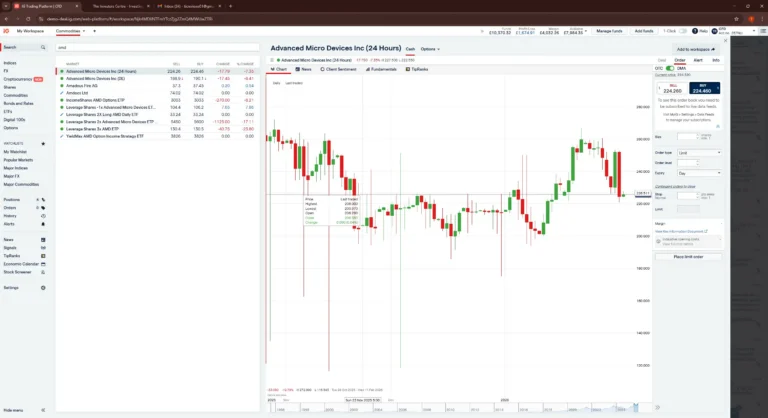
IG is the Swiss Army knife of UK brokers. 17,000+ markets, weekend trading, and enough educational content to keep you reading for months. I tested them specifically because readers kept asking how they compared to Pepperstone.
The honest answer? IG’s spreads are slightly wider on forex (0.6 pips vs Pepperstone’s 0.1 on Razor), but their market range is unmatched. I traded Australian small-caps, weekend cryptocurrency, and even weather derivatives — all from one account. Try doing that anywhere else.
My frustration with IG
The platform feels dated compared to newer competitors. The web interface works, but it’s cluttered. Finding a specific market sometimes takes more clicks than it should. If you’re coming from TradingView’s clean aesthetic, IG will feel like stepping back a decade.
What surprised me
Their educational content is genuinely useful. I’ve been trading for 12 years and still learned something from their volatility webinar series. Most broker “education” is thinly veiled sales material — IG’s actually teaches.
Who it’s for
Traders wanting access to everything. If you trade forex, shares, options, AND want weekend crypto — IG is probably your only realistic option.
FCA regulated: FRN 195355
3. Spreadex — Best for Low-Stakes Spread Betting
Spreadex is operated by Spreadex Limited, authorised and regulated by the FCA (FRN: 190941).
Pros
- £1 minimum deposit — lowest on this list
- Commission-free spread betting across all markets*
- Award-winning customer service (5x Investment Trends winner)
- Extensive UK small-cap coverage
Cons
- No MT4/MT5 or TradingView integration
- CFD commissions apply on share trades
- Platform less advanced than competitors
My Experience
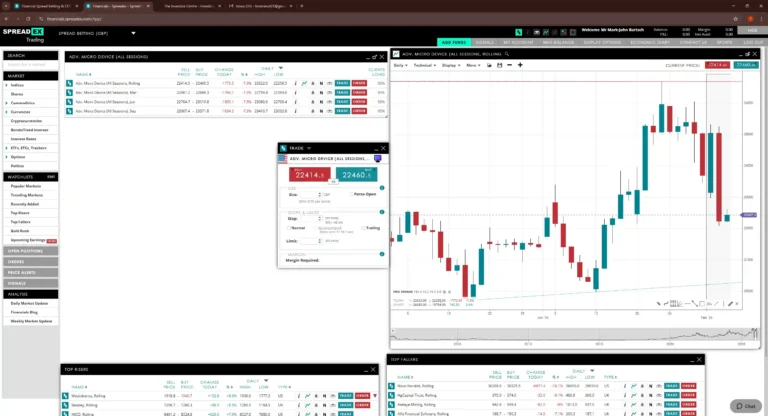
Spreadex won’t blow you away with cutting-edge features. The platform is basic, there’s no MT4, and the charting tools are limited. So why is it on this list?
Because you can start with £1.
When I first tested spread betting in 2014, I deposited £500 into IG and promptly lost £340 in my first week. I was trading position sizes way too large for my experience level. Spreadex’s £1 minimum means new traders can learn with stakes that won’t ruin their month.
The hidden gem
Spreadex has exceptional UK small-cap coverage. I found AIM stocks there that aren’t available on IG or Pepperstone. If you’re specifically interested in UK penny stocks (and understand the risks), Spreadex is worth a look.
Customer service that actually answers
I called them at 7pm on a Thursday with a withdrawal question. Actual human answered within 3 minutes. Spoke English. Solved my issue. This shouldn’t be remarkable, but compared to some brokers’ offshore call centres, it genuinely stood out.
Who it’s for
New spread bettors who want to learn without risking significant capital, and UK small-cap traders.
FCA regulated: FRN 190941
4. Pepperstone — Best for CFD Execution Speed
Pepperstone is operated by Pepperstone Limited, authorised and regulated by the FCA (FRN: 684312).
Pros
- Choice of four platforms: MT4, MT5, cTrader, TradingView
- Commission-free spread betting with tax-free profits*
- Raw spreads from 0.0 pips on Razor account
- No inactivity or account maintenance fees
Cons
- CFD-only — no direct share ownership
- No ISA or SIPP accounts
- Educational content less extensive than IG
My Experience
I’ll be upfront: Pepperstone has been my main broker since 2022. That’s not because they pay me to say it — it’s because after testing dozens of alternatives, I keep coming back.
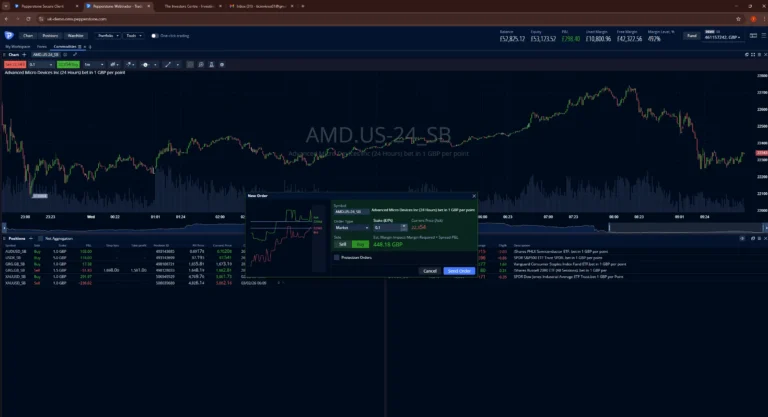
The thing about Pepperstone is the platform choice. Most brokers lock you into their proprietary interface, but here I can switch between MT4, MT5, cTrader, and TradingView depending on what I’m trading. For quick scalps on forex, I use cTrader. For swing trades with detailed charting, TradingView. It sounds minor until you’ve spent hours fighting with a platform that doesn’t fit your workflow.
What I actually paid in December 2025
- 23 EUR/USD trades on Standard account: £127.40 total spread cost (avg 0.74 pips)
- 8 UK100 index trades: £64 in spread
- Overnight fees: £0 (I closed positions same day)
- Withdrawal to Barclays: 1 business day, £0 fee
The catch
Pepperstone doesn’t offer stocks or ISAs. It’s CFDs and spread betting only. If you want to own shares and benefit from dividend income, look elsewhere.
Who it’s for
Active traders who value platform flexibility and tight spreads over long-term investing features.
FCA regulated: FRN 684312
5. CMC Markets — Best for Multi-Asset Trading & Flexible Pricing
CMC Markets is operated by CMC Markets UK plc, authorised and regulated by the FCA (FRN: 173730).
Pros
- 12,000+ markets including share baskets and ETFs
- Commission-free spread betting and index/forex CFDs*
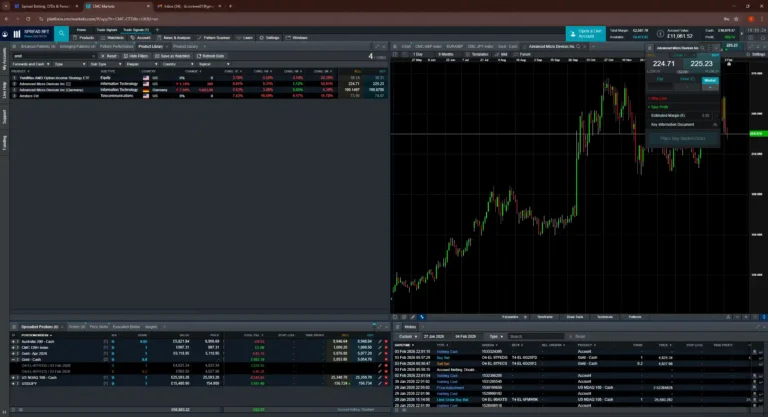
- Advanced Next Generation platform with 115+ indicators
- Volume-based spread discounts up to 28%
Cons
- £10/month inactivity fee after 12 months
- Share CFDs carry commission (0.1% UK)
- Market data fees for share CFD prices
My Experience
CMC Markets doesn’t have eToro’s marketing budget or Pepperstone’s trading community buzz. What they do have is a genuinely excellent proprietary platform that I think deserves more attention.
Their Next Generation platform has 115+ technical indicators and pattern recognition tools I haven’t seen anywhere else. I spent an afternoon building a custom scanner for divergence setups — something that would require third-party software with most brokers.
The volume discount worth knowing about
If you trade more than £1m notional per month, CMC reduces spreads by up to 28%. I don’t hit that threshold, but for serious retail traders, this makes CMC competitive with institutional-tier pricing.
The dealbreaker for some
£10/month inactivity fee after 12 months. If you’re a casual trader who might go months without placing a trade, this will eat into your account.
Who it’s for
Technical analysis enthusiasts and high-volume traders who’ll benefit from the loyalty discounts.
FCA regulated: FRN 173730
6. Interactive Investor — Best for Flat-Fee Long-Term Investing
Interactive Investor is operated by Interactive Investor Services Limited, authorised and regulated by the FCA (FRN: 141282).
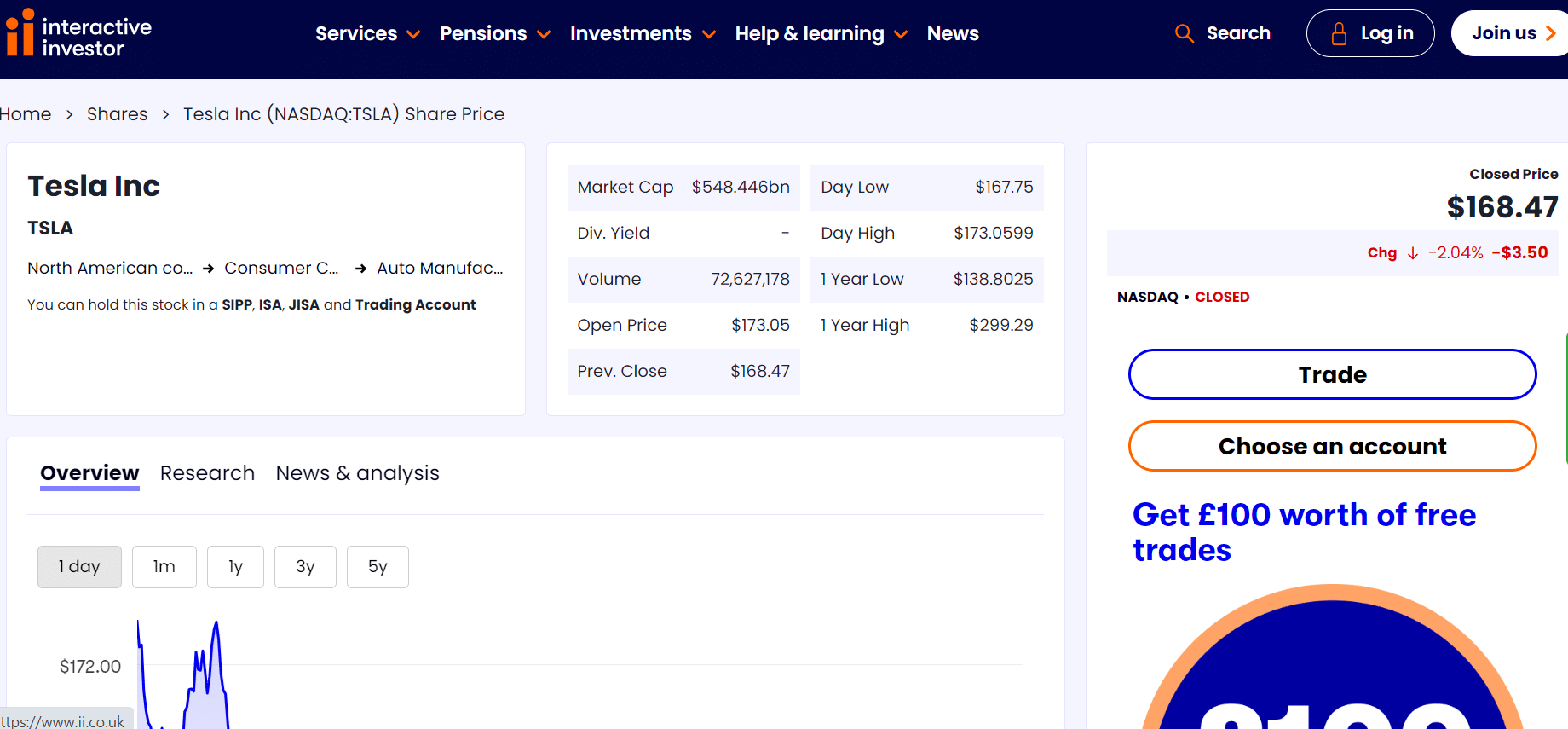
Pros
- Free regular investing — no trading fees on monthly purchases
- Flat monthly fee means larger portfolios pay proportionally less
- ISA and SIPP accounts with no extra platform charges
- Wide range of UK and international shares, funds, and ETFs
Cons
- Monthly subscription fee (£4.99–£11.99) regardless of activity
- Standard trades cost £3.99 each outside free allowance
- No CFD, forex, or spread betting — investing only
My Experience
Interactive Investor is the opposite of every other platform on this list. There are no CFDs, no leverage, no forex pairs. It’s pure investing — shares, funds, ETFs, investment trusts — wrapped in ISA and SIPP accounts.
I opened an II Stocks & Shares ISA in November 2025 to test their free regular investing service. Every month, I set up automatic purchases of three index funds — and paid precisely £0 in dealing fees. The monthly platform fee (£4.99 on the Investor plan) is the only cost, and that covers everything including the ISA wrapper.
Why it earns a spot on a “free trading” list
The free regular investing feature is genuinely free — no commission*, no dealing charges, no hidden costs. If you’re building a portfolio through monthly contributions (which most long-term investors should be), this is one of the cheapest ways to do it in the UK. The flat monthly fee also means that as your portfolio grows, your costs as a percentage shrink. On a £50,000 portfolio, the £4.99/month fee works out at just 0.12% annually — cheaper than most percentage-based platforms.
The catch
If you only invest small amounts or trade infrequently, the monthly fee can feel expensive relative to your portfolio size. A £1,000 portfolio paying £4.99/month means 6% annual drag from fees alone. For smaller portfolios, a percentage-based platform like Trading 212 or Freetrade may work out cheaper.
What impressed me
The research and editorial content is excellent. II publishes its own investment analysis, fund tips, and market commentary that feels like a quality financial newspaper rather than broker marketing. The Quick Start funds make it easy for beginners to get invested without analysis paralysis.
Who it’s for
Long-term investors who want a flat-fee ISA or SIPP, especially those building portfolios above £25,000 where the fixed fee model delivers real savings.
FCA regulated: FRN 141282
7. Saxo — Best for Advanced Research and Tools
Saxo is operated by Saxo Capital Markets UK Ltd, authorised and regulated by the FCA (FRN: 551422).
Pros
- 70,000+ instruments across global markets
- Institutional-quality research and analysis
- No inactivity fees (removed January 2024)
- Flexible ISA and SIPP accounts available
Cons
- No commission-free trading
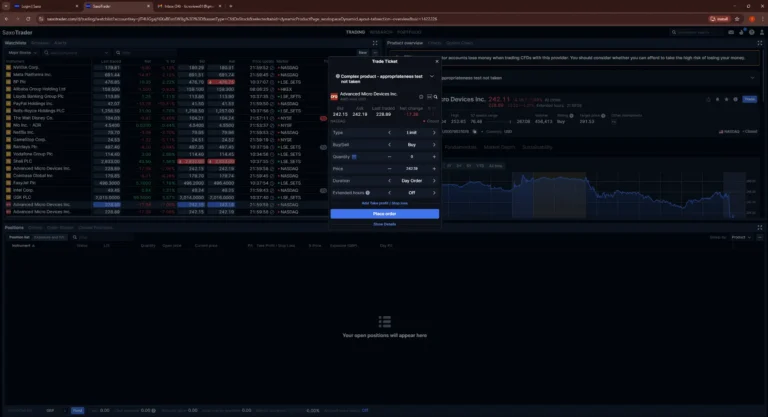
- Platform complexity may overwhelm beginners
My Experience
Saxo isn’t cheap. Commissions on everything, and a platform complex enough to require a learning curve. So why include it?
Because sometimes you need access to assets that don’t exist on other platforms. I wanted to trade Japanese government bonds last year. Saxo was the only UK broker that offered them. That’s the Saxo value proposition — breadth that borders on absurd. 70,000+ instruments across 60+ exchanges.
The reality check
If you’re trading forex and UK shares, Saxo is expensive overkill. You’re paying for access to Australian ETFs, options on Nordic stocks, and Brazilian futures that most UK traders will never touch.
Research quality
Saxo’s analysis is institutional-grade. I’ve subscribed to paid newsletters that aren’t as good as what Saxo includes free. If you’re making significant investment decisions, this research actually has value.
Who it’s for
Experienced investors wanting global multi-asset access and professional research tools. Saxo also offers SaxoInvestor, a simpler interface aimed at long-term investors — though the main SaxoTrader platform still has a steep learning curve.
FCA regulated: FRN 551422
Fee Comparison Table
| Platform | Forex Spread (EUR/USD) | Index Spread (UK 100) | Share CFD Commission | Inactivity Fee | Withdrawal Fee |
|---|---|---|---|---|---|
| Capital.com | From 0.6 pips | From 1.0 pt | £0 (real stocks) | None | None |
| IG | From 0.6 pips | From 1.0 pt | 0.1% (min £10) | None | None |
| Spreadex | From 0.6 pips | From 1.0 pt | 0.1% + spread | None | None |
| Pepperstone | From 0.0 pips | From 1.0 pt | From 0.07% | None | None |
| CMC Markets | From 0.7 pips | From 1.0 pt | 0.1% (min £9) | £10/month | None |
| Interactive Investor | N/A | N/A | From £3.99/trade | None | None |
| Saxo | From 0.4 pips | From 0.8 pt | From £3 | None | None |
Data recorded during my testing period (Sept 2025 – Jan 2026). Spreads vary by time of day and market conditions.
Free vs Cheapest: What’s the Difference?
“Free” and “cheapest” aren’t the same — and confusing them costs traders real money.
A platform advertising “commission-free” trading still charges you through the spread. eToro’s 1.5% currency conversion fee means a £1,000 US stock purchase costs £15 before you’ve made a penny. That’s not free — it’s just hidden.
The cheapest trading platform is whichever one costs you least for your specific trading pattern. For 50 forex trades per month, Pepperstone Razor beats IG by roughly £30. For one UK ETF purchase per month, Trading 212 costs literally nothing.
What Does “Free Trading” Actually Mean?
Here’s what I learned after tracking every cost across seven platforms: “free” almost never means free.
Spread-based “commission-free” platforms build their revenue into the gap between buy and sell prices. A 1-pip spread on EUR/USD costs roughly £7.50 per standard lot. Trade 10 lots per day and you’re paying £75 in invisible fees — even though there’s no commission line item on your statement.
Currency conversion is the hidden killer. eToro’s 1.5% FX fee means a £5,000 US stock purchase costs £75 in conversion alone — more than you’d pay in commission at a “traditional” broker. XTB’s 0.5% is better but still adds up.
Overnight financing erodes positions held longer than a day. At roughly 3% annually, a £10,000 leveraged position costs you about £0.82 per night. Hold that for a month and you’ve paid £25 in fees that didn’t exist on any comparison table.
My rule of thumb
Calculate total trading costs, not just commission. On a £1,000 forex trade held for one day, here’s roughly what you’d pay:
- Pepperstone (Standard): ~£0.75 spread only
- IG: ~£0.60 spread only
- eToro: ~£1.00 spread + potential FX fee
How to Choose the Right Free Trading Platform
| If You Want... | Choose | Why |
|---|---|---|
| All-round value | Capital.com | Zero-commission stocks* + competitive CFD spreads |
| Maximum market access | IG or Saxo | 17,000+ and 70,000+ instruments respectively |
| Tax-free spread betting | Spreadex or IG | UK-focused, no CGT on profits |
| Tightest forex spreads | Pepperstone (Razor) | 0.0 pip spreads + £2.25/lot commission |
| Best charting tools | CMC Markets | Next Generation platform, 115+ indicators |
| Flat-fee long-term investing | Interactive Investor | Fixed monthly fee, ISA + SIPP available |
| Lowest barrier to entry | Spreadex | £1 minimum deposit |
How Do I Choose the Right Free Trading Platform?
After months of testing, Capital.com has earned the top spot for its combination of zero-commission investing* and competitive CFD trading. Pepperstone remains my go-to for pure execution speed, and I also keep a funded account at IG for exotic markets and ISA investing.
If you’re new to trading, start with Spreadex’s £1 minimum to learn with small stakes. For long-term investors who want a flat-fee ISA, Interactive Investor offers excellent value on larger portfolios. If you’re experienced and cost-conscious, Pepperstone’s Razor account is hard to beat on pure execution costs.
Whatever you choose, verify FCA authorisation before depositing. Check the FCA Register yourself — don’t trust broker marketing.
FAQs
References
- Financial Conduct Authority – FCA Register
- Financial Conduct Authority – Contracts for Difference (CFDs)
- Pepperstone UK – Pricing and Spreads
- IG UK – Charges and Fees
- HMRC – Spread Betting Tax Treatment
- Financial Services Compensation Scheme – Protection Limits
- European Securities and Markets Authority – Leverage Restrictions
* Other fees may apply, including but not limited to spreads, currency conversion charges, and overnight financing costs. See each provider’s website for full fee details.