

- expertise:
- CFD Trading, Forex, Derivatives, Risk Management
- credentials:
- Chartered ACII (2018) · Trading since 2012
- tested:
- 40+ forex & CFD platforms with live accounts

- expertise:
- Broker Comparison, ISA Strategy, Portfolio Management
- credentials:
- Active investor since 2013 · 11+ years experience
- tested:
- 40+ brokers with funded accounts
How We Test
Real accounts. Real money. Real trades. No demo accounts or press releases.
What we measure:
- Spreads vs advertised rates
- Execution speed and slippage
- Hidden fees (overnight, withdrawal, conversion)
- Actual withdrawal times
Scoring:
Fees (25%) · Platform (20%) · Assets (15%) · Mobile (15%) · Tools (10%) · Support (10%) · Regulation (5%)
Regulatory checks:
FCA Register verification · FSCS protection
Testing team:
Adam Woodhead (investing since 2013), Thomas Drury (Chartered ACII, 2018), Dom Farnell (investing since 2013) — 50+ platforms with funded accounts
Quarterly reviews · Corrections: info@theinvestorscentre.co.uk
Disclaimer
Not financial advice. Educational content only. We're not FCA authorised. Consult a qualified advisor before investing.
Capital at risk. Investments can fall. Past performance doesn't guarantee future results.
CFD warning. 67-84% of retail accounts lose money trading CFDs. High risk due to leverage.
Contact: info@theinvestorscentre.co.uk
How this is calculated
| Lot Type | Units | Per Pip | 10 Pips | 50 Pips |
|---|
Exchange rates shown are approximate mid-market rates for illustration only and do not reflect live broker pricing. Pip values fluctuate with exchange rate movements. This calculator does not constitute financial advice. Spread bets and CFDs are complex instruments and come with a high risk of losing money rapidly due to leverage. Always verify pip values with your broker before placing a trade.
What Is a Pip in Forex, and Why Does It Matter?
A pip is one unit of movement in the fourth decimal place of a forex price. That’s it. GBP/USD moves from 1.2650 to 1.2651 — that’s one pip.
The exception is any pair involving the Japanese yen, where one pip sits in the second decimal place instead. USD/JPY moves from 149.50 to 149.51 — also one pip.
You’ll see some brokers quote prices to five decimal places instead of four. That fifth digit is a pipette — one-tenth of a pip. It’s there to allow tighter spreads, not to confuse you. When your platform shows GBP/USD at 1.26503, the ‘0’ is the pip and the ‘3’ is the pipette. For calculating risk and position size, you can ignore pipettes entirely.
One more distinction worth clearing up early: pips, points, and ticks aren’t the same thing, despite being used interchangeably on forums. A pip is specific to forex. A point typically refers to a whole number move in an index (the FTSE 100 rises 50 points). A tick is the minimum price increment set by an exchange, which varies by instrument. For currency trading, pip is the only term you need.
What Happens When You Don’t Know Your Pip Value?
I spent my first three months trading without properly understanding pip value, and it cost me. Not because I didn’t know what a pip was — every broker’s glossary covers that — but because I didn’t know what each pip was worth in pounds.
I was setting 30-pip stop losses on GBP/JPY without realising each pip was worth roughly £5.29 on a standard lot. That’s £158.70 at risk per trade, on a £3,000 account. More than 5% per position. I was breaking every risk management rule in the book and didn’t even know it.
That’s the gap this page fills. Most pip calculator pages hand you a widget and leave you to it. We’re going to walk through the actual maths — in GBP, with the pairs UK traders use most — so you understand exactly what’s happening when you punch numbers into any calculator. Then the tool above saves you the arithmetic on every trade after that.
How Is Pip Value Calculated?
Every pip calculator — including the one at the top of this page — runs the same core formula:
For a pair like GBP/USD where the quote currency is USD, one pip on a standard lot gives you: 0.0001 × 100,000 = $10. To convert that into pounds, divide by the current GBP/USD rate. At 1.2650, that’s $10 ÷ 1.2650 = £7.91 per pip.
The formula gets one step more complex when your account currency isn’t the quote currency. Trading EUR/GBP from a GBP account? The pip value lands directly in GBP — no conversion needed, because GBP is already the quote currency. But if you’re going long or short on a pair like USD/JPY from a sterling account, you’ll need to convert from yen to GBP via the GBP/JPY cross rate. The calculator handles this automatically, but knowing the mechanics matters when your broker’s figures don’t match your expectations.
The critical thing to grasp is that pip value isn’t fixed. It shifts with every tick of the exchange rate. A pip on GBP/USD was worth roughly £8.13 when cable was trading at 1.2300 in October 2023, and it’s closer to £7.91 at 1.2650. Small difference on one pip — meaningful difference across a 50-pip move with size behind it.
If you’re getting started with day trading, this is the first calculation you need to master before placing a single live trade.
How Much Is a Pip Worth on the Pairs UK Traders Actually Use?
The formula is the same every time, but the output changes depending on the pair, the lot size, and what currency your account is denominated in. Most online examples use USD accounts. If you’re trading from the UK with a GBP account, here’s what the numbers actually look like.
GBP/USD — Standard Lot (100,000 units), GBP Account
This is the simplest case. One pip = 0.0001 × 100,000 = $10.00. Your account is in pounds, so divide by the GBP/USD rate: $10.00 ÷ 1.2650 = £7.91 per pip.
On a mini lot (10,000 units), that drops to £0.79. On a micro lot (1,000 units), it’s £0.08. The maths scales linearly — double the lot size, double the pip value.
EUR/GBP — Mini Lot (10,000 units), GBP Account
Here’s where it gets easier than people expect. The quote currency in EUR/GBP is already GBP, so there’s no conversion step at all. One pip = 0.0001 × 10,000 = £1.00 per pip. Clean. Simple. That’s why EUR/GBP is one of the most straightforward pairs to size positions on from a sterling account.
GBP/JPY — Standard Lot (100,000 units), GBP Account
This is the one that catches people out. JPY pairs use 0.01 as the pip size, not 0.0001. So: 0.01 × 100,000 = ¥1,000. Now you need to convert yen to pounds. At a GBP/JPY rate of 189.10: ¥1,000 ÷ 189.10 = £5.29 per pip.
That double conversion — pip to yen, yen to GBP — is where mistakes happen. I’ve seen traders assume GBP/JPY pip values are similar to GBP/USD because they’re both “GBP pairs.” They’re not. At current rates, a standard lot pip on GBP/JPY is worth about £2.62 less than on GBP/USD. Over a 40-pip move, that’s a £105 difference in P&L.

How Does Pip Value Connect to Position Sizing and Risk?
Knowing your pip value is only useful if you connect it to how much you’re actually risking per trade. This is where most beginners go wrong — they pick a lot size that “feels right” instead of calculating one that fits their risk tolerance.
The standard approach: risk no more than 1–2% of your account on any single trade. Here’s how that works with pip values.
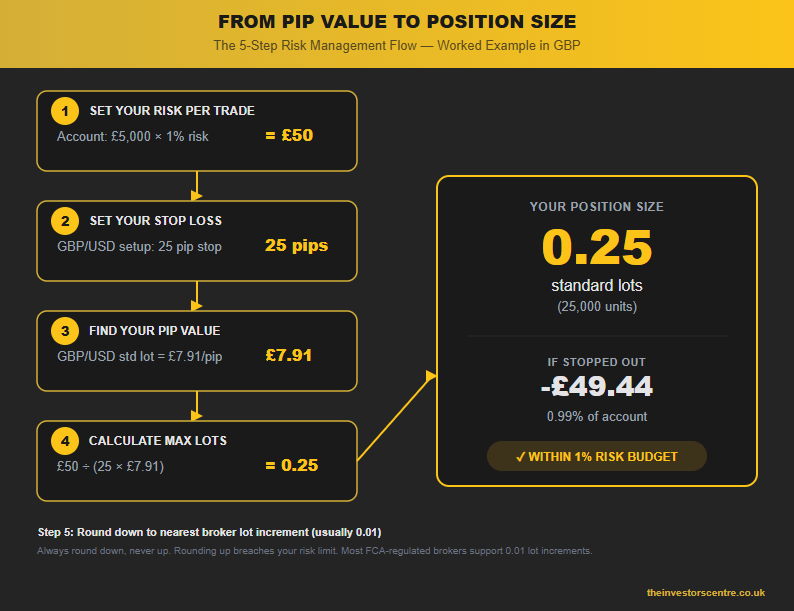
Worked Example: £5,000 account, GBP/USD, 25-pip stop loss
Your maximum risk at 1% = £50. Each pip on a standard lot (100,000 units) is worth £7.91. So: £50 ÷ (25 pips × £7.91) = 0.25 lots. That’s your maximum position size. Anything larger and you’re risking more than 1%.
At 0.1 lots (a mini lot), each pip is £0.79, so 25 pips = £19.75 risk — well within budget. At 0.5 lots, it’s £98.75 — nearly 2%, which some traders are comfortable with but leaves less margin for error.
The FCA requires brokers to disclose that between 69% and 82% of retail accounts lose money trading leveraged products. Position sizing based on pip value is the single most practical thing you can do to avoid being in that majority. It doesn’t guarantee profits, but it stops one bad trade from wiping out a week’s gains.
If you want to test this without real money, practise with a demo account until the calculation becomes instinctive.
How Do Pip Values Work Differently in Spread Betting vs CFDs?
If you’re trading from the UK, there’s a good chance you’re using spread betting rather than CFDs — and the way pip values work is fundamentally different between the two.
With CFDs, you trade in lots. Pip value is calculated using the formula above, and it changes depending on the pair and exchange rate. You’ve seen the maths.
With spread betting, you skip the lot calculation entirely. Instead, you choose how much you want to stake per point of movement — say, £2 per pip on GBP/USD. If the price moves 30 pips in your favour, you make £60. If it moves 30 against you, you lose £60. The pip value is whatever you set it to be.
That simplicity is one reason spread betting is popular with UK traders. The other is tax: spread betting profits are currently exempt from Capital Gains Tax and Stamp Duty. CFD profits aren’t. For traders running smaller accounts, that difference compounds meaningfully over a tax year.
The trade-off is that spread betting typically comes with wider spreads than raw-spread CFD accounts. If you’re scalping or trading on tight timeframes, those wider spreads eat into your edge. For swing traders and anyone holding positions for hours or days, the tax benefit usually outweighs the spread cost.
If spread betting suits your situation, we’ve compared the spread betting platforms that offer the tightest point spreads. And if you’d rather trade CFDs with tighter raw spreads, our FCA-regulated forex broker reviews cover the platforms we’ve tested with real money.
What Are the Most Common Pip Calculation Mistakes?
Four errors come up repeatedly, and every one of them is avoidable.
- Forgetting the JPY exception. JPY pairs use 0.01 per pip, not 0.0001. Getting this wrong means your calculated pip value is 100× off. The worked GBP/JPY example above exists specifically because this trips people up.
- Not converting to your account currency. If you trade EUR/USD from a GBP account, your pip value isn’t $10 per standard lot — it’s $10 converted to GBP at the current rate. Every broker platform does this automatically in your P&L, but if you’re manually sizing positions, forgetting this step means your risk calculation is wrong.
- Confusing pipettes with pips. That fifth decimal digit on your platform is a pipette, not a pip. If your stop loss is “25 pips” and you accidentally enter 25 pipettes, you’ve placed a stop 10× tighter than intended. It’ll get clipped by normal market noise.
- Assuming pip value stays the same. It doesn’t. Pip value recalculates with every movement in the exchange rate. On major pairs the shift is small enough to be negligible intraday. On exotic or volatile crosses, it can move meaningfully within a session.
FAQs
References
- Financial Conduct Authority (FCA) – Contract for differences | FCA
- HM Revenue & Customs – Capital Gains Tax rates and allowances. Available at: gov.uk/capital-gains-tax
- HM Revenue & Customs – Spread betting tax treatment (BIM22015). Available at: gov.uk/hmrc-internal-manuals
For more foundational trading concepts, explore our full trading guides hub.