

- expertise:
- CFD Trading, Forex, Derivatives, Risk Management
- credentials:
- Chartered ACII (2018) · Trading since 2012
- tested:
- 40+ forex & CFD platforms with live accounts

- expertise:
- Broker Comparison, ISA Strategy, Portfolio Management
- credentials:
- Active investor since 2013 · 11+ years experience
- tested:
- 40+ brokers with funded accounts
How We Test
Real accounts. Real money. Real trades. No demo accounts or press releases.
What we measure:
- Spreads vs advertised rates
- Execution speed and slippage
- Hidden fees (overnight, withdrawal, conversion)
- Actual withdrawal times
Scoring:
Fees (25%) · Platform (20%) · Assets (15%) · Mobile (15%) · Tools (10%) · Support (10%) · Regulation (5%)
Regulatory checks:
FCA Register verification · FSCS protection
Testing team:
Adam Woodhead (investing since 2013), Thomas Drury (Chartered ACII, 2018), Dom Farnell (investing since 2013) — 50+ platforms with funded accounts
Quarterly reviews · Corrections: info@theinvestorscentre.co.uk
Disclaimer
Not financial advice. Educational content only. We're not FCA authorised. Consult a qualified advisor before investing.
Capital at risk. Investments can fall. Past performance doesn't guarantee future results.
CFD warning. 67-84% of retail accounts lose money trading CFDs. High risk due to leverage.
Contact: info@theinvestorscentre.co.uk
Why Most Beginners Pick the Wrong Strategy
I blew £400 in my first month of spread betting. Not because I didn't have a strategy — I had too many. One day I was scalping the DAX, the next I was trying to catch reversals on gold. I'd read about MACD crossovers, Fibonacci retracements, and Elliott Wave theory. I understood none of it properly, but I was convinced complexity meant sophistication.
It doesn't. The traders who survive their first year aren't the ones with the cleverest setups. They're the ones who pick one simple approach, size their positions correctly, and don't deviate when they get bored.
Most beginners fail for three reasons. First, they copy strategies designed for full-time traders — scalping requires screen time most people don't have. Second, they ignore position sizing entirely, betting £5 per point on a £500 account because the platform lets them. Third, they switch strategies after every losing trade, never giving any approach enough time to prove itself.
If you're new to how spread betting works, start here: you're betting pounds per point on whether a market goes up or down. You don't own anything. You're speculating. And because it's leveraged, a 50-point move at £2 per point means £100 gained or lost — regardless of whether your account can handle that loss.
That leverage is why strategy matters less than most people think. A mediocre strategy with proper risk management will outperform a brilliant strategy with reckless position sizing every single time.
The Only 3 Strategies Beginners Should Consider
Forget everything you've read about grid trading, mean reversion, or algorithmic systems. As a beginner, you need strategies that are visual, rules-based, and don't require proprietary indicators.
Three approaches fit that criteria:
Trend following — you identify a market moving in one direction and bet it continues. You're not predicting tops or bottoms. You're joining a move already in progress.
Breakout trading — you wait for price to punch through a level it's been stuck at, then bet on momentum carrying it further.
Support and resistance trading — you identify price levels where markets repeatedly bounce, then bet on another bounce.
Each strategy suits different markets and different lifestyles. Trend following works well on indices like the FTSE 100, where momentum can persist for days. Breakout trading suits forex pairs, where economic news creates sharp moves. Support and resistance suits part-time traders who can't watch screens all day.
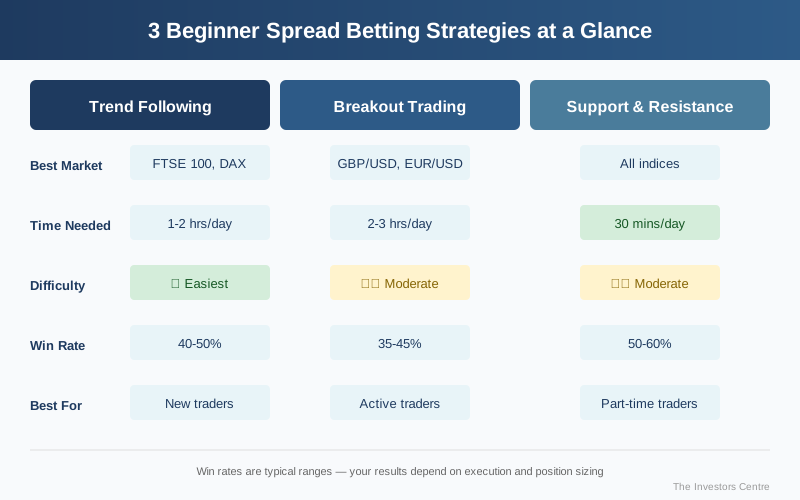
The differences between spread betting and CFDs matter less than understanding which of these three approaches matches your available time. A busy professional with 20 minutes per evening shouldn't be scalping. A student with hours of free time shouldn't be swing trading weekly charts.
In the next sections, I'll walk through each strategy with actual trades — including the maths, the stop placement, and what happens when the trade goes against you. That last part is something most guides skip, and it's the part beginners need most.
Strategy 1: Trend Following on the FTSE 100
Trend following is the simplest strategy to understand: find a market moving in one direction and bet it keeps going. You're not calling the top or bottom. You're joining mid-move and riding momentum.
The FTSE 100 suits this approach because it trends cleanly during UK market hours. Unlike forex pairs that whipsaw on every news release, the FTSE tends to pick a direction in the morning and stick with it — at least often enough to build a strategy around.
A worked example
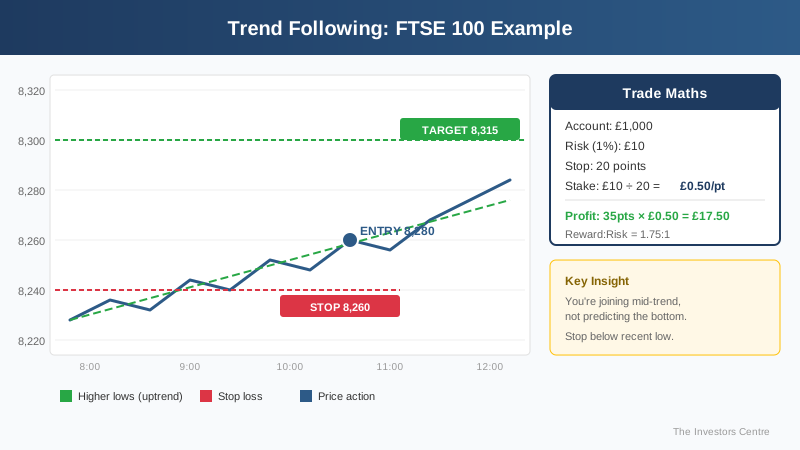
The FTSE opens at 8,240 and spends the first hour making higher lows. By 9:15, it's at 8,275 and the trend is clear. You decide to go long at 8,280, placing your stop below the most recent low at 8,245. That's a 35-point stop.
Now the maths. You've got a £1,000 account and you're following the 1% rule — risking no more than £10 per trade. Your stop is 35 points, so your position size is:
£10 ÷ 35 points = £0.28 per point
Most platforms won't let you bet less than 50p per point, so you'd need to either widen your stop or accept slightly higher risk. Let's say you adjust to a 20-point stop at 8,260, keeping the same £0.50 minimum stake. Now you're risking £10 per trade — exactly 1% of your account.
The FTSE rallies to 8,320 by mid-afternoon. You close at 8,315, banking 35 points at £0.50 per point:
35 points × £0.50 = £17.50 profit
Reward-to-risk ratio: 1.75:1
This is an example of a winning trade. In practice, many trend-following trades fail — the market reverses, your stop is hit, and you lose your risked amount. The strategy only works over time if your winners outweigh your losers, which is not guaranteed and does not happen for most retail traders.
When it goes wrong
The following week, you spot the same setup. FTSE at 8,180, trending higher, you enter at 8,195 with a stop at 8,175. This time, a surprise US inflation print hits at 13:30 and the index drops 60 points in ten minutes. Your stop triggers at 8,175. You lose £10. That's it. No blown account, no panic. The strategy failed but your position sizing held.
This is what most guides don't show you. Losing trades aren't disasters if you've sized correctly — but they're still losses. Even with proper risk management, most retail traders lose money over time. The 1% rule doesn't guarantee profitability; it extends how long you can trade before your account is depleted, giving you more time to learn whether this is right for you.
If you want to test this without risking capital, practise with a demo account until the mechanics feel automatic.
Strategy 2: Breakout Trading on GBP/USD
Breakouts look exciting — price stuck in a range suddenly explodes in one direction. The problem is most breakouts fail. They punch through a level, trigger everyone's orders, then reverse. Beginners get chopped to pieces.
The fix is filtering. You don't trade every breakout. You wait for breakouts that occur with momentum confirmation and ideally during high-volume sessions.
GBP/USD is ideal for this because the London open (8am) and US open (1:30pm UK time) create genuine moves. The pair often consolidates overnight, then breaks hard when London wakes up.
A worked example
GBP/USD has been stuck between 1.2650 and 1.2700 for two days. At 8:15am on Wednesday, it punches through 1.2700 and hits 1.2715 within minutes. You enter at 1.2705, placing your stop just below the breakout level at 1.2685 — a 20-pip stop.
With a £1,000 account risking 1%, that's £10. A 20-pip stop means:
£10 ÷ 20 pips = £0.50 per pip
Your target is the next resistance at 1.2780 — 75 pips away. If it hits, you make £37.50 on a £10 risk. That's nearly 4:1 reward-to-risk.
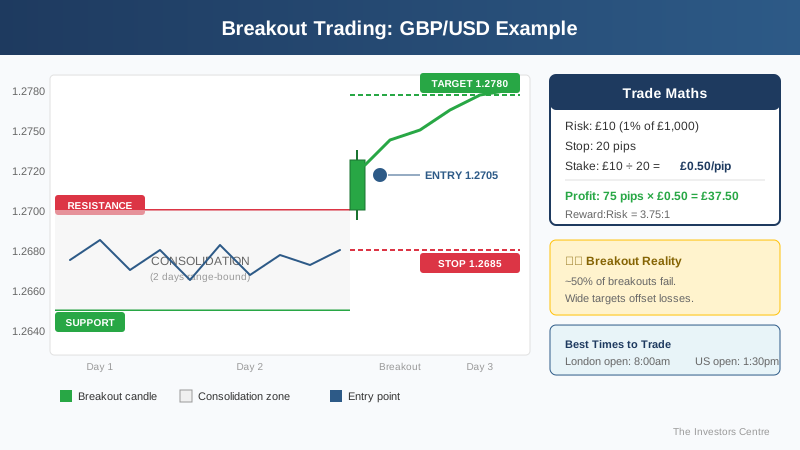
The trade runs to 1.2760 before stalling. You move your stop to breakeven at 1.2705, locking in a risk-free position. It eventually hits 1.2780 the next morning.
75 pips × £0.50 = £37.50 profit
Reward-to-risk ratio: 3.75:1
This example shows a successful breakout — but research suggests around half of breakouts fail, reversing back through the entry level. When that happens, your stop is hit and you lose your risked amount. Even with a favourable reward-to-risk ratio, a 50% win rate means you need your winners to significantly outpace your losers just to break even after spread costs.
Understanding common chart patterns will help you identify stronger breakout setups over time.
Strategy 3: Support and Resistance on Indices
This strategy suits traders who can't watch screens all day. You're not chasing momentum or reacting to breakouts. You're waiting for price to reach a level where it's bounced before, then betting on another bounce.
Support is a price level where buyers consistently step in. Resistance is where sellers take over. These levels form because institutions place large orders at round numbers or historical turning points. The FTSE at 8,000, the DAX at 18,500 — these aren't random. They're psychological barriers where money clusters.
A worked example
The FTSE has bounced off 8,100 three times in the past month. It's now trading at 8,115 and drifting lower. You set an alert for 8,105. When it triggers, you check the price action. If it's showing signs of rejection — a wick, a stall, buyers stepping in — you go long at 8,108 with a stop at 8,085. That's a 23-point stop.
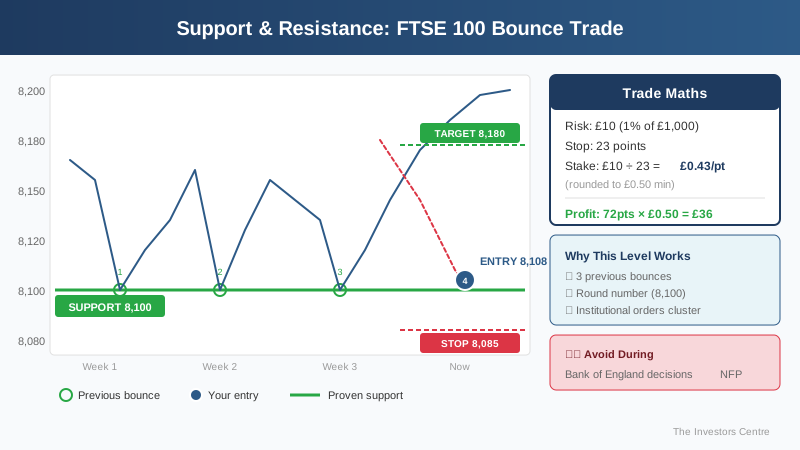
With your £1,000 account and 1% risk rule:
£10 ÷ 23 points = £0.43 per point (rounded to £0.50 on most platforms)
Your target is the recent high at 8,180 — 72 points away. If it hits, you make £36 on a £10 risk.
However, support levels can and do break. When a level that has held three times finally gives way, it often triggers a sharp move against you. Your stop would be hit, resulting in the full £10 loss. There is no guarantee that historical support will hold in the future.
The appeal of this approach is patience. You might only get two or three setups per week. But fewer trades doesn't mean safer trades — each one still carries the full risk of loss.
Position Sizing: Managing How Much You Lose Per Trade
Position sizing doesn't make you profitable — it controls how quickly you can lose your account. This distinction matters. Most traders lose money regardless of their position sizing approach. The 1% rule exists to slow the bleeding, not to stop it.
The logic: even a strategy that wins 60% of the time will produce five consecutive losers eventually. If you're risking 10% per trade, five losers means half your account gone. Risk 1% and those five losers cost you 5%. You're still down, but you have capital left to continue — or to stop and reassess whether spread betting is right for you.
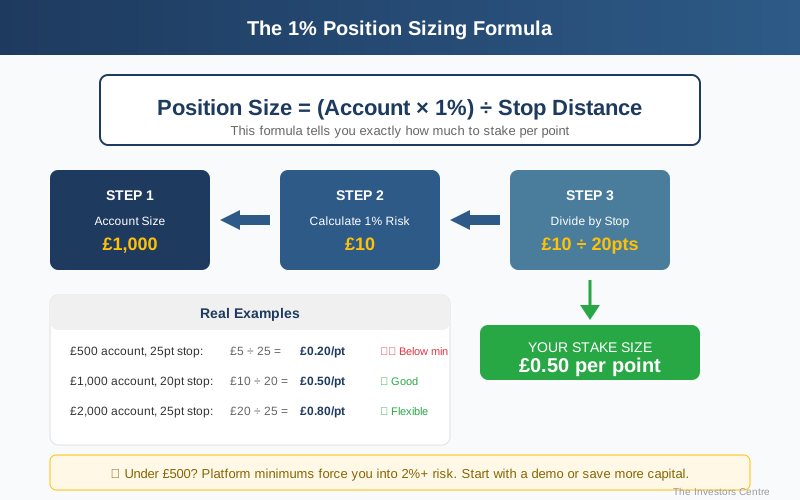
The formula is simple:
Position size = (Account × 1%) ÷ Stop distance
A £500 account risking 1% with a 25-point stop: £5 ÷ 25 = £0.20 per point. Most platforms require £0.50 minimum, so you'd need a smaller stop or accept 2% risk.
A £2,000 account with the same setup: £20 ÷ 25 = £0.80 per point. Now you've got flexibility.
This is why undercapitalisation accelerates losses. With less than £500, you're forced into oversized positions just to meet minimum stake requirements. If you're considering spread betting, compare spread betting platforms carefully — but understand that the platform you choose will not change the fundamental odds against retail traders.
FAQs
References
- FCA PS19/18: Restricting contract for difference products — The FCA's permanent leverage caps, margin close-out rules, and negative balance protection requirements for retail traders.
- HMRC Capital Gains Manual CG56100: Spread Betting — Confirms no chargeable gains or allowable losses arise from spread betting for most retail traders.
- FCA: CFD and Spread Betting Performance Data — Aggregated data showing the percentage of retail accounts that lose money across regulated providers.
- Bank of England: SONIA Benchmark — The Sterling Overnight Index Average, used to calculate overnight financing charges on spread betting positions.
- ESMA: Product Intervention Measures — The European Securities and Markets Authority's original intervention measures on CFDs and spread bets, which the FCA adopted permanently.
- London Stock Exchange: FTSE 100 — Official FTSE 100 index data, constituents, and market hours referenced in strategy examples.