

- expertise:
- Platform Testing, Cryptocurrency, Retail Investing
- credentials:
- Active investor since 2013 · 11+ years experience
- tested:
- 50+ platforms · 200+ guides authored

- expertise:
- CFD Trading, Forex, Derivatives, Risk Management
- credentials:
- Chartered ACII (2018) · Trading since 2012
- tested:
- 40+ forex & CFD platforms with live accounts
How We Test
Real accounts. Real money. Real trades. No demo accounts or press releases.
What we measure:
- Spreads vs advertised rates
- Execution speed and slippage
- Hidden fees (overnight, withdrawal, conversion)
- Actual withdrawal times
Scoring:
Fees (25%) · Platform (20%) · Assets (15%) · Mobile (15%) · Tools (10%) · Support (10%) · Regulation (5%)
Regulatory checks:
FCA Register verification · FSCS protection
Testing team:
Adam Woodhead (investing since 2013), Thomas Drury (Chartered ACII, 2018), Dom Farnell (investing since 2013) — 50+ platforms with funded accounts
Quarterly reviews · Corrections: in**@*******************co.uk
Disclaimer
Not financial advice. Educational content only. We're not FCA authorised. Consult a qualified advisor before investing.
Capital at risk. Investments can fall. Past performance doesn't guarantee future results.
CFD warning. 67-84% of retail accounts lose money trading CFDs. High risk due to leverage.
Contact: in**@*******************co.uk
Key UK Retail Trading Statistics 2026
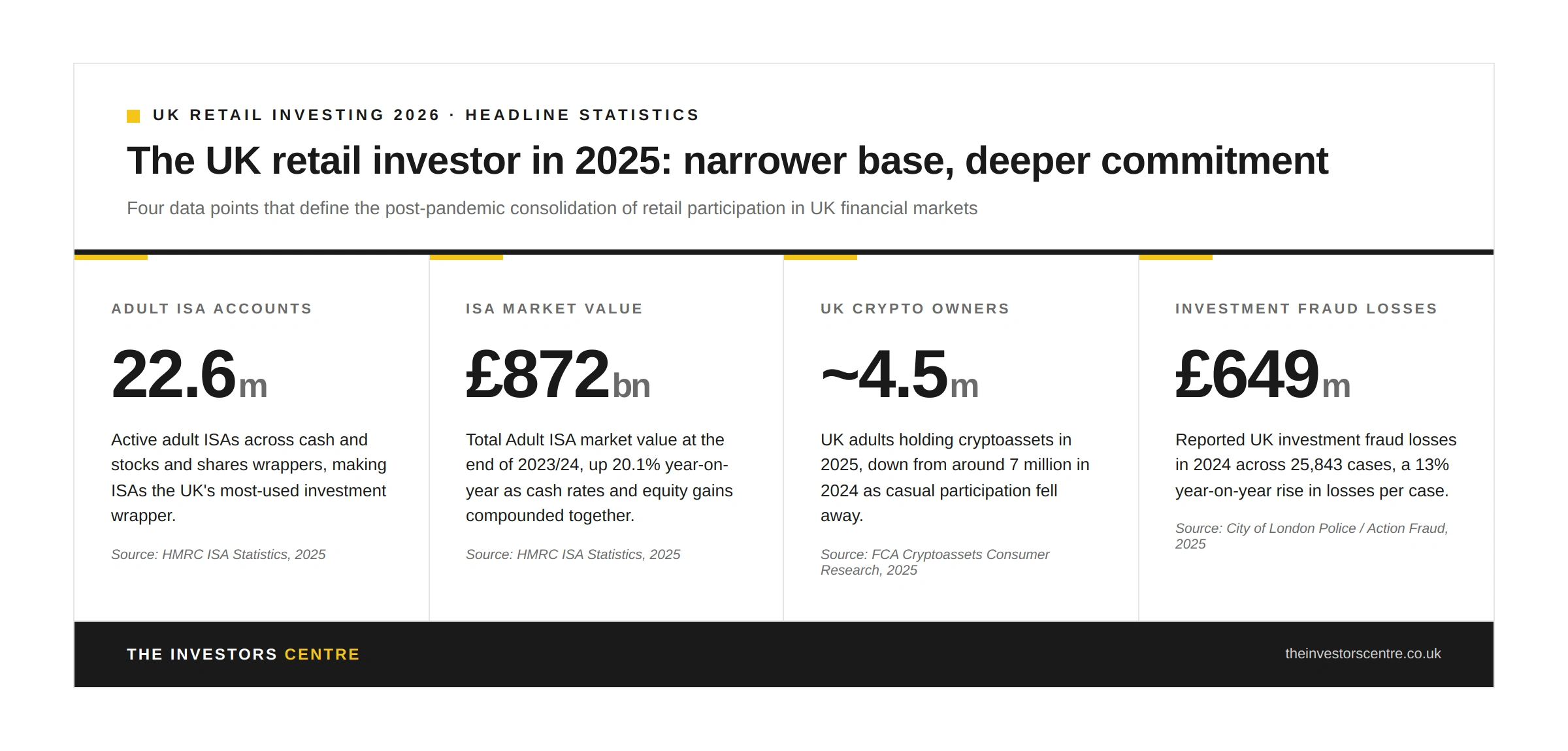
- 22.6 million adult ISAs were actively subscribed to in the UK in 2023/24 — the widest participation in any retail investment product.
- £872 billion total market value of UK Adult ISAs, up 20.1% year-on-year as cash rates and equity gains compounded.
- 15 million adult ISAs subscribed in 2023/24, holding £103 billion of annual contributions — a £31.4 billion year-on-year rise concentrated in cash.
- 8% (~4.5 million) UK adults owned cryptoassets in 2025, down from 12% in 2024 — the first annual decline since the FCA began tracking.
- £649 million lost to UK investment fraud across 25,843 reports in 2024 — a 13% rise in losses despite 7% fewer reports.
- 66% of UK investment fraud reports in 2024 involved cryptocurrency, up 16 percentage points year-on-year.
- 7 million UK adults with more than £10,000 in cash savings are missing out on investing — the core population the 2025 Budget ISA reform is designed to reach.
- 23 million UK consumers underserved by the current advice and guidance market, the FCA estimates ahead of the Targeted Support regime launching 6 April 2026.
- 80% of CFD retail clients lose money — the figure the FCA continues to cite in ongoing concerns about problem firms in the CFD sector.
- £12,000 new cash ISA allowance for under-65s from April 2027 — cut from £20,000 in Rachel Reeves's Autumn Budget to redirect savings toward UK equities.
- 4.1 million UK adults subscribed to a stocks and shares ISA in 2023/24 — a more direct measure of people actively holding market-based investments.
- WhatsApp 40% of investment fraud reports referencing a social platform mentioned WhatsApp, with Facebook in 18% and Instagram in 14% of cases.

Free to use with a dofollow link back to The Investors Centre.
How Many People Trade and Invest in the UK?
The UK retail trading and investing population in 2026 runs into the tens of millions at its widest definition, narrowing sharply at the active-trader end. The 22.6 million adult ISAs active in 2023/24 represent the broadest measure of self-directed financial-market participation — roughly 42% of UK adults hold at least one ISA, spread across cash and stocks and shares wrappers.
Within that, 4.1 million adults subscribed to a stocks and shares ISA in 2023/24, a more direct measure of people actively holding market-based investments. Active traders using leveraged products such as CFDs, spread bets or forex are a much smaller cohort, though the FCA has not published an all-UK count since its 2018 assessment when it estimated around 125,000 UK CFD and spread-betting clients across the largest firms.
The pandemic surge of 2020–2021 roughly doubled participation in high-risk retail investing, and most of that gain has held. The FCA's ongoing tracking shows cryptoasset ownership still running at nearly double its 2021 baseline even after the 2024–2025 decline, while stocks and shares ISA subscribers remain above their pre-pandemic level. The picture is one of permanent structural enlargement of the retail market, alongside a cyclical cooling from the 2024 peak.
The UK ISA Market Crossed £872 Billion in 2024
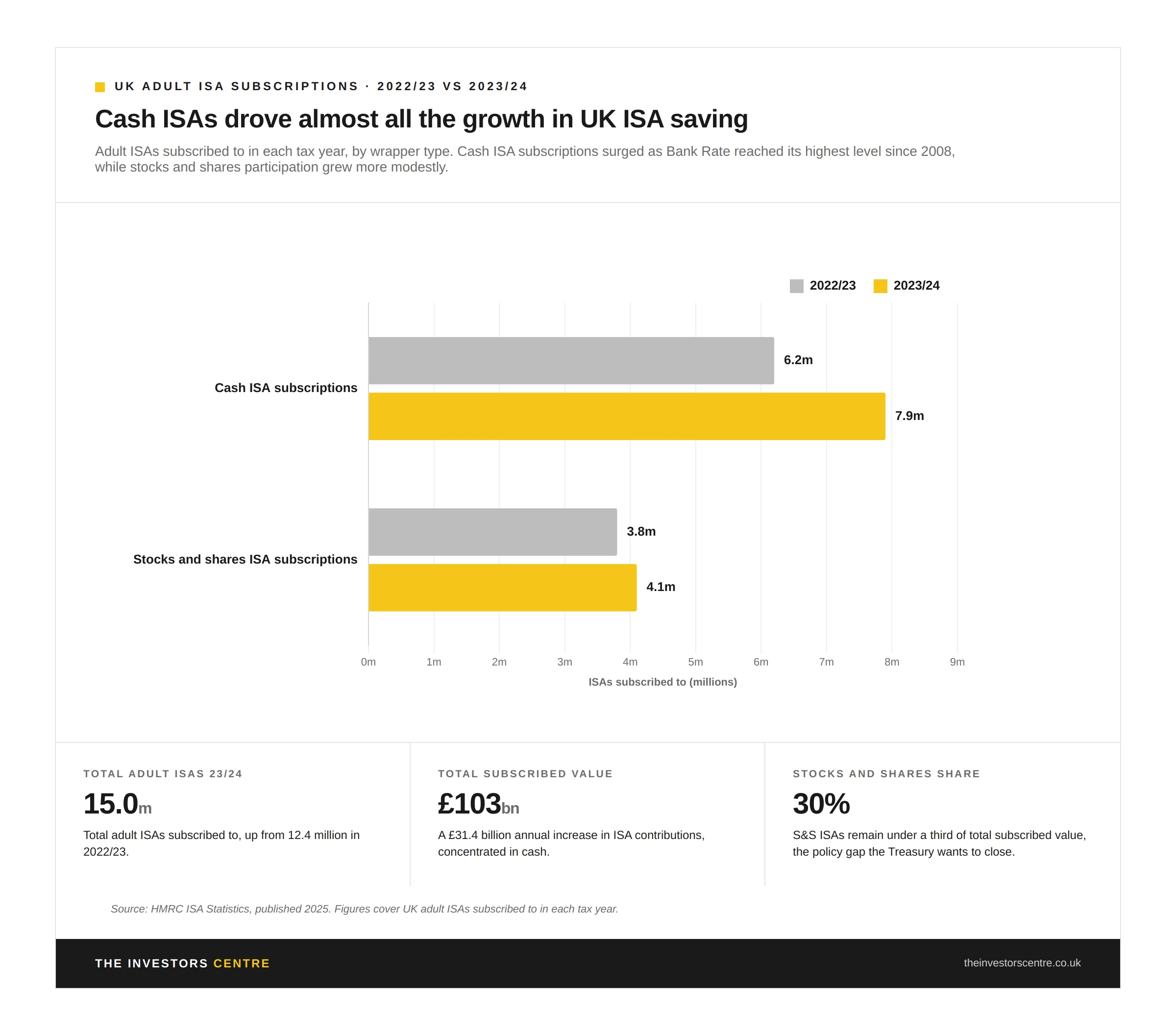
Adult ISAs are the single largest wrapper for UK retail investment activity, and the market is still growing sharply. HMRC figures show the total Adult ISA market value rose 20.1% year-on-year to £872 billion at the end of 2023/24, the largest absolute increase on record. Annual subscriptions hit £103 billion, a £31.4 billion rise driven almost entirely by cash ISAs as Bank Rate reached its highest level since 2008.
Stocks and shares ISA subscriptions grew more modestly to £31.1 billion across 4.1 million accounts — meaning just 30% of new contributions went into market-based investments, the concentration of cash that the Autumn Budget 2025 explicitly set out to address. Readers comparing where to hold their next ISA can see our breakdown of self-directed investment platforms for the major UK options.
UK Adult ISA Subscriptions by Type
| ISA Type | Accounts Subscribed (2023/24) | Amount Subscribed | YoY Change |
|---|---|---|---|
| Cash ISA | 7.9 million | £71.9 billion | +£29.0 billion |
| Stocks and Shares ISA | 4.1 million | £31.1 billion | +£2.4 billion |
| Lifetime ISA | 0.8 million | £2.0 billion | +£0.1 billion |
| Innovative Finance ISA | Under 0.1 million | Under £0.2 billion | Broadly flat |
| Total Adult ISAs | 15.0 million | £103.1 billion | +£31.4 billion |
Source: HMRC Annual Savings Statistics, published September 2025. Figures rounded to the nearest tenth.

Free to use with a dofollow link back to The Investors Centre.
UK Cryptoasset Ownership Fell for the First Time in 2025
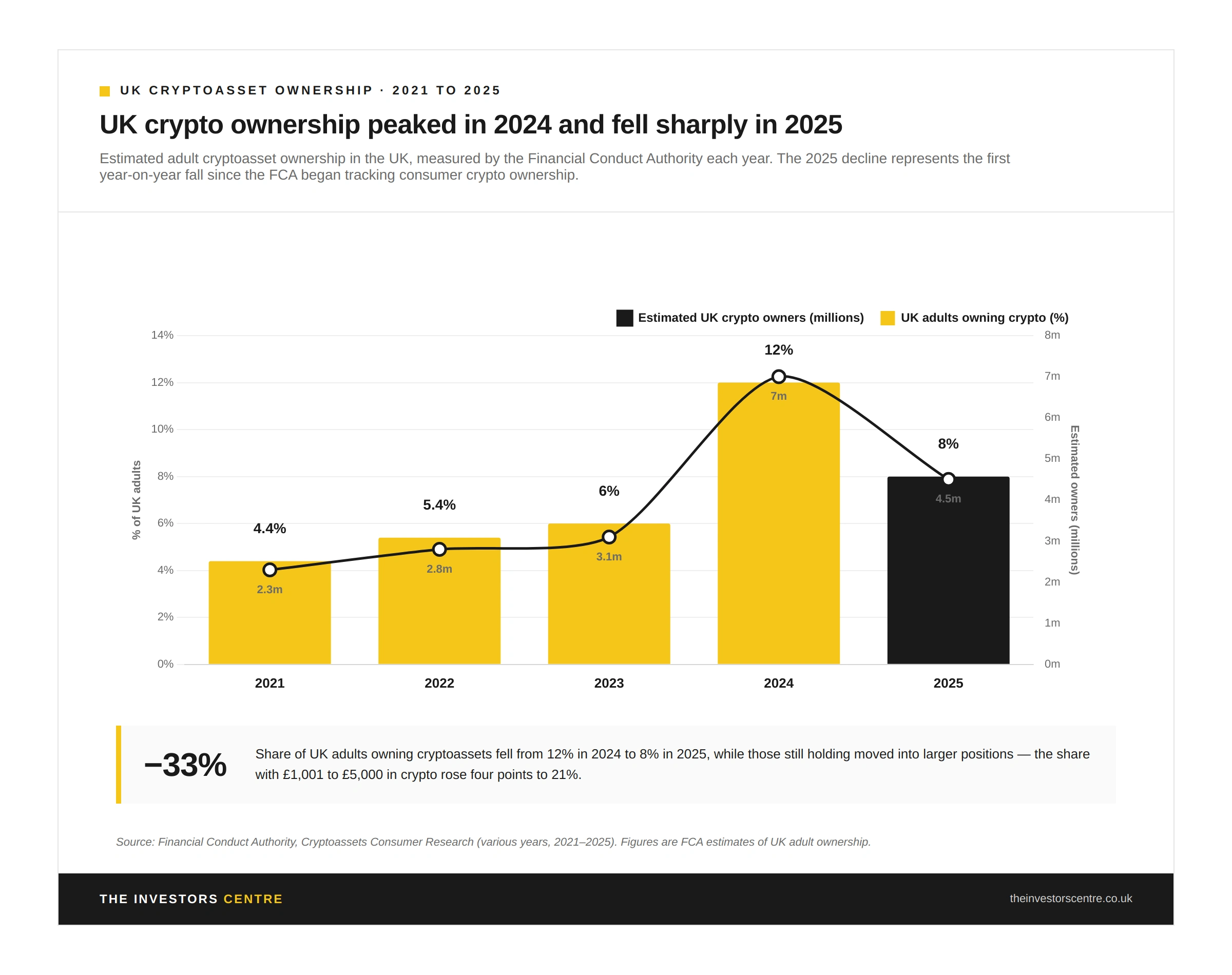
UK adult cryptoasset ownership dropped from 12% in 2024 to 8% in 2025, an annual fall of roughly one-third. The FCA's latest Cryptoassets Consumer Research puts UK ownership at around 4.5 million adults, down from an estimated 7 million a year earlier. It is the first year-on-year decline since the regulator began tracking consumer crypto activity, and it represents the most visible unwind of the 2020–2024 retail speculation boom.
Two signals matter inside that headline. First, casual holders are leaving: the share of owners with under £100 invested continues shrinking. Second, committed holders are consolidating: the share with £1,001 to £5,000 in crypto rose four points to 21%, and the share with £5,001 to £10,000 rose three points to 11%. The market is becoming narrower but deeper — the retail trader profile that remains is one of conviction rather than experimentation. Only 5% of current UK crypto owners first bought after October 2024, suggesting new entry has all but stopped while existing holders add to positions.

Free to use with a dofollow link back to The Investors Centre.
"The crypto cohort isn't shrinking — it's concentrating. Casual holders with under £100 are leaving en masse, but the share holding £1,000+ is rising on every measure. That's not a market in retreat; it's a market self-selecting down to its committed core. The same pattern shows up in the 'fewer reports, bigger losses' fraud data: the people still in the game have more capital at stake per person than at any point since the FCA began tracking it."
Who Are UK Retail Traders and Investors?
UK retail trading and higher-risk investing skews younger, more male, and more crypto-native than the traditional ISA investor base. Crypto ownership runs at 15% among 18–34 year-olds and 11% among men, according to the FCA's 2025 research, versus far lower rates for women and over-55s. Ethnic minority and higher-income groups are also more likely to hold digital assets. This demographic skew matters because it maps onto the same cohort that the FCA's finfluencer investigations and CFD harm work target — a single population that is both the main growth engine for retail trading and the highest concentration of consumer risk.
UK Retail Investor Demographics Snapshot
| Demographic | Crypto Ownership | Notable Behaviour Data |
|---|---|---|
| All UK adults | 8% (~4.5m) | Down from 12% in 2024 |
| Adults aged 18–34 | 15% | Most likely to follow finfluencers |
| Men (all ages) | 11% | Over-represented in higher-risk products |
| Higher-income households | Above national average | Also hold larger ISA balances |
| Ethnic minority adults | Above national average | FCA flags this in its 2025 research |
| Adults aged 55+ | Materially below average | Concentrated in cash ISAs and pensions |
Source: FCA Cryptoassets Consumer Research 2025; Financial Lives 2024; HMRC ISA Statistics 2025.
UK Investment Fraud Losses Reached £649 Million in 2024
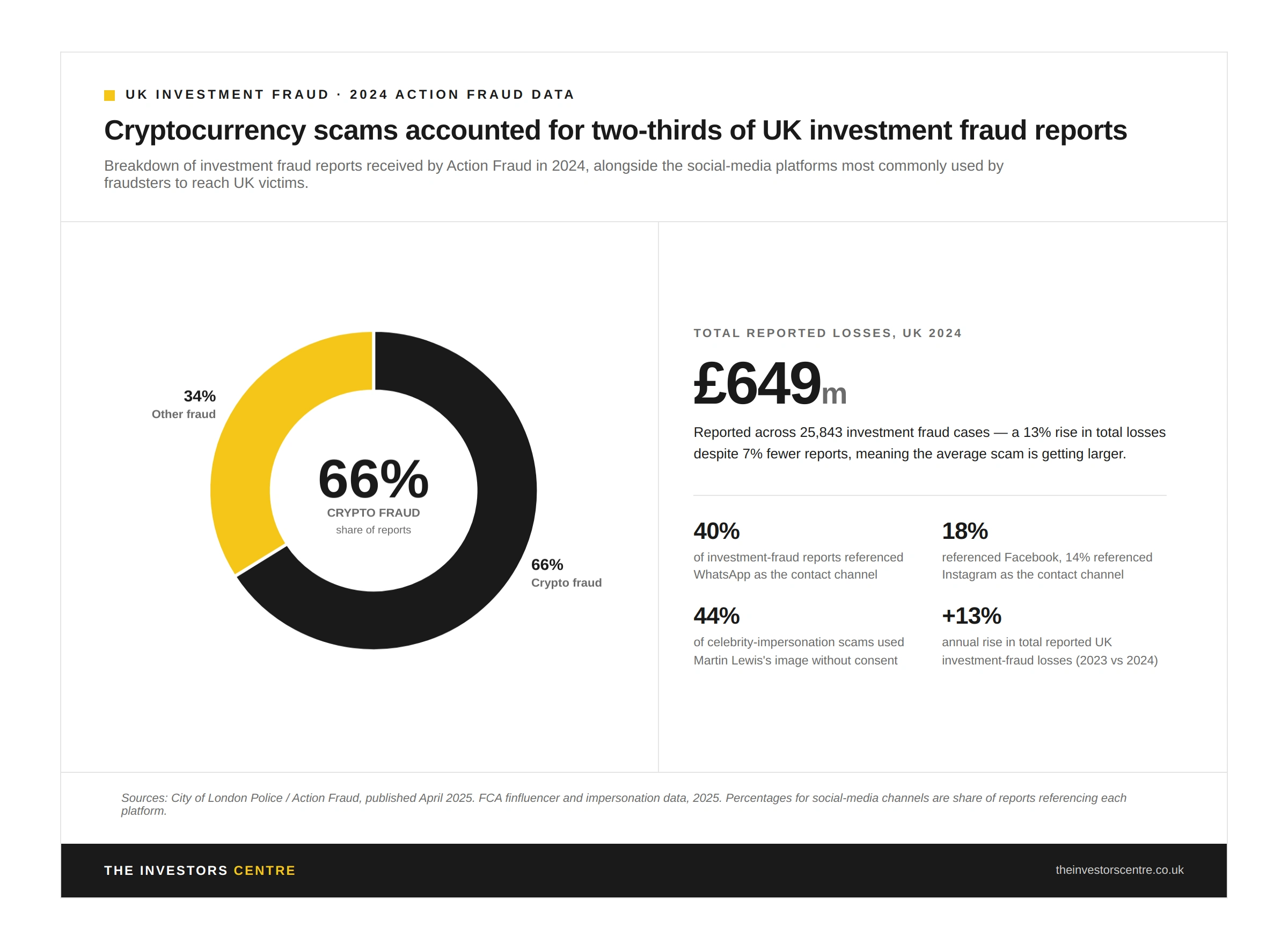
Reported UK investment fraud losses rose 13% in 2024 to £649 million, despite a 7% fall in the number of reports — meaning the average scam is getting larger. Action Fraud recorded 25,843 investment fraud reports across the year, with cryptocurrency fraud accounting for 66% of them, up from 50% a year earlier. Social media is now the dominant contact channel: 36% of reports referenced a social platform, with WhatsApp mentioned in 40% of cases, Facebook in 18%, and Instagram in 14%.
Celebrity-impersonation scams form a distinct sub-category. Martin Lewis's image was used in 44% of celebrity-impersonation investment-fraud reports, followed by Elon Musk at 40% and Jeremy Clarkson at 8%. The FCA led an international week of action in June 2025 alongside regulators from Australia, Canada, Hong Kong, Italy and the UAE that generated more than 650 social-media takedown requests and seven cease-and-desist letters, the largest coordinated finfluencer enforcement push to date.

Free to use with a dofollow link back to The Investors Centre.
The 2026 Regulatory Shake-Up for UK Retail Investors
Two reforms dominate the UK retail trading and investing landscape from April 2026: the FCA Targeted Support regime and the Autumn Budget 2025 ISA changes. The Targeted Support framework, finalised in FCA Policy Statement PS25/22 in February 2026 and live from 6 April 2026, allows authorised firms to make "ready-made suggestions" to pre-defined consumer segments without full individual suitability assessments. The FCA estimates 23 million UK consumers are underserved by the current advice and guidance market, and this is the regulator's answer to that gap. It is explicitly designed to let platforms and banks nudge the estimated 7 million adults holding more than £10,000 in cash towards investment options.
Running alongside it, Chancellor Rachel Reeves used the November 2025 Autumn Budget to cut the cash ISA allowance for under-65s from £20,000 to £12,000 from April 2027, ring-fencing the remaining £8,000 of the overall ISA allowance for stocks and shares. Over-65s retain the full £20,000 cash allowance. The policy is contentious — AJ Bell polling found only 12% of Britons supported a cash ISA cut and 48% opposed it — but it represents the most significant change to the ISA regime since its 1999 launch.
Key UK Retail Trading Regulatory Timeline
| Date | Measure | Impact |
|---|---|---|
| Aug 2018 | FCA / ESMA leverage limits on CFDs | Retail CFD leverage capped at 30:1 on major FX, lower on indices and equities |
| Jan 2021 | FCA ban on retail crypto-derivatives | Crypto-linked CFDs and ETNs withdrawn from UK retail clients |
| Oct 2023 | FCA financial promotions regime for cryptoassets | All UK crypto promotions brought into FCA regulatory perimeter |
| Jul 2023 | Consumer Duty in force | "Good outcomes" obligation covers trading and investment platforms |
| Nov 2025 | Autumn Budget cash ISA reform | Cash ISA allowance for under-65s cut to £12,000 from April 2027 |
| Apr 2026 | Targeted Support regime live | Firms can make segment-level suggestions without full suitability |
| Oct 2027 | Full cryptoasset regulation (planned) | HM Treasury target for bringing crypto into the financial services perimeter |
Source: Financial Conduct Authority; HM Treasury Autumn Budget, November 2025.
What the Data Tells Us About UK Retail Trading Behaviour
UK retail traders take losses harder than professional traders by a factor of around four to one. Research by Mills and Whittle at Leeds and Salford found that losing £1 feels like losing £4 for social retail investors who use platforms such as Reddit-linked communities — twice as painful as the equivalent loss felt by professional traders. The authors argue speculative retail trading functions as a bid for "financial redemption" for a generation that sees conventional wealth-building routes as structurally inaccessible, which helps explain why conviction has deepened even as participation has narrowed.
Risk-appetite data backs this up. 63% of UK crypto users say they are willing to take higher risks for higher returns, compared with only 24% of crypto-aware non-holders. Encouragingly, some harm markers are moderating: use of credit cards to fund crypto purchases fell to 9% in 2025 from 14% in 2024, staking participation dropped five points to 22%, and 76% of crypto purchases are now funded from disposable income rather than borrowing. The investor base is maturing, even if it remains a smaller slice of the population than policymakers would like.
Which UK Trading Products Sit Where on the Risk Spectrum?
UK retail trading products span a wide risk range, from low-risk cash ISAs to high-risk leveraged CFDs. This page covers the full picture; deeper statistics on the active-trading end of the spectrum sit on the dedicated CFD, forex, spread betting, day trading and options pages that follow in this series. Active traders comparing the major regulated venues can see our ranked list of the leading UK CFD trading platforms.
UK Retail Trading Product Risk Spectrum
| Product | Typical User Profile | Leverage | FCA Loss Guidance |
|---|---|---|---|
| Stocks and shares ISA | Long-term retail investor | None | No headline loss figure — market risk disclosed |
| General investment account | Higher-balance investor | None by default | No headline loss figure — market risk disclosed |
| Spread betting | Active UK trader, tax advantages | Up to 30:1 on major FX | Majority of accounts lose money (FCA 2018 assessment) |
| CFDs | Active trader, global markets | Up to 30:1 on major FX | "80% of retail clients lose money" is the industry disclosure |
| Forex (retail spot) | Specialist active trader | Up to 30:1 on major pairs | Loss rates broadly aligned with CFD data |
| Cryptoassets (unleveraged) | Younger retail, higher risk appetite | None (derivatives banned for retail) | FCA warns consumers can lose all their money |
Source: Financial Conduct Authority; industry standard disclosures. The "80% of CFD clients lose money" figure is widely used across FCA-regulated CFD providers; exact figures vary firm-by-firm.
TIC Analysis: The UK Retail Investor Consolidation Ratio
The Investors Centre has calculated what we call the UK Retail Investor Consolidation Ratio for 2025: a measure of how concentrated retail holdings have become as participation has narrowed. Using FCA Cryptoassets Consumer Research data, the ratio compares the share of owners holding £1,001 or more against the total owner base in the same year. In 2024, roughly 39% of UK crypto owners held over £1,000 in their wallets. In 2025, that figure rose to around 51% — meaning as the owner base shrank by an estimated 2.5 million people, the remaining population concentrated into larger positions.
The pattern is consistent with the Mills and Whittle behavioural finding that retail traders increasingly treat these holdings as long-term bets on financial outcomes rather than casual experiments. It also helps explain why the FCA's 2025 harm data shows fewer reports but bigger losses: the remaining population has more capital at stake per person, making each fraud loss larger in absolute terms.
"For every 10 UK adults holding crypto in 2025, around five held more than £1,000 in it, compared with just four a year earlier. The retail population narrowed but each survivor in it bet bigger. That is not a market that's giving up — it's a market that's settled on its final core, and that core is structurally over-exposed."
Frequently Asked Questions
How many people in the UK trade stocks and shares?
Around 4.1 million UK adults subscribed to a stocks and shares ISA in 2023/24, according to HMRC. When non-ISA general investment accounts and SIPPs are added, the total number of UK self-directed investors is materially higher — industry estimates place it around 7 to 9 million.
How many UK adults own cryptoassets?
The FCA estimates around 4.5 million UK adults — 8% of the adult population — owned cryptoassets in 2025, down from 12% in 2024. It was the first year-on-year decline since the regulator began tracking consumer crypto ownership.
How much do UK retail investors lose on CFDs?
FCA-regulated CFD providers must disclose the percentage of their retail clients who lose money. The industry-wide figure typically sits around 70% to 85%, and the FCA uses "80% of retail CFD clients lose money" as its standard public reference. Exact rates vary by provider.
How much was lost to UK investment fraud in 2024?
Action Fraud recorded £649 million in UK investment fraud losses in 2024 across 25,843 reports, a 13% rise in total losses despite a 7% fall in case numbers. 66% of reports involved cryptocurrency.
What is the UK cash ISA allowance in 2025/26?
The cash ISA allowance for 2025/26 remains £20,000, sitting inside an overall £20,000 ISA limit. From April 2027, the Autumn Budget 2025 will cut the cash ISA allowance for under-65s to £12,000, with the remaining £8,000 of the overall allowance ring-fenced for stocks and shares. Over-65s retain the full £20,000 cash allowance.
What is Targeted Support and when does it start?
Targeted Support is a new FCA regulatory framework that allows authorised firms to make pre-designed suggestions to pre-defined consumer segments without conducting full individual suitability assessments. It goes live on 6 April 2026 under FCA Policy Statement PS25/22, and is designed to help the estimated 23 million UK adults the FCA considers underserved by the current advice and guidance market.
Is spread betting tax-free in the UK?
Yes, spread betting profits are free from Capital Gains Tax and Income Tax for UK retail users, because spread betting is classed as gambling rather than investment under HMRC rules. This is a key reason spread betting remains a distinctively UK retail trading product. See our explainer on how spread betting works in the UK for the full rules.
What leverage can UK retail traders use on CFDs?
Since August 2018, the FCA has applied ESMA-aligned leverage limits: up to 30:1 on major currency pairs, 20:1 on non-major pairs and major indices, 10:1 on commodities other than gold, 5:1 on individual equities, and 2:1 on cryptoassets (noting that crypto CFDs have been banned for UK retail clients since January 2021).
How does the UK compare internationally for retail investing?
The UK has higher cash-holding among investable-asset owners than most G7 economies, which the government cited as the main justification for the 2025 ISA reform. On cryptoasset adoption, the UK ranks 11th in the Chainalysis Global Crypto Adoption Index, behind India, the United States, Brazil and Vietnam.
What percentage of UK retail traders are aged under 35?
Younger adults are materially over-represented in higher-risk retail trading. The FCA's 2025 Cryptoassets Consumer Research shows 15% of UK 18–34 year-olds own cryptoassets, compared with 8% of all UK adults. Similar skews appear in CFD, forex, and app-based share-trading populations, though all-UK counts for these are not published.
Which social media platforms are most used by UK investment fraudsters?
Action Fraud 2024 data shows WhatsApp was referenced in 40% of investment-fraud reports involving a social platform, Facebook in 18% and Instagram in 14%. Across all investment-fraud reports, 36% referenced a social-media platform of some kind — a share that has risen steadily since 2020.
How big is the UK ISA market?
At the end of 2023/24, the total Adult ISA market value stood at £872 billion, up 20.1% year-on-year. Adult ISAs held a combined 22.6 million accounts actively subscribed to across cash and stocks and shares wrappers, making ISAs the UK's single largest retail investment wrapper.