


Quick Answer: What Does CFD Trading Really Cost in the UK?
CFD trading costs a little more than the “commission-free” label suggests, but the costs are refreshingly easy to see once you know where to look. You pay the spread when you open a position, plus a small overnight financing charge for each night you keep it. To show how those add up, I left a trade running on an IG demo account and watched the financing reach £213.28 over four weeks, with no real money at stake, which is exactly what a demo is for. IG shows both the spread and the financing on the ticket before you trade, which is one of the reasons I use it. Used with a little discipline, CFDs are one of the most flexible tools a UK trader has. Here is what to look for, and how to start with confidence.

Spread bets and CFDs are complex instruments and come with a high risk of losing money rapidly due to leverage. 69% of retail investor accounts lose money when trading spread bets and CFDs with this provider. You should consider whether you understand how spread bets and CFDs work, and whether you can afford to take the high risk of losing your money.
What Is a CFD, and How Does CFD Trading Work?
A contract for difference is an agreement between you and a broker to exchange the difference in an asset’s price between when you open and close the position. You never own the underlying gold, share or index. You are trading the price movement, with leverage, in either direction.
That flexibility is what makes CFDs so useful. You can go long or short, trade thousands of markets from one account, and size positions precisely. Used with discipline, they are one of the most powerful tools a UK trader has.
The definition, though, is the least important part. When I started out, I read plenty about what a CFD is. What actually moved my account was none of that. It was the lines on the statement: the spread, the financing, and the leverage maths. Those are the things this guide is about.
I have funded and tested 18 UK brokers in the most recent cycle alone, and I have been trading and reviewing them since 2012. This is the version I wish I’d had when I opened my first account.
What a Decade of Testing Brokers With My Own Money Taught Me
My broker testing runs on real, funded accounts, not demo accounts and not fact sheets. In the most recent cycle alone I tested 18 UK brokers from a wired connection in Suffolk, measuring real spreads, real execution speed and real overnight costs across the same instruments.
Ten years of this, across more than 40 platforms, keeps teaching me the same three lessons. They are the things I now check before anything else, and none of them are a reason to avoid CFDs. They are reasons to understand them.
Does Leverage Mean You Only Need a Small Deposit to Trade CFDs?
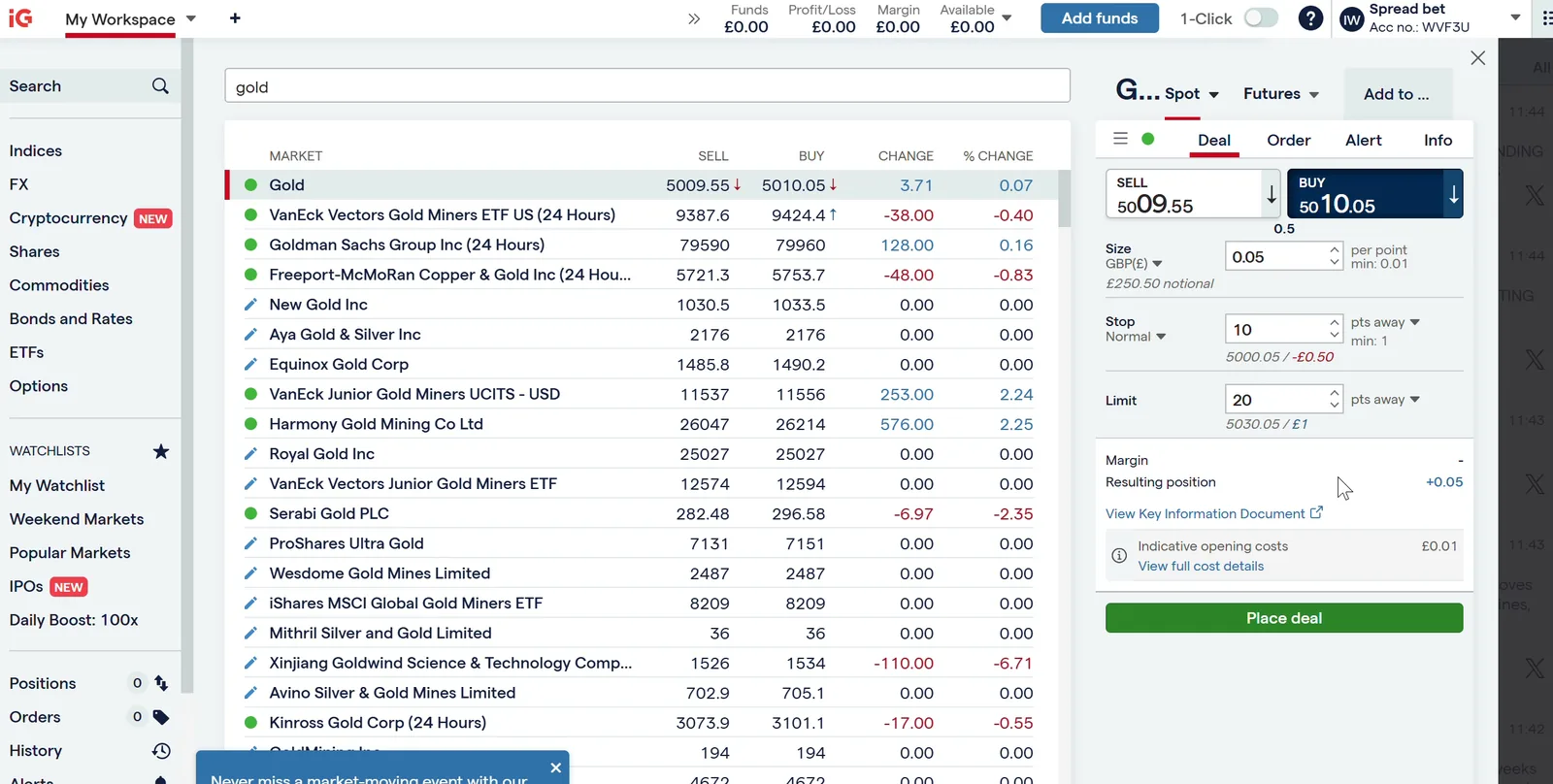
No, and when I started I had this backwards too. Under FCA rules, retail CFD traders get a maximum of 30:1 on major forex pairs and 10:1 on commodities such as silver (gold is at 20:1). The pitch is usually one of efficiency. With 30:1, the argument runs, just £1,000 controls £30,000 of the market.
The figure that matters is the one the pitch leaves out. If £1,000 controls £30,000 of EUR/USD, a 1% move against you costs £300, which is 30% of your account. A move of just 3.33% wipes the £1,000 out entirely, and on major currencies that can happen within a single volatile session. My guide to choosing a forex broker covers how those pairs trade in practice.
The broker will not let you ride a losing position to zero in the hope it recovers, either. FCA rules require a 50% margin close-out, so once your account equity falls to half the margin you are required to hold, positions begin to be liquidated automatically. You do not choose the exit; the arithmetic does.
Handled well, leverage is simply efficient use of capital. The honest way to read it is that it shrinks the move required to lose your deposit, so the answer is smaller position sizes, not bigger ones. Get that right and leverage works for you rather than against you.
Is CFD Trading Actually Commission-Free?
Often, yes. There genuinely is no separate commission, and that is good news, as long as you know about the cost that does apply. Commission-free is not the same as cost-free.
Plenty of UK CFD accounts, IG’s standard account included, charge nothing extra on FX, indices and commodities. The cost simply arrives in two forms rather than one. You pay the spread when you open the position, and overnight financing accrues every night you keep a leveraged trade open. Because the financing is small on any given day, it rarely registers, which is why watching for it is a habit worth building early.
To demonstrate this without risking real money, I deliberately left a long Spot Gold position running on an IG demo account and let it sit. A demo simulates real financing, so the charges are realistic. Here is what built up.
| Date | Charge | Amount |
|---|---|---|
| 12 Jun 2026 | Daily Admin Fee (FX interest, 1 day) | £1.50 |
| 12 Jun 2026 | Daily Financing Adjustment (1 day) | £6.18 |
| 11 Jun 2026 | Daily Financing Adjustment (3 days) | £17.98 |
| 21 May 2026 | Daily Financing Adjustment (4 days) | £27.35 |
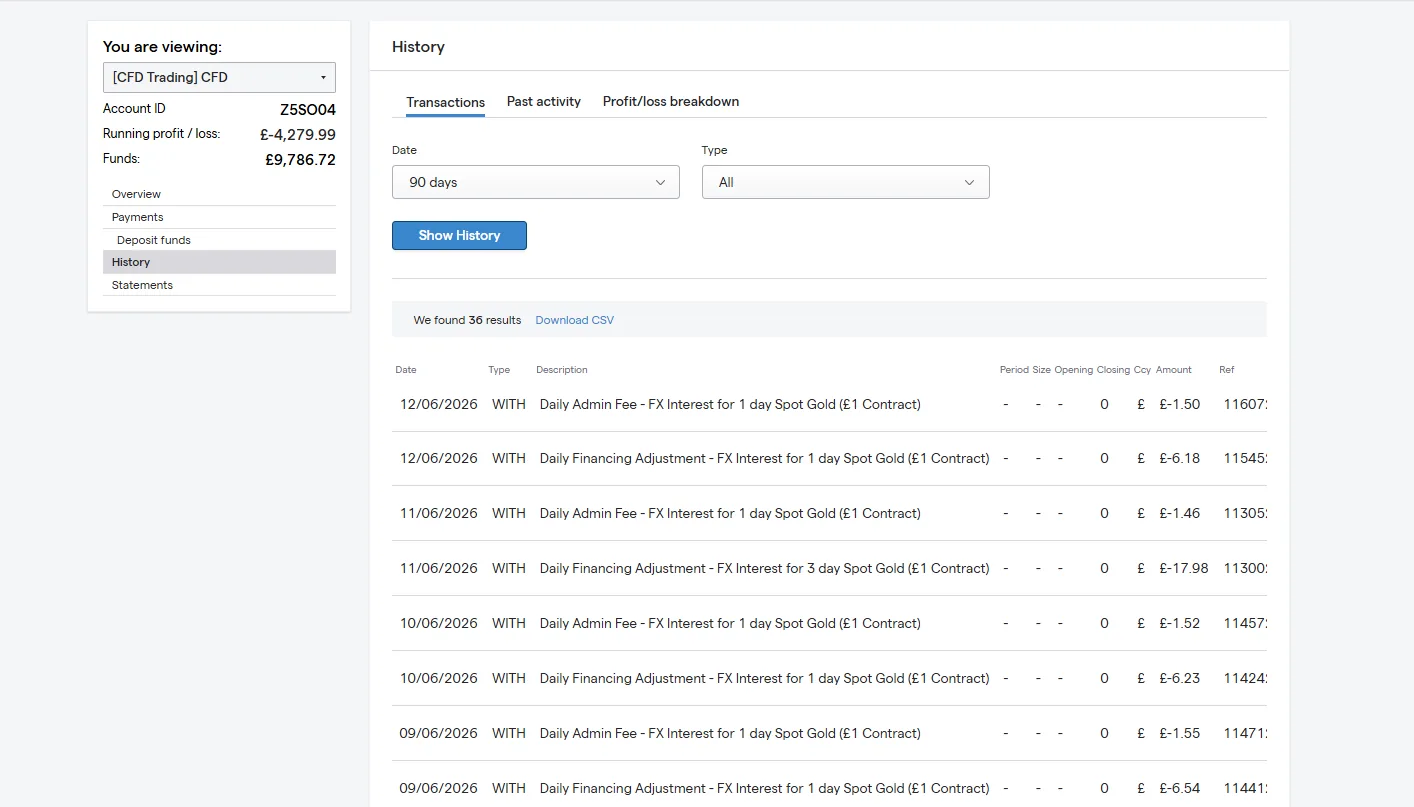
Two details stand out. The first is that most days carry two separate charges, an admin fee and a financing adjustment. On 12 June that was £1.50 plus £6.18, a total of £7.68 for the day, rather than the single line you might expect.
The second is visible on 11 June and 21 May, where three or four days of financing are taken in one hit to cover the weekend. Hold a position over a long weekend and the cost mounts before the market has even reopened.
The financing on this one position totalled £213.28, while the position itself drifted £4,279.99 into the red. On a demo that is a free lesson. On a real account it is the difference a month of inattention can make, and it is exactly why I close or review positions before weekends. If you trade the metal specifically, I compare the gold platforms on cost broker by broker, and cover the wider commodity markets separately.
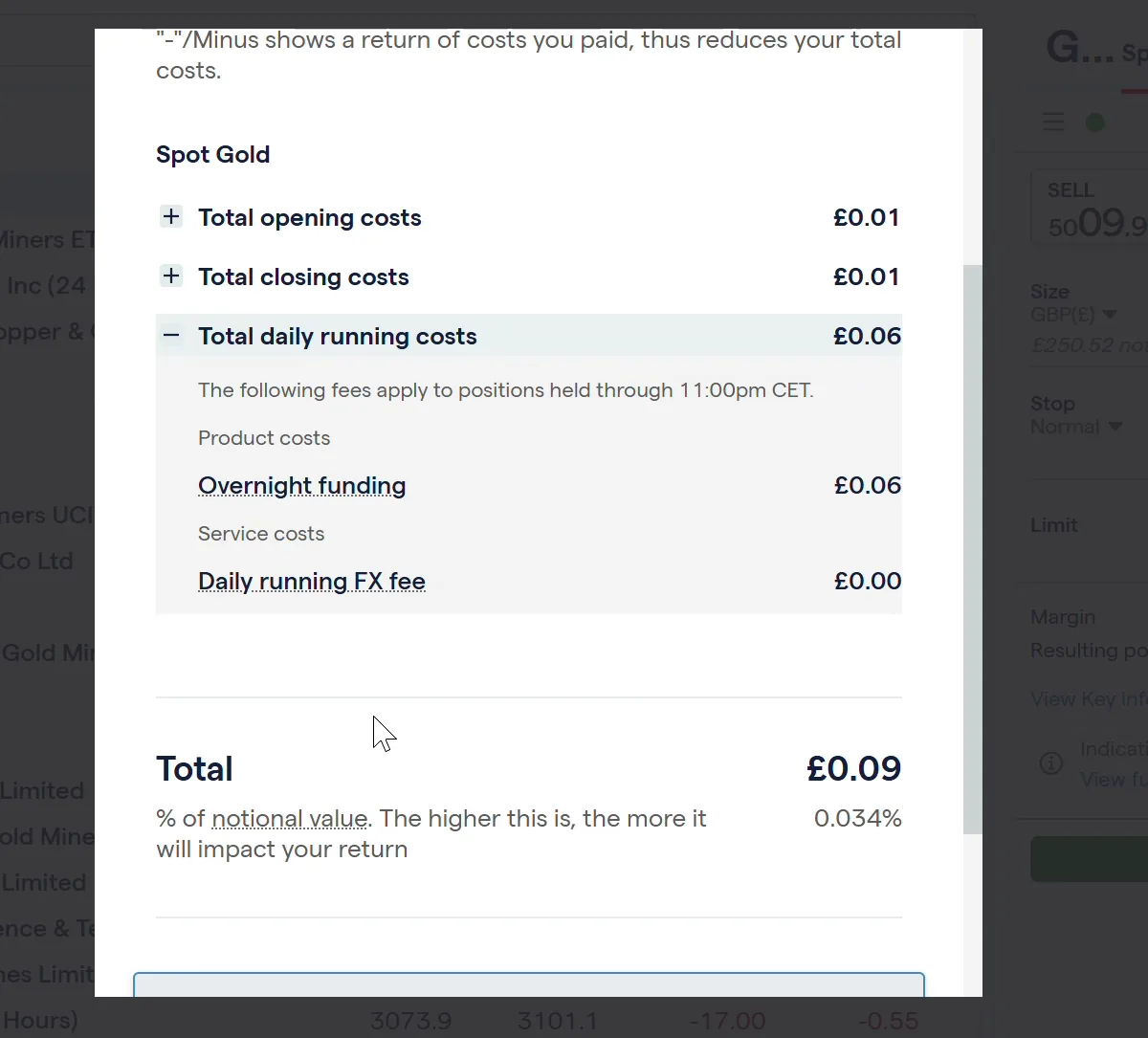
On my live accounts the spread is the cost I manage hardest, because it is paid on every single trade. My guide to which brokers offer the tightest spreads shows how much that varies. To IG’s credit, none of this is hidden. Open the cost breakdown on any ticket and the overnight funding is listed in plain figures before you place the trade.
Does Negative Balance Protection Keep Your Deposit Safe?
No, though it is widely assumed to, and understanding the difference will make you a calmer trader. Many people treat negative balance protection as a safety net. It is worth being precise about what it does.
It is not a feature worth choosing a broker for, because every FCA-regulated broker offering CFDs to retail clients is legally required to provide it, IG, Pepperstone and CMC included. It is a regulatory floor that you already have.
Its job is narrower than the name implies. Should the market gap so violently that a losing position falls straight through zero, the protection ensures you are not pursued for the shortfall. You cannot end up owing the broker money you never held in the account. In a flash-crash scenario that is genuinely reassuring.
What it does not do is protect your deposit. The demo gold position is the clearest illustration: negative balance protection was active and did nothing to stop it falling £4,279.99, because the protection engages only below zero. Everything from your deposit down to that point is in your hands, which is why position sizing matters more than any built-in protection.
Should You Start CFD Trading on a Demo Account?
Yes, if you are new to this. A demo account is the single best way to learn how leverage, spreads and overnight financing behave before any real money is on the line. It is exactly how I produced the gold example above, and it cost nothing.
IG’s demo comes with £10,000 in virtual funds and the full platform, so you can place trades, leave one open for a few days, and watch the financing line build, just as you would on a live account. Spend a couple of weeks there first and the costs in this guide stop being theory.
When you are ready to compare the options, I rank the demo accounts here, and my guide to getting started with day trading covers building a routine. There is no rush to fund a live account until the demo feels boring.
Why I Still Use IG, Even Though It Isn’t the Cheapest
IG is not the broker I would pick purely to minimise overnight financing, where Pepperstone’s raw spreads win comfortably. Where IG earns its place is in range, research and reliability. It offers 17,000 markets, more than any other UK retail broker I have tested, with genuinely strong research, ProRealTime charting, and DMA for professional-tier clients.
There is reassurance in the firm itself, too. It was founded in 1974, promoted to the FTSE 100 in March 2026, and is regulated by the FCA (FRN 195355), with FSCS protection and segregated client funds. Median execution on EUR/USD came in at 85ms in my testing, with spreads from 0.6 pips. For a platform doing this much, that is a strong showing.
None of that means IG wins on everything, and it is worth seeing where it does not. Here is how it compares with the two brokers I rate next, on the costs and features this guide has covered. Every figure is from my own testing window.
| Measured in my testing | IG | Pepperstone | CMC Markets |
|---|---|---|---|
| EUR/USD spread (from) | 0.6 pips | 0.1 pips | 0.7 pips |
| Forex commission | None (spread only) | £2.25 per lot per side | None (spread only) |
| Tradable markets | 17,000 | 1,350 | 12,000 |
| Median EUR/USD execution | 85ms | 47ms | 95ms |
| Demo funds | £10,000 | £50,000 | £10,000 |
| FCA FRN | 195355 | 684312 | 173730 |
| What it wins on | Range and research | Lowest raw cost and speed | Charting depth |
Read honestly, Pepperstone is cheaper to trade and quicker to fill, and if raw cost is all that matters it is the rational pick. IG’s case is the 17,000 markets, the research and the platform depth, which is why it stays my main account while Pepperstone handles my lowest-cost forex. Pick the one that matches how you actually trade.
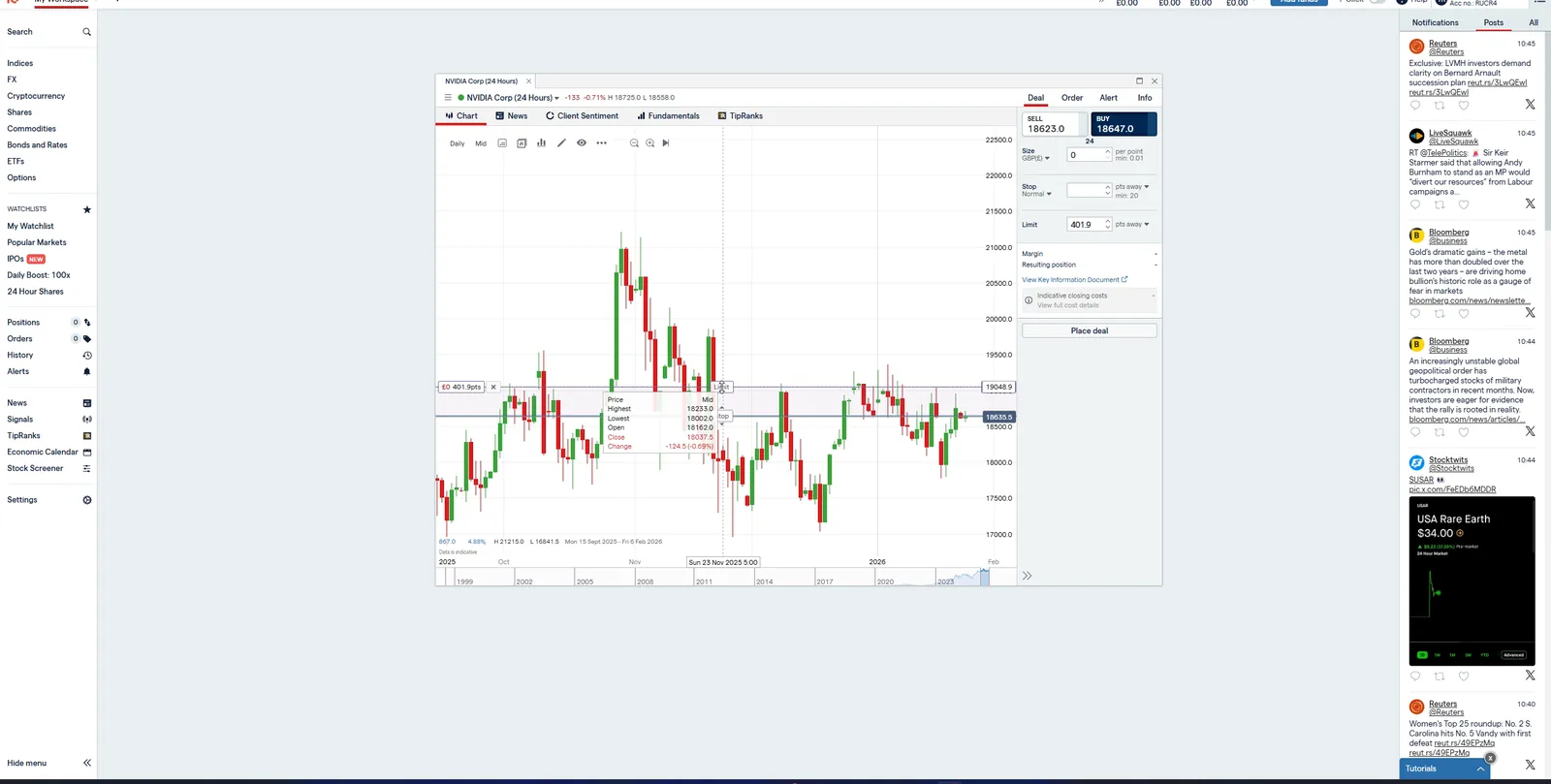
It can feel like a lot on day one, which is the best argument for starting on the demo. But for traders who want everything in one well-built place, it is the one a lot of professionals quietly default to, and the one I keep funded. You can open an IG account or demo here, or weigh the alternatives in the full CFD platform comparison.
CFDs or Spread Betting: Which Makes Sense for You?
I trade both, and this is the comparison that has saved me the most money over the years.
CFDs make sense when you want to offset losses against capital gains tax, when you are trading size that benefits from precise position sizing, or when you specifically need DMA or a product only offered as a CFD. They suit a more deliberate, often professional-leaning approach.
For many UK retail traders, though, spread betting is the better default. Profits are free of capital gains tax and stamp duty for UK residents, since it is treated in law as a bet rather than an investment. You typically get the same platforms and similar spreads, with none of the CGT paperwork.
The trade-off is that you cannot offset losses against capital gains. So for anyone who expects to lose while learning, and many do, the CFD treatment can be the more useful one. There is no universal answer, which is rather the point. I cover the spread betting platforms side by side separately.
Do You Pay Tax on CFD Trading in the UK?
Yes. CFD profits are subject to capital gains tax above your annual allowance, though CFD losses can be offset against other capital gains.
Spread betting is the exception. Its profits are exempt from capital gains tax and stamp duty for UK residents, because the activity is treated in law as betting rather than investing.
Which is better depends entirely on whether you are winning, and on your wider tax picture. Tax treatment depends on individual circumstances and can change.
What I’d Tell Someone Opening Their First CFD Account
Start on a demo, and read the financing line before you read the marketing. When you place your first trade, find the overnight charge on the ticket, then look at it again three days later. That single habit, watching the cost that accrues while you do nothing, taught me more about CFDs than anything I read when I started.
Size your positions as if the close-out is coming, because with leverage the move that wipes you is smaller than you think. Do that, and CFDs become what they should be: a precise, flexible way to trade thousands of markets from one account.
When you are ready, IG is where I would point you, and you can open an account or free demo here. If lowest holding cost is your priority, start with the full broker comparison instead.
Discuss the Real Cost of CFD Trading
Checked your own overnight financing line lately? Share what a held position has actually cost you, and which broker gave you the clearest view of the charges. Our community earns Equity for helpful contributions.
Discussion 0 comments
Be the first to start discussing this topic! Log in or create an account to share your thoughts.
Log In Create AccountFAQs
References
- Financial Conduct Authority (FCA): Contract for differences | FCA
- FCA: CFDs, the rules on leverage and negative balance protection
- FCA Register: IG Markets Limited. FRN: 195355
- FTSE Russell: FTSE UK Index Series quarterly review, March 2026
For more trading guides, explore our full trading hub.
No comments yet. Be the first to start discussing this topic!