


Quick Answer: Is Pepperstone Spread Betting Really Tax-Free?
For most UK retail traders, yes: profits from spread betting are free from capital gains tax and stamp duty under current rules, and that applies to Pepperstone's spread bets exactly as it does anywhere else, because the treatment comes from what spread betting is rather than who provides it. The parts the headline leaves out matter just as much: your losing years earn no tax relief, since losses on spread bets cannot be offset the way CFD losses can, and there is a rare exception where HMRC could treat trading as a taxable trade. I use Pepperstone's spread bets for the tax wrapper and its raw-spread CFDs for everything else, and this piece explains the rules, the exceptions and how I split the two. None of it is tax advice; circumstances vary and rules change.
 Top Rated
72.9% of retail investor accounts lose money when trading spread bets and CFDs with this provider.
Why Is Spread Betting Tax-Free at All?
Because in the eyes of UK law a spread bet is a bet, not an investment, and that single classification does all the work.
The legal logic in one paragraph
You never own the underlying asset and never enter a contract over it; you stake pounds per point on a price moving. Gambling winnings are not subject to capital gains tax, so spread betting profits sit outside CGT for most people, and since no asset changes hands there is no stamp duty either. The treatment attaches to the product category, so it is identical at every FCA-regulated spread betting provider, Pepperstone included: there is no special Pepperstone tax status to look for, and anyone implying otherwise is marketing at you.
The catch nobody advertises
If profits are not taxable, losses are not deductible. A losing year spread betting generates no loss relief at all, where a losing year on CFDs creates losses that can generally offset other capital gains. Tax-free cuts both ways, and which way it cuts for you depends on whether you make money, which is a more uncomfortable question than most tax articles ask.
Why the wrapper is worth more than it used to be
The CGT annual exempt amount has been cut hard in recent years to just a few thousand pounds, so ordinary traders cross into taxable territory far sooner than they once did. Every pound of the allowance a spread bet's profit does not consume is a pound left over for your funds, shares or crypto disposals. The smaller the allowance gets, the more the spread betting wrapper is genuinely worth to a profitable trader.
When Could Spread Betting Become Taxable?
There is one genuine exception and one myth, and the myth is everywhere.
The real one: trading as a trade
HMRC can, in principle, treat activity as a taxable trade where it stops looking like betting and starts looking like a business. The bar is high, though, and the case law is thin: gambling, even skilled and habitual gambling, has generally not been treated as a trade by itself. Where people can drift toward the line is when spread betting is tied to wider financial trade activity rather than standing alone.
If you trade full-time at serious scale, or your spread betting hedges a business, pay a professional for an answer specific to you rather than relying on anything you read online, this page included.
The myth: "they will tax it once you win big"
The size of your winnings does not change the treatment by itself; a large win from betting is still a win from betting. What matters is the character of the activity, not the number on the statement. This myth survives because it flatters everyone who repeats it, and it has cost more than a few traders the wrapper's benefit by scaring them into the wrong products.
What Does Spread Betting Actually Look Like on Pepperstone?
The tax wrapper only earns its keep if the product underneath is priced properly, and this is where Pepperstone's version is stronger than most people expect.
The same spreads as the CFD side
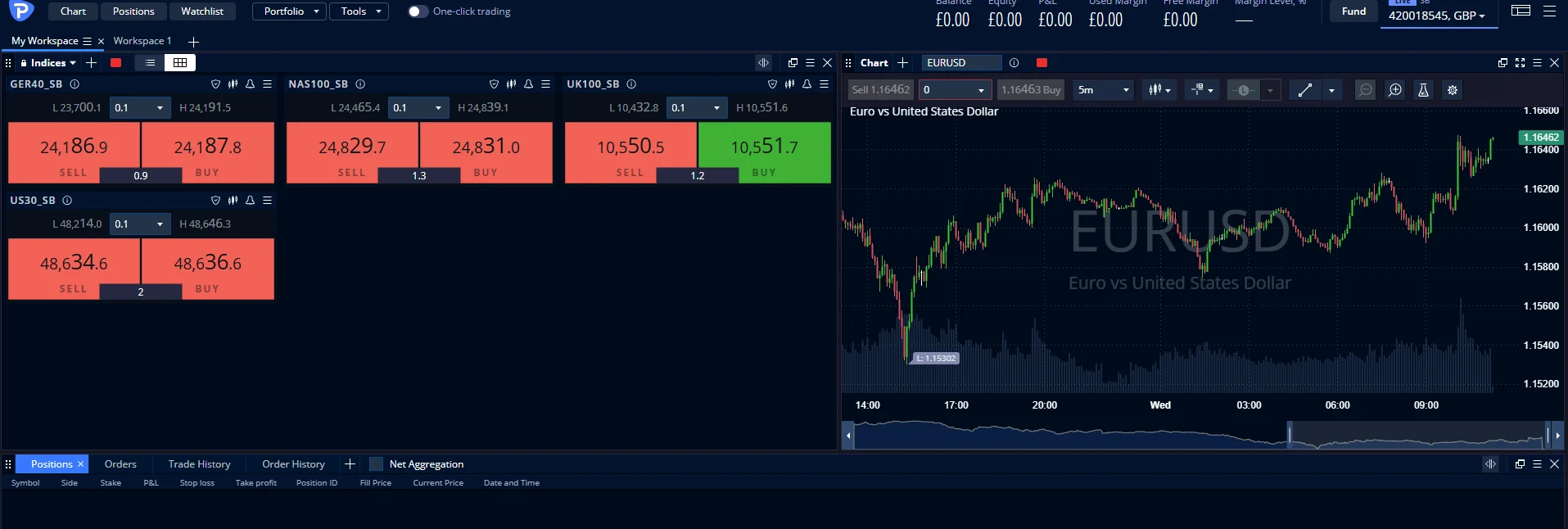
Pepperstone prices its spread bets off the same book as its CFDs, and the published index table makes the point precisely: the FTSE 100 from 1 point, the US 500 from 0.4, Germany 40 from 0.9, the Nasdaq from 1 and the Dow from 2, identical figures on the bet and the CFD, with no commission and the cost in the spread. For years the industry's standard move was to charge spread bettors extra for the wrapper; pricing the bet like the CFD removes the usual tax-versus-cost trade-off entirely.
Staked in pounds, executed like a CFD
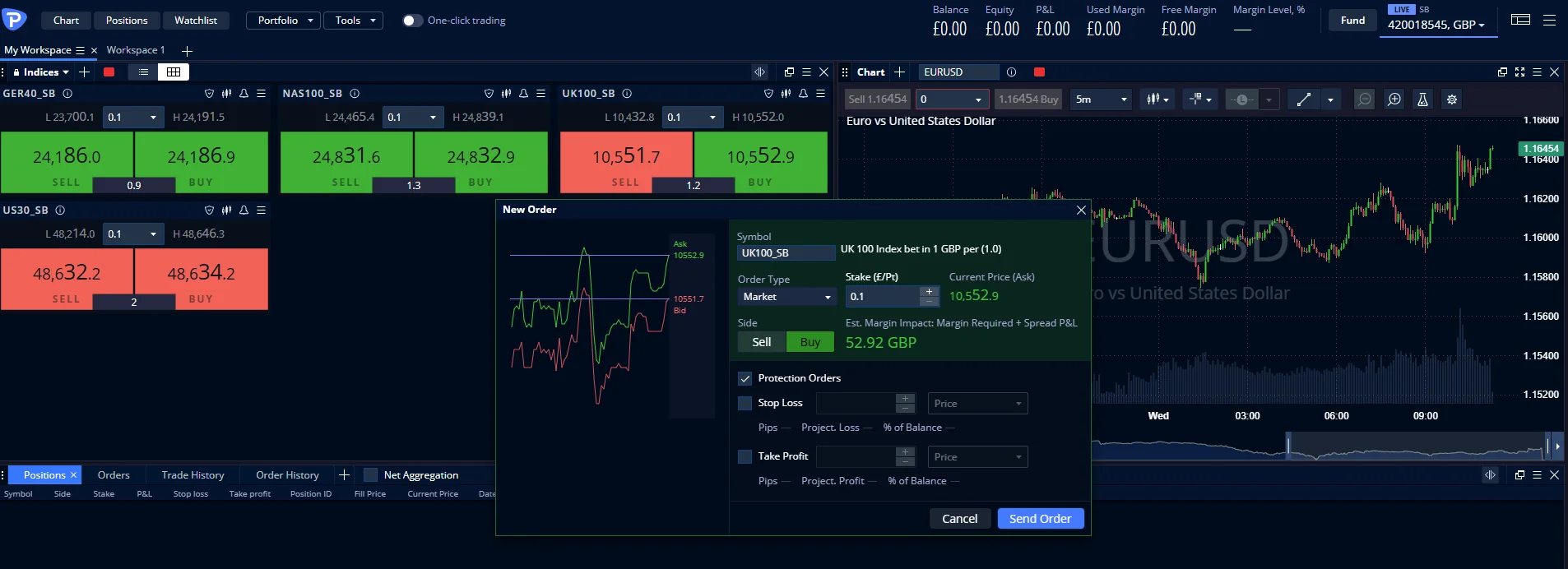
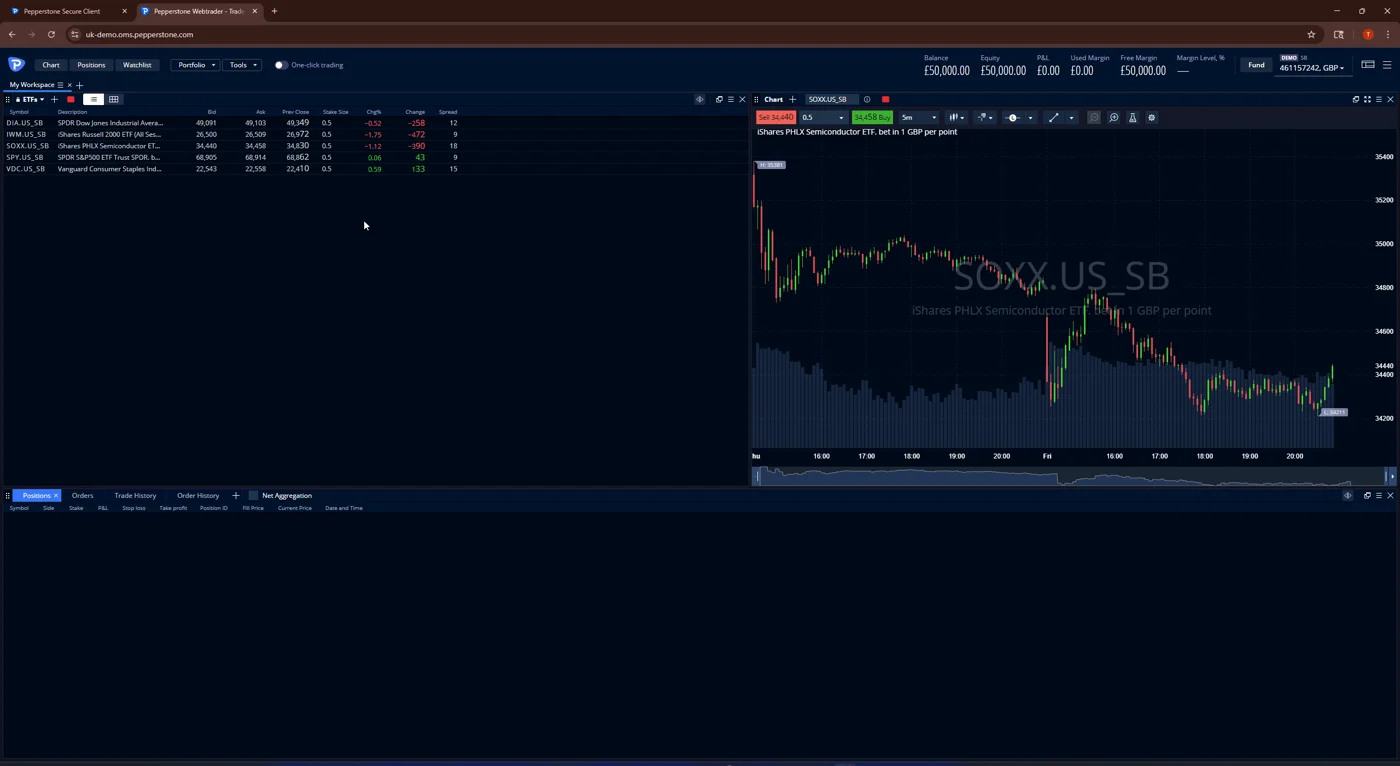
You choose your stake per point, and the P&L lands in pounds however exotic the underlying, which keeps risk arithmetic simple across markets. Execution runs on the same infrastructure as everything else at Pepperstone, from 50 milliseconds with a 99.32% fill rate in its latest published figures, and spread bets can even be placed through TradingView on a Razor account, a combination of tax wrapper and charting that is genuinely rare in the UK. The minimum deposit is £10, so trying the wrapper costs next to nothing.
How I split my own trading between the wrappers
The split is the practical payoff of everything above, so here it is plainly.
Spread bet the expected winners
My directional index and forex positions, the trades where I expect to bank a profit inside days or weeks, go through the spread bet account, because a winning trade with no CGT beats an identical winning trade with a tax bill, and at identical spreads the wrapper is free.
CFD the hedges and the loss-tolerant strategies
Anything that exists to hedge, or strategies where losing legs are part of the design, I run as CFDs, because there the deductibility of losses is worth more than the exemption on wins. The whole game in one sentence: spread bet your expected winners, CFD your risk management. The mechanics of both wrappers are covered in my Pepperstone forex review, and whether the product suits you at all is the subject of is Pepperstone good for spread betting.
So What Did I Actually Owe?
On the spread betting side of my Pepperstone trading: nothing, no CGT, no stamp duty, and nothing to report on those profits for a retail trader in my position under current rules. On the CFD side, gains count toward capital gains like any other disposal, offset by losses, with tax due above the annual exempt amount, which is now small enough that ordinary traders hit it faster than they expect.
The worked contrast that convinced me
Take a trader who banks £5,000 of index profits in a year, over the exempt amount and into CGT territory on a CFD account, where a higher-rate taxpayer would keep roughly £4,000 of it. The identical trades through the spread bet account keep the full £5,000, at identical Pepperstone spreads, for the effort of choosing a different account type at the ticket. Felt in an actual January tax return rather than in theory, that contrast is why the wrapper decision deserves five minutes of your attention before your next trade rather than after your next tax year.
FAQs
References
- FCA Register: Pepperstone Ltd. FRN: 684312
- Pepperstone: spread betting product details
- Pepperstone: index spreads (identical SB and CFD pricing)
- The Investors Centre: is Pepperstone good for spread betting
Tax treatment depends on individual circumstances and may change. Nothing here is tax advice; consult a professional about your own position.