


Quick Answer: What Makes Claude Genuinely Useful on a Portfolio?
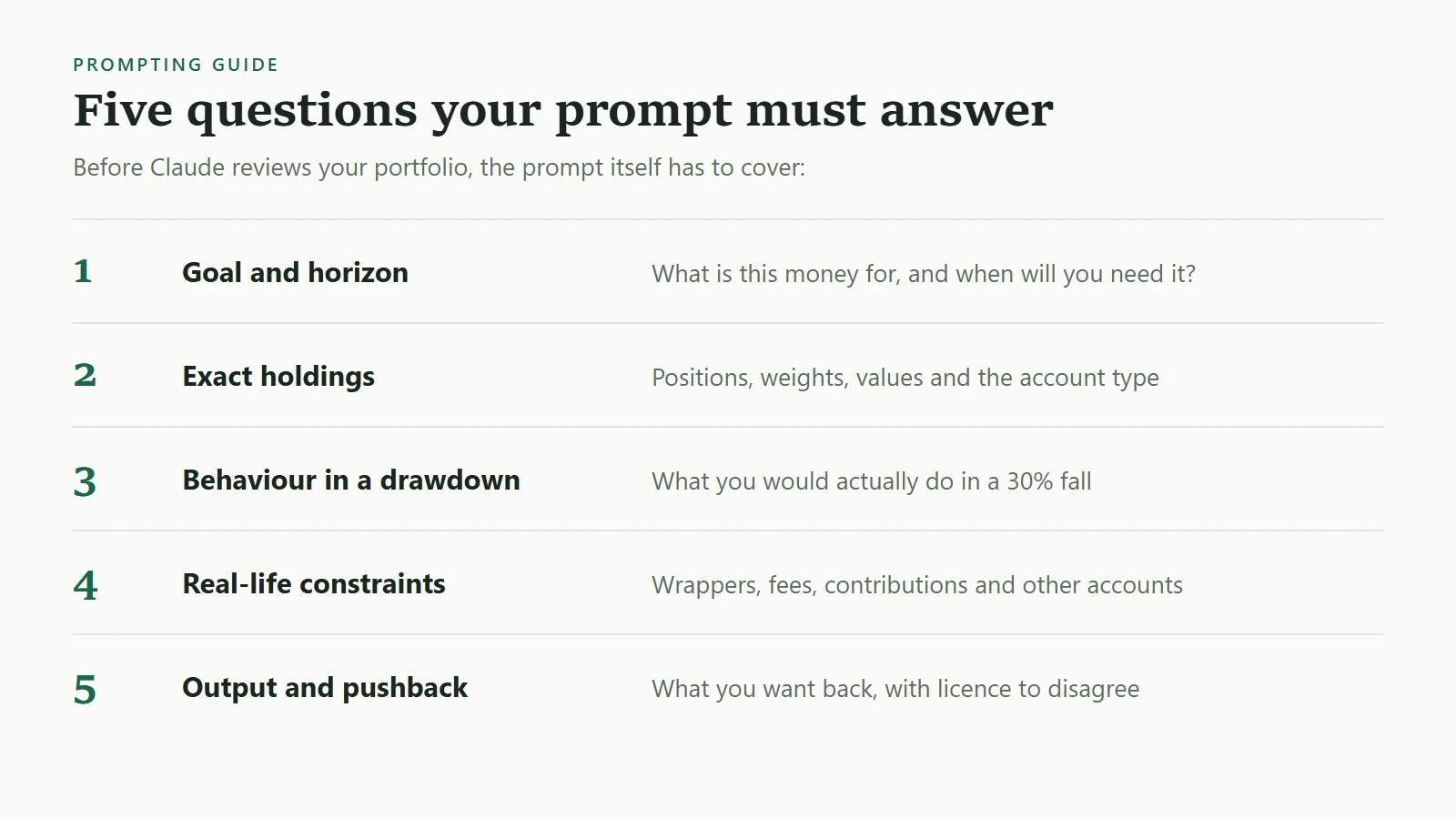
The specificity of your prompt, nothing else. Claude's output is capped by the detail you give it, so a portfolio review request has to answer five questions inside the prompt itself: what the money is for and when you need it, exactly what you hold, how you would actually behave in a 30% drawdown, the real-life constraints it must respect, and what you want back, including explicit permission to push back. Answer all five and you get a tailored review; skip them and you get textbook filler. Below I take each question in turn, show a vague answer against a specific one, and finish with a copy-paste template that assembles the lot into a single prompt.

Spread bets and CFDs are complex instruments and come with a high risk of losing money rapidly due to leverage. 70% of retail investor accounts lose money when trading spread bets and CFDs with this provider. You should consider whether you understand how spread bets and CFDs work, and whether you can afford to take the high risk of losing your money.
1. What Is This Money for, and When Will You Need It?
Growth for retirement in 25 years and a house deposit in three produce opposite recommendations. Without a goal and a horizon, Claude has to hedge, and hedged answers are generic answers.
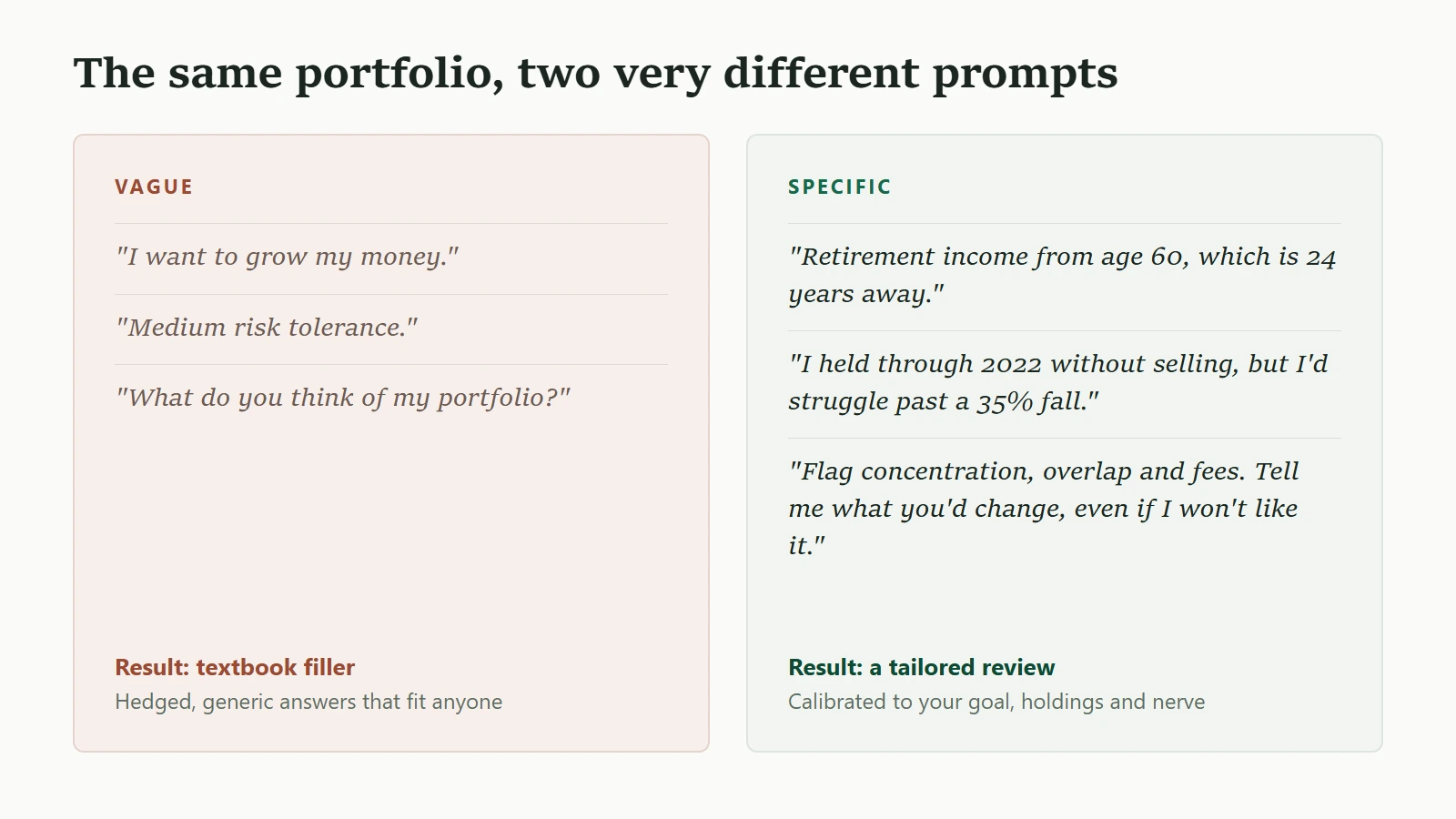
Vague: "I want to grow my money."
Specific: "Retirement income from age 60, which is 24 years away. No other planned withdrawals."
2. What Exactly Do You Hold Right Now?
Claude cannot spot concentration risk, fund overlap or fee drag from a description. A global tracker plus an S&P 500 ETF is roughly 60% the same holdings, and that only shows up when it sees the actual positions, weights and account type.
Vague: "Mostly index funds and a few shares."
Specific: "Stocks & Shares ISA: VWRP 55% (£22k), VUAG 25% (£10k), AAPL 12% (£4.8k), cash 8%."
3. How Would You Actually Behave in a 30% Drawdown?
Risk labels like "moderate" mean different things to different people. A concrete behavioural answer, whether you would hold, buy more or sell, is what lets Claude calibrate the equity and bond split to you rather than to a stereotype.
Vague: "Medium risk tolerance."
Specific: "I held through the 2022 drop without selling, but I checked the app daily and it stressed me. I'd struggle past a 35% fall."
4. What Constraints Does It Need to Respect?
The "right" portfolio on paper is often wrong once real life is factored in. Jurisdiction and tax wrappers (ISA, SIPP, GIA), platform fees, monthly contributions and an existing workplace pension all change the answer, but only if they are in the prompt.
Vague: "I'm in the UK."
Specific: "UK. £400/month into the ISA. Workplace pension is £60k in a default lifestyle fund. Platform charges 0.25% plus fund fees."
5. What Do You Want Back, and Have You Told It to Push Back?
Left unprompted, Claude leans agreeable and will bless a mediocre portfolio. Tell it the output you want and explicitly license disagreement: ask it to question you first, flag overlaps and fee drag, and challenge your choices instead of validating them.
Vague: "What do you think of my portfolio?"
Specific: "Ask clarifying questions first. Then flag concentration, overlap and fees, and tell me what you'd change and why, even if I won't like it."
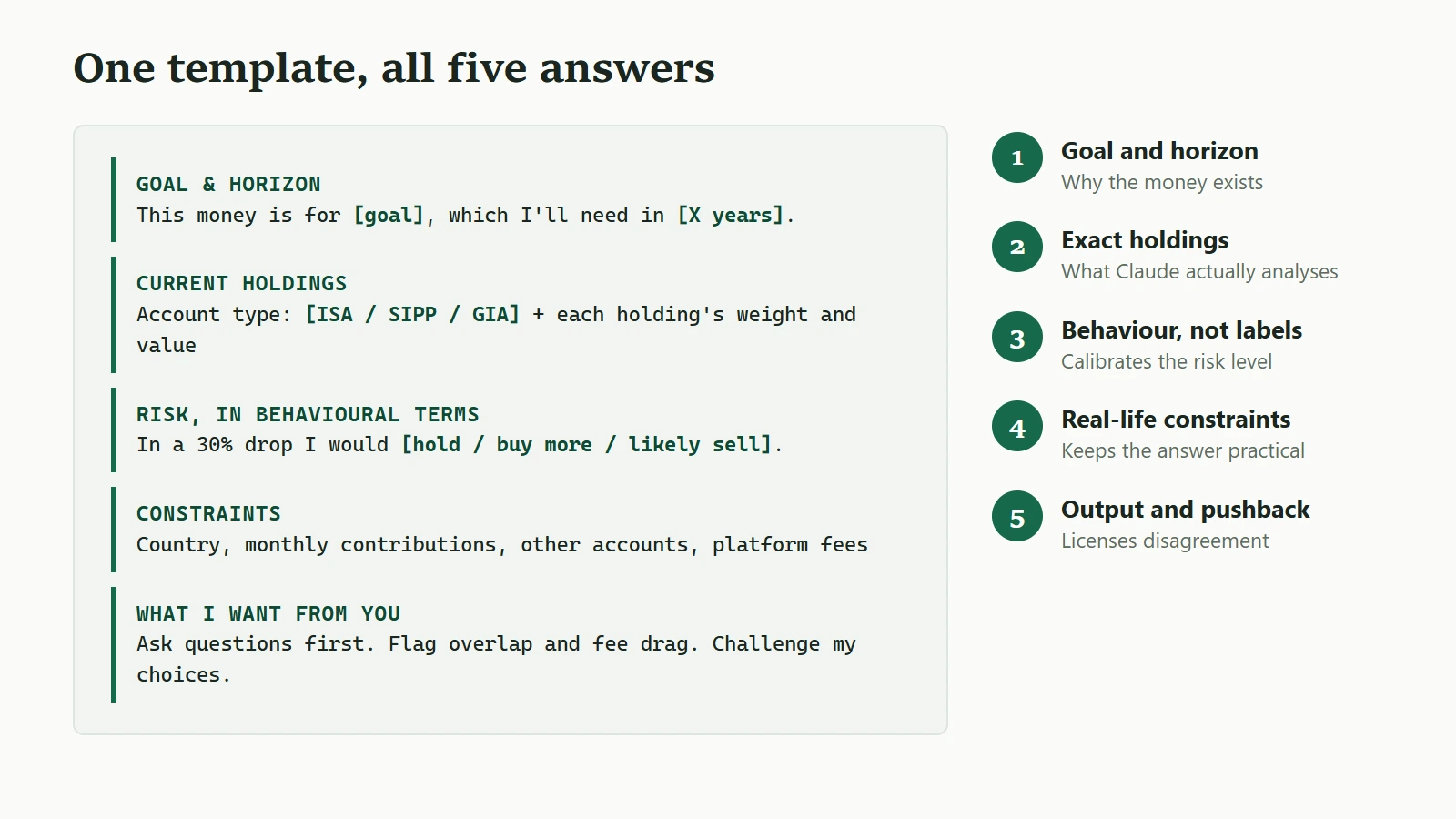
The Copy-Paste Template
The five answers assembled into one prompt. Replace the bracketed blanks with your own details.
The common thread: specificity in, specificity out. AI output on portfolios is research, not regulated advice, and decisions and their consequences stay yours.