


Can you get a mortgage on trading income?
Yes, but a lender will treat you as self-employed, so the mortgage stands on your SA302 tax calculations, tax year overviews and bank statements rather than payslips. Most want two years of figures. A smaller group will lend on one, and that route runs through a specialist broker rather than a branch.
Why this page exists
We write a lot here about getting money into the markets. This piece is about the day the markets have to buy you a house, because that is where full-time traders discover their income has a paperwork problem.
How do lenders classify trading income?
Self-employed, in almost every case. Whether you trade through a limited company, as a sole trader, or sit somewhere in between with prop-firm payouts, there is no employer and no payslip, so you land in the same assessment bucket as a plumber or a freelance designer: declared income, evidenced through HMRC paperwork.
That surprises people whose trading profit dwarfs the salary they used to earn. The lender is not judging how good the year was. It is judging how provable it is, and trading income is provable the same way any self-employed income is.
What proof will a lender ask a trader for?
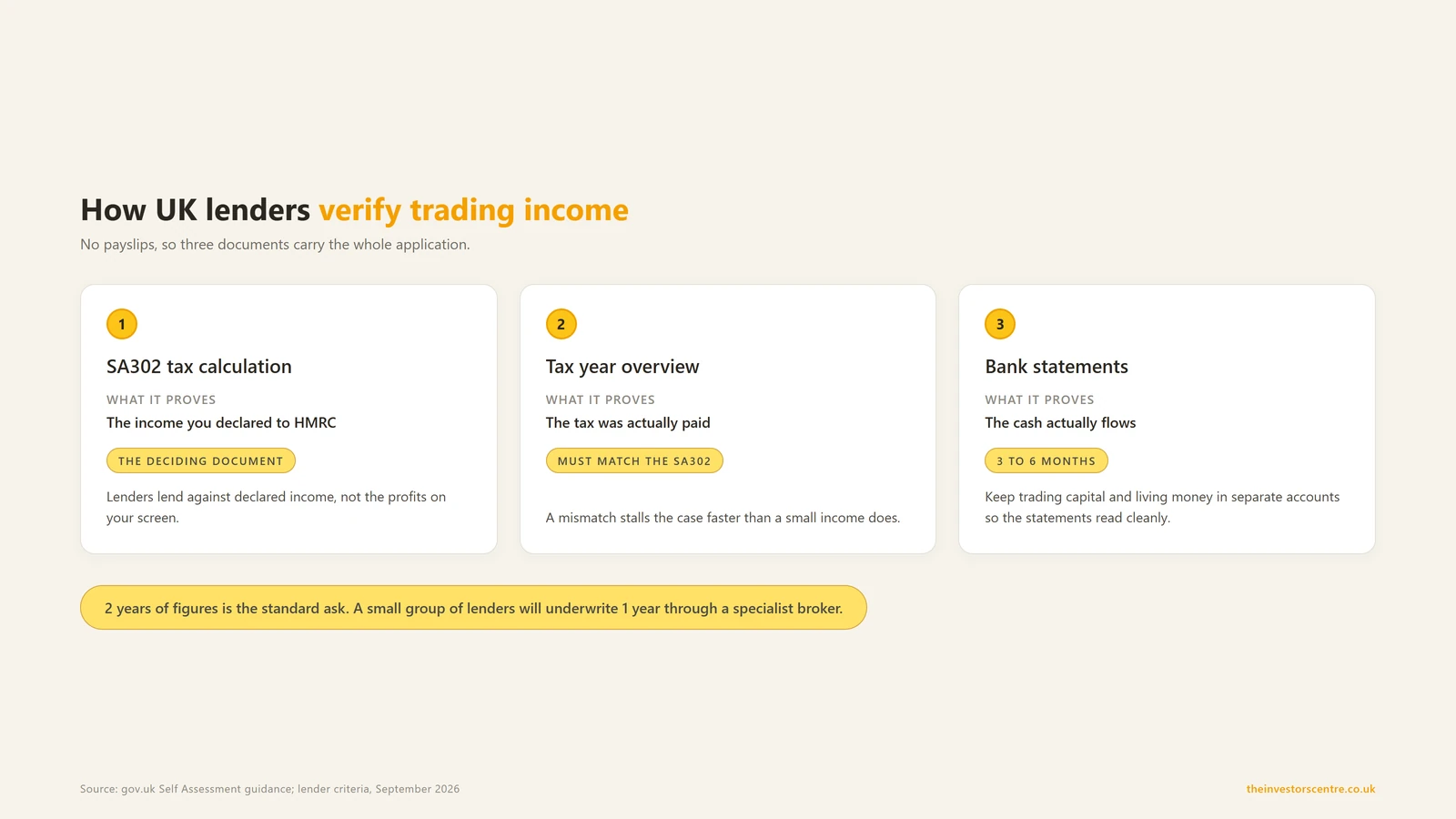
Three documents do most of the work:
- SA302 tax calculations, one per tax year, showing the income you declared to HMRC
- Tax year overviews, which confirm the tax was actually paid
- Business and personal bank statements, usually three to six months
The SA302 is the one that decides the case, because whatever you made in the markets, the lender lends against what you declared. A brilliant year that was never returned to HMRC does not exist as far as a mortgage is concerned. We cover the document itself in what an SA302 shows.
How many years of figures do you need?
Two years of SA302s is the standard ask, and some banks still prefer three. The average of the years, or the latest year if it is lower, is the common calculation.
One year is possible. A handful of lenders will underwrite a first-year trader on twelve months of figures. This is the territory where a broker earns their fee. The branch answer is simply no. Jones & Young, a specialist firm we rate for this problem, place cases on a mortgage with one year of accounts through lenders whose underwriters read first-year figures on their merits.
Do prop-firm payouts count as income?
Sometimes, and less cleanly than your own capital's gains. Payouts from a funded account are, in a lender's eyes, freelance income from the firm rather than investment profit, and lenders vary widely in how they read them. The honest advice is unglamorous: declare them properly, keep the remittances, and put the case through a broker who can match it to a lender rather than testing branch policy yourself.
Why do banks turn traders down?
Three reasons come up again and again. The income is volatile year to year, and averaging punishes one bad year. The trading history is short, because most people go full-time only after a good run. We know that wall personally: as owners of a start-up, our own mortgage conversations have been the tricky kind for the same reason. And profits kept aside as trading capital are invisible to a standard affordability check: it reads what you drew, not what you made. A declined application here rarely means no lender exists. It means the wrong lender was asked, more often than not, so the next stop after a decline is a self-employed mortgage broker, not a second branch.
How do you make yourself lendable while trading full time?
Run the boring machine. File returns on time and declare what you actually make, even when the tax bill stings, because the SA302 is your future payslip. Keep trading capital and living money in separate accounts so statements read cleanly. Time the application after your figures are filed rather than mid-tax-year. And hold a deposit bigger than the minimum, because deposit size is the one lever a volatile earner fully controls.
One data point from our own research: how the top 1 per cent are paid is mostly partnership and dividend income, not salary. The mortgage system is built for payslips anyway. If you are still choosing where to trade, our best day trading platforms testing is the other half of the picture.
FAQ: what traders ask about mortgages
Do lenders class trading as gambling?
No. Declared, taxed trading income is self-employed income. What lenders will not count is undeclared profit sitting in a brokerage account, however real it looks on screen.
Will a lender average my good and bad years?
The common rule is the two-year average, or the latest year if lower. A lender that reads the latest year alone exists for the opposite case, where the new year is the strong one.
Does spread betting income count?
Spread betting winnings are tax-free in the UK and produce no SA302 line, so on their own they are close to unusable as mortgage income. This is the trade-off nobody mentions in the tax-free sales pitch.
What deposit do traders need?
The same bands as everyone else, from 5 per cent up, but a bigger deposit visibly de-risks a volatile income. At 15 to 25 per cent down, more lenders will engage with a short trading history.
Sources
- GOV.UK: Get your SA302 tax calculation
- MoneyHelper: self-employed mortgage guidance
- FCA register, for checking any broker or lender named here
Capital at risk. This article is information, not financial or mortgage advice. The Investors Centre is not authorised to give mortgage advice; speak to an FCA-regulated adviser about your own case.