

Quick Answer: Is £500 Enough to Spread Bet Gold?
Just about, on two conditions: IG's deal ticket has to accept £0.50 a point on spot gold, and you hold one position at a time. To show what that looks like on real prices rather than in theory, we ran a fixed set of beginner rules against IG's own spot gold prices for the four weeks from 17 August to 11 September 2026. This is a worked example, not a live account. Costs were never the problem: fifteen trades paid about £3 of spread between them. The swings were. Gold's median day covered about 100 points, £50 at £0.50 a point, and the worst two-day move against a 9am entry reached 214 points. The same rules finished ahead in those four weeks and roughly flat in the four weeks before, which says more about the market than the rules. If you have never traded leveraged gold, run this month on IG's demo first.

Spread bets and CFDs are complex instruments and come with a high risk of losing money rapidly due to leverage. 69% of retail investor accounts lose money when trading spread bets and CFDs with this provider. You should consider whether you understand how spread bets and CFDs work, and whether you can afford to take the high risk of losing your money.
Why Gold, and Why £500?
Gold because it is the market beginners most often ask me about, and £500 because that is the honest end of a first trading budget. We already publish a full guide to trading gold in the UK; this page puts that guide under pressure at the smallest sensible size, using IG's published charges and IG's own price history.
The numbers make it possible, just. IG quotes spot gold at a standard spread of 0.3 points with a 5% margin factor for retail clients, and one point is a $1 move in the gold price. The minimum stake is messier. IG's help centre product table lists £5 a point for spot gold, but the deal ticket is what applies to your account, and it accepts smaller stakes on gold; this page works at £0.50 a point. That gap decides everything. With gold near 4,370, the margin on a £5 a point position would be about £1,090, more than twice the account. At £0.50 a point it is about £109, which £500 can carry with room to spare. Check the ticket on your own account before copying any of this; the ticket, not the help pages, is the final word.
One warning before the numbers, meant sincerely rather than legally: leveraged gold is fast. Across the nine weeks to 11 September 2026, half of all trading days on IG's spot gold covered between 77 and 118 points from high to low. At £0.50 a point that is a £39 to £59 swing on an ordinary day, against about £109 of margin. At £1 a point, double it. If you have never placed a leveraged trade, run this exact month on IG's demo first.
How Was the Four-Week Example Built?
With rules fixed before any prices were run, applied to IG's own 15-minute spot gold prices from Monday 17 August to Friday 11 September 2026. Every trade buys at IG's offer and sells at its bid, so the spread sits inside every result, and where a stop and a target fall inside the same 15 minutes, the stop is assumed to hit first. None of this is a live account and none of it is a strategy we recommend. The rules exist to show what a beginner's month costs and how far gold travels while you hold it.
| Rule | Weeks one and two | Weeks three and four |
|---|---|---|
| Entry (UK time) | 9am, Monday to Thursday | 2.45pm, Monday to Thursday |
| Direction | The way gold moved since 9am the previous trading day | The way gold moved between 1.15pm and 2.45pm, across the 1.30pm US data slot |
| Stop and target | 30 points and 45 points | 35 points and 52 points |
| Closed if neither is hit | 4.30pm | 9.30pm, before IG's 10pm daily break |
| Stake | £0.50 a point, except one deliberate £1 a point trade with no stop on the Tuesday of week two | £0.50 a point |
Two more rules keep it honest: one position at a time, and nothing new on a Friday. Overnight funding is left out of the results and covered in the costs section, because IG's nightly rate moves and isn't published as a history.
How Did the First Two Weeks Go?
Better than the rules deserved, which is the most dangerous way a first month can start.
Week one: what 50p a point feels like
Monday 17 August went long at 4,404.16 and was closed at the 4.30pm cut-off for £10.64, and Tuesday's short caught a 40 point slide for £20.07. Then the stops arrived. Wednesday's short was stopped out 30 points higher at 1.30pm, on a day gold climbed 200 points from its 2am low to a late-evening high, and Thursday's long, bought at 4,491.08 after that surge, was stopped out just after 1pm. Four trades, two £15 losses, and the week finished 71p ahead. The costs were close to invisible: IG's 0.3 point spread is 15p a trade at £0.50 a point. The ranges were not. That Wednesday alone moved £100 at this stake, against about £110 of margin.
Week two: the £1 a point mistake
Monday 24 August's long added £16.95. On the Tuesday the stake doubled to £1 a point, the stop came off, and the plan became a two-night hold: the mistake most first months contain, run here on purpose. The ticket shows the consequence before you confirm it: £231.51 of margin, nearly half the account, on one position. The rules said short at 4,630.18, and by midnight gold was 44 points higher, a £44 hole with nothing underneath it. Gold then fell 91 points by Wednesday afternoon, and the Thursday 9am close banked 29.62 points, £29.62. Thursday's regular short added £3.49, and the week finished £50.06 ahead.
That is the worst thing that can happen to a bad habit, because it pays. Run the same no-stop, two-night hold from every weekday 9am between 17 August and 9 September, long and short, and the median worst point was 54 points against the position. The worst of all, a short from 9am on Wednesday 19 August, was 214 points under water by Friday morning. At £1 a point that is £214 of a £500 account with no stop to cap it. The same deliberate mistake in the four weeks before, on Tuesday 28 July, also closed in profit, £7.80, after sitting 70 points under water.
What Did Weeks Three and Four Show About Gold's Clock?
That gold keeps American hours. Spot gold trades nearly around the clock on IG, with a daily break from 10pm to 11pm UK time, but trading in nearly every hour is not the same as moving in them. Across the nine weeks to 11 September 2026, IG's 15-minute spot gold prices averaged a range of 13.5 points between 1.30pm and 5pm UK time, against 7.0 points between 8am and noon. The US afternoon moved nearly twice as much as the London morning.
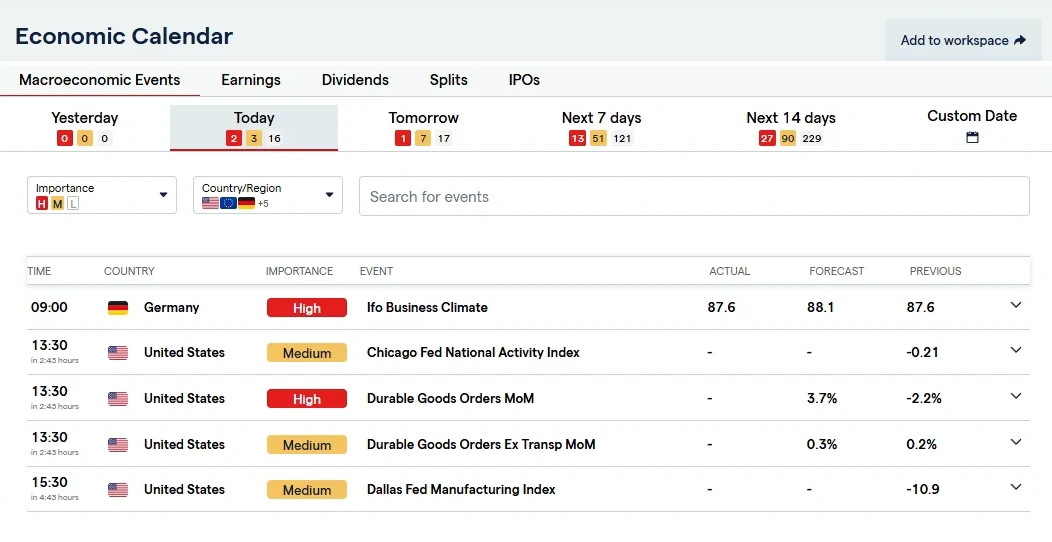
So the second fortnight switched to the US-afternoon rules, and bigger moves arrived in both directions. Week three made £15.07, most of it from a 34.74 point short on Tuesday 1 September, even though IG's quote was briefly 1.05 points wide at the 2.45pm fill. Week four gave back £11.07: two 35 point stops on consecutive days, 8 and 9 September, before a 45.71 point short on the Thursday recovered £22.86. US Labor Day on Monday 7 September closed gold early, so that day's long was flattened at the 7.30pm close for £1.07. While we are on stops: an ordinary one does not protect you through the daily break or a price gap, which is what IG's guaranteed stops are for, at a premium of 0.3 points on spot gold, charged only if the stop is triggered.
What Happens When You Trade Gold on a Saturday?
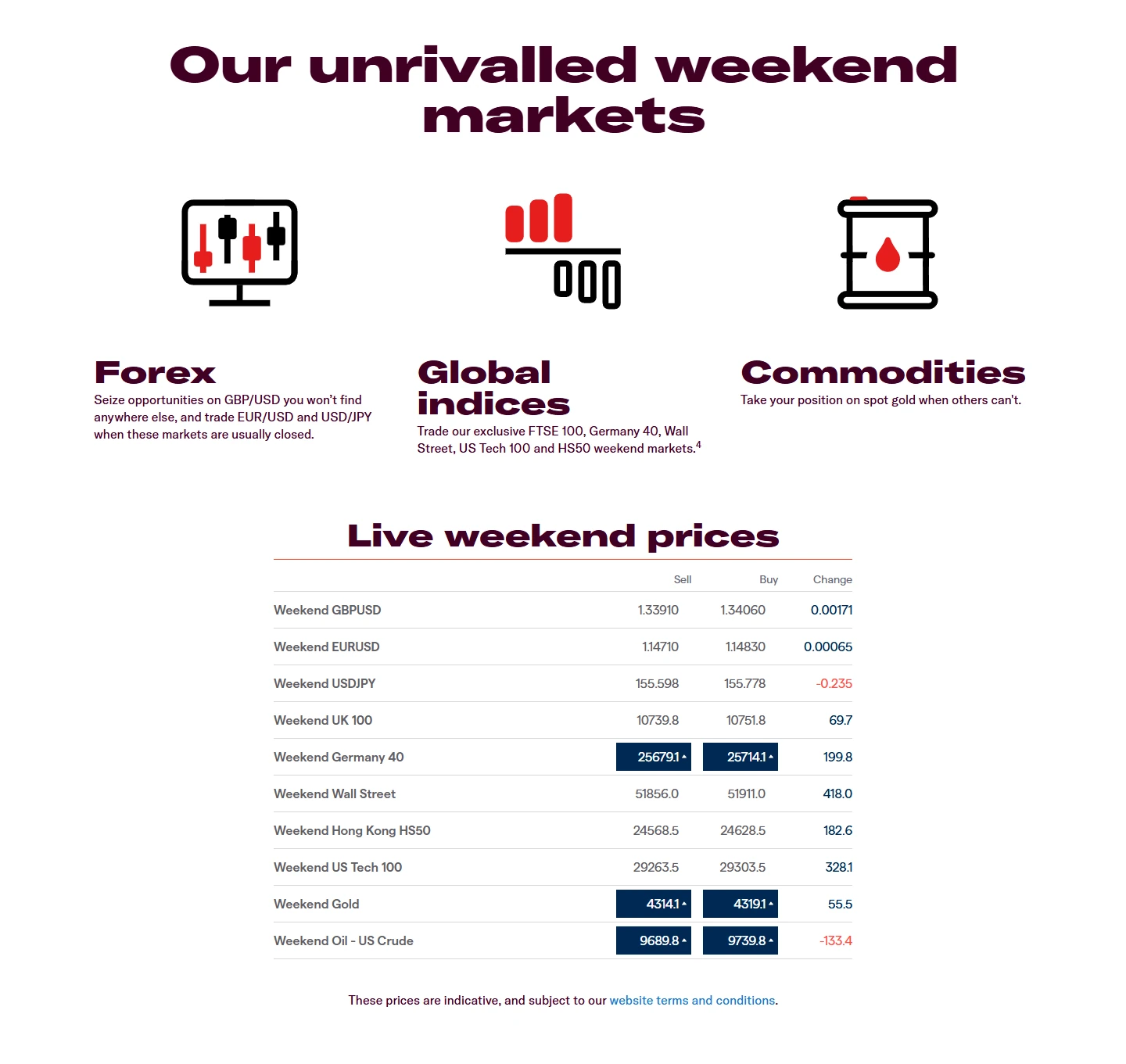
On most platforms nothing happens, because the market is shut. IG runs weekend markets that include spot gold, open until 10.40pm on Sunday UK time. Its weekend trading page says they are available from 10pm on Friday, while a footnote on the same page excludes 10pm Friday to 8am Saturday from its round-the-clock claim, so plan on prices from Saturday morning. IG describes itself as the only provider of weekend trading, and the weekend prices are its own: with the underlying market closed, IG says it sets them from volatility, client activity and news flow.
Two details matter for a small account. A weekend position doesn't stay in a separate box: if it is still open at the Sunday close, it nets off against a weekday position on the same market or, if it carries a stop or limit, rolls into a weekday position with them attached. And because there is no public price history for the weekend market, the worked example above has no weekend trade in it. Treat Weekend Gold as a way to manage risk around weekend news rather than a hunting ground, and check its spread on the ticket before you deal.
What Did the Four Weeks Actually Cost?
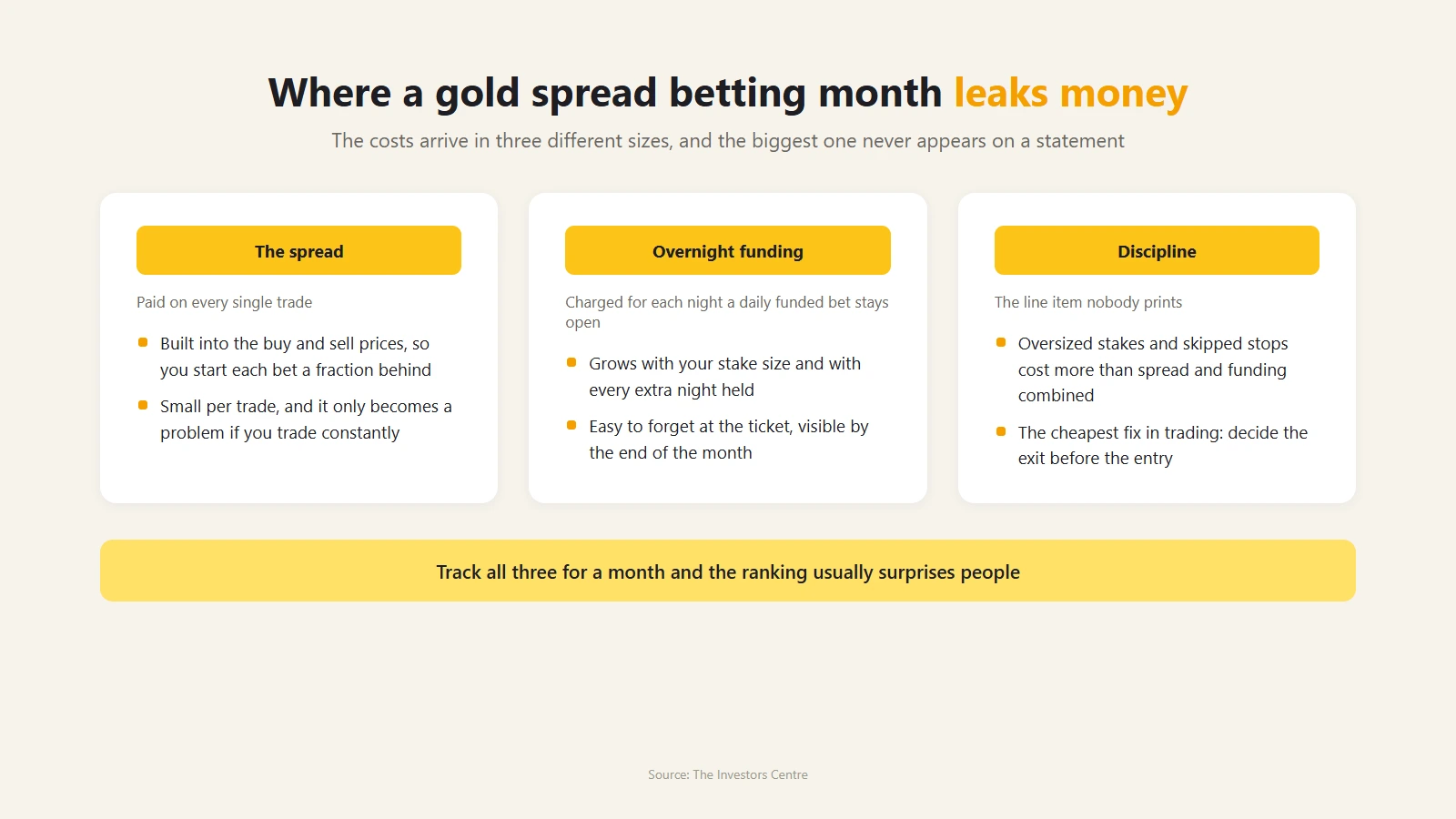
Very little, once IG's charges are separated from the market's swings. The fifteen trades paid about £2.98 of spread between them, roughly 20p each: between 8am and 9pm UK time across the four weeks, IG's quote was 0.3 points in 69% of its 15-minute snapshots and 0.5 points in almost all the rest. No guaranteed stops were used, so no premiums were paid.
| Line | Amount |
|---|---|
| Starting balance | £500.00 |
| Weeks one and two, London-morning rules (7 trades) | £50.77 profit |
| Of which the £1 a point trade with no stop | £29.62 profit |
| Weeks three and four, US-afternoon rules (8 trades) | £4.00 profit |
| Spread paid, already inside those results | £2.98 |
| Overnight funding (2 nights at £1 a point) | Not modelled, see below |
| Balance before funding | £554.77 |
| Same rules, the four weeks before (20 July to 14 August 2026) | 54p profit |
Two lines in that table matter more than the balance. More than half the four weeks' profit came from the one trade that broke the rules on purpose, and the identical rules run over the previous four weeks made 54p. Fifteen trades is far too few to judge any set of rules, and the same month on different prices could just as well have finished below £500.
The funding line is the one to slow down over, because gold does it differently from the index trades in my day trading journal. IG's spot gold is a daily funded bet with an expiry set far in the future, and for each night a position stays open past the 10pm rollover, IG makes an adjustment based on the tom-next spread, including an admin fee of 1% a year. The tom-next rate moves with US dollar interest rates and gold's own lending market, so the nightly figure changes and differs between longs and shorts. For scale, at £1 a point with gold at 4,630, every 1% a year is about 13p a night. IG shows the adjustment in the platform, so price it before holding for weeks rather than after.
What Would I Tell the Next £500?
The list is short and the order matters. First, spend your first gold month on IG's demo, where every lesson on this page, the session timing, the stake discipline, the value of doing nothing, is available at no cost against the same spreads and margins as the live ticket.
Second, trade gold when gold is awake. Set alerts around the US session and data times instead of staring at a flat London-morning chart; the platform will watch the levels so you do not have to. Third, respect the minimum stake as a feature rather than an insult. At £0.50 a point, even the worst two-day swing in these four weeks, 214 points, would have cost £107. At £1 a point with no stop it would have cost £214, and the doubled-stake trade that made the most money here is the one never to copy. The wrapper question is worth ten minutes too: spread betting gains are currently free of UK capital gains tax for most retail traders, and the alternative sits on the other side of our spread betting vs CFDs comparison. Both run from the same IG login, under IG Index Ltd (FCA reference 114059) for spread bets and IG Markets Ltd (FCA reference 195355) for CFDs.
A first month's real job is to leave you with an account for the second.
FAQs
References
- IG: commodities spread bet product details (spot gold spread 0.3, guaranteed stop premium 0.3, retail margin 5%, listed minimum bet, funding basis, daily break; checked 17 September 2026)
- IG: weekend trading (weekend hours, pricing, and Sunday netting and rollover; checked 17 September 2026)
- IG: spot gold market page (source of the 15-minute bid and offer prices used in the worked example, 13 July to 11 September 2026; retrieved 17 September 2026)
- FCA register: IG Index Ltd (FRN 114059, spread betting) and IG Markets Ltd (FRN 195355, CFDs)
- The Investors Centre: how to trade gold in the UK