


Quick Answer: What Does the “Tax-Free” Spread Betting Pitch Leave Out?
For UK residents, spread betting really is free of capital gains tax and stamp duty, and that makes it one of the most efficient ways to trade. The part the marketing skips is the cost of holding: you pay the spread to open, plus a small overnight financing charge for each night you keep a daily funded bet, and a dividend adjustment if you are short over an ex-dividend date. None of it is a dealbreaker once you can see it. Two brokers sit at the top of my spread betting testing, Spreadex and IG, and they are close. I point people new to spread betting at IG first for one simple reason: it offers a free demo with £10,000 of virtual funds, so you can learn how these costs behave before any money is real.

Spread bets and CFDs are complex instruments and come with a high risk of losing money rapidly due to leverage. 69% of retail investor accounts lose money when trading spread bets and CFDs with this provider. You should consider whether you understand how spread bets and CFDs work, and whether you can afford to take the high risk of losing your money.
What Is Spread Betting, and How Does It Actually Work?
Spread betting is a way to bet a stake per point on whether a market will rise or fall, with leverage, without owning the underlying asset. You pick a stake, say £2 per point on the FTSE 100, and your profit or loss is that stake multiplied by how far the market moves in points.
Underneath, it is leveraged derivatives in a UK-tax-favourable wrapper. That wrapper is the whole appeal, so that is where we start.
I have funded and tested 18 UK brokers in the most recent cycle, and I have been spread betting since 2012. This is the version I wish I’d had at the start.
Is Spread Betting Really Tax-Free in the UK?
Yes, for UK residents, with one important caveat. Spread betting profits are free of capital gains tax and stamp duty, because the activity is treated in law as betting rather than investing.
The caveat is the flip side. You cannot offset spread betting losses against capital gains either, so the tax wrapper helps most when you are profitable. While you are still learning, and more likely to be losing, the CFD treatment can actually suit you better. I cover that comparison in my honest look at what CFD trading really costs.
There are edge cases too, mostly around whether trading is your main source of income, that are worth understanding properly. For most retail traders, though, the headline holds: profitable spread bets are not taxed.
What Spread Betting Actually Costs
The spreads at the top of the market are tight and broadly similar between the best brokers. The costs that decide your month are the ones that accrue quietly.
Why does a spread bet cost money to hold overnight?
Because a daily funded bet is leveraged, and you pay to fund that leverage. Every night you hold the position, a small financing charge is applied, exactly as it would be on a CFD.
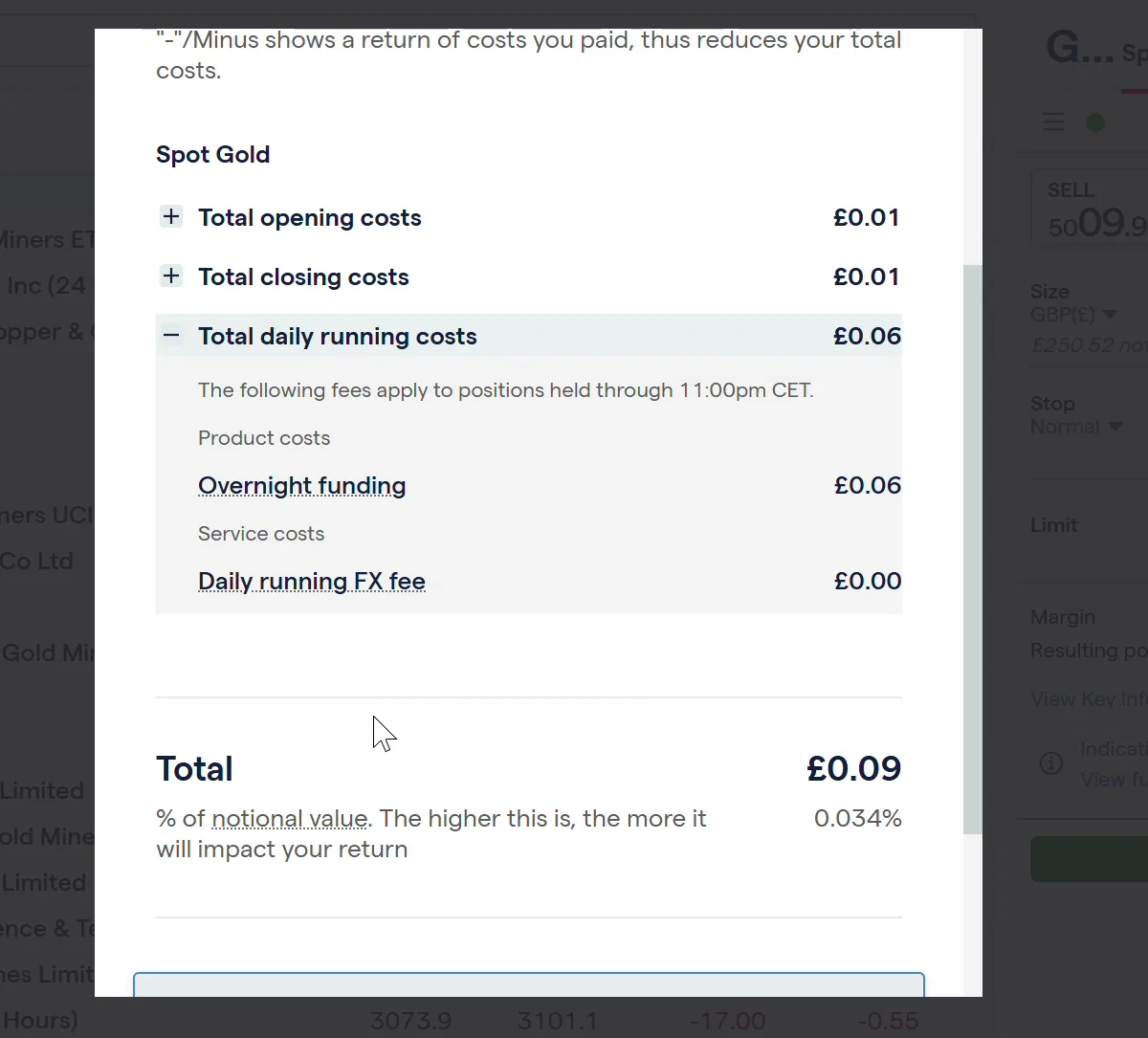
To IG’s credit, it shows you this before you trade. Open the cost breakdown on any ticket and the overnight funding is listed in plain figures. On a small Spot Gold spread bet, the breakdown below shows overnight funding of £0.06 a night. That looks trivial, and on that stake it is, but it scales with your stake and compounds for every night you hold, so on a meaningful position held for weeks it becomes a real number.
The fix is not to avoid spread betting. It is to know the charge is there, check it on the ticket, and factor it into anything you intend to hold.
Why did my short position get a dividend charge?
Because when you are short a share over its ex-dividend date, the dividend is debited from your account. Going long, you are credited the adjustment; going short, you pay it. It has nothing to do with the price moving, which is exactly why it catches people out.
It is logical once you see it: a spread bet mirrors the economics of holding the share, dividend included. Just be aware of ex-dividend dates on any short you are carrying through them.
Daily funded bets vs futures bets: which should you use?
It depends how long you are holding. Daily funded bets have tight spreads but accrue financing every night, so they suit short-term positions. Futures-based bets have a wider spread built in but no nightly financing, so they work out cheaper if you intend to hold for weeks or months.
Picking the wrong one is a common, invisible cost. For a position you plan to hold a while, the futures bet is often cheaper even though the spread looks worse at the open.
Why do spreads widen so much on some markets?
Because the spread reflects liquidity. On a FTSE 100 index or a major forex pair it is tight. On a small-cap UK share or an exotic currency it can be many times wider, and that gap is a real cost you pay on both entry and exit.
It is the single most overlooked cost in spread betting. The headline spread you see advertised is for the most liquid markets, not the thin one you might actually be trading. If gold is your market, I look at the costs broker by broker in my guide to trading gold.
The Top Spread Betting Brokers, and Where I Send Beginners
Two names sit at the top of UK spread betting, and they are close. In my testing, Spreadex edges it overall, and IG is right alongside it.
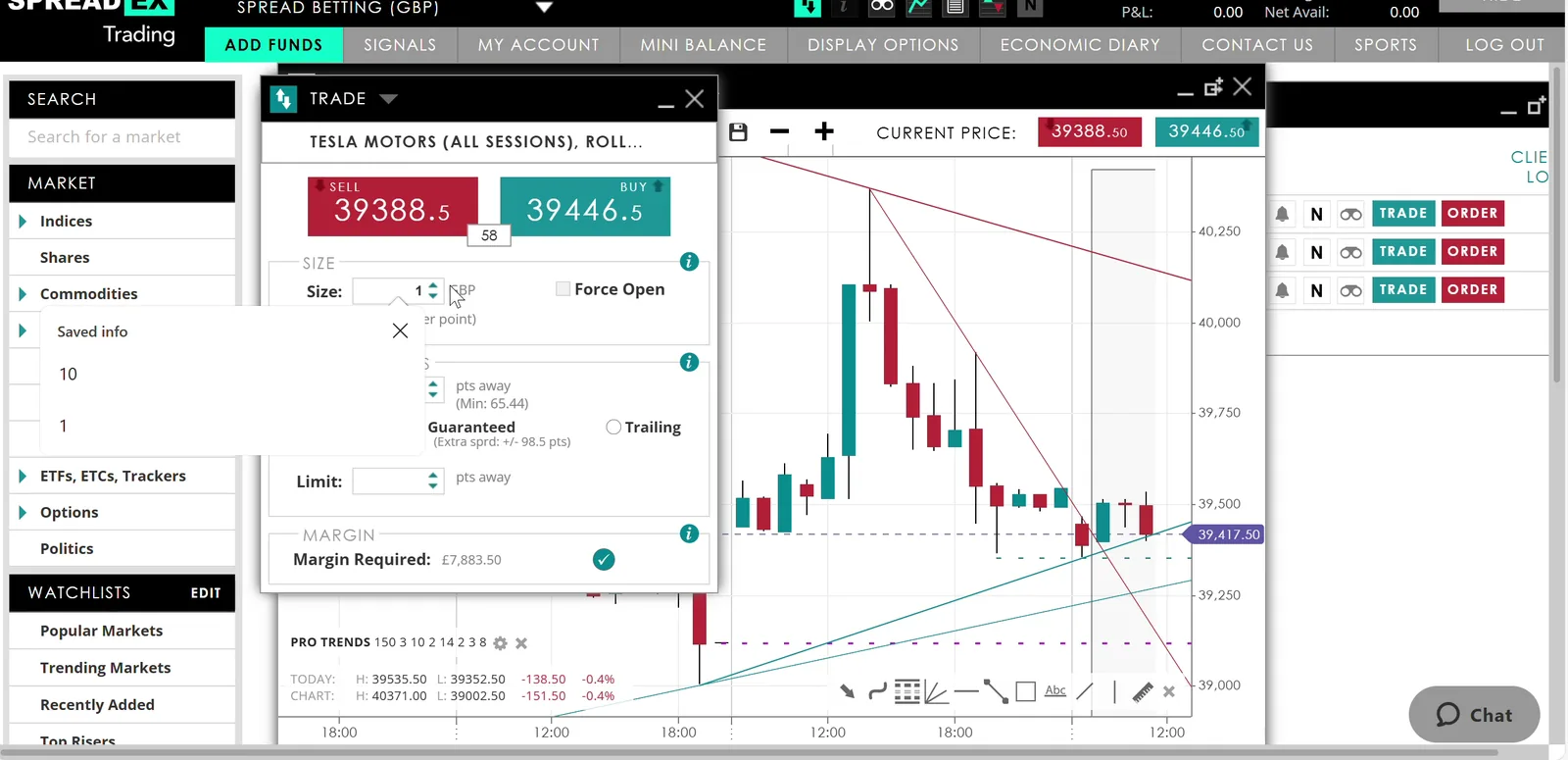
Spreadex earns its place. It is the only UK broker that puts tax-free spread betting and CFDs in a single combined account, it is UK-domiciled with full FSCS protection, and the platform is refreshingly simple. If you want one tidy account and a clean interface, it is genuinely excellent.
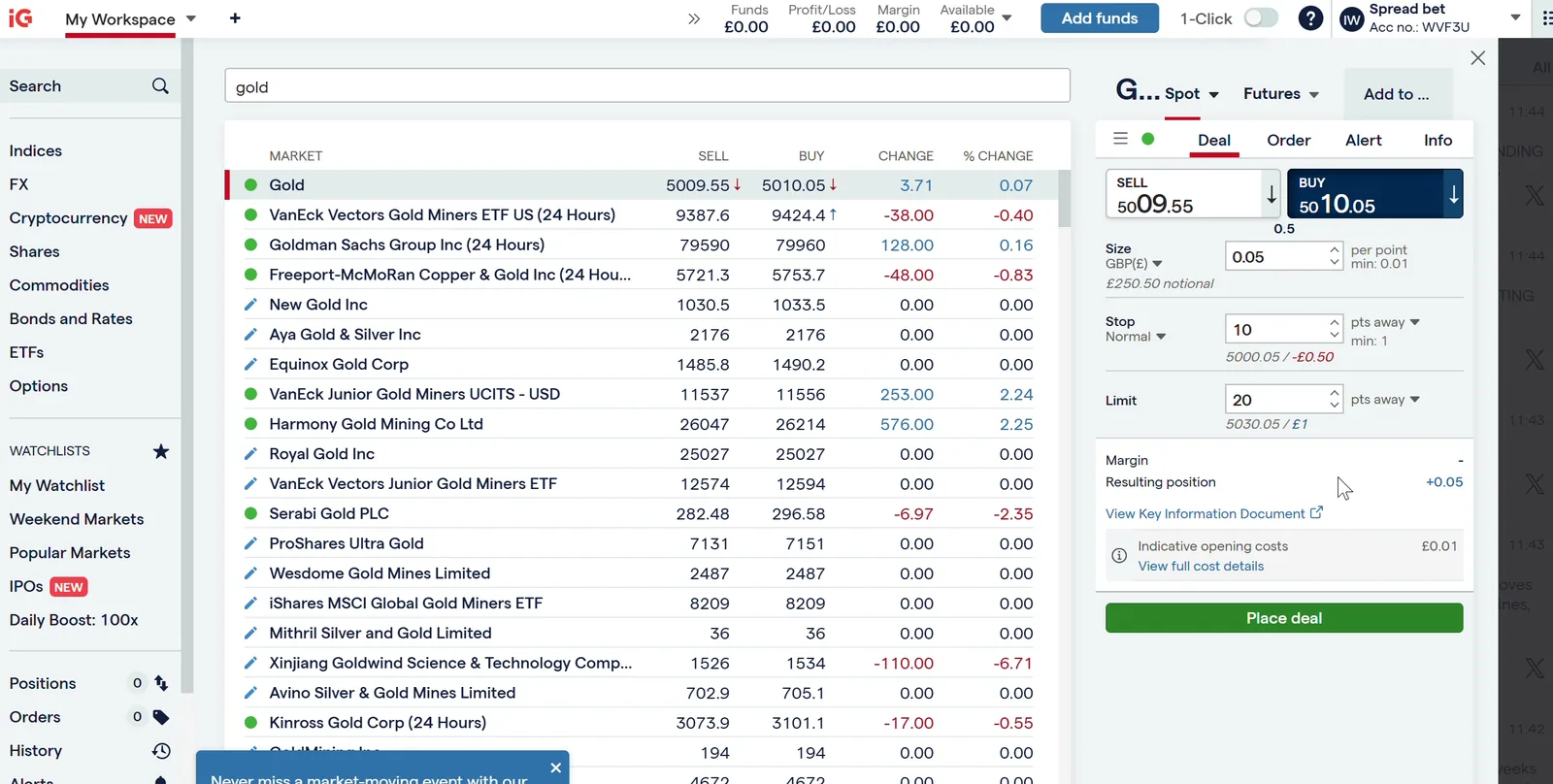
So why do I point people new to spread betting at IG first? One practical reason: IG gives you a free demo account with £10,000 of virtual funds, and Spreadex does not. You can learn how stakes, financing and dividend adjustments actually behave on IG, risk-free, before a penny is real. IG also has the wider range at 17,000 markets, a lower minimum stake at £0.50 per point against Spreadex’s £1.00, and it was the firm that invented UK spread betting back in 1974.
Here is how the top of the market compares on the things that matter.
| Spread betting, as I tested it | Spreadex | IG | CMC Markets |
|---|---|---|---|
| My spread betting rank | #1 | #2 | #5 |
| Free demo account | No | Yes (£10,000) | Yes (£10,000) |
| FTSE 100 spread (from) | 1.0 pt | 1.0 pt | 1.0 pt |
| EUR/USD spread (from) | 0.6 pips | 0.6 pips | 0.7 pips |
| Minimum stake | £1.00/pt | £0.50/pt | £0.10/pt |
| Guaranteed stops | Yes | Yes | Yes |
| Founded / FCA FRN | 1999 / 190941 | 1974 / 195355 | 1989 / 173730 |
Read honestly, the spreads are almost identical at the top, so the choice comes down to how you want to trade. Spreadex wins on the single combined account and simplicity. IG wins on range, a lower minimum stake, and the demo, which is why it is where I tell beginners to start. You can compare the whole field in my rundown of the spread betting platforms I rate.
Should you start spread betting on a demo account?
Yes, if you are new. A demo is the single best way to see how financing and dividend adjustments behave before any money is at stake, and it is exactly how I produce the examples in these guides.
IG’s demo gives you £10,000 in virtual funds and the full platform, so you can place a daily funded bet, hold it for a few days, and watch the financing line build. Spend a couple of weeks there first and the costs above stop being theory. When you are ready to weigh the options, I also rank the demo accounts across brokers.
So Is Spread Betting Worth It? The Honest Case
For a lot of UK traders, yes, clearly. Used with discipline, it is one of the most efficient ways to trade: tax-favourable, flexible, long or short, across thousands of markets, with the same platforms and tight spreads as CFDs.
The costs above are not arguments against it. They are the things to manage, and once you do, the tax wrapper alone makes spread betting hard to beat for a profitable UK resident.
How I Tested This
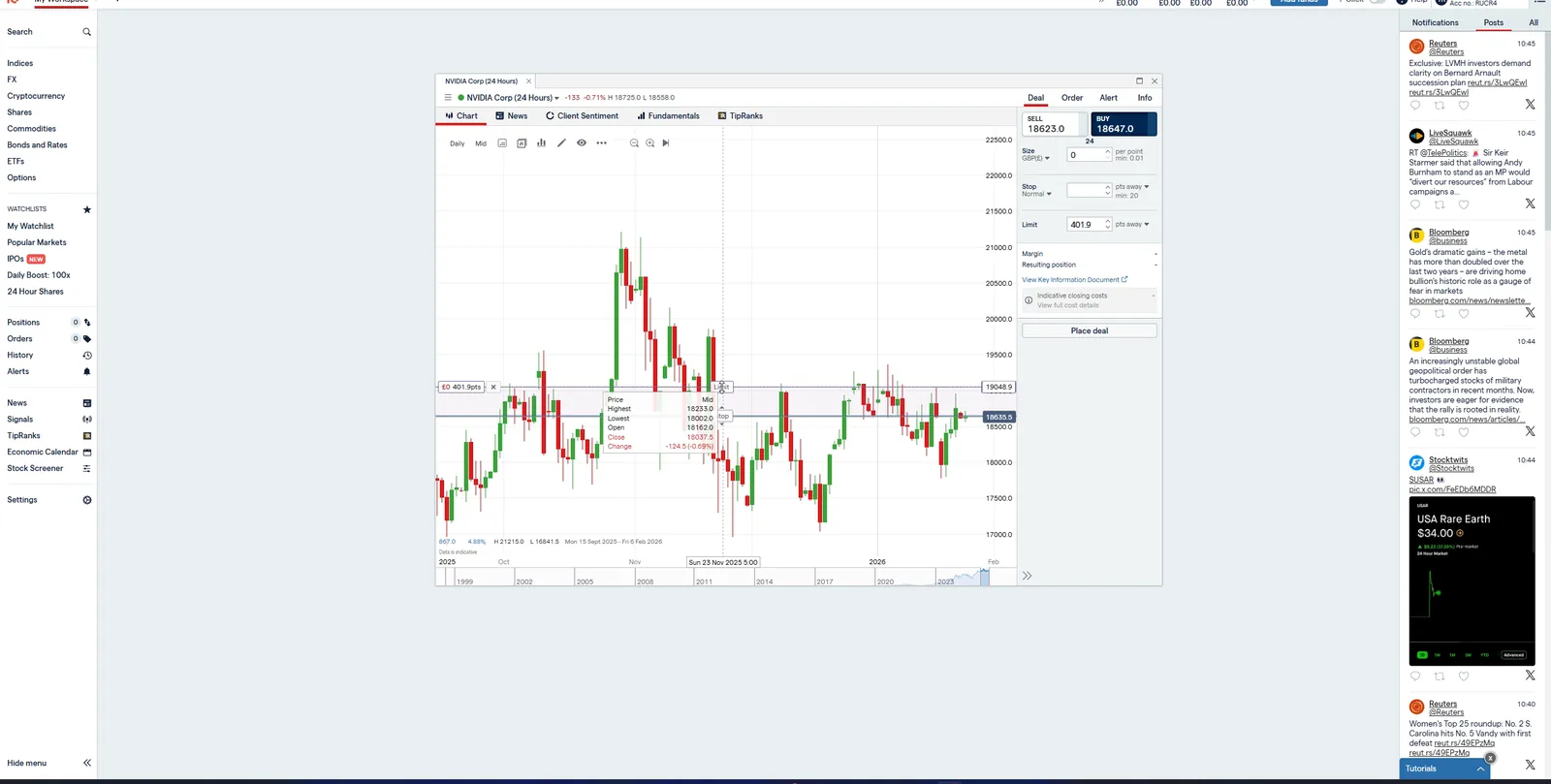
Everything here comes from accounts I funded myself, not fact sheets, with one deliberate exception: the teaching examples I run on a demo so I can show costs without risking real money.
In the most recent cycle I tested 18 UK brokers from a wired connection in Suffolk, measuring real spreads, real financing and real execution across the same markets. The spread betting figures above are what I recorded, not averaged third-party data.
Final Thought: Who Spread Betting Is Genuinely For
Spread betting is for UK residents who trade actively, want the tax efficiency, and are willing to manage the holding costs rather than pretend they do not exist.
If that is you, learn it on a demo first, then open an account when the demo feels boring. IG is where I would start you, and you can open a free IG demo to try it. If you would rather have spread betting and CFDs in one combined account, Spreadex is the one to look at.
Either way, read the financing line before you read the marketing.
Discuss Spread Betting
Spread bettors, what has a held position actually cost you in financing, and which platform shows the charges most clearly? Share below. Our community earns Equity for helpful contributions.
Discussion 0 comments
Be the first to start discussing this topic! Log in or create an account to share your thoughts.
Log In Create AccountFAQs
References
- Financial Conduct Authority (FCA): Leverage, margin and the rules for retail derivatives
- FCA Register: IG Index Ltd. FRN: 195355
- FCA Register: Spreadex Ltd. FRN: 190941
- HMRC: Capital Gains Tax overview
For more trading guides, explore our full trading hub.
No comments yet. Be the first to start discussing this topic!