

- expertise:
- CFD Trading, Forex, Derivatives, Risk Management
- credentials:
- Chartered ACII (2018) · Trading since 2012
- tested:
- 40+ forex & CFD platforms with live accounts

- expertise:
- Broker Comparison, ISA Strategy, Portfolio Management
- credentials:
- Active investor since 2013 · 11+ years experience
- tested:
- 40+ brokers with funded accounts
How We Test
Real accounts. Real money. Real trades. No demo accounts or press releases.
What we measure:
- Spreads vs advertised rates
- Execution speed and slippage
- Hidden fees (overnight, withdrawal, conversion)
- Actual withdrawal times
Scoring:
Fees (25%) · Platform (20%) · Assets (15%) · Mobile (15%) · Tools (10%) · Support (10%) · Regulation (5%)
Regulatory checks:
FCA Register verification · FSCS protection
Testing team:
Adam Woodhead (investing since 2013), Thomas Drury (Chartered ACII, 2018), Dom Farnell (investing since 2013) — 50+ platforms with funded accounts
Quarterly reviews · Corrections: in**@*******************co.uk
Disclaimer
Not financial advice. Educational content only. We're not FCA authorised. Consult a qualified advisor before investing.
Capital at risk. Investments can fall. Past performance doesn't guarantee future results.
CFD warning. 67-84% of retail accounts lose money trading CFDs. High risk due to leverage.
Contact: in**@*******************co.uk
Who charges least to trade gold, on the published numbers?
Pepperstone, by a distance. Its published gold table shows a minimum spread of 0.15 points on Standard and 0.08 on Razor before commission, against "as little as 0.3 points" at IG and from 0.3 at CMC Markets, while Plus500 publishes no gold spread at all; you only see it inside the platform. One caveat sits inside Pepperstone's own house, though. Once Razor's gold commission lands, $7 round turn per lot on cTrader or TradingView, its edge over Pepperstone's own Standard account shrinks to very little on a single lot, so the Razor versus Standard choice matters less than it looks. The gap worth studying is Pepperstone against everyone else, and the sourced, dated table below shows how wide it runs.

73.6% of retail investor accounts lose money when trading spread bets and CFDs with this provider.
How was this comparison built?
Every figure comes from the broker's own published pages, with the date I checked it recorded in the table, and that rule has no exceptions here. No third-party aggregators, no "typical" numbers from review sites, no in-platform readings presented as official. Where a broker publishes nothing, the table says so, because an unpublished price is itself information about how a broker wants to be compared.
The dates matter more than usual here
Pepperstone's gold figures carry a footnote worth reading: they are generated from a single month of data, 1 to 31 August 2026 when I last checked on 17 September 2026, and Pepperstone refreshes that window from time to time. The numbers are the official published ones, but they are a dated snapshot, and this page labels them as such.
The worked trade, defined once
To turn points into money I use one reference trade throughout: a 10oz spot gold position, a tenth of a standard 100oz lot, which at recent prices represents tens of thousands of pounds of exposure. Gold is quoted in dollars per troy ounce and one point on the quote is one dollar, so a 0.15 point spread on 10oz costs about $1.50 to cross. Small numbers. That is rather the point: on gold, the spread is the cheap part.
How does Pepperstone compare with IG, CMC and Plus500 on gold?
Each of the five rows below carries its own source, and the caption does the compliance work.
| Broker | Published gold pricing | Source, checked date |
|---|---|---|
| Pepperstone Standard | Min spread 0.15 points, no commission | pepperstone.com commodity fees (August 2026 data window), 17 Sep 2026 |
| Pepperstone Razor | Min spread 0.08 points + commission: $7 round turn per lot on cTrader, TradingView and the Pepperstone platform; on a GBP account £2.25 per side on MT5 or £4.50 at open on MT4; gold spread bets from 0.1 | pepperstone.com commodity fees and costs and fees page, 17 Sep 2026 |
| IG | "As little as 0.3 points" | ig.com/uk gold trading page, 1 Sep 2026 |
| CMC Markets | From 0.3 points, typically 0.3 to 0.5 per its spread betting page | cmcmarkets.com/en-gb commodities, 1 Sep 2026 |
| Plus500 | Spread not published on its website, shown in-platform only; retail gold leverage 1:20 | plus500.com XAU instrument page, 1 Sep 2026 |
Reading the table honestly
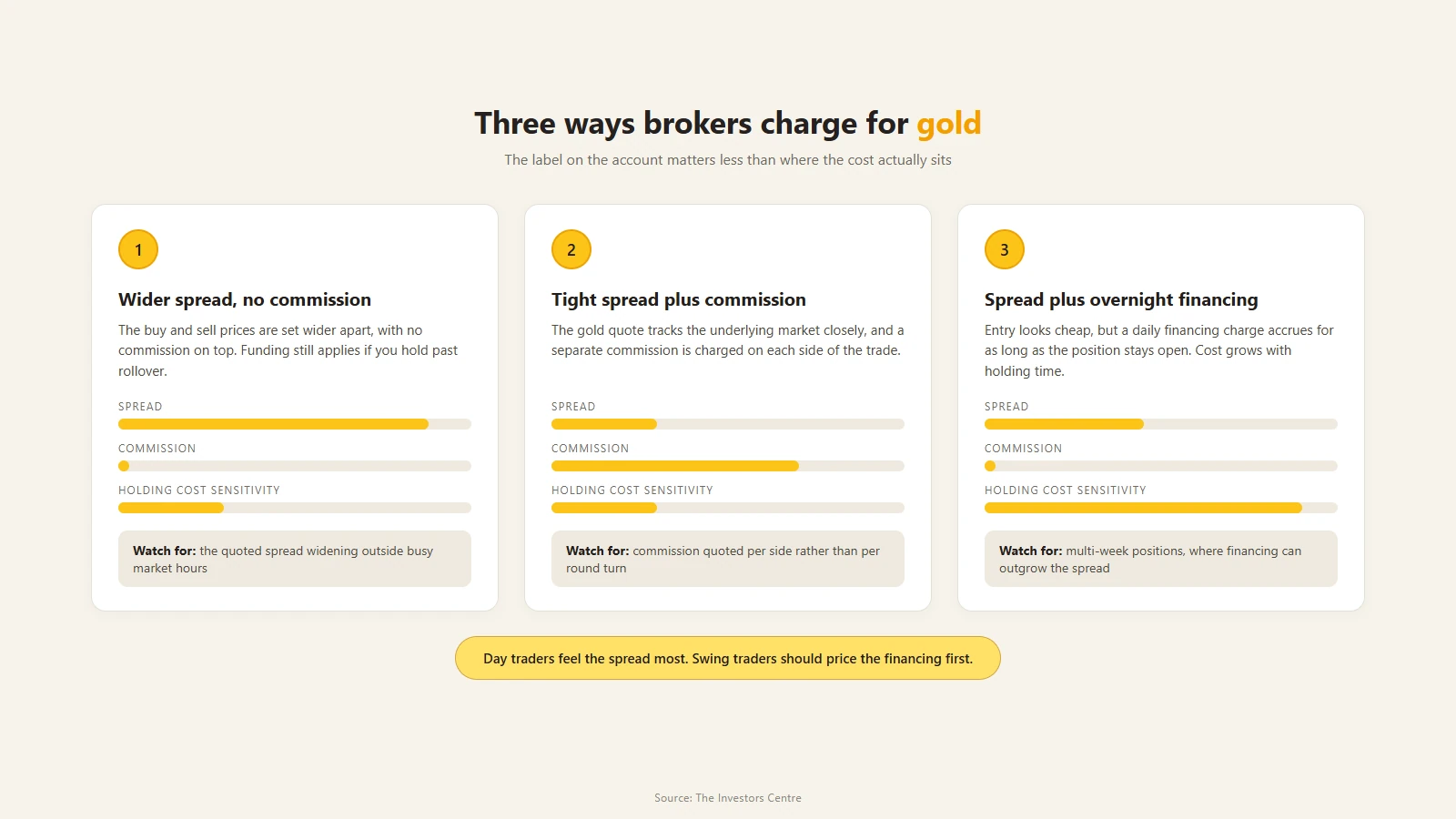
Every one of these is a floor, not an average, so treat them as each broker's best foot forward. Even on that generous reading the ranking is stark. Pepperstone's worst published number, Standard's 0.15, is half of IG's and CMC's best. On the 10oz reference trade that is roughly $1.50 to cross the spread at Pepperstone Standard against $3 at IG or CMC's floor, and up to $5 at CMC's typical top end. Razor's 0.08 costs about 80 cents in spread, then adds 70 cents of pro-rata commission on cTrader or TradingView. Plus500 stays unknowable until you are inside the platform.
What does the spread not tell you about gold costs?
Three things, and together they usually outweigh it. Overnight financing is the big one: gold positions held past rollover pay a daily funding charge at every CFD broker, and over a week or a month that line dwarfs a sub-dollar spread. My week-by-week financing record on a real position is on the Pepperstone gold costs page, the single-broker breakdown this comparison sits alongside.
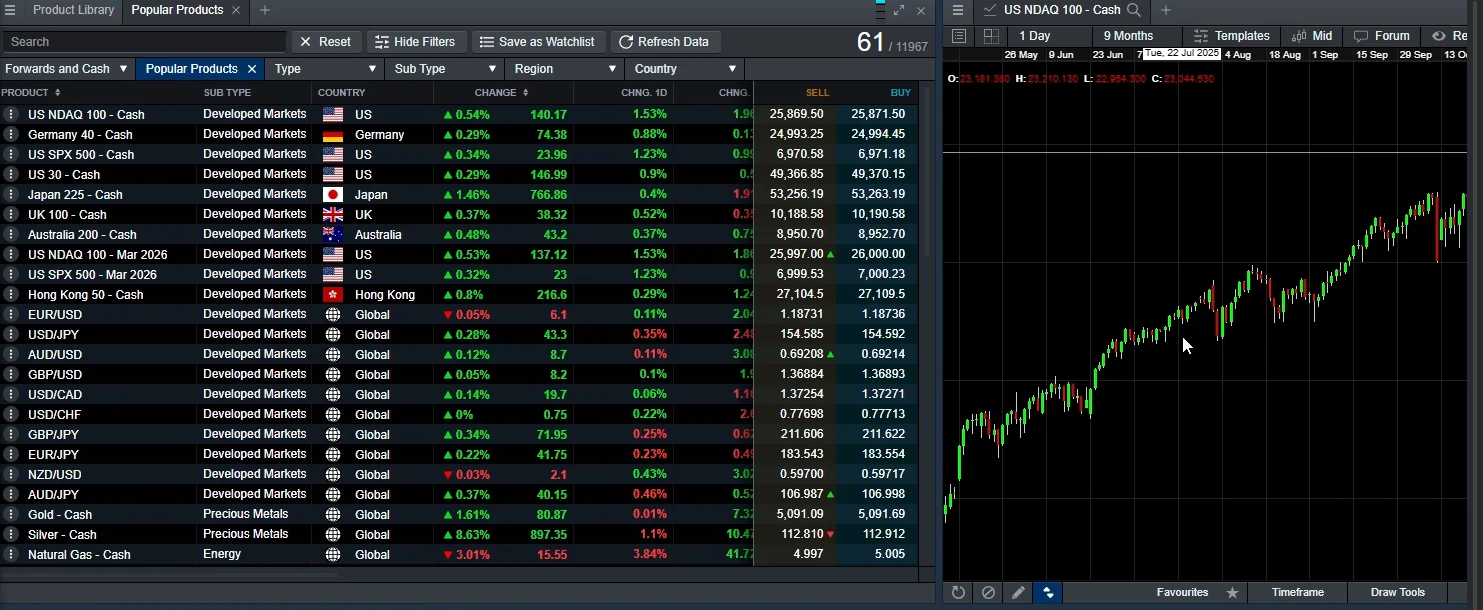
Second, the clock. Spot gold trades close to round the clock but not quite: Pepperstone runs it with a short daily break around the New York close, and spreads stretch in the minutes either side of it. A published minimum is a deep-liquidity number; cross the spread during the break window and you will pay a multiple of it.
Third, the wrapper. UK traders can hold gold as a spread bet or a CFD at Pepperstone and IG, as a CFD only at Plus500, and the pricing above applies to the instrument, not the wrapper. Which wrapper suits you comes down to tax treatment and position sizing, not the spread, and it deserves its own decision rather than a footnote here.
Which route actually suits which gold trader?
If you trade gold a few times a month, Pepperstone Standard is the pragmatic pick: one number on the ticket, no commission line, and a published floor half the size of the big spread-only rivals. Frequent traders who deal in and out daily get more from Razor, but check the platform first, because the gold commission depends on it: $7 round turn per lot on cTrader, TradingView and the Pepperstone platform, or £4.50 per lot on a GBP MetaTrader account. The fill-by-fill workings on both accounts, including the financing week, are on the dedicated gold costs breakdown.
If your shortlist includes CMC for its wider market range, my Pepperstone vs CMC Markets comparison prices the two head to head beyond gold. Pepperstone Limited is authorised and regulated by the FCA, FRN 684312, which is the baseline any broker on this page has to clear before cost even enters the conversation.
FAQs
References
- FCA Register: Pepperstone Ltd. FRN: 684312
- Pepperstone: commodity fees, gold spread table (checked 17 September 2026; table footnote dates its data to August 2026)
- Pepperstone: per-platform commissions and spread betting rates (checked 17 September 2026)
- IG gold trading page: ig.com/uk/commodities/gold-trading (checked 1 September 2026; reference only, deliberately not hyperlinked)
- CMC Markets: commodity trading pricing (checked 1 September 2026)
- Plus500: gold instrument page (checked 1 September 2026)
- The Investors Centre: how we test brokers