

- expertise:
- CFD Trading, Forex, Derivatives, Risk Management
- credentials:
- Chartered ACII (2018) · Trading since 2012
- tested:
- 40+ forex & CFD platforms with live accounts

- expertise:
- Broker Comparison, ISA Strategy, Portfolio Management
- credentials:
- Active investor since 2013 · 11+ years experience
- tested:
- 40+ brokers with funded accounts
How We Test
Real accounts. Real money. Real trades. No demo accounts or press releases.
What we measure:
- Spreads vs advertised rates
- Execution speed and slippage
- Hidden fees (overnight, withdrawal, conversion)
- Actual withdrawal times
Scoring:
Fees (25%) · Platform (20%) · Assets (15%) · Mobile (15%) · Tools (10%) · Support (10%) · Regulation (5%)
Regulatory checks:
FCA Register verification · FSCS protection
Testing team:
Adam Woodhead (investing since 2013), Thomas Drury (Chartered ACII, 2018), Dom Farnell (investing since 2013) — 50+ platforms with funded accounts
Quarterly reviews · Corrections: in**@*******************co.uk
Disclaimer
Not financial advice. Educational content only. We're not FCA authorised. Consult a qualified advisor before investing.
Capital at risk. Investments can fall. Past performance doesn't guarantee future results.
CFD warning. 67-84% of retail accounts lose money trading CFDs. High risk due to leverage.
Contact: in**@*******************co.uk
What does it cost to trade gold on Pepperstone?
Less than most brokers up front, and the account you pick decides how the bill is presented. Standard builds everything into the spread with no commission line, from a published 0.15 points on spot gold. Razor quotes gold raw from a published floor of 0.08 points, then charges a fixed commission from £2.25 per lot per side on a GBP account, pro-rata for smaller sizes. On a typical £5,000 gold exposure the round-trip dealing cost on either account is measured in pennies to a few pounds; the cost that actually builds is overnight financing, which is why the worked example below itemises how to read it. Gold trades as both a spread bet and a CFD here, with a 20:1 retail CFD leverage cap, and this page prices all of it as checked on pepperstone.com/en-gb on 26 August 2026 and re-checked 17 September 2026.

72.9% of retail investor accounts lose money when trading spread bets and CFDs with this provider.
How is gold priced on Standard vs Razor?
Same market, two different receipts. Both accounts trade the same spot gold instrument (XAUUSD), quoted in US dollars per troy ounce, and both routes are available as a spread bet or a CFD. The difference is purely how Pepperstone collects its margin on the trade, and it mirrors the split I have already logged in detail on forex.
Standard: one number, no commission line
Standard bundles the whole dealing cost into the spread, from a published 0.15 points on spot gold with no commission on commodities. One number on the ticket, nothing to reconcile afterwards. The honest caveat is that a from-figure is a floor, not an average: what Standard actually shows through the London afternoon, and how far it sits above Razor's raw quote at the same second, only shows on the two tickets themselves, which is why the comparison worth doing is your own, at the minute you actually trade.
Razor Gold: raw spread plus a fixed commission
Razor Gold is the newer route and the one Pepperstone pitches at active traders: the raw market spread from a published 0.08 points (checked 26 August 2026), plus a fixed commission from £2.25 per lot per side on a GBP account, £4.50 round turn, charged pro-rata below one lot. A standard gold lot is 100oz, so at current prices one lot is a large notional and most retail gold trades are fractions of it, which shrinks the commission line to pennies. On a GBP account the per-platform forex commission carries across to gold everywhere except cTrader, which charges $3.50 per side on gold against $3 on forex.
What the published figures can and cannot tell you
What they can tell you: on the published floors, Razor's raw quote starts 0.07 points inside Standard's from-figure, and Razor then adds its fixed commission line. What they cannot tell you is the number that actually decides the winner, which is how far each account sits above its floor at the minute you deal: from-figures are marketing floors, not averages, and no review figure, this page's included, beats opening both tickets and reading the two quotes at the same second. Treat the figures above as published floors from site checks on 26 August and 17 September 2026, not as what your ticket will show at 3pm on a Tuesday.
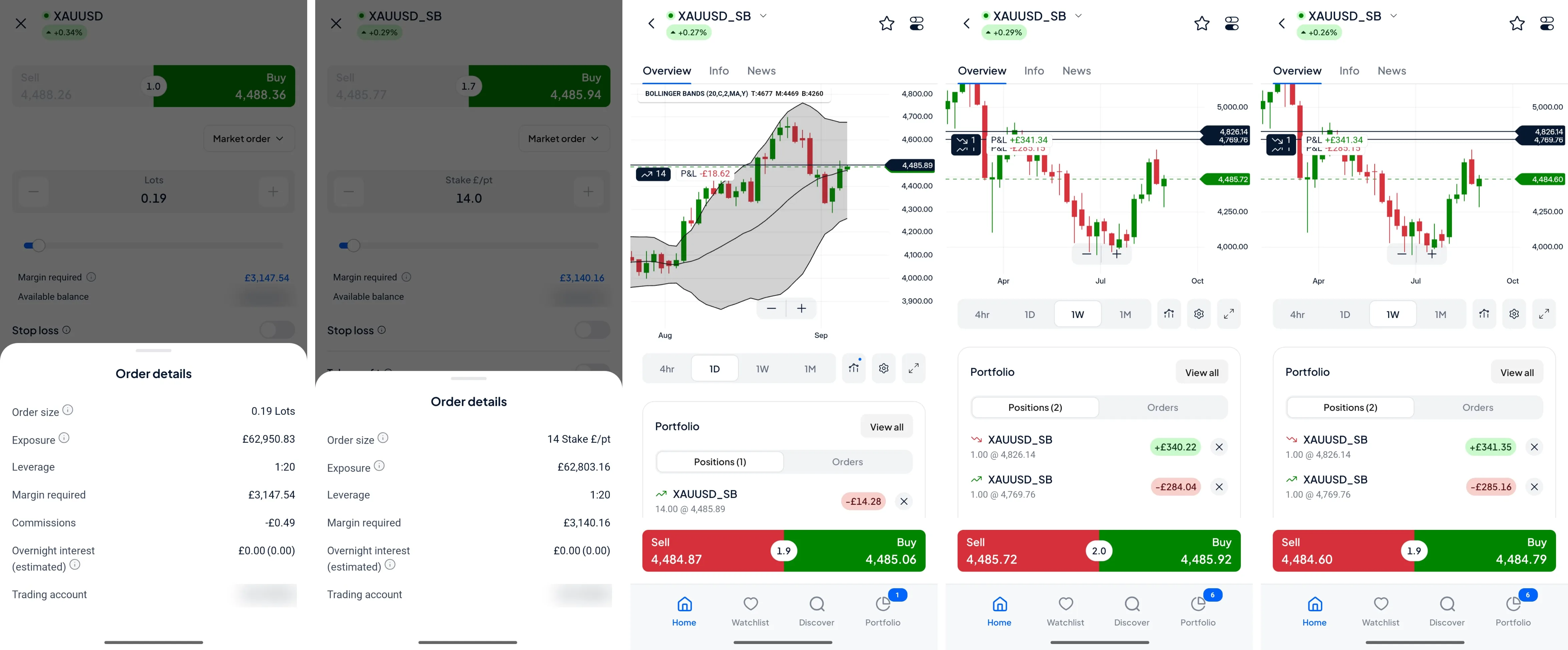
What does a £5,000 gold position actually cost?
About £250 of margin to open at the 20:1 retail CFD cap, a dealing cost you will barely notice, and a financing cost that decides everything if you hold. Here is the shape of the arithmetic, priced from the published figures and pointed at the live platform where only the live platform will do.
| Cost line | Standard | Razor Gold |
|---|---|---|
| Margin at 20:1 (CFD) | £250 | £250 |
| Spread on entry and exit | From a published 0.15 points; the live ticket decides | Raw from a published 0.08 points; the live ticket decides |
| Commission (pro-rata) | None | From £2.25 per lot per side, pro-rata: pennies at this fraction of a lot |
| Overnight financing, per night | The platform's live gold swap rate, applied nightly | Same as Standard |
| Seven-night hold, financing total | Nightly swap times seven, including the midweek triple charge | Same as Standard |
Why financing is the line that matters
Gold pays no interest, so holding a leveraged long means paying the funding on borrowed dollars every night, and the swap is set from published rates that move with US interest rates. On my EUR/USD log the overnight line ended up dwarfing every dealing cost for held positions, and gold behaves the same way: the spread is a toll you pay twice, the swap is rent you pay nightly, and one night each week the rent is charged three times over to cover the weekend. Check the live gold swap on the platform before any hold; the rate on the day beats any review figure, mine included.
When can you trade gold, and when should you?
Almost around the clock on weekdays, but not quite, and the gap matters. Gold on Pepperstone runs from just after 01:00 to 23:59 server time with a daily break of roughly an hour, which is the pause while the underlying futures market rolls over. Two practical consequences: any stop resting through the break cannot fill until trading resumes, and the first prints after the reopen can gap past your level.
The hours that are actually cheap
Spreads are a function of liquidity, and gold's deepest liquidity arrives when London and New York overlap through the UK afternoon. That is when from-figures are most honest. The thin hours after the US close and around the daily break are when a 0.1-point market can print several times wider, which is the same session pattern I logged on my EUR/USD cost log. If you are cost-sensitive, trade gold in the afternoon and leave the reopen to the futures desks.
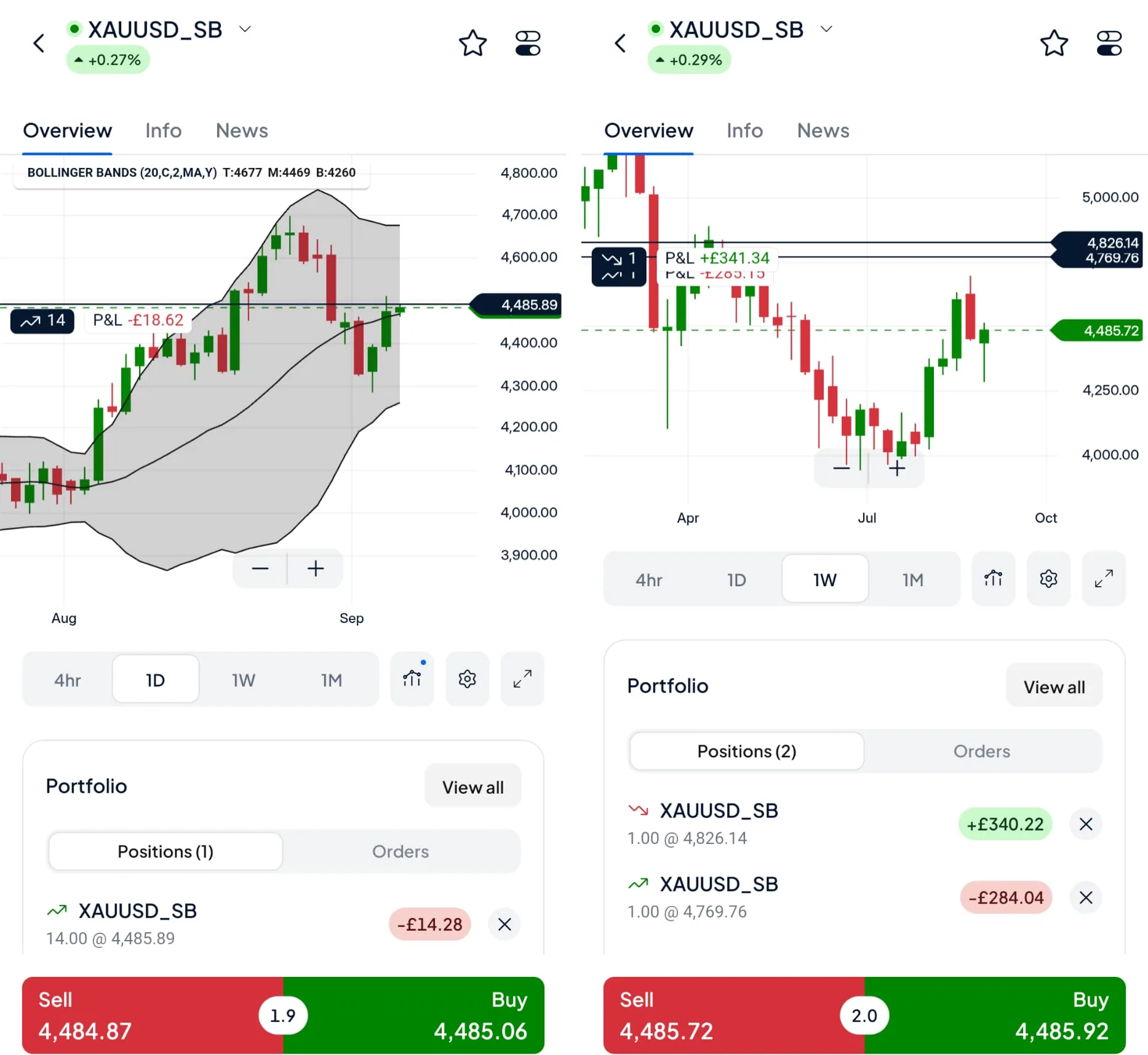
Should UK traders bet gold or trade the CFD?
For most UK retail traders the spread bet wrapper wins on tax and the CFD wins on offsetting, and gold does not change that calculus. Spread betting profits are currently free of capital gains tax for UK individuals, while CFD gains are taxable but CFD losses can offset other gains. The pricing on this page applies either way: Pepperstone quotes the same gold market in both wrappers, the 20:1 figure is the retail CFD leverage cap, and the spread bet ticket sizes in pounds per point instead of lots. The full decision, including when the CFD is actually the smarter wrapper, is written up in our spread betting vs CFDs guide; nothing about gold exempts you from doing that thinking. Tax treatment depends on individual circumstances and can change.
Is Pepperstone the right home for your gold trading?
If your question is which broker to trade gold with, this is deliberately not that page: our ranked answer across the market lives at the best platforms for trading gold, and this page exists one level deeper, as the single-broker cost teardown for the Pepperstone row of that table. What I can say from this side of the ledger: the raw-plus-commission structure that made Razor the cheap seat in my forex testing now extends to gold, the account funds from £10 on most methods so testing these numbers yourself is cheap, and Pepperstone Limited is FCA-regulated (FRN 684312) with negative balance protection for retail clients. Gold is one market of the broker's more than 2,700 spread bets and CFDs, and the same platform stack I compared in my Pepperstone platforms breakdown all carries it.
FAQs
References
- FCA Register: Pepperstone Ltd. FRN: 684312
- Pepperstone: costs and fees, including Razor Gold commission and leverage caps
- Pepperstone: Razor Gold explained
- The Investors Centre: how we test brokers