

- expertise:
- CFD Trading, Forex, Derivatives, Risk Management
- credentials:
- Chartered ACII (2018) · Trading since 2012
- tested:
- 40+ forex & CFD platforms with live accounts

- expertise:
- Platform Testing, Cryptocurrency, Retail Investing
- credentials:
- Active investor since 2013 · 11+ years experience
- tested:
- 50+ platforms · 200+ guides authored
How We Test
Real accounts. Real money. Real trades. No demo accounts or press releases.
What we measure:
- Spreads vs advertised rates
- Execution speed and slippage
- Hidden fees (overnight, withdrawal, conversion)
- Actual withdrawal times
Scoring:
Fees (25%) · Platform (20%) · Assets (15%) · Mobile (15%) · Tools (10%) · Support (10%) · Regulation (5%)
Regulatory checks:
FCA Register verification · FSCS protection
Testing team:
Adam Woodhead (investing since 2013), Thomas Drury (Chartered ACII, 2018), Dom Farnell (investing since 2013) — 50+ platforms with funded accounts
Quarterly reviews · Corrections: in**@*******************co.uk
Disclaimer
Not financial advice. Educational content only. We're not FCA authorised. Consult a qualified advisor before investing.
Capital at risk. Investments can fall. Past performance doesn't guarantee future results.
CFD warning. 67-84% of retail accounts lose money trading CFDs. High risk due to leverage.
Contact: in**@*******************co.uk
Pepperstone or FxPro: which raw-spread broker should you pick?
For once, a comparison between two firms playing the same game. Both are FCA-regulated, both run raw spreads plus a per-lot commission, both carry cTrader, and both offer UK spread betting, so the choice turns on smaller print than usual. Pepperstone's cTrader commission is $6 round-trip per FX lot against FxPro's $7, Pepperstone opens accounts with most methods from £10 while FxPro's own FAQ recommends a first deposit of $1,000, and only Pepperstone has TradingView. FxPro answers back with one commission rate on every platform, volume rebates on its Elite account, and CFDs on futures, which Pepperstone does not list. On cost, Pepperstone edges it by a nose. On fit, the two firms are picturing different customers, and the sections below work out which one is you.

73.6% of retail investor accounts lose money when trading spread bets and CFDs with this provider.
What do the two brokers actually offer?
On paper, near-mirrors. Pepperstone Limited is authorised and regulated by the FCA (FRN 684312); FxPro UK Limited holds FCA registration 509956, and both sit inside the FSCS scheme for eligible claims. Each runs a spread-only account for simplicity and a raw account for anyone who wants the commission itemised. The table below is built from each broker's own published pages, all checked on 1 September 2026, and I have kept it to figures the brokers print themselves.
| Feature | Pepperstone | FxPro |
|---|---|---|
| UK regulation | FCA, FRN 684312 | FCA, registration 509956 |
| Raw account | Razor: spreads from 0, commission per lot varies by platform (see below) | Raw+ and cTrader: spreads from 0, $3.50 per lot per side on every platform |
| Spread-only account | Standard, no commission | Standard on MT4/MT5, marked-up spread, zero commission |
| Platforms | MT4, MT5, cTrader, TradingView, Pepperstone's own web and app platform | MT4, MT5, cTrader, the FxPro Trading Platform, plus FxPro Edge for spread betting |
| Spread betting | Yes, with published SB spreads (EUR/USD from 0.6) | Yes, via FxPro Edge across five asset classes |
| Market count | More than 2,700 spread bets and CFDs | FxPro advertises over 2,100 instruments, including futures CFDs |
| Getting started | Most methods fund from £10 | FxPro's FAQ recommends an initial deposit of $1,000 |
| Volume perks | Not published as a standing rebate table | Elite account: rebates from $1.50 per lot, per FxPro's own FAQ |
Two rows there go to FxPro without argument. If you trade serious monthly volume, Elite's published rebates have no like-for-like Pepperstone equivalent on the pricing page, and if you want futures-based CFDs, FxPro lists them and Pepperstone does not.
Which is cheaper per lot, Razor or Raw+?
Start with FxPro, because its answer is short. Raw+ and the cTrader account charge $3.50 per lot per side, taken as $7 round-trip when the position opens, on FX and metals with spreads from 0. One rate, every platform. There is real appeal in that.
Pepperstone's answer depends on where you trade, which is either a quirk or a lever depending on your temperament. On a GBP-denominated MT4 or MT5 account, Razor commission is £2.25 per lot per side, £4.50 round trip, with MT4 taking the full £4.50 when the position opens. On cTrader it is $6 round-trip per FX lot. On TradingView it is a fixed $7 round-trip, and on Pepperstone's own platform $3.50 per side. So Pepperstone's cTrader route at $6 undercuts FxPro's $7 by a dollar a lot, and the GBP MT4/MT5 rate of £4.50 round trip undercuts it too, landing close to the cTrader figure at recent exchange rates. Trade 50 lots a month on cTrader and the gap is $50. Not life-changing. But it compounds in the right direction, and raw-account traders are exactly the people who count it.
Underneath the commission, both advertise spreads from 0 on majors. Pepperstone goes one step further than most and publishes a dated table: across all sessions in May 2026, EUR/USD averaged 0.1 on Razor and 1.1 on Standard, with GBP/USD at 0.2 and 1.2. FxPro publishes its commission worked example (EUR3.50 per side on EUR/USD) but no equivalent dated average-spread table that I could find, which makes a true all-in comparison impossible from published figures alone. My own logged costs on a funded Razor account are on the page tracking what a EUR/USD round trip really costs, updated monthly.
Where do the platform line-ups split?
Four platforms overlap; two do not. Both brokers carry MT4, MT5 and cTrader, and both have built their own platform besides, so the old shortcut of "pick the broker with cTrader" settles nothing here. The split is at the edges. Pepperstone offers TradingView as a full trading platform on Razor accounts, charts, community scripts and order tickets in one place, and FxPro has nothing equivalent. FxPro's extra card is FxPro Edge, a separate platform built specifically for its spread betting product, where Pepperstone runs spread betting through its existing platforms instead.
Which edge case matters is personal. I have run six months of funded trading across Pepperstone's line-up, written up platform by platform in my guide to every platform Pepperstone offers, and TradingView is the one I kept returning to. A trader whose whole workflow is MT5 EAs will shrug at that. Fair enough: on MT4 and MT5 these two brokers are close to interchangeable, and the decision falls back to commission and account service.
One caveat cuts against my own preference. Pepperstone's TradingView integration is Razor-only and carries the fixed $7 round-trip rate, the joint dearest of its FX commission routes alongside the Pepperstone platform, so the platform I like best is also the one where Pepperstone's cost advantage over FxPro disappears entirely.
Whose execution claims should you believe?
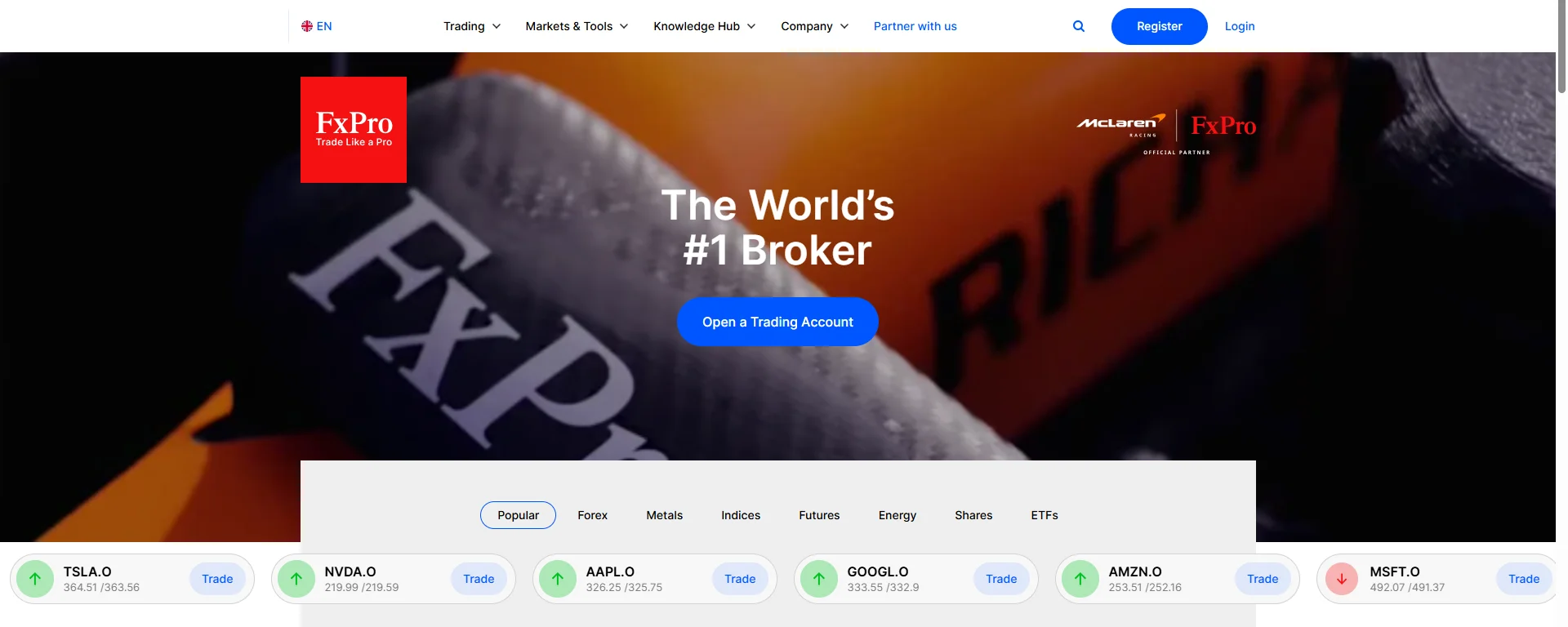
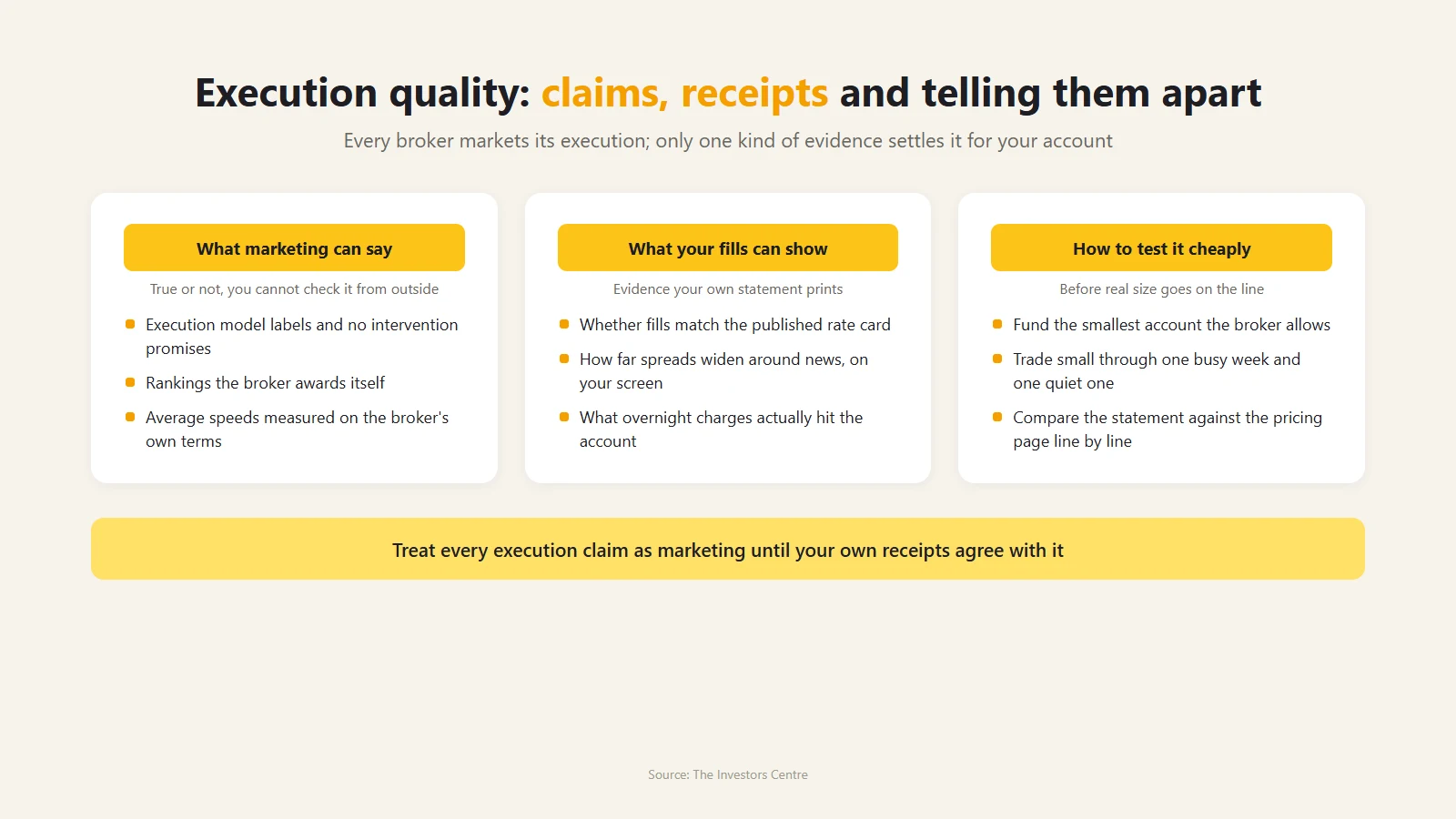
Treat both sets as marketing until your own fills say otherwise. FxPro leads hard on execution in its own material: No Dealing Desk, STP, orders "executed fairly, transparently, and without intervention", market execution on all account types. Its homepage goes as far as calling itself "The World's #1 Broker". These are FxPro's claims, published on FxPro's pages, and I have no funded FxPro account to test them against, so I pass them on labelled exactly as what they are.
Pepperstone markets execution quality too, and there I do hold evidence of my own: six months of real fills, news-event spread widening and swap charges on a funded Razor account, logged in my six-month Pepperstone forex review. That is one account, one trader, one period, and it cannot prove Pepperstone beats FxPro on execution. What it proves is narrower and more useful: Pepperstone's published pricing matched what my account was actually charged.
Can you spread bet with both?
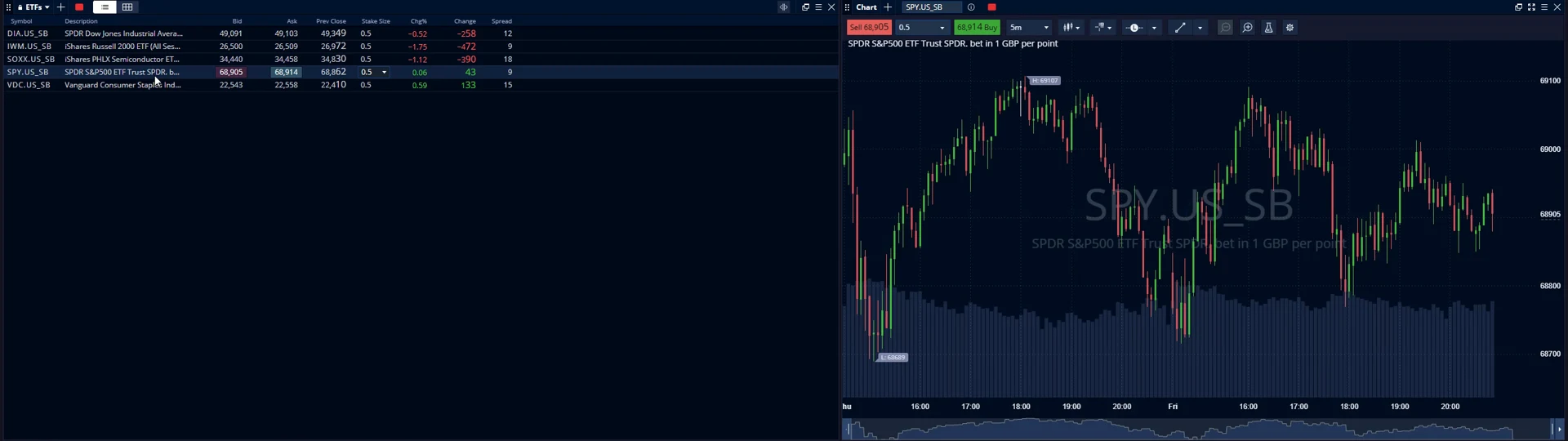
Yes, and that surprised me, because among raw-spread FX brokers spread betting is usually the row Pepperstone wins by default. Not here. FxPro offers spread betting to UK residents through FxPro Edge, spread-only pricing across five asset classes: forex, shares, indices, spot metals and spot energies. Edge is a proper product in its own right.
The difference is disclosure and breadth. Pepperstone publishes its spread betting rates on the same pricing page as everything else, EUR/USD from 0.6, GBP/USD from 0.9, spot gold from 0.1, and its spread betting sits across the same range as its CFDs, more than 2,700 spread bets and CFDs in total. FxPro's Edge pages give the asset classes but, in my checking, no equivalent per-market rate card, so pricing a bet means opening the platform. Both wrappers carry the same tax treatment for UK retail clients, which is the point of the product. If spread betting is your main event rather than a sideline, the published numbers make Pepperstone the easier broker to cost before you commit.
So who should choose which?
Choose Pepperstone if you want the lowest published cTrader commission of the pair, TradingView as a first-class platform, spread betting with a printed rate card, and an account you can open with most methods from £10 and test small. The £10 point matters more than it sounds: I funded mine, traded it for six months, and timed the money coming back out in my Pepperstone withdrawal test, all without needing four figures at risk.
Choose FxPro if you value one commission rate across every platform instead of Pepperstone's four-way menu, if your volume is high enough for Elite's rebates from $1.50 per lot to bite, or if futures CFDs belong in your book. The recommended $1,000 opening deposit signals who FxPro thinks its account is for, and there is no shame in matching yourself to that.
And if this pairing feels too close to call, that is because it is; the differences that decide it are bigger elsewhere, as my comparison of Pepperstone against CMC Markets shows.
FAQs
References
- FCA Register: Pepperstone Ltd, FRN 684312 (checked 1 September 2026)
- Pepperstone: pricing and commissions (checked 1 September 2026)
- Pepperstone: forex pairs and spreads, May 2026 data (checked 1 September 2026)
- FxPro: licences and regulation (checked 1 September 2026)
- FxPro: commissions and swap charges (checked 1 September 2026)
- FxPro: trading platforms (checked 1 September 2026)
- The Investors Centre: how we test brokers