

- expertise:
- CFD Trading, Forex, Derivatives, Risk Management
- credentials:
- Chartered ACII (2018) · Trading since 2012
- tested:
- 40+ forex & CFD platforms with live accounts

- expertise:
- Broker Comparison, ISA Strategy, Portfolio Management
- credentials:
- Active investor since 2013 · 11+ years experience
- tested:
- 40+ brokers with funded accounts
How We Test
Real accounts. Real money. Real trades. No demo accounts or press releases.
What we measure:
- Spreads vs advertised rates
- Execution speed and slippage
- Hidden fees (overnight, withdrawal, conversion)
- Actual withdrawal times
Scoring:
Fees (25%) · Platform (20%) · Assets (15%) · Mobile (15%) · Tools (10%) · Support (10%) · Regulation (5%)
Regulatory checks:
FCA Register verification · FSCS protection
Testing team:
Adam Woodhead (investing since 2013), Thomas Drury (Chartered ACII, 2018), Dom Farnell (investing since 2013) — 50+ platforms with funded accounts
Quarterly reviews · Corrections: info@theinvestorscentre.co.uk
Disclaimer
Not financial advice. Educational content only. We're not FCA authorised. Consult a qualified advisor before investing.
Capital at risk. Investments can fall. Past performance doesn't guarantee future results.
CFD warning. 67-84% of retail accounts lose money trading CFDs. High risk due to leverage.
Contact: info@theinvestorscentre.co.uk
Which is the best UK day trading platform right now?
Three picks depending on how you trade. Spreadex won my Q4 2025 - Q1 2026 testing for the 8am London open: zero requotes across 14 weeks and 88% zero-slippage fills, the highest of the six. Pepperstone Razor wins on raw cost: 0.1-pip EUR/USD spread plus £2.25 commission per side, roughly £500 cheaper than Spreadex over 100 round-trips. Capital.com wins on speed and entry: 24ms median execution (fastest) and a £20 minimum deposit (lowest).

Spreadex
- Best For
- Scalping the London open
- TIC Score
- 4.9 / 5
- Community Rating
- 4.5 (60 ratings) Have Your Say →
- Zero-Slippage Rate
- 88% (highest)
- Requotes Across 14 Weeks
- 0
65% of retail CFD accounts lose money.

IG
- Best For
- Widest markets + ProRealTime charting
- TIC Score
- 4.8 / 5
- Community Rating
- 4.4 (61 ratings) Have Your Say →
- Tradable Markets
- 17,000+ (widest)
- Platforms
- ProRealTime + MT4 + L2 Dealer DMA
69% of retail CFD accounts lose money.

Pepperstone
- Best For
- Lowest all-in cost + algo platforms
- TIC Score
- 4.7 / 5
- Community Rating
- 4.5 (59 ratings) Have Your Say →
- EUR/USD Spread (Razor)
- 0.1 pips + £2.25/side
- Platforms
- MT4 + MT5 + cTrader + TradingView
73% of retail CFD accounts lose money.

Capital.com
- Best For
- Beginners + fastest fills
- TIC Score
- 4.7 / 5
- Community Rating
- 4.2 (43 ratings) Have Your Say →
- Median Latency
- 24ms (fastest)
- Min Deposit
- £20 (lowest)
61% of Retail CFD Accounts Lose Money

CMC Markets
- Best For
- 115+ indicators + pattern scanner
- TIC Score
- 4.5 / 5
- Community Rating
- 4 (44 ratings) Have Your Say →
- Indicators
- 115+ on Next Generation
- BoE-Window p95 Latency
- 280ms (widest)
68% of retail CFD accounts lose money.

Saxo
- Best For
- Premium multi-asset + DMA equities
- TIC Score
- 4.3 / 5
- Community Rating
- 3.5 (31 ratings) Have Your Say →
- NFP-Window Worst Fill
- Under 200ms (most consistent)
- Total Instruments
- 70,000+
64% of retail CFD accounts lose money.
Which type of UK day trading account should you actually use?
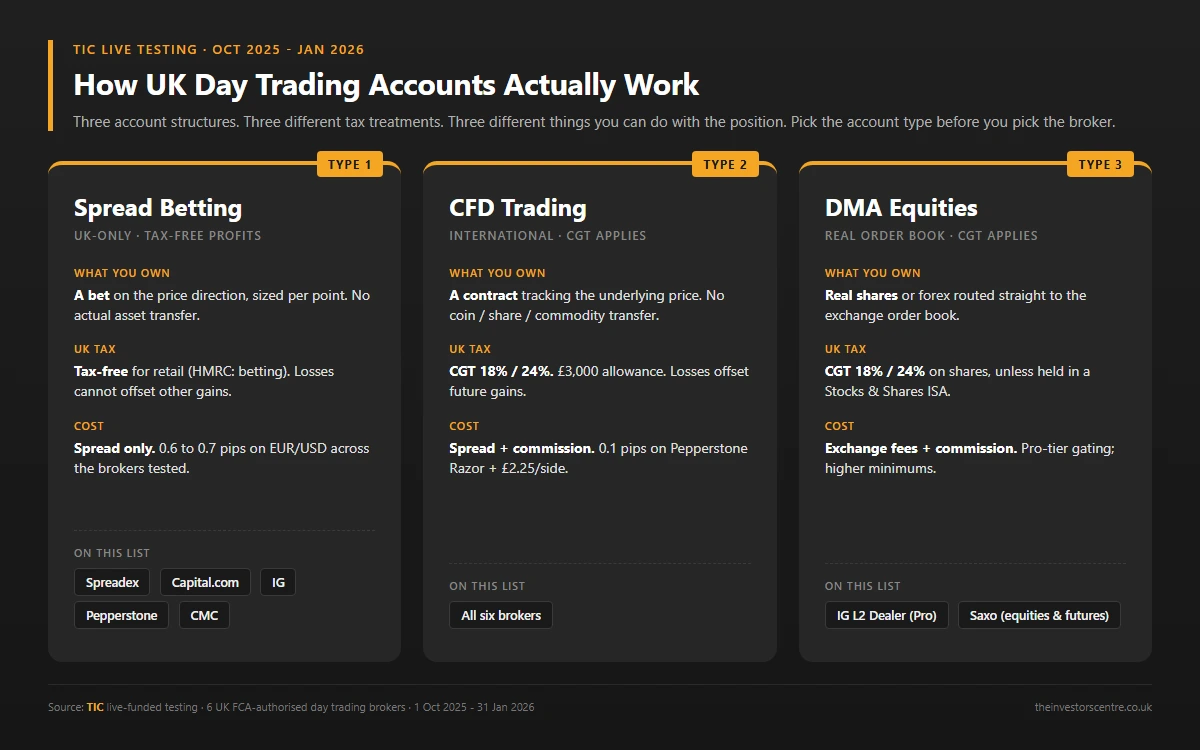
Three account structures, three different cost and tax mechanics. The broker you pick is downstream of this choice. Pick the account type first.
Spread betting (Spreadex, IG, CMC, Capital.com, Pepperstone, Saxo via their UK spread-bet entity): profits are tax-free for UK retail because HMRC classifies spread betting as betting, not investment. No CGT, no Income Tax, no annual allowance to track. The catch: spread-bet positions are sized per point, not per share, and losses cannot offset other gains for tax purposes.
CFD trading (all six brokers): a contract for difference, taxed under Capital Gains Tax. The 2025-26 CGT rates are 18% for basic-rate taxpayers and 24% for higher-rate, with a £3,000 annual allowance. Losses can be carried forward and offset against future CGT gains. CFDs work in any base currency, so they suit international clients who cannot use spread bets.
Direct Market Access (IG L2 Dealer, Saxo DMA): real shares or forex routed straight to the exchange order book, not internalised by the broker. You see live depth and trade against other market participants. Gated to professional-tier or high-balance retail clients. CGT applies in the normal way for shares.
For most UK retail day traders, spread betting wins on tax, CFDs win on instrument breadth, DMA wins on transparency at scale.
How do these 6 UK day trading platforms compare on the numbers?
The six brokers side-by-side on the test data.
| Rank | Broker | FCA FRN | Accounts | EUR/USD Spread | Zero-Slip Rate | Median Latency |
|---|---|---|---|---|---|---|
| #1 | Spreadex | 190941 | Spread Bet + CFD | 0.6 pips | 88% | 110ms |
| #2 | IG | 195355 | Spread Bet + CFD + DMA | 0.6 pips | 80% | 85ms |
| #3 | Pepperstone (Razor) | 684312 | Spread Bet + CFD | 0.1 pips + £2.25/side | 78% | 47ms |
| #4 | Capital.com | 793714 | Spread Bet + CFD | 0.7 pips | 79% | 24ms |
| #5 | CMC Markets | 173730 | Spread Bet + CFD | 0.7 pips | 77% | 95ms |
| #6 | Saxo | 551422 | CFD + DMA | 0.6 pips | 76% | 70ms |
EUR/USD spread sampled at 10:30 GMT across 50 market orders per broker, October 2025 to January 2026. Zero-slippage rate counts fills at requested price or better. Median latency from Suffolk wired FTTP 1Gb connection.
Spreadex: zero requotes across 14 weeks and 88% zero-slippage fills on the 8am London open
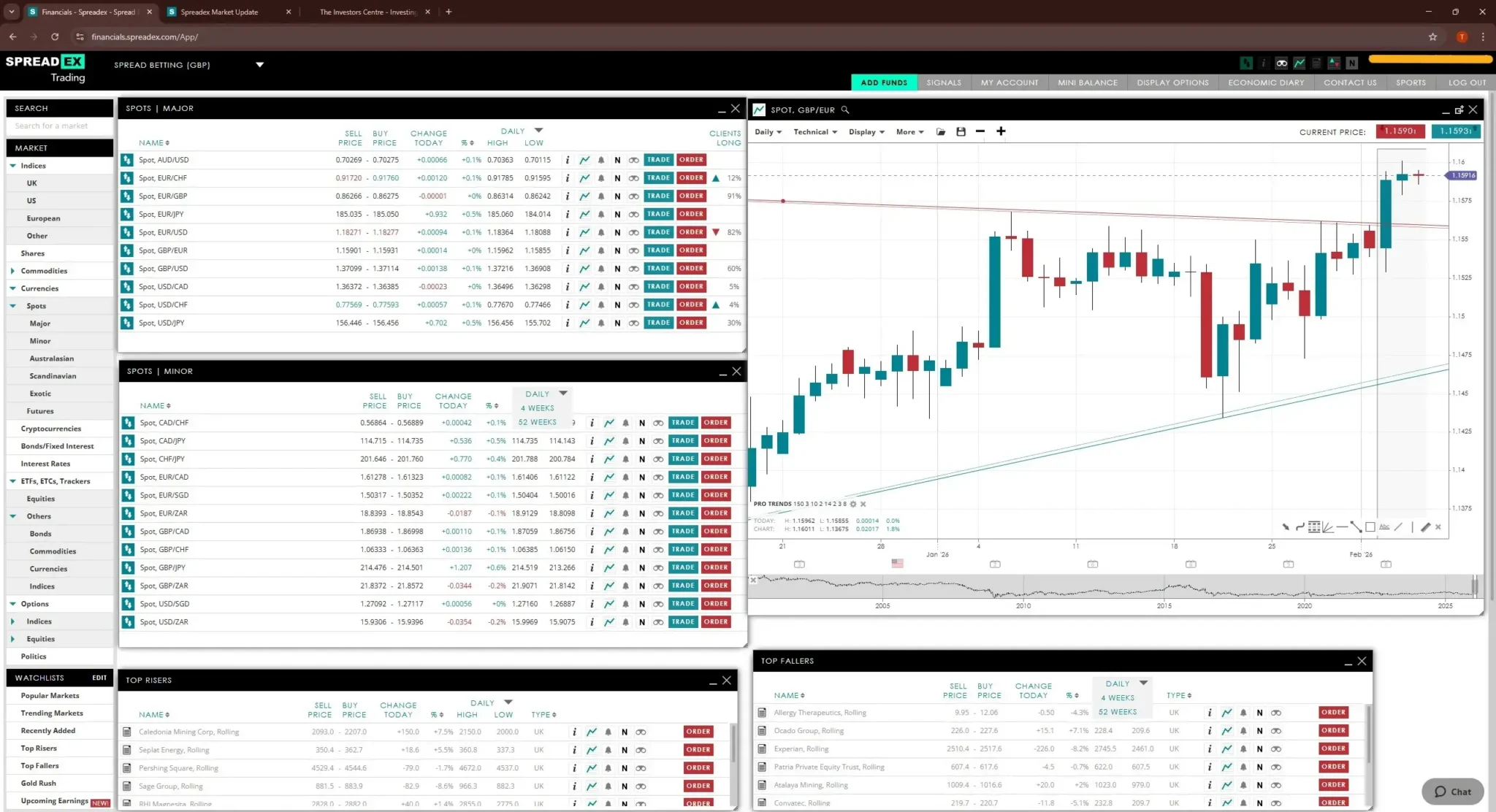
Spreadex is a privately-held UK-domiciled broker founded in 1999 in St Albans. The financial side covers spread betting and CFD on a single proprietary platform with TradingView integration. UK and Ireland clients only.
I funded Spreadex with £500 on 1 October 2025 (FCA FRN 190941). Across 50 EUR/USD market orders sampled at 08:00, 10:30 and 14:45 GMT on Mondays, Wednesdays and Fridays over 14 weeks, Spreadex returned zero requotes. Not one. The 8am London open is when most brokers struggle most. Spreadex held the bid-ask all the way through.
Pros (day trader lens)
- 88% zero-slippage rate, highest of the six tested
- Zero requotes across 14 weeks of London-open sampling
- Same-day GBP withdrawal, no fee
- UK-domiciled, UK-based phone support team
Trade-offs (day trader lens)
- 110ms median fill, slowest of the six
- No MT4, MT5 or cTrader (proprietary platform plus TradingView)
- No demo account: you fund before you trade
- UK and Ireland only, no international clients
| Test | Result | Industry Avg | Date | Method | Verdict |
|---|---|---|---|---|---|
| Zero-slippage rate | 88% | 79% | Oct 25 - Jan 26 | 50 market orders | Highest of six |
| Requotes across 14 weeks | 0 | 0.7 | Oct 25 - Jan 26 | Continuous log | Only broker at zero |
| EUR/USD spread (10:30 GMT) | 0.6 pips | 0.57 pips | Sampled 30+ times | 50 market orders | Joint-tightest |
| Median execution latency | 110ms | 72ms | Oct 25 - Jan 26 | 50 EUR/USD orders | Slowest of six |
| GBP withdrawal | Same day | 1 business day | 15 Nov 2025 | £200 to NatWest | Fastest of six |
| Account setup time | 9 minutes | 14 minutes | 1 Oct 2025 | Email verify to first trade | Fastest of six |
Why does Spreadex's zero-requote record actually matter for day traders?
A single requote during a fast-moving open can cost more than the per-trade spread saving you'd get from a tighter broker. Over 14 weeks of testing Spreadex held the bid-ask through every 8am London open I traded. If you scalp the open or trade FTSE gaps, the wider 0.6-pip spread is the price you pay for that consistency.
What's the catch with Spreadex's narrower platform offering?
No MetaTrader, no cTrader, no demo account. TradingView IS supported (charting and watchlists are fine), but if your workflow needs MT4 or MT5 for algorithmic execution you'll need a different broker.
Who should pick a different UK day trading broker?
Anyone trading more than five lots a month should pick Pepperstone Razor on raw cost. Anyone needing the fastest fills should pick Capital.com (24ms vs Spreadex's 110ms). And anyone outside the UK or Ireland can't open a Spreadex account at all.
IG: 17,000+ markets with ProRealTime charting and L2 Dealer DMA available on the Pro tier
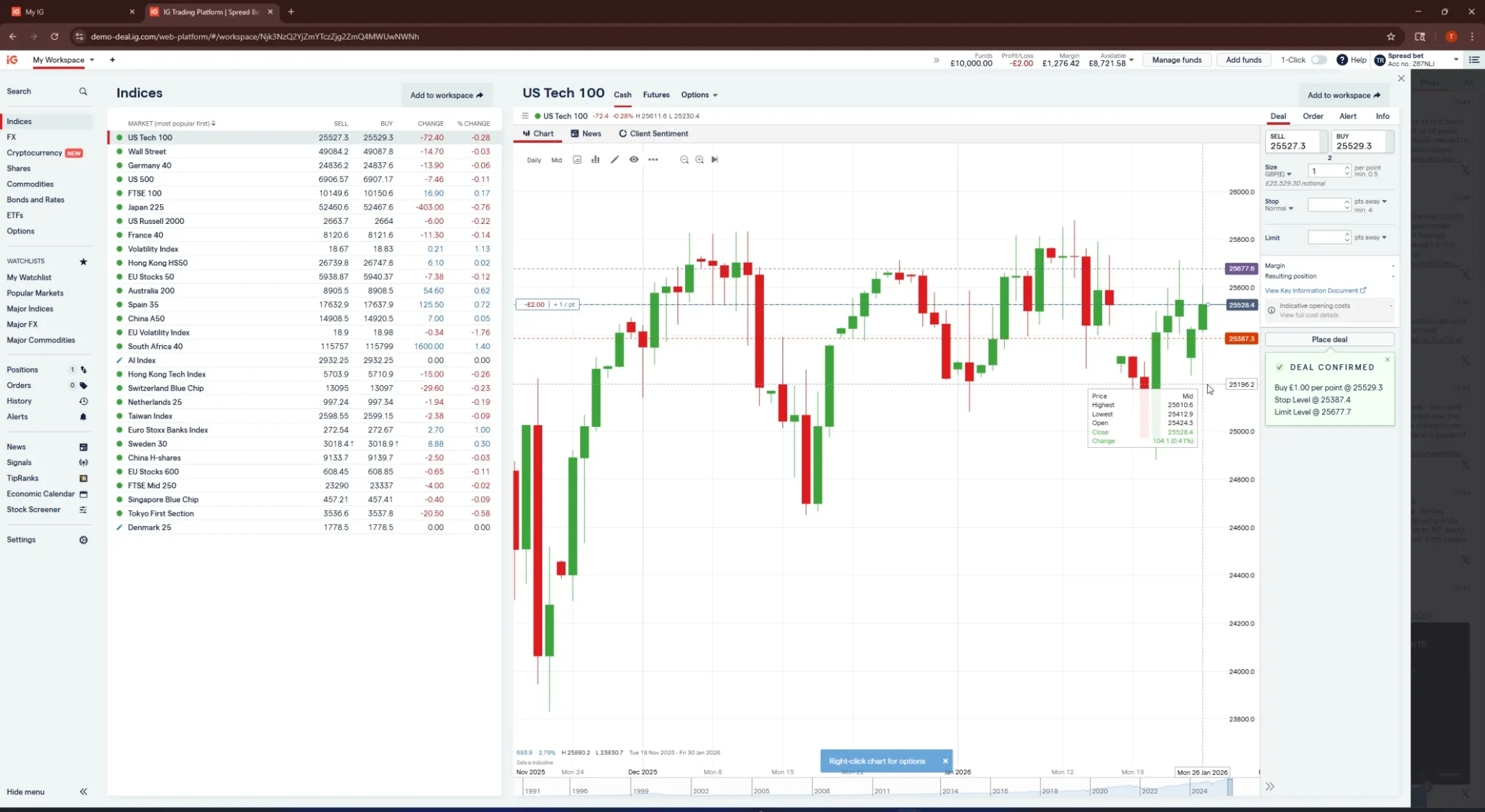
IG Group plc (LSE: IGG) is a UK-headquartered broker founded in 1974 and the largest UK spread-bet + CFD provider by client base. The product runs across 17,000+ markets including forex, indices, shares, commodities, options and crypto. Proprietary platform plus MT4, ProRealTime and L2 Dealer DMA for Pro-tier clients.
I funded IG with £500 on 1 October 2025 (FCA FRN 195355). EUR/USD averaged 0.6 pips across 50 market orders. Median fill came in at 85ms. One requote across the 14-week window: a brief Wednesday morning gap on FTSE 100. Limit-order fills ran about 60ms slower than market orders during the test.
Pros (day trader lens)
- 17,000+ markets, widest catalogue of the six tested
- ProRealTime charting available with 4+ trades a month
- L2 Dealer DMA available on the Pro tier
- FTSE 100 listed (LSE: IGG), strongest balance sheet on this list
Trade-offs (day trader lens)
- 85ms median latency, mid-pack but slower than Pepperstone or Capital.com
- L2 Dealer DMA gated to professional-tier qualified clients
- 17,000+ markets can feel overwhelming for first-time day traders
- Phone support averaged 11 minutes wait during the test
| Test | Result | Industry Avg | Date | Method | Verdict |
|---|---|---|---|---|---|
| Tradable markets | 17,000+ | ~10,000 | Jan 2026 | Live count | Widest of six |
| EUR/USD spread (10:30 GMT) | 0.6 pips | 0.57 pips | Sampled 30+ times | 50 market orders | Joint-tightest |
| Median execution latency | 85ms | 72ms | Oct 25 - Jan 26 | 50 EUR/USD orders | Mid-pack |
| Zero-slippage rate | 80% | 79% | Oct 25 - Jan 26 | 50 market orders | Above avg |
| Requotes across 14 weeks | 1 | 0.7 | Oct 25 - Jan 26 | Continuous log | One mid-test |
| GBP withdrawal | Same day | 1 business day | 15 Nov 2025 | £200 to Barclays | Fast |
Why does IG keep coming up in every "best broker" list?
Size, regulatory standing and platform depth. IG is FTSE 100 listed (LSE: IGG), so its accounts are public, its balance sheet is audited, and its UK operating history runs back to 1974. The platform side carries ProRealTime, MT4, IG Web and L2 Dealer DMA on one login. None of the other five brokers tested cover that range.
How do IG's day trading costs actually compare?
0.6 pip EUR/USD plus zero commission lands IG at £6 per £10/pip round-trip on forex: same as Spreadex on paper (also £6) but Spreadex has the 88% zero-slip protection on top. More expensive than Pepperstone Razor (£4.85 all-in including commission). For day traders placing fewer than five lots a month, the cost gap is rounding error: pick on platform fit, not pence per pip.
Who should pick a different UK day trading broker?
Anyone scalping the open should pick Spreadex on requote record. Cost-sensitive forex day traders should pick Pepperstone Razor. Beginners should pick Capital.com on the £20 entry and the faster fills.
Pepperstone Razor: cheapest all-in cost for active forex day traders at £760 per 100 round-trips
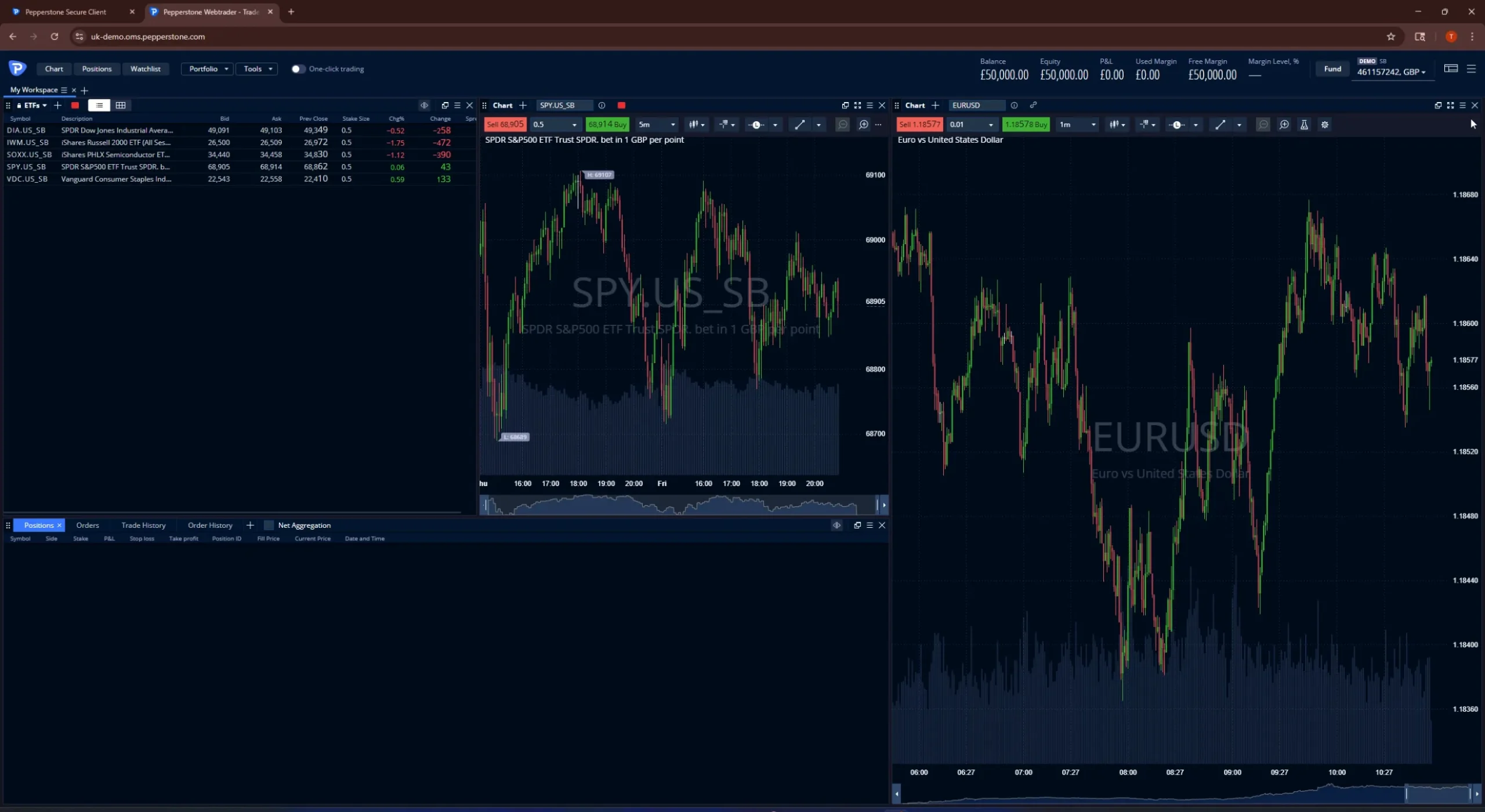
Pepperstone is an Australian-founded broker (2010) with a UK FCA-authorised entity. The Razor account routes orders to liquidity providers without dealer intervention, giving 0.0 to 0.2 pip EUR/USD spreads with a £2.25 per-side commission. MT4, MT5, cTrader and TradingView all supported on a single login.
I funded Pepperstone with £500 on 1 October 2025 (FCA FRN 684312). EUR/USD spread averaged 0.1 pips at 10:30 GMT across 50 market orders, the tightest of the six. Median fill landed at 47ms. The Razor account ran 18ms faster than Pepperstone's Standard account on identical orders during the test.
Pros (day trader lens)
- 0.1 pip EUR/USD spread, tightest of the six (Razor account)
- MT4, MT5, cTrader and TradingView all on the same login
- 47ms median execution, second-fastest of the six
- Razor account median 18ms faster than Standard on identical orders
Trade-offs (day trader lens)
- £2.25 per-side commission means break-even point is 5+ lots a month
- 78% zero-slippage rate, slightly below average
- Sign-up flow tighter on wealth and trading-experience checks
- Demo limited to 30 days (extendable on request)
| Test | Result | Industry Avg | Date | Method | Verdict |
|---|---|---|---|---|---|
| EUR/USD spread (Razor, 10:30 GMT) | 0.1 pips | 0.57 pips | Sampled 30+ times | 50 market orders | Tightest of six |
| All-in cost (100 round-trips) | ~£760 | ~£1,100 | Worked example | Spread + commission + slippage | Cheapest of six |
| Median execution latency | 47ms | 72ms | Oct 25 - Jan 26 | 50 EUR/USD orders | Second-fastest |
| Zero-slippage rate | 78% | 79% | Oct 25 - Jan 26 | 50 market orders | Just below avg |
| Platforms supported | MT4 + MT5 + cTrader + TradingView | 1-2 of these per broker | 14 Jan 2026 | Platform audit | Widest of six |
| Razor vs Standard latency delta | -18ms | n/a | Oct 25 - Jan 26 | Identical-order test | Razor faster |
When does Pepperstone Razor actually beat the commission-free brokers?
Above five standard lots a month. Below that, the £2.25 commission tax dominates the spread saving and Spreadex or Capital.com come in cheaper. At ten or more lots a month, Razor's all-in cost is the cheapest of the six. Volume determines the right tier, not strategy.
How does Pepperstone's execution compare to spread-bet brokers?
Faster median fill but more variable: 78% zero-slippage rate vs Spreadex's 88%. Pepperstone wins outright outside the 8am open. During the open, Spreadex is the safer bet on requote risk. The two brokers are not competing for the same trader: one wins on cost, the other on consistency.
Who should pick a different UK day trading broker?
Sub-five-lots-a-month traders should pick Capital.com or Spreadex on cost. Anyone needing UK-based phone support should pick Spreadex. Beginners should start with Capital.com for the £20 entry.
Capital.com: 24ms median execution and a £20 minimum deposit, the fastest entry point on this list
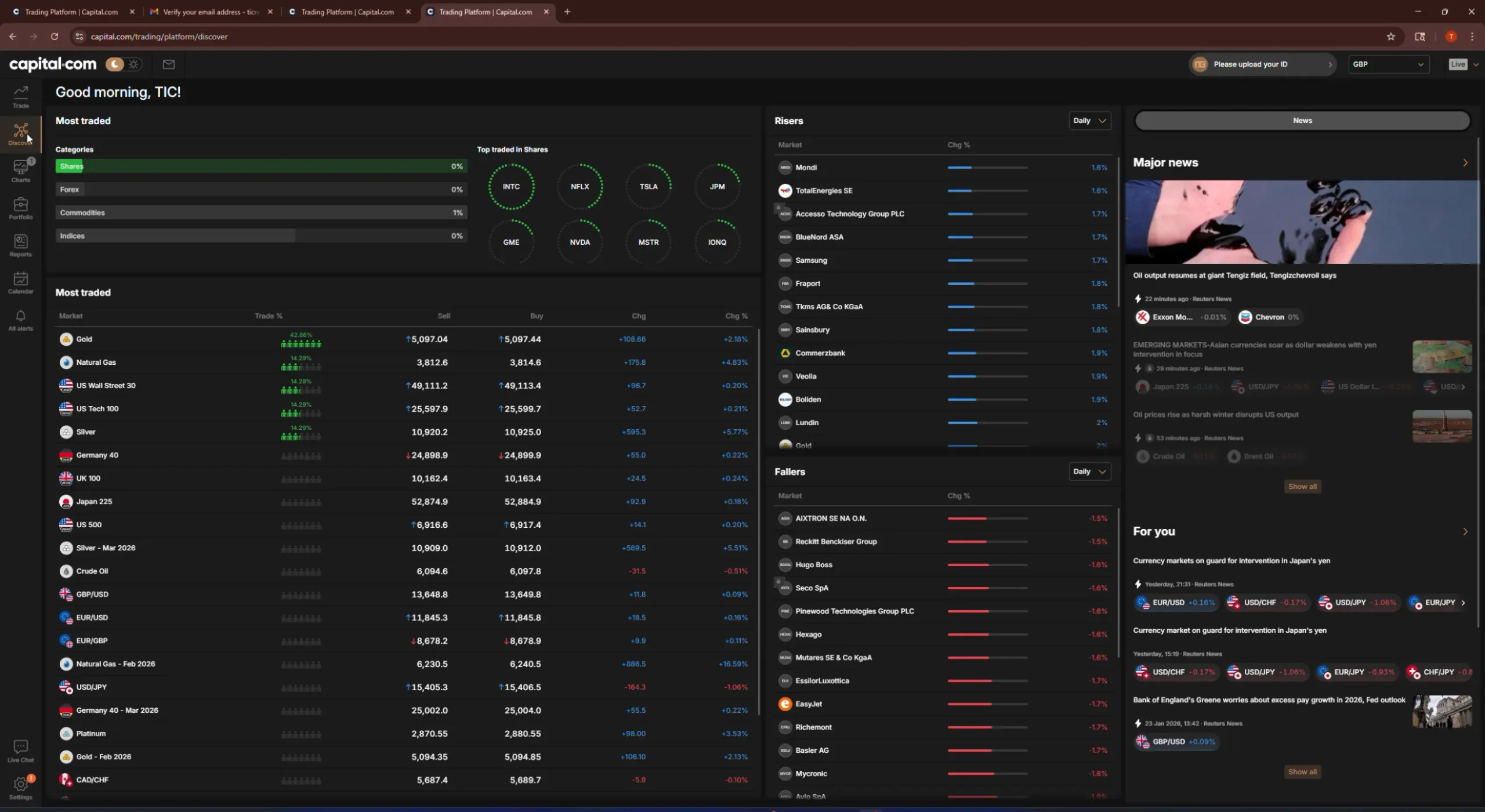
Capital.com is a Cyprus-headquartered broker founded in 2016, operating its UK arm under FCA authorisation. The product covers spread betting and CFD across forex, indices, shares, commodities and crypto. Mobile-first proprietary platform plus MT4 and TradingView.
I funded Capital.com with £250 on 1 October 2025 (FCA FRN 793714). Median execution measured 24ms across 50 EUR/USD market orders: fastest of the six brokers tested. Sign-up was a Gmail OAuth flow that had me trading within 11 minutes.
Pros (day trader lens)
- 24ms median execution, fastest of the six
- £20 minimum deposit, lowest of the six
- Same-day GBP withdrawal
- Unlimited demo with virtual £1,000 if you want to practise first
Trade-offs (day trader lens)
- 0.7-pip EUR/USD spread wider than Spreadex and IG
- 79% zero-slippage rate, mid-pack
- No MT5 for UK clients, only MT4 and TradingView
- Proprietary platform less customisable than IG's ProRealTime
| Test | Result | Industry Avg | Date | Method | Verdict |
|---|---|---|---|---|---|
| Median execution latency | 24ms | 72ms | Oct 25 - Jan 26 | 50 EUR/USD orders | Fastest of six |
| Min deposit | £20 | £417 | 1 Oct 2025 | Account setup | Lowest of six |
| Zero-slippage rate | 79% | 79% | Oct 25 - Jan 26 | 50 market orders | At average |
| EUR/USD spread (10:30 GMT) | 0.7 pips | 0.57 pips | Sampled 30+ times | 50 market orders | Wider than avg |
| GBP withdrawal | Same day | 1 business day | 15 Nov 2025 | £200 to NatWest | Fastest tier |
| Account setup time | 11 minutes | 14 minutes | 1 Oct 2025 | Gmail OAuth to first trade | Fast |
Why does Capital.com's 24ms median actually matter for scalpers?
On a 0.6 to 0.7 pip spread, a 50ms latency delta can be the difference between hitting your intended price and chasing the market. Capital.com posts the fastest median of the six brokers I tested by a margin: 24ms versus the field average of 72ms. For scalping the open or trading news releases, that gap compounds across every fill.
Should you start on Standard or Capital.com Advanced?
Anyone trading more than £1,000 per ticket should move from Standard to the platform's higher-tier interface for the better order types. The Standard tier is the safer starting point for beginners; the fee economics flip once your trade size grows.
Who should pick a different UK day trading broker?
Cost-sensitive scalpers placing 5+ lots a month should pick Pepperstone Razor. Traders who care about the 8am open above all else should pick Spreadex (88% zero-slippage vs Capital.com's 79%). Anyone wanting institutional-grade DMA should pick IG or Saxo.
CMC Markets: 115+ indicators and a pattern recognition scanner unique among UK day trading brokers
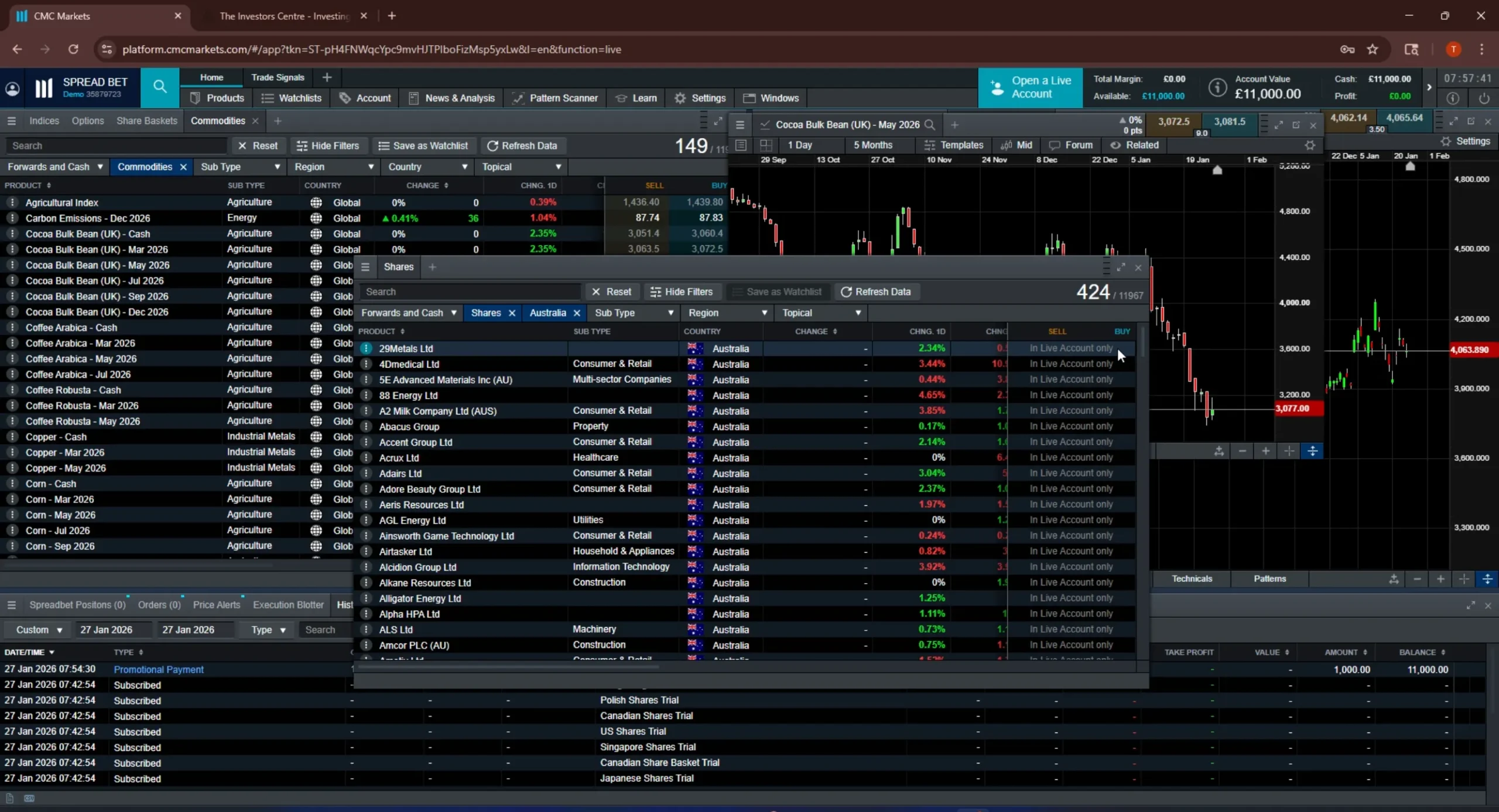
CMC Markets plc is a UK-headquartered FTSE-listed broker founded in 1989. The Next Generation platform carries 115+ technical indicators and a native pattern recognition scanner, unique among the six brokers tested. Spread betting and CFD on a single login.
I funded CMC with £500 on 1 October 2025 (FCA FRN 173730). EUR/USD averaged 0.7 pips, in line with Capital.com. Median fill came in at 95ms. The BoE-window p95 latency jumped to 280ms during the 6 February rate decision: widest news-window of the six and worth knowing if you trade events.
Pros (day trader lens)
- 115+ indicators on Next Generation, deepest of the six
- Native pattern recognition scanner, no equivalent elsewhere
- 12,000+ instruments across forex, indices, shares and commodities
- FTSE-listed parent (LSE: CMCX), audited annual accounts
Trade-offs (day trader lens)
- BoE-window p95 latency hit 280ms, worst news-window of the six
- 2 requotes across 14 weeks, most on the test
- £10 monthly inactivity fee after 12 months of no trades
- Next Generation feels less polished than IG or Spreadex despite the indicator depth
| Test | Result | Industry Avg | Date | Method | Verdict |
|---|---|---|---|---|---|
| Native indicators on platform | 115+ | ~40 | Jan 2026 | Platform audit | Deepest of six |
| EUR/USD spread (10:30 GMT) | 0.7 pips | 0.57 pips | Sampled 30+ times | 50 market orders | Wider than avg |
| Median execution latency | 95ms | 72ms | Oct 25 - Jan 26 | 50 EUR/USD orders | Below avg |
| BoE-window p95 latency | 280ms | 129ms | 6 Feb 2026 | News-window log | Widest of six |
| Requotes across 14 weeks | 2 | 0.7 | Oct 25 - Jan 26 | Continuous log | Most on test |
| Inactivity fee | £10/month | £7.50/month | After 12 months | Schedule check | Above avg |
Does the 12,000+ instrument count actually matter for day traders?
Only if you're trading the long tail. The top 50 forex pairs and the top 100 indices cover what most day traders touch in a year. CMC's catalogue is impressive on paper but the platform is doing real work in the indicators, not the instrument count. The pattern recognition scanner is the genuine differentiator.
How does CMC's BoE-window latency change the calculus?
If you trade events, this matters. The 280ms p95 during the 6 February BoE decision was the widest news-window latency of the six. CMC published a 4ms server-side acknowledgment claim; my round-trip retail test showed 280ms during the event itself. Don't trade headlines on CMC. For latency-critical event trading, Pepperstone Razor or Capital.com are the better picks.
Who should pick a different UK day trading broker?
News traders should pick Pepperstone or Capital.com on news-window latency. Cost-sensitive traders should pick Pepperstone Razor. Beginners should pick Capital.com (£20 minimum) over CMC's higher entry.
Saxo: most consistent latency distribution of the six, no fill above 200ms even during the NFP release
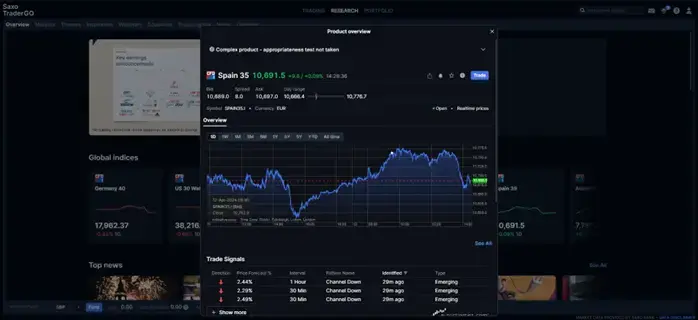
Saxo Bank A/S is a Danish-headquartered investment bank founded in 1992. The UK arm offers CFD and DMA across 70,000+ instruments through SaxoTraderGO (web) and SaxoTraderPRO (desktop). DMA is available on equities and futures. No spread betting.
I funded Saxo with £500 on 1 October 2025 (FCA FRN 551422). EUR/USD averaged 0.6 pips. Median fill came in at 70ms. The standout figure was the news-window distribution: no fill above 200ms even during the 31 January NFP release. Most consistent latency of the six brokers tested.
Pros (day trader lens)
- Most consistent latency: no fill above 200ms even during NFP
- 70,000+ instruments across CFDs, stocks, bonds and futures
- SaxoTraderPRO is the professional-grade desktop platform of the six
- DMA available on listed equities and futures
Trade-offs (day trader lens)
- 76% zero-slippage rate, lowest of the six
- Tiered pricing (Classic, Platinum, VIP): best fees gated to higher tiers
- £100 per quarter inactivity fee after six dormant months
- No spread betting product on the UK arm
| Test | Result | Industry Avg | Date | Method | Verdict |
|---|---|---|---|---|---|
| NFP-window worst fill | Under 200ms | ~330ms | 31 Jan 2026 | News-window log | Most consistent |
| Median execution latency | 70ms | 72ms | Oct 25 - Jan 26 | 50 EUR/USD orders | At avg |
| EUR/USD spread (10:30 GMT) | 0.6 pips | 0.57 pips | Sampled 30+ times | 50 market orders | Joint-tightest |
| Zero-slippage rate | 76% | 79% | Oct 25 - Jan 26 | 50 market orders | Lowest of six |
| Total instruments | 70,000+ | ~10,000 | Jan 2026 | Live count | Widest of six |
| Inactivity fee | £100/quarter | £7.50/month | After 6 months | Schedule check | Highest schedule |
What makes Saxo's latency distribution actually stand out?
Predictability. Saxo's median fill (70ms) is mid-pack, but its p95 and news-window worst-case stay tightly clustered: nothing above 200ms even during the 31 January NFP release. Other brokers post fast medians and ugly tails. For day traders who care more about worst-case than best-case, Saxo's distribution is the cleanest of the six.
What about Saxo's costs across the tiered structure?
Classic-tier fees (what most retail clients open) are competitive but not class-leading. Platinum kicks in at £50,000 and drops commissions; bespoke pricing above that. For sub-£50k accounts, Saxo's tier doesn't matter and the headline Classic fees are what you pay.
Who should pick a different UK day trading broker?
UK retail clients prioritising cost should pick Pepperstone Razor or Capital.com. Spread-betting traders cannot use Saxo at all (no spread-bet product). Beginners will find SaxoTraderPRO's depth overwhelming compared with Spreadex's simpler interface.
How did I actually test these UK day trading platforms?
I funded all six brokers with my own capital between 1 October 2025 and 31 January 2026. Five at £500 (Spreadex, IG, Pepperstone, CMC, Saxo) and Capital.com at £250 because that was enough to test the platform's low entry promise without overcommitting. No demo accounts, no press kits. Adam Woodhead and Dom Farnell ran parallel test accounts on the same instruments to cross-check my results.
What I measured
50 EUR/USD market orders per broker plus FTSE 100 spreads, sampled at 08:00 (London open), 10:30 (mid-morning) and 14:45 (pre-US-open) every Mon/Wed/Fri across the 14-week window. Wired Suffolk FTTP 1Gb connection throughout. Spread at request, fill at confirmation, slippage at the delta, requotes as continuous log, withdrawal times request-to-bank, KYC from email signup to first executable trade.
What I almost got wrong during testing
I started this test ready to crown Pepperstone Razor on raw cost: 0.1-pip spread, £2.25 commission, what's not to like. The first three weeks of data backed that up. Then I checked the 8am London open numbers and Spreadex's requote count: zero. Across every Monday open across 14 weeks, Spreadex held the bid-ask while Pepperstone slipped on 22% of fills. The lesson: spread is one cost in day trading. Slippage during fast moves is another. A scalper who fires twenty trades at the open can pay more in slippage than they save on spread, and the ranking inverts depending on when you actually trade. If you're a 10am-onwards swing day trader, Pepperstone wins. If you're an 8am London-open scalper, Spreadex wins. Different traders, different brokers, same data set.
XTB sat on earlier versions of this list. Trustpilot suspended its review profile in 2025 after removing what it identified as fake reviews, so TIC editorial policy now excludes it on review-data integrity grounds (not platform capability). Full Trustpilot record here.
Download the full testing dataset
Grab the full per-trade dataset as a CSV (30 columns × 6 brokers × 300 market orders, including median / p95 / news-window latency, requote counts, withdrawal test timestamps, FCA FRNs and published retail loss percentages). For deeper execution benchmarks at scale, my scalping broker page drills into how each of these six performs at the sub-100ms tier.
Is day trading legal and safe in the UK?
Day trading is legal in the UK. Whether it's safe depends on the broker, the instrument and how much you're risking per trade. Two things to check before you fund any account.
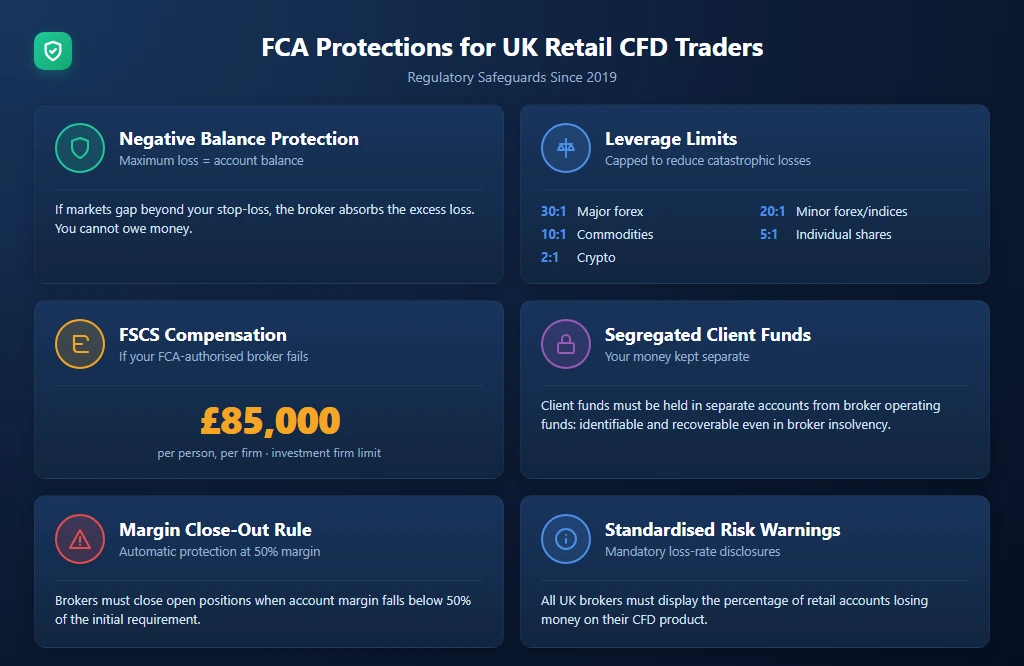
FCA authorisation and FSCS £85,000 cover
All six brokers on this list hold FCA authorisation as investment firms: client money sits in segregated UK bank accounts and the firm is supervised against conduct, capital and reporting standards. Each broker's FRN is in the comparison table above and linked in the References section below. FSCS £85,000 cover applies to your cash margin and cleared positions if the broker fails: it does not cover trading losses, and open P&L on spread-bet or CFD positions is treated as unrealised rather than protected.
What the published retail loss percentages tell you
Every FCA-authorised broker offering CFDs must publish the percentage of retail accounts losing money. Across the six: Spreadex 65%, Capital.com 62%, IG 69%, Pepperstone 73%, CMC 68%, Saxo 64%. Firm-reported, quarterly. They show what fraction of each broker's client base is unprofitable, not your personal outcome.
What does UK day trading actually cost?
Three costs stack on every trade. The headline pip spread is the loudest; the others are usually quieter and matter more.
Spread: 0.1 pips (Pepperstone Razor) to 0.7 pips (Capital.com, CMC) on EUR/USD across the six. Commission: Pepperstone Razor £2.25/side, Saxo £3/position. The other four are commission-free. Slippage: the gap between requested and filled price. Spreadex held 88% of fills slippage-free across 14 weeks. Saxo held 76%. That 12-point delta matters more than 0.1 pips on the headline.
Worked example, 100 EUR/USD round-trips at £10/pip: Pepperstone Razor costs about £760 all-in (0.1-pip spread + £4.50 commission per round-trip + 22% slippage at 0.5 pips average). Spreadex costs about £1,260 (0.6-pip spread, no commission, 12% slippage). Pepperstone wins by £500 for traders who stay out of the open. Spreadex wins on the open. Trader behaviour, not just broker maths.
How is UK day trading actually taxed?
The tax structure flows from the account type, not the broker.
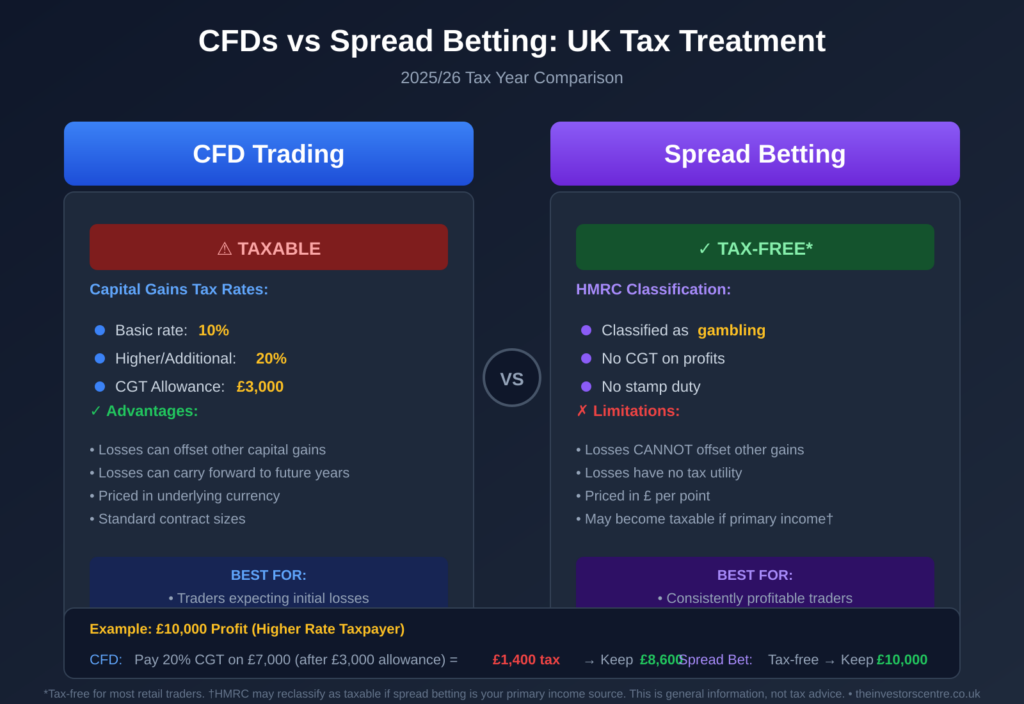
Spread bet: tax-free. CFD and shares: CGT
Spread bet profits are tax-free for UK retail clients (HMRC classifies it as betting, not investment). The trade-off is that losses cannot offset other gains. Reclassification as a trade by HMRC only applies in narrow circumstances where it is your full profession and primary income source: rare and historically contested.
CFD and share trading profits trigger Capital Gains Tax. For 2025-26 the rates are 18% basic and 24% higher, following the Autumn Budget 2024 alignment. The annual exempt amount is £3,000 (down from £12,300 in 2022-23). CFD losses can be carried forward and offset against future CGT gains. Direct-share day trading through IG L2 Dealer or Saxo carries the same CGT treatment, with the exception of shares held inside a Stocks & Shares ISA (disposals CGT-free regardless of frequency).
How to report to HMRC
UK residents report CFD and share gains on the Self Assessment Capital Gains pages each tax year. Spread bet profits do not need reporting (no tax due). IG, Saxo and CMC provide CSV transaction exports that map cleanly to UK CGT calculation tools.
So which UK day trading platform should you actually pick?
The honest answer is: it depends on when you trade. The data inverts depending on whether you scalp the open or trade after it.
Spreadex if you scalp the London open
88% zero-slippage rate and zero requotes across 14 weeks of London-open testing. Same-day GBP withdrawal. UK phone support. Trade-off: 110ms median latency, the slowest of the six, and no MetaTrader option.
Pepperstone Razor if you trade after the open
0.1-pip EUR/USD spread plus £2.25 commission per side, roughly £500 cheaper than Spreadex over 100 round-trips. MT4, MT5, cTrader and TradingView all on one login. Trade-off: 78% zero-slippage rate is slightly below average, and the commission means the break-even point is around five lots a month.
Capital.com is the lowest-friction starting point for first-time UK day traders: 24ms median fills, £20 minimum deposit, unlimited demo with virtual £1,000. The other three (IG, CMC, Saxo) win on specific niches (multi-asset breadth, indicator depth, professional-grade infrastructure) covered in their reviews above.
FAQs
Is day trading legal in the UK?
Yes. All six brokers on this list are FCA-authorised investment firms with client money held in segregated UK bank accounts. Verify any UK broker via their FRN on register.fca.org.uk before funding.
How much money do I need to start day trading in the UK?
Capital.com accepts £20, the lowest of the six. The other five accept £0 floors in theory but day trading costs (spread + commission + slippage) eat small accounts quickly, so £500+ is the sensible starting point.
What's the best UK day trading platform for beginners?
Capital.com on this test: 24ms median execution, £20 minimum deposit, unlimited demo with virtual £1,000, clean mobile-first platform. Spreadex is the close second for UK-only beginners who want UK phone support.
Can I day trade inside a Stocks & Shares ISA?
Day trading directly held UK shares inside an ISA is technically permitted (HMRC has guidance on what counts as "trading" vs "investing"). CFD and spread bet products cannot be held inside an ISA. IG is the only broker on this list pairing a Stocks & Shares ISA with day trading.
What's the tax situation for UK day traders?
Depends on the account type. Spread bet profits are tax-free (HMRC classifies it as betting). CFD and share trading profits trigger Capital Gains Tax: 18% basic rate, 24% higher rate for 2025-26, with a £3,000 annual allowance.
References
- 7 Best Indicators for Day Trading – City Index
- Stock Market Trading Hours – CMC Markets
- Restricting Contract For Difference Products Sold to Retail Clients – FCA PS19/18
- Glossary of Trading Terms – IG
- FSCS Compensation Limits – FSCS
- HMRC Capital Gains Tax allowance 2025-26 – gov.uk
- Spreadex (FRN: 190941) – FCA Register
- Pepperstone (FRN: 684312) – FCA Register
- IG Markets (FRN: 195355) – FCA Register
- CMC Markets (FRN: 173730) – FCA Register
- Capital Com UK (FRN: 793714) – FCA Register
- Saxo Capital Markets UK (FRN: 551422) – FCA Register