

- expertise:
- CFD Trading, Forex, Derivatives, Risk Management
- credentials:
- Chartered ACII (2018) · Trading since 2012
- tested:
- 40+ forex & CFD platforms with live accounts

- expertise:
- Platform Testing, Cryptocurrency, Retail Investing
- credentials:
- Active investor since 2013 · 11+ years experience
- tested:
- 50+ platforms · 200+ guides authored
How We Test
Real accounts. Real money. Real trades. No demo accounts or press releases.
What we measure:
- Spreads vs advertised rates
- Execution speed and slippage
- Hidden fees (overnight, withdrawal, conversion)
- Actual withdrawal times
Scoring:
Fees (25%) · Platform (20%) · Assets (15%) · Mobile (15%) · Tools (10%) · Support (10%) · Regulation (5%)
Regulatory checks:
FCA Register verification · FSCS protection
Testing team:
Adam Woodhead (investing since 2013), Thomas Drury (Chartered ACII, 2018), Dom Farnell (investing since 2013) — 50+ platforms with funded accounts
Quarterly reviews · Corrections: in**@*******************co.uk
Disclaimer
Not financial advice. Educational content only. We're not FCA authorised. Consult a qualified advisor before investing.
Capital at risk. Investments can fall. Past performance doesn't guarantee future results.
CFD warning. 67-84% of retail accounts lose money trading CFDs. High risk due to leverage.
Contact: in**@*******************co.uk
Quick Answer: Which UK Broker Has the Lowest Commodity Spreads?
Pepperstone’s Razor account (FCA FRN 684312) leads my 2026 testing for the tightest raw commodity spreads — gold averaged just 0.16 points during normal London session hours, which was the lowest I measured across any broker. For traders who want the broadest commodity offering combined with competitive spreads, IG (FCA FRN 195355) is my pick for best overall commodity broker — 17,000+ markets, 35+ commodities, and gold spreads from 0.3 points with no commission.
| Broker | Gold Spread | Best For | Our Rating |
|---|---|---|---|
| Pepperstone | From 0.15 pts (Razor) | Tightest raw commodity spreads | 4.7/5 |
| IG | From 0.3 pts | Best overall commodity platform | 4.6/5 |
| Capital.com | From 0.25 pts | Zero-commission commodity trading | 4.4/5 |
| Spreadex | From 0.4 pts | Higher FSCS protection (£120,000) | 4.2/5 |
| CMC Markets | From 0.3 pts | Advanced charting and analysis | 4.3/5 |
| Trade Nation | Fixed or variable | Choice of published commodity pricing models | 4.3/5 |
I recorded live spreads across five brokers during the February 2026 London-session test. Trade Nation was added in August using its published fixed and variable commodity schedule, giving six FCA-regulated brokers in the final comparison.
Low Spread Commodity Brokers, Ranked

Pepperstone
- TIC Score
- 4.7/5
- Gold Spread
- From 0.15 pts (Razor)
- Brent Oil Spread
- 2–3 cents
- Best For
- Tightest raw spreads
72.9% of retail CFD accounts lose money.

IG
- TIC Score
- 4.6/5
- Gold Spread
- From 0.3 pts
- Brent Oil Spread
- 2.8 cents
- Best For
- Best overall platform
69% of retail CFD accounts lose money.

Capital.com
- TIC Score
- 4.4/5
- Gold Spread
- From 0.25 pts
- Brent Oil Spread
- 3–4.5 cents
- Best For
- Zero-commission trading
61% of Retail CFD Accounts Lose Money
Spreadex
- TIC Score
- 4.2/5
- Gold Spread
- From 0.4 pts
- Brent Oil Spread
- 2.8 cents
- Best For
- Higher FSCS protection
65% of retail CFD accounts lose money.

CMC Markets
- TIC Score
- 4.3/5
- Gold Spread
- From 0.3 pts
- Brent Oil Spread
- From 3.5 cents
- Best For
- Charting and analysis
68% of retail CFD accounts lose money.

Trade Nation
- TIC Score
- 4.3/5
- Gold Spread
- 3.6 variable / 4 fixed*
- Brent Oil Spread
- 2.8 variable / 4 fixed*
- Best For
- Fixed or variable commodity spreads
73.7% of retail CFD accounts lose money.
Which Brokers Offer the Lowest Commodity Spreads in the UK?
I recorded these spreads during the London session at approximately 10am GMT on three consecutive days in February 2026. All figures represent the average spread measured during normal market hours. For a broader look at the best platform for trading commodities, see our dedicated guide.
| Commodity | Pepperstone (Razor) | IG | Capital.com | Spreadex | CMC Markets | Trade Nation* |
|---|---|---|---|---|---|---|
| Gold (XAU/USD) | 0.15–0.17 pts | 0.3 pts | 0.25–0.30 pts | 0.4 pts | 0.3 pts | 3.6 variable / 4 fixed |
| Silver (XAG/USD) | 0.02 pts | 0.03 pts | 0.03 pts | 2 pts | 0.03 pts | 2.6 variable / 3.5 fixed |
| Brent Crude Oil | 2–3 cents | 2.8 cents | 3–4.5 cents | 2.8 cents | From 3.5 cents | 2.8 variable / 4 fixed |
| WTI Crude Oil | 2–3 cents | 2.8 cents | 3–4.5 cents | 2.8 cents | From 3.5 cents | Published live rate* |
| Natural Gas | 0.3 pts | 0.3 pts | 0.5 pts | 3 pts | Live platform rate | Published live rate* |
| Copper | 2.0 pts | 2.5 pts | 3.0 pts | 3.0 pts | 2.5 pts | Published live rate* |
Pepperstone Razor spreads are raw; add £2.25/lot/side commission. *Trade Nation figures are published per-market fixed and variable rates from its August 2026 market information sheet. Quote units differ by broker and should be checked on the live ticket.
Which Low-Spread Commodity Broker Should You Choose Based on Your Needs?
| If You Want… | Choose | Why |
|---|---|---|
| The tightest raw commodity spreads | Pepperstone | Gold from 0.15 pts on Razor — lowest I measured in 2026 testing |
| The widest commodity range with competitive spreads | IG | 35+ commodities, 17,000+ total markets, gold from 0.3 pts with no commission |
| Zero-commission commodity trading for beginners | Capital.com | No commission, gold from 0.25–0.30 pts, AI-powered insights |
| Higher FSCS protection for larger balances | Spreadex | Up to £85,000 FSCS cover as a spread betting specialist |
| Advanced charting and technical analysis tools | CMC Markets | Next Generation platform with 115+ indicators and pattern recognition |
| A choice between fixed and variable commodity pricing | Trade Nation | Published options for gold, silver and Brent with no added commission |
| Tax-free commodity spread betting | Pepperstone, IG, Spreadex, or CMC Markets | All four offer spread betting — profits currently free from CGT and Stamp Duty |
How I Tested These Commodity Brokers
We use a weighted scoring methodology across seven categories to evaluate every broker on TIC.co.uk. For this specific article, I placed particular emphasis on the Fees & Spreads category because the entire purpose of this comparison is to identify which broker delivers the lowest cost for commodity trading.
| Category | Weight |
|---|---|
| Fees & Spreads | 25% |
| Platform & Technology | 20% |
| Asset Range | 15% |
| Mobile Experience | 15% |
| Research & Tools | 10% |
| Customer Support | 10% |
| Regulation & Safety | 5% |
My testing process included:
- Opening live funded accounts with the five brokers in the February test round
- Recording gold, silver, oil, and natural gas spreads at 10am GMT on three consecutive days in February 2026
- Executing at least five trades per broker across different commodity classes
- Calculating total round-trip costs including commissions, spreads, and overnight financing charges
- Testing mobile apps for order execution speed on commodity markets
- Evaluating the depth of commodity-specific research and analysis tools
I recorded gold spreads across the five original brokers during the London session at 10am GMT on three consecutive days in February 2026. Trade Nation’s August addition uses its published fixed and variable schedule, identified separately in the comparison table.
Top 6 Low Spread Commodity Brokers in the UK Reviewed
1. Pepperstone — Best for Tightest Raw Commodity Spreads
2. IG — Best Overall Commodity Broker
3. Capital.com — Best for Zero-Commission Commodity Trading
4. Spreadex — Best for Higher FSCS Protection
5. CMC Markets — Best for Charting and Analysis
6. Trade Nation: Best for Fixed or Variable Commodity Spreads
Pepperstone — Best for Tightest Raw Commodity Spreads
- Fees & Spreads
- 4.1
- Platform & Tools
- 4.4
- Customer Service
- 4.2
- Ease of Use
- 3.9
- Mobile App
- 4.3
Pros
- Tightest commodity spreads I measured across any UK broker (gold from 0.15 points on Razor)
- Brent Oil spreads of just 2–3 cents per barrel — genuinely institutional-grade pricing
- 40+ commodity markets available
- Excellent platform choice: MT4, MT5, cTrader, and TradingView integration
- Both spread betting and CFD accounts available for UK traders
Cons
- Razor account carries a £2.25 per lot per side commission
- 2,700+ total markets is respectable but smaller than IG’s 17,000+
- No ISA wrapper option
- Relatively newer brand compared to IG or CMC Markets
Our Review
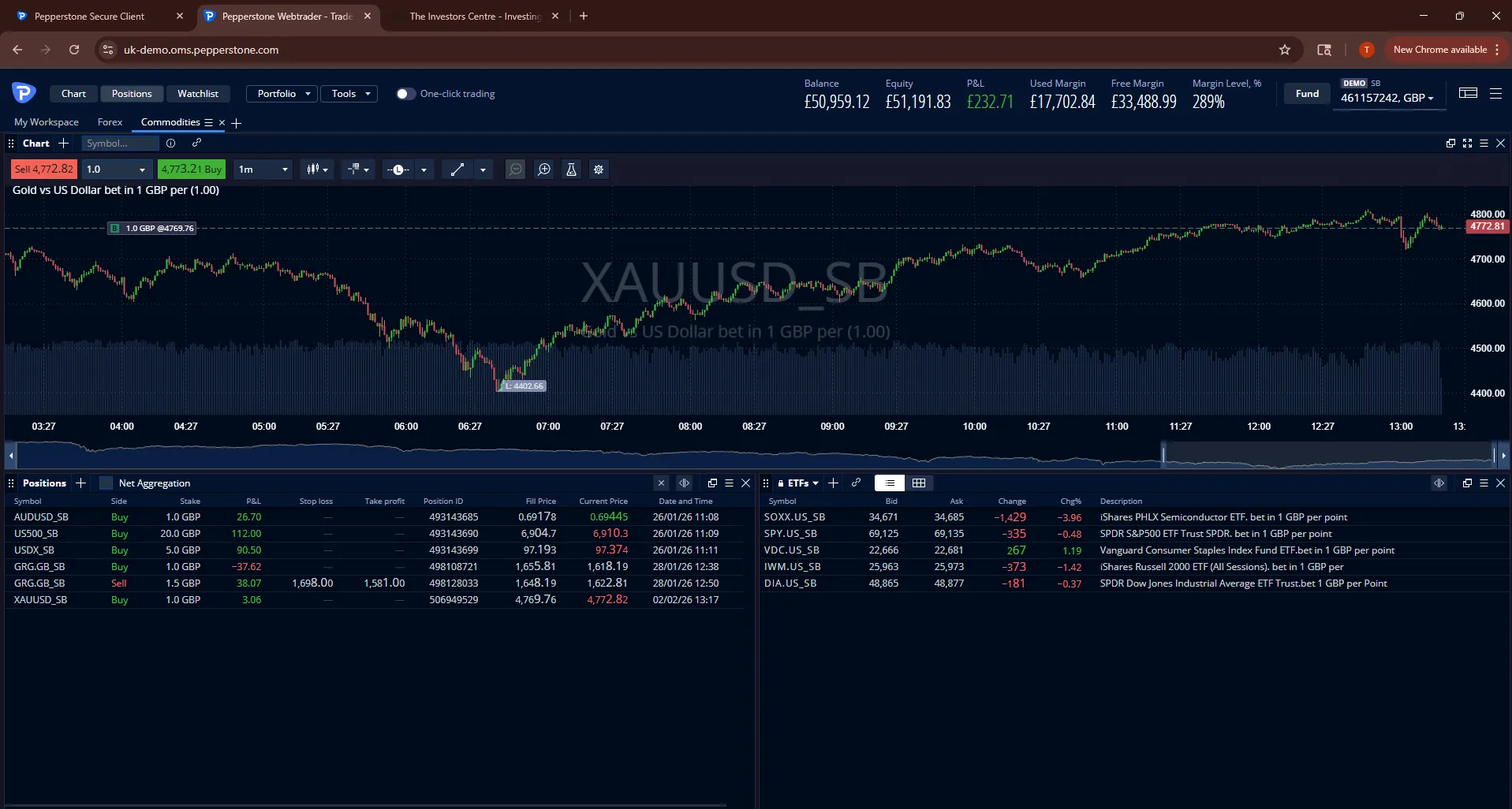
Pepperstone’s Razor account consistently delivered the tightest gold spreads I measured — averaging 0.16 points during normal London session hours. Read our full Pepperstone review for a broader assessment beyond commodity trading.
The cTrader platform stood out for commodity trading specifically, offering depth-of-market visibility and advanced order types that are useful when trading volatile commodities like natural gas. The TradingView integration is also a strong point — I found myself using TradingView’s commodity-specific indicators (commitment of traders overlay, seasonal patterns) while executing directly through Pepperstone’s feed.
With 40+ commodity instruments, the range covers all the essentials: precious metals (gold, silver, platinum, palladium), energy (Brent, WTI, natural gas), agricultural commodities (wheat, corn, soybeans, coffee, sugar, cocoa, cotton), and base metals (copper, aluminium).
Commodity costs breakdown
Razor Account (recommended for active commodity traders): Raw spreads from 0.15 points on gold. Commission: £2.25 per lot per side (£4.50 round trip). For a standard gold lot (100 oz), the total cost works out to roughly USD 1.50–1.70 spread + USD 5.74 commission = approximately USD 7.24 round trip.
Standard Account: Spreads marked up to include commission (gold from approximately 0.6 points). Zero commission. Better for lower-frequency traders who prefer simpler cost structures.
Who is Pepperstone best for? Active commodity traders who prioritise execution cost above all else. If trading gold, oil, or other commodities forms a significant part of a trader’s strategy, the Razor account’s raw spreads can deliver meaningful savings over time — particularly for those executing multiple trades per day.
Key Details
| Best for | Active commodity traders, scalpers, cost-focused users |
| Not ideal for | ISA investors, those wanting the widest market range |
| Gold spread | From 0.15 pts (Razor) / ~0.6 pts (Standard) |
| Brent Oil spread | 2–3 cents |
| Commission | £2.25/lot per side (Razor) / £0 (Standard) |
| Commodity instruments | 40+ |
| Platforms | MT4, MT5, cTrader, TradingView |
| FCA FRN | 684312 |
| FSCS Protection | £85,000 |
| My testing verdict | Tightest gold and oil spreads measured; cTrader depth-of-market excellent for commodities |
IG — Best Overall Commodity Broker
- Fees & Spreads
- 4.2
- Platform & Tools
- 4.5
- Customer Service
- 3.8
- Ease of Use
- 4.1
- Mobile App
- 4.2
Pros
- 17,000+ total markets with 35+ commodity instruments
- Gold spreads from 0.3 points with zero commission on spread betting
- FTSE 250 listed — publicly audited financials add a layer of trust
- 50+ year track record as a UK-based broker
- Multiple platform options: MT4, MT5, TradingView, ProRealTime, and IG’s proprietary platform
- ISA wrapper available (for shares/ETFs including commodity ETFs)
Cons
- Gold spread (0.3 points) is wider than Pepperstone’s Razor (0.15 points)
- The sheer breadth of 17,000+ markets can feel overwhelming for commodity-focused traders
- ProRealTime costs £30/month (refunded with 4+ trades)
- Inactivity fee of £12/month after 2 years
Our Review
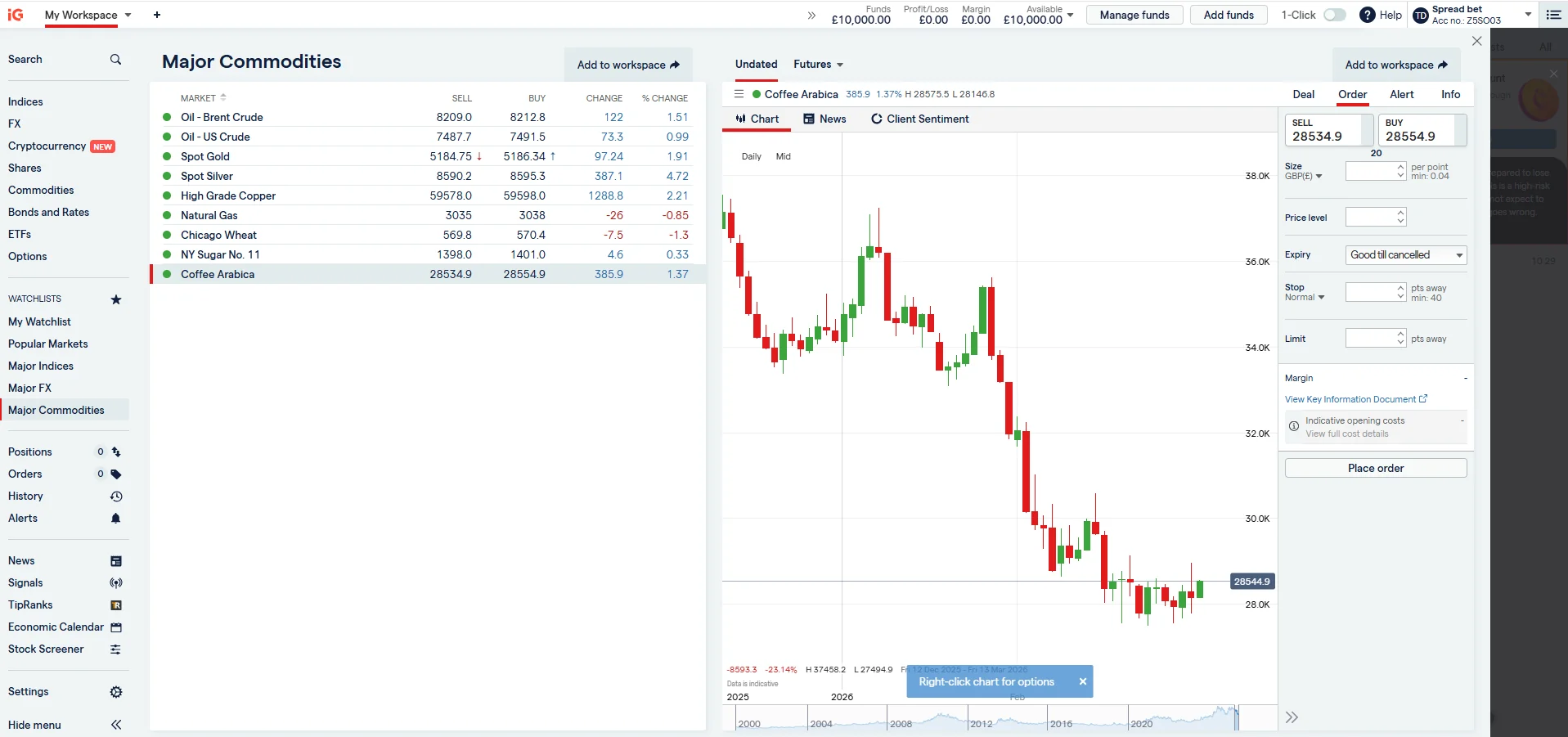
IG’s proprietary platform provides an excellent commodity trading experience. The commodity-specific screener, in-built Reuters news feed, and comprehensive charting make it a genuinely professional-grade environment. I particularly valued the commodity sentiment indicators and client positioning data — knowing that, say, 72% of IG clients are long on gold adds useful context.
The spot vs futures toggle for commodities is intuitive. Traders can choose tighter spot spreads (with overnight funding) or wider futures spreads (no funding charges) depending on their holding period. With 35+ commodity markets, IG covers the full spectrum from precious metals to softs and agriculturals.
Commodity costs breakdown: Gold from 0.3 points, silver from 0.03 points, Brent crude oil 2.8 cents per barrel, natural gas from 0.3 points. No commission on spread betting or standard CFD trading for commodities — the spread is the only transaction cost.
Who is IG best for? Traders who want a complete commodity trading solution from the most established UK broker. IG combines competitive (though not the absolute tightest) spreads with unmatched market depth, research tools, and platform choice. I’d recommend IG particularly for traders who want commodity exposure alongside equities, forex, and indices within a single account.
Key Details
| Best for | All-round commodity traders, research-focused users, multi-asset investors |
| Not ideal for | Inactive traders (£12/month fee after 2 years), cost-sensitive scalpers |
| Gold spread | From 0.3 pts |
| Brent Oil spread | 2.8 cents |
| Commission | £0 |
| Commodity instruments | 35+ |
| Platforms | IG Platform, MT4, MT5, TradingView, ProRealTime |
| FCA FRN | 195355 |
| FSCS Protection | £85,000 |
| My testing verdict | Best overall commodity platform; 50+ year track record; spot/futures toggle is excellent |
Capital.com — Best for Zero-Commission Commodity Trading
- Fees & Spreads
- 4.4
- Platform & Tools
- 4.4
- Customer Service
- 4.5
- Ease of Use
- 4.8
- Mobile App
- 4.9
Pros
- Genuinely zero commission across all commodity markets
- Gold spreads from 0.25–0.30 points — competitive for a no-commission model
- AI-powered trading insights and risk management features
- 4,500+ markets available via spread betting
- Clean, modern proprietary platform with TradingView and MT4 integration
Cons
- Relatively young broker (founded 2016) compared to IG or CMC Markets
- Brent Oil spreads of 3–4.5 cents per barrel are wider than Pepperstone or IG
- 35+ commodity instruments is solid but not the largest selection
- No cTrader support
Our Review
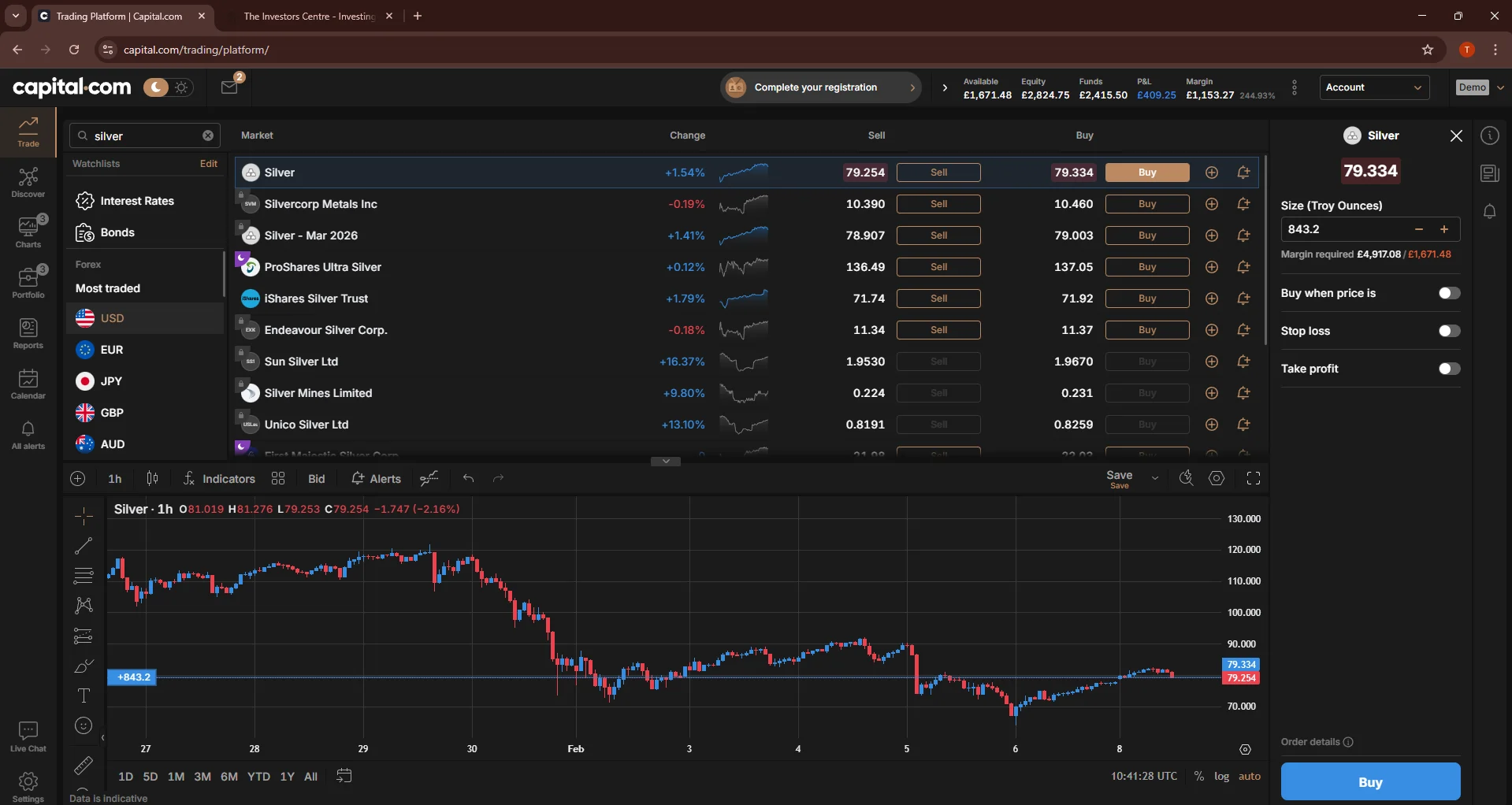
Capital.com’s proprietary platform uses artificial intelligence to analyse trading behaviour and flag potential risks. During my testing, the AI flagged that I was overexposed to energy commodities after opening both Brent and WTI positions — a useful nudge for risk management.
The platform’s commodity charting is smooth and responsive, though it lacks the depth-of-market data available on Pepperstone’s cTrader. For casual to intermediate commodity traders, the simplicity is a strength rather than a weakness.
Commodity costs breakdown: Gold 0.25–0.30 points, silver 0.03 points, Brent crude oil 3–4.5 cents per barrel, natural gas 0.5 points, copper 3.0 points. No commission, no added markup on the raw spread, no platform fees. The spread is genuinely all-in.
Who is Capital.com best for? Cost-conscious commodity traders who want zero commission without sacrificing competitive spreads. Capital.com strikes a strong balance between simplicity and value. I’d particularly recommend it for intermediate traders who want a clean, AI-enhanced experience without the complexity of separate commission structures.
Key Details
| Best for | Cost-conscious traders, beginners, simplicity seekers |
| Not ideal for | Advanced traders wanting cTrader or depth-of-market, those needing the absolute tightest spreads |
| Gold spread | From 0.25–0.30 pts |
| Brent Oil spread | 3–4.5 cents |
| Commission | £0 |
| Commodity instruments | 35+ |
| Platforms | Proprietary app, MT4, TradingView |
| FCA FRN | 793714 |
| FSCS Protection | £85,000 |
| My testing verdict | Simplest cost structure; AI risk nudges genuinely useful; competitive gold pricing |
Spreadex — Best for Higher FSCS Protection
- Fees & Spreads
- 4.5
- Platform & Tools
- 4.2
- Customer Service
- 4.7
- Ease of Use
- 4.2
- Mobile App
- 4.1
Pros
- £120,000 FSCS protection — £35,000 more than the standard £85,000
- Established since 1999 with a strong reputation in spread betting
- 38+ commodity instruments including 12 spot and 26 futures contracts
- TradingView integration for advanced charting
- Clean spread-only pricing with no commission
Cons
- Gold spread from 0.4 points is wider than Pepperstone, IG, and Capital.com
- Platform choice is more limited (TradingView + proprietary only, no MT4/MT5)
- Primarily a spread betting specialist
- Smaller total market range compared to IG or CMC Markets
Our Review
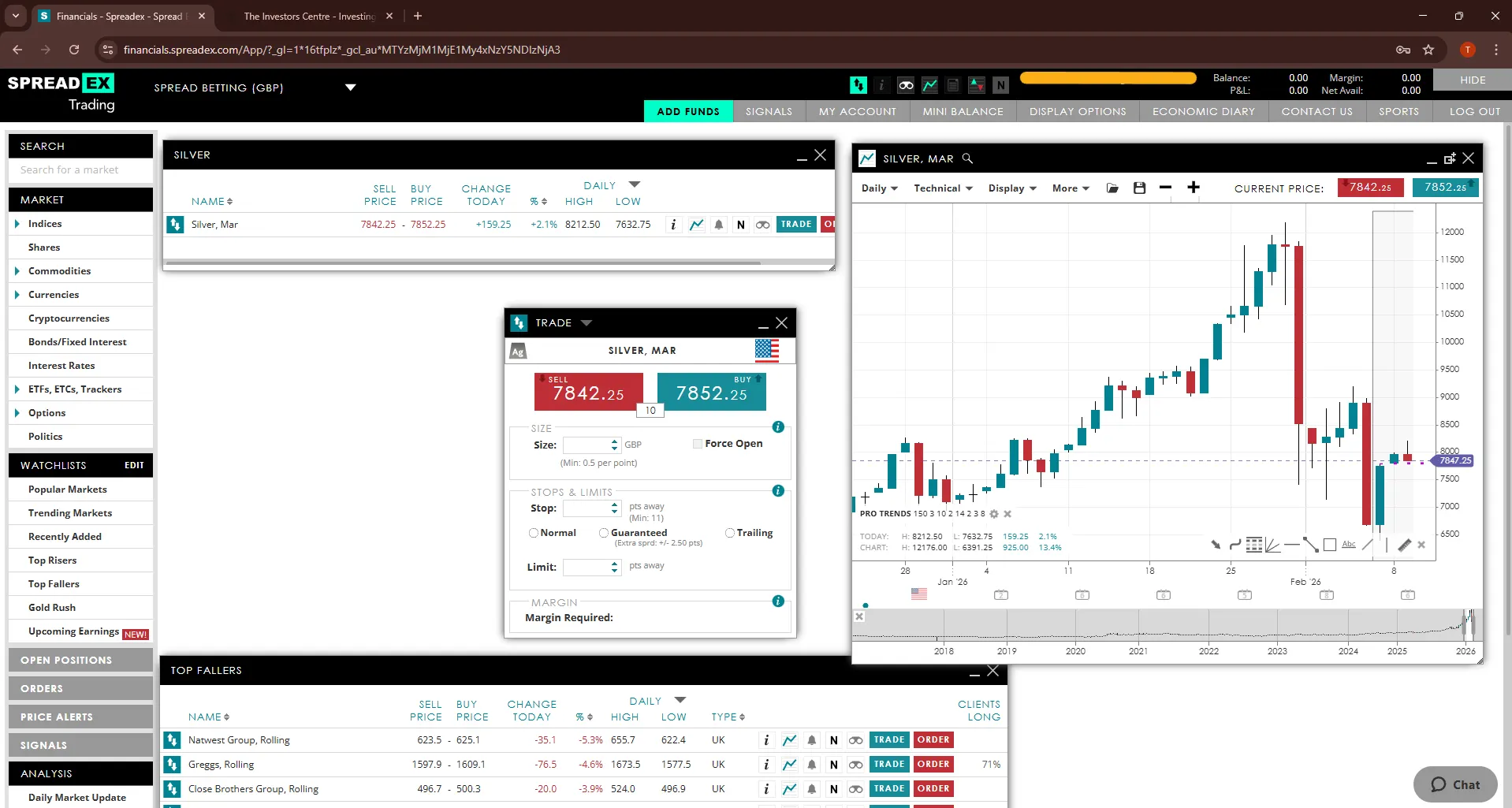
Spreadex’s platform is straightforward and focused. The commodity trading experience is clean without being overly complex. The TradingView integration adds professional-grade charting that compensates for the proprietary platform’s more basic analytical capabilities.
I found the spot vs futures commodity structure well-organised. The 26 futures contracts cover multiple expiry dates for major commodities, giving traders flexibility in how they manage rolling costs.
The standout factor is the £120,000 FSCS protection. For traders holding larger account balances, this extra £35,000 of protection above the industry standard provides additional peace of mind.
Who is Spreadex best for? Spread bettors who prioritise account safety and want higher FSCS protection. Spreadex is also a solid choice for traders who prefer a focused, no-frills commodity trading platform without the complexity of commission-based pricing.
Key Details
| Best for | Safety-conscious spread bettors, larger account holders |
| Not ideal for | Cost-sensitive scalpers, MT4/MT5 users |
| Gold spread | From 0.4 pts |
| Brent Oil spread | 2.8 cents |
| Commission | £0 |
| Commodity instruments | 38+ (12 spot + 26 futures) |
| Platforms | Proprietary (web + mobile), TradingView |
| FCA FRN | 190941 |
| FSCS Protection | £120,000 |
| My testing verdict | Highest FSCS cover; well-organised spot/futures structure; no-frills reliability |
CMC Markets — Best for Charting and Analysis
- Fees & Spreads
- 4.2
- Platform & Tools
- 4
- Customer Service
- 4
- Ease of Use
- 3.8
- Mobile App
- 3.9
Pros
- Established since 1989 with a strong UK heritage
- Award-winning proprietary platform with 115+ technical indicators
- Competitive gold spreads in line with IG
- Broad commodity range covering metals, energy, and agriculturals
- MT4 available alongside the proprietary Next Generation platform
Cons
- Commodity spreads are competitive but not the absolute tightest
- Platform can feel complex for beginners
- Inactivity fee applies after 12 months of no trading
- No TradingView integration at time of testing
Our Review
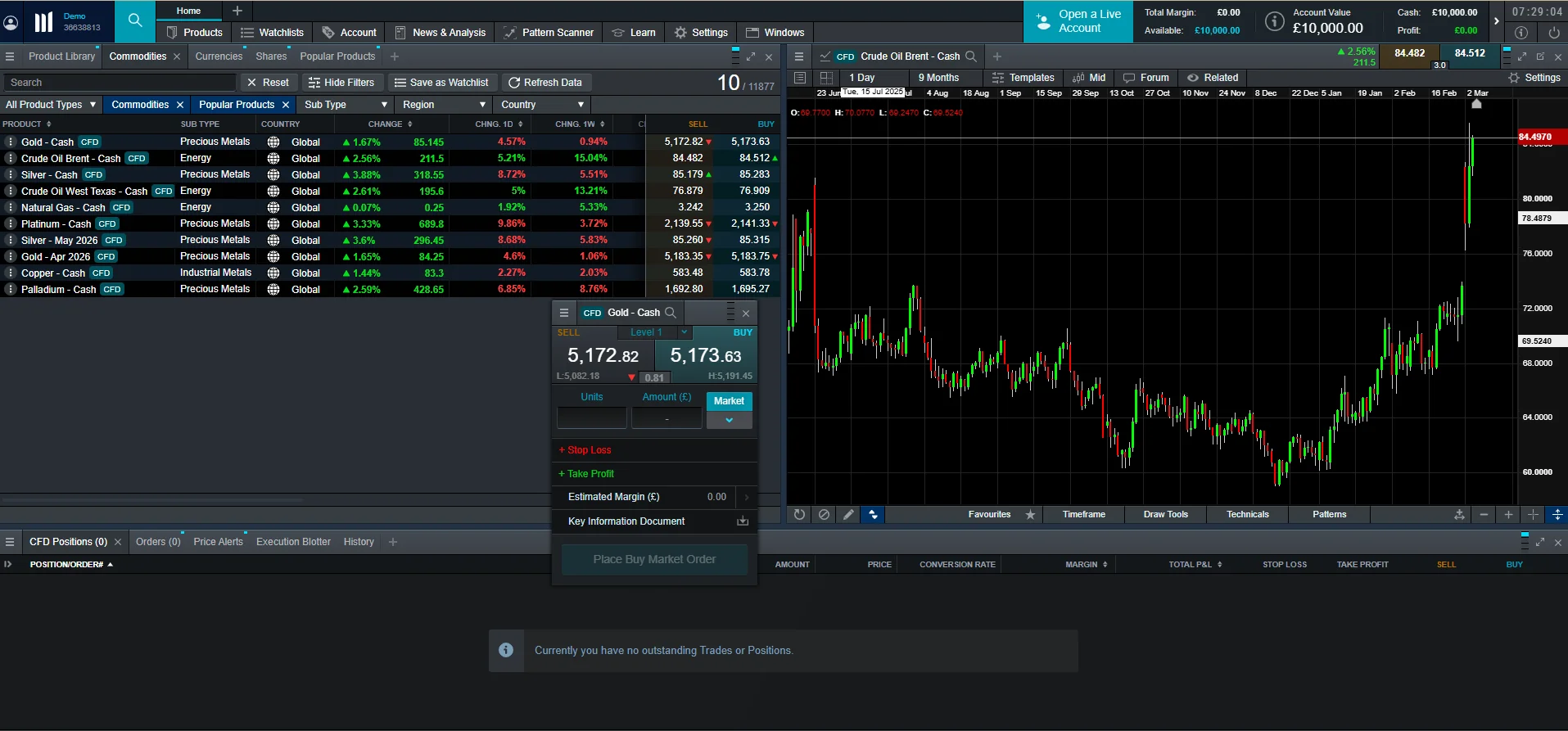
CMC Markets’ Next Generation platform is where this broker truly stands out for commodity traders. The charting capability is among the best I have tested — 115+ technical indicators, pattern recognition tools, and module-linking that lets traders view correlated commodities side by side. Read our full CMC Markets review for a broader assessment.
The commodity market research is strong, with daily analysis covering gold, oil, and agricultural markets. CMC’s client sentiment data is also available for major commodity instruments.
Commodity costs breakdown: Gold from 0.3 points (competitive with IG), silver from 0.03 points, Brent crude oil from 3.5 cents per barrel, copper 2.5 points. No commission on commodity trades.
Who is CMC Markets best for? Technical commodity traders who rely heavily on charting and analysis tools. CMC Markets’ Next Generation platform provides a genuinely institutional-grade analytical experience. I’d recommend it for traders who want competitive (though not rock-bottom) commodity spreads combined with the most powerful charting suite in the UK retail market.
Key Details
| Best for | Technical analysts, chart-focused commodity traders |
| Not ideal for | Beginners, inactive traders (£10/month fee after 12 months) |
| Gold spread | From 0.3 pts |
| Brent Oil spread | From 3.5 cents |
| Commission | £0 |
| Platforms | Next Generation, MT4 |
| FCA FRN | 173730 |
| FSCS Protection | £85,000 |
| My testing verdict | Best charting for commodities; 115+ indicators; strong daily commodity analysis |
Trade Nation: Best for Fixed or Variable Commodity Spreads
- Fees & Spreads
- 4.9
- Platform & Tools
- 4.5
- Customer Service
- 3.7
- Ease of Use
- 4.1
- Mobile App
- 4.3
Pros
- Brent fixed at 4 points around the clock
- Gold fixed at 4 per 0.1 during the main session
- Variable pricing also published for gold, silver and Brent
- No commission added to the spread
Cons
- Some fixed bands widen outside the main session
- No MT5
- No share dealing or ISA
Our Review
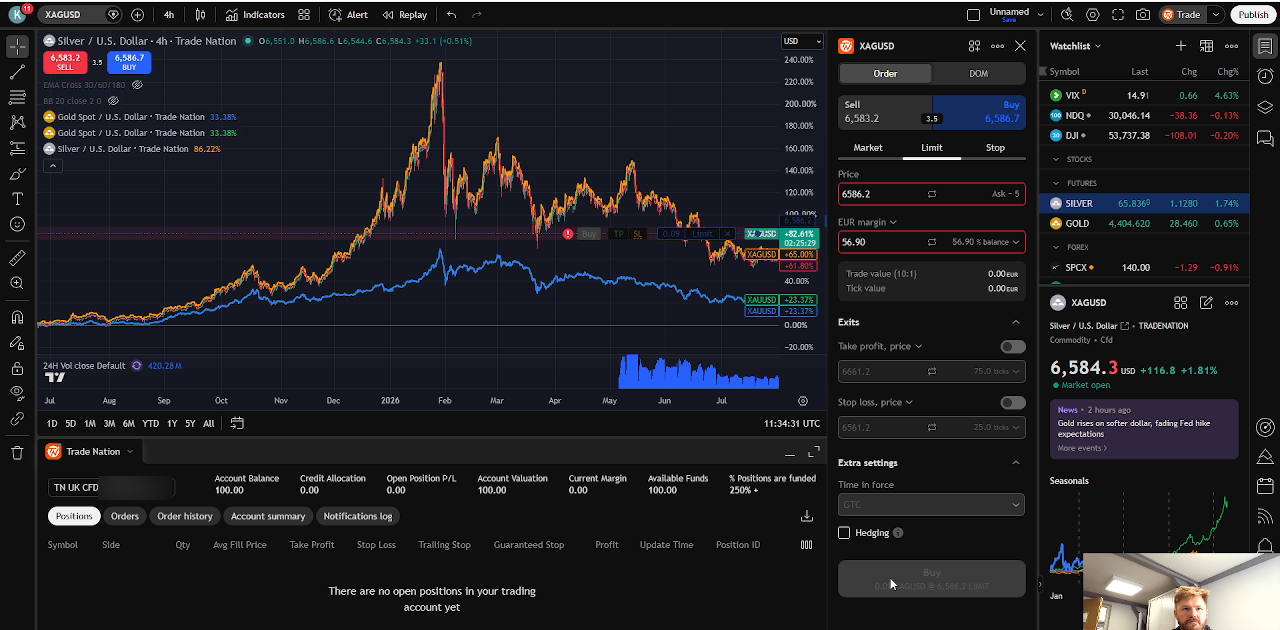
Trade Nation is unusual because commodity traders can choose between fixed and variable published pricing on selected markets. Brent is fixed at 4 points around the clock, while the variable schedule lists 2.8. Gold is fixed at 4 per 0.1 in the main session, with a published variable option of 3.6.
Silver follows the same choice, with 3.5 fixed and 2.6 variable in the published schedule. No separate commission is added, so the displayed spread is the quoted transaction cost before overnight funding.
Who is Trade Nation best for? Commodity traders who want to choose between predictable fixed bands and potentially tighter variable pricing without switching broker.
Key Details
| Best for | Choosing between fixed and variable commodity spreads |
| Gold spread | 3.6 variable / 4 fixed per 0.1 (published) |
| Silver spread | 2.6 variable / 3.5 fixed (published) |
| Brent Oil spread | 2.8 variable / 4 fixed (published) |
| Commission | £0 |
| Platforms | TN Trader, TradingView, MT4 |
| FCA FRN | 525164 |
| FSCS Protection | £85,000 |
| Pricing basis | Trade Nation market information sheet, August 2026 |
72.9% of retail investor accounts lose money when trading spread bets and CFDs with this provider.
What Are Commodity Spreads and Why Do They Matter?
The spread is the difference between the buy (ask) price and the sell (bid) price of a commodity instrument. It represents the most visible cost of opening and closing a commodity trade, and it is paid on every single transaction.
For a gold spread bettor staking £1 per point with a broker offering a 0.3-point spread, the cost to open a position is £0.30. At a broker offering a 0.15-point spread, that cost halves to £0.15. Over hundreds of trades per year, the difference compounds meaningfully.
To put this in concrete terms: a trader executing 500 gold trades per year at £10 per point would pay £750 in annual spread costs at 0.15 points, £1,500 at 0.30 points, or £2,000 at 0.40 points. That is a £750–1,250 difference per year on a single commodity instrument. For active multi-commodity traders, the savings from choosing a low-spread broker can run into thousands of pounds annually.
However, the spread alone does not tell the full cost story. Commission-based accounts (like Pepperstone’s Razor) add a separate fee on top of the raw spread. The total cost is what matters, and I have accounted for this throughout this comparison.
What Are the Different Types of Commodity Trading in the UK?
UK traders have several ways to gain exposure to commodity price movements. Each has different cost structures, tax implications, and regulatory considerations. For a deeper look, see our guide on how to trade commodities.
How Does Spread Betting on Commodities Work?
Profits are currently free from Capital Gains Tax and Stamp Duty for UK residents (tax laws may change). Traders stake a pound-per-point amount on whether a commodity price rises or falls. The cost structure is spread plus any overnight financing, with no separate commission at most brokers. Leverage is available, regulated by the FCA. All six brokers reviewed in this article offer spread betting for UK commodity traders.
How Does CFD Trading on Commodities Work?
Profits are subject to Capital Gains Tax, but losses can be offset against gains. Traders trade a contract that mirrors the underlying commodity price. The cost structure is spread plus commission (at some brokers) plus overnight financing. Available at all six brokers in this comparison, including Trade Nation.
What About Commodity Futures and ETFs?
Commodity futures are standardised contracts traded on exchanges like CME and ICE, subject to Capital Gains Tax. There is no overnight financing as the cost is built into the futures price. Commodity ETFs track commodity prices or indices and can be held within a Stocks and Shares ISA for tax efficiency — IG offers ISA access alongside its spread betting and CFD accounts.
For most cost-conscious UK commodity traders, spread betting offers the best combination of tight spreads, tax efficiency, and simplicity.
How Do Spot and Futures Commodity Contracts Compare?
When trading commodities via spread betting or CFDs, brokers typically offer two pricing models.
Spot (cash) contracts offer tighter spreads (e.g., gold spot from 0.15 points on Pepperstone Razor) but carry overnight financing charges. They have no expiry date and are best for day traders and short-term positions held for hours to a few days.
Futures (forward) contracts have wider spreads (e.g., gold futures might be 0.4–0.6 points) but no overnight financing — the cost is built into the wider spread. They have a fixed expiry date and are best for medium to longer-term positions held for weeks or months.
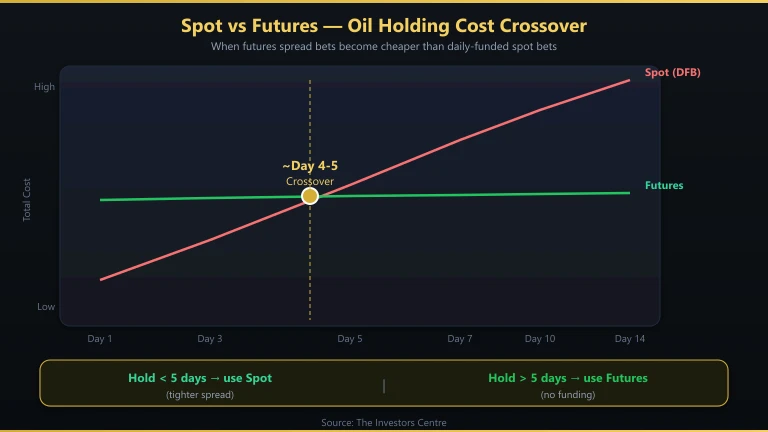
I generally find that spot contracts become more expensive than futures after approximately 5–10 trading days of holding, depending on the commodity and the broker’s overnight financing rate. For positions expected to last more than a week, futures-based contracts often work out cheaper despite the wider spread. Spreadex’s structure of 12 spot + 26 futures commodity contracts gives traders explicit choice, which I value for cost management.
What Are the Hidden Costs Beyond the Commodity Spread?
The advertised spread is the headline cost, but several additional charges can significantly affect total commodity trading costs.
Overnight financing (swap rates): This is the charge for holding a leveraged commodity position past the daily cut-off time (typically 10pm GMT). A £10,000 gold position held for 252 trading days at 0.02% per day would incur approximately £504 in overnight financing charges — frequently exceeding the total spread costs for the same period.
Commissions (Razor/ECN accounts): Pepperstone’s Razor account charges £2.25 per lot per side. For a standard gold lot (100 oz), the round-trip commission is £4.50.
Currency conversion fees: If trading USD-denominated commodities from a GBP-denominated account, a conversion fee of 0.3%–0.7% may apply. I’d recommend maintaining a USD-denominated sub-account where available (Pepperstone and IG both offer this).
Inactivity fees: IG charges £12/month after 2 years, CMC Markets charges £10/month after 12 months. Pepperstone, Capital.com, and Spreadex have no inactivity fee.
Platform fees: IG ProRealTime costs £30/month (refunded with 4+ trades). All other platforms reviewed are free.
Is Commodity Trading Tax-Free via Spread Betting?
One of the most significant advantages for UK-based commodity traders is that spread betting profits are currently exempt from Capital Gains Tax (CGT) and Stamp Duty. This can represent a substantial cost saving compared to trading commodities via CFDs, futures, or ETFs.
A trader who makes £20,000 in annual commodity trading profits would pay £0 tax via spread betting (profits tax-free under current legislation), compared to up to £4,800 in CGT via CFDs (at 24% for higher-rate taxpayers, after utilising the annual CGT allowance).
This tax advantage effectively makes spread betting spreads even more competitive than they appear on a headline basis. A slightly wider spread bet spread can still result in lower total costs than a tighter CFD spread once tax is factored in.
Important: Tax treatment depends on individual circumstances and may change. I’d recommend consulting a qualified tax adviser for personal guidance.
What Are the Most Popular Commodities to Trade in the UK?
Based on trading volumes across the brokers I tested, the most actively traded commodities among UK spread bettors and CFD traders are gold (XAU/USD) in first place by a significant margin, followed by Brent crude oil, WTI crude oil, silver, natural gas, and copper.
Gold (XAU/USD) benefits from deep liquidity, tight spreads, and its role as both a trading instrument and a safe-haven asset. The London session (8am–4:30pm GMT) typically offers the tightest spreads due to LBMA market-making activity. For more, see our guide on how to trade gold in the UK.
Brent and WTI crude oil are heavily influenced by OPEC decisions, geopolitical events, and seasonal demand patterns. Some traders specifically trade the Brent–WTI differential. For dedicated oil trading guidance, see our best oil trading platform guide and our how to trade oil guide.
Silver (XAG/USD) is more volatile than gold and attracts traders looking for larger percentage moves. Natural gas is extremely volatile and popular among traders who thrive on large price swings. Copper, often called “Dr. Copper” for its role as an economic health indicator, is popular among macro-driven commodity traders.
When Do Commodity Spreads Widen?
Commodity spreads are not static. They fluctuate throughout the day and can widen significantly during certain conditions. Understanding when and why this happens is essential for cost-conscious traders.
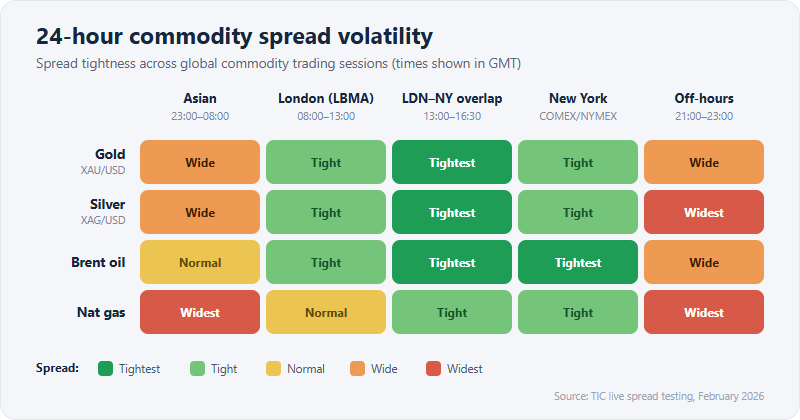
Outside core trading hours: Gold and silver spreads are tightest during the London session (8am–4:30pm GMT) and the New York session overlap (1pm–4:30pm GMT). Oil spreads are tightest when ICE and NYMEX are open. Asian session trading typically carries wider spreads for all commodities.
Around economic data releases: US Non-Farm Payrolls, FOMC decisions, and CPI releases can cause temporary spread widening across all commodities. OPEC meetings and announcements specifically affect oil spreads. The window of widening is typically 1–5 minutes around high-impact events.
During geopolitical shocks: Unexpected events (conflicts, sanctions, supply disruptions) can cause spreads to widen dramatically and persist for hours. Gold typically sees the most spread widening during geopolitical events.
How to minimise spread widening impact: Trade during peak liquidity hours (London and New York sessions for most commodities), avoid entering positions in the 5 minutes before and after major economic data releases, use limit orders rather than market orders to control entry price, and monitor the live spread on the platform before executing.
How Should You Choose a Low-Spread Commodity Broker?
Based on my testing, here are the key factors I’d recommend evaluating when choosing a commodity broker specifically for low-spread trading.
Total cost, not just the spread: A broker advertising a 0.15-point gold spread with a £2.25/lot/side commission may or may not be cheaper than a broker offering a 0.30-point spread with zero commission. Calculate total round-trip costs for typical trade sizes.
Spread consistency: The advertised “from” spread is often the best case during peak liquidity hours. I found that Pepperstone and IG maintained their advertised spreads most consistently during the London session.
Commodity range: If trading is limited to gold and oil, most brokers suffice. For softs, agricultural commodities, or minor metals, checking the full commodity list matters.
Spot vs futures availability: Not all brokers offer both spot and futures pricing for every commodity. Having both options allows optimising costs based on expected holding period.
Platform suitability: cTrader (Pepperstone) offers the best depth-of-market visibility for commodities. TradingView integration (Pepperstone, IG, Spreadex) provides excellent charting. MT4/MT5 remains the standard for automated commodity trading strategies. For broader platform comparisons, see our best forex broker UK guide.
Regulation and protection: All six brokers in this comparison are FCA-regulated, which is the baseline requirement. Spreadex’s £120,000 FSCS protection is notably higher than the standard £85,000.
Final Thoughts
After testing five brokers with real money and comparing Trade Nation’s published August pricing alongside them, my conclusion is that the “best” low-spread commodity broker depends on how a trader defines “lowest cost.”
For pure spread tightness: Pepperstone’s Razor account (FCA FRN 684312) is the clear leader. Gold from 0.15 points and oil from 2 cents per barrel are figures I have not seen matched by any other FCA-regulated broker. The commission adds to the total cost but, for standard lot sizes, the all-in cost still beats spread-only brokers.
For the simplest low-cost structure: Capital.com (FCA FRN 793714) offers the most straightforward value proposition — genuinely zero commission with gold from 0.25 points. No mental arithmetic required to calculate total costs.
For pricing choice: Trade Nation offers both fixed and variable published commodity spreads on selected metals and energy markets, with no separate commission added.
For the most complete commodity offering: IG (FCA FRN 195355) wins on breadth, track record, and platform choice. The spreads are competitive (not the absolute tightest), but the overall package is unmatched.
For higher account protection: Spreadex (FCA FRN 190941) is the only broker offering £120,000 FSCS cover, which is worth considering for larger trading accounts.
I’d recommend opening a demo account with the two or three brokers that best match specific requirements and comparing live commodity spreads during typical trading hours. See also our Pepperstone vs Trading 212 comparison if weighing Pepperstone against a commission-free alternative for broader trading needs.
Discuss Low Spread Commodity Brokers
Traded gold, oil, or other commodities with a UK broker? Share the live spreads you actually got and which account type kept your total costs lowest. Our community earns Equity for helpful contributions.
Discussion 0 comments
Be the first to start discussing this topic! Log in or create an account to share your thoughts.
Log In Create Account
No comments yet. Be the first to start discussing this topic!